The room laughed when Anthony called his marriage a convenience. His wife was the only one who didn’t.
Marian broke the seal.
Anthony watched her eyes move across the page.
At first, there was only confusion in her expression. Then the color slowly drained from her face.
“What does it say?” he asked.
She did not answer.
Instead, she read the letter again.
Anthony felt something cold settle beneath his ribs.
“Marian.”
This time she looked at him.
The softness that had begun to return to her face only moments earlier was gone.
“Lady Eleanor Vale,” she said.
Anthony went still.
Marian noticed.
That frightened her more than any explanation could have.
“You know the name.”
“Yes.”
“How well?”
Anthony opened his mouth, but Marian held up one hand.
“No. Not yet.”
She looked down at the page.
“I want to know how much of this is true before you decide which parts are safest to tell me.”
There was no anger in her voice.
Only caution.
The distinction hurt.
Anthony nodded.
“Read it.”
So she did.
The letter claimed that three years before Anthony married Marian, he had intended to marry Eleanor Vale, the only daughter of the late Earl of Wexford.
It claimed the match had been more than a family arrangement.
It claimed Anthony had loved her.
And then came the sentence that made Marian’s fingers tighten around the paper.
According to Eleanor, Anthony had married Marian because Eleanor had disappeared from society after a scandal.
Marian raised her eyes.
“So I was convenient after all.”
“No.”
The word came too quickly.
She laughed once, but there was no humor in it.
“Then tell me why she knows enough to use the exact word you used before your friends.”
Anthony’s jaw tightened.
Because he knew.
There was only one person besides himself who had heard him call the marriage convenient before that dinner.
Lord Felton.
Anthony crossed the room.
“May I see it?”
Marian hesitated before handing him the letter.
The hesitation was brief.
It was still enough to wound.
He read every line.
Eleanor wrote that she had returned to England after years abroad. She claimed she had learned of Anthony’s marriage only recently and believed Marian deserved to know that Anthony had once promised himself to another woman.
At the bottom was an address in London.
And one final sentence.
Ask your husband why our wedding never happened.
Anthony folded the letter carefully.
“Part of it is true.”
Marian looked away.
“I loved her.”
Her shoulders stiffened.
He continued before cowardice could soften the truth.
“At least, I believed I did.”
“Is there a difference?”
“Yes.”
“How fortunate for you.”
“Marian—”
“You told me our marriage was convenient in front of a room full of people. Now a woman you once intended to marry appears and tells me I was chosen after she vanished. Forgive me if I fail to appreciate the philosophical distinction between believing yourself in love and actually being in love.”
Anthony accepted the blow.
He had earned worse.
“She left me.”
Marian looked back at him.
“Three weeks before the wedding.”
There was something in Anthony’s voice she had never heard before.
Not longing.
Not grief.
Humiliation.
“She disappeared without warning. Her father claimed she was ill. Her mother refused to see me. Then I learned she had gone to France.”
“Why?”
“I never knew.”
“Did you try to find her?”
“Yes.”
The answer landed between them.
Marian closed her eyes.
Anthony felt the distance return.
Every inch of it.
“I looked for almost a year,” he admitted.
“And then?”
“Then I stopped.”
“And married me.”
“Two years later.”
“That hardly improves matters.”
“No.”
He placed the letter on the desk.
“But Marian, I did not marry you because Eleanor was gone.”
“Then why did you marry me?”
He looked at her.
Because he had thought about that question many times in recent days.
The humiliating truth was that he had known the answer long before he had found the courage to say it.
“You laughed at me.”
Marian frowned.
“The first time we met.”
“That is why?”
“I had spilled wine on the Archbishop of Canterbury.”
A reluctant flicker crossed her face.
“You blamed the carpet.”
“The carpet was poorly placed.”
“It was beneath the table.”
“Yes. A dangerous location.”
For a moment, the room remembered what they had once been.
Then Marian’s expression hardened again.
Anthony’s faint smile disappeared.
“You laughed,” he continued, “when everyone else was pretending not to notice. Then you gave me your handkerchief and told me that a duke who feared a wine stain was not much use to the kingdom.”
“I was terrified after saying it.”
“You looked delighted.”
“I was twenty.”
“You were magnificent.”
She lowered her eyes.
Anthony took one step closer, but no more.
“I married you because for the first time in years I could breathe around someone without wondering what they wanted from me. You argued with me. You corrected me. You cared about tenants whose names my steward had forgotten. You cried when old Mrs. Dalloway’s horse died and threatened to dismiss the stable master because he laughed.”
“He deserved it.”
“He did.”
Anthony swallowed.
“I married you because Ravensmere felt empty after you left it.”
Marian’s fingers trembled.
“Then why didn’t you tell me about Eleanor?”
“Because I was ashamed.”
“Of loving her?”
“Of being abandoned.”
That answer stopped her.
Anthony looked toward the darkening window.
“My father taught me that a man who was rejected had misjudged his own worth. Felton and the others knew what happened. They saw me spend months behaving like a fool. When you and I married, I wanted that part of my life buried.”
“So you buried it beneath me.”
“No.”
He looked at her sharply.
“But I understand why it feels that way.”
Marian turned away.
For several seconds, neither spoke.
Then she said, “I want to meet her.”
Anthony’s head lifted.
“I don’t think—”
“That is precisely the problem.”
He fell silent.
“You decided I did not need to know she existed. You decided what your friends should hear about our marriage. You decided embarrassment was more dangerous than dishonesty.”
She faced him.
“You do not get to decide this for me.”
Anthony wanted to refuse.
Every instinct trained into him since childhood urged him to take control of the situation, investigate Eleanor himself, protect Marian from whatever scheme waited behind the letter.
But protection without trust had already cost him enough.
“All right.”
Marian seemed almost surprised.
“When?”
“Tomorrow.”
The next afternoon, they arrived in London beneath a sky heavy with rain.
Eleanor Vale was staying in a modest townhouse belonging to a widowed aunt.
She received them in a narrow sitting room smelling faintly of lavender and coal smoke.
Marian had expected a woman dressed to conquer.
Instead, Eleanor wore gray.
She was beautiful, though not in the effortless way gossip had once described her. There was weariness around her eyes.
When Anthony entered, Eleanor rose.
For one long second, neither moved.
“Anthony.”
“Eleanor.”
Marian watched them carefully.
No secret smile.
No rekindled hunger.
Only history.
Eleanor turned to Marian.
“Your Grace.”
“You wrote to me.”
“I did.”
“Why?”
Eleanor glanced at Anthony.
“Because your husband deserves to be honest.”
Anthony’s expression hardened.
“An admirable concern after three years of silence.”
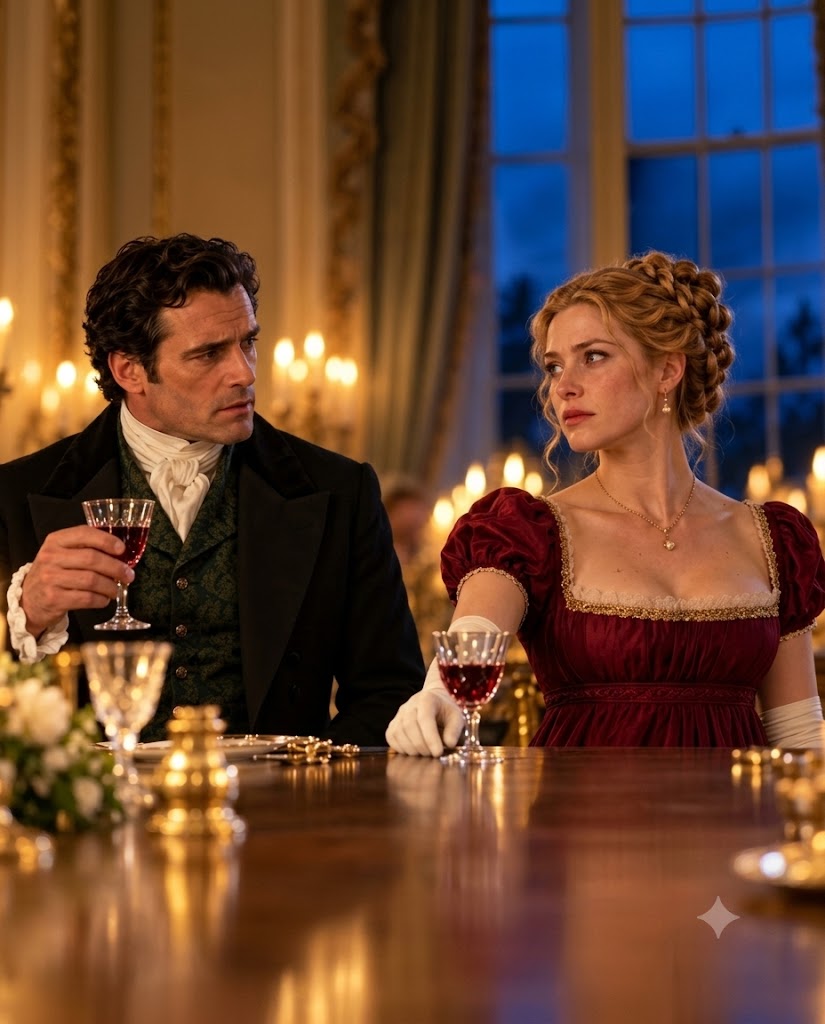
Eleanor flinched.
Marian noticed that too.
“Tell me why the wedding never happened,” Marian said.
Eleanor sat slowly.
“My father stopped it.”
Anthony stared.
“That is not what I was told.”
“No.”
Eleanor twisted her fingers together.
“My father discovered that your father intended to acquire the northern Wexford estates as part of my dowry. He believed your family was using the marriage to save Ravensmere from debt.”
Anthony’s face changed.
“My father never told me that.”
“I know.”
“And that made you run?”
“No.”
Eleanor inhaled.
“My father gave me a choice. End the engagement or he would expose documents proving the late Duke had manipulated several land contracts.”
Anthony became utterly still.
Marian looked at him.
“Is that true?”
“I don’t know.”
Eleanor reached into a small writing desk and removed a packet tied with faded ribbon.
“These are copies.”
Anthony did not take them.
“So you disappeared to protect me?”
“I disappeared because I was frightened.”
Eleanor’s voice broke for the first time.
“I was twenty-one. My father told me your name would be destroyed. He told me you would hate me if I stayed and discovered the truth.”
Anthony stared at her as if trying to reconcile the woman before him with a ghost he had carried for years.
“You could have told me.”
“Yes.”
“Why didn’t you?”
“Because I was a coward.”
Silence.
Marian understood the words before Anthony did.
Perhaps because she had spent days studying what fear did to love.
Eleanor’s eyes filled.
“I went to France. My father died the following year. By then I heard you had stopped asking for me. Later, I learned you were engaged.”
Her gaze moved to Marian.
“I thought I had lost the right to interfere.”
“But you interfered now.”
“Yes.”
“Why?”
Eleanor looked toward the door.
Marian followed her gaze.
A moment later, it opened.
Lord Felton entered.
Anthony surged to his feet.
“You.”
Felton closed the door behind him.
Eleanor looked pale.
“I am sorry. He insisted.”
Anthony’s voice dropped.
“Insisted on what?”
Felton walked forward with maddening calm.
“That the truth finally become useful.”
Anthony stepped between him and Marian.
Felton smiled faintly.
“There you are. The protective husband. Quite convincing now.”
“What do you want?”
“What I have always wanted.”
Felton placed a document on the table.
“Ravensmere.”
Marian stared at him.
Felton explained without hurry.
His family had held a disputed claim over part of the Ravensmere estate for decades. Anthony’s father had defeated it using the very land contracts contained in Eleanor’s packet.
If those contracts were proven fraudulent, Felton could reopen the claim.
“You sent the letter,” Anthony said.
“I suggested Lady Eleanor write it.”
Eleanor whispered, “You told me Marian already suspected him.”
Felton shrugged.
“She did.”
“You used me.”
“I encouraged honesty.”
Anthony moved toward him.
Marian caught his sleeve.
It was the first time she had willingly touched him in days.
He stopped.
Felton noticed.
His smile sharpened.
“Touching.”
Marian released Anthony and stepped forward.
“You expected us to come.”
“Of course.”
“And you expected him to threaten you.”
“A temper is so useful in court.”
Anthony understood.
Felton wanted witnesses.
A public confrontation.
Proof that Anthony had tried to intimidate a claimant.
Marian turned to Eleanor.
“Did he ask you to send the original documents?”
Eleanor nodded.
“I refused.”
“Good.”
Felton’s expression changed.
Only slightly.
But Marian saw it.
“So you do not have them,” she said.
Felton smiled again.
“I have enough.”
“No. You have copies supplied by a frightened woman whose father is dead, and a story about contracts signed decades ago.”
She looked at Anthony.
“Do you have your father’s records?”
“At Ravensmere.”
“Then we leave.”
Felton laughed.
“You think walking away changes anything?”
Marian faced him.
“No.”
Her voice was calm.
“But it prevents us from making your next move for you.”
For the first time, Felton had no reply.
The journey home was quiet.
Near midnight, Anthony finally said, “You believed me.”
Marian watched the rain trace the carriage window.
“I believed Felton wanted us divided.”
“That isn’t what I meant.”
“I know.”
He waited.
She sighed.
“I believe you love me.”
Something inside Anthony loosened.
“But love is not the only thing a marriage needs.”
It tightened again.
“You still do not trust me.”
“I am trying.”
He nodded.
“That is more than I deserve.”
“No.”
Marian turned toward him.
“That is another habit you should abandon.”
“What?”
“Deciding what you deserve.”
She looked tired, but there was warmth somewhere beneath it.
“You decide everything as though suffering gives you authority.”
Anthony almost smiled.
“That sounded like something my wife would say.”
“She sounds exhausting.”
“She is.”
Marian looked back at the rain.
But Anthony saw the corner of her mouth move.
They searched the Ravensmere archives until dawn.
Most of the late Duke’s papers were arranged with military precision.
The disputed contracts were not there.
At sunrise, Anthony’s steward arrived with unexpected news.
Someone had broken into the old records room two nights earlier.
Nothing valuable appeared missing.
Felton had moved first.
Anthony struck the desk with his palm.
“He has the originals.”
“Perhaps,” Marian said.
She picked up one of Eleanor’s copies.
“Or perhaps he thinks the originals prove his case.”
Anthony looked at her.
“What are you thinking?”
“You told me your father kept everything.”
“Yes.”
“Even correspondence?”
“Especially correspondence.”
“Then contracts may not be what we need.”
For three hours they opened drawers, boxes, ledgers, and trunks.
At last Marian found a bundle of letters from the late Duke’s solicitor.
One contained a reference to the disputed contracts.
Another mentioned amendments.
A third changed everything.
Anthony read it twice.
The original contracts had contained an error in boundary measurements.
The final legal versions had been corrected and registered with the Crown.
The copies Eleanor possessed were drafts.
Felton had stolen evidence that proved nothing.
But the letter also revealed something else.
Anthony’s father had indeed concealed significant debts before arranging his son’s engagement to Eleanor.
Anthony sat heavily.
“So her father was right.”
“Partly,” Marian said.
“My father used me.”
“Yes.”
He looked at her bitterly.
“And I spent years blaming Eleanor.”
“You blamed the person whose silence hurt you because the dead man who caused it was no longer available to answer.”
Anthony rubbed a hand over his face.
“Does everyone understand my life except me?”
“Usually.”
He laughed despite himself.
Then his eyes grew serious.
“I did the same thing to you.”
Marian said nothing.
“I was afraid my friends would think I had become sentimental. So I made you pay for my fear.”
He looked at the letter.
“My father feared ruin and used my marriage. Eleanor feared her father and disappeared. I feared humiliation and denied what you meant to me.”
His gaze met hers.
“Fear has made enough decisions in this family.”
Three days later, Felton presented his claim before a private judicial council in London.
Anthony attended.
So did Marian.
Felton expected fury.
He received evidence.
The registered contracts were retrieved from the Crown archive. The solicitor’s letters established the sequence of drafts. Eleanor appeared voluntarily and testified that the documents Felton had obtained were incomplete copies.
Then Marian produced the letter Felton had sent Eleanor.
He had been careless enough to imply that Anthony’s marriage could be “broken open” before the land claim was filed.
Felton’s expression finally cracked.
The claim was dismissed.
An investigation into his conduct was recommended.
When the hearing ended, Anthony found him alone in the corridor.
Felton looked older somehow.
“You destroyed thirty years of my family’s work.”
Anthony studied him.
“No. You did.”
Felton’s mouth twisted.
“You think she will forgive you now?”
Anthony glanced toward the chamber where Marian was speaking with Eleanor.
“I hope so.”
“Hope?”
Felton almost sneered.
“The great Duke of Ravensmere has been reduced to hope?”
Anthony considered that.
Then he smiled.
“No.”
He walked past him.
“I think I have finally been raised to it.”
Eleanor left for France a week later.
Before she went, Anthony met her once more in the garden of her aunt’s home.
“I hated you,” he told her.
“I know.”
“I was wrong.”
“You were hurt.”
“That does not make me less wrong.”
Eleanor’s eyes glistened.
“No.”
He nodded.
It was strangely peaceful.
The great romance of his youth did not end with a kiss or a tragedy.
It ended with two adults admitting they had once been frightened children dressed in expensive clothes.
“I hope you are happy,” Eleanor said.
Anthony looked toward the house.
Marian stood near the steps, speaking to Eleanor’s aunt.
“I am learning how.”
When they returned to Ravensmere, Anthony did not ask Marian whether everything was repaired.
He knew better now.
Trust was not a vase one glued together and placed back on a shelf.
It was a road.
And roads were crossed one step at a time.
So he began with small things.
He told her when he was afraid.
He asked instead of assuming.
When his friends visited, he no longer turned affection into a joke.
Some found the change uncomfortable.
Anthony discovered he could survive their discomfort.
A month later, he hosted another dinner.
Many of the same men attended.
The conversation was loud, careless, familiar.
Eventually someone raised a glass.
“To marriage,” Lord Harcourt announced. “That glorious institution by which a sensible man surrenders half his freedom and all his furniture.”
Laughter circled the table.
Anthony smiled.
Then Harcourt looked at him.
“And what does Ravensmere say? Still a marriage of convenience?”
The room changed.
Marian sat across from Anthony.
She did not look down.
Anthony placed his glass on the table.
“No.”
Harcourt raised an eyebrow.
Anthony continued.
“My marriage is many things. Convenient is rarely one of them.”
A few men laughed uncertainly.
Anthony did not.
“My wife challenges me, contradicts me, rearranges my study when she claims it is unbearable, and once informed a bishop that his sermon was too long.”
“It was,” Marian said.
This time the laughter was warm.
Anthony’s eyes stayed on her.
“She is also the person whose opinion matters most to me.”
The room quieted.
“I once mocked what we had because I was afraid sincerity would make me look weak.”
He lifted his glass.
“I was mistaken.”
Marian’s eyes softened.
Anthony raised the glass toward her.
“To my wife.”
The others followed.
“To the Duchess.”
Later, after the guests had gone, Marian found Anthony standing alone on the terrace.
Snow had begun falling over the gardens.
She joined him without speaking.
After a moment, her hand slipped into his.
Anthony looked down at their joined fingers.
He did not close his hand around hers immediately.
He wanted to be certain.
Marian noticed.
“You may hold it.”
His fingers closed gently.
“I was trying not to assume.”
“You are becoming very tiresome with all this personal growth.”
“I have been told.”
She leaned against the stone railing.
For a while, they watched the snow.
Then Marian said, “I hated you that night.”
“I know.”
“Not because you called our marriage convenient.”
Anthony looked at her.
“That was part of it.”
“What was the rest?”
“I had believed I knew what I meant to you.”
Her voice grew quieter.
“And in one sentence, you made me doubt every memory.”
Anthony swallowed.
“The walks. The mornings. The letters you sent when you traveled. The way you reached for me in your sleep.”
She looked at him.
“That is what careless words can do. They do not only hurt the moment in which they are spoken. Sometimes they crawl backward and poison the past.”
Anthony’s grip tightened slightly.
“I am sorry.”
“I know.”
“Will that ever be enough?”
“No.”
He flinched.
Marian turned fully toward him.
“An apology is not supposed to erase what happened.”
Her thumb brushed once across his hand.
“It is supposed to tell the truth about it.”
Anthony stared at her.
“And what happens after that?”
“We decide what truth we want to live next.”
Snow collected in her hair.
Anthony lifted his free hand, then paused.
Marian smiled faintly.
“You may do that too.”
He brushed the snow away.
“I love you.”
There was no ballroom.
No audience.
No friends to impress.
No fear left large enough to disguise the words.
Marian studied him for a long moment.
Then she said, “I know.”
Anthony groaned.
“That is all?”
Her smile widened.
For the first time in weeks, it reached her eyes.
“I love you too.”
He closed his eyes briefly.
“You might have said that first.”
“You needed the suspense.”
“You are cruel.”
“You married me.”
He laughed.
Then he kissed her.
Not like a man recovering something he owned.
Like a man receiving something that had been freely returned.
Years later, people would tell many stories about the Duke and Duchess of Ravensmere.
They would speak of Marian’s influence on the estate, of Anthony’s reforms, of the schools they funded and the tenant protections they introduced.
They would tell amusing stories about how the Duchess could silence a council room with one raised eyebrow.
They would tell less accurate stories about the scandal involving Lord Felton.
But inside Ravensmere, one story mattered more.
In Anthony’s study, tucked inside a locked drawer, remained Marian’s old list of boundaries.
Beside it lay Eleanor’s letter.
Anthony never destroyed either.
When their eldest son once asked why he kept papers connected to one of the most painful periods of his life, Anthony answered simply.
“Because forgetting a mistake is the easiest way to repeat it.”
His son considered that.
“Was it your greatest mistake?”
Anthony looked through the window.
Across the lawn, Marian was arguing with a gardener about a row of roses while two grandchildren chased each other around her skirts.
“No.”
“What was?”
“Thinking love would remain true even when I was too proud to speak truthfully about it.”
His son frowned.
“Did Grandmother forgive you?”
Anthony smiled.
“She did something harder.”
“What?”
“She required me to become someone worth forgiving.”
That evening, Anthony found Marian in the same drawing room where, decades earlier, he had first admitted that he loved her.
Her hair was silver now.
His knees protested whenever he stood too quickly.
Neither of them had become easier people.
This pleased Marian greatly.
She held out her hand.
Anthony took it.
After all those years, he still remembered the evening when that hand had slipped away from his.
He remembered how empty the space had felt afterward.
Some lessons did not need to remain painful to remain important.
He turned her wedding ring gently around her finger.
She looked at him.
“What are you doing?”
“Making sure it is facing the right way.”
Marian laughed.
“You still notice that?”
“I notice everything now.”
“That is an outrageous lie.”
“Most things.”
“Better.”
He kissed her knuckles.
Outside, Ravensmere settled beneath another winter evening.
Inside, the clock continued its steady rhythm.
Once, Anthony had sat listening to that clock believing silence meant the end of something.
He had been wrong.
Silence could be distance.
It could also be patience.
A chance to hear what pride had drowned out.
A chance to choose different words.
A chance to begin again.
Anthony had spent much of his youth believing strength meant never allowing anyone to see what could hurt him.
Marian taught him otherwise.
Strength was telling the truth when a lie would protect your pride.
It was listening when the answer was painful.
It was understanding that love did not excuse carelessness; it demanded responsibility.
And perhaps most difficult of all, it was accepting that forgiveness could never be demanded simply because regret was sincere.
It had to be earned in the ordinary days that followed.
One truthful conversation.
One kept promise.
One outstretched hand.
Again and again.
Until what had once been called convenient became the most deliberate choice of their lives.
Years passed, and Ravensmere changed.
Not suddenly.
Not dramatically.
But in the quiet way places changed when the people inside them learned to become different.
The eastern cottages were repaired first.
Then came the school Marian had argued for during the first winter of their marriage, the one Anthony had once dismissed as too expensive before quietly approving twice the amount she requested.
A small hospital followed.
Then a fund for widows of estate workers.
People began saying the Duke of Ravensmere had become generous with age.
Marian always corrected them.
“He has become easier to argue with.”
Anthony would hear about it and reply, “That is not remotely the same thing.”
“It is to me.”
Their arguments became a kind of local legend.
So did their loyalty.
But neither Anthony nor Marian ever allowed the story of their marriage to become prettier than the truth.
There had been damage.
There had been pride.
There had been mornings when Marian had wondered whether trust could return.
There had been nights when Anthony had lain awake beside her, afraid that one careless sentence had revealed something ugly about himself that no apology could repair.
They survived because neither of them pretended surviving was effortless.
And because love, once stripped of pride, became work they were both willing to do.
The final test of that lesson came many years later.
Anthony was sixty-three when their eldest son, Edward, returned to Ravensmere unexpectedly.
He arrived after midnight in a carriage covered with mud.
Anthony was still awake in his study.
Age had changed his habits less than Marian liked.
She frequently informed him that respectable dukes slept before midnight.
Anthony frequently informed her that respectable duchesses did not enter studies wearing slippers and threaten their husbands with blankets.
Neither argument had achieved much.
That night, Edward entered without knocking.
Anthony looked up from his papers.
His son was pale.
“Father.”
Anthony immediately set down his pen.
“What happened?”
Edward closed the door.
“My engagement is over.”
Anthony stared at him.
Edward was thirty-one, composed by nature, and had been expected to marry Lady Clara Ashbourne in the spring.
Everyone approved of the match.
More importantly, Edward loved her.
Or Anthony had believed he did.
“What happened?” he repeated.
Edward laughed bitterly.
“I did.”
Anthony waited.
That was another thing Marian had taught him.
Do not rush to fill silence merely because silence makes you uncomfortable.
Edward paced toward the fireplace.
“Three nights ago, I was at Harcourt’s club.”
Anthony already disliked where this was going.
“There were several men there. Friends.”
Edward said the word with disgust.
“They began talking about Clara.”
Anthony’s chest tightened.
“What did they say?”
“That I had become obedient.”
Edward looked away.
“That she had made me soft. That after the wedding she would control Ravensmere through me.”
Anthony remained still.
“And what did you say?”
Edward did not answer.
He did not need to.
Anthony knew.
Because for one terrible second, he was no longer looking at his son.
He was looking at himself.
A younger man at a dinner table.
A careless smile.
A room full of laughter.
A wife sitting beside him.
“What did you say?” Anthony asked quietly.
Edward swallowed.
“I told them Clara was suitable.”
Anthony’s jaw tightened.
“I said the marriage was sensible.”
Edward stopped pacing.
“And then?”
“I said love had very little to do with it.”
Anthony closed his eyes.
The room became unbearably quiet.
“Was Clara there?”
“No.”
A small relief.
Then Edward added, “Her brother was.”
Anthony opened his eyes again.
“Ah.”
“He told her.”
“Of course he did.”
“She sent back my letters this morning.”
Edward’s voice broke.
Not entirely.
But enough.
Anthony rose from his chair.
Edward looked at him as if waiting for judgment.
Instead Anthony walked to a cabinet beside the bookshelf.
He unlocked the lowest drawer.
Inside were two old letters.
Marian’s boundaries.
Eleanor’s confession.
Anthony removed the first.
“What is that?”
“Something your mother wrote to me.”
Edward frowned.
Anthony handed it over.
Edward read.
His expression slowly changed.
“I never knew.”
“No.”
“You said something similar?”
“Worse.”
Edward looked up.
Anthony leaned against the desk.
“I told a room full of men that my marriage to your mother was convenient.”
Edward stared at him.
“You?”
“I know. Astonishing.”
“This is not funny.”
“No.”
Anthony’s faint smile vanished.
“It was not funny then either.”
Edward looked down at Marian’s letter again.
“What did Grandmother do?”
“She stopped giving me the parts of herself I had treated as though they were guaranteed.”
Edward remained silent.
Anthony continued.
“She remained polite. Responsible. Kind when necessary.”
He paused.
“And I discovered that affection freely given is very different from affection demanded by habit.”
Edward lowered the paper.
“How did you fix it?”
“I didn’t.”
Edward frowned.
Anthony walked toward the window.
“I could not fix what I had done. I could only change what I did afterward.”
“That sounds like the same thing.”
“It isn’t.”
Anthony turned toward him.
“When you break trust, your first instinct is to find the right words that will return everything to normal.”
Edward said nothing.
“There are no such words.”
“Then what am I supposed to do?”
“Tell the truth.”
“I already apologized.”
“That is not what I said.”
Edward looked irritated.
Anthony recognized that too.
“An apology is not automatically the truth,” Anthony said.
“Sometimes an apology is only panic dressed politely.”
Edward’s face hardened.
“You think I don’t regret it?”
“I think you regret losing Clara.”
The words landed sharply.
Edward stepped back.
Anthony did not soften them.
“What you need to understand is why you were willing to humiliate her before men whose approval mattered less than hers.”
Edward looked toward the fire.
Anthony waited.
At last his son whispered, “I didn’t want them to think I was weak.”
Anthony almost laughed.
Not because it was amusing.
Because life, apparently, possessed a cruel sense of symmetry.
“And now?”
Edward gave him a miserable look.
“Now I think I was weak.”
Anthony nodded.
“Good.”
Edward blinked.
“Good?”
“That means you have learned the first thing.”
“What is the second?”
“That realizing it does not mean Clara owes you another chance.”
Edward looked down again.
Anthony stepped closer.
“If she never forgives you, you must still become the man who would not make that mistake again.”
Edward’s eyes filled with frustration.
“That seems unfair.”
“Yes.”
Anthony’s voice remained calm.
“Consequences often do.”
The door opened.
Marian stood there in a dark robe, her silver hair loosely tied.
She looked from Anthony to Edward.
“Something is wrong.”
Anthony glanced at his son.
“Your grandson has inherited my talent for public stupidity.”
Marian looked alarmed.
“How serious?”
“Remarkably.”
Edward groaned.
“Father.”
Marian entered and closed the door.
Ten minutes later, she knew everything.
She did not comfort Edward.
This surprised him.
“You hurt her,” Marian said.
“I know.”
“No. You know she is angry.”
Marian sat opposite him.
“Those are not identical things.”
Edward stared at her.
She continued.
“A woman may forgive insult more easily than uncertainty.”
“Uncertainty about what?”
“Whether the man she loves is ashamed of loving her.”
Edward’s face went still.
That was the wound.
Anthony knew immediately.
So did Marian.
Edward seemed to understand only then.
“She thinks I am ashamed of her.”
“She may,” Marian said.
“I’m not.”
“Then she deserves to hear that.”
“I told her.”
“How?”
Edward hesitated.
“I wrote that what I said was foolish.”
Marian sighed.
Anthony nearly smiled.
“What?” Edward demanded.
“Nothing,” Anthony said.
“It is something.”
Marian leaned back.
“You have apologized for saying foolish words.”
“Yes.”
“Have you explained why you chose those particular words?”
Edward’s silence answered.
Marian nodded.
“There is the problem.”
The following morning, Edward left for Ashbourne Hall.
Anthony watched from the front steps as the carriage disappeared through the gates.
Marian joined him.
“Do you think she will forgive him?” he asked.
“I have no idea.”
“That is unsatisfying.”
“Life frequently is.”
Anthony glanced at her.
“You enjoyed saying that.”
“A little.”
He offered his arm.
Marian took it.
They walked toward the winter garden.
Edward remained away for two days.
When he returned, he came alone.
Anthony saw the carriage from the library window.
His heart sank.
Edward entered the house without speaking.
He went directly upstairs.
Anthony nearly followed.
Marian stopped him.
“Leave him.”
“He looks devastated.”
“Yes.”
“He is our son.”
“Yes.”
Anthony frowned.
“You are repeating yourself.”
“I am hoping repetition will accomplish what logic apparently cannot.”
He sighed.
That evening Edward finally came down.
He found his parents at dinner.
Marian looked at him.
“Well?”
Edward sat.
“She did not forgive me.”
Anthony’s chest tightened.
“She said she believed I was sorry.”
Edward stared at his plate.
“But she said she needs time.”
Marian nodded.
“That is reasonable.”
“I know.”
“She also said something else.”
Anthony waited.
Edward looked at his father.
“She said she would rather marry a man who had once behaved badly and understood it than a man who behaved beautifully only because he feared losing her.”
Anthony slowly smiled.
“That sounds promising.”
“It is not a promise.”
“No,” Marian said.
“And that is why it is promising.”
Edward looked confused.
Marian reached across the table and touched his hand.
“She is asking to see who you become when there is no guarantee of reward.”
Edward absorbed that.
Then he nodded.
The engagement did not resume that winter.
Nor in spring.
Edward saw Clara several times in London, always in company.
He did not pressure her.
He stopped attending the club where the insult had occurred.
When one of the same men joked about another friend’s wife, Edward stood and left.
Later, when asked why, he answered plainly.
“Because I once became less of a man trying to impress men like you.”
Word spread.
Anthony heard about it from Harcourt.
He told Marian.
She smiled.
“He may be salvageable.”
“Our family should have that engraved somewhere.”
“On your tomb, perhaps.”
“How affectionate.”
“I am famous for it.”
By autumn, Clara returned to Ravensmere.
Not as Edward’s fiancée.
As Marian’s guest.
For three days Edward behaved with such rigid courtesy that Anthony nearly pitied him.
On the fourth evening, Clara asked Edward to walk with her.
They were gone almost two hours.
When they returned, Clara’s hand rested on his arm.
Marian saw it first.
Anthony saw Marian see it.
Neither said anything.
Edward eventually crossed the drawing room toward them.
Clara stood beside him.
“We have decided to begin again,” he said.
Anthony smiled.
Clara raised one eyebrow.
“Slowly.”
Edward nodded immediately.
“Very slowly.”
Marian looked delighted.
“Excellent.”
Anthony rose and offered Clara his hand.
“Welcome back.”
Clara accepted it.
“Thank you, Your Grace.”
Then she looked directly at him.
“Edward told me what happened between you and the Duchess.”
Anthony froze.
Marian began laughing.
Anthony turned toward his son.
“You told her?”
Edward looked unapologetic.
“You told me honesty mattered.”
“Not historical treason.”
Clara smiled.
“It helped.”
Anthony sighed.
“Then I suppose my humiliation continues to serve the family.”
Marian squeezed his arm.
“At last, a useful inheritance.”
Two years later, Edward and Clara married.
At the wedding breakfast, Anthony was asked to make a speech.
He stood slowly.
The room quieted.
For a moment, he looked at his son.
Then at Clara.
Then at Marian.
He had given speeches before kings, ministers, judges, and landowners.
This one frightened him more.
“People often speak of marriage as though choosing the right person is the difficult part,” Anthony began.
A few heads turned toward him.
“I once believed that too.”
Marian’s eyes softened.
“But choosing someone once is easy.”
Anthony looked at Edward.
“The harder thing is choosing them again when you are angry. When you are embarrassed. When pride offers you a cheaper version of yourself.”
The room was completely silent now.
“You will hurt each other.”
Clara smiled faintly.
Edward looked nervous.
Anthony continued.
“Not because you are doomed. Because you are human.”
A few guests laughed softly.
“When that happens, do not ask first who was right.”
He paused.
“Ask what you are protecting.”
His gaze moved to Marian.
“If the answer is your pride, put it down.”
Marian’s eyes filled.
Anthony raised his glass.
“Protect the marriage instead.”
The room rose with him.
Years later, Edward would remember that speech more clearly than the music, the flowers, or even the weather.
But Anthony remembered something else.
After the wedding, when the house had gone quiet, Marian found him in the ballroom.
The candles had burned low.
He stood near the place where they had danced as newlyweds decades earlier.
“What are you doing?” she asked.
“Remembering.”
“That is dangerous at your age.”
“So you keep reminding me.”
She joined him.
Anthony looked around the empty room.
“Do you ever wish it had been easier?”
Marian considered the question.
“Our marriage?”
“Yes.”
“No.”
He looked surprised.
She smiled.
“I wish we had hurt each other less.”
“That sounds more sensible.”
“But easy?”
She shook her head.
“No.”
“Why?”
“Because easy things sometimes teach us very little.”
Anthony frowned.
“That sounds dangerously philosophical.”
“I married badly and had to develop depth.”
He laughed.
Then Marian became serious.
“I would not choose the pain again.”
Anthony’s smile faded.
“But I would choose what we learned from surviving it.”
He reached for her hand.
This time there was no hesitation.
No fear.
No need to ask permission.
Not because permission had stopped mattering.
Because decades of trust had made the answer familiar.
They stood there until the final candles burned out.
Anthony died seven years later.
Quietly.
At home.
Marian was beside him.
So were Edward and Clara.
On his final morning, Anthony woke before dawn.
The curtains were open.
A pale winter sky stretched beyond the windows.
Marian sat beside the bed holding his hand.
He looked at her wedding ring.
Even then, he noticed.
It faced outward.
He smiled weakly.
“What?”
Marian leaned closer.
“Nothing.”
“You are staring.”
“At your ring.”
She looked down.
Then understood.
“Oh.”
Anthony’s thumb brushed across it.
“I spent half my life making sure that thing was facing the right direction.”
“And the other half annoying me.”
“A successful marriage.”
“By your standards.”
He laughed softly.
The effort made him cough.
Marian tightened her grip.
When it passed, he looked at her.
“I was afraid.”
She knew what he meant.
Not death.
Not entirely.
Leaving.
“I know.”
“I used to think fear was something to hide.”
“You hid it badly.”
“Cruel woman.”
“You married me.”
Anthony smiled.
There it was.
Their old answer.
A thread running through decades.
His eyes closed for a moment.
Then opened.
“Marian.”
“Yes?”
“Thank you.”
She swallowed.
“For what?”
“For not letting me remain the man I was.”
Tears filled her eyes.
“You did that yourself.”
“No.”
He shook his head faintly.
“I chose it myself.”
A pause.
“But you showed me there was something better to choose.”
Marian bent and kissed his forehead.
“I would choose you again.”
Anthony’s eyes shone.
“Even knowing everything?”
“Especially knowing everything.”
He breathed out slowly.
Then smiled.
“How inconvenient.”
Marian laughed through her tears.
“Yes.”
She rested her forehead against his.
“Terribly inconvenient.”
Anthony died with her hand in his.
Years afterward, when Marian herself was gone, Edward found the old locked drawer while sorting his father’s study.
Inside lay the same two letters.
His mother’s boundaries.
Eleanor’s confession.
Beneath them was a third page.
Anthony’s handwriting.
Edward unfolded it.
There were only a few lines.
If you are reading this, then I am gone, and you are probably deciding whether these papers should be kept.
Keep them.
Not because pain deserves a shrine.
Because truth deserves a witness.
Our family spent too many years pretending mistakes became smaller when hidden.
They do not.
They grow in darkness.
Bring them into the light.
Learn from them.
Then let them become useful.
At the bottom, Anthony had written one final sentence.
Love is not proved by never failing someone.
It is proved by what you become after you realize you have.
Edward read the line twice.
Then he carried the letters downstairs.
Clara was waiting by the fire.
Their daughter sat nearby with a book open across her knees.
She looked up.
“What did Grandfather write?”
Edward sat beside her.
He considered giving her the simpler answer.
The polished answer.
The kind that made families look noble and history look clean.
Instead, he handed her the page.
“The truth,” he said.
Outside, winter rain touched the windows of Ravensmere.
Inside, another generation began reading.
And that was how Anthony’s greatest mistake became something he could never have imagined on the night a room laughed and his wife did not.
Not a secret.
Not a scandal.
A lesson.
That pride could turn love into performance.
That fear could make honest people cruel.
That apologies mattered only when followed by change.
That forgiveness was a gift, never a debt.
And that the people we loved most should never have to guess whether we were proud to love them.
The Duke of Ravensmere had once believed strength meant being impossible to wound.
By the end of his life, he understood something far harder.
Real strength was allowing love to change you after the wound had already been made.
And sometimes, the marriage everyone once called convenient became extraordinary for one simple reason.
Two imperfect people kept choosing the truth.
Even when it cost them their pride.
Especially then.
THE END