The rancher who had asked me to marry him was standing beside an empty cattle pen when I arrived. Then I noticed the red notice nailed to his barn door.
The man stepped into the sunlight, and the smile on his face sent a cold shiver down my spine.
“Walter Price,” I whispered.
He tipped his hat as though we were meeting at a Sunday picnic.
“Miss Whitfield. Your father always said you were a clever girl. I see he wasn’t exaggerating.”
Thomas moved beside me. “You know this man?”
“He came to our farm the week before the bank took it.”
Walter chuckled. “Your father made some unfortunate financial decisions. I merely helped the bank collect what was owed.”
“You lied to him,” I said.
His smile faded slightly.
“Careful, young lady. Accusations are expensive things, especially when you have nothing left to lose.”
Thomas stepped forward. “Say what you came to say, Price.”
Walter unfolded the document in his hand.
“I’ve brought you a generous offer. Sign over the ranch today, and I’ll forgive your outstanding debts. I’ll even give you two hundred dollars to start somewhere else.”
Thomas stared at him.
“Two hundred dollars for eight hundred acres?”
“Eight hundred acres of failing pasture,” Walter corrected. “With broken fences, starving cattle, and a house that’s barely standing.”
“Then why do you want it so badly?” I asked.
Walter’s eyes shifted toward the northern hills.
It was a small movement, but I noticed.
“Business,” he replied.
Thomas shook his head. “I’m not signing.”
Walter folded the paper carefully.
“Then perhaps I should remind you that the bank can seize this property in thirty days. And some debts, Mr. Bennett, have a way of coming due much sooner.”
One of the riders behind him rested his hand on the rifle across his saddle.
Thomas noticed.
So did I.
Walter turned toward me.
“Your father was stubborn too, Clara. It cost him everything. I would hate to see you make the same mistake.”
He mounted his horse and rode away, leaving a cloud of dust hanging between us.
For several seconds, Thomas said nothing.
Then he turned toward me.
“You should leave tomorrow.”
I looked at the disappearing riders.
“No.”
“Clara, you don’t understand what kind of man he is.”
“I understand perfectly. He ruined my father. And now he’s trying to ruin you.”
“That doesn’t make this your fight.”
I tightened my grip on my suitcase.
“Maybe it does.”
Thomas looked at me as if he couldn’t decide whether I was brave or foolish.
Perhaps I was both.
That evening, I discovered just how desperate things had become.
The pantry contained a sack of flour, three jars of preserved peaches, a little salt pork, and enough coffee to last perhaps two weeks.
Thomas had been surviving on biscuits and whatever he could hunt.
When I asked about the missing cattle, he explained that disease had taken some, winter storms had killed others, and the remaining herd had been sold to cover interest payments.
But something about his explanation troubled me.
“Did the cattle actually get sick?” I asked.
Thomas frowned.
“What do you mean?”
“Did a veterinarian examine them?”
“No. Price’s men said the herd was infected. They warned the buyers away.”
“And you believed them?”
“I had no choice. Nobody would purchase an animal after hearing that.”
I set down my cup.
“Then perhaps your cattle weren’t sick at all.”
Thomas stared at me.
For the first time since my arrival, I saw something other than defeat in his eyes.
Hope.
It frightened him more than anger ever had.
The following morning, I rose before sunrise.
By the time Thomas entered the kitchen, I had prepared breakfast, washed the dishes, and begun sorting through the papers piled on his desk.
He stopped in the doorway.
“What are you doing?”
“Finding out how much money we owe.”
“We?”
I looked up.
“You asked me to marry you, didn’t you?”
His expression softened, then tightened again.
“That was before.”
“Before what?”
“Before I realized I had nothing to offer you.”
I closed the account book.
“Thomas, I didn’t travel across half the country looking for a wealthy man. I came looking for an honest one.”
He lowered his eyes.
“And if you still want a wife,” I continued, “we have work to do.”
For a long moment, he remained silent.
Then he pulled out a chair.
“Show me what you’ve found.”
The numbers were worse than I expected.
But hidden among the bills was something peculiar.
Three payments had been made to a company called Red Creek Holdings, each supposedly covering livestock transportation.
Thomas insisted he had never hired that company.
The signatures on the receipts looked like his, but the handwriting was wrong.
“My father taught me to keep accounts,” I said. “He also taught me that men who steal money usually leave a trail.”
Thomas leaned closer.
“Those payments add up to almost four hundred dollars.”
“Enough to explain why you couldn’t meet your last bank payment.”
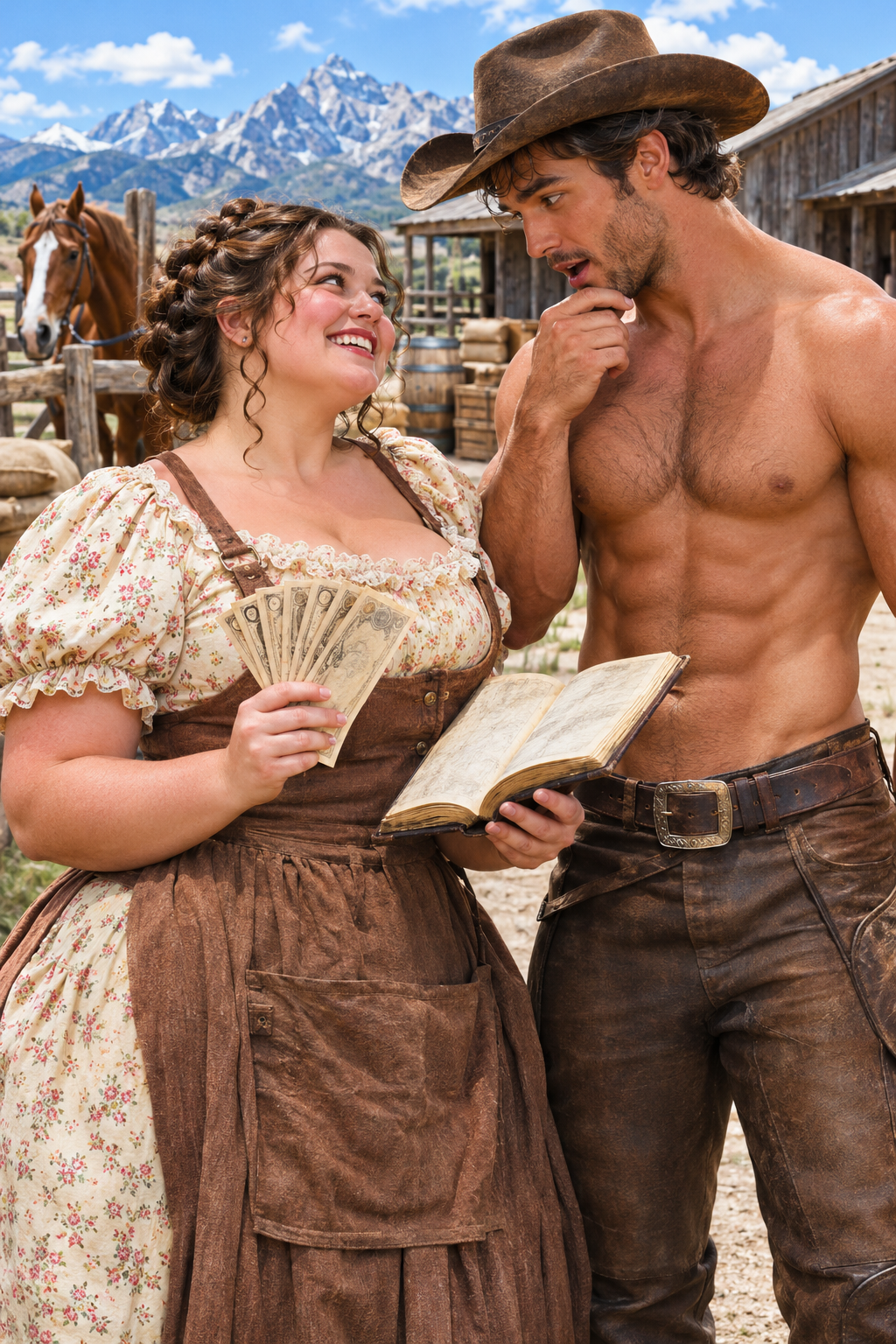
He stared at the papers.
“Price.”
I nodded.
“But we need proof.”
That afternoon, we rode into the nearest town, a dusty settlement called Millstone.
Thomas introduced me to Sheriff Amos Reed, a broad-shouldered man with tired eyes and a silver badge.
The sheriff listened carefully as I explained the suspicious receipts.
When I mentioned Walter Price, his face darkened.
“Miss Whitfield, Price owns half the businesses in this county. He’s got friends in Denver and lawyers who can make trouble disappear.”
“Does that include stolen money?”
“It includes whatever he can persuade a judge to overlook.”
Thomas clenched his fists.
“So you’re saying we should do nothing?”
“I’m saying you need evidence stronger than suspicion.”
As we turned to leave, the sheriff caught my arm.
“There’s something else.”
He glanced toward the street.
“About six months ago, a young woman came through here asking questions about Price’s land purchases.”
My heart began beating faster.
“Was her name Eleanor Bennett?”
The sheriff stared.
“How did you know?”
Thomas stepped forward.
“She’s my sister.”
The sheriff’s expression changed.
“She came to me frightened. Said she’d discovered something in Price’s records. Before she could explain, she saw one of his men outside my office and ran.”
“Where did she go?” Thomas demanded.
“I don’t know.”
“Did she have a little girl with her?”
The sheriff hesitated.
“No. She was alone.”
Thomas went completely still.
Eleanor had disappeared with Rose, or so he believed.
But if she had been in Millstone alone, where was her daughter?
We left the sheriff’s office with more questions than answers.
As we passed the general store, an elderly woman called my name.
“Miss Whitfield?”
I turned.
She wore a plain gray dress and held a basket of sewing supplies.
“My name is Martha Collins. I used to know Eleanor Bennett.”
Thomas hurried toward her.
“Do you know where she is?”
Martha glanced nervously at the passing wagons.
“Not here.”
She pressed a small folded note into my palm.
“Come to the old chapel after dark. And don’t let anyone follow you.”
Before we could question her, she disappeared into the store.
That night, Thomas insisted on accompanying me.
We left our horses among the cottonwoods and approached the abandoned chapel on foot.
A lantern burned behind one cracked window.
Inside, Martha waited beside a woman wrapped in a dark shawl.
When the woman turned, Thomas stopped breathing.
“Eleanor?”
She rushed toward him.
He caught her in his arms, holding her so tightly that she began to cry.
For several moments, neither spoke.
Then Thomas pulled back.
“Where’s Rose?”
Eleanor’s face crumpled.
“They took her.”
The words seemed to drain all the warmth from the room.
“Who?” Thomas whispered.
“Walter Price.”
I felt the floor shift beneath me.
Eleanor sank onto a wooden pew.
“Last winter, I found something in the ranch records. Father had purchased the northern grazing land years before he died. But Price claimed the mineral rights belonged to his company.”
“Mineral rights?” I repeated.
Eleanor nodded.
“There’s silver beneath the northern ridge. A great deal of it.”
Thomas stared at her.
“Our father knew?”
“He suspected. He had the land surveyed before his death, but never had the money to develop it.”
She reached into her shawl and produced a worn leather notebook.
“Price discovered the survey. He wanted the ranch, but he couldn’t buy it while Thomas was doing well. So he started buying debts, forging charges, and destroying our business.”
“And Rose?” Thomas asked.
Eleanor began trembling.
“I found copies of the forged documents. Price’s men caught me leaving the county records office. They took Rose from the schoolhouse and told me she’d die if I spoke.”
Thomas staggered backward.
“You should have told me.”
“They threatened you too.”
“She’s my daughter in everything but blood,” he said, his voice breaking. “You should have trusted me.”
Eleanor covered her face.
“I know.”
Martha knelt beside her.
“I’ve been hiding Eleanor since spring. Price believes she fled east. But he still has the child.”
“Where?” I demanded.
Eleanor looked toward the mountains.
“Black Hollow. An abandoned mining camp beyond the northern ridge.”
Thomas immediately turned toward the door.
I caught his sleeve.
“Wait.”
“My niece is out there.”
“And if you ride into that camp alone, you’ll never bring her home.”
His eyes burned with helpless fury.
“What would you have me do?”
I looked at Eleanor’s notebook.
“We’re going to take back Rose. But first, we’re going to make sure Walter Price can’t hurt another family.”
We spent the next two hours examining Eleanor’s evidence.
The notebook contained dates, names, and payments. It described forged cattle inspections, fraudulent transport charges, and suspicious transfers of property throughout the county.
But one document mattered more than the others.
It was a copy of the original mineral survey, signed by a respected Denver engineer.
According to the survey, the richest silver deposit lay directly beneath Bennett land.
Walter Price had spent years trying to acquire it.
And he had nearly succeeded.
“We need the original survey,” I said.
Eleanor shook her head.
“Price has it locked in his office.”
“Then we get it.”
Thomas looked at me in disbelief.
“You want to break into his office?”
“I want to recover stolen evidence.”
“That sounds remarkably similar.”
“Then perhaps you should marry someone less troublesome.”
Despite everything, he almost smiled.
We decided to seek help from Sheriff Reed.
But when we reached town the following morning, the sheriff’s office stood empty.
A notice on the door announced that Amos Reed had been suspended pending an investigation into misconduct.
Thomas read it twice.
“Price knows.”
A voice spoke behind us.
“He knows more than you think.”
We turned to find the sheriff standing in the alley, no longer wearing his badge.
“Someone told Price about your visit yesterday,” he said. “By morning, the county commissioner had removed me.”
“Then we’re alone,” Thomas replied.
“Not entirely.”
Reed handed me a folded telegram.
“I sent this to Denver last night. A territorial investigator named Samuel Hayes is coming to examine Price’s dealings. But he won’t arrive for three days.”
Three days.
The bank’s deadline was still weeks away, but Rose could be moved at any moment.
And Price had already demonstrated that he would use a child to protect his secrets.
“We can’t wait,” I said.
Reed nodded grimly.
“I was afraid you’d say that.”
Our plan was dangerous, perhaps reckless.
But it was the only one we had.
That evening, Thomas and Reed would ride toward Black Hollow, approaching the mining camp through an old cattle trail.
Meanwhile, I would enter Price’s office during the Saturday social at the hotel, when most of the town gathered for music and supper.
Eleanor would remain hidden with Martha.
Before we separated, Thomas took my hands.
“You don’t have to do this.”
“Yes, I do.”
“Why?”
I considered telling him about my father.
About the night he’d sat at our kitchen table staring at the foreclosure papers, his hands shaking so badly he couldn’t hold his coffee.
About how he’d died six months later, still believing he had failed me.
Instead, I answered simply.
“Because someone should have stopped Price a long time ago.”
Thomas brushed a loose curl from my cheek.
“If anything happens to you—”
“Then make certain Rose gets home.”
His expression changed.
He leaned forward and kissed my forehead.
It was brief and gentle, but it left me trembling.
Then he rode away.
At eight o’clock, I entered the Millstone Hotel wearing my best blue dress.
The ballroom was crowded with merchants, ranchers, and their families.
Walter Price stood near the piano, laughing with the county commissioner.
When he saw me, his smile sharpened.
“Miss Whitfield. What a pleasant surprise.”
“I thought I’d enjoy an evening among civilized company.”
“Then you’ve come to the right place.”
He offered his arm.
I accepted.
For twenty minutes, I endured his conversation while pretending to admire his wealth and influence.
Eventually, I asked about the silver mines north of town.
His fingers tightened around my elbow.
“Who told you about those?”
“Oh, just a rumor.”
“Rumors are dangerous things.”
“So I’ve heard.”
He studied me.
Then he smiled.
“Perhaps you’d like to see my office. I have maps of the entire county.”
My heart skipped.
I had hoped to slip away unnoticed.
Instead, the wolf was inviting me into his den.
“That sounds fascinating,” I replied.
His office occupied the second floor of the bank building across the street.
Inside, polished furniture and expensive carpets announced a fortune built on other people’s misfortunes.
Price poured two glasses of whiskey.
I declined mine.
He stood beside a large oak desk.
“You remind me of your father,” he said.
“Do I?”
“Always asking questions. Always believing the truth would protect him.”
I forced myself to remain calm.
“What happened to my father wasn’t fair.”
“No,” Price agreed. “It wasn’t.”
His admission startled me.
He opened a drawer and removed a yellowed envelope.
“Your father found something he shouldn’t have. A record of payments I made to certain bank officials.”
My mouth went dry.
“He threatened to expose me.”
“So you took his farm.”
Price smiled without warmth.
“I offered him a choice. Silence, or ruin.”
I stared at him.
“You destroyed him.”
“He destroyed himself by refusing to understand how the world works.”
For one terrible moment, I wanted to strike him.
Instead, I glanced toward the open drawer.
Inside lay several leather folders.
One bore the name BENNETT.
“You’re a monster,” I whispered.
Price set down his glass.
“And you’re a foolish girl who came all the way from Missouri to discover that.”
He moved toward the door and turned the key.
The click sounded like a gunshot.
“I know about Eleanor,” he said.
My blood turned cold.
“I know about the sheriff. And I know Bennett is riding toward Black Hollow tonight.”
I backed away.
Price smiled.
“You see, Miss Whitfield, I have men watching every road.”
He opened the Bennett folder and removed a document.
“The child will be moved before midnight. Bennett will find an empty camp.”
“What have you done with Rose?”
“Nothing yet.”
His voice hardened.
“But that depends on you.”
He placed a pen beside the document.
“Sign a statement declaring that Eleanor Bennett fabricated her accusations. Then write a letter persuading Thomas to surrender his ranch.”
“And if I refuse?”
Price looked toward the darkened window.
“Then a little girl may never see her mother again.”
I stared at the pen.
My hands were shaking.
But beneath my fear, a thought began to form.
Price believed he had won.
Men like him always did.
They mistook cruelty for intelligence and fear for obedience.
I picked up the pen.
“All right,” I whispered.
His shoulders relaxed.
“An excellent decision.”
“First, I want proof Rose is alive.”
He hesitated.
Then he took a small object from his pocket.
A faded blue ribbon.
I recognized it immediately.
It matched the ribbon hanging from the little chair in Thomas’s farmhouse.
“She wore this when my men brought her down from the camp yesterday.”
“Yesterday?”
Price’s expression changed.
I understood before he spoke.
Rose wasn’t at Black Hollow anymore.
He had moved her already.
“Where is she?”
Price reached for the ribbon.
I snatched it away.
Then I seized the whiskey glass and hurled it into his face.
He shouted, staggering backward.
I ran for the door, but it was locked.
His hand caught my shoulder.
I twisted free, grabbed the heavy brass lamp from his desk, and swung.
The lamp struck his arm.
He cried out.
The key fell from his pocket.
I dropped to my knees, snatched it up, and unlocked the door.
Behind me, Price roared my name.
I fled down the stairs.
A gunshot shattered the banister beside my head.
I screamed and stumbled into the street.
People were already running from the hotel.
Price appeared above me, pistol raised.
“Stop her!”
I ran toward the livery stable.
A horse stood saddled near the entrance.
I didn’t ask permission.
I mounted and kicked it into a gallop.
Behind me, another shot cracked through the night.
The horse surged forward.
I rode toward the northern hills, clutching the ribbon inside my fist.
I had to reach Thomas.
But the road to Black Hollow was dark, and I knew Price’s men would be following.
Halfway through the canyon, I heard hoofbeats behind me.
Two riders.
I pushed the horse harder.
The trail narrowed along a steep ravine.
A bullet struck the rocks above my head.
I ducked.
Then my horse stumbled.
For one terrifying second, we slid toward the edge.
I threw myself from the saddle and landed hard among the stones.
The horse scrambled away, disappearing into the darkness.
Pain exploded through my ankle.
I tried to stand.
Couldn’t.
The riders were getting closer.
I dragged myself behind a fallen tree, pressing my hand over my mouth.
Lantern light swept across the canyon.
“She came this way,” one man said.
“Price wants her alive.”
“Then he’d better pray she didn’t fall.”
Their horses passed within twenty feet of my hiding place.
I waited until the sounds faded.
Then I began crawling.
Every movement sent pain through my leg.
I didn’t know how far Black Hollow lay ahead.
I only knew that stopping meant surrender.
Nearly an hour later, I heard a familiar voice.
“Clara?”
I lifted my head.
Thomas stood at the edge of the trail, holding a lantern.
For a moment, I thought I was dreaming.
Then he dropped beside me.
“Dear God, what happened?”
“Price knows,” I gasped. “He knows everything.”
Thomas lifted me into his arms.
“Where’s Rose?”
“Not at the camp. He moved her yesterday.”
Reed appeared behind him.
“We found the place empty,” he said. “But there were fresh wagon tracks heading south.”
I seized Thomas’s coat.
“She’s somewhere near town.”
Thomas looked at the ribbon in my hand.
His face crumpled.
Then he pressed it against his heart.
“We’ll find her.”
Reed examined the tracks drawn in the dirt beside his boot.
“There’s an old freight warehouse near the railroad spur. Price owns it. A wagon could reach it from Black Hollow without passing through town.”
Thomas looked toward the southern valley.
“Then that’s where we’re going.”
They helped me onto Reed’s horse.
We rode through the night, following a narrow trail that descended toward the railroad.
Shortly before dawn, we reached the warehouse.
A single lantern burned beside the loading platform.
Two armed guards stood near the entrance.
Through a broken window, I saw a small figure sitting on a wooden crate.
A little girl.
Her dark curls fell around her shoulders.
She was holding a rag doll.
“Rose,” Thomas whispered.
He started forward.
Reed caught him.
“Wait.”
We watched as one guard approached the girl and handed her a cup of water.
She took it with both hands.
Even from a distance, I could see how frightened she was.
Then a wagon rolled into the yard.
Walter Price climbed down.
His left arm hung in a sling.
“Get the girl ready,” he ordered. “The train comes at sunrise.”
Thomas’s face went white.
“They’re sending her away.”
Reed drew his revolver.
“We have to move now.”
But before we could act, another voice rang out.
“Walter Price!”
A rider emerged from the eastern road, accompanied by four armed men.
He wore a dark coat and carried a leather satchel.
“Samuel Hayes,” Reed whispered.
“The investigator?” I asked.
Reed nodded in disbelief.
“He wasn’t supposed to arrive until tomorrow.”
Hayes dismounted.
“Walter Price, I have warrants for your arrest and the seizure of your business records.”
Price stared at him.
Then he laughed.
“You’ve made a mistake.”
“I don’t believe so.”
Hayes opened his satchel.
“Your former bookkeeper arrived in Denver yesterday. He brought ledgers documenting fraud, bribery, and illegal land transfers.”
Price’s expression changed.
For the first time, I saw genuine fear in his eyes.
“You have nothing.”
“We have enough.”
Hayes motioned toward the warehouse.
“Release the child.”
Price slowly raised his uninjured hand.
Then he drew a pistol from beneath his coat.
Everything happened at once.
A shot rang out.
One of Hayes’s men fell.
The guards opened fire.
Thomas leaped from behind the rocks and ran toward the warehouse.
I screamed his name.
Reed fired at a guard, forcing him behind a wagon.
Price seized Rose and dragged her toward the railroad tracks.
The little girl cried out.
“Uncle Thomas!”
Thomas stopped.
Price pressed his pistol against her shoulder.
“Another step and she dies!”
The yard fell silent.
I could hear the approaching train in the distance.
Price backed toward the tracks, pulling Rose with him.
“Put down your weapons!”
Hayes lowered his revolver.
Reed followed.
Thomas stood motionless, his face twisted with anguish.
Price smiled.
“That’s better.”
Then Rose saw me.
I was standing beside the warehouse, leaning against a post because my ankle would no longer support my weight.
Her eyes widened.
I lifted the blue ribbon.
“Rose,” I called gently. “Your mother sent me.”
Price jerked her backward.
“Be quiet!”
But the child kept looking at me.
I remembered something Eleanor had said at the chapel.
Rose loved horses.
She had been taught to stay perfectly still whenever a frightened animal approached.
I met her eyes.
“Remember what your mother taught you about frightened horses?”
Rose nodded almost imperceptibly.
“Stay calm,” I said.
Price glanced toward me.
That was all the distraction she needed.
Rose dropped suddenly to the ground.
Price’s pistol fired into the air.
Thomas lunged.
He struck Price with his shoulder, sending them both crashing onto the gravel.
The gun skidded beneath the wagon.
Rose scrambled toward me.
I caught her and pulled her behind the warehouse wall.
Thomas and Price struggled beside the tracks.
The train whistle screamed.
Price grabbed a loose iron bar and swung it toward Thomas’s head.
Thomas ducked.
The bar struck the ground.
Reed rushed forward, but Price seized Thomas by the collar and dragged him toward the rails.
The locomotive was almost upon them.
“Thomas!” I screamed.
Thomas twisted, throwing Price off balance.
Both men fell.
Reed grabbed Thomas’s coat and hauled him backward.
Price scrambled after them, but Hayes struck him across the wrist with his revolver.
The iron bar fell.
Two deputies pinned Price to the ground.
The train thundered past, shaking the earth.
When the dust cleared, Walter Price was lying face down in the gravel, his hands bound behind his back.
And Thomas was alive.
I held Rose so tightly she began to protest.
“Miss, I can’t breathe.”
I laughed through my tears and loosened my arms.
“I’m sorry, sweetheart.”
Thomas came toward us, limping and bleeding from a cut above his eyebrow.
Rose broke free and ran into his arms.
He lifted her from the ground.
For a long time, he simply held her.
Then he looked at me.
There were tears in his eyes.
“You brought her home.”
I shook my head.
“We all did.”
By noon, Eleanor was reunited with her daughter.
Their cries filled Martha’s little cottage.
I stood in the doorway beside Thomas, watching Eleanor kneel before Rose and kiss her face again and again.
Thomas reached for my hand.
This time, he didn’t let go.
The investigation that followed exposed more corruption than anyone had imagined.
Walter Price had used forged debts and bribed officials to seize seven farms and three ranches.
My father’s property was among them.
The original Bennett survey was recovered from Price’s office, along with the fraudulent accounts.
The territorial court froze his assets and ordered the disputed properties returned to their rightful owners.
The bank withdrew its foreclosure notice against Thomas.
And for the first time in years, the Bennett ranch belonged to the Bennett family without a shadow hanging over it.
But justice did not arrive without pain.
Some families had already moved away.
Others had lost loved ones before the truth emerged.
My father would never return to see his name cleared.
When I received the official letter confirming that his farm had been wrongfully seized, I sat alone on the farmhouse porch and cried.
Thomas found me there at sunset.
He sat beside me without speaking.
After a while, I handed him the letter.
“He was innocent,” I whispered.
Thomas read it carefully.
Then he folded it and placed it in my lap.
“He knew that, Clara.”
“But he died believing he’d failed me.”
Thomas took my hand.
“Your father didn’t fail you. He raised a woman who crossed a thousand miles, faced down a dangerous man, and helped save a child she barely knew.”
I looked away.
“I wish he could have seen this.”
Thomas’s voice softened.
“I think he’d be proud of the woman you became.”
I leaned against his shoulder.
For the first time since my father’s death, grief felt less like a locked room and more like a door I might someday walk through.
Autumn came slowly to the mountains.
With the foreclosure lifted, neighboring ranchers began trading with Thomas again.
The recovered money paid for new fencing, repairs to the barn, and a modest herd of cattle.
Eleanor and Rose returned to the farmhouse.
Laughter filled rooms that had been silent for nearly a year.
As for me, I stayed.
Not because I had nowhere else to go.
The court had offered to restore my father’s Missouri farm, and I could have returned to the life I’d lost.
But somewhere between the broken fences and the frightening nights, Colorado had become more than a place of refuge.
It had become home.
One evening, Thomas asked me to walk with him toward the northern pasture.
The sun was setting behind the mountains, turning the sky gold and crimson.
We stopped beside the fence where I’d first seen the empty cattle pen.
Thomas removed his hat.
“Clara, there’s something I need to ask you.”
I smiled.
“You already asked me to marry you.”
He looked embarrassed.
“That was in a letter. And I asked because I needed help running a household.”
“And now?”
He took a small wooden box from his pocket.
Inside lay a simple gold ring.
It had belonged to his mother.
“Now I’m asking because I love you.”
My breath caught.
Thomas stepped closer.
“I loved you when you refused to leave. I loved you when you challenged me to stop hiding from my troubles. And I loved you even more when you risked everything to bring Rose home.”
Tears blurred my vision.
“I have nothing grand to offer,” he continued. “Just this ranch, my family, and whatever years God gives me.”
I looked toward the farmhouse.
Warm light glowed through the windows.
Rose was chasing a puppy across the porch while Eleanor called her inside for supper.
The barn stood repaired.
Cattle grazed peacefully beneath the hills.
And the man before me was no longer the defeated stranger I’d met beside an empty pen.
He was the man who had taught me that love wasn’t always found in beautiful promises.
Sometimes it was built through hardship, one act of courage at a time.
“Yes,” I whispered.
Thomas blinked.
“Yes?”
I laughed.
“Yes, Thomas Bennett. I’ll marry you.”
He slipped the ring onto my finger.
Then he kissed me beneath the Colorado sunset.
We married the following spring.
It was a simple ceremony beneath the cottonwood trees, with Eleanor standing beside me and Rose scattering wildflowers along the path.
Sheriff Reed, restored to his position, attended with his wife.
Samuel Hayes traveled from Denver to offer his congratulations.
And Martha Collins baked a wedding cake large enough to feed half the county.
After the ceremony, Thomas led me toward the barn.
The red foreclosure notice was gone.
In its place hung a small wooden sign he had carved himself.
BENNETT & WHITFIELD RANCH.
Beneath the names, in smaller letters, were five words.
BUILT ON COURAGE AND TRUST.
I touched the sign with trembling fingers.
“You didn’t have to put my name there.”
Thomas smiled.
“This place would have been lost without you.”
I shook my head.
“No. It would have been lost if we had all stopped fighting for what was right.”
He considered that.
Then he nodded.
“Then perhaps the sign belongs to all of us.”
Years later, when our children asked how their parents had met, Thomas always began with the same story.
“Your mother arrived with one suitcase, a stubborn heart, and absolutely no intention of listening to me.”
I would laugh and remind him that he’d told me to return to Missouri before we’d even been properly introduced.
Our children loved that part.
But as they grew older, I told them the rest.
I told them about a little girl who had been brave when she was terrified.
About a brother who refused to abandon his family.
About a sheriff who chose justice over his badge.
And about a man who believed wealth gave him the right to destroy other people’s lives.
Most importantly, I told them about my father.
I wanted them to understand that a person’s worth could never be measured by the land they owned, the money they possessed, or the power they held over others.
Because I had once arrived in Colorado believing I had lost everything.
My home.
My father.
My future.
Yet the very place that appeared most broken had given me the chance to rebuild.
And the man who had greeted me with an apology had become the greatest blessing of my life.
I never forgot the red notice nailed to that barn door.
For years, Thomas kept it folded inside his desk, not as a reminder of failure, but as proof that even the darkest chapter could become the beginning of something beautiful.
And whenever hardship visited our family again, as it inevitably did, I remembered what that first terrible summer had taught me.
Courage does not mean living without fear.
Love does not mean finding someone who has never been broken.
And hope does not mean believing that life will always be fair.
Sometimes courage is staying when leaving would be easier.
Sometimes love is standing beside someone who has nothing left to offer but an honest heart.
And sometimes hope begins with a single decision to refuse the ending someone else has written for you.
I had traveled to Colorado expecting to become a rancher’s wife.
Instead, I found a family, uncovered the truth about my father’s ruin, and discovered a strength I had never known I possessed.
The ranch that once stood on the edge of destruction became a place where children grew, neighbors gathered, and strangers found shelter when they had nowhere else to turn.
And every spring, when the wildflowers returned to the northern pasture, I would stand beside Thomas and look across the land we had saved together.
I would think of the frightened young woman who had climbed down from a wagon carrying one suitcase and a thousand doubts.
If I could speak to her now, I would tell her not to turn around.
Because sometimes the road that looks like the end of everything is the very road that leads you home.
And for many years, I believed that was where our story ended.
But life has a way of reminding us that a happy ending is not a moment when every hardship disappears. It is the life we choose to build afterward.
Twenty-five years after I first arrived at the Bennett ranch, Thomas and I stood together on the same porch where he had once told me to return to Missouri.
Our hair had begun to turn silver. Our children were nearly grown, and the little wooden chair that had once belonged to Rose now sat beside the fireplace for our grandchildren.
The ranch had prospered beyond anything we could have imagined.
Yet the thing that made me proudest wasn’t the cattle grazing across our fields or the money safely deposited in the bank.
It was the people who came through our gates.
Widows who needed work. Families who had lost their homes. Young men searching for a second chance.
Thomas never turned them away without offering what help he could.
One autumn evening, a young woman arrived carrying a battered suitcase.
Her dress was dusty, her shoes worn through, and her eyes held the same frightened uncertainty I remembered from my younger days.
She stood beside our cattle pen and asked whether we needed someone to help in the kitchen.
Thomas looked at me.
I looked at her suitcase.
And suddenly, I was twenty-three again, standing before a broken ranch with no idea what tomorrow might bring.
“What’s your name, dear?” I asked.
“Anna,” she whispered. “Anna Miller.”
“Do you have family nearby?”
She shook her head.
“Not anymore.”
Thomas opened the gate.
“Well, Anna,” he said gently, “you’ve come to the right place.”
That night, after we had given her supper and a warm room, Thomas found me standing beside the old barn.
“What are you thinking about?” he asked.
I smiled.
“The day I arrived.”
He laughed softly.
“I was a fool to tell you to leave.”
“You were frightened.”
“I was.”
He slipped his hand into mine.
“And you stayed anyway.”
I rested my head against his shoulder.
“Someone had to.”
Above us, the stars stretched across the Colorado sky, bright and endless.
Inside the farmhouse, our family was laughing around the supper table.
The sound drifted through the open windows, mingling with the evening breeze.
I thought of my father, Eleanor, Rose, and all the people whose courage had helped us survive.
I thought of the terrible things Walter Price had done, and how close we had come to allowing his cruelty to decide our futures.
Then I looked at the home we had built.
Price had believed that owning land meant owning the people who lived upon it.
But he had been wrong.
Land could be stolen.
Money could disappear.
Buildings could burn, and fortunes could collapse.
But kindness, courage, and the love we gave freely to others could outlive every one of those things.
Thomas kissed my forehead.
“Ready to go inside, Mrs. Bennett?”
I squeezed his hand.
“In a moment.”
I took one final look at the wooden sign hanging above the barn.
The paint had faded, but the words were still visible.
BUILT ON COURAGE AND TRUST.
I finally understood something that had taken me a lifetime to learn.
We had never truly saved the ranch simply by defeating Walter Price.
We saved it every day afterward, whenever we chose honesty over greed, forgiveness over bitterness, and compassion over indifference.
And that was the legacy I wanted to leave our children.
Not eight hundred acres of Colorado land.
Not a prosperous herd or a comfortable farmhouse.
But the knowledge that even when the world takes nearly everything from you, there is still something no one can steal unless you surrender it yourself.
The kind of person you choose to become.
I turned toward the warm light spilling from our kitchen windows.
Thomas held the door open, just as he had done countless times throughout our marriage.
This time, instead of stepping into a strange house filled with secrets and sorrow, I walked into a home filled with everything we had fought to protect.
And as the door closed behind us, I knew that the greatest treasure we had ever discovered beneath those Colorado mountains was never silver.
It was the life we had built together.
THE END.