The ranch owner humiliated me in front of twelve cowboys, calling me too ugly to serve dinner, but his dying father knew a secret about me.
I stared at the torn letter in my hands, unable to understand how a few faded words could destroy everything I thought I knew about my life.
“Abigail’s father is the man who owns Mercer Ranch, and he must never know she survived.”
My eyes moved slowly from Walter to Caleb, searching their faces for something that might tell me this was a terrible misunderstanding.
Walter stood beside my bed, his shoulders trembling beneath his old wool cardigan.
Caleb remained near the doorway, looking as though someone had knocked the breath from his lungs.
“Who owns this ranch?” I whispered.
Neither man answered.
I turned toward Walter, my voice rising.
“Who owns Mercer Ranch?”
Walter closed his eyes.
“I do, sweetheart.”
The room went silent.
Outside, the Wyoming wind rattled the windows, and somewhere downstairs, the grandfather clock struck midnight.
I looked at the elderly man who had eaten my apple pie, held my hand, and called me his little miracle.
“Are you telling me you’re my father?”
Walter opened his mouth, but no words came out.
Caleb stepped forward.
“Dad, tell her everything.”
Walter lowered himself onto the edge of my bed.
“Your mother and I had a relationship before Caleb was born, when I was already married.”
His voice cracked on the final word.
“My wife, Eleanor, was visiting her sister in Denver when Margaret came to work here.”
I felt sick.
“She was your housekeeper?”
Walter nodded.
“She was twenty-three, beautiful, clever, and stronger than any woman I’d ever met.”
I thought about my mother working in the same kitchen where I had spent weeks trying to bring happiness back to this broken family.
The thought made my chest ache.
“Did you love her?”
Walter stared at the floor.
“Yes, but I was too much of a coward to love her properly.”
I swallowed hard.
“Then why did she leave?”
His hands began shaking.
“Because I made a choice that ruined her life.”
Before he could continue, Caleb reached for the letter.
“There’s something wrong with this story, Dad.”
Walter looked up sharply.
“What do you mean?”
Caleb pointed to the final sentence.
“Mom never mentioned another child, and you told me Margaret disappeared before I was born.”
“That’s true.”
“Then why does this letter say you must never know Abigail survived?”
Walter went pale.
I looked down at the handwriting again.
My mother had always written the letter A with a small curl at the top.
The letter in my hand had the same curl.
But something about the final sentence felt different.
The ink was darker.
The words were crowded together, almost as if they had been added later.
“Where did you get this?” I asked.
Walter hesitated.
“From the locked drawer in my study.”
“And who put it there?”
He shook his head.
“I don’t know.”
Caleb took a long breath.
“Abigail, there’s something else you need to see.”
He disappeared into the hallway.
A few minutes later, he returned carrying an old leather folder.
Inside were letters, photographs, and a newspaper clipping from thirty years earlier.
The headline made my stomach tighten.
LOCAL RANCH EMPLOYEE ACCUSED OF STEALING FAMILY JEWELRY.
Beneath it was a photograph of my mother.
I stared at her young face, at the familiar gentle eyes, and at the word accused printed beneath her name.
“She never stole anything,” I whispered.
Walter began to cry.
“I know that now.”
I turned toward him.
“You knew she was innocent?”
He covered his face.
“Not then.”
Caleb placed another photograph beside the newspaper.
It showed my mother standing outside the ranch house beside a tall, serious-looking man.
On the back, someone had written a name.
Thomas Bennett.
“Who is he?” I asked.
Walter’s expression changed.
“He was my ranch foreman.”
“Was?”
“He left shortly after Margaret disappeared.”
Caleb looked toward the window.
“He came back to Wyoming six months ago.”
Something cold traveled down my spine.
“Why?”
Caleb’s jaw tightened.
“He’s been trying to buy this ranch.”
I stared at the photograph.
The man had dark hair, a square jaw, and eyes that seemed strangely familiar.
Then I remembered something my mother had once told me.
She had been sitting beside my hospital bed after the fire, gently brushing the hair away from my damaged cheek.
“Your father had kind eyes, Abby,” she whispered. “Whatever anyone tells you, remember that.”
I had been only six, but I remembered those words.
And I remembered something else.
She had never said my father was dead.
She had only said he could not come home.
I looked at Walter.
“Did Thomas Bennett know my mother?”
Walter nodded slowly.
“Very well.”
“How well?”
He looked at Caleb.
Then he looked away.
I stood up.
“I deserve the truth, even if it hurts.”
Walter finally whispered, “Thomas was in love with Margaret.”
For several seconds, nobody moved.
Then Caleb spoke.
“Dad, you told me he hated her.”
Walter’s eyes filled again.
“I believed what I was told.”
I pressed my fingers against my forehead.
The scar on my cheek felt strangely hot.
“Who told you?”
Walter’s answer came so quietly that I almost missed it.
“My brother, Richard.”
The name meant nothing to me.
But the way Caleb reacted told me it meant everything to him.
“Uncle Richard?” he said.
Walter nodded.
Caleb stepped back.
“He’s the one who introduced Bennett to the land investors.”
A heavy silence filled the room.
Then Walter whispered something that made my heart stop.
“And Richard was the man who told me Margaret had died.”
I felt the strength drain from my legs.
Caleb caught my arm before I fell.
For the first time since arriving at Mercer Ranch, I did not pull away from his touch.
The following morning, the ranch was covered in fresh snow.
I had barely slept.
At dawn, I went downstairs and found Hank sitting alone at the kitchen table.
He took one look at my face and set down his coffee.
“Something happened.”
I sat across from him.
“Did you know my mother?”
His expression softened.
“Margaret Harper?”
I nodded.
Hank stared into his cup.
“She was the sweetest woman who ever worked this ranch.”
“Then why did everyone believe she was a thief?”
He sighed.
“Because back then, Richard Mercer could make people believe just about anything.”
I leaned closer.
“What did he do?”
Hank looked toward the staircase.
“Your mother found something she wasn’t supposed to find.”
My heart began pounding.
“What?”
He hesitated.
“Ranch money was disappearing, and cattle were being sold without Walter’s knowledge.”
“Richard was stealing?”
“That’s what Margaret believed.”
Hank rubbed his forehead.
“She was going to tell Walter, but two days later, his wife’s jewelry went missing.”
“And Margaret was blamed.”
He nodded.
“She left before the sheriff could question her.”
I stared at the table.
For thirty years, my mother had carried the shame of something she had never done.
I remembered the way strangers sometimes recognized her name in town.
I remembered the quiet conversations that stopped whenever she entered a store.
And suddenly, I understood why she had moved us so often.
She had not been running from a mistake.
She had been running from someone.
“Where is Richard now?” I asked.
Hank’s face turned serious.
“Abigail, you don’t want to go looking for that man.”
Before I could answer, the kitchen door opened.
Caleb stepped inside, shaking snow from his coat.
His expression told me something was wrong.
“Someone cut the fence along the north pasture last night.”
Hank stood immediately.
“How many cattle?”
“At least twenty missing.”
Then Caleb looked at me.
“And somebody left a message on the barn.”
We followed him outside.
The cold air burned my lungs as we crossed the yard.
Written across the barn doors in thick black paint were six words.
SEND THE HARPER WOMAN AWAY NOW.
My stomach twisted.
Hank swore under his breath.
Caleb stood motionless, staring at the message.
Then he turned toward me.
“You’re not leaving.”
I looked at him.
“You don’t even know what you’re protecting me from.”
His voice was steady.
“Then we’ll find out together.”
That afternoon, the sheriff came to Mercer Ranch.
Sheriff Daniel Price was a broad-shouldered man with tired eyes and a habit of listening more than he spoke.
He examined the damaged fence, photographed the barn, and questioned everyone who had been working that night.
When I told him about my mother, he became unusually quiet.
Finally, he asked to speak with me alone.
We sat at the kitchen table while Caleb waited outside.
“Abigail, did your mother ever mention a man named Thomas Bennett?”
“Only indirectly.”
“How?”
“She said my father had kind eyes.”
The sheriff leaned back.
For a moment, I thought he might tell me something important.
Instead, he asked, “Do you have anything belonging to your mother?”
I told him about the letter.
He examined it beneath the kitchen light.
Then he pointed at the darker ink.
“This sentence may have been added by someone else.”
My heart jumped.
“Can you prove that?”
“Not by looking at it, but we can have it examined.”
I handed him the letter reluctantly.
It felt like surrendering the last piece of my mother.
Before leaving, he paused beside the front door.
“One more thing, Abigail.”
I looked up.
“Thomas Bennett never left Wyoming.”
I frowned.
“Walter said he disappeared.”
“He changed his name and worked under several ranch owners.”
“Why would he do that?”
The sheriff hesitated.
“That’s what we’re trying to understand.”
Three days later, a blizzard rolled across the valley.
The sky turned dark before noon, and the wind howled so fiercely that the windows shook.
The ranch hands struggled to bring the cattle into shelter.
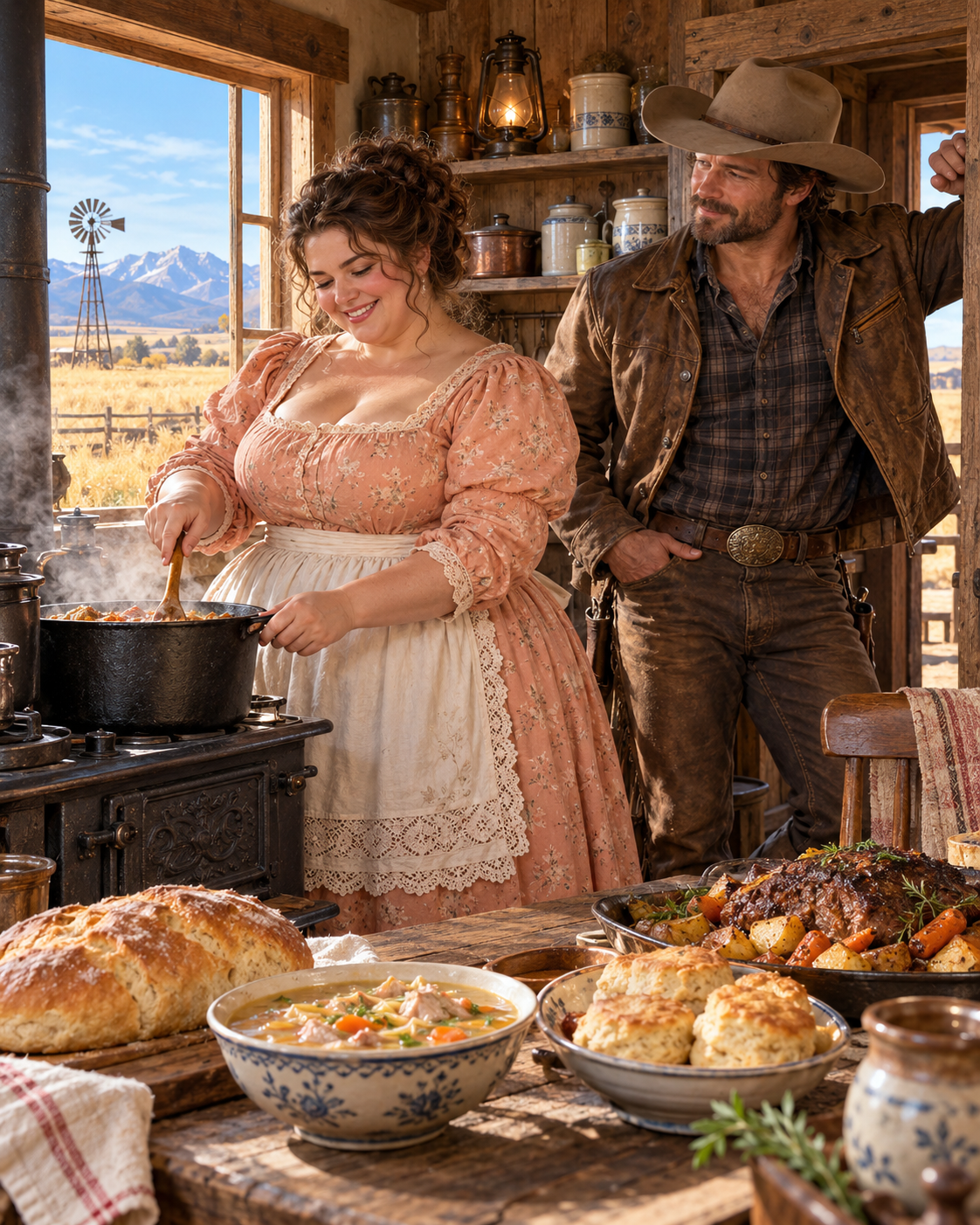
I spent the afternoon preparing soup, coffee, and warm bread.
Walter sat near the fireplace, wrapped in a blanket.
For the first time, he seemed comfortable being downstairs.
But every few minutes, he glanced toward the window.
“Are you expecting someone?” I asked.
He shook his head.
“No, sweetheart.”
Yet his fingers kept twisting the edge of his blanket.
By evening, Caleb had not returned from the north pasture.
Hank came inside, his beard covered in ice.
“We found the cattle, but Caleb stayed behind to check the ridge fence.”
I looked toward the darkness.
“Shouldn’t he be back?”
Hank glanced at the clock.
“Yes.”
An hour passed.
Then another.
The radio crackled with static, but Caleb never answered.
I tried to keep my hands steady as I poured coffee.
Finally, I grabbed my coat.
Hank blocked the doorway.
“You’re not going out there.”
“I know the path to the north pasture.”
“And the storm could kill you.”
I looked at him.
“So could leaving him out there.”
Walter slowly rose from his chair.
“Take the old service road.”
We both turned.
He pointed toward the northern hills.
“There’s a hunting cabin beyond the ridge. Caleb knows it.”
Hank hesitated.
Then he reached for his keys.
“I’m coming with you.”
We drove through the blizzard with the truck headlights barely cutting through the snow.
The wind pushed against the doors.
Branches scraped the windshield.
Every minute felt longer than the last.
Then I saw something beside the road.
A broken fence post.
Beyond it, half buried in snow, was Caleb’s truck.
My heart nearly stopped.
Hank slammed on the brakes.
We stumbled outside, calling Caleb’s name.
There was no answer.
Then I noticed footprints leading toward the trees.
We followed them until the headlights disappeared behind us.
Just as I thought we had lost the trail, I heard a faint voice.
“Over here!”
Caleb was sitting beneath a pine tree, one leg trapped beneath a fallen branch.
Blood had frozen along his forehead.
I dropped beside him.
“Caleb!”
His eyes opened slowly.
“Abigail?”
I pulled off my gloves and touched his face.
“Don’t you dare close your eyes.”
He gave a weak smile.
“You’re bossier than my father.”
Hank worked to lift the branch while I wrapped Caleb in an emergency blanket.
His hands were freezing.
I held them between mine.
“Why didn’t you come back?”
Caleb looked toward the dark trees.
“Someone was waiting near the ridge.”
I froze.
“Who?”
He swallowed painfully.
“I couldn’t see his face, but he fired a shot near my horse.”
Hank looked up sharply.
“Someone shot at you?”
Caleb nodded.
“My horse threw me when the branch came down.”
We managed to free his leg and carry him back to the truck.
By the time we reached the ranch, Caleb was barely conscious.
I helped Hank get him into the house while Walter called for medical assistance.
The doctor arrived the next morning after the roads reopened.
Caleb had a fractured ankle, a concussion, and severe exhaustion.
He would recover, but he needed rest.
For two nights, I barely left his room.
I changed his bandages, brought him meals, and sat beside him when the pain kept him awake.
One evening, he caught my hand.
“Why are you doing all this?”
I looked at him.
“Because somebody has to keep you from getting yourself killed.”
He smiled faintly.
“That’s not what I meant.”
I looked down.
He squeezed my fingers.
“Abigail, I was wrong about you from the beginning.”
I remained silent.
“I thought hiring you might answer questions about the past, but I never expected you to become the reason this house felt alive again.”
Tears blurred my vision.
“Then why didn’t you tell me the truth?”
“Because I was afraid you’d leave.”
His voice broke.
“And because I didn’t know how to tell you that the first person who made me want to live again might be connected to everything my family had hidden.”
I gently pulled my hand away.
“Caleb, before either of us says anything else, we need to know who my father really is.”
He nodded.
“I know.”
Two days later, Sheriff Price returned.
He brought the original missing-person reports, employment records, and preliminary findings from the letter examination.
We gathered around the dining table.
Walter sat beside me.
Caleb leaned against the doorway, his injured ankle resting on a stool.
The sheriff placed a photograph in front of us.
“This is Thomas Bennett, taken six months ago.”
I stared at the older man in the picture.
His hair was gray, his face deeply lined, but his eyes were unmistakable.
They looked like mine.
The sheriff continued.
“We found evidence that Richard Mercer and Thomas Bennett had been communicating recently.”
Walter frowned.
“Thomas would never help Richard.”
“That may be true,” the sheriff replied. “But Bennett has been receiving anonymous payments for years.”
Caleb leaned forward.
“From whom?”
“We’re still tracing the accounts.”
Then the sheriff opened another folder.
“The handwriting examiner believes the final sentence of Margaret’s letter was added later.”
Walter covered his mouth.
I felt a strange mixture of relief and dread.
“Then the letter was meant to make us believe Walter was my father.”
“Possibly,” the sheriff said.
“But why?” Caleb asked.
The sheriff looked directly at Walter.
“Because someone wanted Abigail to think she belonged to this family for the wrong reason.”
Walter went pale.
Before anyone could speak, Hank entered the dining room carrying a dusty metal box.
“I found this behind the loose boards in the old barn.”
Walter stared at it.
“That’s Margaret’s.”
Inside were receipts, faded photographs, and a small notebook.
I recognized my mother’s careful handwriting immediately.
The first pages contained household expenses.
But farther inside were dates, cattle sales, and large sums of money.
Each suspicious entry carried the same initials.
R.M.
Richard Mercer.
Then I found a folded note.
It was addressed to Thomas.
My hands shook as I read it.
“Thomas, Richard knows about the missing money, and I believe he has discovered the truth about Abigail.”
I stopped breathing.
Caleb moved closer.
I forced myself to continue.
“If anything happens to me, please protect our daughter. Walter must never be blamed for what his brother has done.”
I looked up, tears spilling down my cheeks.
“Our daughter.”
Walter began sobbing.
Caleb knelt beside me.
And for the first time in thirty-two years, I knew my father’s name.
Thomas Bennett.
But the relief lasted only seconds.
Because beneath the letter was another piece of paper.
A handwritten warning.
“Richard has threatened to burn down the house if I expose him.”
The room fell silent.
My hands went numb.
I remembered the fire that had scarred my face.
I remembered my mother carrying me through thick smoke.
And I remembered hearing a man’s voice outside our burning home.
At six years old, I had been too frightened to understand the words.
But suddenly, they returned with horrifying clarity.
“You should have stayed away from Wyoming, Margaret.”
I looked at the sheriff.
“The fire wasn’t an accident.”
He leaned forward.
“What did you say?”
I told him everything.
The smell of gasoline.
The broken kitchen window.
The sound of a truck engine outside.
And the voice I had buried beneath years of nightmares.
Walter covered his face.
Caleb stood so suddenly that his chair scraped against the floor.
“Richard did this?”
The sheriff’s expression hardened.
“We need to find him.”
But before he could reach his radio, a vehicle pulled into the yard.
Hank looked through the window.
“Someone’s here.”
A tall man stepped out of a black pickup truck.
He wore a dark coat and carried a leather briefcase.
Walter rose slowly.
His face drained of color.
“Richard.”
The front door opened before anyone could stop him.
Richard Mercer walked inside wearing the confident smile of a man who had never expected to be held accountable.
“Well,” he said, looking around the warm dining room, “isn’t this a touching family reunion?”
His eyes settled on me.
The smile disappeared.
“Margaret’s daughter.”
I felt Caleb move beside me.
Richard glanced at my scar.
“Looks like you inherited more than your mother’s stubbornness.”
Caleb stepped forward.
“Get out.”
Richard chuckled.
“Careful, nephew. You still owe the bank a considerable amount of money.”
Walter gripped the table.
“What do you want, Richard?”
“The same thing I’ve wanted for years. This ranch.”
He placed a document on the table.
“A purchase agreement. Sign it, and everyone’s problems disappear.”
Sheriff Price stepped forward.
“Richard Mercer, I’d like to ask you a few questions.”
Richard’s expression tightened.
“About what?”
“The missing cattle, financial records, and a fire from twenty-six years ago.”
For the first time, fear crossed Richard’s face.
But it vanished quickly.
“You have no proof.”
I stepped toward him.
“My mother kept records.”
Richard looked at the metal box.
His entire expression changed.
“You should have burned that.”
The words escaped before he could stop them.
The sheriff reached for his handcuffs.
“Richard Mercer, you’re under arrest.”
Richard lunged toward the box.
Caleb blocked him.
The two men collided against the table, sending dishes crashing onto the floor.
Richard shoved Caleb’s injured leg.
Caleb cried out and fell.
I grabbed the metal box and stumbled backward.
Richard turned toward me.
“Give me that!”
His face was twisted with rage.
For one terrible moment, I was six years old again, trapped inside a burning house.
Then Walter stepped between us.
“Enough!”
His voice shook the room.
Richard froze.
Walter stood straighter than I had ever seen him.
“You stole from me, destroyed Margaret’s life, and tried to destroy this family.”
Richard sneered.
“You were too weak to protect any of them.”
Walter’s eyes filled with tears.
“You’re right. I was weak.”
He stepped closer.
“But I won’t be silent anymore.”
The sheriff and Hank restrained Richard before he could move again.
As the handcuffs closed, Richard stared at me with hatred.
“Your mother should have minded her own business.”
I looked directly into his eyes.
“She did. She protected her daughter.”
The sheriff led him outside.
For several moments, nobody spoke.
Then Walter sank into his chair and began to cry.
Caleb rested a hand on his shoulder.
I watched them, realizing how much destruction one man’s greed had caused.
But there was still someone missing.
My father.
Three weeks passed before I received any news about Thomas Bennett.
Richard remained in custody while investigators examined decades of financial crimes.
The sheriff told us that evidence connected Richard to the fire, although prosecutors were still determining the charges they could prove.
But Thomas had disappeared again.
Every morning, I checked the mailbox.
Every evening, I wondered whether he even knew I was alive.
Then, one rainy afternoon, a letter arrived.
There was no return address.
Inside was a single sheet of paper.
“Dear Abigail, I have wanted to meet you every day of my life.”
I sank onto the kitchen chair.
“I believed you died with your mother because that was what Richard told me.”
My vision blurred.
“I have lived with that grief for twenty-six years.”
The letter continued.
“When I learned you were alive, I came back to Wyoming, but Richard threatened to hurt you if I approached the ranch.”
I pressed the paper against my chest.
“I am sorry I was not there to protect you, and I understand if you never wish to see me.”
At the bottom was an address.
A small farmhouse outside Sheridan.
Caleb found me crying at the table.
He read the letter quietly.
Then he sat beside me.
“Do you want to go?”
I stared at the address.
“What if he looks at me the way everyone else does?”
Caleb touched my hand.
“Then he’ll be the one who loses something precious.”
I shook my head.
“You don’t understand what it’s like.”
He waited.
“People have spent my whole life deciding who I am before I open my mouth.”
Caleb’s eyes filled with regret.
“I know. I was one of them.”
I looked at him.
He continued softly.
“That first night, I let Hank’s joke pass without defending you. I saw how much it hurt, and I said nothing.”
A tear slipped down my cheek.
“I’m sorry, Abigail.”
I had spent years waiting for someone to acknowledge the cruelty rather than pretend it never happened.
And somehow, those simple words loosened something deep inside me.
The following Sunday, Caleb drove me to Sheridan.
The farmhouse stood at the end of a narrow gravel road, surrounded by cottonwood trees.
An elderly man was repairing a wooden fence.
When our truck approached, he slowly straightened.
I stepped outside.
He stared at me.
Then the hammer fell from his hand.
“Abigail?”
His voice broke around my name.
I nodded.
He took one step toward me, then stopped.
His eyes moved across my face, resting on the scar.
I instinctively lowered my head.
But he began to cry.
“Oh, sweetheart.”
The words shattered me.
He approached slowly.
“Your mother told me you had her smile.”
I couldn’t speak.
He reached into his coat and removed a faded photograph.
It showed my mother holding a newborn baby.
Me.
“I’ve carried this every day.”
My knees weakened.
“Why didn’t you find me?”
His face crumpled.
“Richard sent me a death certificate. I believed I’d buried both of you.”
He covered his mouth.
“I should have checked. I should have fought harder.”
For years, I had imagined what I would say if I ever met my father.
I had prepared angry questions, bitter accusations, and speeches about everything he had missed.
But standing in front of him, I could only whisper one thing.
“Did you ever love me?”
Thomas began sobbing.
“Before you were born. Every day after. Even when I thought you were gone.”
I stepped forward.
He opened his arms.
And at thirty-two years old, I finally felt what it was like to be held by my father.
We stood beside that old fence for a long time.
Neither of us tried to hide our tears.
When I finally pulled away, Thomas gently touched the edge of my scar.
“Your mother gave her life saving you.”
I nodded.
“I know.”
He shook his head.
“No, Abigail. She also saved you before that fire.”
I looked at him.
“What do you mean?”
“She refused to let Richard use you to control her. She kept evidence, changed towns, and started over because she wanted you to grow up free.”
He smiled through his tears.
“She used to tell me that a beautiful life wasn’t one without scars, but one where scars never stopped you from loving.”
I closed my eyes.
For the first time, I could remember my mother without seeing only the flames.
I remembered her laughter.
Her warm hands.
The way she sang while kneading bread.
And suddenly, I understood why cooking had always made me feel close to her.
It was the love she had left behind.
By spring, the snow around Mercer Ranch had melted.
Richard’s financial dealings were being investigated, and the stolen cattle had been recovered from a property connected to one of his associates.
Thomas visited the ranch every Sunday.
At first, Walter struggled to face him.
There were too many years of misunderstandings, shame, and regret between them.
But one afternoon, I found the two old men sitting on the porch.
Walter was crying.
Thomas had one hand resting on his shoulder.
Neither noticed me standing in the doorway.
“I’m sorry I believed Richard,” Walter whispered.
Thomas stared across the fields.
“We both lost Margaret because we trusted the wrong man.”
Walter nodded.
“Can you forgive me?”
Thomas remained silent for a long moment.
Then he answered.
“I don’t know if I can forgive everything today, but I don’t want to waste another year hating you.”
I quietly returned inside.
Some wounds, I realized, did not heal through grand speeches.
They healed through ordinary days and the courage to begin again.
One evening, Caleb found me preparing dinner.
He stood in the doorway, watching as I rolled biscuit dough.
“There’s something I want to show you.”
I wiped my hands.
“What is it?”
He smiled.
“Come outside.”
Behind the house, the old garden had been cleared.
Fresh soil filled neat wooden beds, and a small greenhouse stood beside the fence.
I stared in disbelief.
“What’s all this?”
Caleb rubbed the back of his neck.
“Your mother used to grow vegetables here, according to Dad.”
I stepped closer.
Tiny green shoots were pushing through the soil.
“I thought you might want to bring it back.”
Tears filled my eyes.
“Caleb…”
He reached into his pocket and removed a small brass key.
“This is for the kitchen.”
I laughed through my tears.
“I already have a key.”
He smiled.
“Not that kitchen.”
He pointed toward the renovated building beside the barn.
Through its windows, I could see new tables, shelves, and a large cooking stove.
“I thought we could turn it into a community kitchen.”
I stared at him.
“For whom?”
“Ranch families, travelers, people who need a warm meal, and anyone who’s ever felt they didn’t belong somewhere.”
My throat tightened.
Caleb stepped closer.
“We could call it Margaret’s Table.”
I began crying before he finished speaking.
He gently wiped a tear from my cheek.
“Your mother brought people together, and so do you.”
I looked toward the windows, imagining hungry children, lonely neighbors, and families gathering around tables filled with food.
For so long, I had believed my scar was the first thing people would always see.
But here stood a man who finally saw what my hands and heart could build.
“There’s one more thing,” Caleb whispered.
He took my hands.
“I know we still have a lot to learn about each other, and I know neither of us is finished healing.”
My heart began pounding.
“But I’d like to spend my life learning, if you’ll let me.”
I looked into his eyes.
I thought about the lonely man who had opened his door to me during a freezing Wyoming morning.
I remembered the cold dining room, the untouched meals, and the silence that had once filled every corner of this house.
Now laughter floated through the windows.
Walter was arguing with Hank about a card game.
Thomas was helping the ranch hands repair a gate.
And the kitchen smelled of warm cinnamon bread.
I squeezed Caleb’s hands.
“I think I’d like that.”
He smiled and gently kissed my forehead.
Months later, Margaret’s Table opened its doors.
Neighbors arrived carrying flowers, old recipes, and stories about the woman whose name hung above the entrance.
Some remembered my mother as a hardworking housekeeper.
Others remembered the accusations that had once driven her away.
But when the truth finally spread through the valley, people began telling different stories.
They spoke of her courage.
Her kindness.
The daughter she had protected.
On opening day, I stood beneath the wooden sign and looked at the crowd.
My father stood beside Walter.
Caleb held my hand.
Hank was already complaining that nobody had made enough biscuits.
Everyone laughed.
Then a little girl approached me.
She couldn’t have been older than eight.
A pale birthmark covered one side of her face.
She stared at my scar.
“Does it hurt?” she asked.
I knelt beside her.
“Not anymore.”
She touched her own cheek.
“Some kids at school say I look funny.”
My heart broke for her.
I gently smiled.
“Would you like to know something?”
She nodded.
“Some of the most wonderful things in this world look different from what people expect.”
She studied my face.
“Like you?”
I swallowed the tears rising in my throat.
“Like both of us.”
She smiled.
Then she wrapped her small arms around my neck.
I held her tightly, remembering every time I had been rejected, humiliated, or made to feel ashamed.
I wished I could go back and tell that frightened younger version of myself what I knew now.
That cruelty could leave scars without defining the person who carried them.
That being unwanted by the wrong people did not mean being unworthy of love.
And that sometimes, the home you spent your whole life searching for was not waiting to be found.
It was waiting to be built.
That evening, after the last guests had left, I stood alone in the kitchen.
The tables were empty.
The lights glowed softly.
Outside, the sun sank behind the Wyoming mountains, painting the sky gold.
Caleb came up behind me and wrapped his arms gently around my waist.
“What are you thinking about?”
I looked at the photograph of my mother hanging above the fireplace.
“I’m thinking about how she brought me here without ever knowing it.”
Caleb kissed my hair.
“She’d be proud of you.”
I smiled through my tears.
For years, I had believed the fire took everything from me.
But it had not taken my mother’s love.
It had not taken my ability to trust, to forgive, or to begin again.
And it had never taken my worth.
I reached for Caleb’s hand and turned off the kitchen lights.
As we walked toward the warm ranch house, I heard laughter coming from the dining room.
My father’s voice.
Walter’s laughter.
Hank’s familiar complaints.
And the beautiful sound of a family that had finally learned how to heal.
I paused at the doorway and looked back once more at the sign above the kitchen.
Margaret’s Table.
My mother’s name.
My mother’s legacy.
And the place where broken hearts would always find a seat.
That night, I finally understood something I wished every lonely person in the world could hear.
A home isn’t made beautiful by perfect walls, expensive furniture, or faces without scars.
A home becomes beautiful when someone inside it chooses kindness over judgment, truth over fear, and love over the pain of yesterday.
And sometimes, the person everyone else refuses to welcome is the very person who teaches them what it truly means to belong.
THE END.