“The ranch owner humiliated me before eleven cowboys at Raven Spur, but the kitchen key he threw at my feet concealed a betrayal.”
The three knocks came again, harder this time, and I watched Levi Stout close his fingers around the strange iron key as though it were the last thing keeping him alive.
“Don’t answer him, Dela,” he whispered.
Outside, Mr. Pritchard’s voice remained perfectly polite.
“Miss Morse, I know you’re frightened, but withholding property belonging to Mr. Calder will only make matters worse.”
I looked at my mother’s letter, still trembling between my fingers, and felt something colder than fear settle inside my chest.
My mother had been dead for three months, yet somehow she had known I would stand in this kitchen, facing the very people she had tried to escape.
“That letter belongs to me,” I called through the door.
There was a brief silence.
Then Pritchard answered, “Your mother made certain arrangements before her death, and I’m afraid you don’t understand their consequences.”
Levi stepped closer to the door.
“Get off my property, Pritchard.”
“That question of ownership is precisely why I’m here, Mr. Stout.”
The attorney’s footsteps retreated across the porch, but neither of us moved until we heard his carriage rolling away.
Only then did Levi place the second key on the table.
It was heavier than the kitchen key, with a crooked star carved into its handle.
I recognized the symbol immediately.
My mother had drawn that same star at the bottom of her letter.
“Where did you get this?”
“Samuel gave it to me seventeen years ago.”
I stared at him.
“You knew my uncle?”
Levi nodded slowly.
“He was my friend, Dela, and I failed him when he needed me most.”
His confession hung between us while the fire crackled beneath the stove.
I wanted answers, but the grief in his face made me realize that whatever happened to Samuel Morse had never truly ended.
Levi pulled out a chair and told me about the winter of 1869.
Samuel had come to Texas with little money and an extraordinary talent for turning abandoned buildings into useful ones.
He purchased forty acres beside Raven Spur, built the stone kitchen, and opened it to cattle drivers traveling north.
The kitchen soon became more than a place to eat.
Men gathered there to trade horses, exchange news, and settle disputes without drawing their revolvers.
Samuel believed that a man who had eaten a warm meal was less likely to do something foolish.
My mother had helped him during the first summer, before returning to Missouri to marry my father.
Then Ogden Calder’s father offered Samuel a loan to expand the operation.
The agreement seemed fair until cattle prices collapsed and the lender demanded repayment before the agreed date.
Samuel refused to surrender his property.
Three weeks later, he disappeared.
“What happened to him?” I asked.
Levi stared at the floor.
“That’s what I’ve spent seventeen years trying to discover.”
I wanted to accuse him of lying, but his hands were shaking.
He explained that Samuel had left the iron key with him shortly before disappearing.
He had also warned Levi never to trust anyone carrying papers from the Calder office.
“Why didn’t you tell my mother?”
“I tried.”
Levi swallowed.
“My letters came back unopened, and eventually I was told she wanted nothing to do with Texas.”
I remembered how Mother had changed whenever someone mentioned the West.
She would grow quiet, then return to her work as though she hadn’t heard.
Perhaps she had never received those letters.
Perhaps somebody had made certain of it.
I unfolded the rest of her message.
“My darling Dela, I have kept this secret because I believed silence would protect you, but silence has protected the wrong people for far too long.”
My vision blurred.
“Your uncle did not abandon his land, and he did not willingly sign it away.”
I read the next sentence twice.
“The proof is hidden where Samuel always said the truth should be kept, beneath the place where honest bread was made.”
Levi looked toward the enormous stone hearth.
For a long moment, neither of us spoke.
Then he picked up the iron key.
“We need to find whatever he left behind.”
We waited until the bunkhouse lamps went dark.
I told Amos that the kitchen needed repairs and asked him to keep the men away until morning.
He studied my face and understood that something was wrong.
“Miss Dela, if you’re in trouble, you’ve got eleven men who’d rather lose supper than see you hurt.”
His kindness nearly broke me.
I thanked him and returned to the kitchen, where Levi had already pulled the heavy cooking stove away from the wall.
Behind it stood a row of soot-blackened stones.
One was marked with the crooked star.
My heart began pounding.
Levi inserted the key into a narrow opening beside the stone.
At first, nothing happened.
Then something clicked deep inside the wall.
Together, we pulled the stone outward.
Behind it was a small iron compartment containing a tin box wrapped in oilcloth.
My hands trembled as I lifted it onto the table.
Inside lay a faded photograph, a leather ledger, several folded documents, and a silver pocket watch.
The photograph showed a younger Levi standing beside a smiling man with my mother’s eyes.
Samuel Morse.
For the first time, I saw the uncle whose name had been treated like a forbidden word throughout my childhood.
He was standing in front of this very kitchen.
Beside him stood a woman holding a baby.
I looked closer.
The woman was my mother.
And the baby was me.
I pressed the photograph against my chest.
Mother had brought me here.
I had stood on this land before I was old enough to remember.
Levi watched me quietly.
“She wanted you to know where you came from.”
I wiped my cheeks and opened the ledger.
Samuel had recorded every payment made on the property loan, including several that Calder’s company later claimed had never been received.
There were dates, amounts, and signatures.
But the final pages contained something far more disturbing.
Samuel had written about cattle being moved through Raven Spur under false ownership papers.
He believed Calder’s father was purchasing stolen herds, altering their brands, and selling them through legitimate brokers.
The kitchen property mattered because it included the only reliable wagon road and water access through that section of the valley.
Without it, the operation could not function.
On the final page, Samuel had written one sentence.
“If I disappear, look to the man who promised to protect me.”
I slowly raised my eyes toward Levi.
He had read the sentence too.
His face turned gray.
“Dela, I can explain.”
I stepped away from him.
“Then explain why my uncle thought his friend might betray him.”
Levi lowered himself into a chair.
He told me that Samuel had asked him to deliver copies of the ledger to a judge in Fort Worth.
But Levi had been twenty-six, newly responsible for Raven Spur after his father’s death, and drowning in debt.
Calder’s father offered to save the ranch if Levi surrendered the documents.
“I told myself I was protecting my men,” he whispered.
“But I was protecting my own fear.”
He had handed over the copies.
Three days later, Samuel vanished.
I felt as though the floor had disappeared beneath me.
“You sold him out.”
Levi did not defend himself.
“Yes.”
The honesty of his answer made it hurt even more.
I thought about every meal I had cooked for him, every quiet kindness I had mistaken for proof that he was a good man.
Perhaps he was.
Perhaps good men could still commit terrible betrayals.
That possibility frightened me more than any simple villain ever could.
“Did you help them kill him?”
Levi looked up sharply.
“No, Dela, and I have prayed every day that he survived.”
I wanted to believe him.
But belief had already cost my family too much.
I gathered the ledger and papers into the oilcloth.
“Tomorrow, I’m going to Fort Worth.”
Levi stood.
“Calder won’t let you reach the courthouse.”
“Then he’d better have a good reason to stop me.”
I left him standing beside the open wall.
That night, I slept with my mother’s letter beneath my pillow and the tin box hidden under the floorboards of my room.
Before dawn, I heard footsteps outside.
A shadow passed beneath my window.
Then came the unmistakable smell of smoke.
I jumped from bed.
Orange light flickered against the glass.
The kitchen was burning.
I ran outside barefoot, shouting for help.
Flames were climbing the wooden roof above the stone walls, and smoke poured through the windows I had spent days cleaning.
For one terrible moment, I could only stare.
The kitchen had become the last living connection to my mother, and somebody was destroying it before my eyes.
Then Amos came running with two buckets.
“Water from the horse trough!”
The ranch hands poured out of the bunkhouse, half dressed and coughing.
Billy formed a line between the well and the kitchen.
Levi appeared through the smoke carrying a wet blanket.
He ran straight toward the doorway.
I grabbed his arm.
“The roof’s going!”
“There’s lamp oil beside the stove,” he shouted.
“If it catches, we’ll lose the whole building.”
He disappeared inside before I could stop him.
The next seconds stretched into an eternity.
I heard crashing timber, then a terrible cough.
Levi stumbled through the doorway carrying a smoking wooden crate.
He threw it into the dirt just as part of the roof collapsed behind him.
Amos and the men worked until sunrise.
By then, the fire was out, but the kitchen roof was ruined and half my supplies had burned.
I stood among the ashes holding a blackened copper pot.
The handle had melted.
It had been the first pot I cleaned when I arrived.
Billy approached quietly.
“Miss Dela, we saved the flour.”
He pointed toward the yard.
Three sacks sat beside the water trough, protected beneath a canvas sheet.
I began crying before I could stop myself.
Not because of the flour, but because eleven exhausted men had risked themselves to save something they knew mattered to me.
Amos placed his hand on my shoulder.
“We’ll build it back.”
Levi stood nearby, his sleeve torn and his forearm blistered.
He said nothing.
I could not forgive him yet.
But I could no longer pretend he was a man without courage.
By midmorning, Pritchard returned.
He surveyed the burned kitchen with an expression of carefully arranged concern.
“An unfortunate accident.”
I looked at the carriage tracks near the fence.
They had been made during the night.
“Very unfortunate,” I replied.
Pritchard opened his briefcase.
“Given the damage, Mr. Calder is prepared to purchase whatever claim you believe you possess.”
He placed an offer on the table.
Five hundred dollars.
Enough money to start over somewhere far away.
Enough to escape the danger that had followed my family for seventeen years.
I thought of Mother working through winter with swollen hands, refusing to waste even a crust of bread.
I thought of Samuel’s smiling face in the photograph.
Then I pushed the paper back.
“My family has already paid more than enough.”
Pritchard’s smile disappeared.
“You are making a serious mistake.”
“No, sir, I made my mistake when I trusted the people who hired me.”
He left without another word.
That afternoon, I told Amos everything.
Not every private sorrow, but enough for him to understand why the kitchen had been attacked.
He listened carefully, then called the other men together.
I expected them to be frightened.
Instead, Billy stepped forward.
“My father lost his farm to a crooked lender, Miss Dela, and I won’t watch it happen again.”
One by one, the others agreed.
Amos knew a retired county clerk named Henry Bell who lived near Weatherford.
Bell had once handled land disputes and still maintained contacts at the courthouse.
If anyone could help us understand Samuel’s documents, it was him.
We decided that I would travel with Amos at dawn.
Levi insisted on accompanying us.
I refused.
“You’ve already made one bargain with Calder.”
He accepted the words without argument.
“Then let me make one thing right.”
He handed me a folded paper.
It was a sworn statement describing his betrayal of Samuel, signed before two ranch hands who witnessed him write it.
He had included the names of the men who pressured him and the exact date he surrendered the documents.
“If the truth costs me Raven Spur, so be it.”
I studied his face.
For the first time, he seemed less concerned with saving his ranch than with becoming someone who deserved to own it.
I took the statement.
“Then stay here and protect the men.”
The following morning, Amos and I rode toward Weatherford with the tin box hidden beneath our supplies.
We reached Henry Bell’s house shortly after sunset.
He was a thin elderly man with silver spectacles and a voice like dry leaves.
When I showed him Samuel’s ledger, his expression changed.
“I remember this case.”
He turned several pages.
“Your uncle came to me shortly before he disappeared.”
My breath caught.
“What did he say?”
Bell removed his spectacles.
“He believed the Calder company was stealing land through fraudulent debt claims, and he had proof.”
He examined the documents for nearly an hour.
Then he found something that made him sit upright.
A payment receipt carried the signature of Calder’s father, acknowledging that Samuel’s loan had been paid in full.
It was dated six weeks before Samuel vanished.
Bell pointed to the seal.
“This changes everything.”
The receipt could undermine the debt claim, but Bell warned that proving ownership would still require the original deed and an examination of subsequent transfers.
Then he opened another folded paper.
It was a letter Samuel had written to my mother.
The envelope had never been mailed.
Bell explained that Samuel had asked him to hold it until the danger passed.
But Bell had suffered a stroke that winter, and the papers had been misplaced during his recovery.
He had found them years later, when he no longer knew where my mother lived.
I unfolded the letter with trembling hands.
Samuel had written that he feared Calder’s men were watching the ranch.
He also mentioned a witness who could identify the men responsible for altering the cattle records.
The witness was a young stable hand named Thomas Vale.
Bell looked at me.
“Thomas is still alive.”
For the first time since finding Mother’s signature, hope felt stronger than fear.
Thomas Vale lived outside Fort Worth, repairing wagons and horseshoes.
We found him the next afternoon.
He was nearly sixty, with a damaged leg and a scar across his forehead.
When I introduced myself, he gripped the doorframe.
“Samuel’s niece?”
I nodded.
His eyes filled.
“I wondered whether anyone from his family would ever come.”
Thomas invited us inside.
He told us that Samuel had discovered the fraudulent cattle operation and threatened to expose it.
Calder’s father arranged a meeting at the old freight crossing.
Samuel went believing they would negotiate.
Instead, two hired men seized him.
Thomas had witnessed the struggle from behind a wagon.
“They struck him and put him in a freight cart,” he said.
“Where did they take him?”
Thomas lowered his head.
“I followed as far as the river, but they caught me.”
He touched the scar on his forehead.
“They told me they’d kill my wife if I spoke.”
My heart sank.
“Did Samuel die?”
Thomas was silent for a long time.
“I never saw a body.”
Then he reached beneath his chair and pulled out a small wooden box.
Inside was a brass button bearing the same crooked star as Samuel’s key.
“One of the men dropped this.”
Thomas explained that the symbol belonged to a private freight company controlled by the Calder family.
He had kept the button for seventeen years, waiting for someone brave enough to listen.
That evening, we met with a Fort Worth attorney Bell trusted, a woman named Eleanor Price who had spent years assisting her father’s law practice and now managed much of its civil work.
She studied the papers and listened to Thomas’s account.
“The land claim is strong enough to challenge,” she said, “but the criminal accusations will require independent witnesses and official investigation.”
I understood.
The truth was not the same as proof.
And proof could be buried beneath money, influence, and fear.
Eleanor arranged for the documents to be copied and secured.
She also prepared a petition challenging Calder’s claim to the disputed acreage.
The following morning, we appeared before the county clerk.
I signed my name with the same hand that had scrubbed the kitchen floor only a week earlier.
It was the first time I had ever signed a legal document that felt entirely my own.
But as we stepped outside, a familiar black carriage waited across the street.
Ogden Calder himself stood beside it.
He was taller than I expected, dressed in an expensive dark coat, with gray hair and a face that seemed incapable of warmth.
“Miss Morse,” he said, removing his hat.
“I believe we’ve been introduced through correspondence.”
I stopped.
Amos moved closer.
Calder glanced at him with mild amusement.
“You’ve caused considerable trouble for a woman hired to clean a kitchen.”
I felt my mother’s letter against my ribs.
“Then perhaps you shouldn’t have hired me.”
His expression hardened.
“Your uncle made the same mistake.”
The words struck me harder than a slap.
“What mistake?”
“Believing that being right makes a person safe.”
I looked directly into his eyes.
“Did your father have Samuel killed?”
For the first time, Calder’s composure faltered.
Then he smiled.
“My father has been dead for nine years, Miss Morse, and dead men cannot defend themselves.”
He climbed into his carriage.
“Neither can foolish ones.”
As the wheels rolled away, I realized he had not denied what happened to Samuel.
That night, someone broke into Thomas Vale’s workshop.
The place was ransacked, and his tools were scattered across the floor.
Thomas survived because he had gone to stay with his daughter after speaking to us.
Eleanor immediately informed the sheriff and secured his written statement.
But the attack frightened him badly.
“I can’t do this again,” he whispered.
I sat beside him in his daughter’s kitchen.
“I know what fear costs, Mr. Vale.”
He stared at his damaged hands.
“For seventeen years, I told myself silence kept my family safe.”
I thought of Levi, of Mother, and of the empty place where Samuel should have been.
“Maybe it did for a while,” I answered.
“But the men who frightened you are still frightening people.”
Thomas closed his eyes.
The next morning, he agreed to testify.
Three days later, we returned to Raven Spur.
I expected to find the kitchen standing roofless and abandoned.
Instead, I heard hammers before we reached the gate.
The ranch hands had already rebuilt half the roof.
Two neighboring ranchers were helping them, along with a carpenter who had traveled twelve miles after hearing what happened.
Levi stood on a ladder, fastening new boards across the rafters.
When he saw me, he climbed down slowly.
“You’re home.”
The word caught me off guard.
I had not realized how badly I wanted somewhere to belong.
I told him about the receipt, Thomas’s testimony, and the legal petition.
He listened without interrupting.
Then he said something I never expected.
“I’ve transferred my claim to Samuel’s forty acres into a separate agreement, acknowledging that it belongs to his lawful heirs if the court confirms the original title.”
I stared at him.
“You’d give up the kitchen?”
“It was never mine to take.”
His voice broke slightly.
“And neither was your uncle’s trust.”
I wanted to forgive him then.
But forgiveness was not a door that opened simply because someone finally knocked.
It would take time.
Perhaps it always should.
The legal hearing began two weeks later.
Calder arrived with three attorneys and enough documents to fill a wagon.
His lawyers argued that Samuel had defaulted on the loan and that the disputed acreage had legally passed into the lender’s possession.
Eleanor presented the payment receipt, the original ledger, and Levi’s sworn statement.
Then Thomas Vale took the witness chair.
His voice trembled as he described Samuel’s abduction.
Calder’s attorney questioned his memory, his damaged leg, and his seventeen years of silence.
Thomas nearly broke.
I watched his hands shaking against the wooden rail.
Then he looked toward me.
I held my mother’s photograph where he could see it.
He straightened.
“I was afraid then,” he said quietly.
“I’m afraid now, but I know what I saw.”
The room fell silent.
The judge ordered further examination of the land records and referred the allegations concerning Samuel’s disappearance to the appropriate authorities.
Calder’s attorneys protested.
But the receipt and testimony had made the dispute impossible to dismiss.
The proceedings continued through several difficult weeks.
Additional records revealed inconsistencies in the company’s claimed payments and transfers.
A former bookkeeper eventually came forward with copies of entries showing that Samuel’s debt had been marked paid before his disappearance.
Under pressure, Calder’s company agreed to relinquish its claim to the forty acres rather than continue defending the disputed transfer.
The settlement did not prove every accusation against his father.
Nor did it tell me whether Samuel had survived.
But the property returned to the Morse family, and Raven Spur’s remaining financing was separated from Calder’s disputed claim through a new arrangement.
The news reached us on a warm June afternoon.
I was standing beside the restored kitchen when Eleanor’s telegram arrived.
Amos read it aloud.
Billy whooped so loudly that the horses startled.
The men lifted their hats and cheered.
I stood motionless, holding the paper.
For years, my mother had carried a sorrow she never explained.
Now something stolen from her family had finally been returned.
I wished she could have seen it.
That evening, Levi found me sitting outside the kitchen with Samuel’s photograph in my lap.
“Are you going back to Missouri?” he asked.
I looked toward the open doorway.
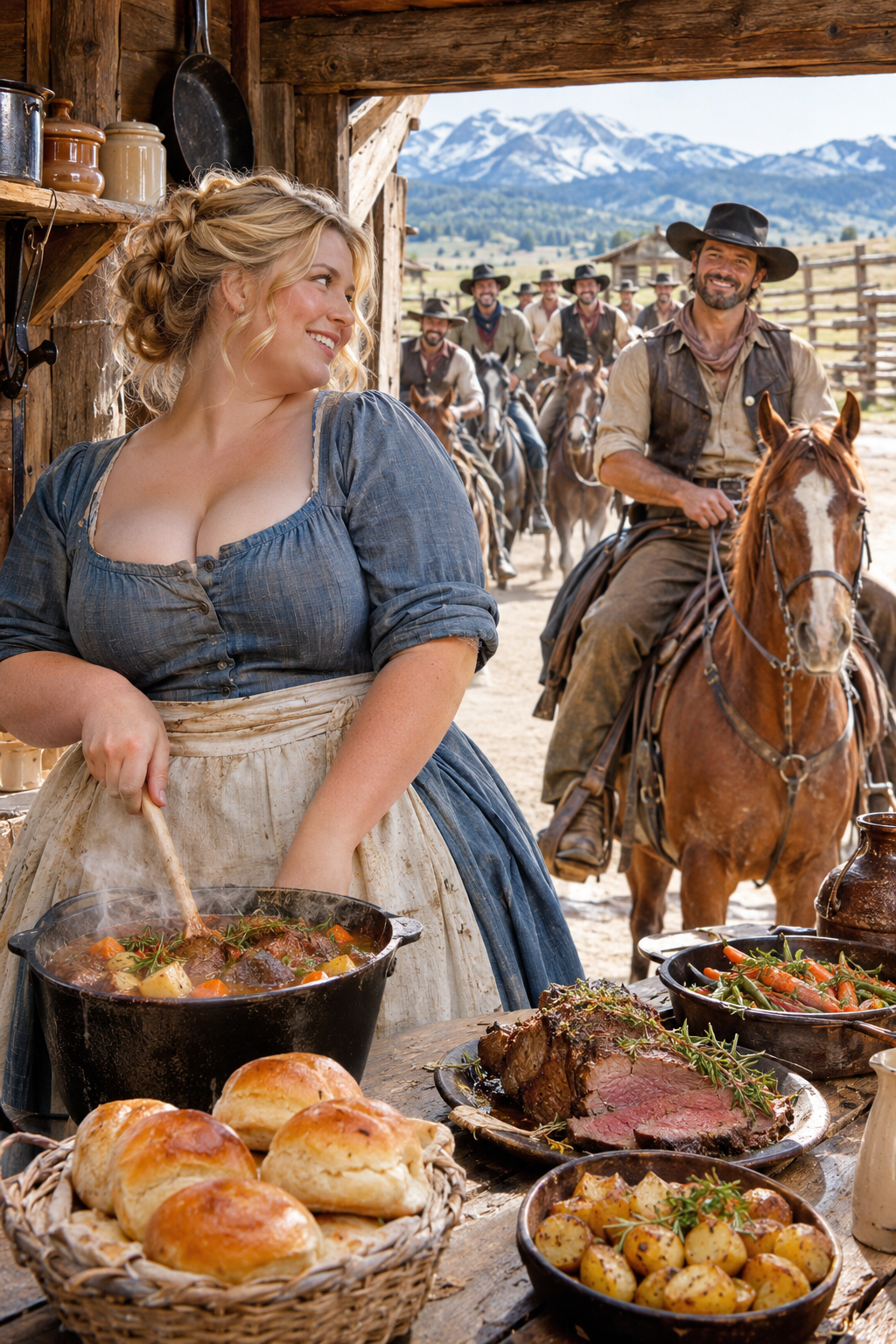
Inside, the stove was burning, bread was rising, and eleven men were arguing over who deserved the last slice of pie.
“No,” I answered.
“I think I’ve finally found where I’m supposed to be.”
Levi sat beside me.
“I don’t expect you to forget what I did.”
“I won’t.”
He nodded.
“But I can see that you’re trying to make it right.”
His eyes shone in the fading light.
“That’s more than I deserve.”
I shook my head.
“Maybe deserving isn’t the point, Levi, but what we choose to do after we’ve failed someone certainly is.”
For a long time, we watched the sunset without speaking.
The kitchen officially reopened the following Sunday.
We hung a new wooden sign above the entrance.
MORSE KITCHEN.
Beneath it, in smaller letters, I had the carpenter carve the words Samuel once believed.
“A warm meal can change a man’s mind.”
Ranch hands came from miles around.
Travelers stopped for bread and coffee.
Women from neighboring farms brought preserves, vegetables, and recipes passed down through generations.
I hired Billy’s widowed aunt to help with baking, and we began serving anyone who needed a meal, whether they could pay or not.
The business grew slowly, honestly, and with more laughter than I had ever known.
Levi repaired the old well and helped build a small garden behind the kitchen.
Sometimes he stayed after supper, washing dishes while I prepared dough for the next morning.
We spoke of ordinary things at first.
Rainfall, cattle prices, and the stubborn rooster that insisted on sleeping beside the back door.
Eventually, we spoke about grief.
He told me about the men he had lost and the mistakes he could never undo.
I told him about Mother, about the loneliness of her final winter, and how I sometimes still reached for a second cup when making tea.
He never tried to make my sorrow smaller.
He simply listened.
And slowly, the distance between us became something gentler.
One afternoon in September, a letter arrived from Eleanor.
The investigation into Samuel’s disappearance had uncovered an old freight manifest showing that a prisoner matching his description had been transported south toward the Mexican border.
The record did not establish his identity or what happened afterward.
But it gave me something I had almost stopped allowing myself.
Hope.
I carried the letter outside and found Levi repairing a fence.
He read it carefully.
Then he looked at me.
“Do you want to search for him?”
I considered the question.
For seventeen years, my family had lived beneath the shadow of a disappearance.
I could not bring Samuel home through wishing.
But I could honor him by refusing to let his story end in silence.
“Yes,” I said.
“Someday, when we know where to begin.”
Levi folded the letter and returned it.
“Then we’ll begin when you’re ready.”
That winter, snow fell across Raven Spur for the first time in years.
The men crowded into the kitchen, their coats hanging beside the stove.
Billy played a battered fiddle while Amos told stories nobody believed but everyone enjoyed.
I served beef stew, fresh bread, and apple pie made from fruit brought by a passing wagon.
When the last plates were cleared, I stepped outside into the cold.
The kitchen windows glowed behind me.
I thought about the frightened woman who had arrived months earlier, carrying a suitcase, a recipe notebook, and the belief that she was worth only the wages someone offered.
She had been dismissed, manipulated, and nearly driven away.
Yet she had discovered something no forged document could ever take from her.
Her work had value.
Her voice mattered.
And the truth belonged to her family, even when powerful men tried to bury it.
Levi joined me on the porch, carrying my shawl.
“You’ll catch cold.”
I smiled as he settled it around my shoulders.
“You’re beginning to sound like my mother.”
He laughed softly.
Then he looked toward the sign above the kitchen door.
“She would have been proud of you.”
I felt tears rise, but this time they came without the old bitterness.
“I hope so.”
He reached for my hand, slowly enough that I could have pulled away.
I didn’t.
We stood together while snow settled across the yard, and inside the kitchen, eleven cowboys began singing badly and enthusiastically.
For the first time in my life, the future did not feel like something I had to survive.
It felt like something I could build.
Months later, I received another letter concerning Samuel.
The investigators had located a man in southern Texas who remembered treating an injured traveler with Samuel’s name many years earlier.
The information was uncertain, but I placed it carefully inside Mother’s recipe notebook.
I did not know whether my uncle had lived long enough to see the world change.
I did not know whether the answers I wanted would ever come.
But I knew that if Samuel could have seen his kitchen that evening, filled with warmth and people who cared for one another, he would have recognized the dream he once built with his own hands.
And perhaps that was the part of him no one had ever managed to steal.
The following spring, I planted a young pecan tree beside the kitchen.
I buried a copy of Samuel’s photograph beneath its roots, wrapped carefully against the damp earth.
Levi helped me cover the hole.
Then I pressed the soil down with my hands.
“For Mother and Samuel,” I whispered.
Levi removed his hat.
“For the people who deserved better from us.”
I looked at the kitchen, the ranch, and the man beside me.
“Then let’s spend the rest of our lives doing better.”
And we did.
Because I learned that justice does not always arrive with thunder, and healing does not erase the wounds that came before it.
Sometimes justice begins with a frightened woman refusing to sign away what belongs to her.
Sometimes redemption begins with a guilty man finally telling the truth.
And sometimes the most powerful thing a person can do is open a door, light a stove, and remind eleven weary strangers that they are worthy of being cared for.
I came to Raven Spur believing I had been hired to clean an abandoned kitchen.
Instead, I uncovered my family’s stolen history, found the courage my mother had quietly carried, and discovered that a place becomes home not because someone gives it to you, but because you choose to fill it with love.
And every morning afterward, when I opened the kitchen door and smelled fresh bread rising in the warmth, I remembered the words Mother had spoken beside her dying fire.
“Never let another person decide what your work is worth.”
I never did again.
I believed the story of Raven Spur had finally reached its peaceful ending, but one October morning, a stranger arrived carrying the answer to the question that had haunted my family for seventeen years.
He was an elderly man with a weather-beaten face, a silver beard, and a limp that made every step look painful.
I was kneading bread when he appeared in the kitchen doorway, holding a battered leather satchel against his chest.
“Is this the Morse Kitchen?”
“Yes, sir, and you’re welcome to come inside.”
He studied my face for so long that I began to feel uncomfortable.
Then his eyes filled with tears.
“You have your mother’s eyes.”
My hands stopped moving.
“Did you know my mother?”
The stranger removed his hat.
“My name is Samuel Morse.”
For a moment, the entire world seemed to fall silent.
I stared at him, searching his face for the man in the faded photograph I had carried across Texas.
The years had changed him terribly, but beneath the scars and silver hair, I recognized the same gentle eyes.
“Uncle Samuel?”
He nodded, and the satchel slipped from his trembling fingers.
I crossed the kitchen before I realized I was moving.
When I wrapped my arms around him, he began crying with a grief so deep that I understood he had spent seventeen years believing this reunion would never happen.
We stood together beside the stove while the bread rose forgotten on the table.
When Levi arrived, he stopped in the doorway as though he had seen a ghost.
“Samuel?”
My uncle slowly released me.
For several seconds, the two men stared at each other.
Then Levi lowered his head.
“I betrayed you.”
Samuel’s expression changed, but he did not turn away.
“I know.”
Levi’s voice broke.
“I’ve spent seventeen years wishing I could undo what happened.”
Samuel studied the man who had once been his closest friend.
“You cannot change what you did, Levi, but Dela tells me you’ve spent this past year trying to make things right.”
Levi nodded, unable to speak.
Samuel stepped forward and placed a hand on his shoulder.
“Then don’t waste another seventeen years hating yourself when there are still good things left to do.”
It was not instant forgiveness, and neither man pretended it was.
But something old and painful finally began to loosen between them.
That evening, Samuel told us what had happened after his disappearance.
Calder’s hired men had taken him south, intending to force him to sign away his land.
When he refused, they abandoned him injured near a remote freight crossing.
A Mexican ranching family found him and saved his life, but a severe head injury left him unable to remember his name or where he belonged.
For years, he worked on their ranch, slowly recovering fragments of his past.
He remembered a stone kitchen, a crooked star, and a little girl laughing beside a flour-covered table.
Only recently had his memories returned clearly enough for him to begin searching.
A traveling merchant told him about a woman named Dela Morse who had reclaimed an old kitchen near Raven Spur.
Samuel knew then that he had to come home.
I listened until the candles burned low, holding his hand across the table.
Then I asked the question I had feared asking since he arrived.
“Did you ever know that Mother died?”
His face crumpled.
“No, sweetheart.”
I told him about her final winter, about the little house in Missouri, and how she had kept his photograph tucked inside her recipe notebook.
He wept quietly when I described her last words.
“She never stopped loving you,” I whispered.
Samuel pressed the photograph against his chest.
“And I never stopped trying to remember her.”
The following morning, we walked together to the young pecan tree beside the kitchen.
I showed him where I had buried a copy of his photograph, believing I might never know his fate.
He knelt beside the tree and touched its narrow trunk.
“Your mother always loved pecans,” he said softly.
I smiled through my tears.
“I know.”
He looked toward the kitchen, where Billy and Amos were already carrying fresh firewood inside.
“She would have loved this place.”
For the next several months, Samuel stayed at Raven Spur.
His strength returned slowly, and he found great pleasure in teaching the younger cowboys how to repair stonework and build sturdy ovens.
He and Levi spent long afternoons working together, sometimes talking, sometimes sharing the kind of silence that only old friends understand.
There were difficult conversations, too.
Samuel admitted that he still remembered the betrayal.
Levi never asked him to forget.
Instead, he listened, apologized when necessary, and continued showing through his actions that he had changed.
I watched them and learned that forgiveness was not the same as pretending nothing had happened.
It was a choice to stop allowing yesterday’s cruelty to decide every tomorrow.
By the following spring, the Morse Kitchen had become a gathering place for ranchers, travelers, widows, and children from miles around.
We added two long tables, built a larger bread oven, and opened a small room where stranded travelers could sleep safely.
Samuel insisted that a portion of every week’s earnings be set aside to feed families who had fallen on hard times.
“Nobody should have to earn the right to eat when they’re hungry,” he told me.
I agreed.
One Sunday evening, Levi asked me to walk with him beyond the pasture fence.
The sky glowed pink above the Texas plains, and the first stars were appearing over the distant hills.
He stopped beneath an old oak tree and took my hands.
“Dela, I spent most of my life believing a man’s worth was measured by the land he owned and the debts he could pay.”
I looked into his eyes.
“And now?”
“Now I know it’s measured by the people who can trust him when things go wrong.”
His voice trembled.
“I love you, Dela, and I want to spend whatever years I have left being worthy of the life we’ve built.”
He took a small silver ring from his pocket.
It was simple, with a tiny blue stone that reminded me of the Texas sky.
“Will you marry me?”
I thought about the first day we met, when he had thrown a rusty key into the dust and told me the kitchen would never open again.
Neither of us could have imagined where that key would lead.
I smiled.
“Yes, Levi.”
He laughed, then pulled me into his arms with such tenderness that I began crying.
We married that autumn beneath the pecan tree.
Samuel walked me down the aisle, his hand trembling slightly against mine.
Amos stood beside Levi, and Billy played his fiddle while the other ranch hands tried unsuccessfully to sing in tune.
There were no expensive decorations or grand speeches.
Only wildflowers, fresh bread, roasted beef, and a long table crowded with people who had become our family.
When Samuel raised his glass, everyone grew quiet.
“Seventeen years ago, I believed everything I built had been taken from me.”
He looked around the kitchen.
“But I was wrong.”
His eyes settled on me.
“A building can burn, land can be stolen, and good people can lose their way, but kindness has a remarkable way of surviving.”
He lifted his glass higher.
“To Dela, who brought this place back to life, and to everyone who helped her keep its doors open.”
The room erupted in applause.
I looked at Levi, then at Samuel, and finally at the eleven cowboys who had once sat hungry around an abandoned stove.
I realized that the greatest thing I had recovered was not the forty acres or the kitchen itself.
It was the chance to build a family from people who had once been separated by fear, grief, and mistakes.
Years passed, and Raven Spur continued to grow.
Samuel lived long enough to see the pecan tree spread its branches across the kitchen yard.
Levi and I welcomed two children, a daughter named Margaret after my mother and a son named Samuel after the uncle who had finally found his way home.
Our children grew up surrounded by the smell of baking bread and the sound of travelers sharing stories around the table.
Whenever someone asked why we fed strangers who couldn’t pay, I told them about a young cowboy who once cried over a piece of cornbread because it reminded him of his mother.
I told them that hunger was not always something a meal could cure.
Sometimes people were hungry for kindness, forgiveness, dignity, or simply a place where someone remembered their name.
One evening, many years later, my daughter found the old rusty kitchen key inside my recipe notebook.
“Why do you keep this, Mama?”
I took it from her and turned it over in my palm.
The iron had darkened with age, and its edges were worn smooth.
“Because this key taught me something important.”
She climbed into my lap.
“What did it teach you?”
I looked toward the kitchen, where Levi was helping our son carry fresh bread to the tables.
“It taught me that sometimes the door someone closes in your face is the very door you’re meant to open.”
She considered that for a moment.
“Even when they’re mean to you?”
I smiled.
“Especially then, sweetheart, because another person’s cruelty doesn’t decide what kind of person you become.”
I placed the key in her small hand.
“Remember that you never have to become cruel to prove that you’re strong.”
Outside, the evening wind moved gently through the pecan branches.
Inside, the kitchen glowed with warmth and laughter.
I thought of my mother, who had died believing her brother was lost forever.
I thought of Samuel, who had survived years of loneliness without knowing that someone still remembered him.
And I thought of Levi, who had learned that redemption required more than regret.
It required courage, honesty, and the willingness to repair what could still be repaired.
I had arrived at Raven Spur with nothing but a suitcase, a few recipes, and a heart still aching from grief.
I had been dismissed as an unwanted burden and manipulated by men who believed a poor woman’s labor could be used without her understanding.
Yet the very work they underestimated had given me the strength to uncover their deception.
In the end, the kitchen became more than a business, and the ranch became more than land.
They became proof that the things we build with love can outlast the harm others try to do.
And whenever I stood beside the stove at sunrise, watching the first golden light fall across the tables, I remembered the promise I had made to myself on that frightening first night.
I would never allow anyone else to decide what my work, my kindness, or my life was worth.
Because the greatest inheritance my mother left me was not a deed, a hidden ledger, or forty acres of Texas soil.
It was the courage to stand upright when someone tried to make me feel small, and the wisdom to know that a heart strong enough to demand justice could still remain gentle enough to offer forgiveness.
And that was the legacy I passed on to my children.
Not wealth.
Not revenge.
But a home where the door was always open, the bread was always warm, and nobody was ever made to feel unwanted.
THE END.