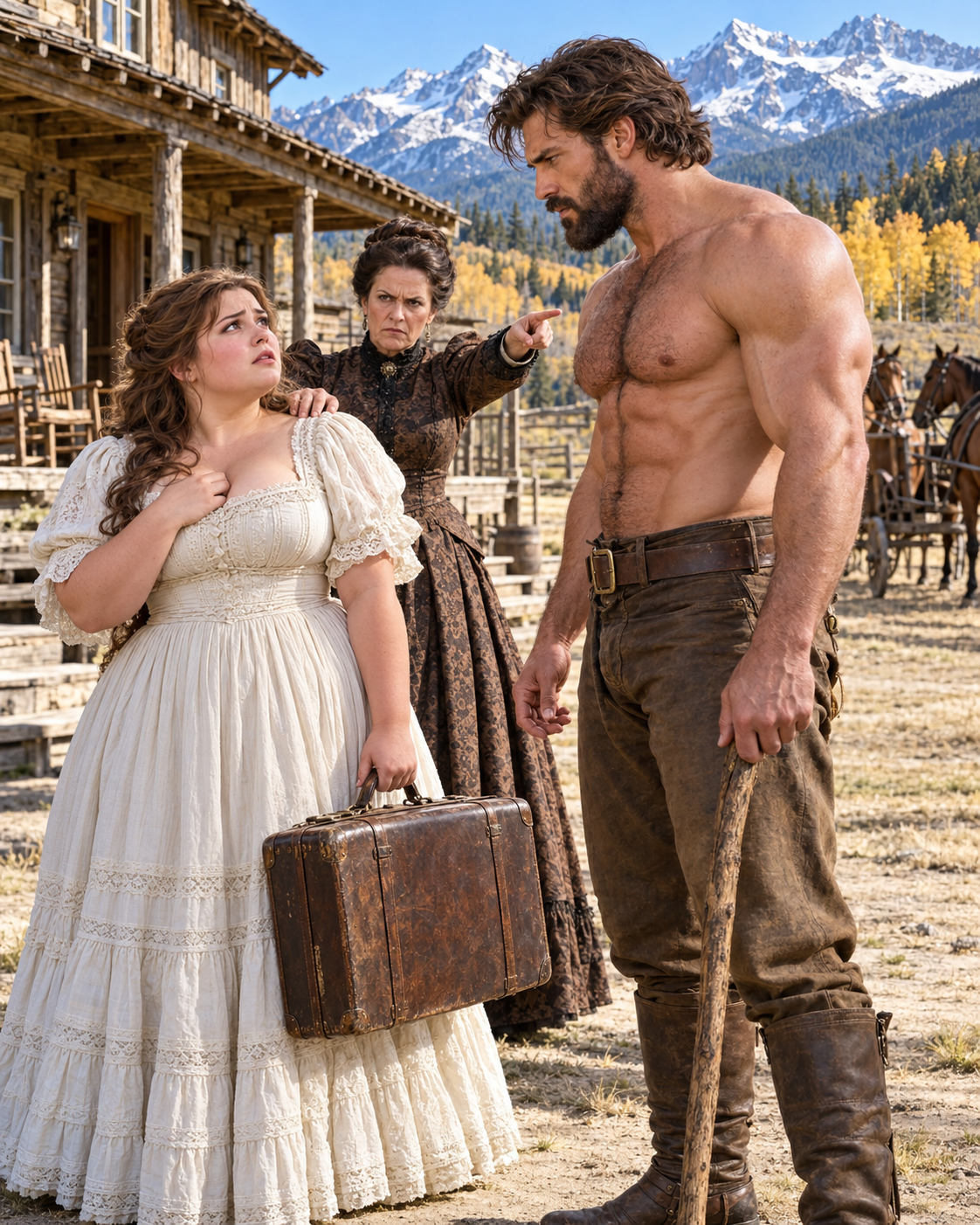
The preacher stood in Henry Cole’s Montana barn, watching my groom refuse me like damaged goods, until one forged letter exposed my stepmother’s cruel betrayal.
The woman standing beside Margaret was the same smiling woman from the photograph behind Henry’s clock.
Elizabeth Cole was alive.
I stared at the photograph until the edges trembled between my fingers, unable to understand how a dead woman could be standing beside my stepmother.
Henry took one look at the picture and staggered backward.
“That’s impossible,” he whispered.
The deputy watched him carefully, his hand resting near the revolver at his waist.
“Mr. Cole, I suggest you sit down.”
But Henry didn’t move.
His eyes remained fixed on the woman’s face, and for the first time since I’d arrived at his ranch, I saw genuine terror in them.
“I buried my wife,” he said.
His voice sounded like something breaking.
“I carried her coffin myself.”
The deputy placed his hat on the table.
“Then someone owes you an explanation.”
I looked between them, feeling as though the walls of the little farmhouse were closing around me.
“Where was this photograph taken?”
“Outside the courthouse in Helena, yesterday afternoon.”
“And you’re certain it’s Elizabeth?”
The deputy hesitated.
“That’s what the woman claims.”
Henry suddenly reached for his coat.
“I’m going to Helena.”
“You won’t make it through the pass tonight,” the deputy warned.
Henry ignored him.
I stepped in front of the door before he could leave.
“Henry, look at me.”
He stopped, breathing heavily.
“If she’s alive, why would she let you believe she was dead?”
The question seemed to wound him more deeply than anything else.
“I don’t know, Hannah.”
For a long moment, neither of us spoke.
Then the deputy unfolded another paper.
“There’s something about that photograph you should understand.”
He pointed toward a small mark above the woman’s eyebrow.
“Does your wife have this scar?”
Henry leaned closer.
His expression changed.
“No.”
The deputy nodded slowly.
“That’s what I thought.”
He reached into his satchel and removed a second photograph, older and faded around the corners.
Two young women stood beside a white farmhouse, smiling beneath the summer sun.
They looked almost identical.
Henry gripped the table.
“Elizabeth never told me she had a sister.”
The deputy tapped the second woman’s face.
“Her name is Evelyn Mercer.”
I studied the photograph, recognizing the same scar above her eyebrow.
“Then Evelyn is pretending to be Elizabeth?”
“That’s what I intend to find out.”
Henry sank into a chair, covering his face with both hands.
I wanted to comfort him, but I was still trying to understand why Margaret had become involved with his wife’s family.
The deputy cleared his throat.
“My name is Samuel Brooks, and I didn’t come all this way simply to deliver bad news.”
He looked directly at me.
“Miss Parker, I believe your father’s death was no accident.”
The room fell silent.
I remembered the morning Father died, the doctor standing beside his bed, and Margaret crying into a handkerchief that never seemed to grow wet.
“He was sick,” I whispered.
“That’s what I was told.”
Brooks shook his head.
“Your father had been investigating stolen inheritance funds, forged land deeds, and several marriages arranged under false identities.”
My stomach tightened.
“Marriages?”
“Young women with money were married to men who either didn’t exist or didn’t know about the ceremonies.”
I looked down at the fraudulent certificate bearing Henry’s name.
The truth began arranging itself into something horrifying.
“Margaret used me because Father left me money.”
“Yes,” Brooks replied.
“And the moment that certificate was recorded, someone began trying to withdraw your inheritance.”
Henry stood again.
“Who?”
Brooks met his eyes.
“That’s why we need to speak with Evelyn Mercer.”
Outside, the storm grew stronger, burying the ranch beneath another curtain of snow.
The deputy agreed to remain until morning.
That night, sleep refused to come.
I sat beside the bedroom window, watching the moon disappear behind the mountains.
My father’s final weeks returned to me in fragments.
His locked study.
His sudden headaches.
The way Margaret insisted on preparing his evening tea.
And one memory I’d spent months trying to forget.
Three nights before he died, Father had entered my bedroom carrying a small wooden box.
“If anything happens to me, Hannah, remember that your mother wanted you to have a life of your own.”
I’d laughed nervously and told him not to speak so strangely.
He’d kissed my forehead.
Then he’d whispered something I hadn’t understood.
“Never sign away what you cannot replace.”
I had thought he meant the family home.
Now I wasn’t so sure.
A quiet knock interrupted my thoughts.
Henry stood in the doorway, holding a cup of warm milk.
“I saw your light.”
I accepted the cup, noticing his hands were trembling.
“Do you think Elizabeth knew about my father?”
He leaned against the doorframe.
“I think she knew something dangerous.”
“Did you love her?”
The question escaped before I could stop it.
Henry looked toward the dark window.
“With everything I had.”
I lowered my eyes.
“And if she were alive?”
He was silent for a long time.
“Then I’d have to ask why she left me.”
I nodded, even though the answer hurt in a way I had no right to feel.
Henry noticed.
He stepped closer, then stopped himself.
“Hannah, whatever happens in Helena, you haven’t done anything wrong.”
I looked at him.
“Sometimes I wonder if anyone would have cared where I went if I’d never reached this ranch.”
His face tightened.
“I would have.”
Those three words stayed with me long after he left.
By morning, the snowfall had eased enough for the deputy to attempt the mountain road.
Henry harnessed the horses while I packed bread, blankets, and a small bag of clothing.
When he saw my belongings, he frowned.
“You’re staying here.”
“No.”
“Hannah, it could be dangerous.”
“Someone stole my father’s money, forged my marriage, and possibly murdered him.”
I tightened the straps of my bag.
“I’m finished letting other people decide where I belong.”
For a moment, I expected him to argue.
Instead, he opened the wagon door.
“Then you’d better sit beside me.”
We traveled through a world buried in white.
The horses struggled against icy wind, and the wheels sank repeatedly into deep snow.
Near a narrow mountain crossing, Henry suddenly pulled the reins.
Ahead of us, a fallen tree blocked the road.
Brooks climbed down to inspect it.
“That tree didn’t fall naturally.”
Before Henry could respond, a gunshot cracked through the mountains.
The horses reared.
I screamed as splinters exploded from the wagon’s wooden frame.
Henry threw himself over me.
“Get down!”
Another shot struck the wheel.
Brooks drew his revolver and fired toward the rocky hillside.
I saw a dark figure disappear between the pines.
“Stay behind the wagon!” Brooks shouted.
Henry pulled me into the snow as the horses fought against their harnesses.
For several terrifying seconds, gunfire echoed through the valley.
Then everything stopped.
Brooks moved toward the trees, keeping his revolver raised.
When he returned, his expression was grim.
“Whoever it was knew we’d be traveling this road.”
My hands were numb.
“Margaret?”
“Possibly.”
Henry examined the damaged wheel.
“They weren’t trying to rob us.”
Brooks nodded.
“They were trying to prevent us from reaching Helena.”
I looked toward the mountains, suddenly certain that the people responsible for Father’s death knew exactly where I was.
We managed to move the fallen tree and repair the wheel enough to continue.
By late afternoon, the rooftops of Helena appeared beneath a smoky winter sky.
Brooks took us directly to the sheriff’s office.
Inside, a clerk confirmed that the fraudulent marriage certificate had been filed using documents supposedly witnessed in my hometown.
He also revealed something even worse.
A request to transfer my inheritance had been submitted two days earlier.
The amount was twenty-eight thousand dollars.
I stared at the figure.
Father had spent years working to provide for me, and Margaret had convinced me he’d left nothing.
“Where is the money now?” I asked.
“Still in trust,” the clerk explained.
“The transfer was delayed because the signature on your father’s final instructions didn’t match his earlier records.”
Brooks exchanged a look with Henry.
“Someone at the courthouse noticed the forgery.”
Then the clerk lowered his voice.
“And yesterday evening, that same employee disappeared.”
A cold sensation crawled across my skin.
“Who was he?”
“Thomas Reed, the deputy registrar.”
Brooks cursed quietly.
He turned to the sheriff.
“We need to locate Evelyn Mercer immediately.”
The sheriff opened a desk drawer and placed a folded telegram before us.
His expression told me something had already gone wrong.
“She left Helena this morning.”
“Where?”
The sheriff hesitated.
“According to the hotel register, she was traveling with a woman named Margaret Parker.”
I felt Henry’s hand settle gently against my back.
It was the only thing keeping me steady.
That evening, Brooks arranged rooms for us at a boardinghouse near the courthouse.
Henry barely touched his supper.
I watched him across the table, thinking about the woman he’d buried and the sister he’d never known existed.
“Why didn’t Elizabeth tell you about Evelyn?”
He ran a hand through his hair.
“She said her childhood was complicated.”
“Did she ever mention her family?”
“Only once.”
He looked at me.
“She told me some people would rather bury the truth than admit what they’d done.”
I thought about Father’s final words.
Perhaps both of them had discovered pieces of the same terrible secret.
After dinner, I returned to my room and opened the small traveling trunk Margaret had packed for me.
Beneath my dresses lay Mother’s old Bible.
I’d carried it across three states without opening it.
Now, remembering Father’s wooden box, I turned its brittle pages.
A folded piece of paper slipped from the Book of Proverbs.
It was a letter.
And I recognized my father’s handwriting immediately.
My dearest Hannah,
If you are reading this, then I have failed to protect you in person.
But I pray the truth will protect you now.
I covered my mouth as tears blurred the words.
Father explained that he’d discovered Margaret was working with a man named Charles Mercer, a former bank officer accused of stealing from vulnerable families.
Mercer had used false marriage records and forged wills to gain control of estates.
When Father confronted Margaret, she threatened to accuse him of financial crimes unless he remained silent.
He’d begun gathering evidence.
Then came the sentence that made my blood run cold.
Elizabeth Cole helped me obtain the records, but her life is now in danger.
If anything happens to either of us, seek the truth in the old silver mine north of Helena.
I read the letter twice before running down the hallway.
Henry opened his door, startled by my pale face.
“What’s wrong?”
I pushed the letter into his hands.
As he read, his expression changed from confusion to disbelief.
“Elizabeth was helping your father.”
“And someone wanted them both dead.”
His eyes stopped on the final line.
“The old silver mine.”
He looked up sharply.
“I know that place.”
Before I could speak, footsteps sounded downstairs.
A man’s voice demanded to see Henry Cole.
Henry folded the letter and slipped it inside his coat.
“Stay here.”
But I followed him.
In the boardinghouse entrance stood a thin woman wearing a dark wool coat.
Her face was almost identical to Elizabeth’s.
A small white scar marked her eyebrow.
Evelyn Mercer.
Henry stopped on the staircase.
The woman looked at him, and tears immediately filled her eyes.
“Henry, I’m sorry.”
He descended slowly.
“You have five seconds to tell me why you’re using my dead wife’s name.”
Evelyn flinched.
“Because Margaret said she’d kill my daughter if I didn’t.”
The words silenced everyone.
She gripped the banister as though she could barely remain standing.
“My husband, Charles, forced Elizabeth to help him falsify estate documents years ago.”
Henry stared at her.
“Elizabeth told me she’d worked as a bookkeeper.”
“She did.”
Evelyn swallowed.
“But when she realized what Charles was doing, she began collecting evidence against him.”
“Why didn’t she tell me?”
“She was trying to protect you.”
Henry’s voice broke.
“She’s dead, Evelyn.”
“I know.”
Evelyn began crying.
“And I know who killed her.”
Before she could say another word, glass shattered behind us.
A bullet tore through the boardinghouse window.
Henry grabbed Evelyn and pulled her to the floor.
I dropped beside them as another shot struck the wall.
Someone outside screamed.
Brooks rushed through the doorway with his revolver drawn.
“Everybody down!”
A moment later, footsteps thundered away into the street.
When the danger passed, Evelyn was shaking uncontrollably.
“They found me.”
Brooks knelt beside her.
“Who?”
She looked straight at me.
“Your stepmother and my husband.”
I felt a terrible pressure build inside my chest.
“Tell us what happened to Elizabeth.”
Evelyn wiped her eyes.
“Elizabeth discovered Charles had forged a will worth nearly thirty thousand dollars.”
“My father’s inheritance,” I whispered.
She nodded.
“She planned to meet your father and give him the original documents.”
Henry’s face hardened.
“But she never reached him.”
“No.”
Evelyn looked away.
“Charles intercepted her near the mountain road.”
For a moment, she couldn’t continue.
Then she whispered the words that shattered Henry’s world.
“He pushed her into the ravine.”
Henry stepped backward, his expression empty.
I reached for his hand.
This time, he held mine.
“Did Margaret know?” I asked.
Evelyn nodded.
“She helped arrange the meeting.”
The silence afterward felt unbearable.
I had spent years believing Margaret was simply cruel.
Now I understood that her cruelty had been hiding something monstrous.
Brooks brought Evelyn to the sheriff’s office under guard.
There, she told us that Charles had moved the stolen records to an abandoned silver mine.
He planned to destroy them before leaving Montana.
But Evelyn believed one ledger remained hidden.
“Elizabeth copied everything,” she explained.
“She told me she kept proof somewhere Charles would never think to search.”
Henry suddenly looked at me.
“The clock.”
I frowned.
“What clock?”
“The one in my kitchen.”
He swallowed.
“Elizabeth always said it was the only thing in the house she couldn’t bear to lose.”
I remembered finding her photograph tucked behind it.
Perhaps that hadn’t been an accident.
We left Helena before dawn with Brooks and two trusted deputies.
The journey back felt longer than our escape from the mountains.
Henry said almost nothing.
But whenever the wagon jolted over frozen ground, his hand reached instinctively to steady me.
By afternoon, we reached the ranch.
The kitchen looked exactly as we’d left it.
The fire was cold.
A thin layer of frost covered the windows.
Henry lifted the clock from the wall and carried it to the table.
Behind the wooden panel, carefully wrapped in oilcloth, lay a small leather notebook.
Inside were names, dates, payments, and forged marriage records.
My father’s name appeared on the final pages.
So did Margaret’s.
And beside hers stood Charles Mercer’s signature.
Brooks studied the entries.
“This could put them away for the rest of their lives.”
I should have felt relieved.
Instead, I was frightened.
Because the notebook also contained a map of the old silver mine.
One location had been circled in red.
Beneath it, Elizabeth had written four words.
The original deeds are here.
Brooks wanted to take the evidence directly to the sheriff.
But when one of the deputies returned from checking the stable, his face was pale.
“Our horses are gone.”
Henry rushed outside.
The harnesses had been cut, and fresh tracks led toward the northern ridge.
Then we smelled smoke.
The barn was burning.
Flames climbed the wooden walls as the animals cried in terror.
Henry ran toward them without hesitation.
I followed, grabbing a blanket from the porch.
Together, we forced open the stable doors and led the frightened animals into the snow.
The little calf we’d saved weeks earlier stumbled beside its mother.
I wrapped my arms around its neck and pulled it away from the heat.
Then I heard Henry shout.
“Hannah, get back!”
A burning beam crashed between us.
Smoke swallowed the doorway.
For one awful moment, I couldn’t see him.
“Henry!”
I heard coughing, then the sound of breaking wood.
He emerged carrying the last frightened foal, his coat smoldering at the shoulder.
I ran to him as he collapsed into the snow.
He was alive.
But his right arm had been badly burned.
While Brooks examined the fire, I helped Henry inside.
My hands shook as I cleaned the wound.
“You could have died.”
He looked at me quietly.
“So could you.”
“Don’t do that again.”
A faint smile touched his lips.
“I’ll try.”
I tied the bandage with more force than necessary.
Then the tears I’d been holding back finally escaped.
Henry caught my wrist gently.
“Hannah.”
I couldn’t look at him.
“I can’t lose another person who matters to me.”
His hand tightened around mine.
“You matter to me too.”
For one breath, the world became still.
Then Brooks entered carrying a burned scrap of cloth.
“Charles Mercer was here.”
Henry stood despite his injured arm.
“Where did he go?”
“North.”
Brooks looked at the notebook.
“Toward the mine.”
Before sunrise, we followed the tracks using the horses that had escaped into the nearby pasture.
The burned barn stood behind us like a blackened skeleton.
I knew Henry was hurting, but he refused to remain at the ranch.
The old silver mine lay hidden between steep cliffs, its entrance almost buried beneath snow.
We approached quietly.
Inside, a lantern flickered against the stone walls.
Then I heard a familiar voice.
“You should have stayed in that miserable little house.”
Margaret stepped from the darkness holding a revolver.
For the first time in my life, I saw her without the mask of a respectable widow.
Her expression was cold and strangely satisfied.
“Hello, Hannah.”
I felt Henry move beside me.
Margaret raised the gun.
“Don’t.”
Brooks stepped forward.
“Put the weapon down, Mrs. Parker.”
She laughed bitterly.
“Do you really think I’d come here alone?”
Charles Mercer emerged behind her.
He was a broad-shouldered man with tired eyes and a pistol in his hand.
Beside him stood Thomas Reed, the missing courthouse registrar, his wrists bound with rope.
I realized immediately that he’d been taken prisoner.
Charles pointed his gun toward Brooks.
“Drop your weapons.”
With Margaret’s revolver trained on me, the deputies had no choice.
Charles ordered everyone against the mine wall.
Then he looked at me.
“You have your father’s eyes.”
I wanted to scream at him.
Instead, I forced myself to speak.
“Did you kill him?”
Charles smiled without warmth.
“Your father was a stubborn man.”
Margaret’s expression flickered.
“Charles, don’t.”
“He wouldn’t stop asking questions.”
I looked at her.
“You poisoned him.”
She said nothing.
And her silence was the confession I’d feared.
I remembered every cup of tea she’d carried to his bedside.
Every time she’d insisted that I leave him alone.
My voice trembled.
“He trusted you.”
Margaret’s face hardened.
“Your father would have ruined everything.”
“He loved you.”
“He loved your mother,” she snapped.
The words seemed to surprise even her.
“He kept that woman’s portrait in the hallway and spoke of her as though I could never compare.”
Tears burned behind my eyes.
“So you punished him for remembering someone he loved?”
Margaret looked away.
For one brief moment, I saw the bitter, lonely woman beneath her cruelty.
But whatever sympathy I might have felt disappeared when she raised her revolver again.
“Give me the notebook.”
Henry stepped forward.
“Leave Hannah out of this.”
Charles laughed.
“You’ve already lost one wife, Cole.”
Henry went perfectly still.
Charles leaned closer.
“Elizabeth begged me to spare you before she died.”
I felt Henry’s body tense beside mine.
“She begged you?”
“She said you were a good man.”
Charles smiled.
“A foolish woman until the very end.”
Henry lunged.
The gun discharged.
The sound exploded through the mine.
I screamed as Henry struck Charles and sent them both crashing against the stone wall.
Brooks seized Margaret’s wrist.
Another shot shattered the lantern.
Darkness swallowed us.
I dropped to my knees, feeling blindly across the cold ground.
“Henry!”
Someone groaned.
Then I heard stones falling from the ceiling.
The gunfire had loosened the old timber supports.
A terrible cracking sound echoed through the tunnels.
“Everyone out!” Brooks shouted.
I found Henry against the wall, clutching his wounded shoulder.
Blood darkened his coat.
He had been shot.
I slipped beneath his good arm.
“Lean on me.”
“Hannah, go.”
“Not without you.”
We stumbled toward the pale light of the entrance.
Behind us, Charles tried to escape through a narrow side passage.
Margaret followed him, screaming that he couldn’t leave her.
Then the ceiling collapsed.
A cloud of dust rolled through the tunnel.
I fell forward into the snow, dragging Henry with me.
For several seconds, I couldn’t breathe.
When I finally lifted my head, Brooks was pulling Reed from the mine.
One deputy had escaped with a fractured wrist.
The others were alive.
But Margaret and Charles were trapped inside.
We heard Charles shouting for help.
Brooks immediately ordered the deputies to retrieve ropes and tools.
Henry lay against a snowbank, his face frighteningly pale.
I pressed my hands against his wound.
“Stay with me.”
His eyes opened slightly.
“I’m here.”
“You promised you’d try not to die.”
Despite everything, he gave a faint, painful smile.
“I remember.”
The rescue took nearly an hour.
Charles was dragged out unconscious, his leg crushed beneath fallen timber.
Margaret emerged moments later, coughing and trembling.
Her face was streaked with dirt.
When she saw me kneeling beside Henry, something changed in her expression.
For once, she looked small.
“Hannah.”
I turned toward her.
She stretched out a shaking hand.
“Please.”
I stared at the woman who had stolen my childhood, betrayed my father, and tried to sell my future.
There were a thousand things I wanted to say.
Instead, I answered quietly.
“I hope you live long enough to understand what you’ve done.”
Brooks placed her under arrest.
The authorities found the original deeds and stolen records in a locked iron chest inside the mine.
Thomas Reed later testified that Charles had kidnapped him after he questioned the forged marriage certificate.
Evelyn provided letters linking Charles and Margaret to Elizabeth’s death.
And the doctors who reviewed Father’s final illness found evidence consistent with deliberate poisoning.
The investigation lasted through the rest of winter.
Charles and Margaret were eventually convicted of their crimes.
The forged marriage was declared invalid, and my inheritance was restored.
But none of that brought Father back.
Nor did it erase the years when I’d believed I was unwanted.
Henry survived the gunshot.
For several weeks, I sat beside his bed, changing bandages and reading aloud when his fever made sleep difficult.
Sometimes he woke calling Elizabeth’s name.
I never held it against him.
Grief doesn’t disappear simply because another person enters your life.
One evening, as spring sunlight melted the last snow from the windowsills, Henry asked me to bring him the photograph of Elizabeth.
I found it in the kitchen drawer.
He held it for a long time.
Then he placed it on the bedside table.
“I think she’d have liked you.”
I swallowed.
“I wish I’d known her.”
He looked toward the mountains.
“She believed everyone deserved a chance to choose their own life.”
I smiled sadly.
“So did my father.”
Henry reached for my hand.
“Then perhaps we should listen to them.”
By April, the mountain roads had reopened.
The first wildflowers appeared along the fence, and the rescued calf had grown strong enough to race across the pasture.
My inheritance meant I could return east, buy a house, or begin an entirely different life.
For the first time, no one could force me to stay anywhere.
I packed my trunk anyway.
Henry watched from the bedroom doorway.
“You’re leaving?”
“I’m going to town.”
He nodded slowly.
“To arrange the bank transfer?”
“To purchase something.”
He looked confused, but he didn’t ask.
When I returned that afternoon, I carried a folded deed.
I placed it on the kitchen table.
Henry opened it carefully.
The neighboring meadow and its small abandoned cottage now belonged to me.
“I thought you might want a place of your own,” he said.
“I do.”
His smile faded slightly.
I took his hand.
“But I also wanted somewhere I could choose to come home from.”
Henry looked at me for a long moment.
Then he understood.
That summer, we repaired the cottage together.
We painted its walls, planted apple trees, and built shelves for the books Father had left me.
I kept my mother’s Bible on the mantel.
And in the little front room, I placed a framed photograph of Father beside one of Elizabeth.
Neither of them had survived the cruelty that brought Henry and me together.
But both had left us something greater than money.
The courage to tell the truth.
On a warm September evening, Henry found me beneath the apple trees.
He carried a small wooden box.
My breath caught when he opened it.
Inside lay a simple gold ring.
It wasn’t Elizabeth’s.
He’d had it made especially for me.
“Hannah Parker,” he said softly, “the first time you came to this ranch, someone else had already decided your future.”
Tears gathered in my eyes.
“I remember.”
“I won’t ever do that to you.”
He lowered himself onto one knee.
“So I’m asking, with no preacher waiting, no papers signed, and no one telling you what you owe.”
His voice trembled.
“Would you choose to marry me?”
I looked at the man who had given me shelter without demanding gratitude, kindness without expecting obedience, and love without trying to possess me.
Then I looked toward the little cottage, its windows glowing in the sunset.
I had arrived in Montana believing marriage was something that happened to women like me.
Something arranged, endured, and survived.
But standing beneath those apple trees, I finally understood the difference between being claimed and being loved.
I knelt beside Henry and took his face between my hands.
“Yes,” I whispered.
“But only because I know I can say no.”
He laughed through his tears.
“That’s exactly why I asked.”
We married that autumn in the meadow between our two homes.
Reverend Thompson returned to perform the ceremony he had once been forced to abandon.
Evelyn attended with her little daughter, who scattered wildflowers along the grass.
Deputy Brooks stood beside Henry.
And when the preacher asked whether I took this man freely, I answered without hesitation.
“I do.”
That evening, Henry and I stood together watching the last light fade over the Montana mountains.
He slipped his hand into mine.
“Do you ever wish none of it had happened?”
I thought about Father, Elizabeth, and the terrible road that had brought us here.
“Every day, I wish they were still alive.”
My voice softened.
“But I don’t wish away the life we’ve chosen to build.”
Henry kissed my forehead.
And as the first autumn stars appeared, I finally felt something I’d searched for since childhood.
Home.
Years later, when our daughter asked how her father and I had fallen in love, Henry smiled and said I had arrived in the mountains as a stranger who refused to be defeated by winter.
I told her the truth was much simpler.
Her father had opened his door when the world had closed every other one.
And when spring finally came, he opened that door again so I could leave if I wished.
I stayed because he never tried to lock it.
My father once told me never to sign away what I couldn’t replace.
It took betrayal, heartbreak, and a journey through the Montana mountains to understand what he meant.
Money could be recovered.
A house could be rebuilt.
Even a broken heart could learn to love again.
But the right to choose your own future was worth more than any inheritance.
And sometimes, the deepest love isn’t found in someone who promises never to let you go.
It’s found in someone who gives you the freedom to leave and makes you feel safe enough to stay.
THE END.