The owner of the Blackbird Hotel threw my suitcase onto Dry Creek’s muddy sidewalk, smiled at the watching guests, and concealed the lie that could get me killed.
For twenty-nine years, I had imagined what it would feel like to hear someone call me their daughter, but standing in Benjamin Hail’s office with a gunshot echoing across the ranch, I felt nothing but terror.
Outside, Midnight’s furious cries tore through the afternoon air, followed by the frantic pounding of hooves against the frozen ground.
Benjamin still held my mother’s letter, his gray eyes fixed on mine as though he feared I might disappear if he looked away.
“Hannah, I think you’re my daughter, and whoever threatened your mother has just discovered you’re here.”
I wanted to ask him a hundred questions, but another shout came from the stable.
“Mr. Hail! The north gate’s open!”
Benjamin shoved the letter into his coat and hurried toward the door.
“Stay inside, Hannah.”
I followed him anyway.
The ranch yard had erupted into confusion, with cowboys running toward the pasture while Amos struggled to calm two frightened horses.
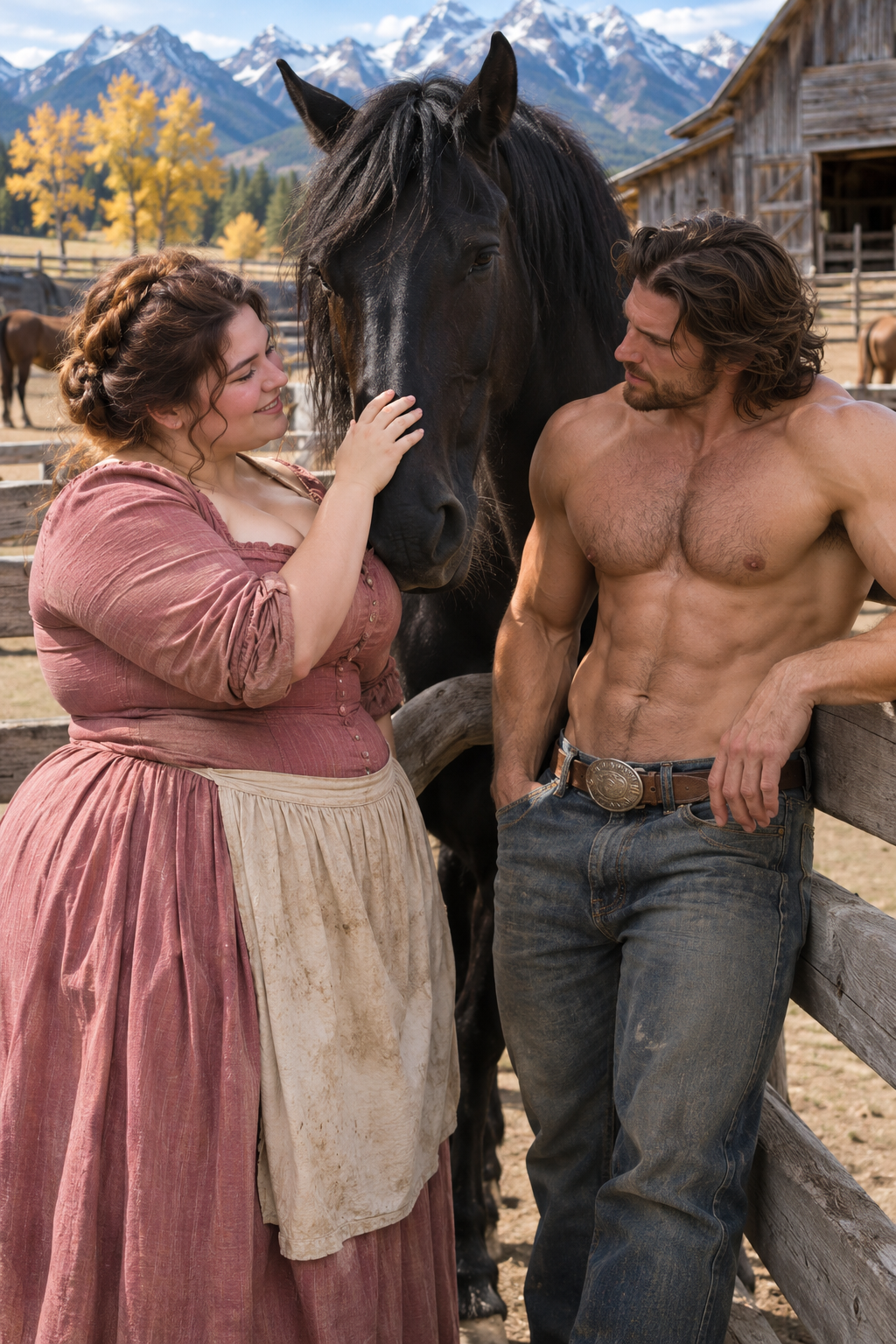
Beyond the broken gate, Midnight was galloping toward the distant tree line, his black coat shining beneath the approaching storm.
A rider on a chestnut horse disappeared between the pines ahead of him.
“Who was that?” Benjamin demanded.
Amos shook his head.
“Couldn’t see his face, but somebody fired a shot into the air before opening the gate.”
Benjamin’s expression changed.
He looked toward the road leading to Dry Creek, then back at the accounting records visible through his office window.
I recognized that look.
It was the same expression my mother had worn whenever someone knocked unexpectedly on our door.
Fear disguised as anger.
“We need the sheriff,” I whispered.
Benjamin nodded, but his attention remained fixed on Midnight.
“That horse won’t survive the northern ravine if the storm comes in.”
I watched the black gelding vanish into the trees, and an unexpected ache tightened my chest.
For seven days, Midnight had been the one creature on the ranch who never judged me for arriving with nothing.
He had listened when I read aloud, and somehow his silence had made me feel less alone.
Now he was running straight toward danger.
“I can help find him,” I said.
Benjamin turned sharply.
“Absolutely not.”
“But he knows my voice.”
“And the man who opened that gate may still be out there.”
His words stopped me.
For the first time, I understood that Midnight’s escape might not have been an accident or a cruel prank.
Someone had deliberately created a distraction.
Someone who knew Benjamin would do almost anything to save that horse.
Benjamin sent Amos and two ranch hands toward the ravine while another rider hurried to Dry Creek for Sheriff Daniel Mercer.
Then he brought me back inside and locked the office door.
The silence between us felt heavier than the approaching thunder.
I stood beside the desk, staring at the photograph of my mother holding a newborn baby.
“Tell me the truth,” I said.
Benjamin lowered himself into his chair.
“I don’t know all of it.”
“Then tell me what you do know.”
He looked at the photograph for a long time before speaking.
“Your mother came to Hail Ridge when she was nineteen, looking for work after her father died.”
His voice softened.
“She was clever, stubborn, and the kindest person I’d ever met.”
I swallowed.
“She never told me about you.”
“I know.”
Benjamin explained that Elizabeth had worked in the ranch office, keeping the accounts and helping his aging father manage the property.
They had fallen in love during a summer filled with long evenings, cattle drives, and promises neither understood how easily life could destroy.
He had intended to marry her.
But one morning, Elizabeth disappeared.
She left a short note saying she had accepted another position and wanted no further contact.
Benjamin searched for her for months.
Eventually, he learned she had married Thomas Pierce, a traveling merchant who later settled in Dry Creek.
“I thought she’d chosen another life,” Benjamin said.
His hands tightened around the photograph.
“I was angry enough to believe it.”
I remembered my mother sitting beside our kitchen window, sewing dresses for women who rarely bothered to learn her name.
She had worked until her fingers swelled, yet she always saved enough money to buy me a birthday cake.
Thomas Pierce had died when I was six, leaving behind debts and almost nothing else.
My mother never spoke cruelly of him, but I had always sensed that theirs had not been a happy marriage.
“Did you know she was pregnant?” I asked.
Benjamin shook his head.
“No.”
The answer hurt more than I expected.
For years, I had imagined my father as someone who had known about me and simply decided I wasn’t worth keeping.
Now I was looking at a man who might have spent nearly three decades believing I didn’t exist.
Benjamin opened my mother’s letter again.
“She says someone threatened her unborn child.”
I leaned closer as he read the remaining pages.
Elizabeth had discovered that ranch money was being diverted through false feed purchases and fraudulent supply invoices.
The scheme had begun shortly before Benjamin’s father became seriously ill.
When she confronted the person responsible, he threatened to accuse her of stealing the money herself.
He also threatened Benjamin.
The letter described how frightened she had been, especially after discovering she was pregnant.
Then came a sentence that made Benjamin stop reading.
“The man who helped me leave promised that marrying him would protect my child from the people who wanted us silenced.”
I stared at the handwriting.
“Thomas.”
Benjamin nodded slowly.
My mother’s marriage had not begun with love.
It had begun with fear.
For several minutes, neither of us spoke.
Then I noticed something written at the bottom of the final page.
“Benjamin, the proof is where the blackbird cannot fly.”
I read the sentence twice.
“The blackbird?”
Benjamin frowned.
“Does that mean something to you?”
A memory surfaced so suddenly that I caught the edge of the desk.
The Blackbird Hotel.
The place where I had spent six years working.
The place whose owners had suddenly sold the property and sent me to Hail Ridge under a false recommendation.
“Mr. and Mrs. Whitcomb,” I whispered.
Benjamin looked up.
“What about them?”
“They sent me here.”
I explained how the Whitcombs had insisted I accept the ranch position, even after I admitted knowing nothing about horses.
They had seemed strangely eager to get me out of Dry Creek.
Benjamin listened without interrupting.
When I finished, his face had gone pale.
“What’s wrong?” I asked.
He opened an old ledger and turned it toward me.
One of the names appearing repeatedly beside the suspicious payments was Whitcomb Trading Company.
The business had supplied feed and equipment to Hail Ridge for almost thirty years.
My stomach dropped.
“That’s their company.”
Benjamin nodded.
“And until recently, I trusted them.”
A knock sounded at the office door.
We both jumped.
It was Amos.
His hat was wet with sleet, and his expression was grim.
“We found Midnight’s tracks near the northern ravine, but there’s something else.”
Benjamin stood.
“What?”
“Someone cut the fence wire before opening the gate.”
Amos hesitated.
“And we found a cartridge casing near the stable.”
Benjamin took a deep breath.
“Keep everyone together until the sheriff arrives.”
Amos nodded and disappeared.
I looked down at the photograph again.
My mother’s face seemed almost painfully familiar, yet the secrets surrounding her suddenly made her feel like a stranger.
“Why didn’t she tell me?” I whispered.
Benjamin approached slowly.
“Maybe she was afraid.”
“She had twenty-nine years.”
My voice cracked.
“Twenty-nine years to tell me I might have a father who wanted me.”
Benjamin said nothing.
That silence was somehow kinder than an excuse.
By nightfall, Sheriff Mercer arrived with two deputies.
He was a broad-shouldered man in his fifties, with sharp blue eyes and the patient manner of someone accustomed to hearing lies.
Benjamin showed him the letter, the ledgers, and the cartridge casing.
The sheriff studied everything carefully.
“These payments go back decades,” he said.
“Who approved them?”
Benjamin looked ashamed.
“My father at first, then me.”
“And nobody checked whether the supplies arrived?”
“We trusted the company.”
Sheriff Mercer closed the ledger.
“Trust is useful until somebody learns how to make money from it.”
He promised to investigate the Whitcombs, but warned us not to confront them.
Then he asked whether my mother had left anything else.
I thought of her little silver locket.
It was still inside my suitcase.
I retrieved it from my room and placed it on the desk.
The locket was shaped like a small oval, its silver surface worn smooth by years of handling.
Inside was a faded photograph of my mother standing beside a young man.
Benjamin stared at it.
“That’s me.”
My knees weakened.
I had looked at that photograph hundreds of times without ever knowing who the man was.
The sheriff examined the locket.
“Has it ever been opened beyond the photograph?”
I shook my head.
He noticed a tiny seam beneath the lining and carefully lifted it with the tip of a pocketknife.
A narrow strip of folded paper slipped into his palm.
My breath caught.
It contained a series of dates, invoice numbers, and initials.
At the bottom, my mother had written three words.
“Blackbird cellar wall.”
Sheriff Mercer looked at Benjamin.
“I think we know where to start.”
The following morning, the sheriff went to Dry Creek with his deputies.
Benjamin wanted to accompany him, but Mercer insisted he remain at the ranch.
“If somebody’s watching this place, I don’t want you walking into a trap.”
I spent the morning in the kitchen, trying to keep my hands busy.
But every time I looked toward the northern pasture, I thought of Midnight.
The storm had passed during the night, leaving a thin layer of snow across the mountains.
There had been no sign of him.
Around noon, Amos returned from another search.
His horse was exhausted, and his coat was covered in mud.
“Nothing,” he said quietly.
Benjamin stood beside the stable, staring toward the trees.
For the first time, I saw how much Midnight meant to him.
“Margaret raised him from a foal,” he told me.
“After she died, he wouldn’t let anyone near him.”
I looked at the empty corral.
“How did she die?”
Benjamin’s face tightened.
“She was riding along the north trail when her horse slipped during a storm.”
He paused.
“Midnight was with her.”
I waited.
“She was trying to bring him home after he broke loose.”
The words settled heavily between us.
Midnight had lost the only person he trusted, and Benjamin had spent years blaming himself for letting her ride out alone.
Suddenly, his anger toward the horse made sense.
It wasn’t anger.
It was grief that had nowhere to go.
That afternoon, I asked Amos to show me the safest trail toward the ravine.
He refused at first.
Then I explained that I didn’t intend to ride.
I only wanted to know where Midnight might seek shelter.
Amos studied me for a moment.
“There’s an old line cabin near the creek,” he said.
“Margaret used to take him there when the weather turned bad.”
I felt a strange certainty.
“Then that’s where he’ll be.”
Benjamin overheard us.
He looked exhausted, but after a long silence, he agreed to accompany me.
We rode slowly on a gentle mare named Daisy, with Amos following behind.
I sat behind Benjamin, gripping the saddle as we crossed the snowy pasture.
The mountains rose around us, beautiful and indifferent.
By the time we reached the old cabin, the afternoon light had begun to fade.
Then I heard it.
A low, frightened whinny.
Midnight stood beneath a stand of pine trees, one hind leg tangled in a length of broken wire.
He was trembling.
Benjamin started toward him, but the horse threw back his head and screamed.
“Wait,” I whispered.
I climbed down carefully and stood several yards away.
My heart hammered against my ribs.
I had never been so close to him outside the safety of his corral.
But I remembered the afternoons when he had listened to my voice.
So I began reciting the opening lines of my mother’s favorite story.
The same story she had read to me whenever storms frightened me as a child.
Midnight’s ears turned toward me.
His breathing slowed.
I continued speaking, softly and steadily, while Benjamin and Amos waited.
After several minutes, the horse lowered his head.
Benjamin approached from the side, speaking quietly as Amos prepared to cut the wire.
Midnight flinched once, but he did not strike.
When the last strand fell away, he stood motionless.
Then he stepped forward and pressed his enormous forehead against my shoulder.
I closed my eyes.
For one impossible moment, I felt as though my mother and Margaret had both reached across the years to comfort us.
Benjamin looked away, wiping his face with the back of his hand.
We brought Midnight home before sunset.
The ranch hands gathered quietly as he entered his corral without resistance.
Amos removed his hat.
“Well, I’ll be damned.”
Benjamin smiled through his exhaustion.
“She’s done more in eight days than we’ve managed in eight years.”
But our relief did not last.
Sheriff Mercer returned after dark with troubling news.
The Blackbird Hotel had been emptied.
The Whitcombs were gone.
And someone had started a fire in the cellar.
Fortunately, the flames had been discovered before they spread through the building.
The sheriff believed the fire had been deliberately set.
“Whoever did this knew we were looking,” he said.
Benjamin’s expression hardened.
“Did you find anything?”
“Not yet.”
I remembered the strange sentence in my mother’s letter.
The proof is where the blackbird cannot fly.
“Maybe she didn’t mean the cellar itself,” I said.
Everyone turned toward me.
“What do you mean?” Mercer asked.
“The Blackbird Hotel has an old stone foundation, and the cellar wall has a sealed ventilation shaft.”
I remembered cleaning that cellar years earlier.
The shaft had been blocked with bricks long before I began working there.
“No bird could fly through it,” I whispered.
The sheriff stood immediately.
“Show me.”
We reached Dry Creek shortly before midnight.
The Blackbird Hotel stood dark and empty, its windows reflecting the pale moonlight.
I had spent six years believing those walls were the only home I deserved.
Now they seemed to hold the answer to my entire life.
The sheriff led us into the cellar with lanterns.
Smoke still lingered beneath the ceiling.
I found the sealed ventilation shaft behind a row of broken shelves.
One brick was slightly darker than the others.
Benjamin carefully loosened it.
Behind the brick lay a narrow metal box wrapped in oilcloth.
Inside were old bank records, copied invoices, and a handwritten confession signed by Thomas Pierce.
My hands shook as I unfolded it.
Thomas admitted that he had helped Walter Whitcomb conceal stolen ranch funds.
He had also helped Elizabeth escape after Whitcomb threatened her.
But Thomas had eventually discovered that Whitcomb intended to accuse Elizabeth of the theft and seize her child if she returned.
Thomas married her to give her a new name and protection.
Years later, he began collecting evidence against Whitcomb.
Before he could expose the scheme, he became seriously ill.
He hid the documents in the hotel cellar, intending for Elizabeth to retrieve them when it was safe.
At the bottom of the confession was a sentence that made tears spill down my cheeks.
“I was not Hannah’s father by blood, but I loved her as my own, and I hope someday she understands that love can be chosen.”
I pressed the paper against my chest.
For years, I had remembered Thomas as a distant, tired man who struggled to provide for us.
Now I understood that he had carried a dangerous secret to protect a child who wasn’t his.
Benjamin placed a hand on my shoulder.
“He was a good man.”
I nodded, unable to speak.
The sheriff gathered the documents.
Then a sound came from the staircase.
Slow footsteps.
We turned.
Walter Whitcomb stood at the top of the stairs holding a revolver.
His face was pale, and his expensive coat was stained with soot.
“Put the box down,” he ordered.
Sheriff Mercer stepped forward.
“Walter, don’t make this worse.”
Whitcomb laughed bitterly.
“Worse?”
His eyes moved toward Benjamin.
“That ranch should have been mine years ago.”
Benjamin stared at him.
“You stole from my father.”
“I kept that place running while your father wasted money on bad cattle and foolish investments.”
“You threatened Elizabeth.”
Whitcomb’s expression twisted.
“She should have minded her own business.”
My fear turned into something colder.
“You knew who I was when you hired me at the hotel.”
He looked at me with open contempt.
“Of course I knew.”
The words struck harder than any blow.
“You kept me there for six years.”
“Your mother was dying, and I needed to know whether she’d told you anything.”
I remembered every humiliating shift, every withheld paycheck, every cruel remark about my worth.
He had kept me close because he was afraid of what I might know.
“Why send me to Hail Ridge?” I demanded.
Whitcomb hesitated.
Then his mouth curled into a bitter smile.
“Because Benjamin had been asking questions about the accounts, and I thought a frightened little maid pretending to be a horsewoman would create enough trouble to get him distracted.”
Benjamin took a step forward.
Whitcomb raised the revolver.
“Stay back.”
The sheriff’s voice remained calm.
“Walter, put it down.”
For a terrible moment, nobody moved.
Then Mrs. Whitcomb appeared behind her husband.
Her face was streaked with tears.
“Walter, it’s over.”
He turned toward her.
“You were supposed to be waiting with the wagon.”
“I was,” she whispered.
“Then I heard what you said.”
She looked at me.
“I’m sorry, Hannah.”
I wanted to hate her.
Part of me did.
But the woman standing there looked nothing like the cold hotel owner who had thrown my suitcase into the mud.
She looked frightened and ashamed.
“I knew about the false invoices,” she continued.
“But I didn’t know he’d threatened your mother.”
Whitcomb shouted at her to be quiet.
She stepped backward.
That moment of distraction was enough.
Sheriff Mercer moved quickly, striking Whitcomb’s gun arm aside while Benjamin pulled me behind a stone pillar.
The revolver discharged into the ceiling.
Dust and plaster rained down.
A deputy rushed forward, and within seconds Whitcomb was on the floor, his weapon secured.
Nobody had been hurt.
I stood trembling against the cold stone wall, listening to the sheriff place Walter Whitcomb under arrest.
For the first time in my life, the man who had made me feel powerless was the one being led away.
The investigation lasted several months.
Walter Whitcomb eventually admitted to falsifying invoices, stealing ranch funds, threatening Elizabeth, and arranging the destruction of evidence.
His wife cooperated with investigators and surrendered records that helped establish the full extent of the scheme.
The stolen money could not all be recovered, but enough remained to keep Hail Ridge from financial ruin.
The court also ordered compensation for the wages the Whitcombs had withheld from me.
I had expected victory to feel like fireworks.
Instead, it felt like waking after a long illness and realizing the fever had finally broken.
The truth about my parents took longer to settle.
Benjamin and I had a blood test, and the results confirmed what my mother’s letter had suggested.
He was my biological father.
When he showed me the results, he looked more frightened than he had facing Whitcomb’s revolver.
“I don’t expect you to call me anything different,” he said.
“I know I haven’t earned that.”
I studied the man standing before me.
He had given me work when I was desperate.
He had listened when I spoke.
He had protected me without demanding gratitude.
And now he was offering me something I had never believed I would have.
A place in his life.
“I don’t know how to do this,” I admitted.
Benjamin smiled sadly.
“Neither do I.”
So we learned.
Not all at once.
Not perfectly.
We learned over morning coffee and evening walks, over arguments about ranch expenses and quiet conversations beside Midnight’s corral.
Benjamin told me stories about my mother as a young woman.
How she loved wildflowers.
How she laughed when she was nervous.
How she could calm frightened animals simply by speaking to them.
I told him about the woman she became.
How she worked through illness.
How she taught me to read by candlelight.
How she always insisted that kindness mattered most when nobody was watching.
Sometimes Benjamin cried.
Sometimes I did.
And sometimes we sat together without speaking, discovering that silence could be peaceful when nobody was hiding the truth.
One spring morning, I found him standing beside the old photograph in his office.
He had placed it in a new frame.
Beside it stood another photograph.
One of us together, taken outside the ranch house.
Midnight stood behind us, his black head lowered toward my shoulder.
Benjamin noticed me looking.
“I thought the family pictures should finally tell the whole story.”
I smiled.
Then I reached for his hand.
“Dad?”
He froze.
It was the first time I had called him that.
His eyes filled immediately.
“Yes, sweetheart?”
I couldn’t remember what I had intended to ask.
Instead, I stepped forward and hugged him.
He held me tightly, as though he were trying to make up for every birthday, every Christmas, and every lonely night we had lost.
Neither of us pretended those years could be returned.
But we had the years ahead.
That summer, I became the official manager of Hail Ridge’s household accounts and supplies.
Benjamin insisted on paying me a proper salary, even after I protested that family shouldn’t have to.
“Especially family,” he said.
“Your work deserves respect.”
I never forgot those words.
They were the opposite of everything the Whitcombs had taught me.
Under my management, the ranch began to recover.
We replaced dishonest suppliers, repaired the barns, and established a fund to help struggling ranch families through harsh winters.
Amos claimed the place hadn’t run so smoothly in twenty years.
He also claimed my biscuits were responsible for half the improvement.
Midnight changed, too.
He never became a horse that welcomed every stranger.
But he stopped fighting the fence.
He allowed Benjamin to groom him.
And every afternoon, he waited beside the corral until I arrived with my mother’s old book.
Sometimes I read aloud.
Sometimes I simply sat beside him.
One evening, Benjamin joined me as the sun disappeared behind the mountains.
He watched Midnight resting peacefully in the golden light.
“Margaret would have loved you,” he said.
I looked at him.
“Do you think she knew about my mother?”
Benjamin shook his head.
“I don’t know.”
Then he smiled faintly.
“But I think she would have understood why you came here.”
I thought about the strange path that had brought me to Hail Ridge.
A cruel dismissal.
A dishonest recommendation.
A dangerous horse.
A hidden letter.
And a father who had spent nearly thirty years waiting for a truth he didn’t know existed.
For so long, I had believed my life was defined by what other people took from me.
My home.
My wages.
My dignity.
My chance to know my father.
But the ranch taught me something I had never understood before.
The people who hurt us may change the road we travel, but they do not get to decide where that road ends.
That autumn, I returned to Dry Creek for one final visit to the Blackbird Hotel.
The building had been sold again, this time to a young widow who wanted to turn it into a boardinghouse for women seeking honest work.
She offered to show me the renovations.
I walked through the familiar hallway, past the rooms I had cleaned and the staircase where Mrs. Whitcomb had once humiliated me.
Everything looked smaller than I remembered.
At the front desk, the new owner asked whether I had any suggestions.
I thought about the frightened girl who had left with a broken suitcase and nowhere to sleep.
Then I smiled.
“Pay your workers fairly,” I said.
“And never make someone feel that needing a job means they deserve to be treated badly.”
She nodded solemnly.
“I promise.”
Before leaving, I noticed a young woman standing near the entrance with a battered suitcase.
She looked exhausted and frightened.
The owner explained that she had arrived that morning looking for work.
I recognized the expression on her face immediately.
It was the same one I had worn when Benjamin first opened his ranch door.
I approached her gently.
“What’s your name?”
“Clara,” she whispered.
“Do you have somewhere to stay tonight?”
She shook her head.
I looked at the owner, who smiled and nodded.
Then I turned back to Clara.
“Come inside,” I said.
“Let’s get you something warm to eat.”
As she followed me through the doorway, I realized something extraordinary.
The place where my life had once fallen apart had become a place where someone else’s life might begin again.
When I returned to Hail Ridge that evening, Benjamin was waiting on the porch.
Midnight stood peacefully in the pasture beyond the house, his black coat shining beneath the setting sun.
“Good day?” Benjamin asked.
I thought about Clara, the boardinghouse, and the long journey from fear to forgiveness.
“Better than I expected.”
He handed me a cup of coffee.
We stood together as the mountains turned purple beneath the evening sky.
For the first time, I wasn’t afraid of tomorrow.
I had a home.
I had meaningful work.
I had a father who loved me.
And I had learned that sometimes the greatest blessings enter our lives disguised as the worst days we have ever survived.
My mother once told me that a person’s worth could never be measured by the kindness other people were willing to show them.
For years, I hadn’t understood.
Now I did.
The Whitcombs had thrown me into the street believing they were sending me toward humiliation and failure.
Instead, they had unknowingly sent me toward the truth.
Toward the family I had lost before I was born.
Toward a wounded horse who needed patience rather than force.
And toward the woman I was always meant to become.
That night, before going inside, I walked to Midnight’s corral and rested my hand against his warm neck.
He lowered his head and breathed softly against my shoulder.
Behind me, Benjamin called from the porch.
“Hannah, supper’s ready.”
I looked back at the glowing windows of the ranch house.
For twenty-nine years, I had searched for a place where I truly belonged.
I had finally found it.
And this time, when someone called me home, I knew they meant it.
The End.