The oldest boy raised his phone and laughed as Ellie stepped in front of her little brother.
The first image appeared on the screen, and Mason’s mother covered her mouth.
It was a video of Owen standing outside the school cafeteria, his backpack hanging from one shoulder. Mason’s voice came through the speakers, loud enough for everyone gathered at the gas station to hear.
“Tell everybody what you are, loser.”
On the screen, Owen stood frozen while three boys circled him. Someone grabbed his backpack and dumped its contents onto the ground. Another boy kicked his lunchbox across the pavement.
Then came the laughter.
Mason’s mother, Rebecca, stared at the screen as if she were watching a stranger.
“That can’t be my son,” she whispered.
But the next video was worse.
Owen was kneeling beside a chain-link fence, gathering scattered notebooks while Mason held his phone inches from his face.
“Come on, cry for the camera. Everybody wants to see it.”
Ellie felt Owen shrink beside her.
She immediately reached for his hand.
“You don’t have to watch,” she whispered.
Owen nodded, but his eyes remained fixed on the screen.
For months, he had been terrified that people would see those videos. Now strangers were watching them in the middle of town.
Cole noticed his expression.
He stepped toward the station owner.
“Pause it, Daniel.”
The screen went dark.
A confused silence settled over the crowd.
Mason’s mother turned sharply toward Cole.
“Why would you show something like that in public? He’s just a child!”
Cole looked at her for a long moment.
“So is the boy he hurt.”
Rebecca opened her mouth, then closed it.
Cole continued, his voice steady.
“And you’re right about something. This shouldn’t be entertainment. We don’t need to humiliate your son to prove what he’s done.”
He turned toward Owen.
“I should’ve asked whether you were comfortable showing those videos here. I’m sorry.”
Owen looked surprised.
Adults rarely apologized to him.
Cole crouched beside him.
“Would you rather we take this somewhere private?”
Owen swallowed.
“Yes, sir.”
“Then that’s what we’re going to do.”
Mason let out a nervous laugh.
“See? I told you there wasn’t anything you could do.”
Cole stood.
“You’re confusing kindness with weakness, son.”
Then he turned to Rebecca.
“We need to talk to the school principal. And judging by what I’ve seen, we need to talk to more than one parent.”
Rebecca folded her arms.
“My husband knows the principal. I’m sure we can handle this without making a circus out of it.”
At those words, Ellie’s expression changed.
Cole noticed.
“What is it?”
Ellie hesitated.
“Her husband is on the school board.”
Rebecca stiffened.
“That has nothing to do with this.”
Ellie looked straight at her.
“Then why did the principal tell my mom there was nothing he could do?”
A murmur moved through the crowd.
Rebecca’s face turned pale.
“What?”
Ellie’s voice grew stronger.
“My mom went to the school three weeks ago. She showed them pictures of Owen’s bruises. Principal Harris told her boys sometimes played rough, and that Owen needed to learn how to stand up for himself.”
Owen tugged on her sleeve.
“Ellie, please.”
But something inside Ellie had finally broken open.
“He comes home scared every day. He checks the windows before he goes outside. Sometimes he pretends he’s sick because he doesn’t want to go to school.”
Her eyes filled.
“And everybody keeps telling him to be stronger.”
Nobody spoke.
Cole looked toward the three boys.
Two were staring at the ground.
Mason’s expression had hardened.
“You’re making stuff up.”
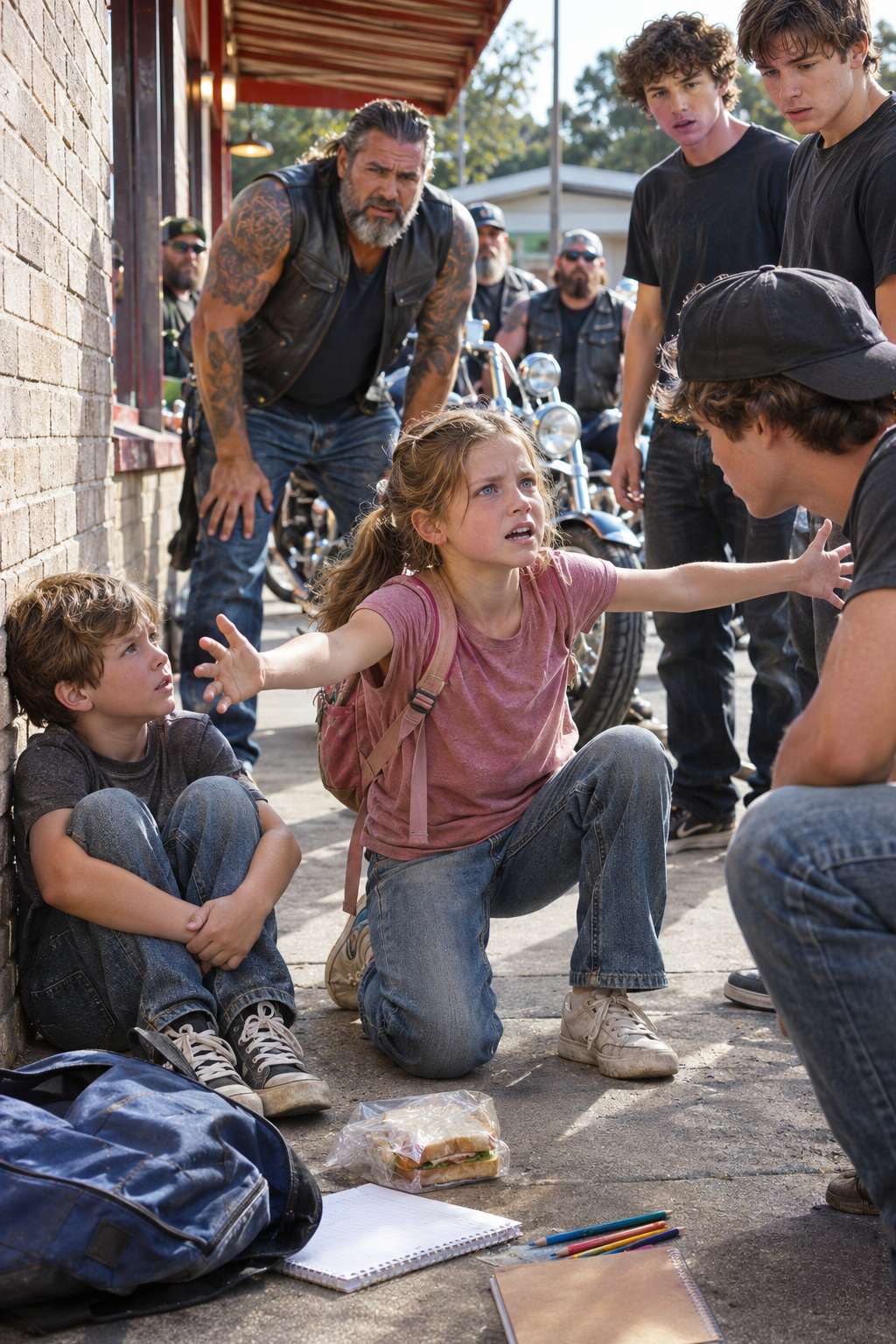
Ellie turned toward him.
“You sent him a message saying you were going to make him disappear.”
Rebecca spun toward her son.
“Mason?”
He shrugged.
“It was a joke.”
Cole’s voice cut through the silence.
“Then explain why nobody’s laughing.”
For the first time, Mason had no answer.
A few minutes later, a silver minivan pulled into the gas station.
A woman in hospital scrubs climbed out before the engine had completely stopped.
“Ellie! Owen!”
Their mother, Sarah Bennett, rushed across the pavement and wrapped both children in her arms.
“What happened? Are you hurt?”
Owen buried his face against her shoulder.
Ellie tried to explain, but the words tangled together.
Cole stepped forward.
“Ma’am, I’m Cole Mercer. Your children are safe. But I think there’s something important you need to know.”
Sarah looked at the motorcycles, the gathered strangers, and the three boys standing beside Rebecca.
Then she saw Mason.
Her expression changed instantly.
“You.”
Rebecca drew herself upright.
“Sarah, I think we should discuss this calmly.”
Sarah stared at her.
“Calmly?”
Her voice cracked.
“Your son has been tormenting mine for months. I’ve called his teachers. I’ve called the principal. I’ve taken time off work I couldn’t afford just to sit in meetings where everybody promised to look into it.”
Rebecca looked away.
“And every single time,” Sarah continued, “my little boy was the one told to change.”
Owen tightened his arms around her.
“Mom, can we go home?”
Sarah’s anger vanished into heartbreak.
“Of course, sweetheart.”
But before they could leave, a quiet voice came from behind the gas station counter.
“Mrs. Bennett?”
A teenage girl stood in the doorway.
She wore a blue work apron and held a phone against her chest.
Her name was Lily Carter.
She was seventeen, a senior at the same school.
“I think I have something you need to see.”
Mason’s head snapped up.
“Lily, shut up.”
The girl flinched.
Cole moved slightly between them.
“You can speak if you want to.”
Lily looked at Owen, then at Ellie.
“I’ve seen what they’ve been doing. Everybody has.”
Sarah’s face tightened.
“Then why didn’t anybody tell me?”
Lily’s eyes filled with tears.
“Because Mason said anyone who reported him would be next.”
She unlocked her phone.
“And because last year, when somebody tried, things got worse.”
She opened a folder containing screenshots, messages, and a photograph of a boy standing beside a hospital bed.
“His name was Tyler Reed.”
Mason’s face drained of color.
Rebecca whispered, “What does Tyler have to do with this?”
Lily looked directly at her.
“Everything.”
Three months earlier, Tyler Reed had transferred out of Westbrook Middle School.
The official story was that his family had moved closer to relatives.
But Lily knew differently.
Tyler’s younger sister was her best friend.
For almost a year, Tyler had been bullied by Mason and several other boys. The harassment began with insults, then stolen belongings, then humiliating videos.
Eventually, someone created a fake account in Tyler’s name and posted messages designed to make him look cruel and unstable.
The school suspended Tyler for three days.
When his mother protested, she was told there was insufficient evidence to identify the person responsible.
Two weeks later, Tyler was injured during an incident near the gym.
He spent four days in the hospital.
His family left town shortly afterward.
Lily’s voice shook as she explained.
“Tyler told me Mason was there. But nobody believed him.”
Rebecca looked toward her son.
“Mason, tell me this isn’t true.”
He remained silent.
“Mason!”
“I didn’t put him in the hospital!”
The words came too quickly.
Lily stared at him.
“Then how did you know he was in the hospital?”
Mason blinked.
Rebecca slowly stepped backward.
Cole raised a hand.
“Let’s be careful. We need facts, not guesses.”
He turned toward Lily.
“Do you have anything that can be verified?”
She nodded.
“Messages. Some videos. Tyler’s mom kept copies of everything.”
Cole looked at Sarah.
“With your permission, I’d like to help you make sure the school and the proper authorities review this.”
Sarah studied his face.
“Why?”
The question caught him off guard.
“Why are you helping us?” she repeated. “You don’t even know my children.”
Cole glanced at Owen.
For a moment, something old and painful moved behind his eyes.
“Because somebody should have helped a boy I knew a long time ago.”
He said nothing more.
That evening, Sarah sat at her kitchen table while Owen slept upstairs.
Ellie remained beside her, still wearing the sweater she had worn to the grocery store.
Across from them sat Cole and a woman named Patricia Hayes, one of the other motorcycle riders.
Patricia was a retired school counselor who had spent thirty years working with children.
Unlike Cole, she had no intimidating presence.
She wore reading glasses on a silver chain and carried a notebook covered with little yellow flowers.
“I want to be very clear,” Patricia told Sarah. “We can’t promise what the school will do. But we can help you organize the evidence, request formal action, and make sure Owen isn’t forced to face these boys alone.”
Sarah rubbed her forehead.
“I’ve tried everything.”
“Then we’ll start by documenting everything you’ve already tried.”
Cole sat quietly beside the window.
After a moment, Owen appeared in the hallway.
He was wearing pajamas and holding a small stuffed dog with one missing ear.
“Mom?”
Sarah stood immediately.
“What’s wrong, honey?”
Owen looked toward Cole.
“Can I ask him something?”
Cole nodded.
“Anything.”
Owen took a hesitant step forward.
“Were you ever scared of somebody?”
Cole’s face softened.
“More times than I can count.”
“But you’re big.”
“That doesn’t mean fear disappears.”
Owen thought about that.
“Did you ever run away?”
Cole looked down at his hands.
“Yes.”
“Did it help?”
“Sometimes leaving a dangerous situation is the smartest thing you can do.”
Owen frowned.
“But everyone says running away makes you a coward.”
Cole shook his head.
“Being brave doesn’t mean proving you can take a beating. Sometimes it means knowing you deserve to be safe.”
Owen considered that for a long moment.
Then he asked the question nobody expected.
“Did you ever lose someone because nobody helped?”
Cole went completely still.
Patricia lowered her eyes.
The room grew quiet.
Finally, Cole answered.
“Yes.”
His voice was barely above a whisper.
“My little brother.”
Owen sat on the opposite chair.
“What happened?”
Cole looked toward Sarah, silently asking whether he should continue.
She nodded.
“His name was Danny,” Cole said. “He was thirteen. Smaller than most boys his age. Loved drawing cars, hated thunderstorms, and thought every stray dog in the neighborhood belonged to him.”
A faint smile crossed his face.
“He was the best kid I ever knew.”
Then the smile disappeared.
“Some older boys started picking on him. They took his things. Made fun of him. Told him nobody would believe him if he complained.”
Cole paused.
“I was eighteen. I worked nights at a garage. Danny tried telling me what was happening, but I was always tired. Always busy.”
He stared at the tabletop.
“I told him to ignore them. Told him they’d get bored.”
Owen hugged his stuffed dog tighter.
“One afternoon, those boys chased Danny near an abandoned railroad bridge. He tried getting away and fell.”
Sarah covered her mouth.
Cole’s eyes shone.
“He never came home.”
Nobody moved.
For a long time, the only sound was the refrigerator humming.
Finally, Cole looked at Owen.
“I spent years wishing I’d listened sooner. I can’t change what happened to Danny. But I can listen now.”
Owen rose, walked around the table, and wrapped his small arms around Cole.
The broad-shouldered biker closed his eyes.
He held the boy gently, as though afraid something precious might break.
The next morning, Westbrook Middle School received a formal complaint supported by screenshots, witness statements, medical records, and copies of Sarah’s previous correspondence.
Patricia helped Sarah prepare the documents.
Cole arranged for a local attorney, who volunteered with a youth protection organization, to review them.
Meanwhile, the story began spreading through town.
Not because Cole posted the humiliating videos.
He refused.
Instead, Lily spoke to other students.
And once one person found the courage to talk, others followed.
A boy named Caleb admitted Mason had taken his lunch money for months.
A girl named Emma described how Mason’s friends had created an online account to ridicule her appearance.
Three more students shared similar experiences.
By Friday, twelve families had contacted the school.
Principal Harris could no longer pretend there was no pattern.
But Mason’s father, Richard Whitmore, had no intention of allowing the matter to continue.
He was a wealthy property developer, a school board member, and a man accustomed to getting his way.
On Saturday afternoon, he arrived at Cole’s motorcycle repair shop in a black SUV.
Cole was underneath an old motorcycle when Richard entered.
“Are you Cole Mercer?”
Cole slid out from beneath the bike.
“Depends who’s asking.”
Richard placed a business card on the workbench.
“Richard Whitmore. We need to talk about my son.”
Cole wiped his hands with a rag.
“Then talk.”
Richard glanced around the workshop.
“Nice place. Would be unfortunate if you lost it.”
Cole stopped wiping his hands.
“Is that a threat?”
“It’s advice.”
Richard stepped closer.
“My son made some mistakes. Nothing that justifies destroying his future.”
“Protecting other children doesn’t destroy his future.”
“You’ve involved yourself in something you don’t understand.”
Cole folded the rag.
“Then explain it.”
Richard smiled without warmth.
“People in this town respect my family. I’ve supported the schools, funded their programs, paid for their new athletic facilities.”
“And you think that buys your son permission to hurt people?”
Richard’s smile vanished.
“Careful.”
Cole leaned against the workbench.
“You know what worries me about your son?”
Richard said nothing.
“He’s learning from somebody who thinks power means nobody can tell him no.”
Richard’s jaw tightened.
“You’ll regret making an enemy of me.”
Cole looked him directly in the eyes.
“I don’t want to be your enemy. I want your son to stop hurting children.”
Richard turned toward the door.
Before leaving, he delivered one final warning.
“The school board meets Monday. After that, this nonsense ends.”
By Monday morning, the entire town seemed to know about the meeting.
The school auditorium was packed.
Parents filled every seat, while students and teachers stood along the walls.
Sarah sat in the front row with Ellie.
Owen had stayed home with Patricia.
Cole stood near the back beside five fellow riders, all dressed in ordinary clothes rather than their leather vests.
Richard Whitmore occupied the center seat at the board’s table.
Principal Harris sat beside him.
The meeting began with prepared statements about student safety and the importance of maintaining a respectful learning environment.
Then Richard spoke.
“Recent accusations have created unnecessary fear in our community. While we take every complaint seriously, we must remember that children sometimes exaggerate conflicts.”
Sarah’s fingers tightened around Ellie’s hand.
Richard continued.
“We cannot allow rumors, social media outrage, and outside agitators to undermine our school.”
Several parents began murmuring.
Then Principal Harris announced that the school had investigated the complaints and found no evidence of systematic harassment.
Ellie stood so abruptly that her chair scraped the floor.
“That’s a lie!”
Sarah reached for her arm.
But Ellie was already looking toward the stage.
“You have the videos!”
Harris adjusted his glasses.
“Miss Bennett, please sit down.”
“You have my brother’s messages. You have pictures of his bruises. You have everything!”
Richard leaned toward his microphone.
“This is exactly the kind of emotional behavior we’re trying to avoid.”
Cole began moving forward.
But before he reached the aisle, another voice spoke.
“Then maybe you’d prefer hearing from someone who isn’t emotional.”
A woman stood near the auditorium doors.
She wore a dark green coat and carried a thick folder.
Beside her stood a thin teenage boy with a pale scar above his eyebrow.
Lily gasped.
“Tyler?”
The room fell silent.
Tyler Reed had returned.
His mother, Angela, walked with him toward the front.
Richard’s face changed immediately.
“Mrs. Reed, this is a closed discussion concerning current students.”
Angela stopped.
“Then why are there two hundred people here?”
A few nervous laughs rippled through the audience.
Angela placed her folder on the table.
“My son was a student here when your school failed him. And I have something your principal has spent months pretending doesn’t exist.”
Harris looked at Richard.
Angela opened the folder.
“Emails documenting twelve separate complaints. Photographs. Hospital discharge papers. Statements from four witnesses.”
Richard cleared his throat.
“These allegations were already reviewed.”
“Yes,” Angela replied. “By a principal who sent me an email saying my son was responsible for provoking his attackers.”
She held up a printed page.
“Would you like me to read the rest?”
Harris’s expression turned gray.
Then Angela delivered the revelation that changed everything.
“Three weeks after Tyler was injured, I received a voicemail from an unknown number.”
She turned toward the audience.
“It was from another parent. Someone who knew the school had security footage of the incident.”
Harris stood abruptly.
“That footage was unavailable due to a technical malfunction.”
Angela looked straight at him.
“Then perhaps you can explain why I received a copy yesterday.”
The auditorium erupted.
Richard slammed his hand against the table.
“This meeting is out of control!”
Angela raised her voice.
“The video shows Mason Whitmore and two other boys cornering my son near the gym. It shows Tyler trying to walk away. It shows one boy shoving him into a metal equipment rack.”
Tyler stood beside his mother, trembling.
“It also shows a staff member approaching afterward,” Angela continued. “A staff member who later signed a report stating there were no witnesses.”
Every head turned toward Principal Harris.
He sank back into his chair.
Cole watched the scene without moving.
He had seen anger before.
He had seen people demand revenge.
But what unfolded next was something he had almost forgotten how to recognize.
Accountability.
One of the other school board members, a woman named Dr. Evelyn Brooks, stood.
“I was never shown these materials.”
Richard turned toward her.
“Evelyn, sit down.”
She ignored him.
“Were any other board members informed about this footage?”
Nobody answered.
Dr. Brooks faced Angela.
“Mrs. Reed, will you provide that evidence to the independent investigator and the appropriate authorities?”
Angela nodded.
“I already have.”
Richard’s face darkened.
“You’re going to ruin a fourteen-year-old boy’s life over one incident?”
A voice rose from the front row.
“No.”
Everyone turned.
Rebecca Whitmore was standing.
She looked exhausted, her eyes swollen from crying.
“Mason didn’t make one mistake,” she said.
Richard stared at his wife.
“Rebecca, don’t.”
She shook her head.
“For months, I defended him because I couldn’t bear the thought that my child could be cruel.”
She turned toward Sarah.
“I told myself your son was exaggerating. I told myself children fought. And whenever someone complained, I found another excuse.”
Tears slid down her cheeks.
“Then I watched those videos.”
She looked toward Richard.
“And I realized our son had learned that being loved meant never being held responsible.”
Richard rose.
“This conversation is over.”
“No,” Rebecca said quietly. “It isn’t.”
She removed an envelope from her handbag.
“Last night, Mason told me something.”
Richard’s face hardened.
“Be careful what you say.”
Rebecca looked at him with an expression of sorrow rather than fear.
“He said you told him the principal would make everything disappear.”
The room went silent.
Richard glanced toward Harris.
For once, neither man had an answer.
Rebecca placed the envelope on the table.
“Those are messages between my husband and Principal Harris. They need to be examined.”
The board’s attorney stepped forward.
He collected the envelope and asked that the meeting be recessed.
Richard stormed out through a side door.
But Rebecca remained.
She approached Sarah slowly.
“I know an apology won’t undo what happened.”
Sarah said nothing.
Rebecca’s voice trembled.
“But I’m sorry. For what Mason did. And for how long I refused to see it.”
Sarah looked at her.
“I’m glad you’re finally listening.”
Then she added something Rebecca would never forget.
“But my son shouldn’t have had to suffer this much before you did.”
Two weeks later, the district announced an independent investigation into the school’s handling of bullying complaints.
Principal Harris was placed on administrative leave pending the outcome.
Richard stepped away from his school board duties as the evidence was reviewed.
The district introduced immediate safety measures, including additional supervision, confidential reporting procedures, and independent review of unresolved complaints.
Mason and the other boys received disciplinary consequences, and the families were referred for counseling and restorative support where appropriate.
But none of that meant Owen suddenly became happy.
Recovery didn’t work that way.
He still flinched when his phone buzzed.
He still hesitated before entering crowded hallways.
Sometimes he woke from nightmares he couldn’t explain.
Sarah arranged for him to meet with a counselor.
Ellie walked with him to school whenever he wanted company.
And every Wednesday afternoon, Owen visited Cole’s garage.
At first, he only watched.
Cole showed him how engines worked, how to recognize worn brake pads, and why every small part mattered.
One afternoon, Cole handed him a wrench.
“Think you can loosen that bolt?”
Owen tried.
It wouldn’t move.
He tried again, his face turning red.
“I can’t.”
Cole crouched beside him.
“Want some help?”
Owen hesitated.
Then he nodded.
Together, they loosened the stubborn bolt.
Cole smiled.
“See? Asking for help didn’t make you weaker.”
Owen grinned.
“No. It made the bolt weaker.”
Cole laughed so hard that Patricia came out of the office to see what had happened.
Something began changing after that.
Not all at once.
Not magically.
But little by little, Owen started laughing again.
One Wednesday, while Cole was teaching him how to change a spark plug, a familiar figure appeared outside the garage.
Mason Whitmore.
He stood alone, holding a folded piece of paper.
Owen immediately stepped backward.
Cole noticed.
“You don’t have to talk to him,” he said.
Mason remained by the entrance.
“Mr. Mercer?”
Cole approached.
“What do you need?”
Mason looked thinner than before.
His expensive jacket hung loosely from his shoulders.
“I wanted to talk to Owen.”
Cole crossed his arms.
“That’s his decision.”
Mason looked past him.
“Owen, I just wanted to say—”
“Stop,” Owen whispered.
Mason fell silent.
Owen’s hands were shaking.
For a moment, he looked exactly as he had outside the grocery store.
Then he took a breath.
“You made me hate going to school.”
Mason lowered his eyes.
“I know.”
“You made me think everybody was laughing at me.”
“I know.”
Owen’s voice cracked.
“And when I told you to stop, you just kept doing it.”
Mason wiped his nose with his sleeve.
“I’m sorry.”
Owen stared at him.
“Why?”
Mason seemed confused.
“What?”
“Why did you do it?”
The question hung between them.
Finally, Mason answered.
“Because when people laughed at you, they paid attention to me.”
Cole said nothing.
Mason continued.
“At home, my dad always talks about winners and losers. He says people only respect you if they’re afraid to challenge you.”
He looked down.
“I wanted people to think I was somebody.”
Owen’s eyes filled.
“So you made me feel like nobody?”
Mason’s face crumpled.
“Yes.”
He unfolded the paper.
“I wrote you a letter. My counselor helped me figure out what I wanted to say. I know it doesn’t fix anything.”
He extended it.
Owen didn’t take it.
“Can you give it to Cole?”
Mason nodded and handed over the letter.
Then he turned to leave.
But Owen spoke again.
“Mason?”
He stopped.
“I don’t forgive you yet.”
Mason swallowed.
“Okay.”
“And I don’t want you near me at school.”
“Okay.”
Owen took another breath.
“But I hope you stop being mean to people.”
Mason nodded, tears sliding down his cheeks.
“I want to.”
After he left, Owen sat on an overturned crate.
Cole joined him.
“Was that hard?”
Owen nodded.
“Really hard.”
“Then you did something brave.”
Owen stared at the closed garage door.
“Do I have to forgive him someday?”
Cole thought carefully.
“No. Forgiveness is yours to give, if and when you’re ready. What matters now is that you’re safe and that he changes his behavior.”
Owen looked relieved.
“Good.”
Cole smiled.
“Good.”
Spring arrived slowly in Westbrook.
The first warm days brought children back to the parks, bicycles onto sidewalks, and flowers into the dusty planters outside the grocery store.
The school district completed its investigation.
Its public findings confirmed serious failures in responding to repeated harassment reports. Administrative changes followed, and the district established a parent-student safety council.
Angela Reed joined that council.
So did Sarah Bennett.
And, to the surprise of many, Rebecca Whitmore volunteered to support parent education programs about recognizing harmful behavior before it escalated.
Her marriage had become strained.
Her husband’s influence had diminished.
But she was no longer willing to trade her conscience for comfort.
Mason continued attending counseling and fulfilling the consequences assigned to him.
He was required to repair some of the damage he had caused, including contributing to supervised school projects aimed at preventing harassment.
It wasn’t easy.
Some students distrusted him.
Others mocked him for losing his popularity.
For the first time, Mason began to understand how isolation felt.
But understanding wasn’t the same as earning trust.
That would take time.
Meanwhile, Ellie had started a student group called The Open Door.
Its purpose was simple: make sure no student had to face bullying alone.
Members organized peer support, helped classmates identify trusted adults, and reported dangerous situations rather than trying to handle them through confrontation.
Lily joined immediately.
So did Tyler, who began attending the school again after his family decided to return to town.
And one afternoon, Owen surprised everyone by asking to speak at an assembly.
Sarah worried he wasn’t ready.
Patricia reminded her that the decision belonged to him.
Cole offered to sit in the audience.
When the day arrived, Owen walked onto the stage holding a small sheet of paper.
His hands trembled.
Nearly four hundred students watched.
For several seconds, he couldn’t speak.
Then he spotted Ellie in the front row.
Beside her sat Sarah, Patricia, and Cole.
Cole gave him a small nod.
Owen looked down at his paper.
“When people were mean to me,” he began, “I thought the worst part was what they said.”
He paused.
“But it wasn’t.”
The auditorium grew quiet.
“The worst part was thinking nobody cared.”
A teacher in the back lowered her head.
Owen continued.
“Sometimes people saw what happened and walked away. Sometimes they laughed because they didn’t want to be the next person getting picked on.”
His voice strengthened.
“I used to think being brave meant fighting back. But I learned that sometimes being brave means telling someone what happened. Or helping somebody who can’t ask for help yet.”
He looked toward Tyler.
“And if you see somebody being hurt, you don’t have to become a superhero. You can get an adult who will listen. You can stand beside the person afterward. You can tell them they’re not alone.”
He folded his paper.
Then he said the words that would stay with Cole for the rest of his life.
“Sometimes the smallest thing you do for someone becomes the reason they believe tomorrow can be better.”
For a moment, nobody moved.
Then Ellie stood.
She began clapping.
Lily joined her.
Then Tyler.
Then the teachers.
Within seconds, the entire auditorium was on its feet.
Owen looked overwhelmed.
But this time, when hundreds of people were watching him, he wasn’t afraid.
He was smiling.
That evening, Cole returned to the garage and found an envelope on his workbench.
Inside was a drawing.
It showed six motorcycles parked outside a grocery store.
A little boy and his older sister stood beside them.
Above the picture, in careful handwriting, Owen had written:
“Thank you for seeing me when everybody else looked away.”
Cole sat down slowly.
He stared at the drawing for a long time.
Then he opened the bottom drawer of his desk.
Inside was an old photograph of two boys standing beside a red bicycle.
One was eighteen, tall and serious.
The other was thirteen, smiling with a gap between his front teeth.
Danny.
Cole placed Owen’s drawing beside the photograph.
For years, he had carried his brother’s memory like a punishment.
He believed that if he stopped blaming himself, it would mean he had forgotten Danny.
But now he understood something different.
He couldn’t go back and rescue his brother.
He couldn’t erase his own mistakes.
He could only decide what kind of man those mistakes would teach him to become.
A gentle knock interrupted his thoughts.
Patricia stood at the doorway.
“You okay?”
Cole wiped his eyes.
“Yeah.”
She noticed the photograph and drawing.
A soft smile appeared on her face.
“Danny would’ve liked that boy.”
Cole nodded.
“I think so.”
Patricia stepped inside.
“You know, you’ve spent twenty years trying to make up for one afternoon.”
Cole looked at her.
“And maybe,” she continued, “it’s time you stopped measuring your life by the person you couldn’t save and started seeing the people you’ve helped.”
Cole looked at Owen’s drawing again.
His voice broke.
“I miss him.”
“I know.”
“I always will.”
Patricia rested a hand on his shoulder.
“Then keep loving him. Just don’t forget to live, too.”
Outside, the evening sunlight stretched across the motorcycles lined up beside the garage.
A breeze moved through the open doorway.
Cole picked up the photograph and set it beside the drawing on his desk.
For the first time in many years, Danny’s memory brought him more gratitude than guilt.
Several months later, on a bright Saturday morning, Westbrook held its first annual Ride for Kindness.
Motorcyclists from neighboring towns gathered to raise money for school counseling, student safety initiatives, and families who needed support accessing mental health services.
More than eighty motorcycles filled the parking lot.
Sarah helped organize refreshments.
Ellie stood beside the registration table, handing out bright blue ribbons.
Tyler and Lily worked with younger volunteers.
Rebecca arrived early and quietly helped set up chairs.
Even Mason came, accompanied by his mother.
He didn’t approach Owen.
Instead, he spent the morning carrying boxes, collecting trash, and doing whatever the organizers asked.
Nobody applauded him for it.
And that was important.
He was finally learning to do the right thing without needing an audience.
Just before the ride began, Cole noticed Owen standing beside his motorcycle.
The boy was staring at the empty passenger seat.
“Something on your mind?” Cole asked.
Owen looked up.
“Do you think I could ride with you someday?”
Cole smiled.
“When you’re old enough, properly equipped, and your mom says yes.”
Owen laughed.
“So probably never.”
“Your mother seems pretty reasonable to me.”
“She made me eat broccoli yesterday.”
“Terrible woman.”
They both laughed.
Then Owen reached into his pocket and pulled out a small metal keychain.
It was shaped like a motorcycle.
“I bought this with my allowance.”
Cole accepted it.
On the back, two words had been carefully engraved.
“Keep Going.”
Cole ran his thumb over the letters.
“What’s this for?”
Owen shrugged.
“Because you told me being scared doesn’t mean I have to stop trying.”
Cole looked at the boy standing before him.
A few months earlier, Owen had barely been able to look strangers in the eye.
Now he stood in the morning sunlight, smiling with the kind of confidence that came not from being stronger than others, but from finally feeling safe enough to be himself.
Cole closed his hand around the keychain.
“Thank you, buddy.”
Owen grinned.
“Don’t cry, okay?”
Cole laughed, even as his eyes filled.
“No promises.”
When the motorcycles finally started their engines, the sound rolled through Westbrook like distant thunder.
Families waved from the sidewalks.
Children held handmade signs.
And at the front of the procession, Cole rode with the little keychain fastened securely to his vest.
As they passed the grocery store where everything had begun, he glanced toward the narrow path beside the building.
Nothing about the place looked different.
The same brick wall.
The same cracked pavement.
The same old shopping carts beside the entrance.
Yet everything had changed.
Not because six bikers had frightened three bullies.
Not because a powerful family had been embarrassed.
And not because one boy had delivered a speech that made an auditorium stand and applaud.
Things had changed because people who once looked away had finally chosen to pay attention.
Because a mother had refused to stop fighting for her child.
Because a sister had stepped between her brother and the people hurting him.
Because witnesses had found their voices.
Because even those who had caused harm were being taught that actions carried consequences, and that change required more than an apology.
And because one man, still carrying the grief of losing his younger brother, had decided that another frightened child deserved to be heard.
Years later, Owen would barely remember the exact words Mason shouted outside that grocery store.
He would forget the color of Mason’s jacket, the sound of the boys laughing, and even the humiliation of seeing his belongings scattered across the pavement.
But he would never forget the moment six motorcycles arrived.
He would never forget the stranger who knelt to look him in the eyes.
And he would never forget the feeling of discovering that he mattered.
For Cole, the greatest reward was not the town’s gratitude or the charity ride that eventually became an annual tradition.
It was a photograph that arrived at his garage many years afterward.
In it, a grown Owen stood outside a community center beside a group of smiling children.
He had become a youth counselor.
On the back of the photograph, he had written:
“Some people save lives without ever knowing how many. You saved mine, and now I’m trying to do the same for others.”
Cole placed that photograph beside Danny’s picture and Owen’s childhood drawing.
Three pieces of paper.
Three different chapters of one life.
And one truth connecting them all.
We cannot always control the cruelty that exists in the world. We cannot undo every mistake, erase every painful memory, or protect everyone we love from suffering.
But we can choose whether to remain silent when someone needs our voice.
We can choose whether to judge a frightened person for their fear or help them find safety.
We can choose whether our influence becomes a weapon against the vulnerable or a shield for those who have none.
And sometimes, the most meaningful thing we will ever do begins with something as simple as noticing a person everyone else has overlooked.
Because true strength is not measured by how many people fear you.
It is measured by how many people feel safe because you are there.
And the people who change the world are not always the loudest, the richest, or the most powerful.
Sometimes, they are simply the ones who refuse to walk away.
But there was one final chapter in Cole’s story that nobody in Westbrook could have predicted.
It began on a rainy Thursday afternoon, nearly fifteen years after the day six motorcycles pulled into a grocery store parking lot.
Cole was sixty-three now. His beard had turned almost entirely silver, and the hands that once repaired engines with effortless precision had begun to tremble on cold mornings.
He still owned the garage, although he spent more time teaching young mechanics than working beneath motorcycles himself.
The Ride for Kindness had grown into one of the largest charitable events in the county.
And Owen Bennett, the frightened twelve-year-old boy who had once hidden behind his sister, had become the director of a youth counseling center that helped hundreds of struggling children every year.
Yet on that particular afternoon, Cole received a letter that brought the past rushing back.
There was no return address.
Only his name, written in careful handwriting.
Inside was a single photograph.
It showed an abandoned railroad bridge.
The same bridge where Danny had died.
Cole felt the blood drain from his face.
Behind the photograph was a short message.
“There’s something you deserve to know about your brother. I should have told you forty-five years ago.”
At the bottom was a name.
Thomas Avery.
Cole stared at it.
He hadn’t heard that name since Danny’s funeral.
Thomas had been one of the boys who chased Danny that afternoon.
For decades, Cole had imagined what he would say if he ever saw him again.
He had rehearsed angry speeches in the darkness of sleepless nights.
But now, holding the letter in his trembling hands, he felt something far more complicated than anger.
He felt afraid.
That evening, Owen arrived at the garage after receiving Cole’s unusually brief phone call.
He found the older man sitting at his desk, surrounded by photographs.
“Cole?”
Cole handed him the letter without speaking.
Owen read it twice.
“Do you know where this man is?”
Cole nodded.
“He left a telephone number.”
“Have you called?”
“No.”
Owen sat across from him.
“Do you want to?”
Cole looked at Danny’s photograph.
“For forty-five years, I’ve believed I knew what happened on that bridge. Now somebody wants to tell me I might not.”
Owen leaned forward.
“You don’t have to face him alone.”
Cole gave a sad smile.
“Funny. I remember telling you something like that when you were twelve.”
“Then maybe it’s time you took your own advice.”
For the first time that evening, Cole laughed.
Two days later, they drove to a small nursing facility outside Millbrook.
Thomas Avery was seventy years old and dying from advanced heart disease.
He sat beside a window overlooking a garden, his body thin beneath a gray cardigan.
When Cole entered, Thomas began to cry.
“Cole.”
Cole remained standing.
“Tell me what happened.”
Thomas lowered his head.
“We were cruel to Danny. There’s no excuse for it.”
Cole’s jaw tightened.
“I already know that.”
“But there’s something you don’t know.”
Thomas struggled to breathe.
“That afternoon, Danny wasn’t running away from us when he fell.”
Cole stared at him.
“What?”
Thomas reached for a glass of water.
“He was trying to help someone.”
The room became completely still.
“There was a little boy near the bridge. Maybe seven years old. He’d climbed down the embankment to get his dog and couldn’t get back up.”
Thomas’s voice cracked.
“We were chasing Danny when he heard the boy screaming. Danny stopped. He could’ve kept running, but he went down to help.”
Cole gripped the back of a chair.
“He lifted the little boy onto the safer part of the slope. Then the ground gave way beneath him.”
Thomas covered his face.
“We ran. We were scared we’d get blamed. Later, when people started asking questions, we lied about how it happened.”
Cole could barely breathe.
“Why didn’t you tell anybody?”
“Because we were cowards.”
Thomas looked up, tears streaming down his cheeks.
“And every year that passed made telling the truth harder.”
Cole turned toward the window.
For nearly half a century, he had pictured Danny terrified and alone in his final moments.
Now another image appeared.
Danny stopping.
Danny hearing someone smaller crying for help.
Danny choosing compassion when he had every reason to think only of himself.
“Who was the little boy?” Cole whispered.
Thomas reached into a drawer and removed an old newspaper clipping.
“I found him years later. His family moved away shortly after the accident. He told the police a boy had saved him, but nobody connected his account to Danny’s fall.”
Cole accepted the yellowed paper.
There was a photograph of a young child holding a shaggy brown dog.
Underneath it was a name.
Michael Bennett.
Owen, standing beside Cole, suddenly froze.
“Bennett?”
Cole turned.
Owen’s face had gone white.
“My father,” he whispered.
Cole looked at him in disbelief.
“Your father?”
Owen nodded slowly.
“My dad’s name was Michael Bennett. He grew up near Millbrook.”
For several seconds, neither man could speak.
Owen’s father had died when Owen was eight years old.
Sarah had always told the children that Michael had survived a terrible childhood accident involving a railroad bridge, but she knew few details.
He had rarely spoken about it.
All Owen remembered was that his father had been unusually protective of children and animals.
Cole lowered himself into a chair.
The truth settled over him with overwhelming force.
Forty-five years earlier, Danny had saved a frightened little boy.
That boy had grown up, married, and become Owen’s father.
And decades later, without knowing any of it, Cole had helped save Owen from a different kind of suffering.
Thomas watched them, confused.
“What’s happening?”
Owen slowly sat beside Cole.
“The boy Danny saved was my dad.”
Thomas covered his mouth.
Cole stared at Owen.
His eyes filled with tears.
All those years, he had believed Danny’s life had ended without leaving anything behind except grief.
But the boy Danny rescued had lived.
He had grown into a man.
He had raised a family.
And one of his children was sitting beside Cole now.
Owen reached across the table.
Cole took his hand.
Neither tried to speak.
There were moments in life when words were simply too small.
Before leaving, Cole approached Thomas’s bed.
The dying man looked up at him.
“I don’t expect forgiveness.”
Cole studied the face of the boy who had once tormented his brother.
“You should’ve told the truth.”
Thomas nodded.
“I know.”
“You let my family carry a terrible misunderstanding for decades.”
“I know.”
Cole paused.
“But I’m glad you finally told me.”
Thomas began crying again.
Cole didn’t embrace him.
He didn’t promise that everything was forgiven.
Some wounds couldn’t be erased by a confession.
But as he walked toward the door, Cole stopped.
“Thomas?”
“Yes?”
“Spend whatever time you have left telling the truth to the people who need to hear it.”
Thomas nodded.
“I will.”
Outside, the rain had stopped.
Cole and Owen stood beside the car beneath a sky beginning to clear.
Owen looked toward the distant hills.
“Do you think Danny knew what he was doing?”
Cole considered the question.
“He probably just saw someone who needed help.”
Owen smiled through his tears.
“Sounds like somebody I know.”
Cole shook his head.
“No, son. I spent my life trying to become somebody like him.”
One month later, Westbrook held a small ceremony at the community center.
Sarah, Ellie, Patricia, Tyler, Lily, and dozens of families gathered in the garden.
At the center stood a newly planted oak tree.
Beneath it was a bronze plaque.
It carried Danny Mercer’s name and the words:
“In honor of a boy whose courage gave another child a future.”
Cole stood beside Owen as the plaque was unveiled.
Sarah was crying.
Ellie held her mother’s hand.
Owen stepped toward the microphone.
“Many years ago,” he began, “a thirteen-year-old boy made a choice. He saw a frightened child in danger, and he decided to help.”
He looked at Cole.
“That child grew up to become my father.”
A ripple of emotion moved through the crowd.
“And years later, when I was frightened and needed help, Danny’s older brother made the same choice.”
Owen paused.
“I used to think kindness was a small thing. Something you did when it was convenient.”
He glanced toward the oak tree.
“But now I understand that kindness can travel farther than we ever imagine. It can outlive us. It can reach people whose names we’ll never know.”
Cole lowered his head.
Owen continued.
“My father never knew the name of the boy who saved him. Danny never knew that the child he helped would someday have a family. And Cole never knew that the little boy he protected outside a grocery store was the son of the person his brother had rescued.”
He smiled through his tears.
“But none of them needed to know.”
The garden fell silent.
“Because real kindness doesn’t demand proof that it mattered.”
After the ceremony, Cole remained beside the tree while everyone else slowly returned inside.
Owen approached him carrying two cups of coffee.
“Thought you might need this.”
Cole accepted one.
They stood together, watching the oak leaves move gently in the wind.
“Do you know what I’ve been thinking?” Cole asked.
“What?”
“All those years I thought Danny’s story ended on that bridge.”
Owen looked at the plaque.
“And now?”
Cole smiled.
“Now I think it was only the beginning.”
Owen rested a hand on his shoulder.
For a while, they said nothing.
Then a little girl from the counseling center approached them.
She couldn’t have been more than eight.
She was carrying a handmade paper flower.
“Mr. Cole?”
He turned.
“Yes, sweetheart?”
“My teacher said your brother was a hero.”
Cole knelt carefully.
“He was a very good boy.”
The little girl looked at the plaque.
“Do you have to be big and strong to be a hero?”
Cole smiled.
“No.”
“Do you have to be famous?”
“Not at all.”
She considered this seriously.
“Then maybe I could be one.”
Cole’s eyes filled.
“I think you already can.”
The little girl placed her flower beside the tree and ran back toward her friends.
Cole watched her disappear into the building.
Owen stood beside him, smiling.
And in that quiet garden, beneath the branches of a young oak tree, Cole finally understood the lesson his brother had left behind.
A life is not measured only by its length, its achievements, or the number of people who remember its name.
Sometimes, its greatest value lies in the futures it makes possible.
Danny had lived only thirteen years.
Yet his kindness had traveled across generations.
It had reached a frightened child beneath a railroad bridge, a father who cherished his family, a boy standing helpless outside a grocery store, and hundreds of children who would one day walk through the doors of Owen’s counseling center.
The chain of compassion had never truly been broken.
It had simply waited for someone to recognize it.
Cole looked up at the sky and whispered the words he had wanted to say for forty-five years.
“You did good, little brother.”
Then he turned toward Owen, and together they walked back into the community center, where children were laughing, families were gathering, and new stories of courage were already beginning.
Because cruelty may leave scars that last a lifetime, but kindness can leave something even more powerful.
A legacy.
And sometimes, one act of compassion doesn’t just change a person’s day.
It changes the lives of people who haven’t even been born yet.
THE END.