The night twenty-nine starving cattle drivers appeared at Hollow Pine Ranch, Abigail Turner realized she might have to choose who got to eat and who went hungry
Abigail looked at Samuel, wondering why he had chosen such a terrible moment to discuss her future.
Outside, the blizzard screamed against the ranch house. Inside, forty-two people were depending on a broken stove, a nearly empty pantry, and a handful of men searching for a miracle in an abandoned tack room.
“Samuel, whatever it is, can it wait?”
“I don’t believe it can.”
He pulled a folded envelope from his coat and placed it on the table.
Abigail recognized the handwriting immediately.
It belonged to Mr. Caldwell, the owner of the boarding house in Laramie.
Her heart began beating faster.
“How did you get that?”
“It arrived three days before the storm. The messenger asked me to make certain you received it.”
“Why didn’t you give it to me?”
Samuel lowered his eyes.
“Because I was afraid of what it meant.”
Abigail stared at him.
For six years, she had worked at Hollow Pine Ranch, first as a housekeeper, then as its cook, nurse, bookkeeper, and whatever else the difficult seasons demanded.
She had buried her father, lost her childhood home to debt, and learned that promises meant little when a woman possessed nothing of her own.
The boarding house represented something she had never dared say aloud.
Independence.
A place where nobody could dismiss her with a week’s notice.
A place bearing her own name.
She reached for the envelope.
Inside was a letter confirming that the final lease payment had to be delivered by noon tomorrow. Otherwise, the property would be offered to another interested buyer.
Abigail read the words twice.
“There’s no way to reach Laramie in this storm,” she whispered.
Samuel remained silent.
“You knew this deadline was coming.”
“Yes.”
“And you kept the letter from me?”
“I intended to tell you.”
“When?”
The question struck harder than any accusation in the hallway.
Samuel looked older suddenly.
“After I found the courage.”
Abigail pushed back her chair.
“For six years, I’ve trusted you with everything. I never thought I’d have to wonder whether you were hiding something from me.”
“Abigail—”
“No. Not now.”
She folded the letter and slipped it into her apron.
Then she returned to the kitchen.
There were people to keep alive.
Her broken dreams would have to wait.
The two men who had inspected the tack room returned carrying discouraging news.
The old stove was still there, but its chimney pipe had collapsed years earlier. Worse, the iron firebox was rusted along one side.
“It might work,” said Thomas Reed, a broad-shouldered driver with a scar across his chin. “But if we light it without repairing the pipe, we’ll fill the house with smoke.”
Samuel considered the problem.
“The blacksmith’s shed has spare stovepipe.”
“Buried under six feet of snow,” someone answered.
Thomas shrugged.
“Then we’d better start digging.”
Within minutes, six men wrapped themselves in blankets and stepped into the white darkness with shovels.
Abigail watched them disappear.
The wind swallowed their figures almost immediately.
She turned toward the remaining men.
“We need every scrap of warmth we can save. Close the unused bedrooms. Bring everyone into the dining room.”
While the ranch hands worked outside, Abigail gathered the remaining food.
She counted eighteen potatoes, three small sacks of beans, a little flour, two onions, and less than four pounds of dried beef.
Forty-two people.
Perhaps three more days if they ate almost nothing.
The injured foreman, Daniel Mercer, needed more than almost nothing.
His leg had been crushed beneath a fallen wagon, and the swelling had worsened. Since morning, he’d been burning with fever.
Abigail entered his room carrying a clean cloth.
Daniel opened his eyes.
“You should be resting,” he murmured.
“So should you.”
He managed a weak smile.
“Did the boys give you trouble?”
“They’re frightened.”
“Fear makes decent men say ugly things.”
Abigail pressed the cool cloth against his forehead.
Daniel caught her wrist.
“There’s something you need to know.”
She leaned closer.
“About what?”
“The cattle.”
Abigail frowned.
“The cattle are miles away.”
“Not all of them.”
His breathing became shallow.
“We lost the main herd before reaching Hollow Pine. But there’s a supply wagon… hidden near Willow Creek.”
Abigail stared at him.
“A supply wagon?”
“Flour. Salt pork. Coffee. Medicine. Enough to get us to Cheyenne.”
“Why didn’t anyone mention it?”
Daniel closed his eyes.
“Because I told them it was gone.”
A chill moved through her.
“Why would you do that?”
He struggled to answer, but a violent cough seized him.
When it passed, his voice was barely audible.
“Because someone tried to kill me over what’s inside.”
Before Abigail could ask another question, Daniel slipped back into unconsciousness.
She remained beside his bed, listening to the storm scrape against the window.
A hidden wagon.
Food.
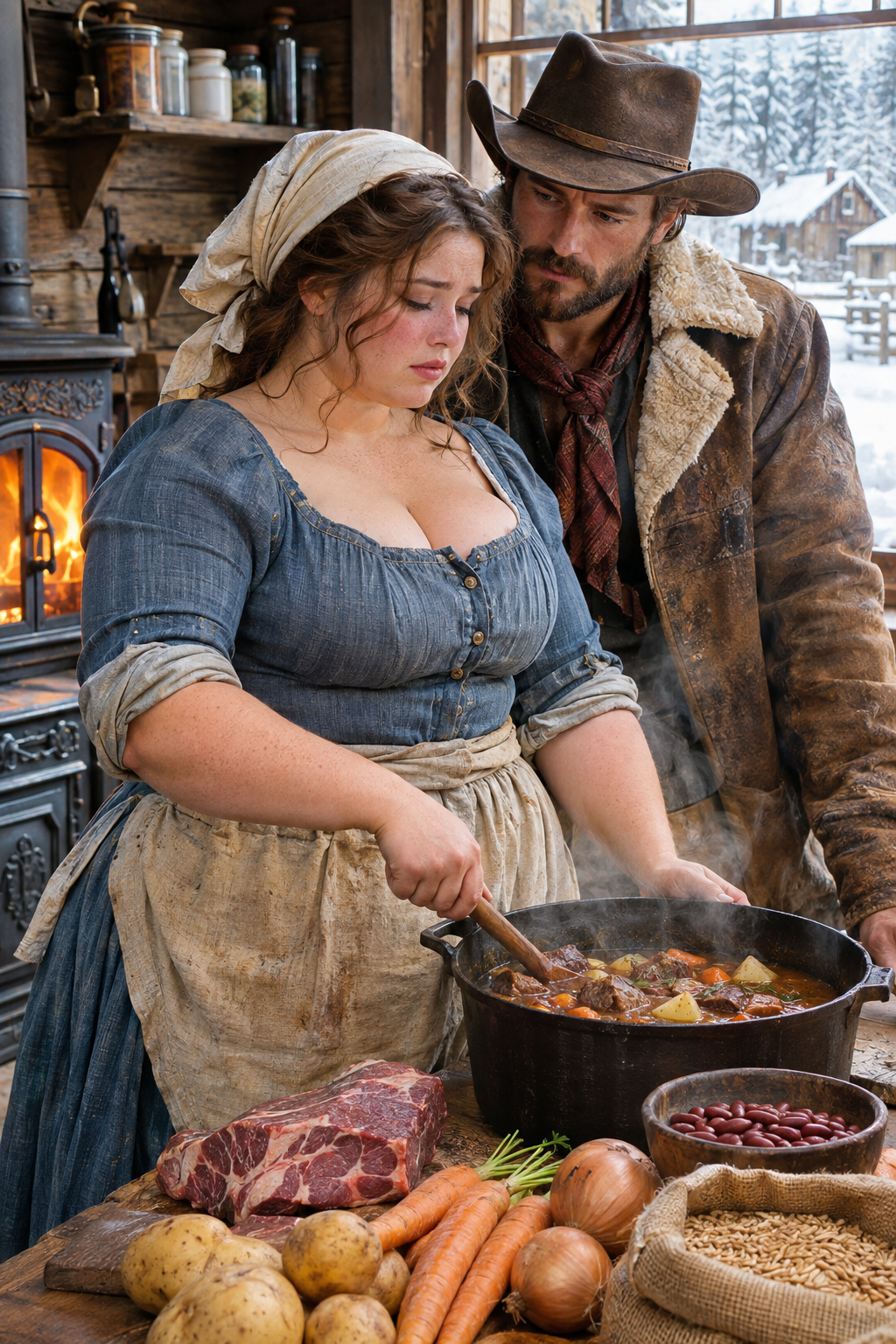
And a secret worth killing for.
She hurried to find Samuel.
But halfway down the hallway, she heard two men arguing behind the dining room door.
One voice belonged to Thomas Reed.
The other belonged to the man who had accused her of stealing food.
His name was Caleb Voss.
“You should’ve left it alone,” Caleb hissed.
Thomas answered sharply.
“There’s thirty men involved, Caleb. Somebody’s going to figure it out.”
“Not if Mercer keeps his mouth shut.”
Abigail stopped breathing.
Thomas lowered his voice.
“He might die.”
“Then he dies.”
A chair scraped against the floor.
Abigail moved away just as the door opened.
Caleb stepped into the hallway.
His eyes narrowed when he saw her.
“How long have you been standing there?”
“Long enough to know Mr. Mercer’s fever is getting worse.”
Caleb studied her face.
Then he gave a thin smile.
“Best get back to your kitchen, Miss Turner.”
Abigail said nothing.
But as he passed, she noticed something protruding from his coat pocket.
A small brass key attached to a leather tag.
Stamped into the leather were two words.
WILLOW CREEK.
She understood then that the greatest danger inside Hollow Pine Ranch might not be the storm.
It might be one of the men they had welcomed through the door.
By midnight, the men outside returned with lengths of stovepipe.
One had frostbite beginning on two fingers. Another had fallen through a hidden drift and nearly suffocated.
Still, they carried enough iron to make the old stove usable.
Samuel and Thomas began repairing it.
Abigail wanted to confront Samuel about what she had overheard, but Caleb remained near the dining room, watching everyone.
She waited until he went upstairs.
Then she approached Thomas.
“Mr. Reed, I heard your conversation.”
His hammer stopped.
“Which conversation?”
“The one about Daniel Mercer.”
Thomas glanced toward the doorway.
“Keep your voice down.”
“What is in that wagon?”
He hesitated.
“Supplies.”
“And?”
Thomas swallowed.
“A locked iron chest.”
Abigail felt her stomach tighten.
“What’s inside?”
“I don’t know.”
“Then why is Mr. Mercer afraid?”
Thomas set down the hammer.
“Because three nights before the storm, someone sabotaged his wagon. Cut the brake line while we were crossing a steep ridge. Mercer nearly died stopping it.”
“Who did it?”
“I think Caleb knows.”
“Why haven’t you told the others?”
“Because Caleb has friends among the drivers. And because I have no proof.”
Abigail looked toward the staircase.
“Then we’ll have to find some.”
At dawn, the storm finally weakened.
Not enough to make travel safe, but enough that the mountains became faint shadows beyond the blowing snow.
The repaired stove was burning, and for the first time in two days, the dining room smelled of warm food.
Abigail should have felt relieved.
Instead, she found Samuel standing outside Daniel’s room, his face grave.
“He’s getting worse.”
Daniel’s fever had climbed through the night. His injured leg was hot and swollen, and red streaks were beginning to spread above the wound.
Abigail knew what that meant.
Infection.
Without proper treatment, he could lose the leg.
Or his life.
She told Samuel about the supply wagon and the medicine Daniel had mentioned.
Samuel listened without interrupting.
When she finished, he reached for his coat.
“Where is it?”
“Near Willow Creek.”
“That’s eight miles through deep snow.”
“I know.”
“We’ll need horses.”
“The horses can barely get through the yard.”
Samuel stared out the window.
Then his expression changed.
“The old freight sled.”
Abigail remembered it immediately.
The sled had been used years earlier to haul timber from the northern woods. Its runners were heavy, but it could travel over snow if pulled by strong horses.
Within an hour, Samuel, Thomas, and two ranch hands were preparing to leave.
Abigail joined them in the stable.
Samuel looked startled.
“Absolutely not.”
“Daniel told me where to look.”
“You told me everything he said.”
“Not everything.”
That wasn’t entirely true, but Abigail had learned how to be stubborn from six Wyoming winters.
Samuel shook his head.
“You can barely stand after starving yourself.”
“And you can barely ride after that shoulder injury last autumn.”
Thomas hid a smile.
Samuel sighed.
“Fine. But you’ll stay on the sled.”
They were securing the harness when Caleb appeared.
“Where are you going?”
Samuel answered calmly.
“Looking for supplies.”
Caleb’s expression hardened.
“Where?”
“Willow Creek.”
For an instant, something dangerous flashed in Caleb’s eyes.
Then he laughed.
“You’ll never find anything out there. Mercer’s wagon went over a cliff.”
“We’d like to see for ourselves,” Abigail said.
Caleb moved closer.
“Miss Turner, you’re making a mistake.”
Samuel stepped between them.
“Then it’ll be ours to make.”
They left before Caleb could reply.
The journey was worse than anyone expected.
Snow reached the horses’ bellies. Windblown drifts concealed rocks and fallen branches. Twice, Thomas had to climb down and clear the runners.
Abigail’s hands grew numb inside her gloves.
But she kept searching the banks of the frozen creek.
Daniel had said the wagon was hidden near three crooked pines.
After nearly three hours, she spotted them.
“Over there!”
The trees rose from a narrow ravine.
Beneath their branches, a dark shape protruded from the snow.
They hurried toward it.
The wagon lay tilted against a fallen tree, half buried but intact.
Thomas climbed onto the driver’s seat.
“Someone covered this with pine branches.”
Samuel pulled back a canvas sheet.
Underneath were sacks of flour, barrels of salt pork, dried apples, coffee, candles, and medical supplies.
Enough food to sustain everyone until the roads reopened.
Abigail nearly wept with relief.
Then Thomas found the iron chest.
It was bolted beneath the wagon bed.
The lock was strong.
Samuel tried breaking it with a crowbar, but the iron refused to yield.
Abigail remembered the brass key in Caleb’s pocket.
“He has the key,” she whispered.
Samuel turned.
“Who?”
“Caleb Voss.”
Before she could explain, a rifle shot shattered the silence.
One of the horses screamed.
Thomas dropped behind the wagon.
Another bullet struck the wood beside Samuel’s head.
From the ridge above them, Caleb Voss emerged through the snow, holding a Winchester rifle.
“Step away from the chest!”
Abigail’s blood turned cold.
Caleb had followed their tracks.
Samuel raised his hands.
“Caleb, put that gun down.”
“Don’t tell me what to do.”
Thomas cautiously reached for his revolver.
Caleb aimed at him.
“Touch it and you’re dead.”
The wounded horse struggled against its harness, pulling the sled sideways.
Abigail saw the animal’s frightened eyes and realized the entire load could slide into the creek.
She moved slowly toward the reins.
Caleb shouted.
“Stay where you are!”
“I’m trying to keep the horse from killing itself!”
For one suspended moment, their eyes met.
Caleb looked frightened.
Not angry.
Desperate.
“What’s in the chest?” Abigail asked.
“Something that belongs to me.”
“Then why did you try to kill Daniel?”
Caleb’s jaw tightened.
“Mercer stole from me first.”
Thomas shouted from behind the wagon.
“That’s a lie!”
Caleb swung the rifle toward him.
At that instant, the injured horse lunged.
The sled jerked violently.
Abigail seized the reins, but the leather snapped tight around her wrist.
She lost her footing.
The next thing she knew, she was sliding down the snowy bank toward the frozen creek.
“Abigail!”
Samuel ran toward her.
A rifle cracked.
Samuel stumbled and fell.
For one terrible second, Abigail believed he had been shot.
Then she saw blood spreading across his sleeve.
She screamed his name.
Caleb hesitated.
That hesitation saved them.
Thomas sprang from behind the wagon, struck Caleb’s rifle with the crowbar, and sent the weapon tumbling into the snow.
The two men crashed together.
Abigail clawed her way back up the bank while Samuel struggled to stand.
Caleb pulled a knife.
Thomas caught his wrist.
They wrestled dangerously close to the ravine.
Then the snow beneath Caleb’s feet collapsed.
He fell backward.
His scream disappeared into the creek bed below.
Silence followed.
Thomas stood breathing hard.
Samuel pressed his hand against his bleeding arm.
Abigail hurried to the edge.
Caleb lay fifteen feet below, one leg twisted unnaturally beneath him.
He was alive.
But the ice around him was beginning to crack.
Thomas looked down.
“Leave him.”
Abigail stared at him.
“He’ll freeze.”
“He tried to murder us.”
“I know.”
“He nearly killed Samuel.”
“I know that too.”
She grabbed a coil of rope from the sled.
Thomas caught her arm.
“Don’t be foolish.”
Abigail looked into the ravine.
Caleb was staring up at her, his face white with terror.
She remembered the hungry man who had accused her of stealing food.
She remembered his apology.
And she understood something that frightened her.
It was easy to show mercy when kindness cost nothing.
The true test came when the person needing mercy had done nothing to deserve it.
“Help me,” she said.
Thomas hesitated.
Then Samuel placed his uninjured hand on the rope.
Together, they lowered a loop toward Caleb.
Twice, he failed to catch it.
The third time, he wrapped it beneath his arms.
They pulled until their muscles burned.
At last, Caleb collapsed onto solid ground.
Abigail knelt beside him.
He stared at her in disbelief.
“Why?”
She tightened the rope around his injured leg to secure a makeshift splint.
“Because I won’t let you decide what kind of person I become.”
They tied Caleb’s hands, treated Samuel’s wound, and loaded the supplies.
The journey home took nearly five hours.
By the time Hollow Pine Ranch appeared through the snow, darkness was falling.
The men waiting at the door erupted into cheers when they saw the food.
But the cheering stopped when they noticed Caleb bound to the sled.
Samuel ordered everyone into the dining room.
There, beside the newly repaired stove, he told them what had happened.
Caleb remained silent.
Thomas placed the iron chest on the table.
Then Abigail stepped forward holding the brass key she had taken from Caleb’s pocket.
She unlocked the chest.
Inside were bundles of banknotes, land deeds, and a thick leather ledger.
Samuel opened the ledger.
His expression darkened.
The documents revealed that Caleb had been collecting money from cattle owners for livestock that had already been sold.
He had falsified delivery records, taken payments under different names, and concealed thousands of dollars.
Daniel Mercer had discovered the fraud while reviewing the trail accounts.
The night before the blizzard, he confronted Caleb.
The damaged wagon was no accident.
Caleb had tried to destroy the evidence and silence the man who found it.
A murmur of outrage spread through the room.
Several drivers surged toward Caleb.
Thomas stepped in front of them.
“Enough!”
One man shouted.
“He deserves to hang!”
Abigail raised her voice.
“And who among us has been appointed judge?”
The room quieted.
She stood beside the table, exhausted, pale, and trembling.
“This man must answer for what he’s done. But if we become murderers because we’re angry, we’ll have lost something no court can return.”
Samuel nodded.
“We’ll take him to the sheriff when the roads open.”
Caleb lowered his head.
For the first time, he had no answer.
The medicine from the wagon changed everything for Daniel.
Abigail cleaned his wound with proper supplies while Samuel and Thomas helped keep him still.
The wound needed more care than she could provide, but they were able to dress it, immobilize his leg, and keep him warm.
For two more days, his fever rose and fell.
Abigail barely slept.
Then, on the third morning, Daniel opened his eyes and asked for breakfast.
She laughed so suddenly that tears spilled down her cheeks.
“That’s the most beautiful thing I’ve heard all week.”
By then, the storm had ended.
Sunlight poured across the snow, turning the fields into dazzling sheets of white.
Smoke rose steadily from the ranch chimney.
For the first time since the cattle drivers arrived, nobody went hungry.
Yet Abigail felt no peace.
Her lease deadline had passed.
The boarding house was gone.
That evening, Samuel found her sitting alone near the kitchen window, holding Caldwell’s letter.
He pulled out the chair opposite her.
“I owe you an apology.”
She didn’t look up.
“You already said that.”
“Not the kind you deserve.”
He folded his hands.
“When my wife died, this ranch became a place filled with memories I couldn’t bear to face. I let everything fall apart. The accounts, the house, even the people who depended on me.”
Abigail remained quiet.
“Then you came here. You made it a home again.”
His voice grew rough.
“I grew accustomed to needing you. So accustomed that when I learned you wanted to leave, I felt as though I was losing my family all over again.”
“You should have told me.”
“I should have handed you that letter the moment it arrived.”
“Yes.”
“I was selfish, Abigail.”
She finally looked at him.
Samuel’s eyes were wet.
“I thought if I gave you enough reasons to stay, eventually you’d stop dreaming of leaving.”
Abigail placed the letter on the table.
“You know what hurts most?”
He shook his head.
“I would have stayed through the storm even if you’d given me the letter. I would never have abandoned these people.”
“I know that now.”
“No, Samuel. You knew it before. You simply didn’t trust me to make the choice.”
He accepted the words without defending himself.
Then he took another envelope from his coat.
“This belongs to you.”
Inside was a bank draft.
Abigail stared at the amount.
It was far more than the money she had lost.
“What is this?”
“Six years of wages I should have paid you, including work you did beyond your original duties. I went through the accounts with Thomas.”
“Samuel, I—”
“It’s not charity. It’s yours.”
Her eyes filled.
“But it won’t bring back the boarding house.”
“No,” he said gently. “It won’t.”
The next morning, a rider arrived from Laramie.
The roads had finally become passable.
He brought mail, news, and a surprising letter addressed to Abigail Turner.
It was from Mr. Caldwell.
She opened it with shaking fingers.
His letter explained that the other prospective tenant had withdrawn.
However, the boarding house’s owner had decided to sell the property outright rather than continue leasing it.
The asking price was nearly twice what Abigail had saved.
Her heart sank again.
Then she read the final paragraph.
The owner was willing to accept an installment arrangement if a reliable guarantor could be found.
Abigail looked up.
Samuel stood nearby.
“What’s wrong?”
She handed him the letter.
He read it carefully.
Then he smiled.
“Perhaps we should discuss your future again.”
Abigail almost laughed.
“Not another secret, I hope.”
“No more secrets.”
He laid the letter on the table.
“I’ll guarantee the payments.”
She shook her head immediately.
“I can’t ask you to do that.”
“You didn’t.”
“Samuel—”
“And I won’t ask you to remain here in return.”
Her expression softened.
He continued.
“But I do have one request.”
“What is it?”
“When your boarding house opens, save an occasional room for an old rancher who doesn’t know how to cook.”
Abigail laughed through her tears.
“You’ll have to pay like everyone else.”
“I wouldn’t dream of anything else.”
Three weeks later, the men of Hollow Pine Ranch gathered in the yard to say goodbye.
Daniel Mercer, recovering slowly with the help of a doctor summoned after the roads cleared, sat in a wagon with his leg carefully supported.
Caleb Voss had been taken into custody by the county sheriff. The stolen money and records were now evidence, and several cattle owners had begun the difficult process of recovering their losses.
Thomas Reed stepped forward carrying a wooden box.
“We made something for you.”
Abigail opened it.
Inside was a small brass plaque, polished until it shone.
Engraved across its surface were the words:
THE TABLE IS BIGGER WHEN WE MAKE ROOM FOR ONE ANOTHER.
Beneath the inscription were twenty-nine signatures.
Abigail traced the letters with her fingertips.
“I don’t know what to say.”
Thomas smiled.
“Good. You’ve been telling us what to do for three weeks. It’s nice to have a little silence.”
Everyone laughed.
Then Daniel spoke.
“Miss Turner, those men came here cold, hungry, and afraid. Some of us behaved worse than we should have.”
His eyes moved toward the doorway where Caleb had once accused her.
“You fed us when you had almost nothing. You protected a man who didn’t deserve it. And you showed us that strength isn’t always about how hard a person can fight.”
He paused.
“Sometimes it’s about what they refuse to become.”
Abigail closed the box.
For a moment, she couldn’t speak.
Then she embraced Samuel.
He held her tightly.
“You’ll do well,” he whispered.
“So will you.”
He shook his head with a smile.
“Only if I find someone who can keep my stove from exploding.”
Six months later, the first snow of winter began falling over Laramie.
On a quiet street near the railway station stood a freshly painted building with green shutters and warm yellow light spilling through its windows.
Above the entrance hung a wooden sign.
TURNER HOUSE.
ROOMS, MEALS, AND A PLACE TO REST.
Inside, Abigail moved between tables carrying a steaming pot of beef stew.
Her boarding house had opened three months earlier.
Business was modest but steady.
Railway workers, traveling merchants, widowed farmers, and families crossing Wyoming had already begun calling it the kindest establishment in town.
There were rules, of course.
Guests had to pay their bills.
They had to respect one another.
And no one was permitted to insult the cook.
But Abigail had established one additional rule that puzzled some visitors.
Every evening, one place at the dining table remained empty until the meal began.
When a guest finally asked about it, she explained simply.
“That’s for someone who might need it.”
One freezing December evening, just as she was preparing to close the front door, a boy appeared on the porch.
He couldn’t have been more than twelve.
His boots were split.
His coat was too thin.
And he held a small cloth bundle against his chest.
“Ma’am,” he whispered, “is there any work I can do for a meal?”
Abigail looked past him.
Snow was falling hard.
“What’s your name?”
“Eli.”
“Where are your parents?”
The boy lowered his eyes.
“My mother died in September. My father went looking for work. He hasn’t come back.”
Abigail felt an old ache stir in her chest.
She remembered being young, frightened, and desperate for a place where she belonged.
“How long since you’ve eaten?”
“Yesterday.”
She opened the door wider.
“Then you’d better come inside before the stew gets cold.”
The boy hesitated.
“I don’t have money.”
“I didn’t ask for money.”
“But I don’t want charity.”
Abigail smiled gently.
“Neither did I, once.”
She led him toward the dining room.
On the wall beside the stove hung the brass plaque from Hollow Pine Ranch.
Eli stopped to read it.
“What does that mean?”
Abigail looked at the words, remembering the blizzard, the hungry men, the broken stove, and the terrible moment when she had nearly lost hope.
“It means,” she said, “that helping someone doesn’t always make us poorer.”
She pulled out the empty chair.
“Sometimes it reminds us how much we truly have.”
Eli sat down.
For the first time since entering, he smiled.
The following morning, Abigail offered him small jobs around the boarding house in exchange for wages, meals, and a warm room while they tried to learn what had happened to his father.
Eli accepted, insisting that he could chop wood better than any grown man.
Abigail laughed and promised to let him prove it.
As winter deepened, he became part of the household.
He repaired broken hinges, swept the porch, and learned to read from the newspapers guests left behind.
Every evening, he helped Abigail set the dining table.
And every evening, he placed one extra plate beside the window.
Then, one January afternoon, a familiar wagon rolled up outside Turner House.
Samuel Whitcomb climbed down, brushing snow from his shoulders.
Behind him came Thomas Reed and Daniel Mercer, now walking with a cane.
Abigail hurried to the doorway.
“What are you three doing here?”
Samuel grinned.
“Checking whether your establishment is respectable.”
“And?”
He glanced at the polished windows, the busy dining room, and the cheerful boy carrying firewood through the hallway.
“I think you’ve done better than respectable.”
Daniel presented her with a small package.
Inside was a silver key engraved with her initials.
“A proper spare key for a proper businesswoman,” he said.
Thomas leaned against the doorframe.
“And in case you haven’t noticed, we’re starving.”
Abigail folded her arms.
“Then you’ll have to earn your supper.”
Samuel laughed.
“Some things never change.”
But as they gathered around the table, Abigail realized how much had changed.
She had once believed independence meant never needing anyone.
She had spent years saving every coin, refusing assistance, and imagining that safety could be purchased with enough hard work.
The blizzard had taught her otherwise.
She had needed the men’s strength to repair the stove.
Samuel had needed her courage to face his own mistakes.
Daniel had needed mercy and care.
Even Caleb, guilty as he was, had needed someone to pull him from the ice.
None of them had survived alone.
And accepting help had not made Abigail less independent.
It had given her the freedom to build something greater than she could have created by herself.
That evening, snow covered the streets of Laramie.
Inside Turner House, laughter filled the dining room.
Eli passed fresh bread around the table while Samuel told an exaggerated story about how he had personally defeated the worst blizzard in Wyoming history.
Thomas interrupted him three times.
Daniel laughed until his injured leg began to ache.
And Abigail stood for a moment in the kitchen doorway, watching the people she loved.
The boarding house was hers.
Every chair, every window, every warm light shining into the winter darkness.
But its greatest treasure could never be measured in dollars.
It was the simple knowledge that whoever crossed her threshold would be treated as a human being before being judged as a stranger.
Years later, the people of Laramie would remember Turner House for its generous meals and welcoming rooms.
They would tell stories about the woman who had opened her door to exhausted travelers, helped lost children find their footing, and refused to let hardship make her heart bitter.
But Abigail never considered herself extraordinary.
Whenever someone praised her kindness, she would glance toward the brass plaque beside the stove and remember the night twenty-nine starving cattle drivers appeared at Hollow Pine Ranch.
She remembered how close everyone had come to disaster.
And she remembered the truth that had carried them through.
A person can lose money, opportunities, possessions, and even the future they once imagined.
Yet there is one thing hardship cannot take unless we surrender it willingly.
The choice to remain compassionate.
Because the greatest measure of a life is not how much we manage to keep for ourselves, but how much hope we leave in the hearts of those who cross our path.
And sometimes, the smallest act of kindness—a warm meal, an offered chair, a hand reaching into the cold—becomes the beginning of a future more beautiful than anything we had planned.
But Abigail’s story was not quite finished.
For all the warmth she had brought into the lives of strangers, there was still one person she had not been able to save.
And that person would return to her life on a bitter winter evening, carrying a secret that would test everything she believed about forgiveness.
It happened nearly two years after the great blizzard at Hollow Pine Ranch.
Turner House had become one of the busiest boarding establishments in Laramie. Abigail had hired two women to help with the cooking and laundry, and young Eli, now fourteen, had grown into a capable assistant who could handle everything from repairing furniture to keeping the accounts.
Samuel Whitcomb visited whenever ranch business brought him into town. Daniel Mercer had recovered enough to supervise another cattle drive, although he walked with a slight limp. Thomas Reed had married a schoolteacher and settled on a small piece of land outside Cheyenne.
Life had become peaceful.
Perhaps too peaceful.
One January evening, a stranger knocked on the boarding house door.
He was thin, exhausted, and wearing a coat that seemed several sizes too large. His beard was streaked with gray, and a deep scar crossed his left cheek.
Abigail opened the door.
“Can I help you?”
The man removed his hat.
For several seconds, neither spoke.
Then Abigail recognized him.
“Caleb?”
Caleb Voss lowered his eyes.
“I didn’t know where else to go.”
Abigail felt the cold air rushing through the doorway.
The last time she had seen him, he was being taken away in shackles for fraud, theft, and attempted murder.
“What are you doing here?”
“I was released six weeks ago.”
“How?”
“I served my sentence after the court considered the evidence and my confession. I’ve spent most of my time since then looking for work.”
He swallowed.
“Nobody wants to hire a convicted thief.”
Abigail remained motionless.
Caleb looked past her toward the warm dining room.
“I heard you sometimes helped people who had nowhere to go.”
“You nearly killed Samuel.”
“I know.”
“You tried to kill Daniel.”
“I know that too.”
“And you threatened me with a rifle.”
His face twisted with shame.
“There isn’t a morning I wake up without remembering it.”
Abigail studied him.
The arrogant man who had accused her of stealing food seemed to have vanished. In his place stood someone who looked as though life had stripped away every excuse he had ever made.
“I don’t expect forgiveness,” Caleb said. “I only hoped you might know someone willing to give me honest work.”
From behind Abigail, Eli appeared.
“Miss Abigail, is everything all right?”
Caleb glanced at the boy.
Something in his expression changed.
“Eli?”
The boy froze.
The bundle of firewood slipped from his arms.
“Pa?”
Abigail turned sharply.
The silence that followed seemed to swallow the entire house.
Eli stared at the stranger as if afraid that moving would make him disappear.
Then he rushed forward.
“Pa!”
Caleb dropped to his knees and caught his son in his arms.
He held him desperately, pressing his face against the boy’s hair.
“I looked everywhere,” Eli sobbed. “I thought you were dead.”
Caleb’s shoulders shook.
“I know, son. I’m sorry. I’m so sorry.”
Abigail stepped back, one hand covering her mouth.
She had known that Eli’s father had disappeared after his mother’s death.
She had never known his name.
The boy had always spoken of him simply as Pa.
And Caleb, in all their terrible encounters, had never mentioned having a child.
Suddenly, the past looked different.
Not less terrible.
But far more complicated.
That night, after Eli had fallen asleep upstairs, Abigail and Caleb sat across from each other in the empty dining room.
Caleb told her everything.
His wife had died shortly before he joined the cattle drive. Desperate to provide for his son, he had begun stealing from his employers, telling himself he would replace the money once he made a fortune.
But one theft had led to another.
Soon, he was falsifying records and hiding payments.
When Daniel discovered the fraud, Caleb panicked.
“I convinced myself that if I lost the money, I’d lose my boy too,” he said.
He stared at his hands.
“Instead, I nearly lost my soul.”
Abigail listened quietly.
“Why didn’t you tell anyone about Eli?”
“Because I was ashamed. And because, by the time I understood what I’d done, I couldn’t bear the thought of him knowing.”
He looked toward the staircase.
“Does he know?”
“Only that his father disappeared.”
Caleb closed his eyes.
“Then he deserves the truth.”
“Yes,” Abigail answered. “He does.”
The following morning, Caleb told Eli about his crimes and imprisonment.
The boy listened without speaking.
When his father finished, Eli stood and walked outside.
Caleb started after him, but Abigail stopped him.
“Give him time.”
“He hates me.”
“He’s hurt. That’s different.”
For the next two days, Eli barely spoke to his father.
Caleb remained at Turner House, sleeping in a small room near the kitchen and working without pay to cover his meals.
He chopped firewood, repaired the stable roof, and cleaned the snow from the walkway before sunrise.
Abigail watched him carefully.
She did not trust him.
Not yet.
But she understood that a person who had done wrong needed more than punishment to change.
He needed an opportunity to prove that he could live differently.
On the third evening, Eli approached her while she was preparing bread.
“Miss Abigail?”
“Yes, dear?”
“Do you think a bad man can become good?”
Abigail set down the dough.
“I think people can change. But saying they’ve changed is easy. Proving it takes time.”
“Did my father ever do anything good?”
She considered the question.
“He loved you,” she said. “But love alone doesn’t excuse what he did.”
Eli nodded slowly.
“I’m angry with him.”
“You have every right to be.”
“But I still missed him.”
“You’re allowed to feel both.”
The boy looked toward the window, where Caleb was carrying another load of firewood through the snow.
Then he whispered, “I don’t want to lose him again.”
Abigail placed a gentle hand on his shoulder.
“Then perhaps the two of you can begin again. Not by pretending the past didn’t happen, but by deciding what kind of future you want to build.”
Over the following months, Caleb worked harder than anyone at Turner House.
Abigail paid him fair wages once he had earned enough to settle his board. He saved most of what he received, sending payments toward the debts that remained from his crimes.
He never complained about difficult work.
He never asked Abigail to forget what he had done.
And slowly, Eli began speaking to him again.
First about the weather.
Then about the horses.
Eventually, about everything.
One spring morning, Abigail found father and son repairing a broken fence behind the boarding house.
Eli was laughing at something Caleb had said.
The sound stopped her in her tracks.
For years, Abigail had believed that her greatest achievement was building a place where hungry people could find food and exhausted travelers could find rest.
But now she understood that Turner House had become something more.
It was a place where broken lives could be repaired.
Not magically.
Not without consequences.
But through patience, honesty, responsibility, and the courage to begin again.
That summer, Samuel Whitcomb arrived with surprising news.
He had decided to retire from running Hollow Pine Ranch.
“I’ve spent forty years fighting Wyoming winters,” he announced over supper. “I believe I’ve earned the right to sit beside a warm stove and complain about them instead.”
Abigail laughed.
“And what will become of the ranch?”
Samuel smiled.
“I’ve found someone who knows how to take care of it.”
He handed her a legal document.
Abigail unfolded it.
Her eyes widened.
Samuel had arranged for the ranch to be transferred into a small partnership.
The partners were Thomas Reed, Daniel Mercer, and Abigail Turner.
She looked up in astonishment.
“Samuel, I can’t accept this.”
“You already helped save it once.”
“But I have Turner House.”
“And you’ll keep it. Daniel and Thomas will manage the ranch. You’ll oversee the accounts and receive your share of the profits.”
Abigail shook her head, overwhelmed.
“Why would you do this?”
Samuel’s expression softened.
“Because years ago, I tried to keep you at Hollow Pine by hiding a letter. I thought your success meant losing you.”
He paused.
“Now I know that helping someone grow doesn’t mean losing them. Sometimes it means becoming part of something greater.”
Abigail reached across the table and took his hand.
“Thank you.”
Samuel winked.
“Besides, somebody has to make sure those two fools don’t spend all the profits on new horses.”
Their laughter filled the dining room.
Years passed.
Eli grew into a fine young man and eventually took over much of the daily management of Turner House. Caleb continued working beside him, quietly rebuilding the trust he had once destroyed.
Thomas and Daniel turned Hollow Pine Ranch into a prosperous cattle operation.
Samuel spent his retirement traveling between the ranch and Laramie, usually arriving at Abigail’s door with a ridiculous complaint about the weather and an enormous appetite.
And Abigail?
She never married.
Not because she feared love, but because she had discovered that a meaningful life could take many forms.
Her family was not bound together by blood alone.
It consisted of people who had chosen one another through hardship, loyalty, forgiveness, and gratitude.
On her seventieth birthday, the dining room of Turner House was filled with guests.
There were ranchers, railway workers, teachers, merchants, former employees, and children who had once arrived at her door with nothing.
Eli, now a grown man with children of his own, stood to make a speech.
“When I first came here,” he began, “I thought I was asking for a meal.”
He looked toward Abigail.
“But what I really needed was someone to believe my life could become better.”
The room grew quiet.
“Miss Abigail gave me food. Then she gave me work. Then she gave me something I had almost forgotten existed.”
He paused.
“Hope.”
Abigail wiped her eyes.
Eli continued.
“She taught me that kindness isn’t the same as weakness. Forgiveness isn’t the same as forgetting. And helping another person doesn’t mean allowing them to hurt you.”
He glanced toward his father, whose hair had turned completely white.
“She also taught me that a person should never be judged only by the worst thing they’ve ever done, provided they’re willing to take responsibility and change.”
Caleb lowered his head, overcome with emotion.
Eli raised his glass.
“To Abigail Turner. The woman who always kept one extra chair at her table.”
Everyone stood.
The applause seemed to last forever.
Later that evening, after the guests had departed, Abigail remained alone in the dining room.
The fire burned softly.
The old brass plaque still hung beside the stove.
Its inscription had faded with age, but every word remained visible.
THE TABLE IS BIGGER WHEN WE MAKE ROOM FOR ONE ANOTHER.
Abigail ran her fingers across the letters.
She thought of that terrible winter night at Hollow Pine Ranch.
The broken stove.
The starving men.
Samuel’s frightened face when she fainted.
Caleb’s accusation.
Daniel’s fever.
The hidden wagon.
And the moment she had reached into the frozen ravine to save a man who had tried to destroy her.
At the time, she had believed she was simply doing what needed to be done.
She had never imagined that those choices would shape so many lives.
Eli appeared in the doorway.
“Are you tired, Miss Abigail?”
“A little.”
“Shall I put out the fire?”
“Not yet.”
He approached her.
“What are you thinking about?”
She smiled.
“How strange life is.”
“In what way?”
“When I was young, I thought happiness meant having enough money that I would never need anyone’s help.”
“And now?”
Abigail looked around the room.
At the worn wooden tables.
At the chairs polished by generations of travelers.
At the photographs of people who had come and gone.
“Now I think happiness means building a life where people are willing to help one another.”
Eli sat beside her.
“Do you ever regret what happened at Hollow Pine?”
She thought carefully.
“I regret the suffering. I regret that people were hurt. And I wish some things had been different.”
“But?”
“But I don’t regret choosing kindness when cruelty would have been easier.”
Outside, snow began falling over Laramie.
Abigail watched the flakes drift past the window.
Then she noticed a solitary figure walking slowly along the street.
A young woman.
She carried a small suitcase and wore a threadbare shawl around her shoulders.
Even from a distance, Abigail could see that she was exhausted.
The woman stopped beneath the Turner House sign.
For a moment, she hesitated.
Then she raised her hand and knocked.
Eli started toward the door.
But Abigail gently touched his arm.
“Let me.”
She rose carefully from her chair and crossed the familiar room.
When she opened the door, the young woman looked at her with frightened eyes.
“I’m sorry to disturb you so late,” she said. “Someone told me this was a place where a person could find help.”
Abigail smiled.
Behind her, the fire glowed warmly.
A pot of soup remained on the stove.
And beside the dining table stood one empty chair.
“You’ve come to the right place,” Abigail said.
She opened the door wider.
“Come inside.”
And so the story that had begun with twenty-nine starving cattle drivers in a Wyoming blizzard continued through another winter, another stranger, and another simple act of compassion.
Because Abigail Turner had learned something the harshest storms could never teach through suffering alone.
We cannot control every hardship that enters our lives.
We cannot prevent every betrayal, every loss, or every painful mistake.
But we can choose what those experiences make of us.
We can allow suffering to harden our hearts, or we can use it to understand the suffering of others.
We can spend our lives guarding what little we possess, or we can discover that generosity often creates riches money cannot buy.
And we can remember that redemption does not erase the past, but it can give the future a different ending.
Abigail’s greatest legacy was never the boarding house, the ranch partnership, or the money she eventually earned.
It was the countless people who learned, because of her, to open their own doors when someone came knocking.
For a warm meal may save a person for a night.
A helping hand may save them for a season.
But a kindness that restores someone’s faith in humanity can change the course of an entire life.
And sometimes, that kindness continues long after the person who first offered it is gone.
THE END.