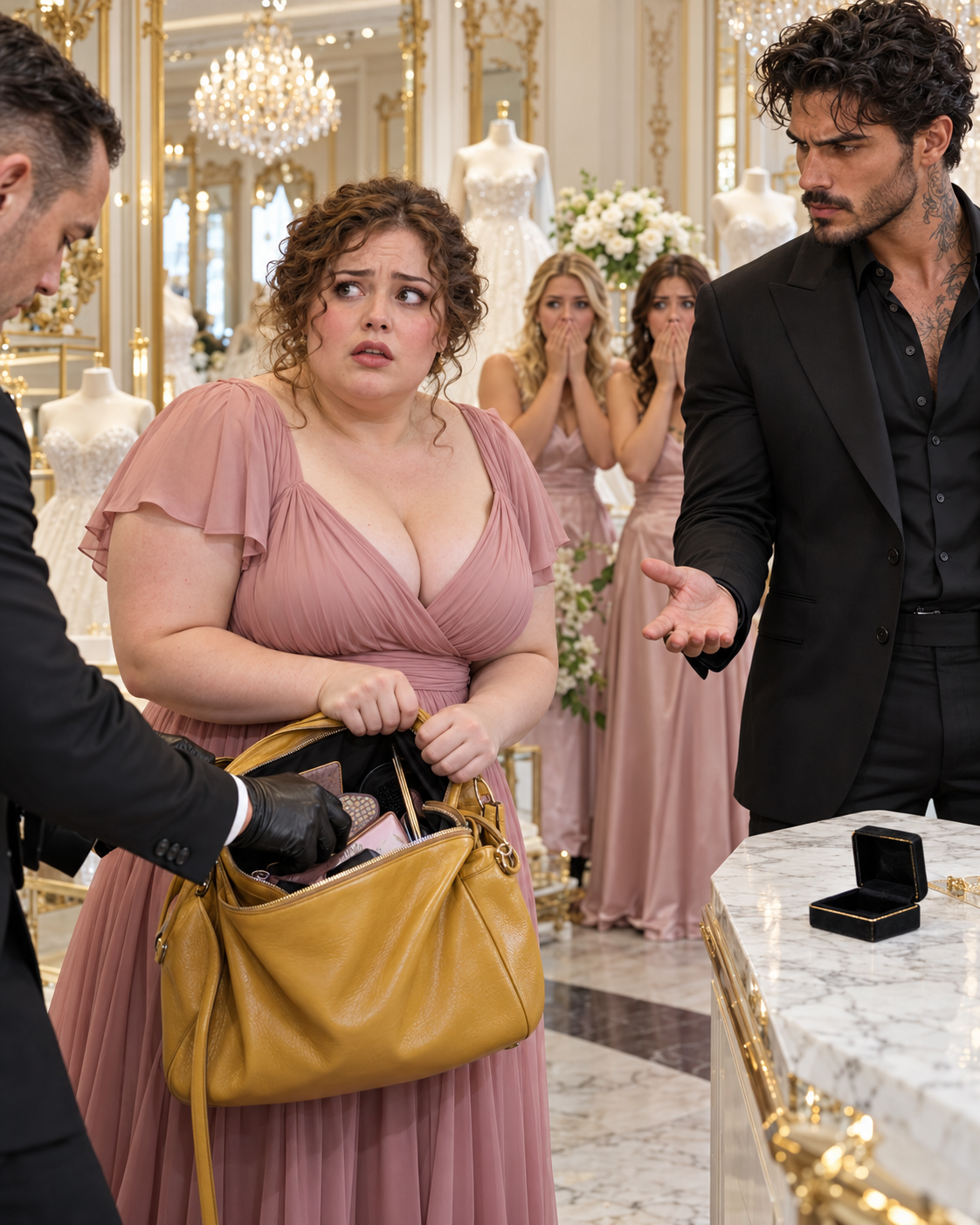
The most humiliating moment of Serena Sinclair’s life happened at her best friend’s wedding, surrounded by hundreds of guests in one of New York’s most elegant venues.
The name flashing across Damiano Vachelli’s phone was one he hadn’t expected to see that morning.
His cousin, Lorenzo Vachelli.
The same man whose wedding had turned Serena Sinclair’s life upside down.
Damiano answered, still standing beneath the damaged awning of Serena’s Brooklyn bakery, while the morning rain continued falling around them.
“Damiano, we have a problem,” Lorenzo said, his voice unusually strained.
“What kind of problem?”
“The security footage from the wedding. Someone finally recovered the missing recordings.”
Damiano’s expression hardened.
For weeks, he had believed that the disappearance of the ruby cameo had been an unfortunate misunderstanding, one that had exposed the ugliest side of his own judgment.
But Lorenzo’s next words made him realize the truth might be considerably worse.
“The footage shows someone placing the brooch behind that antique mirror.”
Damiano straightened.
“Who?”
There was a long silence.
“Your uncle’s personal assistant, Claudia Moretti.”
Damiano felt the world around him shift.
Claudia had worked for the family for nearly fifteen years.
She had organized charity galas, managed private schedules, and carried enough family secrets to destroy several reputations.
More importantly, she had been the first person to suggest that Serena might have taken the brooch.
“Where is Claudia now?” Damiano asked.
“We don’t know. She resigned yesterday, and this morning her apartment was empty.”
Damiano ended the call slowly.
When he looked up, Serena was watching him with an expression that was cautious but undeniably curious.
“Something happened,” she said.
He hesitated.
The old Damiano would have handled the matter privately, protected the family name, and decided what Serena needed to know.
But that man had already cost him the respect of someone whose opinion had unexpectedly begun to matter.
“There may be evidence that you were deliberately framed at Mia’s wedding,” he admitted.
Serena’s fingers tightened around the edge of her apron.
For several seconds, she didn’t speak.
Then she asked a question that seemed painfully simple.
“By whom?”
“Claudia Moretti. She worked for my family.”
Serena stared at him.
“The woman who pointed at me?”
Damiano nodded.
“The same woman.”
A bitter laugh escaped Serena’s lips.
“Of course.”
“Serena—”
“No,” she interrupted, shaking her head. “Do you understand what that means?”
He remained silent.
“It means someone decided I was convenient enough to sacrifice, and everyone else followed along because I didn’t belong in their world.”
Her voice trembled, but she refused to let the tears gathering in her eyes fall.
“I wasn’t wearing diamonds. I wasn’t someone’s wealthy daughter. I was just the girl who brought the wedding cake.”
Damiano felt every word land exactly where it deserved.
“You were Mia’s best friend,” he said quietly.
“I was also a guest,” Serena replied. “And I deserved to be treated like one.”
He lowered his gaze.
“You’re right.”
She looked almost surprised by his immediate agreement.
But before either could speak again, Lucy opened the bakery door.
“Serena, the ovens are ready, and Mrs. Henderson is asking whether we have the almond croissants today.”
Serena turned toward the familiar warmth of her bakery.
There were customers waiting, bills to pay, and a life that could not stop simply because a powerful family had finally discovered the truth.
“I have work to do, Damiano.”
“I understand.”
He stepped away from the doorway.
But just before he reached his car, Serena called after him.
“If you find out what really happened, I want to hear it from you.”
Damiano turned.
“You will.”
And for the first time, he understood that keeping a promise to Serena would require more than good intentions.
It would require courage.
By noon, the Vachelli family mansion on Long Island had become a battlefield of whispered accusations and carefully concealed panic.
Damiano entered his uncle Vittorio’s study to find Lorenzo pacing beside an enormous mahogany desk.
Mia sat near the window, her wedding ring catching the afternoon light.
She looked exhausted.
“I should have stopped them,” Mia said the moment Damiano entered.
“You tried,” Lorenzo reminded her.
“Not hard enough.”
Damiano didn’t argue.
Because neither had he.
Vittorio Vachelli stood beside the fireplace, looking older than his sixty-eight years.
“The footage is clear,” he announced. “Claudia removed the cameo from its display case and hid it behind the mirror.”
“Why?” Damiano demanded.
Vittorio hesitated.
“That’s what we’re trying to determine.”
Lorenzo placed a tablet on the desk.
“There’s something else.”
The recording showed Claudia moving through a side corridor shortly before the brooch was reported missing.
She stopped near a service entrance, spoke briefly to someone outside the camera’s view, and then returned to the ballroom.
Seconds later, she approached Damiano and whispered something into his ear.
Damiano remembered the moment perfectly.
The missing heirloom.
The uncertainty.
Claudia’s suggestion that a young woman carrying a large handbag had been seen near the display.
And his own unforgivable decision.
He had never asked for evidence.
He had simply issued an order.
“We need to bring this recording to the police,” he said.
Vittorio’s jaw tightened.
“Damiano, think carefully. This family has spent generations building its reputation.”
“Then perhaps it’s time we started behaving like people who deserve one.”
The room fell silent.
Lorenzo slowly nodded.
Mia looked at Damiano with something resembling hope.
Vittorio turned away.
“Do what you believe is necessary.”
Two days later, the first newspaper article appeared.
It was buried in the local section of a New York publication, but the headline was impossible to misunderstand.
Wedding Guest Wrongly Accused as New Evidence Raises Questions About Missing Family Heirloom.
Serena saw the article while drinking coffee behind her bakery counter.
She read it twice.
Then a third time.
The report did not name her directly, but anyone who had attended the wedding would recognize the incident.
Within hours, her phone began ringing.
Former wedding guests sent awkward messages.
Some apologized.
Others offered explanations that sounded suspiciously like excuses.
One woman wrote that she had always known Serena was innocent.
Serena remembered that same woman watching silently while security searched her bag.
She deleted the message.
By the afternoon, an unfamiliar customer entered the bakery.
She was a well-dressed woman in her late fifties, carrying a designer handbag and wearing an enormous diamond ring.
“Are you Serena Sinclair?” she asked.
“Yes.”
The woman glanced around the modest shop.
“I attended the Vachelli wedding.”
Serena felt her stomach tighten.
“I see.”
“I wanted to tell you that the entire situation was terribly unfortunate.”
Serena waited.
The woman continued.
“Of course, when something valuable disappears, certain precautions are understandable.”
For a moment, the bakery seemed to grow very quiet.
Serena folded the towel in her hands.
“Ma’am, are you here to buy something?”
The woman blinked.
“Well, I thought you might appreciate hearing another perspective.”
“I’ve heard plenty of perspectives about why humiliating me was acceptable.”
The woman’s expression stiffened.
“That wasn’t what I meant.”
“Then perhaps you should think about what you mean before saying it.”
Lucy, who was arranging pastries nearby, pretended not to listen.
The customer left without purchasing anything.
When the door closed, Lucy grinned.
“That was incredible.”
Serena let out a tired breath.
“No. It was exhausting.”
Because defending her dignity was not something she wanted to spend the rest of her life doing.
She wanted to bake.
She wanted to laugh with Mia.
She wanted to wake up without remembering the sound of strangers opening her handbag.
And increasingly, she wanted to understand why Damiano Vachelli had become so difficult to forget.
He still visited the bakery.
Sometimes he arrived before sunrise.
Sometimes he came during the afternoon rush.
He never asked about the investigation unless Serena brought it up.
And he never tried to turn his visits into something more than she allowed.
One evening, after the last customer had left, Serena found him standing outside beneath the glowing streetlights.
“You’re late,” she observed.
Damiano glanced at his watch.
“I wasn’t aware I had an appointment.”
“You usually come in the morning.”
A small smile appeared.
“So you’ve noticed.”
Serena immediately regretted speaking.
“Don’t get comfortable.”
“I wouldn’t dream of it.”
She unlocked the door and stepped aside.
“You can have five minutes. I made too much coffee.”
Damiano followed her inside.
The bakery smelled of cinnamon, butter, and freshly baked bread.
It was nothing like the cold marble halls of his family’s estate.
Here, everything felt real.
The scratched wooden counters.
The handwritten menu.
The tiny photograph of Serena’s grandmother beside the cash register.
Damiano studied the picture.
“She taught you to bake?”
Serena followed his gaze.
“Everything I know.”
“She looks kind.”
“She was.”
Her voice softened.
“She used to say that bread tells you everything about the person making it.”
Damiano raised an eyebrow.
“How?”
“If you’re impatient, you rush the dough. If you’re careless, you forget the temperature. And if you don’t give it time to rise, you can’t blame it for turning out badly.”
He considered that.
“Your grandmother sounds wiser than most people I know.”
“She was also very good at knowing when someone was lying.”
Damiano gave a quiet laugh.
For the first time, Serena found herself smiling back.
It startled them both.
Then Damiano grew serious.
“The police located Claudia.”
Serena’s smile disappeared.
“Where?”
“In Connecticut. She’s cooperating with investigators.”
“And?”
Damiano hesitated.
“She claims someone paid her to create the incident.”
Serena set down her coffee cup.
“Someone paid her to accuse me?”
“Yes.”
“Who?”
“We don’t know yet.”
She shook her head slowly.
“I don’t understand. I barely knew anyone at that wedding.”
Damiano looked at her with an expression she couldn’t quite read.
“That’s what worries me.”
The following morning, Serena arrived at the bakery to find a white envelope pushed beneath the front door.
There was no return address.
Inside was a single sheet of paper.
Stay away from the Vachelli family. Some doors should remain closed.
Serena read the message twice before calling Damiano.
He arrived twenty minutes later, his expression darker than she had ever seen it.
“Did you touch anything else?” he asked.
“Only the envelope.”
“We should report this.”
“I already called the police.”
Damiano looked at her.
Serena crossed her arms.
“I learned something at that wedding, remember? I don’t need permission to protect myself.”
His expression softened.
“No. You don’t.”
The authorities collected the note, but Serena could not shake the uneasy feeling it left behind.
That evening, Mia came to the bakery carrying takeout from Serena’s favorite Chinese restaurant.
They sat together at a small table after closing.
“I miss us,” Mia admitted.
Serena looked up.
“Us?”
“Before the wedding. Before all of this.”
Serena swallowed.
“I miss that too.”
Mia reached across the table.
“I should have stood beside you.”
“You were trying to keep your wedding from falling apart.”
“That doesn’t excuse it.”
Serena stared at their joined hands.
For weeks, she had carried the hurt of seeing her closest friend surrounded by people who treated her as though she didn’t matter.
“I needed you that night, Mia.”
“I know.”
“I needed someone to say I wasn’t alone.”
Tears filled Mia’s eyes.
“You weren’t alone. I just failed to show you.”
There was no dramatic speech.
No perfect explanation.
Only two women who had known each other since college, trying to repair something precious.
Eventually, Serena squeezed Mia’s hand.
“I don’t want to lose you.”
Mia began crying.
“You won’t.”
For the first time since the wedding, Serena felt one part of her world settle back into place.
But the next revelation would shake everything again.
Three days later, Damiano received a call from Detective Rachel Morgan of the New York Police Department.
Claudia had finally explained who had approached her.
The person behind the scheme was not a stranger.
It was Adrian Bellamy, a wealthy real estate investor with longstanding business connections to the Vachelli family.
And his real target had never been the ruby cameo.
It had been Damiano.
Bellamy had been trying to pressure Damiano into approving a controversial redevelopment agreement involving several properties in Brooklyn.
Damiano had rejected the proposal months earlier because it would displace dozens of small businesses.
One of those properties stood on the very block where Serena’s bakery operated.
Bellamy knew that Damiano would attend Lorenzo’s wedding.
He also knew that a public scandal involving an ordinary guest could be used to embarrass the Vachelli family and weaken Damiano’s position.
Claudia had been promised a considerable payment for arranging the disappearance and quietly steering suspicion toward someone outside the family’s social circle.
Serena had been selected because she was carrying a large handbag filled with emergency wedding supplies.
She had simply been convenient.
But Bellamy’s plan had begun falling apart when the brooch was discovered earlier than expected.
The recovered footage, payment records, and Claudia’s statements had finally given investigators enough information to pursue the case.
Damiano listened to the detective in silence.
Then he asked the question that mattered most.
“Was Serena’s bakery specifically targeted?”
“We’re still establishing that,” Detective Morgan replied. “But Mr. Bellamy appears to have known about the business before the wedding.”
Damiano felt a cold weight settle in his chest.
Within the hour, he was standing inside Serena’s bakery.
She listened as he explained everything.
When he finished, Serena leaned against the counter, struggling to process what she had heard.
“So I was dragged into a business dispute involving people I didn’t even know?”
“It appears that way.”
“And my shop might be involved?”
“Possibly.”
Serena closed her eyes.
The bakery had been her grandmother’s dream.
It had become her own.
Every chipped tile, every secondhand oven, every handwritten recipe represented years of sacrifice.
She couldn’t imagine losing it.
Damiano stepped closer but stopped when he saw her expression.
“Serena, I want you to know that I’ll do everything legally possible to make sure your business is protected.”
She looked at him.
“That’s kind, but I need to understand something.”
“Anything.”
“Are you helping me because you feel guilty, or because you believe I deserve help?”
The question caught him completely off guard.
He thought carefully before answering.
“Both were true at first.”
Serena remained silent.
“But now,” he continued, “I believe in what you’ve built. And I believe you deserve to keep it, regardless of whether you ever forgive me.”
For a long moment, she searched his face.
Then she nodded.
“That answer I can believe.”
The following weeks brought a storm of developments.
Bellamy was questioned by investigators, and his business dealings became the subject of intense scrutiny.
Claudia’s cooperation exposed a network of financial arrangements that extended far beyond one stolen brooch.
The Vachelli family released a public statement acknowledging Serena’s innocence and apologizing for her treatment.
Damiano insisted that the statement include his name.
He refused to hide behind vague language about misunderstandings.
At a press conference outside the family’s Manhattan offices, he stood before a cluster of reporters and cameras.
“I made a decision based on suspicion rather than evidence,” he said.
“A woman who had done nothing wrong was humiliated because I allowed my assumptions to replace fairness.”
He paused.
“No title, no fortune, and no family name excuses that.”
The footage spread quickly online.
For the first time, Serena saw the powerful man who had once ordered her searched publicly accept responsibility without asking her to soften the consequences.
She watched the video alone in her bakery office.
And although she wasn’t ready to call it forgiveness, something in her heart finally began to loosen.
A week later, Damiano stopped by after closing.
Serena had been preparing dough for the following morning.
“Would you like to learn something?” she asked unexpectedly.
He looked genuinely confused.
“About business?”
“About bread.”
Damiano glanced at his immaculate shirt.
“I should warn you that I’m not particularly talented in the kitchen.”
“I suspected as much.”
She handed him an apron.
It was bright yellow, decorated with tiny strawberries.
Damiano stared at it.
Serena raised an eyebrow.
“Problem?”
“None whatsoever.”
He tied it around his waist.
Within ten minutes, he had flour on his sleeves, dough stuck to his fingers, and an expression of growing frustration.
Serena laughed so hard she had to lean against the counter.
“You’re terrible at this.”
“I’ve negotiated contracts worth millions of dollars.”
“And yet a loaf of sourdough has defeated you.”
He looked at her.
And then he laughed too.
Not the restrained, polite laugh of a businessman.
A genuine laugh that filled the little bakery.
Serena realized she had never heard it before.
Something warm and unfamiliar stirred inside her.
Later, while the dough rested, they sat beside the front window with two cups of coffee.
Brooklyn glowed beyond the glass.
“You know,” Damiano said, “my grandfather started our family’s first business selling produce from a pushcart.”
Serena turned toward him.
“Really?”
“He arrived in New York with almost nothing. He worked six days a week and slept in a room above a grocery store.”
“What happened?”
“He built something successful. And somewhere along the way, the generations after him forgot what that struggle meant.”
Serena studied him.
“Maybe you haven’t completely forgotten.”
Damiano shook his head.
“I needed someone to remind me.”
Their eyes met.
For a moment, the distance between them seemed smaller than it had ever been.
But Serena looked away first.
She was beginning to care for him.
That frightened her more than she wanted to admit.
Because trusting someone who had once hurt her required a kind of courage she wasn’t certain she possessed.
Then came the night everything nearly fell apart again.
A severe autumn storm swept across New York, flooding streets and knocking out power in several Brooklyn neighborhoods.
Serena’s bakery lost electricity shortly after midnight.
The refrigerators stopped working.
The ovens went cold.
And a delivery scheduled for a major charity event the next morning suddenly became impossible.
Serena stood in the darkness, staring at trays of unfinished pastries.
Years of hard work had taught her how to handle emergencies.
But this was beyond anything she could solve alone.
She called Lucy, then a nearby commercial kitchen.
Every available space was either closed or affected by the outage.
Finally, her phone lit up with a message from Damiano.
Is everything all right in your neighborhood?
She stared at the screen.
For several seconds, she considered pretending everything was fine.
Then she typed two words.
Not really.
Damiano called immediately.
Serena explained the situation.
He listened without interrupting.
“I know a kitchen in Queens with backup power,” he said. “It’s owned by a friend. Would you like me to ask whether it’s available?”
Serena hesitated.
“Would I owe you something?”
“Nothing.”
“Damiano.”
“Serena, if you’re uncomfortable, I’ll give you the number and you can speak to the owner yourself.”
That made the decision easier.
“Send me the number.”
An hour later, Serena and Lucy were loading ingredients into a rented delivery van.
Damiano arrived wearing jeans and an old navy jacket, ready to help carry boxes.
For the next seven hours, the three of them worked inside the borrowed commercial kitchen.
Damiano hauled flour sacks, washed equipment, and labeled pastry containers with handwriting so dreadful that Lucy threatened to ban him from using a marker.
At four in the morning, Serena found him sitting on an overturned crate, exhausted and covered in powdered sugar.
“You look ridiculous,” she said.
“I feel ridiculous.”
She smiled.
“Thank you.”
Damiano looked up.
“For what?”
“For helping without making me feel small.”
His expression changed.
“Serena, I never want you to feel that way because of me again.”
She sat beside him.
Neither spoke for a while.
Then Serena rested her head gently against his shoulder.
Damiano went completely still.
He didn’t reach for her.
He didn’t presume anything.
He simply stayed.
And Serena discovered that sometimes, trust returned not through dramatic gestures, but through the quiet comfort of knowing someone would respect your choices.
By sunrise, every pastry was ready.
The charity event received its order on time.
And Serena returned to Brooklyn with aching feet, an exhausted smile, and a feeling she had almost forgotten.
Hope.
Winter arrived slowly in New York.
The first snow dusted the brownstone steps of Brooklyn, while holiday lights began appearing in shop windows.
The investigation into Bellamy continued, with prosecutors reviewing the evidence and the courts left to determine responsibility.
Meanwhile, the redevelopment agreement that threatened Serena’s block was suspended.
Several local business owners formed an association to protect their interests.
Serena joined them.
To her surprise, she discovered she enjoyed speaking up for people who had once been too intimidated to challenge powerful investors.
Damiano attended one community meeting but remained at the back of the room.
When Serena stepped forward to discuss fair lease protections, he listened with unmistakable admiration.
Afterward, he approached her outside.
“You were extraordinary.”
Serena smiled.
“I was nervous.”
“You didn’t look nervous.”
“That’s because I was imagining everyone in their underwear.”
Damiano laughed.
“An effective strategy.”
She tilted her head.
“Would you like to have dinner with me?”
He froze.
Serena enjoyed his reaction more than she should have.
“Dinner?” he repeated.
“Yes, Damiano. It’s a meal people occasionally share after sunset.”
“I’m familiar with the concept.”
“Then why do you look terrified?”
“Because I’ve spent months hoping you’d ask, and now I seem to have forgotten how to speak.”
Serena laughed.
For their first date, she chose a tiny Italian restaurant in Carroll Gardens.
There were no private dining rooms.
No photographers.
No expensive displays of wealth.
Just candlelight, fresh pasta, and a waiter who had known Serena for years.
They talked about everything.
Childhood.
Family.
Regrets.
Dreams.
Damiano admitted that he had spent much of his adult life confusing control with strength.
Serena confessed that independence sometimes made it difficult for her to accept kindness.
“I don’t want someone to rescue me,” she explained.
“I know.”
“But I might want someone to stand beside me.”
Damiano reached across the table, stopping just short of her hand.
“May I?”
Serena looked at his outstretched fingers.
Then she placed her hand in his.
It was a small gesture.
But it meant more than either of them could explain.
Their relationship developed slowly.
There were misunderstandings, difficult conversations, and moments when old memories resurfaced.
Damiano learned that apologies did not erase consequences.
Serena learned that accepting genuine change did not mean forgetting her own worth.
And together, they discovered that love was not about one person fixing the other.
It was about two people choosing to grow without demanding that either surrender who they were.
Several months later, Mia invited Serena to a small family gathering at her home.
Serena hesitated.
The thought of sitting among the Vachellis brought back uncomfortable memories.
Damiano noticed.
“You don’t have to go.”
“I know.”
“And if you decide to leave early, I’ll understand.”
She looked at him thoughtfully.
“Actually, I think I’d like to go.”
The gathering was nothing like the wedding.
There were no grand chandeliers or enormous crowds.
Only a long dining table, warm conversation, and the familiar smell of homemade food.
Vittorio approached Serena shortly after she arrived.
He looked uncomfortable.
“Miss Sinclair, may I speak with you?”
Serena nodded.
The older man held a small velvet box.
Inside lay the ruby cameo.
The same brooch that had caused so much pain.
Serena’s breath caught.
“This belonged to my mother,” Vittorio explained. “She treasured it because her own mother gave it to her during difficult times.”
He closed the box.
“I spent years believing that protecting this object meant protecting my family’s honor.”
Serena said nothing.
“But when it disappeared, I allowed innocent people to be treated without dignity. And I failed to recognize that our honor was never inside this box.”
His voice trembled slightly.
“I am deeply sorry.”
Serena looked at the old man for a long moment.
Then she answered.
“Thank you for saying that.”
Vittorio nodded, relief crossing his face.
He offered her the box.
“I’d like you to have it.”
Serena stepped back gently.
“No, Mr. Vachelli.”
He appeared confused.
“Please understand—”
“I do understand,” she interrupted kindly. “But I don’t need something valuable to prove that I matter.”
She looked toward Damiano, who stood quietly near the doorway.
“Keep it in your family. Just remember what it cost everyone when you believed a piece of jewelry mattered more than a person’s dignity.”
Vittorio lowered his eyes.
Then he nodded.
“I will.”
Damiano watched the exchange with a feeling that was almost overwhelming.
He had once believed Serena was beneath his world.
Now he understood that she possessed something his world had nearly forgotten.
Character.
The following spring, Serena’s bakery celebrated its fifth anniversary.
The little Brooklyn shop was decorated with fresh flowers, pastel ribbons, and photographs of the neighborhood customers who had supported her through the years.
Lucy had become the assistant manager.
Mia arrived carrying an enormous bouquet.
Lorenzo brought three bottles of sparkling cider.
Even Mrs. Henderson, Serena’s oldest regular customer, insisted on making a speech.
When Damiano walked in, he was carrying a simple wooden frame.
Inside was a photograph of Serena’s grandmother standing in front of a tiny kitchen, smiling proudly beside a tray of freshly baked bread.
Beneath the photograph was a small engraved plaque.
A good life, like good bread, requires patience, care, and time.
Serena stared at it.
“Where did you find this photograph?”
“Mia helped me locate an old family album.”
Her eyes filled with tears.
“My grandmother used to say something exactly like that.”
“I know.”
Damiano smiled gently.
“You told me.”
Serena ran her fingers along the wooden frame.
For months, she had watched him change.
Not into a perfect man.
Not into someone incapable of mistakes.
But into someone willing to recognize them, face their consequences, and do better.
That mattered.
More than money.
More than grand promises.
More than any beautiful words he could have offered.
As the celebration continued around them, Serena reached for his hand.
“Come outside with me.”
They stepped onto the Brooklyn sidewalk beneath a sky painted gold by the setting sun.
The city moved around them.
Buses rumbled past.
Children laughed near the corner.
A distant siren echoed through the evening traffic.
It was the same neighborhood where Damiano had first appeared outside her bakery before dawn.
The same street where he had learned that patience could accomplish what power never could.
Serena turned to face him.
“Do you remember the first morning you came here?”
“Every detail.”
“I wanted to slam the door in your face.”
“I was fairly certain you would.”
She smiled.
“Part of me still can’t believe we’re standing here.”
Damiano’s expression softened.
“Neither can I.”
Serena took a steady breath.
“I need you to understand something.”
He waited.
“I didn’t fall in love with you because you apologized.”
Damiano’s eyes widened slightly.
“I didn’t fall in love with you because you helped save an order or because you stood up to your family.”
Her voice grew quieter.
“I fell in love with you because, after all your mistakes, you kept choosing to become someone better, even when I wasn’t watching.”
For a moment, Damiano couldn’t speak.
Then he lifted her hand gently.
“And I fell in love with you because you never allowed me to confuse my importance with my worth.”
Serena laughed softly through her tears.
“You really did need someone to tell you that.”
“Apparently, I needed a very stubborn baker from Brooklyn.”
She stepped closer.
“And what happens now, Mr. Vachelli?”
Damiano smiled.
“Now we keep learning.”
“Together?”
“If that’s what you want.”
Serena looked into his eyes.
For the first time, she saw no arrogance, no expectation, and no attempt to control the answer.
Only a man offering her a choice.
And that was what made the moment beautiful.
“Yes,” she whispered.
“Together.”
When Damiano kissed her, it was gentle and unhurried, beneath the ordinary Brooklyn sky, with the scent of fresh bread drifting from the bakery behind them.
There were no chandeliers.
No famous guests.
No priceless jewels.
Only two people who had learned that genuine love could never grow where respect was absent.
A year later, Serena opened a second bakery in Queens.
She financed the expansion through savings, a small-business loan, and the steady success of her first shop.
Damiano celebrated every milestone, but the business remained entirely hers.
He never tried to purchase a share.
Never interfered with her decisions.
And never introduced her simply as the woman he loved without also proudly calling her an extraordinary entrepreneur.
They continued building their lives together, sometimes disagreeing, sometimes laughing, and always returning to the same promise.
To listen before judging.
To respect before demanding.
To choose kindness before pride.
The ruby cameo remained in the Vachelli family, but its story changed.
It was no longer remembered merely as an heirloom that had once disappeared.
It became a reminder of the night a wealthy family nearly lost something far more precious than a jewel.
Their humanity.
And in a small Brooklyn bakery, beneath a framed photograph of a smiling grandmother, Serena kept a handwritten note tucked beside her oldest recipe book.
It was a letter Damiano had written months after their first meeting.
Not a request for forgiveness.
Not a declaration of love.
Simply a promise that he would never again make another person feel powerless merely because he possessed power himself.
Serena read it occasionally, especially on difficult mornings.
Because she knew people could change.
But she also knew change meant very little unless it became a habit.
And sometimes, when customers asked how a Brooklyn baker and a wealthy New York businessman had fallen in love, Serena would smile and offer a rather unexpected answer.
“It began with the worst first impression imaginable.”
Damiano, standing beside her, would shake his head.
“And the most patient woman I’ve ever met.”
Serena would give him a playful look.
“Don’t exaggerate. I nearly threw you out several times.”
“You did throw me out.”
“Only once.”
“Three times.”
She would laugh, and he would take her hand.
Neither of them pretended that their beginning had been romantic.
It had been painful, unfair, and filled with mistakes.
But the life they built afterward was not defined by that beginning.
It was defined by what they chose to do with it.
Because a person’s true character is not measured by the wealth they inherit, the authority they command, or the mistakes they never make.
It is measured by how they treat those who cannot offer them anything in return.
By whether they have the courage to admit when they are wrong.
And by whether their apologies are followed by actions when no one is watching.
Serena had once walked away from Damiano because he had failed to recognize her dignity.
She eventually opened her heart to him because he learned to honor it.
And Damiano, who had spent his life believing that the most valuable things could be protected through money and power, finally discovered something neither could buy.
The trust of someone who was free to walk away.
On their second anniversary, as the first autumn sunlight filtered through the bakery windows, Damiano arrived before sunrise carrying two coffees and a small bag of cinnamon rolls.
Serena looked at him from behind the counter.
“You know, you don’t have to keep showing up this early.”
He placed the coffee beside her.
“I know.”
“Then why do you?”
He smiled.
“Because this is still my favorite place in New York.”
Serena raised an eyebrow.
“The bakery?”
Damiano reached for her hand.
“No. Wherever you are.”
She rolled her eyes, but the smile she tried to hide gave her away.
Outside, Brooklyn was waking.
Inside, the bread was rising.
And somewhere between the warmth of the ovens, the familiar sound of morning traffic, and the gentle laughter of two people who had once been strangers, a new day began.
Not every wound had disappeared.
Not every memory had become pleasant.
But their happiness was real because it had been built on truth rather than denial.
Serena had never needed Damiano to make her valuable.
She had always been valuable.
And the greatest thing he ever did for her was not rescuing her, protecting her business, or winning her forgiveness.
It was learning to see what had been there all along.
A woman whose dignity had never depended on his opinion, and whose love became the greatest privilege of his life.
THE END.