The most feared mob boss in town walked into a small dental clinic with a toothache.
Lena Russo stood motionless beside her apartment window, the telephone pressed against her ear, watching the black sedan settle beneath the streetlight outside.
The mysterious caller had just told her that someone knew the truth about the night Salvatore Lombardi was nearly murdered.
“Who are you?” Lena whispered.
For several seconds, she heard nothing except the man’s uneven breathing.
“My name is Daniel Mercer,” he finally replied. “Fifteen years ago, I was a detective with the New York State Police. I investigated the shooting of Salvatore Lombardi.”
Lena’s eyes remained fixed on the vehicle below.
“Then why are you calling me?”
“Because someone buried the evidence, Doctor. And tonight, you found a piece they missed.”
Before Lena could respond, the driver’s door opened.
An elderly man wearing a brown overcoat stepped onto the sidewalk and looked toward her window.
“Is that you outside?” she asked.
“Yes. But don’t come down until I explain something.”
His voice suddenly became urgent.
“The man who shot Salvatore wasn’t a stranger. He was someone Salvatore would have opened his own front door for.”
Lena felt the cold glass against her fingertips.
“Are you saying his brother did it?”
“I’m saying the truth is worse than anything Salvatore imagined.”
A second vehicle turned onto the street.
Mercer immediately stopped speaking.
“Doctor Russo, turn off your lights. Now.”
The call ended.
Lena stepped away from the window and switched off the lamp.
From the darkness, she watched Mercer move toward his sedan.
Before he could reach the driver’s door, another man emerged from the approaching vehicle.
The two exchanged words she could not hear.
Then Mercer abruptly raised his hands.
Lena’s stomach tightened.
The stranger opened his jacket, revealing something clipped to his belt.
A badge.
Moments later, a third vehicle arrived, and two uniformed officers stepped onto the sidewalk.
Lena released a breath she hadn’t realized she was holding.
Someone had called the police.
But she had no idea whether that made her safer.
***
Twenty minutes later, Lena sat at her kitchen table opposite Detective Rebecca Hayes of the New York State Police.
Mercer occupied the chair beside the refrigerator, his weathered face pale beneath the kitchen light.
Hayes was in her early forties, with sharp eyes and the composed manner of someone who had spent years separating truth from fear.
“Mr. Mercer contacted our office before approaching your building,” she explained. “He believed someone might be following him.”
Lena folded her trembling hands.
“Why would anyone follow a retired detective over a dental procedure?”
Mercer looked at Hayes before answering.
“Because I never stopped investigating Salvatore Lombardi’s shooting.”
He opened a leather folder and removed an old photograph.
It showed a black Cadillac parked beside a warehouse near the Hudson River.
The driver’s window was shattered.
Blood darkened the seat.
Lena recognized the vehicle from Mercer’s description.
“This was taken on November seventeenth, fifteen years ago,” he said.
“Salvatore survived a gunshot injury. The official investigation concluded that the attack was connected to a dispute between criminal organizations.”
“But you didn’t believe that?” Lena asked.
“No. Because the evidence never supported it.”
He placed another photograph on the table.
Two men stood outside a restaurant, smiling with their arms around each other.
Salvatore and Carmine Lombardi.
“The night before the shooting, witnesses heard the brothers arguing about money missing from a family-controlled business.”
Hayes added, “We recently recovered financial records suggesting Carmine had been transferring funds through companies Salvatore didn’t know about.”
Lena looked between them.
“Then why wasn’t Carmine arrested?”
Mercer’s jaw tightened.
“Because our most important witness disappeared, and part of the evidence vanished from police custody.”
“Who was the witness?”
“A warehouse employee named Thomas Bell.”
The detective hesitated before continuing.
“Bell claimed he saw Carmine’s car near the scene minutes before the shooting. He also heard two men arguing inside the building.”
“And then?”
“Three days later, Bell disappeared.”
Lena stared at the photograph.
“Was he killed?”
“We believed so,” Mercer admitted. “Until six months ago.”
He reached into his folder again.
This time he produced a photograph of an elderly man sitting outside a small house.
“Thomas Bell is alive, Doctor. He’s been living under another name in Pennsylvania.”
For the first time that evening, Lena understood why Mercer sounded frightened.
A secret buried for fifteen years was beginning to surface.
And somehow, an infected molar had reopened the entire investigation.
***
At the Lombardi estate, Salvatore stood before the enormous fireplace in his private library.
Rain struck the windows overlooking the sprawling grounds.
His attorney, Anthony Moretti, placed a sealed folder on the mahogany desk.
“I spoke with the forensic laboratory,” Anthony said. “They can examine the fragment, but they’ll need proper documentation and the original records.”
Salvatore stared into the flames.
“For fifteen years, I believed strangers tried to kill me.”
Anthony said nothing.
“My brother was beside me every day after that night. He brought me food in the hospital. He sat beside my bed when I couldn’t speak.”
Salvatore turned slowly.
“Tell me there is another explanation.”
Anthony lowered his eyes.
“There may be. But we need evidence before we accuse anyone.”
A quiet knock interrupted them.
The household manager entered.
“Mr. Lombardi, your brother has returned.”
Salvatore’s expression hardened.
“Send him in.”
Carmine appeared several moments later, wearing a charcoal suit beneath a rain-soaked overcoat.
At fifty-eight, he resembled Salvatore closely, although his eyes lacked his older brother’s commanding steadiness.
“Sal,” Carmine said warmly. “I heard you finally found a dentist who could fix that terrible tooth.”
Salvatore studied his face.
“Where were you tonight?”
Carmine paused.
“Meeting a supplier in Albany. Why?”
“Interesting. I was told you left the estate in a hurry.”
“Business doesn’t always wait.”
Salvatore walked toward the desk.
“Do you remember the warehouse by the Hudson?”
The warmth disappeared from Carmine’s expression.
“Why would you bring that up?”
“Because my dentist found something inside my jaw.”
Carmine remained silent.
“A piece of a bullet.”
The room suddenly felt smaller.
Carmine glanced toward Anthony.
“Is that possible?”
“Apparently,” Salvatore replied.
His brother forced a short laugh.
“Well, maybe you’ll finally get some answers.”
Salvatore stepped closer.
“Would you welcome that?”
Carmine looked directly at him.
“Of course. You’re my brother.”
For a moment, neither spoke.
Then Salvatore said something that Carmine had never expected to hear.
“Thomas Bell is alive.”
Carmine’s face lost its color.
It was only a flicker.
A tiny hesitation.
But Salvatore saw it.
And something inside him broke.
***
The following morning, Lena arrived at her clinic to find a white envelope pushed beneath the front door.
Her name was written across the front in careful handwriting.
Inside was a cashier’s check for twenty thousand dollars.
There was no signature.
Only a note.
“For your silence.”
Lena stared at the money.
Her clinic was struggling.
The landlord had recently warned that another missed payment could jeopardize her lease.
Twenty thousand dollars would cover urgent repairs, equipment bills, and several months of rent.
For a brief moment, she imagined how much easier her life could become.
Then she remembered the frightened voice on the telephone.
She remembered Mercer’s photographs.
And she remembered the expression on Salvatore’s face when she asked whether he had ever been shot.
Lena placed the check back inside the envelope.
She called Detective Hayes.
“Someone is trying to buy my silence.”
Hayes arrived within the hour and carefully documented the envelope.
“Do you recognize the handwriting?”
“No.”
“Did anyone see who delivered it?”
Lena shook her head.
Hayes examined the check.
“This may help us.”
“How?”
“Because people sometimes reveal more through the things they try to hide than through the things they say.”
Before leaving, Hayes stopped beside the examination room.
“Doctor Russo, you should understand something. You are not responsible for solving this case.”
Lena looked at the dental chair.
“Then why do I feel responsible?”
“Because you found something important. But finding evidence doesn’t mean you have to face dangerous people alone.”
Lena nodded.
She had spent years believing courage meant handling every problem herself.
For the first time, she realized courage might also mean knowing when to ask for help.
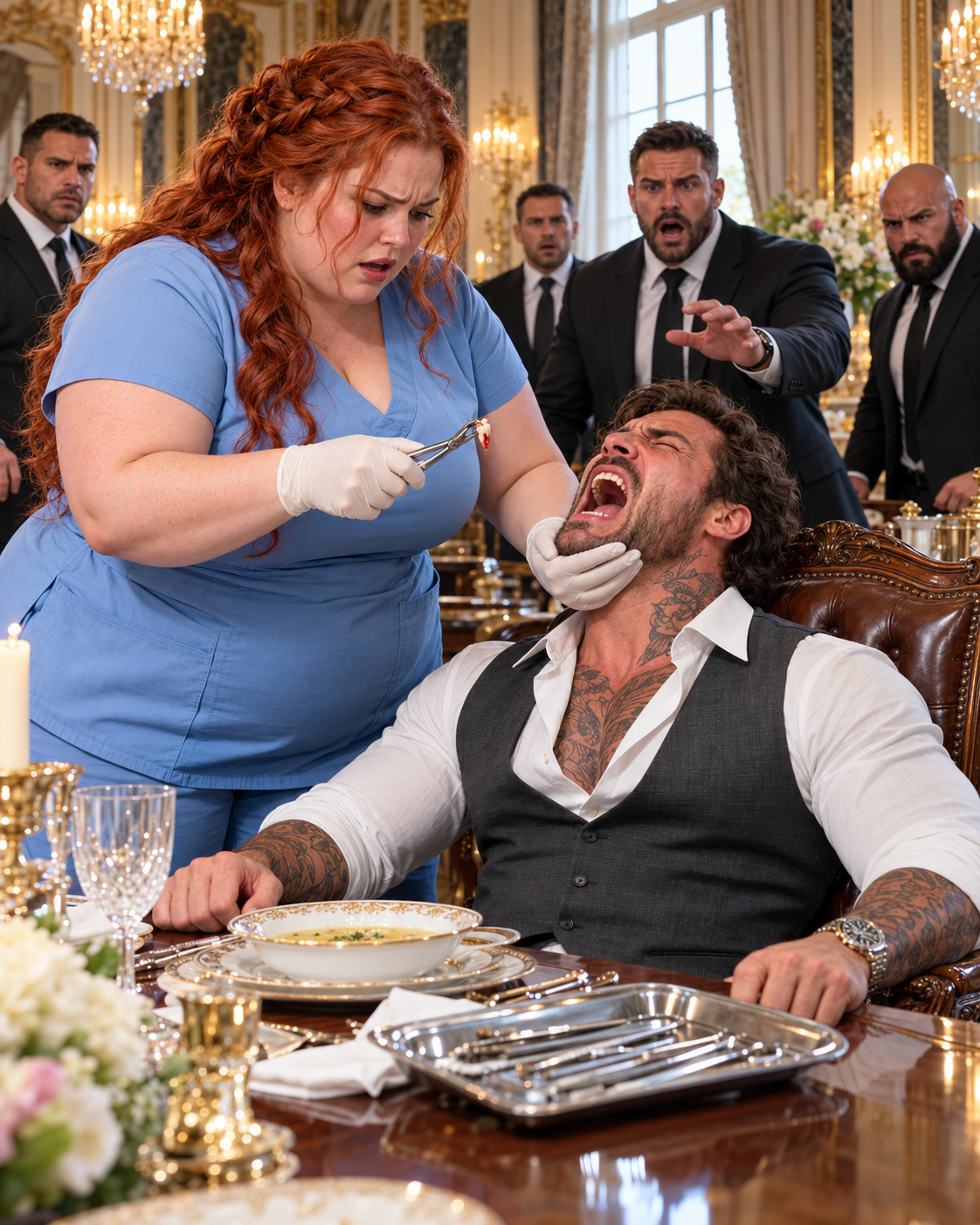
Two days later, forensic specialists completed their preliminary examination of the metal fragment.
It was consistent with a projectile fragment, and its condition suggested it could have remained embedded for many years.
The finding could not independently identify a shooter.
But when investigators compared medical records, old photographs, and the recovered fragment, they found that its location aligned with the documented path of Salvatore’s original injury.
More importantly, a newly recovered police evidence record pointed toward a firearm that had never been properly investigated.
A revolver registered to a security contractor employed by Carmine.
The contractor’s name was Victor Sloane.
According to Mercer, Sloane had vanished from New York shortly after the shooting.
Now he was living in a retirement community outside Tampa, Florida.
Detective Hayes arranged for investigators to interview him.
At first, Sloane denied knowing anything.
Then they showed him the recovered evidence and informed him that Thomas Bell was alive.
His composure collapsed.
“I didn’t fire the gun,” Sloane insisted.
“Then who did?” an investigator asked.
Sloane stared at the floor.
“Carmine.”
The single name changed the investigation.
But his explanation was even more disturbing.
Carmine had originally planned to frighten Salvatore into surrendering control of several family businesses.
He had convinced himself that his older brother was destroying opportunities that rightfully belonged to him.
The confrontation was meant to force a decision.
Instead, Carmine arrived armed.
An argument escalated.
And in one reckless moment, he fired.
Salvatore survived only because the shot failed to cause a fatal injury.
Sloane helped Carmine leave the scene.
For years afterward, money and threats kept the remaining witnesses quiet.
When detectives asked why Sloane was finally speaking, he looked exhausted.
“Because I’m old,” he answered. “And I’m tired of waking up every morning remembering what we did.”
***
Back at the estate, Carmine understood that his carefully constructed life was collapsing.
He paced his study as unanswered calls accumulated on his phone.
His businesses were under investigation.
His old associate was cooperating with authorities.
And Salvatore had stopped speaking to him.
Then a message arrived.
“Come to the family chapel. Alone. We need to talk.”
It was from Salvatore.
The chapel stood at the edge of the estate, surrounded by ancient oak trees and overlooking a quiet pond.
Their mother had insisted on building it decades earlier.
She had believed every family needed a place where anger could be set aside long enough for people to remember what truly mattered.
Carmine arrived just before sunset.
Salvatore stood near the front pew, dressed in a dark coat.
He looked older than Carmine remembered.
Not physically.
Something deeper had changed.
“You asked me to come,” Carmine said.
Salvatore nodded.
“Sit down.”
Carmine remained standing.
“I know what you’ve heard.”
“Then you know why we’re here.”
“Sal, people are lying to you.”
Salvatore turned.
“Was Thomas Bell lying?”
Carmine said nothing.
“Was Victor Sloane lying?”
Still nothing.
“Was the evidence inside my own jaw lying?”
Carmine’s breathing grew shallow.
Salvatore approached him slowly.
“For fifteen years, I thought someone outside this family wanted me dead.”
He swallowed.
“I spent fifteen years protecting the wrong people and trusting the wrong person.”
Carmine’s voice cracked.
“You always had everything.”
Salvatore stopped.
“What?”
“Father gave you the business. The house. His confidence. Every important decision belonged to you.”
“You were my brother.”
“I was your shadow!”
The words echoed through the small chapel.
Carmine’s eyes filled with tears.
“Do you know what it’s like to spend your entire life being introduced as Salvatore Lombardi’s little brother?”
Salvatore stared at him.
“Did that make you want to kill me?”
Carmine covered his face.
“I wanted you to be afraid. I wanted you to understand what it felt like to have no power.”
“And when you pulled the trigger?”
His brother began to cry.
“I panicked.”
Salvatore stepped backward as though the confession itself had struck him.
For a long moment, the only sound was rain tapping against the chapel windows.
Then Carmine whispered, “I never meant for you to spend years suffering.”
Salvatore’s voice was quiet.
“But you watched me suffer.”
Carmine lowered his head.
“You sat across from me at Thanksgiving dinners. You came to Christmas celebrations. You watched me struggle to eat, and you never told me why.”
“I was afraid.”
“So was I.”
Carmine looked up.
Salvatore’s eyes were wet.
“I was afraid every night after that shooting. I trusted you because I thought you were the only person who understood.”
Carmine reached toward him.
“Sal, please.”
But Salvatore stepped away.
“You didn’t just betray me that night.”
His voice trembled.
“You betrayed me every morning afterward.”
***
Unknown to Carmine, investigators had already obtained substantial evidence linking him to the shooting.
Salvatore’s attorney had arranged for the meeting to occur with law enforcement aware of the brothers’ location.
Neither Salvatore nor the police wanted the confrontation to end in another act of violence.
When Carmine left the chapel, two unmarked vehicles were waiting near the estate’s main entrance.
Detective Hayes approached him.
“Carmine Lombardi, we need to speak with you regarding the attempted murder of your brother.”
Carmine turned toward Salvatore, who had followed him outside.
For one desperate moment, his expression seemed to ask for protection.
The protection he had received all his life.
But Salvatore remained still.
“You need to tell the truth, Carmine,” he said.
His brother lowered his eyes.
And for the first time in fifteen years, he stopped trying to run from what he had done.
***
News of Carmine’s arrest spread quickly through the Hudson Valley.
Local newspapers published photographs of the Lombardi estate.
Television reporters gathered outside the courthouse.
Residents who had spent years whispering about the family suddenly discussed the case openly in coffee shops and grocery stores.
Lena watched the coverage from her clinic’s waiting room.
She felt no satisfaction.
She had never wanted to destroy a family.
She had wanted to relieve a man’s pain.
Yet the discovery had uncovered something far more serious than an infected tooth.
Three weeks later, Salvatore returned to her clinic.
This time, there were no intimidating lines of black SUVs.
Just one ordinary sedan and a driver waiting outside.
Salvatore entered carrying a small bouquet of white lilies.
Lena looked surprised.
“Mr. Lombardi?”
“Salvatore,” he corrected gently.
She accepted the flowers.
“How are you feeling?”
He smiled faintly.
“Better than I have in years. The physical pain is almost gone.”
“And the rest?”
His expression grew distant.
“That will take longer.”
Lena invited him into the examination room and checked his healing gum.
Everything looked healthy.
When she finished, Salvatore remained seated.
“Doctor, I owe you something.”
“You already paid your dental bill.”
He laughed softly.
“That’s not what I mean.”
He glanced around the room.
“Do you know what bothered me most about those fifteen years?”
Lena shook her head.
“It wasn’t the wound. It wasn’t even the pain. It was discovering how badly I had confused loyalty with obedience.”
He paused.
“I surrounded myself with people who told me what I wanted to hear. You were the first person in a long time who simply told me what was true.”
Lena sat on the stool beside him.
“That’s what my father taught me.”
“What did he do?”
“He repaired farm equipment outside Syracuse. Sometimes customers couldn’t pay immediately, but he never lied to them about what needed fixing.”
Salvatore looked thoughtful.
“He sounds like a good man.”
“He was.”
Lena smiled sadly.
“He used to say that your name is only worth something if people can trust it.”
Salvatore repeated the words quietly.
“Your name is only worth something if people can trust it.”
For a man who had spent most of his life building power around his surname, the sentence carried an uncomfortable truth.
***
A week later, Lena received a letter from her landlord.
She opened it expecting another warning about her overdue rent.
Instead, the letter informed her that the rent for her clinic had been paid in full for the next ten years.
Lena read the document three times.
There had to be a mistake.
She called the landlord immediately.
“Who paid this?”
The man cleared his throat.
“The payment came through a legal trust established by Mr. Salvatore Lombardi.”
Lena went silent.
“Ten years?”
“Ten years, Doctor. Everything has been handled.”
After hanging up, she stood in the center of her waiting room, overwhelmed.
For years, every month had brought the same fear.
Would she have enough money to keep the lights on?
Could she afford to replace the aging X-ray equipment?
Would she be forced to close the clinic her parents had helped her build?
Now the weight of those questions suddenly felt lighter.
But Lena knew she needed to speak with Salvatore.
She called his attorney and arranged a meeting.
***
The Lombardi estate was even more imposing than she imagined.
A long driveway curved through rolling lawns lined with maple trees.
American flags fluttered near the entrance, and the stone mansion overlooked acres of carefully maintained gardens.
Inside, Anthony Moretti escorted her to the library.
Salvatore was standing near a window with a cup of coffee.
“I thought you might come,” he said.
Lena placed the landlord’s letter on his desk.
“I can’t accept this without understanding why.”
Salvatore glanced at the document.
“Because you helped me.”
“I did my job.”
“And you did it when you could have looked away.”
Lena hesitated.
“I appreciate your generosity, but I don’t want to owe anyone special favors.”
Salvatore’s expression softened.
“Then don’t.”
He pointed toward the letter.
“There are no conditions. No services expected. No debt.”
She studied him carefully.
“Why ten years?”
Salvatore looked toward the gardens.
“Because ten years is enough time for something good to grow.”
Lena remained silent.
“Your clinic serves people who don’t have many options,” he continued. “I asked your landlord what it would take to make sure you could keep serving them.”
He took a slow breath.
“I’ve spent much of my life using money to protect my own interests. I wanted to use some of it differently.”
Lena’s eyes filled with tears.
“Then promise me something.”
“What?”
“Let me decide how to help people. No interference.”
Salvatore smiled.
“Agreed.”
“And every dollar must be properly documented.”
“Anthony has already arranged that.”
She finally allowed herself to smile.
“Then thank you.”
Salvatore shook his head.
“No, Doctor. Thank you for reminding me what respect should actually mean.”
***
Over the following months, life began changing for both of them.
Carmine eventually admitted his role in the shooting as part of the criminal proceedings.
His confession did not erase the betrayal or repair the years of damage.
He faced a lengthy prison sentence.
Salvatore attended the final hearing alone.
When the judge asked whether he wished to address the court, Salvatore stood slowly.
For several seconds, he looked toward the brother he had once trusted more than anyone.
“I spent fifteen years asking who hurt me,” he said.
“Now I know.”
His voice remained steady.
“But I don’t want to spend the rest of my life becoming someone who hurts others in return.”
Carmine lowered his head.
Salvatore continued.
“I cannot pretend what happened was acceptable. I cannot restore the trust we lost. But I hope one day my brother understands that the power he wanted was never worth the family he destroyed.”
He sat down.
There were no threats.
No promises of revenge.
Only a painful truth spoken in a quiet courtroom.
Outside, reporters shouted questions as Salvatore stepped toward his waiting car.
He did not answer them.
For perhaps the first time in his adult life, he no longer cared whether strangers feared him.
***
Back in her hometown, Lena used the financial breathing room to transform her dental practice.
She replaced broken equipment, hired another dental assistant, and began reserving appointments each week for patients who struggled to afford treatment.
Retired factory workers, single parents, veterans, and elderly neighbors came through her doors.
Some had postponed dental care for years because they feared the cost.
Others simply needed someone willing to listen.
One afternoon, a little boy named Ethan arrived with his mother.
He was terrified of dentists.
Lena knelt beside his chair.
“Do you know something?” she asked.
“What?”
“Sometimes even very brave grown-ups are afraid of the dentist.”
Ethan looked skeptical.
“Really?”
She smiled.
“Really. I once treated a man who frightened almost everyone in town, and even he was nervous about having a tooth removed.”
The boy giggled.
“Did he cry?”
“Not exactly.”
“Was he brave?”
Lena considered the question.
“Eventually, yes. But not because he wasn’t afraid.”
“Then why?”
“Because he learned that being brave sometimes means facing something you’ve been avoiding.”
Ethan thought about that for a moment.
Then he opened his mouth.
Lena laughed.
“That’s a pretty good start.”
***
A year after the original extraction, Lena received an invitation to a small dinner at the Lombardi estate.
She almost declined.
She was still uncomfortable being associated with a family whose history carried so much controversy.
But the invitation included a handwritten note from Salvatore.
“Nothing formal. Just dinner with people who helped me find my way back.”
When she arrived, she noticed that the estate felt different.
Fewer security guards stood near the gates.
Several rooms once used for private business meetings had been converted into offices for a charitable foundation.
Through independent legal advisers, Salvatore had begun separating himself from criminal associates and directing legitimate resources toward local medical programs, educational scholarships, and community assistance.
Those changes did not erase his past.
He knew that.
So did Lena.
But she believed that choosing a better path still mattered, even when the decision came late.
At dinner, the table was filled with familiar faces.
Anthony Moretti sat beside his wife.
Detective Hayes, attending as a personal guest after the case had concluded, spoke with retired investigator Daniel Mercer.
Several members of the household staff joined the meal rather than serving it.
An empty chair stood near Salvatore.
When Lena approached, he pulled it out for her.
“This one is yours.”
She laughed.
“Are you assigning seats now?”
“Only one.”
He gestured toward the chair.
“Whenever you come here, you have a place at this table.”
Lena glanced around.
“I think you’re making too much of a tooth.”
Salvatore smiled.
“It was never just about the tooth.”
The conversation continued late into the evening.
There were stories about childhood, difficult decisions, missed opportunities, and second chances.
For once, nobody seemed interested in discussing power.
***
Later, Lena stepped onto the terrace overlooking the Hudson Valley.
The evening air was cool, and distant lights shimmered along the hills.
Salvatore joined her carrying two cups of coffee.
“Do you ever regret finding that fragment?” he asked.
Lena considered the question.
“It brought a lot of trouble.”
“That’s true.”
“But it also brought the truth.”
She accepted the coffee.
“Do you regret knowing?”
Salvatore looked out across the dark lawn.
“Some days.”
He paused.
“I lost my brother in a way I never imagined. I lost the comfortable story I told myself about my family.”
“That must have been terrible.”
“It was.”
He turned toward her.
“But I also learned something.”
“What?”
“Pain doesn’t always come from the place we think it does.”
Lena smiled faintly.
“That’s certainly true in dentistry.”
He laughed.
Then his expression grew serious.
“For years, I tried to control everything around me because I believed control would keep me safe.”
“And did it?”
“No. It kept me surrounded by people who were afraid to tell me the truth.”
He looked through the windows toward the people gathered around his dining table.
“You treated me like a patient, not like a powerful man. You weren’t trying to impress me or frighten me. You simply wanted to help.”
Lena shook her head.
“That’s how everyone deserves to be treated.”
Salvatore nodded.
“I wish I’d understood that sooner.”
***
Five years passed.
The small dental clinic on Main Street became one of the most respected community practices in the region.
A simple plaque hung beside the front entrance.
“RUSSO FAMILY DENTAL — EVERY SMILE DESERVES CARE.”
Lena never placed Salvatore’s name on the building.
She believed the clinic should belong to the community it served.
But she kept a photograph in her office.
It showed her standing beside Salvatore at the opening of a new treatment room funded by a legally established community health grant.
He was smiling awkwardly.
She was holding an oversized pair of ceremonial scissors.
Behind them stood a group of children who had received free dental care that morning.
Visitors sometimes asked about the photograph.
Lena would smile and say, “That’s someone who taught me that people can surprise you.”
What she rarely told them was that she had surprised herself, too.
She had once believed success meant building a thriving practice, paying her bills, and proving she could stand on her own.
Now she understood that her greatest achievements were not measured by money or recognition.
They were measured by the frightened patients who learned to trust her, the elderly neighbors who could finally eat without pain, and the children who no longer associated a dental chair with fear.
***
On a quiet autumn afternoon, Salvatore visited the clinic for his routine checkup.
His hair had turned almost entirely silver.
He walked more slowly now, but the old heaviness in his expression had softened.
Lena greeted him at the door.
“Ready for another appointment?”
Salvatore smiled.
“As long as you promise not to find any more family secrets.”
They both laughed.
After the examination, he stood beside the front window, watching a young mother help her daughter into a car.
“Do you remember the night we met?” he asked.
“How could I forget?”
“I came here thinking the worst thing in my life was a toothache.”
Lena tilted her head.
“And what do you think now?”
He looked at her thoughtfully.
“I think the worst thing was living so many years without understanding the people around me.”
He paused.
“And the best thing was meeting someone who cared enough to tell me the truth.”
Lena smiled.
“You gave me something important too.”
“What was that?”
“The chance to keep my father’s dream alive.”
Salvatore glanced toward the old photograph of Lena’s parents behind the reception desk.
“He would have been proud of you.”
Her eyes grew warm.
“I hope so.”
“I’m certain of it.”
Before leaving, Salvatore reached into his coat and removed a small wooden box.
Lena raised an eyebrow.
“Please tell me that’s not another expensive gift.”
He shook his head.
“Nothing expensive.”
Inside was a simple brass key attached to a worn leather tag.
Lena looked confused.
“What’s this?”
“The key to the family chapel.”
She looked up.
Salvatore continued.
“My mother believed it was a place where people could speak honestly, even when the truth was difficult.”
He placed the key in her palm.
“I want you to have access whenever you visit. Sometimes the people who help us heal deserve a quiet place of their own.”
Lena closed her fingers around it.
For once, she could not find the right words.
Salvatore smiled.
“Don’t worry, Doctor. You don’t have to say anything.”
***
That winter, Lena visited the estate for its annual holiday dinner.
Snow covered the oak trees, and golden lights glowed through the mansion’s windows.
The dining room was filled with laughter.
Salvatore sat at the head of the table, surrounded not by people who feared him, but by people who had chosen to be there.
The chair beside him remained reserved for Lena.
When dinner was served, he lifted his glass.
“I want to say something before we eat.”
The room became quiet.
“Most of my life, I believed respect was something you could demand.”
He looked around the table.
“I was wrong.”
No one interrupted.
“Fear can make people obey you. Money can make people flatter you. Power can make people stand when you enter a room.”
He turned toward Lena.
“But none of those things can make someone truly care about you.”
Lena lowered her eyes, deeply moved.
Salvatore continued.
“Five years ago, I walked into a little dental clinic believing I needed someone to remove a painful tooth.”
A soft ripple of laughter moved around the table.
“What I really needed was someone willing to uncover a truth I had spent years avoiding.”
He lifted his glass a little higher.
“To courage. To honesty. And to the people who help us become better than we were yesterday.”
Everyone raised their glasses.
Outside, snow continued falling over the quiet Hudson Valley.
Inside, warmth filled a home that had once been defined by suspicion and betrayal.
Lena looked around the table and realized that the greatest gift she had received was not ten years of free rent.
It was the opportunity to witness a man begin changing the direction of his life.
And Salvatore, watching the guests laugh together, understood something even more important.
The respect he had searched for through wealth and intimidation had finally come from something far simpler.
A willingness to acknowledge the truth, take responsibility, and offer kindness without expecting obedience in return.
Years earlier, a tiny piece of metal had been hidden inside his jaw, slowly causing pain that no one could explain.
But the deeper wound had never been physical.
It was the betrayal he had carried unknowingly and the life he had built around mistrust.
A young dentist had removed the source of his physical suffering.
Facing the truth had forced him to begin healing everything else.
And in a modest American town where Main Street lights still glowed over family diners and old storefronts, Lena Russo continued opening her clinic every morning.
Not because she wanted power.
Not because she expected gratitude.
But because she believed even the smallest act of care could change a life.
Sometimes, the most important discoveries happen in the most ordinary places.
Sometimes, the person who changes your future is someone the world barely notices.
And sometimes, healing begins not when pain disappears, but when someone finally finds the courage to face its true cause.
In the end, Salvatore Lombardi discovered that a powerful name could inspire fear, but only an honorable life could earn genuine respect.
Lena discovered that doing the right thing might never be easy, but its influence could reach far beyond anything she imagined.
And both learned a lesson worth remembering:
The greatest measure of a person is not how much power they possess, how much money they control, or how many people answer when they call.
It is how they treat someone who has nothing to offer except honesty, compassion, and the courage to do what is right.
Because fear may open doors for a moment, but kindness can leave them open for generations.
THE END.