The most feared mafia boss in the city had spent seven years walking with a limp.
Silvio Vescovi stared at the photograph in his hand, his face turning so pale that even his mother noticed.
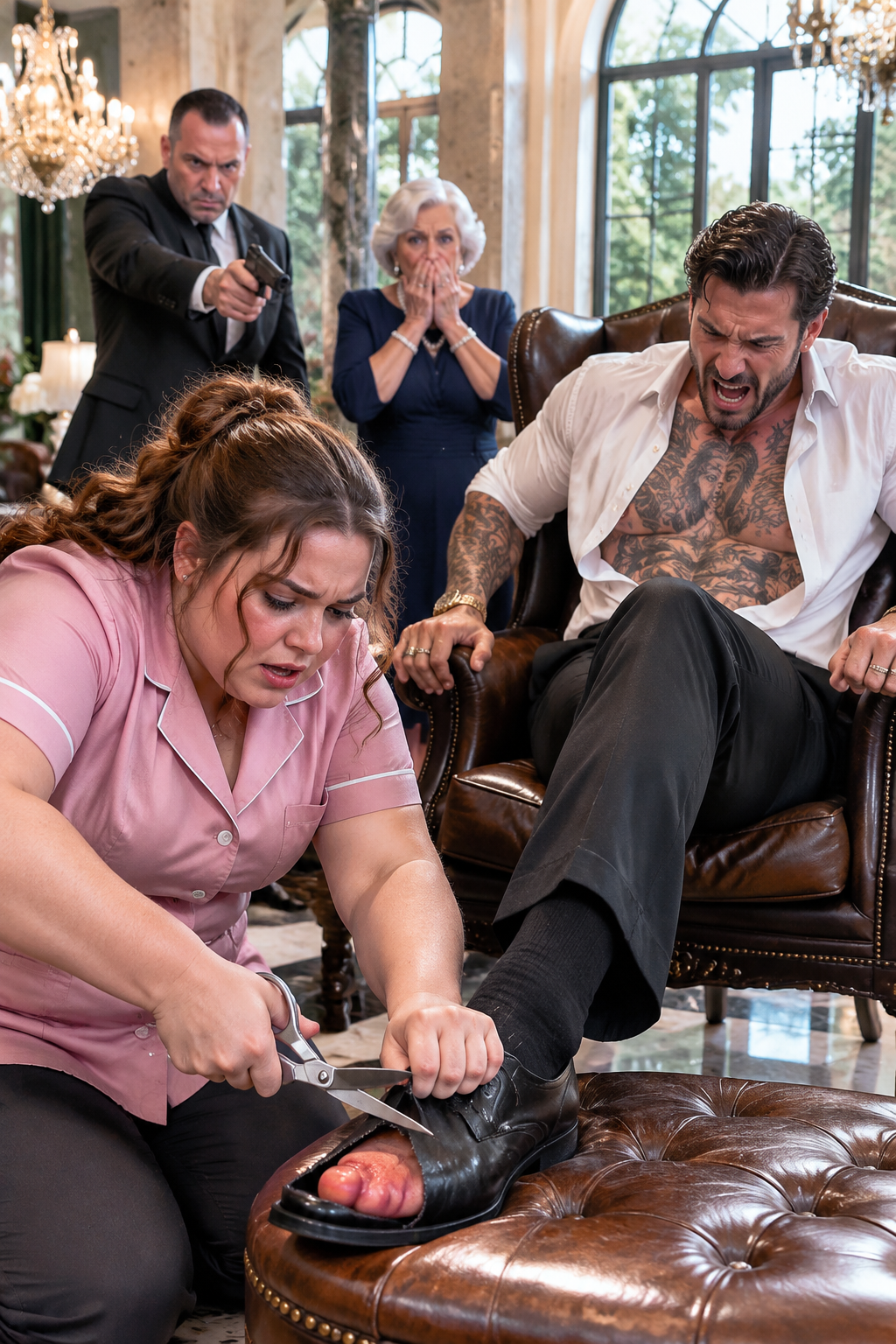
Mavis stood beside the dining table, watching the powerful mafia boss struggle to understand what he was seeing.
“What’s written on it?” she asked.
Silvio didn’t answer immediately.
Instead, he turned the photograph over and read the message again.
“The woman knows what Bellini did. If she touches your foot, neither of you will survive the week.”
The room went completely silent.
Mavis felt a cold sensation spread through her chest.
“That’s my house,” she whispered, pointing at the photograph. “Someone took that picture outside my house.”
Silvio looked toward his head of security, Marco.
“Lock down the estate. Nobody enters or leaves without my permission.”
Marco nodded and immediately spoke into his radio.
Mavis took a step backward.
“I came here to give your mother a pedicure. That’s all. I don’t know anything about your enemies.”
“I believe you,” Silvio replied.
“Then why does someone want me dead?”
Silvio looked at the swollen foot resting awkwardly beneath the table.
“That’s what we’re going to find out.”
His mother, Elena Vescovi, reached for Mavis’s trembling hand.
“Sit down, sweetheart.”
But Mavis couldn’t sit.
She was thinking about her small apartment, her elderly neighbor who watered her plants, and the ordinary life she had worked so hard to build after leaving the hospital.
She had spent twenty-three years as a trauma nurse.
She had seen terrible accidents, desperate families, and people whose lives changed in seconds.
But she had never imagined that examining a man’s toenail could put a target on her back.
“Mr. Vescovi,” she said, forcing herself to remain calm, “your foot needs medical attention. Whatever is happening outside this room, that infection is real.”
Silvio gave a bitter laugh.
“Seven years of specialists, expensive medications, and procedures. And you’re telling me the problem might have been right under my nose?”
“Not under your nose,” Mavis replied. “Under your shoe.”
For the first time that afternoon, Elena smiled.
Silvio almost did, too.
Then Marco returned.
“Boss, we’ve checked the security cameras. Bellini’s assistant visited the property yesterday. He never entered the house, but he spoke to one of our guards.”
“Which guard?”
Marco hesitated.
“Anthony.”
Silvio’s expression hardened.
Anthony had worked at the estate for eleven years.
He had been present at family dinners, accompanied Elena to medical appointments, and once carried Silvio out of a burning warehouse.
“Bring him here,” Silvio ordered.
Marco lowered his voice.
“We can’t.”
“Why not?”
“He’s missing.”
Silvio slowly placed the photograph on the table.
Mavis noticed that his hand was shaking.
Not from fear.
From anger.
“Find him.”
Marco disappeared again.
Elena looked at her son.
“Silvio, whatever happens, don’t let your temper make the decisions.”
He turned toward her.
“Mother, someone has been hurting me for seven years.”
“And someone may have been helping them from inside this house,” Elena answered.
Her words struck harder than any accusation.
Silvio looked around the dining room, suddenly aware that the men standing near the doors might not all be loyal.
He dismissed everyone except Marco and Elena.
Then he turned back to Mavis.
“Tell me exactly what you found.”
Mavis pulled a chair closer.
“The edge of your toenail is buried deep in the surrounding tissue. It’s severely inflamed, and there’s evidence of a long-standing infection.”
“Bellini told me the nail was growing normally.”
“It isn’t.”
“He said the pain came from damaged nerves.”
“Some nerve irritation is possible, but it doesn’t explain everything I’m seeing.”
Silvio leaned forward.
“Can someone cause this deliberately?”
Mavis considered her answer.
“Repeatedly cutting the nail incorrectly can make an ingrown nail worse. If the wound never heals properly, the pain can become unbearable.”
Silvio closed his eyes.
He remembered every appointment.
Every time Bellini had removed his shoe, examined the toe, and announced that another treatment was necessary.
Every time the pain had briefly changed before returning worse than before.
And every time Bellini had assured him that he would never walk normally again.
“That man has been in my house every month,” Silvio whispered.
Elena’s eyes filled with tears.
“He told me my son would eventually need a wheelchair.”
Mavis reached for a clean towel.
“Before we talk about anything else, we need to get you evaluated by an independent medical team. The infection could be deeper than it looks.”
Silvio shook his head.
“No hospital.”
“Then bring qualified medical professionals here.”
“Bellini handled all my medical arrangements.”
“Then stop letting Bellini choose your doctors.”
Silvio stared at her.
Nobody spoke to him that way.
Not his guards.
Not his business partners.
Certainly not strangers.
But Mavis wasn’t trying to impress him.
She was trying to help him.
Finally, Silvio nodded.
“Marco, contact Dr. Rebecca Hayes at the university hospital. Tell her I need an urgent consultation.”
Marco made the call.
Within an hour, a physician and a foot specialist arrived with portable medical equipment.
Mavis explained what she had observed and stepped aside while they examined Silvio.
The specialist, Dr. Hayes, studied the toe carefully.
“This is a serious ingrown nail with a significant localized infection,” she said. “We’ll need to assess whether the infection has reached deeper tissue.”
Silvio’s face tightened.
“Can it be treated?”
“Yes. But I won’t promise instant recovery. You’ve been suffering for years, and there may be other problems we haven’t identified.”
Silvio looked toward Mavis.
“She figured it out in five minutes.”
Dr. Hayes glanced at her.
“You have medical experience?”
“Twenty-three years in trauma nursing.”
“That explains why you recognized the infection.”
Mavis folded her arms.
“It also explains why I don’t want anyone cutting into that toe without proper equipment.”
Silvio looked disappointed.
“You’re telling me I have to wait?”
“I’m telling you that you’ve already lost seven years. Don’t risk losing your foot because you’re impatient.”
Elena squeezed her son’s shoulder.
“Listen to her.”
The doctors arranged imaging, laboratory tests, and a carefully planned procedure.
While they worked, Marco returned with disturbing news.
Anthony’s car had been found abandoned near the river.
There was no sign of him.
But inside the glove compartment, investigators had discovered a receipt from a private medical supply company.
The same company had delivered equipment to Bellini’s office for years.
Silvio studied the receipt.
“Who owns it?”
Marco placed a tablet on the table.
“A holding company called Northbridge Medical.”
Silvio’s expression changed.
He recognized the name.
Northbridge was connected to Victor Salerno, the leader of a rival criminal organization that had spent years trying to weaken the Vescovi family.
For seven years, Victor had avoided direct confrontation with Silvio.
Instead, he had watched Silvio become increasingly dependent on his cane, increasingly isolated, and increasingly reluctant to leave his estate.
Silvio had assumed his enemies were afraid of him.
Now he wondered whether they had simply been waiting.
“Victor,” he murmured.
Mavis heard the name.
“Who is Victor?”
“Someone who benefits when I’m weak.”
Elena looked at her son.
“Don’t jump to conclusions.”
Silvio held up the receipt.
“Mother, Bellini’s supplies came from a company connected to Victor Salerno.”
“That doesn’t prove Bellini was working for him.”
“No,” Silvio admitted. “But it gives us somewhere to start.”
Mavis appreciated Elena’s caution.
She had seen too many people make terrible decisions when fear and anger took control.
“Evidence first,” Mavis said.
Silvio looked at her.
“You really don’t scare easily, do you?”
“I’m terrified,” she answered. “I’m just not going to let that make me careless.”
The medical team completed its initial evaluation.
Fortunately, the imaging showed no clear evidence that the infection had spread into the bone.
The specialist recommended removing the embedded portion of the nail, cleaning the infected area, and continuing appropriate treatment afterward.
Silvio insisted that Mavis remain nearby.
“I want her in the room.”
Dr. Hayes looked at Mavis.
“Are you comfortable assisting?”
Mavis hesitated.
She hadn’t worked in a hospital for nearly four years.
She had left after a devastating night in the emergency department, when three patients arrived from a highway collision and only one survived.
The memories still visited her in dreams.
She remembered the alarms.
The frantic voices.
The helpless expression on a father’s face when she told him his daughter hadn’t made it.
After that night, Mavis had begun questioning whether she could continue.
Eventually, she resigned.
Pedicures were quieter.
People came to her smiling.
They left feeling better.
There were no emergency calls, no desperate relatives, and no terrible decisions made under pressure.
But now a man was looking at her with the same frightened hope she had seen in countless hospital rooms.
She took a breath.
“I can assist within my training,” she said.
Silvio nodded.
“Then stay.”
The procedure took place in a properly prepared room on the estate.
Silvio received local anesthesia, and the specialist carefully removed the deeply embedded nail edge.
Mavis helped maintain the sterile field and watched the physician clean the infected tissue.
When the small, curved fragment was finally lifted free, Dr. Hayes placed it on a tray.
Silvio stared at it.
“That little thing?”
“That little thing has been cutting into your skin,” the doctor explained.
Silvio looked almost offended.
He had survived gunshots, broken bones, and years of violent conflict.
Yet something smaller than a fingernail clipping had brought him to his knees.
The absurdity made him laugh.
Then, unexpectedly, he began crying.
He turned his face away, embarrassed.
Elena stepped closer.
“Silvio?”
He covered his eyes.
“I thought I was losing my body, Mama.”
His voice cracked.
“I thought every year would get worse until I couldn’t walk at all.”
Elena embraced him.
For several moments, nobody spoke.
Mavis quietly moved toward the door.
But Silvio called her back.
“Don’t leave.”
She stopped.
He looked at her with wet eyes.
“Thank you.”
Mavis smiled gently.
“Thank me when you’ve recovered.”
The next morning, the pain was different.
Silvio still had tenderness from the procedure, but the relentless stabbing sensation that had haunted him for years was noticeably reduced.
He slept for six uninterrupted hours.
Elena said it was the first peaceful night she had seen him enjoy in almost a decade.
By the third day, Silvio could place his foot on the floor more comfortably.
Under medical supervision, he began taking short steps without relying entirely on his cane.
His balance was poor.
His leg muscles had weakened after years of altered walking.
But the improvement was real.
One afternoon, Mavis found him standing beside the library window.
His cane rested against a chair.
“You’re supposed to be following the rehabilitation plan,” she said.
“I am.”
“Then why are you standing here alone?”
“Because I wanted to see whether I could.”
She glanced at the cane.
“And?”
Silvio smiled.
“I can.”
He took three careful steps.
Then another.
His eyes widened.
Mavis held out her arm, ready to support him.
He didn’t need it.
For the first time in seven years, Silvio Vescovi crossed a room without the sharp, familiar pain that had shaped every movement.
Elena appeared in the doorway.
She watched her son walk toward her.
Then she began to cry.
Silvio embraced her.
“I forgot what this felt like,” he whispered.
Mavis looked away, giving them privacy.
But her own eyes were wet.
For the first time in years, she remembered why she had become a nurse.
Not for the uniforms.
Not for the recognition.
For moments like this.
Unfortunately, the peace didn’t last.
That evening, Marco entered the library carrying a folder.
“We found Anthony.”
Silvio straightened.
“Where?”
“At a motel outside Albany. He’s alive.”
“Bring him here.”
“He’s asking for police protection.”
Silvio frowned.
“Why?”
Marco opened the folder.
“Because he says Bellini threatened his daughter.”
Mavis felt her stomach tighten.
Anthony had a sixteen-year-old daughter named Sofia.
Elena had spoken about her several times.
The girl had recently been hospitalized for a serious illness.
“Is she safe?” Mavis asked.
Marco nodded.
“She’s with relatives now.”
Silvio lowered himself into a chair.
“Tell Anthony I won’t hurt him. I want the truth.”
Two hours later, Anthony arrived with an attorney and two investigators.
He looked exhausted.
His hands trembled as he sat across from Silvio.
“I’m sorry, boss.”
Silvio said nothing.
Anthony swallowed.
“Bellini approached me eight months ago. He said Sofia’s medical bills could disappear if I helped him.”
“Helped him do what?”
“Report your movements. Tell him who visited. Make sure he knew when outside medical professionals were coming.”
Silvio’s eyes narrowed.
“And Mavis?”
Anthony looked at her.
“Bellini called me yesterday. He said a woman had been hired to treat Mrs. Vescovi. He wanted her photograph and address.”
Mavis felt her heart pounding.
“You gave him my address?”
Anthony lowered his head.
“Yes.”
“Why?”
“He said if I refused, Sofia’s treatment would stop being paid for.”
Silvio leaned forward.
“You could have come to me.”
Anthony’s eyes filled.
“I know.”
“You’ve known me eleven years.”
“I was ashamed.”
Silvio stared at the man who had once saved his life.
He wanted to shout.
Instead, he remembered what Mavis had said.
Evidence first.
“Tell the investigators everything,” Silvio said.
Anthony nodded.
Then he revealed something nobody expected.
“Bellini wasn’t supposed to keep you injured forever.”
Silvio froze.
“What does that mean?”
Anthony’s voice dropped.
“Something changed six months ago. He started asking questions about your mother’s estate documents and your business succession arrangements.”
Elena looked confused.
“My documents?”
Anthony nodded.
“He wanted to know who would control everything if Silvio became legally unable to manage his affairs.”
Silvio felt a chill.
His limp had been more than an inconvenience.
Over the years, Bellini had repeatedly suggested that Silvio’s condition might affect his judgment.
He had recommended stronger pain medications.
He had encouraged Silvio to avoid public meetings.
He had even proposed appointing a permanent medical representative.
Silvio had rejected the idea.
But what if that had been the real plan?
Mavis looked toward Elena.
“Did Bellini ever ask you to sign anything?”
Elena hesitated.
“Yes.”
Silvio turned sharply.
“What?”
“He brought some papers last Christmas. He said they would make things easier if you became seriously ill.”
“Did you sign them?”
“No. I told him I wanted our lawyer to read them first.”
Silvio exhaled.
Elena continued.
“He became angry. He said I was putting the family at risk.”
Marco immediately contacted the family’s attorney.
Within an hour, they learned that Bellini had attempted to obtain medical authority documents on Silvio’s behalf.
The papers had never been legally completed.
But they contained something disturbing.
A prepared statement claiming Silvio suffered from progressive neurological decline and was becoming incapable of independent decision-making.
Mavis stared at the statement.
“Did anyone ever diagnose you with that?”
“No.”
“Then why was it written?”
Silvio already knew the answer.
Someone wanted him declared incompetent.
Someone wanted control without having to fight him openly.
The investigators took copies of the documents.
They also obtained a warrant for Bellini’s office.
What they discovered changed everything.
Inside a locked cabinet were years of medical notes, photographs, and financial records.
Some notes described legitimate appointments.
Others contained instructions that had no medical justification.
There were records of repeated aggressive nail trimming despite worsening inflammation.
There were payments routed through Northbridge Medical.
And there were communications suggesting Bellini had deliberately discouraged independent consultations.
Most importantly, investigators recovered a message sent by an account associated with Victor Salerno.
It referred to Silvio’s condition as “the leverage that keeps him contained.”
The message wasn’t enough to prove every detail of the conspiracy.
But it was enough to justify a much larger investigation.
When Silvio heard the news, he stood silently in his office.
Mavis watched him from the doorway.
“You’re angry,” she said.
“Angry doesn’t begin to describe it.”
“What are you going to do?”
Silvio looked toward the city.
“For years, I’ve solved problems in ways you wouldn’t approve of.”
Mavis didn’t answer.
He turned.
“I could send men after Victor tonight.”
“Yes,” she said.
“And then?”
“He’d send men after you. Someone else would get hurt. And we’d never know who else was involved.”
Silvio looked at her for a long moment.
“You think I should let the police handle it?”
“I think the truth deserves a chance to survive.”
Silvio lowered his eyes.
It was a strange feeling, being challenged by a woman who wasn’t afraid to disagree with him.
He had spent his life surrounded by people who either obeyed him or feared him.
Mavis did neither.
She cared whether he recovered.
That was different.
The following morning, Silvio made a decision that shocked his own men.
He instructed his attorney to cooperate with the investigators and provide relevant records through proper legal channels.
Marco objected.
“Boss, this could expose things we don’t want exposed.”
Silvio nodded.
“I know.”
“Then why do it?”
Silvio looked at the cane resting against his desk.
“Because I spent seven years believing a lie. I’m not going to protect another one.”
The investigation moved quickly.
Bellini was arrested at a private airport while attempting to leave the country.
He initially denied everything.
Then investigators confronted him with the financial records.
His confidence disappeared.
He requested an attorney.
Several days later, through his lawyer, Bellini began negotiating cooperation.
His account was chilling.
Victor Salerno had approached him years earlier with an offer.
At first, Bellini had been asked to exaggerate Silvio’s medical problems and encourage unnecessary treatment.
Later, the arrangement became more deliberate.
Bellini continued interventions that worsened the ingrown nail and allowed the infection to persist.
He supplied misleading explanations whenever Silvio questioned the pain.
He discouraged second opinions.
And he slowly convinced Silvio that his physical decline was inevitable.
But the final stage had been different.
Victor wanted Bellini to establish a medical basis for removing Silvio from control of his businesses.
The goal was not simply to make him suffer.
It was to make him powerless.
When the investigators asked why Bellini had continued, he admitted that money had eventually become fear.
Victor had threatened to expose his earlier misconduct if he refused further orders.
Bellini had become trapped in the very conspiracy he helped create.
None of that excused what he had done.
But it explained why the deception had continued for so long.
Victor Salerno was arrested after investigators connected financial transfers, communications, and witness testimony.
The legal proceedings would take months.
Silvio understood that justice would not arrive overnight.
But for the first time, he didn’t feel compelled to settle everything himself.
Meanwhile, Mavis faced a problem of her own.
Her small pedicure business had effectively stopped.
She had missed appointments, refunded customers, and spent weeks under security protection.
She missed her apartment.
She missed the woman who sold flowers outside her building.
She even missed the terrible coffee from the corner store.
One morning, she told Silvio she wanted to go home.
He looked surprised.
“You can stay here as long as you want.”
“I know.”
“My mother loves having you around.”
“I love her, too.”
“Then what’s wrong?”
Mavis smiled sadly.
“This isn’t my life.”
Silvio looked around the enormous library.
The marble floors, expensive paintings, and security guards suddenly seemed less impressive.
“What would make it your life?”
“Being able to walk down the street without someone following me.”
Silvio nodded slowly.
“I understand.”
Then he reached into his desk and removed a folder.
“I wanted to offer you something.”
Mavis raised an eyebrow.
“If it’s a mansion, the answer is no.”
Silvio laughed.
“Not a mansion.”
Inside the folder was a proposal for a medical foot-care clinic.
It would serve elderly patients, people with limited mobility, and those who couldn’t afford regular care.
The clinic would employ licensed medical professionals and provide referrals for conditions beyond routine foot care.
Silvio had arranged for an independent nonprofit board to oversee the funding.
Mavis read the proposal twice.
“Why are you doing this?”
“Because there are people who suffer for years from things that could have been treated much sooner.”
She looked up.
“You’re talking about yourself.”
“I’m talking about everyone who doesn’t have someone willing to look closely.”
Mavis turned another page.
The clinic would be named the Elena Vescovi Community Foot Care Center.
She smiled.
“Your mother knows?”
“She suggested it.”
Mavis laughed softly.
“Of course she did.”
Silvio leaned forward.
“I want you to help design the program. And I’d like you to work there, if you choose.”
Mavis studied the proposal.
It was generous.
But she had one condition.
“No interference in medical decisions. No special treatment for your friends. No pretending we’re qualified to do things we’re not.”
Silvio nodded.
“Agreed.”
“And I choose my own staff.”
“Agreed.”
“And if you ever try to intimidate a patient, I’ll throw you out myself.”
Silvio smiled.
“I believe you.”
Six months later, the clinic opened.
Its waiting room was bright and welcoming.
There were comfortable chairs, large windows, and a small table where Elena insisted on keeping fresh flowers.
Mavis worked alongside nurses, podiatrists, and other trained professionals.
Some patients needed routine care.
Others arrived with serious problems that required specialist treatment.
Mavis made sure nobody was dismissed simply because their complaint seemed small.
One afternoon, an elderly man entered with a worn shoe and an embarrassed expression.
“I don’t want to bother anyone,” he said. “It’s probably nothing.”
Mavis pulled up a chair.
“Show me.”
He hesitated.
“It’s just my toe.”
She smiled.
“That’s exactly why you’re here.”
Across the city, Silvio continued his rehabilitation.
His strength returned gradually.
His limp became less noticeable.
He still experienced occasional stiffness, and his doctors reminded him that seven years of altered movement couldn’t disappear in a few weeks.
But he no longer lived in constant agony.
More importantly, he had changed in ways that surprised everyone around him.
He began delegating responsibilities.
He listened more carefully.
He stopped treating every disagreement as an act of disrespect.
And he started examining the people he trusted with the same care Mavis had given his foot.
The legal case against Bellini and Victor continued.
Both faced serious consequences for their actions, and the evidence exposed a network of corruption that reached far beyond Silvio’s medical treatment.
Anthony cooperated with investigators.
His betrayal was not forgotten, but neither was the pressure placed on his family.
Silvio ensured Sofia’s medical care continued through a legitimate charitable fund, without demanding loyalty in return.
When Anthony learned this, he wept.
“After everything I did, why would you help my daughter?”
Silvio answered quietly.
“Because she’s a child. She didn’t betray anyone.”
The words surprised even him.
A year after Mavis first entered the estate, Elena invited her to dinner.
There were no armed men standing in the dining room.
No tense whispers.
No medical equipment.
Just a beautifully prepared meal and three people who had become unlikely friends.
Silvio walked into the room carrying a tray.
Mavis immediately looked at his feet.
“You’re wearing those ridiculous leather shoes again.”
He grinned.
“They’re comfortable now.”
“They’re still too narrow.”
“You’re impossible.”
“And you’re stubborn.”
Elena laughed so hard she had to put down her glass.
After dinner, Silvio led Mavis onto the terrace.
The city lights shimmered in the distance.
For a while, they stood quietly.
Then he reached into his pocket.
Mavis raised an eyebrow.
“If that’s another employment contract, I’m leaving.”
Silvio chuckled.
“No.”
He held out a small velvet box.
Inside was a simple silver bracelet with a tiny engraved charm shaped like a footprint.
Mavis stared at it.
“Silvio…”
“Before you say anything, it’s not expensive.”
“Coming from you, that means absolutely nothing.”
He smiled.
Then his expression became serious.
“Seven years ago, I started believing my life was getting smaller. Every step hurt. Every doctor told me I was getting worse. Eventually, I stopped questioning them.”
Mavis listened.
“I thought being powerful meant never admitting I needed help.”
He looked down at the bracelet.
“Then a woman walked into my house with a medical bag and told me I was wrong.”
Mavis smiled through sudden tears.
“You were wrong about several things.”
“I know.”
Silvio gently placed the bracelet in her hand.
“You didn’t just help me walk again. You reminded me that strength means knowing when to trust someone who tells you the truth.”
Mavis closed her fingers around the gift.
For years, she had carried guilt from the hospital, remembering the patients she couldn’t save.
She had measured her worth by the worst nights of her career.
But standing on that terrace, she finally understood something.
She had never needed to save everyone.
She only needed to keep caring for the person in front of her.
“Thank you,” she whispered.
Silvio shook his head.
“No, Mavis. Thank you.”
The following morning, Mavis returned to the clinic.
Her first patient was a little old woman who had been afraid to ask for help because she couldn’t afford treatment.
Mavis welcomed her, pulled up a chair, and listened.
Outside, the city moved at its usual frantic pace.
Inside, someone was finally being heard.
And that was how Mavis came to understand the greatest lesson of her unexpected journey.
Sometimes the suffering that controls a person’s life isn’t caused by something enormous.
Sometimes it’s something small that everyone else has overlooked.
Sometimes the people who appear strongest are quietly enduring the most pain.
And sometimes the person who changes everything isn’t the wealthiest, the most powerful, or the most important person in the room.
It’s simply the one who cares enough to notice.
Silvio Vescovi had spent seven years surrounded by people who feared him, obeyed him, and profited from him.
But the person who helped him reclaim his life was a humble woman who refused to be impressed by his power.
She saw a patient where others saw a dangerous man.
She saw a treatable problem where others had insisted there was no hope.
And she offered honesty when everyone around him had offered either fear or flattery.
Years later, when people asked Silvio what had finally changed his life, he never mentioned his enemies, his fortune, or the criminal empire he once believed made him untouchable.
He simply smiled and said, “A woman looked at my feet and reminded me how to stand.”
Because real strength isn’t measured by how many people obey you.
It’s measured by whether you can recognize the truth, accept help, and use your second chance to make someone else’s life better.
Three years after Mavis first walked through the gates of Silvio Vescovi’s estate, a letter arrived at the Elena Vescovi Community Foot Care Center.
It was addressed to Mavis in careful, uneven handwriting.
There was no return address.
Inside was a single sheet of paper.
“Dear Ms. Mavis, you probably don’t remember me. My name is Sofia. My father is Anthony, the man who betrayed Mr. Vescovi. I have wanted to thank you for a long time, but I never knew how.”
Mavis sat down beside her desk.
She remembered Sofia.
The frightened sixteen-year-old whose medical treatment had been used to control her father.
The girl whose illness had nearly destroyed an entire family.
Mavis continued reading.
“My father told me what happened. He told me how scared he was, how badly he failed, and how Mr. Vescovi helped me anyway. I used to think powerful people only helped others when they wanted something in return. But you and Mr. Vescovi proved me wrong.”
Mavis felt tears gathering in her eyes.
The final paragraph made her stop breathing for a moment.
“I’m studying nursing now. I want to become someone who helps people when they’re afraid. My father says you once told Mr. Vescovi that being scared doesn’t mean you have to be careless. I think about that whenever I doubt myself.”
Mavis folded the letter carefully.
Then she picked up her phone.
“Silvio, are you busy?”
“For you? Never.”
“I received something I think you should see.”
An hour later, Silvio arrived at the clinic.
He no longer carried a cane.
His walk wasn’t perfect, especially on cold mornings, but the pain that had once ruled his life was gone.
Mavis handed him the letter.
He read it without speaking.
When he finished, he stared through the window for a long time.
“Anthony’s daughter,” he murmured.
“She’s going to be a nurse.”
Silvio nodded.
“Good.”
Mavis watched his expression.
“Do you ever regret helping her?”
He looked almost offended.
“Why would I?”
“Because her father betrayed you.”
Silvio placed the letter on her desk.
“Her father made a terrible choice. She didn’t. I spent too many years punishing people for things they couldn’t control.”
Mavis smiled.
“You’ve changed.”
Silvio glanced toward the busy waiting room.
“So have you.”
She looked around the clinic.
There were patients talking quietly, nurses moving between examination rooms, and Elena arranging flowers near the entrance.
The center had grown beyond anything Mavis originally imagined.
It now served hundreds of patients each month.
Several local hospitals referred elderly patients who struggled to obtain routine foot care.
A transportation program helped people who couldn’t drive.
And a small emergency fund covered necessary treatment for those who couldn’t afford it.
Mavis had returned to the kind of work she once believed she could never face again.
But this time, she understood that caring for people didn’t mean carrying every tragedy alone.
Silvio reached into his jacket.
“There’s something else.”
Mavis raised an eyebrow.
“Please tell me you haven’t bought another building.”
He smiled.
“Not exactly.”
He handed her a folder.
Inside was a proposal to establish scholarships for nursing students from families facing financial hardship.
The first scholarship would be awarded to Sofia.
Mavis looked up.
“Silvio…”
“She earned her place in school. This will help her stay there.”
“And the others?”
“Ten students every year. More if the program succeeds.”
Mavis closed the folder.
“Your mother is going to cry.”
“She already did.”
They both laughed.
Then Silvio grew quiet.
“I spent most of my life thinking a legacy was something you built with money and power.”
“And now?”
He looked toward the examination rooms.
“Now I think it’s what people are able to do because you helped them.”
That afternoon, Elena joined them for lunch.
She listened as Mavis read Sofia’s letter aloud.
When Mavis finished, Elena wiped her cheeks with a napkin.
“I knew bringing you into our home was a good idea,” she said.
Silvio smiled.
“You brought her in to trim your toenails, Mama.”
“And look how much trouble that caused.”
Their laughter filled the small office.
For a moment, the years of fear, betrayal, and pain seemed very far away.
Later that evening, Mavis was preparing to leave when a young nursing student approached her.
“Excuse me, Ms. Mavis?”
“Yes?”
The young woman held a worn notebook against her chest.
“My instructor told us about this clinic. She said you believe every patient deserves to be heard.”
“I do.”
The student hesitated.
“Can I ask you something?”
“Of course.”
“How do you know when you’re making a difference?”
Mavis considered the question.
Once, she would have answered with numbers.
Patients treated.
Lives saved.
Procedures completed.
But now she thought about Silvio taking his first careful steps without his cane.
She thought about Elena crying with relief.
She thought about Anthony being given the chance to tell the truth.
And she thought about Sofia, somewhere in a classroom, preparing to care for people she hadn’t met yet.
“You don’t always know,” Mavis answered. “Sometimes the person you help will never come back to thank you. Sometimes you’ll never hear what happened afterward.”
The student looked disappointed.
Mavis smiled gently.
“But that doesn’t mean your kindness stopped mattering.”
She placed a hand on the notebook.
“Do your work carefully. Listen when someone tells you they’re hurting. And never decide a person’s problem is too small to deserve your attention.”
The young woman nodded.
“Thank you.”
After she left, Mavis turned off the office lights.
Outside, Silvio was waiting beside his car.
“Need a ride?”
Mavis laughed.
“I have my own car.”
“I know.”
“Then why are you here?”
He smiled.
“My mother asked me to make sure you got home safely.”
Mavis shook her head.
“Tell Elena I’m perfectly capable of looking after myself.”
“I’ve been telling her that for three years.”
They stood together beneath the warm glow of the clinic entrance.
For once, neither felt the need to fill the silence.
Finally, Silvio looked at the building.
“Do you ever think about what would have happened if you hadn’t come to the estate that day?”
Mavis considered it.
“Sometimes.”
“I might still be sitting in that dining room, believing I would never walk properly again.”
“And I might still be giving pedicures, convinced that the best part of my career was behind me.”
Silvio smiled.
“Funny how life works.”
Mavis looked at him.
“Not funny. Just unpredictable.”
He nodded.
“Good night, Mavis.”
“Good night, Silvio.”
She watched him walk toward his car.
His steps were steady.
His shoulders were relaxed.
He looked nothing like the frightened, angry man she had first met.
And Mavis realized that the most remarkable thing about their story wasn’t the discovery of an infected toenail.
It wasn’t the criminal conspiracy, the arrests, or even Silvio’s recovery.
It was what happened afterward.
A man who had once used power to inspire fear had learned to use his resources to protect and help others.
A woman who had lost confidence in her calling had found a new way to serve.
A frightened teenager had discovered a future in nursing.
And an elderly mother had watched her son regain not only his ability to walk, but also a part of his humanity.
Mavis locked the clinic door and stepped into the evening air.
Tomorrow, there would be more patients.
More worries.
More people who needed someone to listen.
She couldn’t solve every problem.
She couldn’t heal every wound.
But she could make sure that no one who came through her door felt invisible.
And that was enough.
Because sometimes a single act of care doesn’t just change one person’s life.
It travels quietly from one person to another, creating opportunities and kindness that the original giver may never see.
The smallest act of compassion can begin a chain of good that lasts for generations.
And the greatest legacy we leave behind isn’t how much power we held, how much money we earned, or how many people knew our names.
It’s how many lives became a little better because we were there when someone needed us.
THE END.