The most feared crime boss in the city pointed a gun at my head when I told him his doctors had been wrong for nine years. I was only there to fix a broken cabinet hinge.
The final chime of midnight echoed through the mansion as I reached for my toolbox.
My hands were shaking so badly that I nearly dropped it. On the other side of the storage room door, Hadley’s footsteps faded down the hallway.
I pressed my ear against the wood and listened.
Nothing.
Then, somewhere beneath the house, I heard the faint sound of metal scraping against metal.
Someone was unlocking a door.
I had spent twenty years repairing furniture, hanging doors, and restoring old houses. I knew the difference between the sound of a building settling and the sound of someone trying to enter without being noticed.
And whoever was coming into this mansion wasn’t bringing good news.
I examined the storage room door. It was old, with a damaged frame that had probably been neglected for decades.
Under ordinary circumstances, I would have told the owner that it needed replacing.
Tonight, I was grateful nobody had bothered.
A few desperate minutes later, I managed to free myself. I grabbed my toolbox and stepped into the dark hallway.
The mansion was strangely quiet.
Most of Saverio’s guards had been stationed near the front entrance. Hadley must have arranged it that way.
He had spent years earning his employer’s trust, and now he was using everything he knew about the house against him.
I hurried toward the kitchen, hoping to find someone who could help.
Instead, I nearly collided with an elderly maid carrying a basket of towels.
She gasped when she saw me.
“Miss Dobbs? Mr. Voss said you’d been taken away.”
“Where’s Mr. Albanese?”
“In his study, I believe.”
“Listen to me. There are men coming through the service entrance. You need to get upstairs and warn him.”
Her eyes widened.
“Men? What men?”
“Men who intend to kill him.”
She stared at me, uncertain whether to believe a stranger who had apparently been accused of spying.
Then a muffled voice came from the basement stairs.
“Keep your voices down. We’re early.”
The maid dropped her basket.
I grabbed her arm.
“Go. Now.”
She disappeared up the staircase while I turned toward the service hallway.
At the far end stood a heavy oak door. Beyond it was a covered passage connecting the mansion to an old carriage house.
Through the narrow window, I saw movement.
Three men were approaching through the snow.
One carried a pistol. Another held something beneath his coat.
I didn’t wait to discover what it was.
I rushed toward the door and forced it shut just as the first man reached the handle.
He pulled.
The door held.
“What’s going on?” someone shouted from outside.
I grabbed the wooden wedges from my toolbox and jammed the door shut.
They were simple pieces of hardwood that I used every day when installing cabinets and adjusting furniture.
Never in my life had I imagined using them to stop armed killers.
The door shook violently.
“Open this damn door!”
I backed away.
Another impact rattled the window.
Then a familiar voice spoke behind me.
“You really should have stayed in that storage room.”
I turned.
Hadley stood at the entrance to the hallway, holding a pistol.
His polite expression was gone.
For the first time that evening, I saw the man beneath the expensive suit and carefully practiced manners.
“Move away from the door,” he ordered.
I didn’t move.
“You’ve made a terrible mistake, Miss Dobbs.”
“No,” I said. “I think you made yours nine years ago.”
His eyes narrowed.
“What did you tell him?”
“Enough to make him start asking questions.”
Hadley stepped closer.
“You carpenters always think you understand everything because you know how things fit together.”
“And you apparently thought nobody would notice what didn’t.”
His jaw tightened.
Behind me, the men continued pounding against the door.
Hadley raised his gun.
“Last chance.”
I thought about my little workshop downtown. The unfinished rocking chair waiting beside my workbench. The bills on my kitchen table. The photograph of my parents hanging above the fireplace.
I wondered whether anyone would ever know what had happened to me.
Then another voice filled the hallway.
“Put the gun down, Hadley.”
Saverio Albanese stood at the opposite end of the corridor.
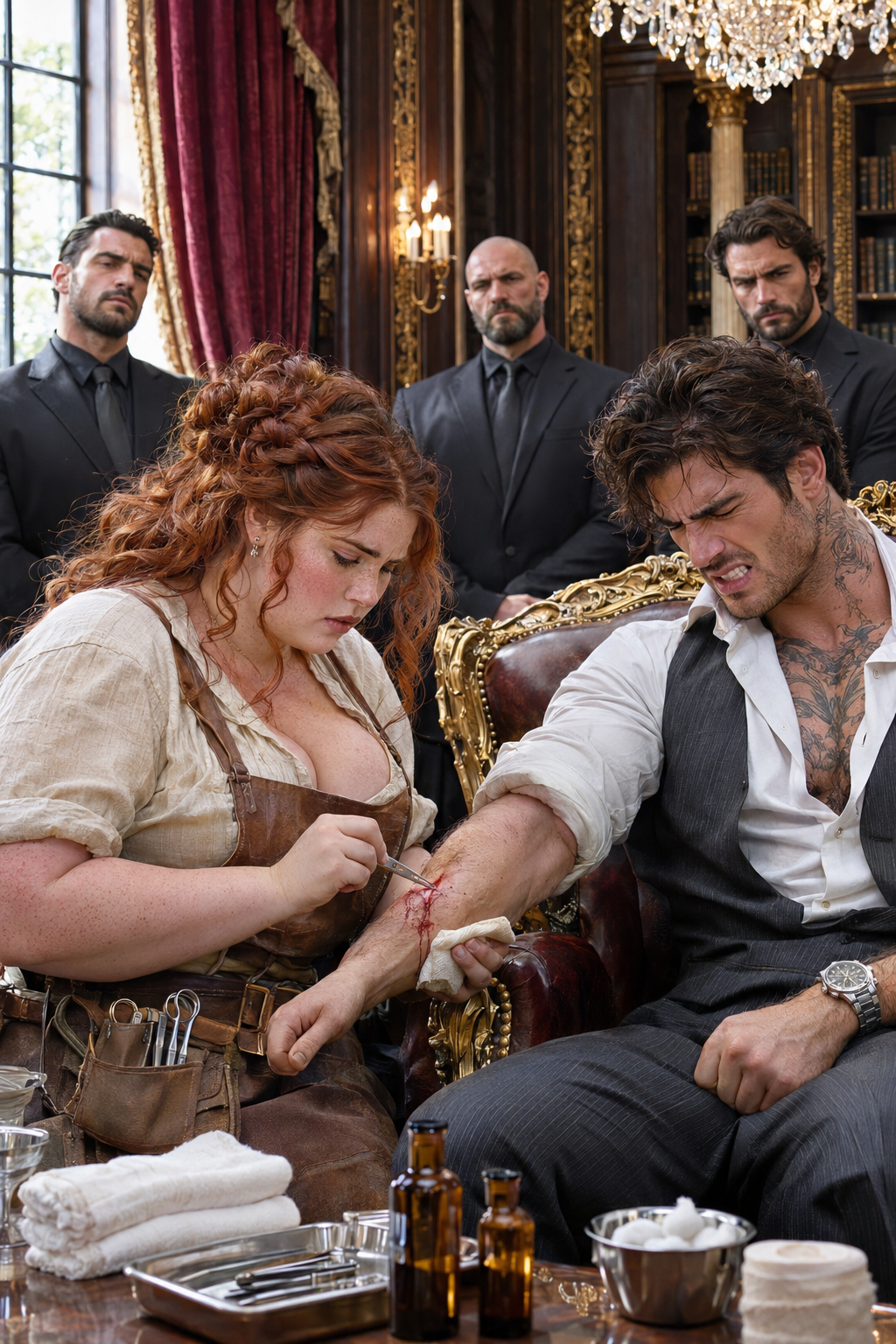
His right arm was wrapped in bandages. His left hand held a pistol.
Four of his men stood behind him.
The elderly maid was among them, trembling but unharmed.
Hadley slowly turned.
“Sir, thank goodness. This woman is attempting to let intruders into the house.”
Saverio glanced at the shaking door.
Then he looked at the wooden wedges.
“Interesting,” he said. “She appears to be doing the opposite.”
Hadley opened his mouth, but no words came out.
Saverio walked closer.
“Who is outside?”
“I don’t know.”
“Then why did you send my guards to the front gate?”
Hadley swallowed.
“There was a security concern.”
“And why did you disconnect the alarm at the carriage house?”
The butler’s face changed.
One of Saverio’s men stepped forward.
“We checked the security room, boss. Someone disabled the cameras covering this entrance.”
Saverio nodded slowly.
“Hadley has always been very thorough.”
The pounding suddenly stopped.
A moment later, a voice shouted from the other side of the door.
“Voss! Open up! Stahl isn’t paying us to freeze out here!”
Nobody spoke.
Hadley closed his eyes.
Saverio looked almost disappointed.
“Corwin Stahl,” he murmured.
The name seemed to carry more weight than the guns in the hallway.
Hadley suddenly lifted his weapon.
Before he could aim, Saverio’s men rushed him. His pistol fell to the floor, and within seconds, he was restrained.
Saverio stepped over the fallen weapon.
“Take him upstairs.”
Then he ordered his guards to surround the carriage house.
The three men outside tried to escape through the snow, only to find themselves facing armed guards approaching from both sides of the property.
Within minutes, all three had surrendered.
I remained beside the service door, staring at the wooden wedges.
My knees finally gave way.
Saverio caught my shoulder with his good hand.
“Easy, Miss Dobbs.”
I looked up at him.
“Are you going to kill me?”
He appeared genuinely surprised.
“After what you just did?”
“You threatened to earlier.”
For the first time, he smiled without bitterness.
“Then perhaps I owe you an apology.”
He helped me to my feet.
“Come upstairs. We have a conversation to finish.”
When we returned to the study, Hadley was seated in a chair between two guards.
His hair was untidy. His expensive jacket was wrinkled.
He looked smaller than he had when he first welcomed me into the mansion.
Saverio sat behind his desk and placed the blackened oak splinter on a white handkerchief.
“Tell me about the tavern.”
Hadley stared at the floor.
“I don’t know what you’re talking about.”
Saverio turned toward me.
“Miss Dobbs, earlier you mentioned that your father worked on the furniture in that tavern.”
I nodded.
“My father owned a small woodworking shop. He built the tables and chairs for several businesses in town.”
“What happened to his business?”
“He lost most of his customers after a man refused to pay him for a large order. We struggled for years afterward.”
“Do you remember that man’s name?”
I hesitated.
“Corwin Stahl.”
Saverio leaned back.
Hadley began breathing faster.
“My father used to talk about that tavern,” I continued. “He said someone had damaged one of his tables before a fight broke out. He was furious because the owner blamed him for building poor furniture.”
“Damaged it how?” Saverio asked.
“He never knew for certain. He only said the table had been sturdy when he delivered it. He couldn’t understand why it broke so easily.”
Saverio looked at the splinter again.
For nine years, he had believed that his injury was the result of an unfortunate accident during a drunken fight.
Now the pieces were beginning to fit together.
He turned to Hadley.
“You were the one who told me Stahl’s men were insulting my mother that night.”
Hadley said nothing.
“You convinced me to go to that tavern. You even insisted I leave most of my guards behind.”
Saverio’s voice remained calm, but his left hand tightened around the armrest.
“And when the fight started, you disappeared.”
Hadley looked toward the window.
“I was frightened.”
“No. You were waiting.”
Saverio opened a drawer and removed an old envelope.
Inside were medical reports from the six doctors who had examined his arm.
Every report mentioned the X-rays.
Every report concluded that no foreign object was visible.
None recommended a thorough investigation for buried wood.
“You arranged every appointment,” Saverio said. “Whenever I suggested another specialist, you found a reason to discourage me.”
Hadley shook his head.
“I was protecting you.”
“From what? The truth?”
The room fell silent.
Finally, Hadley began to cry.
Not loudly. Not dramatically.
Just a quiet, defeated sound.
“He promised me money,” he whispered.
Saverio didn’t move.
“Who?”
“Stahl.”
The name came out like a confession he had been carrying for years.
“He wanted you weakened. He thought if you lost the use of your arm, your enemies would see you as vulnerable. He paid me to arrange the fight.”
My stomach turned.
“And the doctors?” Saverio asked.
“I told them what tests to perform. Some believed the X-rays were enough. Others asked questions, but I made sure you never saw them again.”
Saverio looked down at his bandaged arm.
“You watched me suffer.”
Hadley wiped his face.
“I didn’t know it would get that bad.”
“You watched me struggle to button my shirt. You watched me drop things. You watched me put my mother’s violin away.”
His voice cracked slightly.
“And every morning, you asked whether I was feeling better.”
Hadley lowered his head.
“I’m sorry.”
Saverio stood.
For a moment, I thought he might reach for his pistol.
Instead, he walked to the fireplace.
“My mother trusted you,” he said.
Hadley began sobbing.
“She brought you into this house when you had nowhere to go. She gave you work. She treated your family with kindness.”
“I know.”
“And this is how you repaid her.”
Nobody dared interrupt.
After a long silence, Saverio asked where Stahl was waiting.
Hadley resisted at first.
Then one of the captured gunmen confirmed that Stahl was at a hunting lodge several miles away, expecting word that Saverio was dead.
Hadley finally admitted everything.
Stahl had learned about my visit through a telephone call from the mansion. Once Hadley realized I had discovered the splinter, they decided Saverio had to die before he uncovered the truth.
They planned to blame the murder on me.
Hadley had even prepared false evidence connecting me to Stahl’s organization.
I stared at him.
“You were going to destroy my life because I fixed a cabinet?”
He couldn’t meet my eyes.
Saverio ordered his men to secure the evidence and contact the authorities through his attorney.
Then he gave instructions to have Stahl located and detained.
By dawn, Corwin Stahl had been taken into custody. The captured gunmen and Hadley’s confession gave investigators enough information to begin building a case against him.
When the news reached the mansion, Saverio didn’t celebrate.
He simply stood beside the window, watching snow fall over the garden.
“It’s finished,” I said.
He shook his head.
“No, Miss Dobbs. Some things take longer to finish than others.”
A physician arrived shortly after sunrise.
Unlike the doctors Hadley had arranged, this one examined Saverio carefully and ordered further tests. He was concerned about the years of damage, the infection, and the possibility that fragments remained.
Saverio would need proper treatment, medication, and months of rehabilitation.
There was no promise that his hand would fully recover.
But there was hope.
Before leaving, the physician examined the old splinter.
“Wood can be difficult to detect on ordinary X-rays,” he explained. “Someone should have investigated this much sooner.”
Saverio looked toward Hadley’s empty chair.
“Yes,” he said quietly. “Someone should have.”
By then, I was exhausted.
I collected my tools and prepared to leave.
Saverio stopped me near the front entrance.
“How much do I owe you?”
“For the cabinet?”
“For everything.”
I thought about it.
“Forty dollars for the hinge. The rest wasn’t part of the job.”
He laughed.
It was a warm, unexpected sound.
“You nearly died in my house, and you’re charging me forty dollars?”
“Fifty, if you want me to repair that storage room door.”
He laughed even harder.
Then his expression softened.
“Miss Dobbs, your father deserved better than what happened to him.”
I nodded.
“He was a good man.”
“Would you allow me to repay what Stahl owed him?”
“My father is gone. Money won’t change that.”
“No,” Saverio agreed. “But perhaps it could change something for you.”
I considered his offer.
My workshop was struggling. The roof leaked, my equipment was aging, and winter was always difficult.
But I didn’t want to spend the rest of my life owing favors to a powerful man.
“If you want to help,” I said, “send honest customers my way. People who pay for the work they order.”
Saverio extended his left hand.
“Then we have an agreement.”
I shook it.
Before I stepped outside, he added something else.
“You have my protection, Winifred. For as long as I live. Nobody connected to Stahl will come near you.”
It was the first time he had called me by my first name.
I thanked him and went home.
Over the following weeks, my little workshop became busier than it had been in years.
Customers arrived with damaged furniture, broken doors, antique cabinets, and requests for custom pieces.
They paid fairly and treated me with respect.
One morning, a delivery truck arrived carrying new woodworking equipment.
There was no invoice.
Only a handwritten note.
“For the carpenter who taught me that small things can cause great damage, and small things can also save lives. — S.A.”
I smiled and placed the note beside my father’s photograph.
Meanwhile, Hadley and Stahl faced serious criminal charges. Their arrests exposed years of corruption and betrayal that had affected far more people than Saverio.
Several former employees came forward.
Businesses recovered records of unpaid debts and threats.
The truth, once hidden behind expensive suits and powerful names, could no longer be ignored.
Saverio kept me informed through occasional letters.
He never asked me to visit.
He never demanded anything in return.
Then, nearly eight months after that snowy night, an invitation arrived.
“Dinner at the mansion. Saturday evening. I have something I would like you to hear.”
When I returned, the house looked different.
The curtains were open. Fresh flowers stood in the entrance hall. The elderly maid greeted me with a hug.
Saverio met me in the study.
He looked healthier.
His right arm was no longer wrapped in bandages, although he still moved it carefully.
“How’s the hand?” I asked.
“Stubborn.”
“Sounds familiar.”
He smiled.
Then he opened the cabinet I had repaired on my first visit.
Inside rested a beautiful violin.
Its dark wooden surface shone beneath the lamplight.
“My mother’s,” he said.
He lifted it carefully.
“I spent nine years believing I would never play again.”
He positioned the violin beneath his chin and raised the bow with his right hand.
The first note was rough.
The second was better.
His hand trembled, and he stopped briefly to adjust his grip.
Then he began again.
A gentle melody filled the room.
It wasn’t perfect. Some notes were uneven, and his movements lacked the confidence of an experienced musician.
But as he continued, I noticed tears running down his cheeks.
I quietly sat beside the fireplace.
When the song ended, neither of us spoke for a while.
Finally, Saverio lowered the violin.
“My mother used to play that when I couldn’t sleep.”
He looked at the instrument.
“After she died, it was the only way I knew how to feel close to her.”
I understood.
I felt the same way whenever I picked up my father’s old tools.
Some things carry more than memories. They carry pieces of the people who taught us how to live.
Saverio placed the violin back in its case.
“I thought power meant never needing anyone,” he said. “I surrounded myself with people who feared me. I believed that made me safe.”
He looked directly at me.
“But the person who saved my life was someone I threatened for telling me the truth.”
I didn’t know what to say.
He continued.
“I can’t change everything I’ve done. But I can decide what kind of man I become with the time I have left.”
Over the next year, Saverio began stepping away from the most dangerous parts of his old life.
It wasn’t a simple transformation, and it didn’t erase his past.
But he started making different choices.
He helped former employees find legitimate work. He settled debts that had been ignored for years. He funded a vocational training program for young people who couldn’t afford to learn a trade.
He asked me to teach woodworking there once a week.
I accepted.
On the first day, a nervous teenage girl stood beside my workbench.
“Do you think I can really learn this?” she asked.
I handed her a piece of oak.
“Of course. Everyone starts somewhere.”
Years later, I still remember the night I entered Saverio Albanese’s mansion carrying nothing more than an old toolbox.
I had no money, no influence, and no powerful friends.
What I had was knowledge my father had passed down to me, the courage to speak when silence would have been easier, and a stubborn belief that every person deserved the truth.
Those things proved more valuable than any weapon in that mansion.
Saverio never forgot it.
Every winter, he invited me to dinner. And every winter, he played his mother’s violin.
His hand never completely recovered, but he learned to work with its limitations.
The music became steadier with each passing year.
And whenever he finished playing, he would glance at the cabinet beside the fireplace and smile.
All because of a broken hinge.
Sometimes the greatest changes in our lives begin with something so ordinary that we almost overlook it.
A stranger arrives at the door. A simple question is asked. Someone notices a detail that everyone else has ignored.
And suddenly, the truth begins to emerge.
I learned that betrayal can hide behind years of loyalty, while genuine kindness can come from someone you have known for only a few hours.
I also learned that courage doesn’t mean standing without fear.
It means choosing to do what is right even when your hands are shaking.
Saverio spent nine years believing his greatest weakness was his injured arm.
In the end, his greatest weakness had been trusting the wrong people and refusing to question what he had been told.
And his greatest strength wasn’t the power he held over others.
It was his willingness to finally listen.
As for me, I never stopped being a carpenter.
I still repair broken cabinets, restore old furniture, and teach young people how to turn rough pieces of wood into something beautiful.
Above my workbench hangs a photograph of my father, alongside a small framed note from a man who once pointed a gun at me.
Whenever life becomes difficult, I look at those two reminders and remember something important.
Not everything broken needs to be thrown away.
Some things need patience. Some need care. And some simply need someone brave enough to discover what has been hurting them all along.
Sometimes, even a life that seems beyond repair can become something beautiful again.
Five years after that unforgettable winter, I received another letter from Saverio.
This time, there was no invitation to dinner.
Instead, the envelope contained a photograph of his mother’s violin and a handwritten message.
“Winifred, there is one last thing I need your help with. Come whenever you can.”
Something about those words worried me.
When I arrived at the mansion the following afternoon, Saverio was sitting in the garden beneath an old oak tree. His hair had turned almost completely gray, and he walked with a cane.
But his smile was the same.
“You’re getting old,” I teased.
“So are you, Miss Dobbs.”
He laughed and motioned toward the empty chair beside him.
For a while, we talked about ordinary things. My workshop, the students I was teaching, and the repairs his aging mansion needed.
Then he handed me a folder.
Inside were documents transferring ownership of an old building downtown.
I recognized the address immediately.
It was my father’s former woodworking shop.
My heart nearly stopped.
“Where did you get this?”
“I bought it three years ago,” Saverio explained. “I’ve been restoring it.”
I stared at him.
“Why?”
“Because your father lost something that should never have been taken from him.”
He explained that the building would become a permanent woodworking school. Students from struggling families could attend without paying a single dollar.
The school would carry my father’s name.
I couldn’t hold back my tears.
“Saverio, this is too much.”
He shook his head.
“Not compared to what you gave me.”
He looked down at his right hand.
“You gave me back something I thought I’d lost forever. Now it’s my turn.”
A week later, we stood together outside the newly restored building.
Above the entrance was a wooden sign bearing my father’s name.
Inside, sunlight poured through tall windows. New workbenches stood where my father had once worked. His old tools, which I had carefully preserved, were displayed behind glass.
I could almost hear his voice.
“Measure twice, Winnie. Cut once.”
I smiled through my tears.
Saverio watched quietly.
“Do you think he would have liked it?”
“He would have loved it.”
The school opened that spring.
Dozens of young people came through its doors, many carrying the same uncertainty I had felt when I first entered my father’s workshop as a child.
Some had lost their parents. Others had grown up in poverty. A few had made mistakes and were desperate for another chance.
We welcomed every one of them.
Saverio visited regularly. He never introduced himself as the owner or the man who had funded the school.
He simply sat in the corner, drinking coffee and watching the students work.
Sometimes, he brought his violin.
The students loved listening to him play.
None of them knew that the gentle old man had once been feared throughout the city.
And perhaps that was what he wanted most.
Not to be remembered for the fear he had created, but for the good he had finally learned to do.
Two winters later, Saverio became seriously ill.
I visited him almost every day.
One evening, he asked me to bring his violin from the cabinet.
His hands were too weak to play.
“Would you hold it for me?” he asked.
I placed the instrument carefully across his chest.
He closed his eyes.
“Do you remember the first thing you said to me?”
I smiled.
“I asked how long your arm had been hurting.”
“No,” he whispered. “You told me there was something inside me that didn’t belong there.”
He opened his eyes again.
“You were right about more than the splinter.”
I held his hand.
For a long time, neither of us spoke.
Then he looked toward the window, where snow was beginning to fall.
“Thank you for not being afraid to tell me the truth.”
“I was terrified,” I admitted.
He smiled.
“That makes it worth even more.”
Saverio passed away peacefully the following morning.
At his funeral, I saw people from every part of his life. Former employees, business owners, students, and families he had helped during his final years.
His past had not been forgotten, and the good he had done could never erase every wrong.
But the people standing there were proof that a person could choose a different path, even after spending decades walking the wrong one.
Several days later, his attorney delivered a small wooden case to my workshop.
Inside was his mother’s violin.
Beneath it lay a final letter.
“Dear Winifred,
My mother believed that music could reach places in the heart that words could not.
For years, I forgot what she taught me. I believed money could buy loyalty and fear could guarantee respect.
Then a carpenter walked into my house and proved me wrong.
Please give this violin to someone who will love it as much as my mother did.
And never stop teaching people how to build things.
The world has enough people who know how to destroy them.
Your friend,
Saverio.”
I read the letter three times before folding it carefully.
Months later, I met a twelve-year-old girl whose mother couldn’t afford music lessons. She had been borrowing a violin from her school and dreamed of becoming a musician.
I gave her Saverio’s violin.
When she played it for the first time, I recognized the same gentle warmth I had heard in the mansion all those years ago.
I looked toward the ceiling and smiled.
“It’s in good hands, Saverio.”
Today, my father’s woodworking school continues to welcome students.
The young girl who received the violin eventually earned a music scholarship. She returns every Christmas to perform for our students and their families.
And beside the entrance hangs a small glass frame.
Inside are two ordinary wooden wedges.
Most visitors walk past without noticing them.
But whenever someone asks what they mean, I tell them about a snowy night, a broken cabinet hinge, a dangerous man, and a truth that had been buried for nine years.
I tell them how a simple carpenter discovered that the most powerful man in the city needed something his money couldn’t buy.
Someone willing to care enough to tell him the truth.
My father once taught me that the value of a piece of wood wasn’t determined by how damaged it looked, but by what someone could patiently make from it.
It took me a lifetime to understand that his lesson applied to people, too.
We cannot undo every mistake.
We cannot recover every lost year.
But as long as we are alive, we can choose to become better than we were yesterday.
Saverio Albanese made that choice.
And because he did, countless young people were given the chance to build a future they once thought impossible.
All those years ago, I entered his mansion expecting to repair a cabinet.
I never imagined that I would help change a man’s life.
Or that, in return, he would change so many others.
And that is why I still believe the smallest acts of courage and kindness can leave behind the greatest legacies.
THE END.