The most dangerous man in the city threatened to have Molly Hayes killed before she even finished checking his blood pressure
Vincent nodded toward the envelope, and his bodyguard handed it to Molly.
“Open it.”
She hesitated before sliding her finger beneath the flap. Inside was a set of car keys, a repair invoice, and a photograph of her old blue Honda parked outside the hospital.
Molly stared at the photograph.
“What is this?”
“Your car,” Vincent replied. “Unless you have another one sitting outside your apartment with a broken transmission.”
She looked at the invoice. The transmission had been replaced. So had the brakes, the battery, and two worn tires. Someone had even fixed the driver’s side window that hadn’t worked properly in three years.
At the bottom of the invoice, two words were printed in bold letters.
PAID IN FULL.
“Vincent, this is nearly four thousand dollars.”
“Is it?”
“You know perfectly well how much it is.”
He shrugged. “The mechanic said it was necessary.”
Molly placed the envelope on his bedside table.
“I can’t accept this.”
His smile disappeared.
“Why not?”
“Because I’m your nurse. There are rules about accepting expensive gifts from patients. And because you had no right to go looking into my personal life.”
Vincent’s bodyguard, a broad-shouldered man named Marco, suddenly became very interested in the view outside the window.
“I was trying to help,” Vincent said.
“You could have asked.”
“Would you have said yes?”
“Probably not.”
“Exactly.”
Molly folded her arms.
“That doesn’t make it okay.”
Vincent looked genuinely confused. He had spent most of his adult life solving problems with money, influence, or fear. Nobody had ever complained when he made their problems disappear.
At least, nobody had dared to complain to his face.
“It’s a car, Molly. I’m not asking you to marry me.”
“And I’m not asking you to rescue me.”
The words landed harder than she intended.
Vincent looked away.
For a moment, Molly wondered whether she had gone too far. Then she remembered the first night, when he had threatened her simply because she wouldn’t follow his orders.
She pulled a chair beside his bed.
“Listen. What you did was incredibly generous. I mean that. But helping someone doesn’t mean you get to make their decisions for them.”
He remained silent.
“I’ve spent years taking care of myself,” she continued. “I might not be very good at it sometimes, but my life belongs to me.”
Vincent finally looked at her.
“You really believe that, don’t you?”
“Of course I do.”
He glanced at the envelope.
“Then consider it a mistake made by a man who doesn’t know how to say thank you.”
Something in his voice softened her anger.
Molly picked up the invoice again.
“Let me speak to my supervisor. We’ll figure out what can be done properly.”
“Fine.”
“And no more investigating me.”
He raised his good hand.
“Understood.”
She stood and reached for her medical supplies.
“Now, let’s see how those stitches are doing.”
Marco cleared his throat.
“Boss, should I cancel the other thing?”
Molly froze.
Vincent closed his eyes.
“Marco.”
“What other thing?” Molly demanded.
Marco looked between them.
“The groceries.”
Molly slowly turned toward Vincent.
“You bought me groceries?”
“Nothing excessive.”
“How much?”
Marco answered before Vincent could stop him.
“Two refrigerators’ worth.”
For the first time since entering room 412, Molly burst out laughing.
She laughed so hard that she had to sit down again.
Vincent watched her, initially offended, then amused despite himself.
“You’re absolutely ridiculous,” she told him.
“So I’ve been informed.”
The laughter faded into a comfortable silence. Molly returned to his bandages, and Vincent watched her hands as she worked.
He had been surrounded by people his entire life. Yet somehow, sitting in that hospital room with an exhausted nurse who refused to obey him, he felt less alone than he had in years.
Then his phone rang.
Marco checked the screen.
His expression changed immediately.
“It’s your brother.”
Vincent’s entire body went rigid.
“Not now.”
Marco stepped into the hallway to answer. When he returned, he leaned close to Vincent and whispered something.
Molly noticed Vincent’s fingers tighten around the blanket.
“Get everyone out,” he ordered.
Marco glanced at her.
“Everyone?”
Vincent looked directly at Molly.
“Especially her.”
The warmth that had filled the room disappeared.
Molly finished securing his bandage.
“What’s going on?”
“Nothing you need to worry about.”
“Your heart rate says otherwise.”
“Molly, leave.”
His tone was no longer playful.
She recognized the man she had met on the first night. Cold, commanding, and dangerous.
“Fine,” she said. “But you’re still my patient. Don’t do anything stupid.”
She gathered her supplies and walked out.
Twenty minutes later, a man in an expensive gray suit arrived on the fourth floor. He looked enough like Vincent that Molly immediately guessed who he was.
Unlike Vincent, however, he smiled at everyone.
He smiled at the receptionist. He smiled at the security officer. He even smiled at Molly when he passed the nurses’ station.
“Good evening,” he said.
She nodded politely.
He entered room 412 without knocking.
Molly returned to her paperwork, but raised voices soon came through the closed door.
“You should have died in that warehouse.”
She stopped typing.
Vincent answered, but his voice was too low for her to understand.
Then came the sound of something breaking.
Molly stood.
Before she could reach the room, Marco stepped into the hallway.
“Everything’s fine.”
“That didn’t sound fine.”
“Family disagreement.”
“Then your family can disagree somewhere else.”
She moved past him and opened the door.
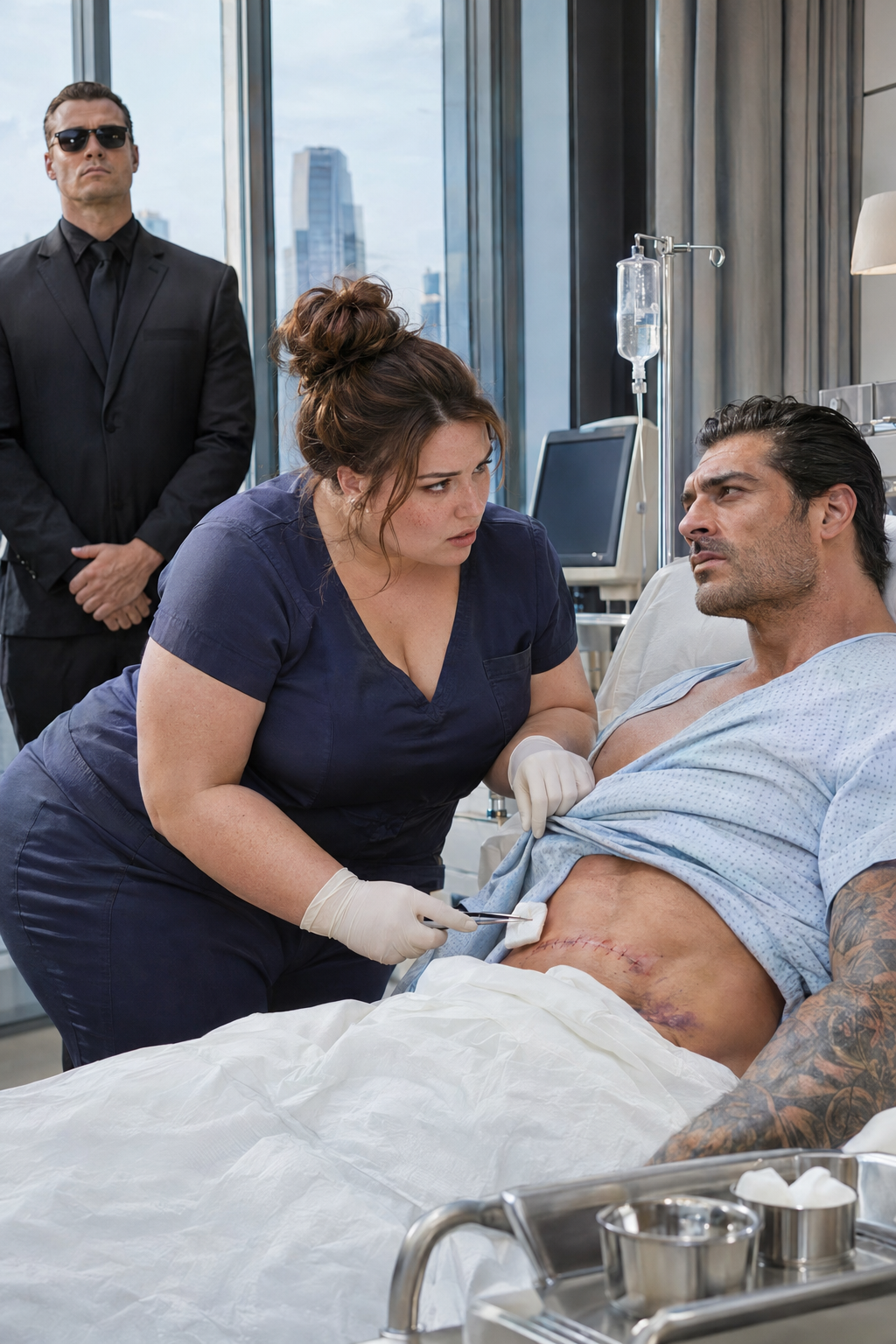
A glass lay shattered across the floor. Vincent was sitting upright, breathing heavily, while his brother stood beside the bed.
Both men turned toward her.
“Visiting hours are over,” Molly announced.
The stranger smiled.
“You must be Nurse Hayes.”
She didn’t like the way he said her name.
“And you must be leaving.”
He laughed softly.
“My brother told me you were entertaining.”
Vincent’s face darkened.
“Adrian. Go.”
Adrian adjusted his jacket.
“Of course. I wouldn’t want to interfere with your recovery.”
He walked toward the door, stopping beside Molly.
“Be careful who you become friends with, sweetheart. Some people bring trouble wherever they go.”
Molly held his gaze.
“Good night, sir.”
After he left, she noticed fresh blood spreading beneath Vincent’s dressing.
“What did he do?”
“Nothing.”
“Your wound has reopened.”
“I moved too quickly.”
She pressed the call button and began assessing the injury.
Vincent didn’t argue when the doctor arrived. He didn’t threaten anyone when they examined him.
He simply stared at the ceiling.
Once the doctor had stabilized him and left, Molly returned to check his vital signs.
“Your brother seems lovely,” she remarked.
Vincent gave a humorless laugh.
“He’s always been charming.”
“Is he the reason you’re here?”
The question hung between them.
Vincent turned his head toward the window.
“You should go home.”
“My shift isn’t over.”
“Then request another patient.”
Molly studied him.
“Are you trying to protect me?”
He didn’t answer.
That was answer enough.
She lowered her voice.
“Vincent, whatever is happening outside this hospital, you cannot bring it in here. There are sick people on this floor. Children visit their grandparents. Nurses come to work expecting to go home safely.”
“I know.”
“Do you?”
He looked at her sharply.
She didn’t back away.
After a long silence, Vincent spoke.
“My brother believes I’ve become a liability.”
“Because you were shot?”
“Because I’m considering walking away.”
Molly blinked.
“From what?”
“Everything.”
For the first time, Vincent told her something about his life.
He had been born into a family where loyalty meant obedience. His father had ruled their household with the same cruelty he used against his enemies.
When Vincent was nine, he had tried to protect Adrian after his younger brother broke an expensive bottle of whiskey.
Their father had been furious.
Vincent took the blame.
The punishment left the scar across his shoulder.
Molly stopped moving.
“Your father burned you?”
Vincent nodded once.
“My mother took me to the hospital the next morning. She told everyone it was an accident.”
“Vincent…”
“There was a nurse there. I don’t remember her name. She gave me a sandwich and sat beside me until I stopped crying.”
He swallowed.
“She was the first adult who ever asked me whether I was afraid.”
Molly felt a tightness in her throat.
“What did you tell her?”
“That I wasn’t.”
“Were you?”
“Terrified.”
He looked down at his hands.
“My father taught me that fear was weakness. So I spent the next thirty-seven years making sure everyone else was more frightened than I was.”
Molly sat quietly beside him.
She finally understood why he had reacted so strongly when she discovered his scar.
But understanding his pain didn’t erase the things he had done.
“Being hurt explains a lot,” she said carefully. “It doesn’t excuse hurting other people.”
Vincent nodded.
“I know.”
“Then what are you going to do about it?”
Before he could answer, Marco appeared in the doorway.
“Boss, we have a problem.”
His face was pale.
“The police are downstairs. Adrian’s men are outside.”
Vincent closed his eyes.
Molly stood.
“What does that mean?”
“It means,” Vincent replied, “that my brother has decided I’m not leaving this hospital alive.”
For several seconds, nobody spoke.
Then Molly reached for the phone.
“I’m calling hospital security.”
Marco stepped forward.
“Miss Hayes, we can handle this.”
“No. You absolutely cannot.”
Vincent looked at Marco.
“Do what she says.”
Molly contacted security and alerted her charge nurse. Within minutes, hospital administrators were coordinating with police, restricting access to the fourth floor, and moving vulnerable patients away from the immediate area.
Vincent watched the activity through his open door.
For decades, he had responded to threats with threats of his own.
Now an exhausted nurse was dealing with the consequences of his life while he lay helpless in a hospital bed.
He had never felt more ashamed.
Two detectives arrived shortly afterward.
One of them, Detective Reynolds, had apparently known Vincent for years.
“Costa,” he said. “You look terrible.”
“Nice to see you too.”
“We need to talk.”
Vincent glanced toward Molly.
“Give us a minute.”
Reynolds shook his head.
“You’ve had plenty of minutes. About twenty years’ worth.”
The detective explained that Adrian was under investigation for the warehouse shooting. Authorities believed the attack was part of an internal struggle for control of the Costa organization.
They had enough evidence to arrest several men, but they needed someone willing to testify about the operation.
Someone who knew everything.
Vincent understood exactly what Reynolds was asking.
“If I cooperate, I go to prison.”
“Probably.”
“And my brother?”
“That depends on the evidence.”
Vincent looked toward Marco, who stood silently against the wall.
For the first time in his life, Vincent faced a decision that money couldn’t solve.
He could continue the war, protect his empire, and spend whatever remained of his life waiting for the next bullet.
Or he could end it.
He asked the detectives to step outside while he spoke privately with Molly.
She entered reluctantly.
“You heard?”
“Enough.”
“What would you do?”
Molly shook her head.
“I’m not making this decision for you.”
“I’m asking your opinion.”
She thought for a moment.
“When I was twenty-three, I lost my mother. She had been sick for years. After she died, I kept working extra shifts because I didn’t know what else to do.”
Vincent listened.
“One night, a patient thanked me for holding his hand while he waited for surgery. That’s when I realized I couldn’t change what had happened to my mother. But I could decide what kind of person I became afterward.”
She looked at him.
“You can’t change your childhood. You can’t undo the things you’ve done. But you’re still responsible for what happens next.”
Vincent stared at her for a long time.
“Even if it costs me everything?”
“Especially then.”
He nodded slowly.
“Send the detectives back in.”
Molly stepped toward the door.
“Molly?”
She turned.
“Thank you.”
This time, there was no envelope. No money. No expensive gesture.
Just two words.
She smiled.
“You’re welcome.”
Vincent spent the next three hours speaking with the detectives and his attorney. He agreed to cooperate with investigators, provide records, and testify about the organization he had controlled.
When Marco learned what Vincent had decided, he looked devastated.
“Boss, we’ve been together for eighteen years.”
“I know.”
“What happens to us now?”
Vincent took a deep breath.
“You get a lawyer. You tell the truth. And you stop calling me boss.”
Marco lowered his head.
Then he nodded.
By sunrise, Adrian had been arrested after police intercepted him near the hospital. Several members of the organization were taken into custody.
The immediate danger was over.
But Vincent’s consequences were only beginning.
When Molly returned to room 412 the following evening, two police officers stood outside instead of armed bodyguards.
Vincent was eating oatmeal.
“Look at you,” she said. “Following medical advice without supervision.”
“Don’t get used to it.”
She checked his chart.
“The hospital approved an arrangement for the car. I can reimburse the repair costs through a payment plan with the garage. No personal gifts.”
Vincent sighed.
“You really are impossible.”
“And you’re going to live.”
He smiled.
“Apparently.”
Two days later, Vincent was medically cleared to leave the hospital under police supervision.
Molly helped him prepare for discharge.
He wore an ordinary sweater and dark pants. Without his expensive suits, his guards, and his commanding presence, he looked like any other middle-aged man recovering from a serious injury.
At the door, he stopped.
“Do you think I’m a good person, Molly?”
She considered the question carefully.
“I think you’re a person who has done terrible things and is finally choosing to do something different.”
He looked disappointed for a moment.
Then he smiled.
“Fair enough.”
She handed him his discharge instructions.
“Take care of yourself, Vincent.”
“You too, Nurse Hayes.”
He walked away between the officers.
Molly watched until the elevator doors closed.
Then she returned to work.
There were medications to distribute, patients to assess, and families waiting for answers. Room 412 needed to be cleaned for its next occupant.
Life continued.
Over the following months, Vincent’s name appeared regularly in the news. His testimony helped investigators uncover years of criminal activity. Adrian and several others were convicted.
Vincent pleaded guilty to multiple offenses and received a lengthy prison sentence.
Some newspapers described his cooperation as a calculated attempt to reduce his punishment. Others called it an extraordinary betrayal of his own organization.
Molly never pretended to know everything about his motives.
She only knew what she had witnessed.
A frightened man had finally stopped running from the consequences of his choices.
Almost a year after Vincent left the hospital, Molly received a letter through the hospital’s approved correspondence process.
The handwriting was neat and surprisingly small.
Dear Nurse Hayes,
You will be pleased to know that I take my medication without arguing. The food here is worse than yours, which I previously believed was impossible.
I have started attending counseling. I don’t particularly enjoy it, but I suspect you would tell me that enjoyment isn’t the point.
For most of my life, I thought being respected meant being feared. You were the first person who showed me the difference.
I cannot repair everything I have broken. But I am trying to stop breaking things.
I hope the Honda is still running.
Thank you for treating me like a human being without pretending I was innocent.
Vincent.
Molly read the letter twice.
Then she folded it carefully and placed it inside her locker.
Her Honda was, in fact, still running. She had paid off a significant portion of the repair bill, and for the first time in years, she had started putting money aside for emergencies.
More importantly, she had stopped believing that accepting help was always a sign of weakness.
One evening, she discovered a young nursing assistant crying in the break room. The woman’s car had broken down, and she was worried about losing her job because she couldn’t afford transportation.
Molly sat beside her.
“Would it help if I gave you a ride for a few days?”
The young woman wiped her eyes.
“You’d do that?”
“Of course.”
“I don’t know how I’ll repay you.”
Molly smiled.
“You don’t have to. Just let me know what you need.”
Later that night, she walked past room 412.
An elderly man was sleeping peacefully inside, his daughter holding his hand.
Molly paused for a moment before continuing down the hallway.
She had spent only a handful of nights caring for Vincent Costa, yet those nights had changed something in both of them.
Vincent had learned that kindness wasn’t something he could purchase, demand, or control.
Molly had learned that even the most frightening people could carry wounds nobody else could see.
Neither lesson erased the past. Neither made cruelty acceptable. But both reminded them that the future didn’t have to be an endless repetition of what had come before.
Sometimes, compassion meant sitting beside someone when they were afraid.
Sometimes, it meant refusing to let them escape responsibility.
And sometimes, the greatest kindness was believing that a person could become better while still expecting them to answer for everything they had done.
Vincent Costa had spent his entire life believing that power meant making other people surrender.
In room 412, an exhausted nurse with a broken-down car had taught him something different.
Real strength was having the courage to change when nobody could force you to.
And for the first time in his life, Vincent was learning how to be strong.
Five years later, Molly Hayes was standing at the nurses’ station when a familiar name appeared on the evening news.
Vincent Costa.
She stopped writing and turned toward the television.
The reporter explained that Vincent had recently testified in another trial involving his former criminal organization. His cooperation had helped authorities recover millions of dollars, some of which would be returned to victims and their families.
But it was the next announcement that caught Molly’s attention.
Vincent had been granted a reduced sentence because of his continued cooperation. He was expected to be released the following spring, under strict supervision.
One of Molly’s coworkers noticed her watching.
“Wasn’t he your patient once?”
“Years ago.”
“Weren’t you terrified of him?”
Molly smiled slightly.
“Sometimes.”
Her coworker laughed, assuming she was joking.
Molly wasn’t.
She remembered the threats, the armed men, and the night his brother arrived at the hospital. She also remembered the frightened little boy hidden beneath the scar on Vincent’s shoulder.
Both versions of him had been real.
The following spring, Molly received another letter.
It contained only a few sentences.
Dear Nurse Hayes,
I’m getting out next Tuesday. I don’t expect anyone to welcome me home, and I understand why.
For the first time, I have no idea what comes next.
Strangely enough, I’m looking forward to finding out.
Vincent.
Molly placed the letter beside the first one in her desk drawer.
She hoped he would find a way to build an ordinary life.
She knew it wouldn’t be easy.
Three months passed before she heard anything else about him.
Then, on a Saturday morning, her Honda began making a familiar rattling sound.
“Oh, come on,” she muttered, gripping the steering wheel.
The car had served her faithfully for years, but it was finally showing its age.
She drove to a small repair shop recommended by a coworker.
A bell rang when she entered the office.
“I’ll be right with you,” someone called from the garage.
Molly sat down and picked up an old magazine.
A moment later, a man emerged wearing faded jeans and a work shirt covered in grease.
He was wiping his hands with a rag when he saw her.
They both froze.
“Molly?”
She slowly lowered the magazine.
“Vincent?”
His hair was grayer. His face was thinner. There were lines around his eyes that hadn’t been there before.
But she recognized his smile immediately.
“Well,” he said, looking toward the parking lot. “I see you’re still driving that terrible car.”
“And I see you’re finally doing an honest day’s work.”
He laughed.
It was a genuine laugh, free of the arrogance she remembered from room 412.
“What are you doing here?” she asked.
“Working.”
“I can see that.”
“The owner gave me a chance. Apparently, I’m better at fixing engines than dealing with customers.”
“Somehow, that doesn’t surprise me.”
Vincent pulled out a chair and sat across from her.
For a few minutes, they simply looked at each other.
There was so much to say that neither knew where to begin.
Finally, Molly asked, “How are you doing?”
Vincent considered his answer.
“Some days are good. Some aren’t.”
“That’s life.”
“I’m starting to understand that.”
He explained that he lived in a small apartment above a bakery. He worked six days a week, attended counseling, and continued cooperating with authorities whenever necessary.
A portion of his earnings went toward court-ordered restitution.
He had no expensive cars, no mansion, and no men waiting to follow his orders.
He bought his own groceries and washed his own clothes.
“The washing machine and I have a complicated relationship,” he admitted.
Molly laughed.
“Have you tried reading the instructions?”
“Several times. I believe they’re deliberately misleading.”
For the next hour, they talked like old friends.
Then Vincent inspected her Honda.
When he returned, he carried a printed estimate.
“Your exhaust system needs some work.”
“How much?”
He handed her the paper.
Molly examined it suspiciously.
“Is this the actual price?”
“Every penny.”
“No mysterious payments?”
“No.”
“No secret favors?”
“Absolutely not.”
She smiled.
“Good. You’ve learned something.”
Vincent looked at her with quiet gratitude.
“I learned quite a lot.”
While she waited for the repairs, Molly noticed a photograph hanging beside the office door.
It showed Vincent standing with several young men outside the garage.
“Who’s that?”
He followed her gaze.
“The shop runs a training program for young people who’ve been in trouble. The owner lets me help teach them.”
Molly looked closer.
One boy couldn’t have been older than seventeen.
“He reminds me of myself,” Vincent said. “Angry at everyone. Convinced the world owes him something.”
“What do you tell him?”
“That being angry isn’t a career.”
Molly smiled.
“And does he listen?”
“Sometimes.”
Vincent’s expression grew serious.
“I also tell him what prison is really like. What it feels like to lose years you can never get back. What happens when you spend your life hurting people and eventually run out of excuses.”
He looked down at his hands.
“I don’t want him to become me.”
Molly felt a familiar warmth in her chest.
“Then keep showing up.”
Vincent nodded.
Before she left that afternoon, he handed her the keys and the receipt.
She paid the entire bill.
As she walked toward her car, Vincent called after her.
“Molly.”
She turned.
“There’s something I’ve wanted to ask you for years.”
“What is it?”
“Why weren’t you afraid to be kind to me?”
Molly thought about it.
“I was afraid, Vincent. Being kind doesn’t mean you’re never scared.”
“Then why?”
“Because you were my patient. You needed care. And your past didn’t change my responsibility to provide it.”
He looked at her quietly.
“You could have treated me like a monster.”
“I could have. But that wouldn’t have made either of us better.”
Vincent swallowed.
For a moment, he looked exactly as he had that night in room 412, when she had discovered his scar.
Only this time, he didn’t look away.
“Thank you,” he said.
Molly smiled.
“Take care of yourself.”
She drove away, leaving Vincent standing outside the garage.
Years passed.
Molly eventually became a nursing supervisor. She trained new nurses, helped establish an emergency assistance fund for hospital employees, and made sure nobody on her team felt ashamed to ask for help.
Vincent continued working at the repair shop.
He never became wealthy again.
But he became dependable.
The young men he trained began finding jobs of their own. Some returned to thank him. Others simply moved forward with their lives.
Every successful departure felt like a small victory.
One winter afternoon, a teenager arrived at the garage with bruised knuckles and an angry expression.
He had been suspended from school and was threatening to run away from home.
Vincent recognized the pain behind his anger.
Instead of lecturing him, he brought him a sandwich and pulled up a chair.
“Are you afraid?” Vincent asked.
The boy shook his head.
“No.”
Vincent smiled gently.
“That’s what I used to say, too.”
He stayed beside the boy until he was ready to talk.
That evening, Vincent sat alone in his apartment and thought about the nurse who had cared for him when he was nine.
Then he thought about Molly.
Two women, separated by decades, had offered him the same simple thing when he needed it most.
Human kindness.
The first had shown him that kindness existed.
The second had reminded him that he could choose to practice it himself.
He couldn’t bring back the people he had hurt. He couldn’t return the years stolen from innocent families. Nothing he did would erase those truths.
But he could spend the years he had left preventing someone else from making the same mistakes.
And that was what he intended to do.
On the tenth anniversary of his discharge from the hospital, Molly received a small package.
Inside was a framed photograph of Vincent and the first group of young mechanics who had completed the garage’s training program.
On the back, he had written a message.
You once told me that my life belonged to me, and that I was responsible for what happened next.
These young men are part of what happened next.
Thank you for helping me understand the difference between having power and having a purpose.
Molly placed the photograph on her office shelf.
Whenever a new nurse asked about it, she told them the story of a difficult patient who had taught her something she would never forget.
People were more than their worst moments, but becoming better required more than simply regretting the past.
It required courage, accountability, and the willingness to make different choices every single day.
Vincent Costa had once believed his greatest achievement was building an empire that nobody dared challenge.
In the end, his greatest achievement was helping others build lives that never needed an empire like his.
And Molly Hayes, the exhausted nurse who had entered room 412 with nothing but a medical chart and a stubborn sense of duty, had helped him discover that possibility.
She hadn’t saved him from prison.
She hadn’t saved him from the consequences of his crimes.
She had simply reminded him that he still had a choice.
What he did with that choice was finally his responsibility.
And this time, Vincent chose kindness.