The morning Isabel Lennox discovered she was carrying the Duke of Ashgrove’s child, she also discovered exactly how much her husband intended to sell her for.
The servant stood in the doorway, his eyes moving uneasily between the Duchess of Ashgrove and Lady Beatrice, while the distant sound of carriage wheels faded beneath the rain beginning to fall across the Yorkshire courtyard.
“His Grace is waiting in the morning room, Your Grace. He has asked that you join him immediately.”
Isabel remained beside her father’s writing desk, one hand resting against its polished edge. The physician’s leather bag was still visible near the door, and the servant’s expression suggested that Rafe had noticed it.
“What did His Grace say to the doctor?”
The servant lowered his gaze.
“I cannot say, Your Grace. I only heard him ask whether you were unwell.”
Lady Beatrice crossed the room and quietly dismissed the man. Once the door closed, she turned toward Isabel with an expression that held neither surprise nor pity.
“You need not go downstairs until you are ready.”
Isabel looked toward the window. Beyond the rain-streaked glass, Rafe’s carriage stood beneath the portico, its horses shifting impatiently in the cold.
“He has traveled nearly two hundred miles because I refused him money,” she said. “He will not leave simply because I refuse him an audience.”
“Then we shall make certain he understands that an audience is a privilege, not a right.”
Isabel almost smiled.
Lady Beatrice approached and took her hand.
“And before you face him, there is something you should know. I heard the physician speaking with your housekeeper earlier. He mentioned that your condition required discretion.”
Isabel felt the blood drain from her face.
“Did he tell you?”
“No. I have lived long enough to recognize what a young woman is trying very hard to conceal.”
For several moments, Isabel said nothing.
Then she placed Lady Beatrice’s hand against her stomach.
The older woman’s expression softened.
“Oh, my dear.”
It was the first time Isabel had shared the news with anyone outside the medical profession. She had imagined telling Rafe in the library, perhaps watching his face brighten with the happiness she had once believed they shared.
Instead, she stood in her father’s house with another woman holding her hand, and felt an unexpected relief that someone finally knew.
“Does he know?” Lady Beatrice asked.
“I do not believe so.”
“Then you must decide when he learns. Not him.”
A sharp knock interrupted them.
Rafe’s voice came through the door.
“Isabel, I know you are in there.”
Lady Beatrice’s face hardened.
“How charming. He has apparently forgotten how doors work.”
She opened it before Isabel could respond.
Rafe stood in the corridor wearing a traveling coat darkened by rain. His boots were muddy, his expression impatient, and his gloved hand rested on the silver handle of his walking cane.
“Aunt Beatrice. I had not expected to find you here.”
“Clearly. Otherwise you might have remembered your manners.”
His gaze moved past her toward Isabel.
“We need to speak.”
“Then speak,” Isabel answered.
Rafe glanced at his aunt.
“Privately.”
Lady Beatrice remained exactly where she stood.
“My nephew, whatever you have traveled here to demand can be said in my presence.”
Rafe’s jaw tightened, but he entered without arguing.
The room smelled faintly of coal smoke and lavender. On the desk lay neat columns of figures, factory correspondence, and a map of the family’s manufacturing properties.
Rafe surveyed them with open irritation.
“So this is how you have occupied yourself. Playing at commerce.”
Isabel folded the letter she had been reading.
“The mills employed four hundred and twelve people last quarter. I would hardly call their livelihoods a game.”
He removed his gloves.
“I have not traveled here to discuss factory workers.”
“No. You have come about fifteen thousand pounds.”
The precision of her answer stopped him.
Rafe placed his cane beside the fireplace and attempted the familiar smile that had once made Isabel forgive almost anything.
“My dear, there has been an unfortunate misunderstanding. The wager is not the reckless enterprise you imagine. The horse is exceptionally well bred, and the odds are favorable.”
“Then I wish you every success.”
He waited.
She returned to her chair.
“Isabel.”
“Yes?”
“I require the funds.”
“And I have declined.”
The silence that followed was so complete that the rain against the windows became suddenly audible.
Rafe looked toward Lady Beatrice, apparently expecting her to intervene.
She merely settled into an armchair.
“You are my wife,” he said at last.
“I am aware.”
“Our interests are the same.”
“Then you should be pleased that I am protecting them.”
He took a step toward the desk.
“You have no understanding of the obligations attached to my position.”
Isabel opened a ledger and turned it toward him.
“Your position has required twenty-seven thousand pounds in discretionary expenditure over the last eighteen months. Your estates have produced less than half that amount after necessary expenses. Your creditors have been remarkably patient.”
Rafe stared at the figures.
“You have been examining my private affairs.”
“I have been examining the accounts connected to property securing debts held by my trust.”
His expression changed.
For the first time, he seemed to understand that the woman before him was not merely withholding an allowance.
She possessed information he had never troubled himself to learn.
“You cannot seriously intend to use those mortgages against your own husband.”
“I sincerely hope I shall never need to.”
The calmness of her answer unsettled him more than anger would have.
He glanced toward the physician’s bag.
“And what of your health? I encountered a doctor outside. Are you ill?”
Isabel felt Lady Beatrice watching her.
“A private matter.”
“Surely a husband is entitled to know whether his wife is unwell.”
“Entitlement,” Lady Beatrice observed, “seems to be a subject of considerable interest to you today.”
Rafe ignored her.
“Isabel, I am trying to be reasonable.”
“Then you may begin by leaving the wager alone.”
He stared at her for several seconds before retrieving his gloves.
“You have become remarkably difficult since coming north.”
“No,” Isabel replied. “I have simply stopped agreeing.”
He left without another word.
But before his carriage reached the main road, Rafe had already decided that his wife needed to be reminded of the consequences of defying him.
The following morning, Isabel received a letter from a London solicitor she did not recognize.
It informed her that the Duke of Ashgrove was seeking a legal opinion concerning the management of her inheritance and the obligations of a married woman to her husband’s household.
She read it while standing beside the breakfast table.
Lady Beatrice watched her expression.
“He is consulting lawyers?”
“Yes.”
“Then you should consult a better one.”
Isabel sent a messenger to Leeds that afternoon.
Her father’s former solicitor, Mr. Edmund Harcourt, arrived the following evening carrying two leather cases and a reputation for patience that had survived thirty years of difficult clients.
He was a narrow, silver-haired man who listened without interruption as Isabel explained the situation.
When she finished, he opened the trust deed.
“Your father anticipated considerable trouble, Your Grace.”
“Did he anticipate my husband?”
Harcourt hesitated.
“He never expressed an accusation against the duke. But he was deeply concerned about the estate’s debts before the marriage.”
Isabel looked down at the documents.
“Why did he not tell me?”
“He did. In the letter he left you. He hoped you would read it when you were ready.”
She remembered the sealed envelope, the years she had allowed it to remain untouched, and the faith she had placed in a husband who had never earned it.
Harcourt continued carefully.
“The trust was established before your marriage, with independent trustees and provisions preserving the capital for your separate benefit. Your father also acquired the Ashgrove mortgages through a properly constituted holding arrangement. The duke cannot simply command those assets.”
“Can he challenge them?”
“He can attempt almost anything. Whether he succeeds is another matter.”
He paused.
“But there is something else.”
From his case, Harcourt withdrew a second folder.
“These documents arrived from London yesterday. The duke has approached a private lender willing to advance the fifteen thousand pounds.”
Isabel frowned.
“Against what security?”
“That is precisely the difficulty.”
He placed a draft agreement before her.
The document described the Ashgrove estate as substantially unencumbered and identified Isabel’s trust as a party prepared to postpone its existing mortgage claims.
Beneath the declaration appeared a signature.
Isabel Lennox.
She stared at it.
The handwriting was an imperfect imitation of her own, but the resemblance was unmistakable.
Lady Beatrice rose from her chair.
“Rafe would never dare.”
Harcourt did not answer.
Isabel examined the page, noticing the uneven curve of the final letter.
“Has this been signed in front of witnesses?”
“Not properly. The lender’s agent has requested verification before releasing funds.”
“Then whoever prepared it expected the transaction to proceed without my knowledge.”
Harcourt nodded.
Isabel set the document down.
“Do not accuse my husband yet. I want to know who prepared this and whether he authorized it.”
Over the next four days, the Yorkshire house became a place of quiet activity.
Messengers departed before sunrise. Letters arrived beneath plain seals. Harcourt corresponded with the mortgage trustees, the lender, and a London firm responsible for examining the proposed security.
Isabel continued visiting the mills, though she obeyed her physician’s instructions to shorten her hours.
At night, she sat beside the fire with the forged document resting on the table.
She could tolerate Rafe’s contempt.
She could even endure the discovery that he had never loved her.
But the possibility that he intended to steal control of the fortune her father had spent his life building was something altogether different.
On Thursday morning, Harcourt returned with confirmation.
The proposed loan had been arranged through a racing associate named Lord Fenwick, a man whose debts were nearly as notorious as his appetite for expensive horses.
The suspicious signature had been supplied by Fenwick’s clerk.
And Rafe had personally approved the submission of the agreement.
Isabel read the correspondence without speaking.
At the bottom of one letter, Rafe had written a short instruction.
My wife’s consent may be regarded as assured.
Lady Beatrice made a small, furious sound.
Harcourt waited.
“What would you like me to do, Your Grace?”
Isabel looked toward the window, where workers were crossing the mill yard beneath a gray morning sky.
“First, inform the lender that the signature is not mine and that the trust has given no consent.”
“And then?”
“Arrange a meeting at Ashgrove. I believe my husband should explain himself in front of the people whose money he intended to risk.”
The meeting was scheduled for the following Tuesday.
Rafe received the notice while inspecting his favorite stallion.
By then, he had begun to suspect that his financial difficulties were more serious than he had imagined.
His racing creditors had become insistent. Two merchants had threatened proceedings. The household steward had informed him that wages would soon be delayed unless he approved substantial reductions in expenditure.
Then came Harcourt’s letter.
It stated that the trust’s representatives would attend Ashgrove to discuss the attempted loan and the estate’s financial position.
Rafe read the final paragraph three times.
The proposed signature had been formally disputed.
The lender had suspended the transaction.
And his wife was returning.
He threw the letter onto a stable bench.
“Have the carriage prepared.”
But before the groom could move, Lady Beatrice’s own carriage appeared at the gates.
She had arrived ahead of Isabel.
Rafe met her on the terrace.
“If you have come to lecture me, Aunt, I have heard quite enough.”
“Then perhaps you should begin listening.”
She walked past him into the house.
In the drawing room, she removed her gloves and examined the faded upholstery, the chipped gilt frames, and the magnificent chandelier that had not been properly cleaned in years.
“This house is falling apart,” she said.
“It is perfectly sound.”
“The roof above the east gallery leaks. The tenants’ cottages need repairs. The servants have been stretching their wages to keep their families fed. Yet you are prepared to gamble fifteen thousand pounds on a horse.”
Rafe poured himself a drink.
“You have been speaking to Isabel.”
“I have been speaking to people you employ.”
He turned away.
Lady Beatrice’s voice softened.
“Your father was proud of this estate. He was not a wise businessman, but he understood that the title meant responsibility.”
“My father left me debts.”
“And you have spent years adding to them.”
Rafe set down his glass.
“You do not understand what is expected of a duke.”
“I understand that a duke who cannot pay his servants has no business purchasing champagne.”
He said nothing.
Lady Beatrice moved toward the door, then stopped.
“There is another matter. Isabel came to this marriage believing she would have a companion, not a master. Whatever happens on Tuesday, you should remember that.”
Rafe looked at her sharply.
“What has she told you?”
“Enough.”
For the first time, uneasiness stirred beneath his anger.
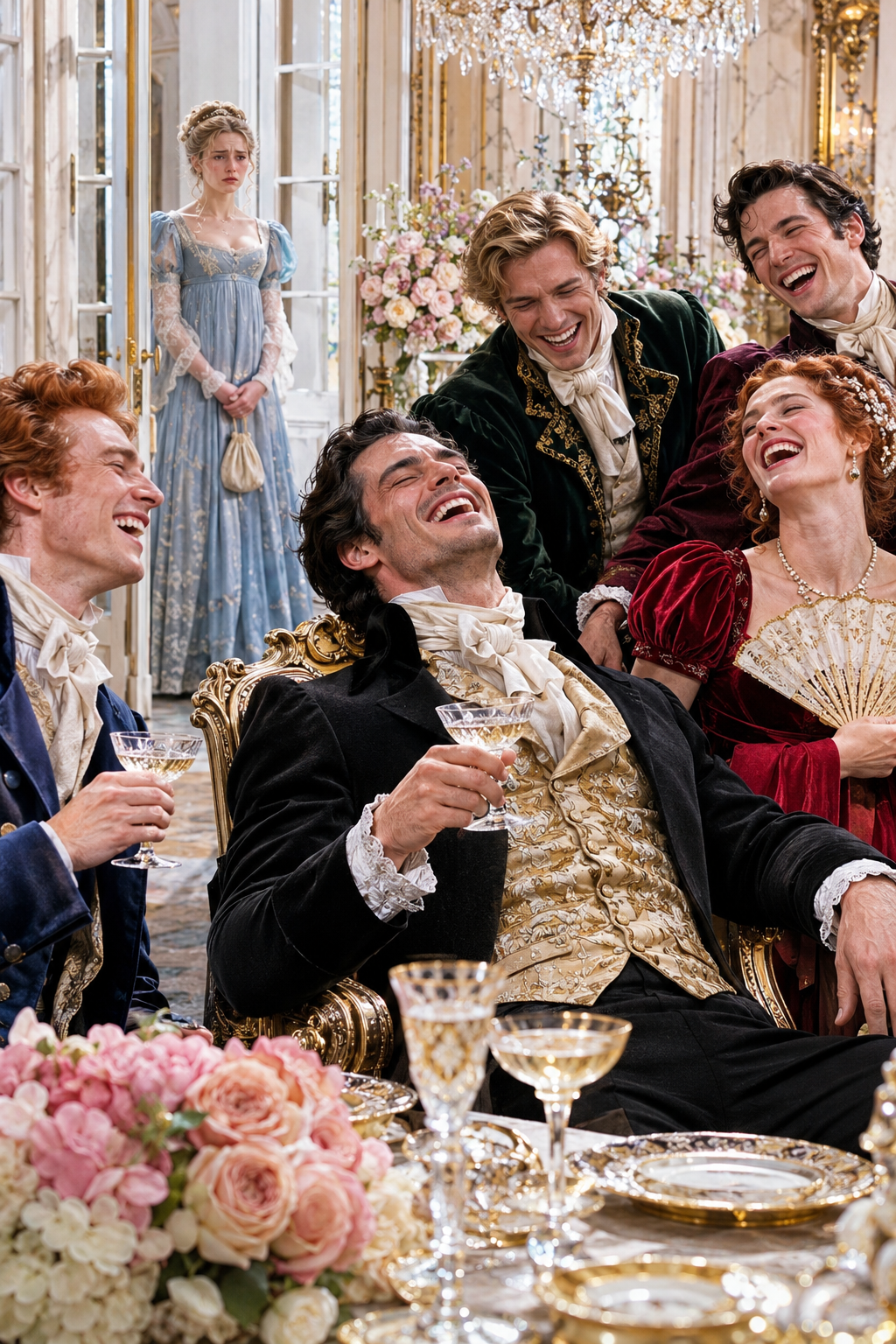
He remembered the library conversation months earlier, the careless laughter of his friends, and the door he had thought was closed.
But he dismissed the thought almost immediately.
Isabel had always been gentle.
She had never challenged him before.
Surely she could not have heard.
On Tuesday morning, a cold wind swept across Ashgrove’s gravel drive as three carriages arrived in succession.
The first carried Harcourt and two trustees.
The second brought a representative of the London lender.
The third carried Isabel.
Rafe watched from the library window as she stepped down.
She wore a dark blue traveling gown and a simple bonnet. Her face appeared paler than he remembered, but her movements were composed.
He noticed that she paused before climbing the front steps.
Lady Beatrice offered her arm.
Only then did he see the faint change in the shape of Isabel’s figure.
Something tightened in his chest.
The meeting began at eleven.
Harcourt placed the disputed loan documents on the table and explained the circumstances under which they had been submitted.
The lender’s representative confirmed that the advance had never been released.
Rafe sat rigidly at the head of the table.
“I believed my wife’s consent would be forthcoming.”
Isabel looked at him.
“Then why was my signature supplied before you asked me?”
He opened his mouth, then closed it.
Lord Fenwick, who had been summoned to explain his involvement, shifted uncomfortably.
“The duke assured me the arrangement was a formality.”
“A formality?” Harcourt repeated.
Fenwick cleared his throat.
“My clerk prepared the papers. I was not aware that the signature had been disputed.”
Isabel turned toward him.
“Did my husband instruct your clerk to imitate my handwriting?”
Fenwick looked at Rafe.
The duke’s expression hardened.
“I said the matter would be settled.”
“That is not an answer,” Isabel replied.
For several seconds, no one moved.
Then Fenwick admitted that the clerk had been told to prepare a complete set of documents using an earlier specimen of Isabel’s signature.
Rafe had approved the draft without obtaining her permission.
The lender’s representative closed his folder.
“Our firm will have no further involvement in this transaction.”
He rose and left.
Fenwick followed shortly afterward, avoiding the duke’s eyes.
When the door closed, Rafe stood.
“You have humiliated me before my associates.”
Isabel remained seated.
“You submitted a document bearing my name without my consent.”
“I intended to repay the money.”
“With what?”
“The winnings.”
She looked at him for a long moment.
“And if the horse lost?”
He had no answer.
Harcourt cleared his throat and explained that the trust would preserve its rights, that no further borrowing could be secured against its interests without proper authorization, and that the trustees would consider the estate’s financial position before deciding how to proceed.
Rafe barely listened.
His attention had settled on Isabel.
When the meeting ended, he asked her to remain.
Harcourt glanced toward her, but she nodded.
Lady Beatrice stayed by the fireplace.
Rafe waited until the others had gone.
“Isabel, what has happened to you?”
She looked almost surprised.
“Nothing that you did not set in motion.”
He stepped closer.
“I have made mistakes.”
“Yes.”
“But this cannot continue. We are husband and wife.”
“Are we?”
The question seemed to strike him harder than any accusation.
Isabel rose slowly.
“I came to your library several months ago because I had something wonderful to tell you.”
Rafe went still.
She watched recognition begin to form in his face.
“You were with your friends,” she continued. “You were discussing the price of marrying me.”
His complexion changed.
“Isabel—”
“One hundred thousand pounds. An unfortunate necessity. A wife to be sent back to Yorkshire once she had fulfilled her purpose.”
He gripped the back of a chair.
“You misunderstood.”
“I heard every word.”
“It was foolish talk. Men say things among friends—”
“Then perhaps you should choose friends before whom you need not pretend to despise your wife.”
The words were quiet.
Rafe looked away.
For once, he could not find a polished explanation.
Isabel reached for her gloves.
“I will remain in Yorkshire. The trust will continue to administer its interests properly. I have instructed Harcourt to prepare a formal arrangement for our separate households.”
Rafe turned toward her.
“You cannot simply leave me.”
“I already have.”
He looked down at her gown.
His gaze lingered.
Then he whispered, “Isabel. Are you with child?”
The room seemed to narrow around them.
Lady Beatrice moved away from the fireplace, but Isabel lifted a hand.
“Yes.”
Rafe stared at her.
For a moment, something unguarded crossed his face.
Then he stepped forward.
“Why did you not tell me?”
“I intended to.”
“When?”
“The morning I heard you explain what I was worth.”
He stopped.
Outside, the wind moved through the bare branches beside the library windows.
Rafe looked at her stomach, then back at her face.
“My child,” he said.
“Our child,” Isabel corrected.
His eyes filled with sudden urgency.
“Then you must stay. The heir to Ashgrove cannot be born in some Yorkshire mill town.”
Isabel’s expression changed.
There it was again.
The heir.
The title.
The estate.
Even now, he had spoken first of what the child might inherit, not of the woman carrying it.
She drew her gloves over her fingers.
“The child will be born where I can be properly cared for.”
“I am the father.”
“Yes. And you will have responsibilities. But fatherhood does not grant you ownership of me.”
Rafe looked toward his aunt, perhaps expecting support.
Lady Beatrice’s face was grave.
“Do not make this worse, Rafe.”
He sank into a chair.
Isabel walked to the door.
For the first time in their marriage, he did not attempt to stop her.
The weeks that followed were difficult for everyone at Ashgrove.
The canceled wager became the subject of fashionable gossip, although the precise circumstances remained private.
Rafe sold two racing horses, dismissed several unnecessary attendants, and surrendered the London house he had maintained for extravagant entertainments.
At first, he did so angrily.
He complained to the steward, blamed Fenwick, and wrote letters to Isabel that alternated between wounded pride and demands for reconciliation.
She answered only matters concerning the estate or her health.
Then winter arrived.
A storm damaged the roof of three tenant cottages, and the steward informed Rafe that repairs could not wait until spring.
Ordinarily, the duke would have instructed someone else to manage the inconvenience.
This time, the estate account contained insufficient funds.
He traveled to the cottages himself.
Inside the first, a woman was attempting to keep rainwater from a child’s bed with a cracked basin.
The room smelled of damp wool and cold ashes.
Her husband stood awkwardly beside the fireplace, apologizing for the disorder.
Rafe looked at the ceiling.
He had passed those cottages hundreds of times without once entering them.
“How long has the roof been leaking?”
“Since October, Your Grace.”
October.
The month he had spent nearly six hundred pounds entertaining his racing friends.
He returned to the house before dusk and ordered the repairs begun.
When the steward asked where the money would come from, Rafe removed his father’s gold pocket watch from his waistcoat.
It was a valuable piece, one he had rarely worn without attracting admiration.
“Sell this,” he said.
The steward hesitated.
“Your Grace, it belonged to your father.”
“My father would have preferred a dry roof.”
The work began two days later.
It did not erase his debts.
It did not restore his marriage.
But it marked the first time Rafe had surrendered something he valued without expecting anyone to praise him.
In Yorkshire, Isabel received reports of the repairs through Harcourt.
She read them beside the nursery window, where a small cradle stood beneath a white linen canopy.
Lady Beatrice watched her fold the letter.
“He is trying,” the older woman said.
“I know.”
“Does that matter?”
Isabel looked toward the cradle.
“Yes. But trying is not the same as becoming trustworthy.”
Lady Beatrice nodded.
The baby arrived in early spring, after a long night of rain.
Isabel’s labor began shortly after midnight, and by dawn the house was filled with the quiet urgency of servants carrying warm water and clean linen.
Lady Beatrice remained beside her throughout.
At seven in the morning, a daughter was born.
She had dark hair, astonishingly small hands, and a fierce cry that made the attending physician smile.
Isabel held her against her chest while sunlight crept across the bedroom floor.
For a long time, she simply watched the child breathe.
Then she whispered, “Eleanor.”
Her father’s mother’s name.
A name that belonged to no title and required no permission.
Rafe received the news that afternoon.
He read the letter standing in the library, the same room in which he had once laughed about sending his wife away.
A daughter.
Healthy.
Beautiful.
Both mother and child recovering well.
He read the letter again.
There was no heir to the dukedom.
No immediate solution to the succession.
Yet he found himself staring at the description of the baby’s tiny hands, trying to imagine how something so small could belong to him.
He sat down and began a letter.
He wrote three sentences, crossed them out, and started again.
At last, he sent only a brief message.
I am grateful that you are both safe. If you permit it, I should like to meet our daughter.
Isabel received the request three days later.
She considered it carefully.
Then she agreed.
Rafe arrived in Yorkshire on a bright April morning.
He brought no expensive gifts, no elaborate flowers, and no companions.
Only a small parcel wrapped in brown paper.
Isabel received him in the nursery.
He stopped at the threshold.
Eleanor lay sleeping in her cradle, one fist curled beside her cheek.
For several seconds, Rafe did not move.
Then he approached.
“She is very small.”
“She is three weeks old.”
He smiled faintly.
“Of course.”
Isabel lifted the baby and placed her in his arms.
Rafe held her awkwardly, his hands suddenly uncertain.
Eleanor opened her eyes.
He looked down at her, and something in his expression gave way.
“She has your eyes.”
“They may change.”
“I hope they do not.”
The baby stretched her fingers around one of his.
Rafe lowered his head.
When he spoke again, his voice was rough.
“I have been a fool.”
Isabel said nothing.
“I thought a title made me important. I thought money existed to preserve the appearance of importance. And I treated the person who trusted me most as though she were another possession.”
He looked at her.
“I cannot ask you to forget that.”
“No,” she answered.
“I cannot even ask you to forgive it.”
“Not yet.”
He nodded.
Then he returned his attention to Eleanor.
“I would like to become someone she need not be ashamed of.”
Isabel studied him.
For the first time, his words contained no demand.
No reference to inheritance.
No assumption that his wishes should determine hers.
Only a hope he could not purchase.
“You may begin by being her father,” she said.
Rafe looked up.
“And you?”
“That will take longer.”
He accepted the answer.
Over the following year, Rafe visited Yorkshire regularly.
He did not arrive unannounced.
He wrote before traveling, respected Isabel’s arrangements, and spent his visits learning how to care for a child who regarded his title with complete indifference.
He learned to walk the nursery floor when Eleanor would not sleep.
He learned that a baby’s laughter could interrupt the most serious conversation.
And he learned that apologies meant little unless followed by conduct that remained honorable when nobody was watching.
Meanwhile, the Ashgrove estate began slowly recovering.
With Harcourt’s assistance, the mortgages were reorganized under a realistic repayment schedule. Unnecessary expenditures were eliminated, tenant repairs were prioritized, and the remaining agricultural land was managed with greater care.
Rafe attended meetings he would once have avoided.
He learned the names of the people who worked his fields.
He stopped wagering.
He also wrote a formal acknowledgment of his attempt to authorize the loan without Isabel’s consent, accepting responsibility and agreeing to the safeguards required by the trustees.
The document remained in Harcourt’s files.
Isabel never used it to humiliate him.
She kept it because trust, once broken, required more than pleasant intentions to repair.
By Eleanor’s first birthday, the estate had met its scheduled payments without drawing upon Isabel’s personal income.
The mills, meanwhile, had expanded their trade, and Isabel had introduced improvements to working conditions that her father had once hoped to undertake.
She was no longer merely the wealthy daughter who had married a duke.
She was an employer, a mother, and a woman whose decisions affected hundreds of lives.
One afternoon, Rafe arrived at the Yorkshire house carrying a small wooden horse he had carved himself.
The workmanship was imperfect.
One ear was slightly larger than the other.
Eleanor adored it.
She carried it across the nursery, laughing whenever it tipped onto its side.
Isabel watched from the doorway.
Rafe looked up.
“I fear I am better at losing money on horses than making them.”
She smiled despite herself.
“Perhaps. But this one seems considerably more successful.”
He rose.
For a moment, they stood facing each other in the warm afternoon light.
“I have been offered the opportunity to sell the remaining racing stable,” he said.
“Do you intend to?”
“Yes. The proceeds will clear another portion of the estate’s obligations.”
“That is sensible.”
“I wanted you to know before I decided.”
Isabel regarded him quietly.
“You no longer need my permission for every decision, Rafe.”
“I know. But I have discovered that asking your opinion is often wiser than assuming I already know it.”
She looked toward Eleanor, who was attempting to persuade the wooden horse to stand upright.
Then she turned back to him.
“Would you stay for supper?”
Rafe’s expression softened.
“If you would like me to.”
“I would.”
It was a small invitation.
There were no declarations, no dramatic embraces, and no promise that the years ahead would be simple.
But that evening, Rafe sat at Isabel’s table and listened while she discussed the mills, the workers, and her plans for a new school near the factory.
He asked questions.
He did not interrupt.
And when Eleanor began crying upstairs, he excused himself and went to her without waiting for a servant.
Isabel watched him leave.
She remembered the man who had once considered her an inconvenience, the library conversation that had destroyed her illusions, and the frightened woman who had stood alone with a physician’s note in her hand.
She no longer wished to return to that earlier life.
Whatever future she chose would have to make room for the person she had become.
Several months later, she agreed to spend part of the summer at Ashgrove, maintaining her own financial independence and continuing her work in Yorkshire.
Rafe did not ask her to surrender either.
On the morning of their return, the carriage passed through the familiar gates beneath a sky washed clear by overnight rain.
The estate looked different.
The tenant cottages had new roofs. The neglected gardens had been restored. Children waved from the roadside as the carriage passed.
At the entrance, the steward stood waiting with the household staff.
Rafe stepped down first, then turned and offered Isabel his hand.
She accepted it.
Not because she needed assistance.
Because, for once, the gesture was simply an offer.
Inside the library, sunlight fell across the old mahogany desk.
Isabel paused beside the doorway.
Rafe followed her gaze.
He knew what she was remembering.
“I have thought about that morning more times than I can count,” he said.
“So have I.”
“I cannot change what I said.”
“No.”
“But I can spend the rest of my life refusing to become that man again.”
Isabel looked at him.
“Then do it for yourself, Rafe. Not because you hope it will earn you something.”
He nodded slowly.
“I understand.”
From the corridor came Eleanor’s delighted laughter, followed by Lady Beatrice’s voice protesting that a duchess of such tender years ought not to pull ribbons from her aunt’s bonnet.
Isabel turned toward the sound.
Rafe opened the library door.
Together, they walked out.
Years later, when Eleanor was old enough to ask why her mother spent so much time examining accounts and visiting factories, Isabel took her to the Yorkshire mills.
She showed her the weaving rooms, the warehouses, and the school where workers’ children learned to read.
Then she brought her into the office that had once belonged to her grandfather.
Inside the desk lay a small wooden box.
Isabel opened it and removed a faded letter.
“Your grandfather left me something very important,” she told her daughter.
Eleanor studied the paper.
“Money?”
Isabel smiled.
“He left me the means to make my own choices.”
“Is that better than money?”
“Much better.”
Eleanor considered this with the seriousness of a child trying to understand the adult world.
“Will I have choices too?”
Isabel knelt beside her.
“As many as I can help you make.”
Outside, the mill bell rang, and the afternoon workers began crossing the courtyard beneath the pale Yorkshire sun.
Isabel folded the letter and returned it to its box.
She had once believed that happiness meant being chosen by someone powerful, admired, and important.
She had learned that a title could conceal weakness, that wealth could invite exploitation, and that affection without respect was merely another form of possession.
But she had also learned that people could change when they accepted responsibility without demanding forgiveness as payment.
Rafe had not become a better man because she had saved him.
He had become better only when she stopped protecting him from the consequences of his choices.
Their marriage had survived, though not by returning to what it had been. It had survived because the old arrangement had ended, leaving them to build something more honest in its place.
And Isabel, who had once stood outside a library door believing her entire future depended upon her husband’s love, now understood something her father had tried to teach her long before his death.
A woman’s worth was never determined by the fortune she brought into a marriage, the children she bore, or the approval she received from those who claimed authority over her.
Her worth had existed before any of those things.
It remained when they were taken away.
And it would belong to her for as long as she lived.
As Eleanor slipped her small hand into her mother’s, Isabel closed the desk and led her daughter into the sunlight, knowing that the greatest inheritance she could leave behind was not the mills, the money, or even the grand estate waiting in the south.
It was the knowledge that love should never require a person to surrender the right to stand on her own.
THE END.