The moment I stepped off the stagecoach in Cold Creek, Montana, my future husband publicly rejected me, but his trembling hands concealed a heartbreaking secret.
Mrs. Bennett’s words seemed to freeze the very air inside the farmhouse.
William stood motionless, his eyes fixed on the hospital payment recorded beside his daughter’s name.
“What do you mean, the other children?” he whispered, his voice barely recognizable.
The elderly woman pressed a trembling hand against her mouth, struggling to control her tears.
I could hear the clock ticking above the fireplace, each second stretching painfully into the silence.
“Mr. Whitcomb has been paying Doctor Harlan for years,” she finally said.
“Paying him for what?” William demanded.
Mrs. Bennett looked toward the staircase, where six sleeping boys knew nothing about the darkness gathering below.
“To keep certain families from discovering what really happened to their children.”
William took a step backward as though someone had struck him across the chest.
“Our Rose died of pneumonia,” he said, his voice cracking.
“That’s what Doctor Harlan told us, and Eleanor was holding her when she stopped breathing.”
Mrs. Bennett lowered her eyes.
“I don’t know whether your little girl’s death could have been prevented, Mr. Hayes, but I know someone paid the doctor to keep his treatment records hidden.”
My heart began pounding so violently that I could feel it in my throat.
“Why would a banker care about a baby’s medical records?” I asked.
Mrs. Bennett opened the ledger to another page, revealing a column of names written in fading blue ink.
Beside each name was a debt, a property description, and a payment to Doctor Harlan.
Some of the entries had been crossed out in red.
“Those families lost their land,” she whispered.
William’s expression changed as he recognized several names.
“The Millers,” he murmured. “And the Hendersons. They both left Cold Creek after their children died.”
Mrs. Bennett nodded.
“Whitcomb lent money to desperate parents for medical treatment, then used forged documents to claim their farms when they couldn’t repay him.”
I stared at the ledger, feeling an awful certainty settle over me.
“And Eleanor discovered what he was doing.”
Mrs. Bennett’s silence answered before her lips did.
“She came to the bank three days before Rose became sick,” the woman finally confessed.
“She believed Whitcomb had been stealing from the families who trusted him, and she wanted proof.”
William clutched the edge of the table.
“Eleanor never told me.”
“She was trying to protect you.”
His eyes filled with anguish.
“She was my wife. She shouldn’t have had to protect me alone.”
I stepped closer and gently placed my hand against his arm.
Mrs. Bennett turned another page, revealing a letter folded between the leather covers.
The paper was yellowed, and the handwriting was unmistakably Eleanor’s.
William recognized it instantly.
I watched his fingers tremble as he unfolded the letter.
“My dearest William,” he read, before his voice broke completely.
He handed it to me, unable to continue.
I swallowed hard and began reading aloud.
“If you are holding this letter, something has happened that I was too frightened to tell you about.”
William covered his mouth.
“Mr. Whitcomb has been taking land from families whose children became sick under Doctor Harlan’s care.”
“I found records showing that some children received medicine that was never properly tested or explained to their parents.”
My stomach turned.
“Eleanor suspected the doctor had concealed dangerous mistakes,” I whispered.
Mrs. Bennett nodded through her tears.
“The doctor was deeply in debt to Whitcomb, and Whitcomb used that debt to control him.”
I continued reading, my voice shaking.
“I have hidden copies of the bank’s original records where no one would think to look.”
“If anything happens to me, remember that the truth belongs to the families who suffered.”
The letter ended with four words that shattered William.
“Love always, your Eleanor.”
He sank slowly into the chair beside the fireplace.
For several moments, he simply stared at the paper.
Then a terrible sob escaped him.
I had heard grown men cry before, but never like that.
It was the sound of someone discovering that grief had been carrying a secret weight all along.
“She was fighting for our family,” he whispered.
“And I spent every day believing I’d failed her.”
I knelt beside him.
“You didn’t fail her, William. Someone took advantage of the worst days of your life.”
Mrs. Bennett reached across the table.
“There is something else you need to know.”
Before she could continue, hoofbeats thundered across the frozen yard.
All three of us turned toward the window.
Two lanterns moved through the darkness, stopping near the barn.
Mrs. Bennett’s face went white.
“Oh, Lord,” she whispered. “They followed me.”
William rose immediately.
“Amelia, take the boys upstairs.”
But before I could move, a familiar voice shouted from outside.
“William Hayes, open that door. We know the old woman is inside.”
It was Whitcomb.
And he hadn’t come alone.
Through the window, I recognized Sheriff Dalton standing beside him.
William grabbed his coat.
“I won’t let them frighten my children.”
I caught his wrist.
“Then don’t give them a reason to take you away.”
He looked at me, anger and fear battling behind his eyes.
For one breath, I wondered whether he would listen.
Then he gently released his hand and opened the door.
Whitcomb stepped onto the porch wearing the satisfied smile of a man who believed the world belonged to him.
“Evening, Hayes,” he said. “I believe you’ve got something that belongs to my bank.”
Mrs. Bennett appeared behind me, clutching the ledger against her chest.
“These records belong to the truth,” she answered.
Whitcomb’s smile disappeared.
“Those records were stolen.”
“Then perhaps the sheriff should read them,” I said.
Sheriff Dalton looked uncomfortable.
“Miss Carter, this isn’t your business.”
I stepped forward.
“Six hungry children are sleeping upstairs because a man believes he can steal their home. That makes it my business.”
Whitcomb laughed coldly.
“You’re not even married to Hayes.”
His words landed harder than I expected.
For an instant, I remembered the stagecoach, the laughter, and William’s public rejection.
But I also remembered Tommy asking whether he could call me Mama.
“You’re right,” I said quietly. “But I don’t need a marriage certificate to recognize cruelty.”
Whitcomb turned toward the sheriff.
“Arrest Mrs. Bennett for stealing confidential financial documents.”
Dalton hesitated.
“She’s an elderly woman, Mr. Whitcomb.”
“Then I suggest you remember who’s responsible for your reelection.”
The sheriff’s jaw tightened.
William stepped between them.
“Nobody is arresting her tonight.”
Whitcomb leaned closer.
“Careful, Hayes. Your children have already lost one mother.”
The sound that came from William’s throat frightened me.
He lunged forward, but I caught his coat with both hands.
“William, look at me.”
His breathing came fast and uneven.
“He’s talking about Eleanor.”
“I know.”
“He knows something about her death.”
I held his gaze.
“And we’re going to find out, but your sons need their father here tomorrow morning.”
Something in his face softened.
He stepped back.
Whitcomb watched us with open contempt.
“You have until noon tomorrow to return that ledger,” he said.
“Otherwise, the sheriff will collect your debts and remove you from this property.”
He turned and disappeared into the darkness.
Sheriff Dalton lingered behind.
For a moment, he looked as though he wanted to speak.
Instead, he tipped his hat and followed the banker.
Only when their horses had faded into the distance did Mrs. Bennett collapse into a chair.
“We have very little time,” she whispered.
William closed the door.
“Then tell us everything.”
Mrs. Bennett looked at Eleanor’s letter.
“The copies she mentioned are the only evidence Whitcomb doesn’t know how to destroy.”
I studied the final lines again.
“Where no one would think to look,” I repeated.
William stared at the paper.
“She never told me about a hiding place.”
We searched the kitchen first.
I checked beneath loose floorboards while William examined the cupboards.
Mrs. Bennett searched behind the old family Bible.
Nothing.
Outside, the wind grew stronger.
By midnight, Samuel appeared at the foot of the stairs, rubbing his sleepy eyes.
“Why is everyone awake?” he asked.
I went to him and gently straightened his nightshirt.
“We’re looking for something your mama left behind.”
His expression changed.
“Mama’s treasure?”
William turned sharply.
“What treasure?”
Samuel looked frightened again.
I crouched beside him.
“You’re not in trouble, sweetheart.”
He glanced toward the fireplace.
“Mama said she hid her treasure where the little horse couldn’t run away.”
My eyes followed his gaze.
The wooden rocking horse stood beside Eleanor’s chair, its faded paint catching the firelight.
I remembered William’s warning on my first day.
“Don’t touch it.”
William slowly approached the toy.
“Rose loved that horse,” he whispered.
“Eleanor painted the flowers on its saddle herself.”
He knelt and ran his hand along the worn wooden mane.
Then his fingers stopped.
A tiny brass screw beneath the saddle looked newer than the others.
William fetched a screwdriver.
With trembling hands, he loosened the saddle and lifted it away.
Inside was a narrow hollow compartment.
And tucked within it was a small oilcloth packet.
William stared at it for a long moment.
Then he carefully unfolded the wrapping.
There were bank documents, copies of medical accounts, and a handwritten list of families.
At the bottom lay a second letter.
This one was addressed to William and the children.
He opened it slowly.
“My beloved boys,” he read.
His voice broke, and I took over.
“If you ever read this, I want you to know that every ordinary day we shared was the greatest gift of my life.”
“I loved the muddy boots, the noisy supper table, and the little hands reaching for mine.”
“Please don’t let sorrow convince you that happiness would be a betrayal.”
I stopped.
William’s shoulders shook.
The letter continued.
“Your father has the kindest heart I’ve ever known, even when he forgets it himself.”
“And someday, if another woman comes into your lives and loves you well, let her.”
William closed his eyes.
I could hardly see through my tears.
“Love isn’t a chair that belongs to only one person,” I read.
“It is a table that grows larger whenever someone is welcomed home.”
Samuel began crying softly.
William reached for him and lifted him into his arms.
For the first time since I’d arrived, I saw father and son weep together without either trying to hide it.
I wanted that moment to last.
But Mrs. Bennett was already examining the documents.
“Amelia,” she whispered. “Come look at this.”
Among the papers was an original mortgage agreement bearing William’s signature.
Except William had never signed it.
And beside it was a medical bill showing that Whitcomb had paid Doctor Harlan to record Rose’s treatment as unsuccessful.
There were no details proving the doctor had deliberately harmed her.
But the records showed that he had charged for medicine never purchased, and that the date of Rose’s final examination had been changed.
William stared at the figures.
“He told us there was nothing else he could do.”
Mrs. Bennett nodded sadly.
“Whether he could have saved her, only he can tell us.”
William looked toward the rocking horse.
“Then I’ll make him tell us.”
At dawn, I woke to the smell of burning wood.
For one confused moment, I thought William had started the kitchen stove.
Then I heard horses screaming.
I rushed to the window.
Orange flames climbed the barn walls.
“William!” I screamed.
He was already running across the yard.
I grabbed my coat and hurried downstairs.
The boys stood crowded in the doorway, their faces white with terror.
“Stay inside!” I shouted.
But Tommy slipped past me.
“The horses!”
He ran toward the burning barn before I could catch him.
I chased him through the freezing mud.
William had already forced open the stable doors, releasing two frightened horses into the yard.
Then a beam collapsed.
The roof groaned.
Tommy disappeared through the smoke.
My heart stopped.
“Tommy!”
William turned.
For a moment, I saw pure horror in his face.
Then he plunged back into the burning building.
I ran after him, covering my mouth with my sleeve.
Smoke swallowed everything.
Through the crackling flames, I heard Tommy crying.
“Papa! I can’t find the door!”
I followed his voice toward an overturned feed trough.
The little boy was crouched behind it, trembling.
I reached him just as William appeared through the smoke.
He grabbed Tommy, lifted him against his chest, and pushed us toward the entrance.
Behind us, another beam crashed to the ground.
The impact threw William against the wall.
He cried out and fell.
I turned back.
“Get Tommy outside!” he shouted.
I dragged the child through the doorway and placed him in his oldest brother’s arms.
Then I went back.
I don’t remember deciding.
I only remember the terrible thought that six boys had already lost too much.
I found William trying to stand beneath a broken beam.
Together, we pulled his trapped leg free.
He leaned heavily against me as we stumbled toward the light.
The moment we reached the yard, the roof collapsed behind us.
William fell to his knees, coughing violently.
Tommy threw himself into his father’s arms.
I sank beside them, my hands shaking uncontrollably.
And there, beneath the gray morning sky, William pulled me close.
“I thought I’d lost you,” he whispered.
I pressed my forehead against his.
“I’m here.”
His arms tightened around me.
“Please stay.”
I looked at the six boys standing nearby, crying and clinging to one another.
“I already chose to.”
By sunrise, half of Cold Creek had gathered around the ruined barn.
Whitcomb arrived shortly afterward, looking almost pleased.
“Terrible accident,” he remarked.
William struggled to his feet.
“Somebody set that fire.”
Whitcomb raised an eyebrow.
“That’s a serious accusation.”
I noticed black soot along the banker’s riding gloves.
But I knew soot alone proved nothing.
Then Sheriff Dalton dismounted and approached us.
His face was grim.
“A ranch hand reported seeing two riders leaving this property before dawn.”
Whitcomb’s expression tightened.
“Are you accusing me, Sheriff?”
Dalton looked directly at him.
“I’m saying there will be an investigation.”
It was the first time I’d seen the sheriff speak without fear.
Whitcomb turned his horse and rode away without another word.
That afternoon, Mrs. Bennett and I carried Eleanor’s documents into town.
William insisted on coming despite his injured leg.
We walked into the church just as Reverend Miller was preparing for the weekly community meeting.
Every head turned.
I recognized the woman who had laughed at me outside the stagecoach.
She leaned toward her neighbor and whispered something.
For a brief moment, I felt the same humiliation that had greeted my arrival.
Then William took my hand.
The simple gesture steadied me more than any speech could have.
Reverend Miller approached.
“William, what’s happened?”
I placed Eleanor’s documents on the front table.
“Your town has been robbed,” I said. “And some of your neighbors have been paying for it with their homes.”
A murmur rippled through the room.
Mrs. Bennett stood beside me and began explaining what she had witnessed during her years at the bank.
She named the families.
She described the forged mortgages.
She showed the false medical bills and the transfers into Whitcomb’s private account.
At first, people stared in disbelief.
Then an older man near the back stood abruptly.
“My brother lost his farm after his daughter died,” he said.
His voice trembled.
“Whitcomb told him there was no other choice.”
A woman began crying.
Another man demanded to see the documents.
And then the church doors opened.
Doctor Harlan stood in the entrance.
His face was gray, and his hands shook.
“I heard what was happening,” he said.
William went rigid beside me.
The doctor slowly approached.
“I’ve done things I’ll answer for until the day I die.”
The church fell silent.
Harlan looked at William.
“Your daughter was terribly sick, and I cannot promise she would have survived with different treatment.”
William’s face twisted.
“But I used medicine I hadn’t properly evaluated, because Whitcomb controlled the debts on my practice.”
A collective gasp swept the room.
“I changed the records afterward,” the doctor confessed.
“Whitcomb told me I’d lose everything if I refused.”
William stepped toward him.
For a moment, I feared grief might turn into violence.
But he stopped just inches away.
“Did Eleanor know?”
Harlan lowered his head.
“She suspected the records had been altered.”
“And when she confronted Whitcomb, he threatened to take your ranch.”
William’s voice became almost inaudible.
“Did my wife die because of him?”
The doctor looked stricken.
“Eleanor died of fever, William. I have no evidence anyone caused her illness.”
William swayed slightly.
I caught his arm.
It was not the answer he had feared.
But it couldn’t erase what had happened to Rose, or what Eleanor had endured alone.
Reverend Miller stepped forward.
“These papers need to reach the territorial authorities.”
Sheriff Dalton appeared behind the doctor.
“They will,” he said.
To my surprise, he removed his badge and placed it on the table.
“I ignored complaints because I was afraid of Whitcomb’s influence.”
He looked around the church.
“I won’t pretend that makes me innocent.”
Then he turned toward William.
“I’ve already sent word to the district marshal.”
The next three days passed beneath a cloud of fear.
Whitcomb disappeared from town.
Rumors spread that he’d taken money from the bank and fled toward the Canadian border.
But the truth arrived on the fourth morning.
The district marshal rode into Cold Creek with two deputies and a prisoner.
Whitcomb sat between them, his wrists chained.
Someone had recognized him at a trading post forty miles north.
When the marshal led him past the general store, the town gathered in silence.
Whitcomb saw me standing beside William.
His eyes narrowed.
“You think you’ve won something, Miss Carter?”
I stepped forward.
“No. I think you’ve finally been stopped.”
He laughed bitterly.
“That ranch is still buried in debt.”
The marshal interrupted.
“Not under those forged mortgages, it isn’t.”
Whitcomb’s smile vanished.
The investigation was far from finished, but the authorities had already frozen the disputed debts while the bank’s accounts were examined.
Mrs. Bennett’s ledger had done what years of pleading never could.
It had given the truth somewhere to stand.
Yet when we returned home, our troubles weren’t magically gone.
The barn was ash.
Winter was approaching.
Two horses had escaped the fire, but much of the stored feed was ruined.
And the ranch still needed repairs we could barely afford.
That evening, William sat alone at the kitchen table, staring at a list of expenses.
I placed a bowl of stew before him.
“You haven’t eaten.”
He gave a tired smile.
“Neither have you.”
I sat across from him.
For several moments, we listened to the boys laughing upstairs.
Then he reached into his pocket and withdrew the advertisement he’d mailed months earlier.
The paper was creased and worn.
“I was ashamed of this,” he admitted.
“Why?”
“Because I didn’t write it looking for love.”
He studied my face.
“I wrote it because I was afraid my children would die hungry, and I couldn’t see any other way forward.”
I reached across the table.
“William, I didn’t come here because I had some beautiful dream of marriage.”
He looked surprised.
“I came because my parents were gone, the boardinghouse where I worked had closed, and I had nowhere left that felt like home.”
My throat tightened.
“When you rejected me in town, I thought I’d made the worst mistake of my life.”
His eyes filled.
“And now?”
I looked toward the staircase.
A moment later, Tommy appeared wearing a blanket like a cape, followed by Samuel and the others.
They were pretending to be cowboys defending the ranch from imaginary outlaws.
I smiled through my tears.
“Now I think I finally understand why I was meant to get off that stagecoach.”
William stood and came around the table.
He knelt beside my chair, ignoring the pain in his injured leg.
“Amelia Carter, I can’t promise you an easy life.”
“I know.”
“I can’t promise you fine dresses or a grand house.”
“I don’t need those.”
He took both my hands.
“But I can promise that you’ll never have to face another hard day alone.”
Tears blurred his face.
“And if you’ll let me, I’d like to spend the rest of my life proving that.”
He opened his palm.
Resting inside was a simple gold ring.
“Eleanor’s?” I whispered.
He shook his head.
“My mother’s. I kept it after she died.”
He smiled nervously.
“I thought it should belong to the woman who taught this family how to hope again.”
I began crying before he finished asking.
“Amelia, will you marry me?”
“Yes,” I whispered.
Then I laughed through my tears.
“Yes, William Hayes. I will.”
A tremendous crash came from the staircase.
Six boys tumbled into view, having apparently been listening the entire time.
Tommy shouted louder than all of them.
“Does that mean she’s really staying?”
William opened his arms.
“It means she’s staying because she wants to.”
The boys rushed toward us.
For several minutes, I disappeared beneath a mountain of small arms, tangled blankets, and happy tears.
I had never felt so wealthy.
But the greatest surprise came the following Sunday.
As we approached the church, I noticed wagons lining the road.
Men carried lumber.
Women unloaded baskets of food.
Several teenage boys were leading horses toward our ranch.
Reverend Miller stood waiting on the church steps.
“Cold Creek owes your family more than apologies,” he said.
The woman who had mocked me outside the stagecoach stepped forward.
Her eyes were red.
“I judged you before I knew you, Amelia.”
She handed me a carefully folded quilt.
“My mother made this when I got married. I’d like your family to have it.”
I stared at the beautiful stitching.
“You don’t have to give this away.”
She shook her head.
“I want to.”
Behind her, the townspeople began discussing how to rebuild the barn before the first heavy snowfall.
Nobody spoke about charity.
They spoke about nails, beams, hay, horses, and which neighbors could spare an afternoon.
William stood speechless.
For so long, he had believed asking for help meant admitting failure.
Now he watched an entire town arrive because helping one another was something decent people simply did.
The barn rose again over the following weeks.
The oldest boys worked beside their father.
Samuel carried nails in his uninjured hand.
Tommy proudly delivered cups of water, spilling most of them along the way.
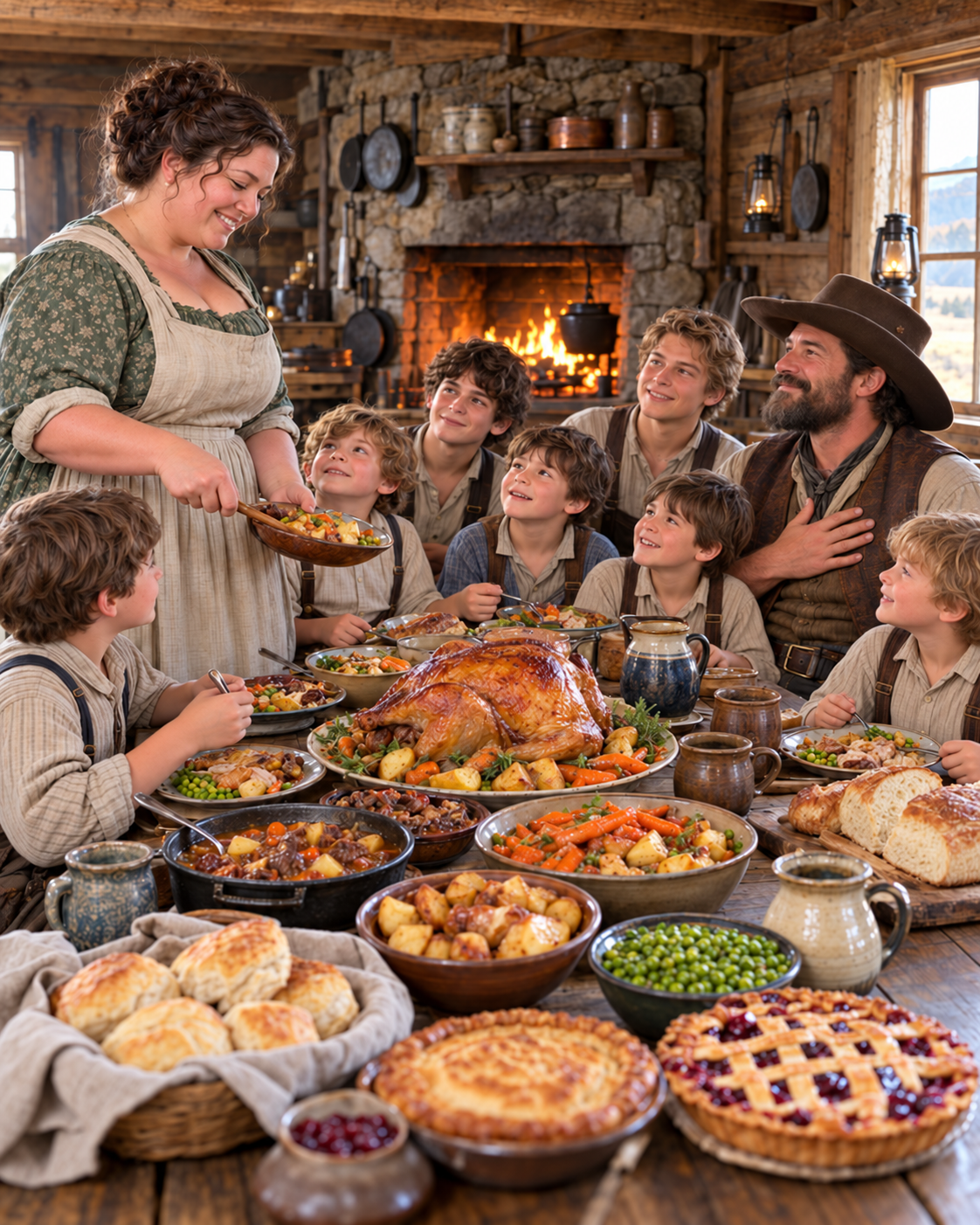
Each evening, I made supper for whoever stayed late.
Our kitchen filled with muddy boots, tired laughter, and the comforting noise of people who no longer felt like strangers.
The wedding took place on the first morning of December.
Snow fell gently across Cold Creek, turning the hills silver beneath a pale winter sun.
I wore a simple blue dress that Mrs. Bennett had helped me sew.
William waited at the front of the church with his six sons standing beside him.
His hands were trembling.
But this time, he wasn’t turning me away.
When I reached him, Tommy whispered loudly enough for everyone to hear.
“Papa, don’t forget to say yes.”
The church erupted in laughter.
William knelt and kissed his youngest son’s forehead.
“I won’t, son.”
Then he stood and looked at me with tears shining in his eyes.
When Reverend Miller asked whether I would take William as my husband, I remembered the stagecoach, the ridicule, the cold farmhouse, and six hungry children waiting on a porch.
“I will,” I answered.
My voice was steady.
When William was asked the same question, he didn’t hesitate.
“I will, with everything I have.”
After the ceremony, we walked home beneath the falling snow.
The boys ran ahead, shouting and throwing snowballs.
William kept my hand tucked warmly inside his coat pocket.
Near the farmhouse, he stopped beside the little wooden rocking horse, which he’d repaired and placed near the window.
“Eleanor would’ve liked you,” he said quietly.
I looked at the toy, remembering the secret it had protected.
“I wish I’d known her.”
He nodded.
“So do I.”
That night, after the boys were asleep, I found William sitting beside the fireplace with Eleanor’s final letter in his hands.
He looked up when I entered.
“Amelia, there’s something I haven’t told you.”
I sat beside him.
He held the letter carefully.
“For months after Eleanor died, I thought loving anyone else would mean forgetting her.”
His eyes moved toward the staircase.
“But you never asked us to forget.”
“No,” I whispered. “I wouldn’t want you to.”
He took my hand.
“And somehow, you gave us permission to remember her without drowning in sorrow.”
I rested my head against his shoulder.
For a long time, we watched the fire together.
Then small footsteps approached.
Tommy stood in the doorway, holding the old quilt against his chest.
“Can’t sleep?” I asked.
He shook his head.
I opened my arms, and he climbed onto my lap.
For a few moments, he played with the edge of my sleeve.
Then he looked up.
“Mama Amelia?”
My heart seemed to stop.
“Yes, sweetheart?”
He swallowed.
“If I call you Mama, will my first mama be sad in heaven?”
I felt William’s hand tighten around mine.
I brushed Tommy’s hair away from his forehead.
“Oh, darling, I don’t believe love works that way.”
He frowned thoughtfully.
“How does it work?”
I held him closer.
“When someone loves you, that love becomes part of who you are. And when another person loves you, the first love doesn’t disappear.”
Tommy considered this very seriously.
“So I can have two mamas?”
I kissed his forehead.
“Yes, sweetheart. You can.”
His little arms wrapped around my neck.
“Then I think I’m the luckiest boy in Montana.”
William turned his face toward the fire, but I saw the tears falling.
Outside, snow settled over the newly repaired barn.
Inside, the farmhouse glowed with warmth.
There were still difficult days ahead.
There would be failed harvests, scraped knees, arguments, and winters when money grew painfully tight.
There would be moments when grief returned unexpectedly, carried by a familiar song or a child’s resemblance to someone dearly missed.
But none of those things frightened me the way they once might have.
Because I had learned that a home was not a perfect place where nothing bad ever happened.
It was where people remained when life became difficult.
It was where children could admit they were hurting without being ashamed.
It was where a grieving man could finally put down the burden of pretending to be strong.
And it was where a woman who had once arrived with nothing but a battered suitcase could discover she had something priceless to give.
A few weeks later, I found the old stagecoach ticket tucked inside my Bible.
I smiled as I remembered how close I’d come to leaving Cold Creek on the very day I arrived.
William walked into the room and noticed the ticket in my hand.
“Thinking about running away?” he teased.
I laughed and shook my head.
“Only thinking about how differently everything might have turned out.”
He kissed my forehead.
“What made you stay?”
I looked through the window.
Outside, our six boys were building a crooked snowman beside the barn.
Samuel was carefully helping Tommy balance a wooden bucket on its head.
The oldest boy, who had barely smiled when I first arrived, was laughing so hard he could hardly stand.
I watched them for a moment before answering.
“Because the first night I came here, I saw six children who needed someone to believe they were worth staying for.”
William’s expression softened.
“And what did you find?”
I turned toward him.
“Seven people who taught me I was worth staying for, too.”
He pulled me into his arms.
And as the winter sunlight filled our little farmhouse, I understood something Eleanor had known long before me.
Love was never about replacing those we’d lost.
It was about honoring them by continuing to live, continuing to care, and refusing to let sorrow have the final word.
Years later, people in Cold Creek would still tell the story of the mail-order bride who arrived with an empty suitcase and somehow saved a family.
But whenever I heard them say it, I always corrected them.
I hadn’t saved the Hayes family by myself.
William had saved his sons by finding the courage to face his grief.
Six little boys had saved their father by giving him reasons to keep living.
And together, they had saved a lonely woman who thought the world had forgotten her.
The greatest lesson of my life began with a humiliating rejection outside a Montana general store.
It ended with a husband who held my hand, six sons who called me Mama, and a home filled with more love than I had ever dared imagine.
Because sometimes the people who appear to have nothing left to offer are the ones who can give us everything that truly matters.
And sometimes the most extraordinary love story doesn’t begin when someone promises to give you the world.
It begins when someone sees your broken world, takes your hand, and quietly says, “I’m staying.”
That was the promise William and I made to each other.
And through every season that followed, it was the promise we kept.
THE END.