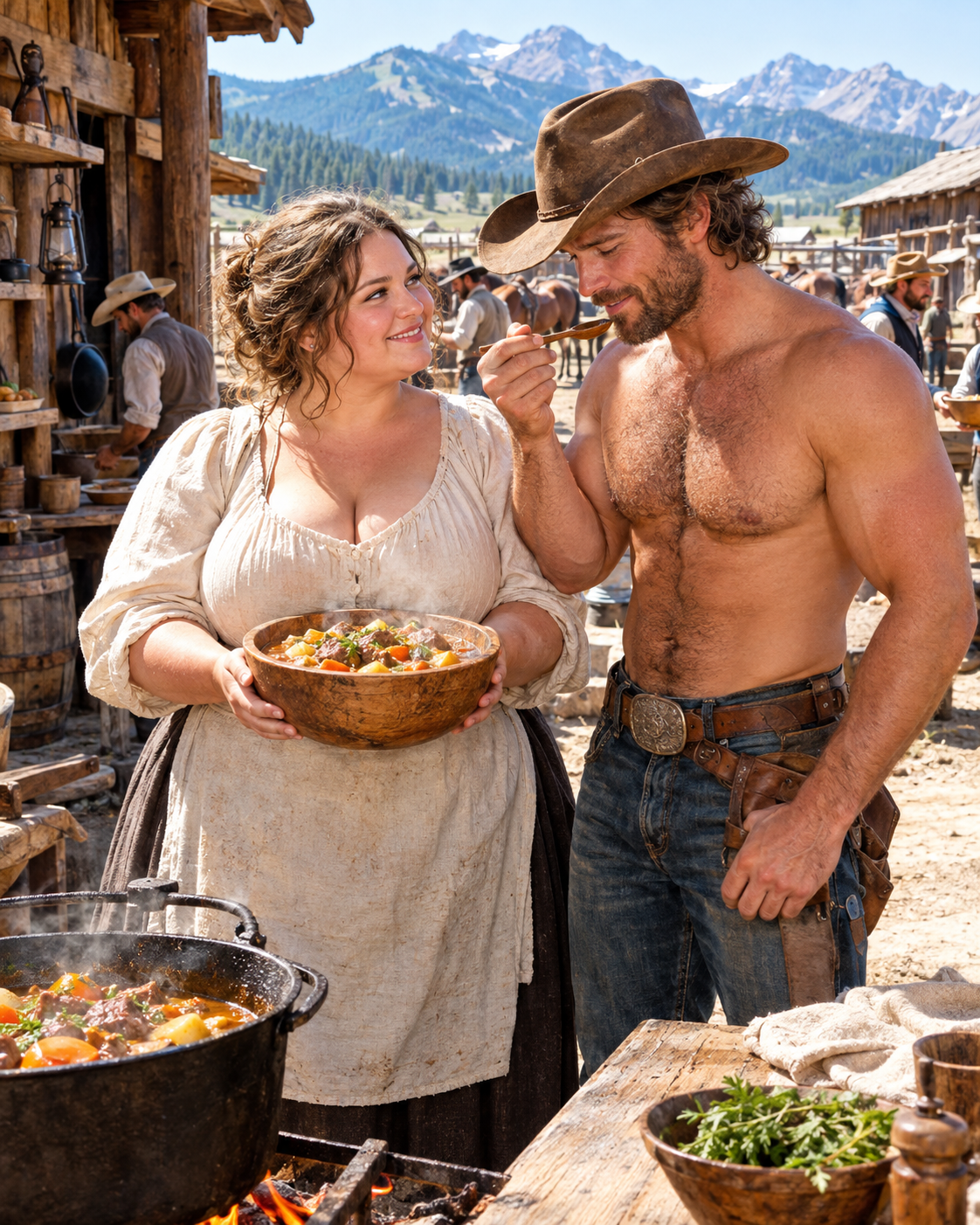
The moment I stepped into the Red Willow Ranch dining hall, eighteen cowboys laughed at my size, while Wade Dalton stared coldly at me as if he already knew the truth I had traveled across Wyoming to hide.
The door opened.
Wade stepped inside first, followed by Earl and two men I recognized from the dining hall.
Nobody spoke.
For several seconds, all I could hear was the storm beating against the windows.
I held the letter against my chest.
“What does this mean?” I asked.
Wade’s eyes dropped to the paper in my hand.
His face changed.
Not with anger.
With something much worse.
Fear.
“Who else knows?” he asked.
I stared at him.
“That is your first question?”
Earl shut the door behind him.
“Emily, listen to me.”
“No.”
My voice shook, but I didn’t lower it.
“I have listened since the night I arrived. I listened when your men laughed at me. I listened when you told me I was your wife because some letter said so. I listened when everyone started acting as if I belonged here without ever telling me why.”
I held up the letter.
“Now I find this hidden in your pantry, with my name on it, and you want me to listen again?”
Wade took one step toward me.
I stepped back.
He stopped.
His jaw tightened.
“You deserve the truth.”
“I think I deserve it more than anyone.”
Earl looked at Wade.
“Tell her.”
Wade closed his eyes for a moment.
Then he reached into his coat and pulled out a folded document.
He placed it on the table.
“Your father wrote to me six weeks ago.”
The room seemed to tilt.
“My father?”
“He knew he was dying.”
I stared at him.
“My father died three years ago.”
Wade’s expression didn’t move.
“Your father isn’t dead.”
The words struck harder than any slap.
I couldn’t breathe.
“What?”
Earl looked down.
Wade continued.
“Thomas Foster is alive.”
I shook my head.
“No.”
“Emily—”
“No.”
I backed against the pantry shelf.
“My father died in Ohio. My mother told me. The funeral—”
“There was no body,” Wade said quietly.
“There was a closed coffin.”
I remembered.
Suddenly, a memory I had spent years burying came rushing back.
Rain.
A church bell.
My mother’s pale face.
A coffin no one was allowed to open.
I had been nineteen.
I had believed grief was supposed to feel like an empty room.
Instead, mine had always felt like a locked door.
“Where is he?” I whispered.
Wade looked toward the window.
“Wyoming.”
My knees nearly gave out.
Earl caught my elbow.
I pulled away.
“Why?”
“Because your father was hiding.”
“From whom?”
Wade didn’t answer immediately.
Then he said, “From the men who are coming for you.”
A coldness spread through me.
“Who?”
“The Black Creek Syndicate.”
The name meant nothing to me.
Wade explained that years earlier, my father had worked as an accountant for a powerful cattle company that secretly smuggled stolen horses, weapons, and money across the Wyoming territory.
Thomas Foster discovered the operation and secretly copied their records.
When he threatened to expose them, the syndicate tried to kill him.
He disappeared.
But before disappearing, he hid the evidence somewhere only one person could find it.
His daughter.
Me.
“I don’t understand,” I whispered.
“Neither did I at first,” Wade said.
He pointed at the letter.
“Your father told me he needed someone he could trust to bring you west without telling you the truth. He believed anyone who knew the reason would be watched.”
“So you answered my letter?”
“No.”
His answer was immediate.
“You answered mine.”
I stared at him.
“I never wrote you.”
“I know.”
My heart stopped.
Wade’s voice became quieter.
“The advertisement was placed by your father.”
The room went silent.
“You were never supposed to be my wife.”
I looked at the dining hall beyond the doorway, remembering the laughter, the awkward welcome, the way Wade had looked at me from the first moment.
“Then why did you marry me?”
“I didn’t.”
I blinked.
Wade stepped closer.
“Legally, we aren’t married.”
The floor seemed to disappear beneath me.
“The letter was a decoy. Your father wanted everyone watching the stagecoach routes to believe you were coming here as a mail-order bride. But once you arrived, I intended to tell you everything.”
“Then why didn’t you?”
“Because someone in this ranch was reporting our movements.”
Earl’s face hardened.
Wade looked at him.
“We didn’t know who.”
I stared at the men around me.
“You thought it was one of them?”
“We thought it could be.”
“Then why bring eighteen men into this?”
Wade gave a humorless smile.
“Because every one of them was already in danger.”
He told me Red Willow Ranch was more than a cattle operation.
It was a refuge.
Every man working there had lost something to the syndicate.
Some had lost land.
Some had lost brothers.
One had lost a wife.
Another had spent years in prison for a crime he didn’t commit.
Wade had gathered them because the syndicate had been slowly taking control of the valley.
And now, after years of waiting, Wade believed they were preparing for one final move.
“Your father knows where the original ledger is,” he said.
“What ledger?”
“The one containing names, payments, judges, sheriffs, politicians, and every ranch they stole.”
I looked at the letter again.
“What does it have to do with me?”
Wade’s eyes met mine.
“Your father wrote that he hid the ledger inside something that belonged to your mother.”
My breath caught.
“My mother?”
“You brought something from Ohio.”
I thought of my battered suitcase.
Then suddenly I remembered the old wooden sewing box my mother had insisted I take.
It had been sitting beneath my clothes since the day I left.
I ran upstairs.
Wade followed.
I dropped to my knees beside the bed and dragged out the suitcase.
My fingers trembled as I pulled everything aside.
There it was.
The sewing box.
Old.
Paint chipped.
A brass clasp darkened with age.
I opened it.
Thread.
Needles.
Buttons.
A thimble.
Nothing else.
Wade crouched beside me.
“Look underneath.”
I removed the tray.
Still nothing.
Then I remembered something.
My mother had always told me never to lose the little silver thimble.
I turned it over.
There was a tiny symbol carved into the bottom.
A willow tree.
Wade’s expression changed.
“That’s it.”
He took the thimble and pressed the willow symbol against the bottom of the box.
A hidden compartment clicked open.
Inside was a rolled piece of paper.
I unfolded it.
It wasn’t a ledger.
It was a map.
At the bottom, in my father’s handwriting, were six words.
“Trust the woman who feeds them.”
I stared at the sentence.
Wade looked at me.
“That’s you.”
Before I could respond, a gunshot exploded outside.
The window shattered.
Glass flew across the room.
Wade grabbed me and pulled me to the floor.
Another shot.
Then another.
Men shouted downstairs.
Horses screamed in the barn.
The storm had become an army.
Wade drew his revolver.
“Stay here.”
I grabbed his sleeve.
“Where are you going?”
“To keep them out.”
“You’ll be killed.”
His eyes softened for the first time.
“Not tonight.”
He left.
I crawled toward the broken window and looked outside.
Figures moved through the snow.
At least ten men.
Maybe more.
They were surrounding the ranch.
The cowboys rushed from the barn, rifles in their hands.
Earl fired first.
The night erupted.
I pressed myself against the wall.
For the first time since coming to Wyoming, I understood something.
The laughter.
The cooking.
The strange kindness.
The boots outside my kitchen.
None of it had been pity.
These men had been protecting me.
And I had mistaken their silence for cruelty.
A scream came from downstairs.
Then a crash.
I ran.
“Emily!” Wade shouted.
But I was already moving.
A man had entered through the kitchen window.
He was holding a pistol.
I recognized him.
He had been sitting at the dining table the night I arrived.
His name was Silas.
He had always been quiet.
Too quiet.
He raised the gun.
I grabbed the iron skillet from the stove and swung it with everything I had.
The skillet struck his wrist.
The gun fell.
He cursed.
I swung again.
He collapsed against the table.
I stood there panting.
Wade appeared in the doorway.
He stared at the unconscious man.
Then at me.
“You just saved my life.”
I swallowed.
“I was angry.”
A strange smile touched his mouth.
“Remind me never to make you angry.”
The battle outside continued.
Wade and Earl dragged Silas into the cellar.
When Wade returned, his face was streaked with blood.
“How many?”
“Three wounded. Two attackers down. The rest are pulling back.”
“Then it’s over?”
Wade looked toward the window.
“No.”
A deep rumble came from outside.
Horses.
Too many.
“They’re bringing the main group.”
My stomach dropped.
“How many?”
“Thirty.”
Earl walked into the room.
“We can’t hold them.”
Wade looked at the map in my hand.
Then he looked at me.
“Maybe we don’t have to.”
I unfolded the map.
A red line ran from Red Willow Ranch into the hills.
It ended at an abandoned mine.
“The ledger,” I said.
Wade nodded.
“If we can reach the mine, we can get the evidence before they burn it.”
“You want to leave the ranch?”
“I want them to think we did.”
He pointed at the map.
“There is an old tunnel beneath the ranch. It leads into the hills.”
I stared at him.
“How do you know?”
“My father built it.”
“Your father?”
Wade hesitated.
Then he said, “The syndicate killed him too.”
The hatred in his voice finally made sense.
He hadn’t chosen this fight because he wanted to be a hero.
He had chosen it because he had spent years living with ghosts.
“How many men can go?” I asked.
“Six.”
“Then I’m going.”
“No.”
“I know the map.”
“It’s too dangerous.”
“So is staying here.”
Wade stared at me.
“You don’t understand.”
“I understand perfectly.”
I stepped closer.
“You brought me across half the country without telling me the truth. You married me without marrying me. You protected me without trusting me. If my father left that map for me, then I’m going.”
For several seconds, nobody spoke.
Then Earl chuckled.
“She’s got you there, boss.”
Wade looked at him.
Earl shrugged.
“She usually does.”
We left through the tunnel.
Snow filled the hills, swallowing our tracks.
Wade, Earl, and four cowboys moved ahead.
I followed with the map tucked inside my coat.
For nearly an hour, we climbed through darkness.
Then we reached the mine.
The entrance was hidden behind fallen timber.
Inside, the air smelled of damp earth and smoke.
Wade raised his lantern.
“There.”
A wooden door stood at the end of the tunnel.
It had the same willow symbol carved into it.
I touched it.
The door opened.
Inside was a small room.
There were boxes.
Dozens of them.
Ledgers.
Letters.
Photographs.
Official documents.
Names.
Evidence.
Enough to destroy the syndicate.
I began crying before I even realized it.
My father had spent years collecting proof.
And now I was standing inside the truth he had risked his life to protect.
Wade opened one of the boxes.
“This is everything.”
A voice came from behind us.
“No.”
We turned.
Silas stood in the doorway.
Blood covered his forehead.
He held a rifle.
“You found it.”
Wade raised his gun.
“Drop it.”
Silas laughed.
“You still don’t understand, Dalton.”
His eyes moved to me.
“Your father never intended for her to see this.”
“What are you talking about?” I asked.
Silas smiled.
“He didn’t hide the ledger for you.”
My blood went cold.
“He hid it from you.”
Wade fired.
Silas dropped behind the doorway.
The bullet missed.
“Run!” Wade shouted.
We grabbed the boxes.
Then the mine shook.
An explosion thundered through the tunnel.
Dust poured from the ceiling.
“They’re blowing the entrance!” Earl shouted.
We ran.
The tunnel began collapsing behind us.
Rocks crashed down.
Smoke filled my lungs.
I couldn’t see.
Someone grabbed my hand.
Wade.
“Keep moving!”
“I can’t!”
“Yes, you can!”
I stumbled.
A beam fell between us.
Wade shoved me forward.
The ceiling cracked.
“Go!”
“No!”
“Emily, go!”
I turned.
He was trapped beneath a fallen timber.
Earl tried to lift it.
It wouldn’t move.
Another explosion shook the mine.
The walls began to collapse.
I looked at Wade.
Then at the boxes.
Then at the narrow opening ahead.
Something inside me broke.
For years, I had believed my size made me weak.
I had spent my whole life apologizing for taking up space.
I had learned to make myself smaller whenever someone looked at me with contempt.
But standing there in that collapsing mine, I realized something my mother had tried to teach me long ago.
Strength had never belonged to the smallest person in the room.
I dropped the boxes.
I crawled beneath the beam.
Wade stared at me.
“What are you doing?”
“Moving it.”
“You can’t.”
“Maybe.”
I planted my feet.
Earl joined me.
Then another cowboy.
Then another.
Together, we pushed.
The beam moved.
Wade pulled himself free.
We ran.
Behind us, the mine collapsed completely.
We emerged into the snow just as the first light of dawn touched the mountains.
For a few seconds, none of us spoke.
Then Wade laughed.
It was the first real laugh I had ever heard from him.
I looked at him.
“What’s funny?”
He shook his head.
“Nothing.”
“You’re laughing.”
“I just realized something.”
“What?”
“You were never the woman I needed to protect.”
He looked at the others.
“You were the woman who was going to save us.”
We returned to Red Willow Ranch three hours later.
The fighting had stopped.
The syndicate men were gone.
Several had been captured.
The rest had fled.
But there was one person waiting in the dining hall.
An older man stood near the window.
His hair was gray.
His face was thinner than I remembered.
But I knew him.
Even after all those years.
My father.
I couldn’t move.
He couldn’t either.
Then he whispered my name.
“Emily.”
Everything inside me collapsed.
I crossed the room.
He opened his arms.
I struck his chest with both fists.
“You lied to me.”
He cried.
“I know.”
“You let me believe you were dead.”
“I thought it was the only way.”
“You let me mourn you.”
“I know.”
I hated him.
I loved him.
I hated him for making me suffer.
I loved him because he was still my father.
So I did the only thing I could.
I held him.
For the first time in three years, I heard him cry.
Later, he told me the truth.
He had been hiding near Red Willow because the syndicate had discovered that he had survived.
He had sent for me because he knew the evidence would eventually be found.
But he had also made one terrible mistake.
He had believed he could control everything from the shadows.
He hadn’t realized that secrets could hurt the people they were meant to protect.
The authorities arrived two days later.
The documents were enough to expose the syndicate.
Men who had once seemed untouchable were arrested.
Judges resigned.
Sheriffs were removed.
Land stolen from families was returned.
Red Willow Ranch became known throughout Wyoming as the place where the Black Creek operation finally ended.
But I didn’t care about the newspapers.
I cared about what happened afterward.
The cowboys rebuilt the kitchen.
Earl painted the dining hall.
Someone carved a willow tree above the front door.
And Wade changed.
Not suddenly.
Not perfectly.
But honestly.
One evening, weeks after the arrests, I found him standing outside the kitchen.
The same place where I had caught him watching me before.
This time, he wasn’t looking worried.
He was smiling.
“You’re doing it again,” I said.
“Doing what?”
“Watching me.”
“I like watching you.”
I raised an eyebrow.
“That’s a dangerous confession.”
He laughed.
Then his expression became serious.
“Emily, I owe you something.”
“What?”
“The truth.”
He reached into his coat.
My heart skipped.
He pulled out a small ring.
Not expensive.
Not decorated with diamonds.
Just a simple silver band.
“I know our first marriage wasn’t real.”
I smiled.
“Because there wasn’t one.”
“I know.”
He took a breath.
“And I don’t want to hide behind letters or arrangements anymore.”
He held out the ring.
“If you ever choose me, I want it to be because you want me.”
I stared at him.
“What if I say no?”
“Then I’ll spend the rest of my life regretting that I wasn’t brave enough to ask.”
I laughed softly.
“That’s a terrible sales pitch.”
“I’ve never been good at this.”
“No.”
I looked at the ring.
“You’re not.”
Then I held out my hand.
“But you are getting better.”
He slipped the ring onto my finger.
Behind us, the dining hall erupted in cheers.
I turned.
Eighteen cowboys stood in the doorway.
Earl lifted his cup.
“Took him long enough!”
Everyone laughed.
This time, I laughed too.
Months passed.
Spring came to Red Willow.
The snow disappeared from the fields.
The ranch grew.
My kitchen became the busiest room on the property.
Not because I was the cook.
Because I had started teaching women from nearby towns how to make a living from their own skills.
Some baked.
Some sewed.
Some kept books.
Some had been told their entire lives that they were too poor, too old, too plain, too heavy, too different, or too weak to matter.
I told them what I had finally learned.
“Never let someone else’s opinion become your identity.”
My father stayed nearby.
He spent his remaining years helping return land to families the syndicate had harmed.
He apologized often.
I didn’t always forgive him immediately.
But forgiveness, I learned, wasn’t pretending the wound never happened.
It was deciding that the wound would not control the rest of your life.
And Wade?
He never again called me his mail-order bride.
He called me his wife.
Not because a letter had said so.
Not because a father had arranged it.
Not because he needed someone to cook for eighteen cowboys.
He called me his wife because every morning, after everything we had survived, he chose me again.
Years later, when people asked how I came to Red Willow Ranch, they usually expected a romantic story.
I would smile and tell them about the snowstorm.
The eighteen cowboys.
The cruel laughter.
The hidden letter.
The secret mine.
The man I thought I had come west to marry.
But the truth was much simpler.
I hadn’t traveled to Wyoming to find a husband.
I had traveled there because I believed I had nowhere left to go.
Instead, I found a place where I learned to stop asking whether I was enough.
I learned that people who laugh at your appearance are often revealing their own smallness, not yours.
I learned that being loved does not mean being rescued.
It means being seen.
Really seen.
And I learned that sometimes the life waiting for you on the other side of fear is far bigger than the life you were too frightened to imagine.
One summer evening, years after the storm, I stood on the porch of Red Willow Ranch and watched the sun disappear behind the hills.
Wade came up behind me.
“You thinking about Ohio?”
I shook my head.
“No.”
“Your father?”
“No.”
“The mine?”
I smiled.
“Sometimes.”
He slipped his hand into mine.
“What are you thinking about?”
I looked across the ranch.
At the barn.
At the fields.
At the kitchen where warm light spilled through the windows.
At the men who had once laughed at me and later became family.
Then I looked at my hands.
They were still the same hands.
Soft in some places.
Scarred in others.
Strong because they had learned what strength really meant.
“I’m thinking,” I said, “that I spent half my life trying to become smaller so people would accept me.”
Wade squeezed my hand.
“And now?”
I looked at the wide Wyoming sky.
“Now I don’t want to be smaller anymore.”
He smiled.
Neither did I.
And that was the greatest secret Red Willow Ranch had ever taught me.
You do not have to shrink yourself to fit into a world that was built to make you doubt your worth.
Sometimes, you simply have to find the place where your full size—your full heart, your full voice, your full self—can finally breathe.
And when you do, you may discover that the thing you thought made you unworthy was never a weakness at all.
It was the very thing that made you strong.
The first snow of winter came quietly that year.
It began with a few white flakes drifting across the fields before dawn, settling on the wooden fence posts and the red roof of the barn.
By sunrise, Red Willow Ranch looked almost exactly as it had on the night I arrived.
Only I was different.
I stood at the kitchen window with a cup of coffee between my hands, watching the snow cover the road.
For a moment, I remembered the girl who had stood in that same doorway years ago.
She had been frightened.
Lonely.
Ashamed of taking up too much space.
She had believed that if she could simply become useful enough, quiet enough, agreeable enough, perhaps someone would decide she deserved to stay.
I almost didn’t recognize her anymore.
“You’re awake early.”
Wade’s voice came from behind me.
I turned.
He was older now.
There were silver threads at his temples, and the hard lines around his eyes had deepened.
But when he looked at me, his eyes still softened in exactly the same way.
“I’ve always been an early riser.”
“You’ve always been an early worrier.”
I smiled.
“And you’ve always been a terrible liar.”
He walked toward me and wrapped his arms around my waist.
I leaned against him.
For several quiet seconds, neither of us spoke.
Then we heard horses.
Wade looked toward the window.
“That doesn’t sound like our men.”
My smile disappeared.
Neither of us moved.
The horses came closer.
Four riders appeared through the falling snow.
Behind them came two wagons.
Wade’s hand instinctively moved toward the revolver hanging beside the door.
“Stay here.”
I caught his wrist.
“No.”
He looked at me.
“Emily.”
“I’ve spent too many years being told to stay somewhere safe.”
He sighed.
“That doesn’t mean you have to prove anything.”
“I’m not proving anything.”
I picked up my coat.
“I’m standing beside my husband.”
His expression softened.
“That’s different.”
We stepped outside together.
The riders stopped near the barn.
The first man dismounted.
He was young, perhaps twenty-five.
His coat was covered in snow.
“I’ve come from Cheyenne,” he called.
Wade didn’t lower his hand from his gun.
“What do you want?”
The man reached inside his coat.
“Easy.”
He pulled out a folded paper.
“The territorial court sent this.”
Wade took it.
He read the first few lines.
Then his face hardened.
“What is it?”
I asked.
He handed me the paper.
My eyes moved across the page.
The Black Creek case was not finished.
Three men who had escaped during the arrests had been found.
But one of them had confessed to something that changed everything.
The syndicate had kept another ledger.
A second ledger.
One that contained the names of everyone who had secretly helped them.
And one name was missing from the original evidence.
My father’s.
I looked at Wade.
“That’s impossible.”
The rider shook his head.
“The court believes Thomas Foster was involved.”
My heart sank.
“My father?”
“He was listed in several transactions.”
Wade took the paper back.
“Where is the man who made the confession?”
“Dead.”
“Convenient.”
The rider nodded.
“He was killed before he could testify.”
Wade looked toward the mountains.
“Who else knows?”
“Enough people to make this dangerous.”
The rider glanced at me.
“They believe your father may have hidden the second ledger before he disappeared.”
I felt the old fear return.
Not for myself.
For him.
My father had spent years trying to repair the damage caused by his past.
If he had lied again, everything we had built could collapse.
“I need to speak with him.”
Wade shook his head.
“Not until we know whether the confession is real.”
“He deserves the chance to defend himself.”
“So do you.”
I looked at him.
“What does that mean?”
“It means you’re not going anywhere alone.”
Three days later, we left Red Willow.
The journey to Cheyenne took two days.
The courthouse was crowded when we arrived.
Men whispered as we walked through the doors.
Some stared at me.
Some at Wade.
Others looked at my father.
He was sitting alone at a wooden table.
His face looked older than it had a week before.
When he saw me, he stood.
“Emily.”
I stopped several feet away.
“Did you know about the second ledger?”
He closed his eyes.
That was answer enough.
Wade stepped forward.
“You lied to her.”
Thomas shook his head.
“I didn’t lie.”
“You concealed it.”
“Because I was trying to protect her.”
I laughed bitterly.
“That excuse again?”
My father flinched.
“You don’t get to protect me by deciding what truths I can handle.”
He looked down.
“I know.”
“Then tell me everything.”
He was silent for a long time.
Finally, he said, “The second ledger doesn’t contain names of criminals.”
“What does it contain?”
“The names of people who tried to resist them.”
I frowned.
“What?”
“The syndicate kept two records. One showed who they paid. The other showed who they wanted destroyed.”
My father looked at Wade.
“Your father was on that list.”
Wade’s expression changed.
“And you?”
“Yes.”
He looked at me.
“And your mother.”
The room became silent.
“My mother?”
My father nodded.
“She knew about the syndicate before I did.”
I felt the ground shift beneath me.
“Why didn’t she tell me?”
“Because she believed you were safer knowing nothing.”
I almost laughed.
“Everyone kept deciding what was best for me.”
My father lowered his head.
“Your mother regretted it.”
“How do you know?”
“Because she wrote me a letter.”
He reached into his coat and pulled out an envelope.
My name was written across it.
My mother’s handwriting.
I recognized it immediately.
My hands trembled as I opened it.
There were only two pages.
She wrote that she had been afraid.
Not of the syndicate.
Of losing me.
She wrote that sometimes love could become another kind of fear.
That parents could mistake control for protection.
And she apologized for teaching me to believe that silence was safety.
At the bottom, she had written:
“My darling Emily, never spend your life becoming smaller because someone else is frightened by how brightly you might live.”
I couldn’t read the final sentence through my tears.
Wade gently took my hand.
For the first time in years, I understood my mother.
She had not wanted me to be weak.
She had simply been afraid the world would punish me for being strong.
I folded the letter.
“Where is the second ledger?”
My father looked at me.
“I destroyed it.”
Wade frowned.
“You destroyed evidence?”
“I destroyed the original.”
“Then how do you know what was inside?”
“Because I memorized it.”
A cold silence filled the room.
My father stood.
“I wrote down everything afterward.”
He placed a small notebook on the table.
The pages contained names.
Dates.
Locations.
Not enough to prove every crime.
But enough to reopen the investigation.
The next several weeks became a battle of paperwork, testimony, and threats.
Men who had once hidden behind wealth and influence began fighting to protect themselves.
Some tried to bribe my father.
Others threatened Wade.
One night, someone fired a shot through the window of our hotel room.
Another time, our carriage was forced off the road.
The old fear returned.
But something inside me had changed.
I no longer froze when danger came.
I acted.
We returned to Red Willow with armed escorts.
The ranch became a temporary headquarters for the investigation.
Men arrived from neighboring towns.
Women brought food.
Families who had once been too afraid to speak began telling their stories.
The truth spread from one person to another.
And the more people spoke, the weaker the syndicate became.
Then, one cold evening, Earl came running into the kitchen.
“Emily!”
I turned.
“What happened?”
“They found him.”
“Who?”
“The last man from Black Creek.”
My heart stopped.
“Where?”
“Near the northern ridge.”
Wade entered behind him.
“He wants to talk.”
“To whom?”
He looked at me.
“You.”
I stared at him.
“Why me?”
“Because he claims your father wasn’t the only person who knew where the second ledger was.”
We rode out before sunrise.
The man was hiding in an abandoned cabin.
He was wounded.
Barely conscious.
When he saw me, he laughed.
“You look just like your mother.”
I froze.
“What did you say?”
“Your mother knew.”
“Knew what?”
“Where the ledger was.”
My father had said he destroyed it.
The man shook his head.
“Your father destroyed a copy.”
Wade stepped forward.
“Where is the original?”
The man looked at me.
“At Red Willow.”
My blood ran cold.
“What?”
He smiled weakly.
“Your father never trusted paper.”
He pointed toward the ranch.
“He hid the original beneath the house.”
We returned immediately.
The entire ranch was searched.
Floorboards were removed.
Walls were opened.
Nothing.
Then I remembered the old kitchen.
The pantry.
The place where I had found Wade’s first letter.
I moved the wooden crate.
There was a loose stone beneath it.
I knelt.
My fingers found a small metal latch.
I opened it.
A narrow compartment appeared.
Inside was a black leather book.
The second ledger.
I stared at it.
Years of secrets were sitting beneath the kitchen where I had cooked meals for eighteen men.
The same kitchen where I had first believed I was worthless.
The same room where I had learned that people could change.
Wade stood beside me.
“Are you afraid?”
I looked at the ledger.
“Yes.”
He waited.
“But I’m not running.”
We took the ledger to the court.
This time, there was no escape.
The names inside connected the syndicate to officials in three territories.
Men who had thought themselves untouchable were arrested.
The investigation lasted nearly a year.
Some fought until the end.
Some confessed.
Some disappeared.
But eventually, Black Creek was gone.
Not because one man had defeated it.
Not because Wade had been stronger.
Not because my father had been clever enough.
It ended because people finally stopped being afraid to speak.
When the final verdict was announced, Red Willow held a celebration.
The dining hall was packed.
Eighteen cowboys had become nearly forty ranchers, neighbors, wives, children, and friends.
Earl stood at the head of the table.
He raised his glass.
“To Emily.”
Everyone cheered.
I shook my head.
“To everyone.”
Earl grinned.
“Fine. To everyone.”
The room erupted.
Wade leaned toward me.
“You know something?”
“What?”
“When you first arrived, I thought you were going to hate this place.”
“I did.”
He laughed.
“For about three days.”
“Four.”
“Four?”
“I was being generous.”
He smiled.
Then he kissed my forehead.
Across the room, my father was laughing with Earl.
For the first time, he looked peaceful.
The years of hiding were over.
The secrets were over.
And perhaps most importantly, I was no longer waiting for someone else to tell me who I was.
Years later, when Red Willow had grown into one of the largest ranches in the territory, people still told stories about the winter the Black Creek Syndicate fell.
Some said Wade Dalton was the hero.
Some said my father was.
Others said the cowboys had saved the ranch.
But whenever someone asked me what really happened, I always gave the same answer.
“It wasn’t one person.”
“It was everyone who finally decided fear had taken enough from them.”
One spring morning, I stood on the porch with my daughter.
She was eight years old, with dark hair and stubborn eyes.
She looked up at me.
“Mama?”
“Yes?”
“Why do people call you the Red Willow woman?”
I smiled.
“Because of the ranch.”
“Did you save it?”
I thought about the girl who had arrived carrying one battered suitcase.
“I think the ranch saved me first.”
She frowned.
“How?”
I looked across the fields.
“By teaching me that being different isn’t something you have to apologize for.”
She considered that.
Then she asked, “Was Papa there?”
I laughed.
“Yes.”
“Did he save you?”
I looked toward the barn.
Wade was standing there, watching us.
“No,” I said.
“He walked beside me.”
My daughter smiled.
“Is that better?”
I looked at Wade.
He smiled back.
“Much better.”
That evening, after everyone had gone to sleep, Wade and I sat on the porch beneath a sky full of stars.
He took my hand.
“You ever think about leaving Ohio?”
“Sometimes.”
“Would you do it again?”
I looked at him.
“Would I cross the country in the middle of winter, believing I was going to marry a stranger?”
He nodded.
“No.”
He laughed.
“I was afraid you’d say that.”
I leaned against his shoulder.
“I’d do something different.”
“What?”
“I’d come here sooner.”
He kissed my temple.
The wind moved softly through the willow trees.
For a moment, I closed my eyes.
I could almost hear the laughter from that first night.
The cruel laughter.
The kind that had once made me feel small.
But now it sounded distant.
Almost harmless.
Because I finally understood something I wished I had known when I was young.
People will sometimes judge you before they know your heart.
They will tell you that you are too much.
Too large.
Too loud.
Too emotional.
Too ambitious.
Too different.
They will try to convince you that the safest way to survive is to disappear.
But love should never require you to disappear.
Real love does not ask you to become smaller.
Real family does not make you earn your place.
And real strength is not the absence of fear.
It is choosing to move forward while fear is still standing beside you.
I looked at the willow trees swaying beneath the moonlight.
Once, I had come to Wyoming believing I needed someone to choose me.
A husband.
A family.
A home.
Instead, I discovered something far more important.
I had to choose myself first.
Everything else came after.
Wade squeezed my hand.
“Emily?”
“Yes?”
“I’m glad you came.”
I smiled.
“So am I.”
The wind carried the scent of snow from the distant mountains.
The ranch lights glowed behind us.
And somewhere in the darkness, eighteen old cowboys were probably arguing over who had been the first to realize I wasn’t what they thought I was.
I laughed quietly.
Wade looked at me.
“What?”
“Nothing.”
I rested my head against his shoulder.
“Just remembering the night I arrived.”
“The worst night of your life?”
I shook my head.
“No.”
I looked toward the horizon.
“It was the beginning of the best part.”
And that was the truth.
Sometimes the door you are terrified to walk through is the door leading into the life you were always meant to live.
Sometimes the people who make you feel unwanted become the people who teach you what belonging really means.
And sometimes the greatest journey is not crossing a thousand miles to find someone who will love you.
It is learning, after a lifetime of being told otherwise, that you were worthy of love before you ever arrived.
I had crossed Wyoming looking for a home.
I found one at Red Willow Ranch.
But the greatest thing I found there was not Wade.
It was not my father.
It was not the ranch.
It was myself.
And once I stopped trying to make myself smaller for the world, I finally discovered how large my life could become.
The willows moved gently in the night wind.
The stars burned above the mountains.
Wade’s hand remained wrapped around mine.
And for the first time in my life, I didn’t wonder whether I belonged.
I knew.
I always had.
THE END.