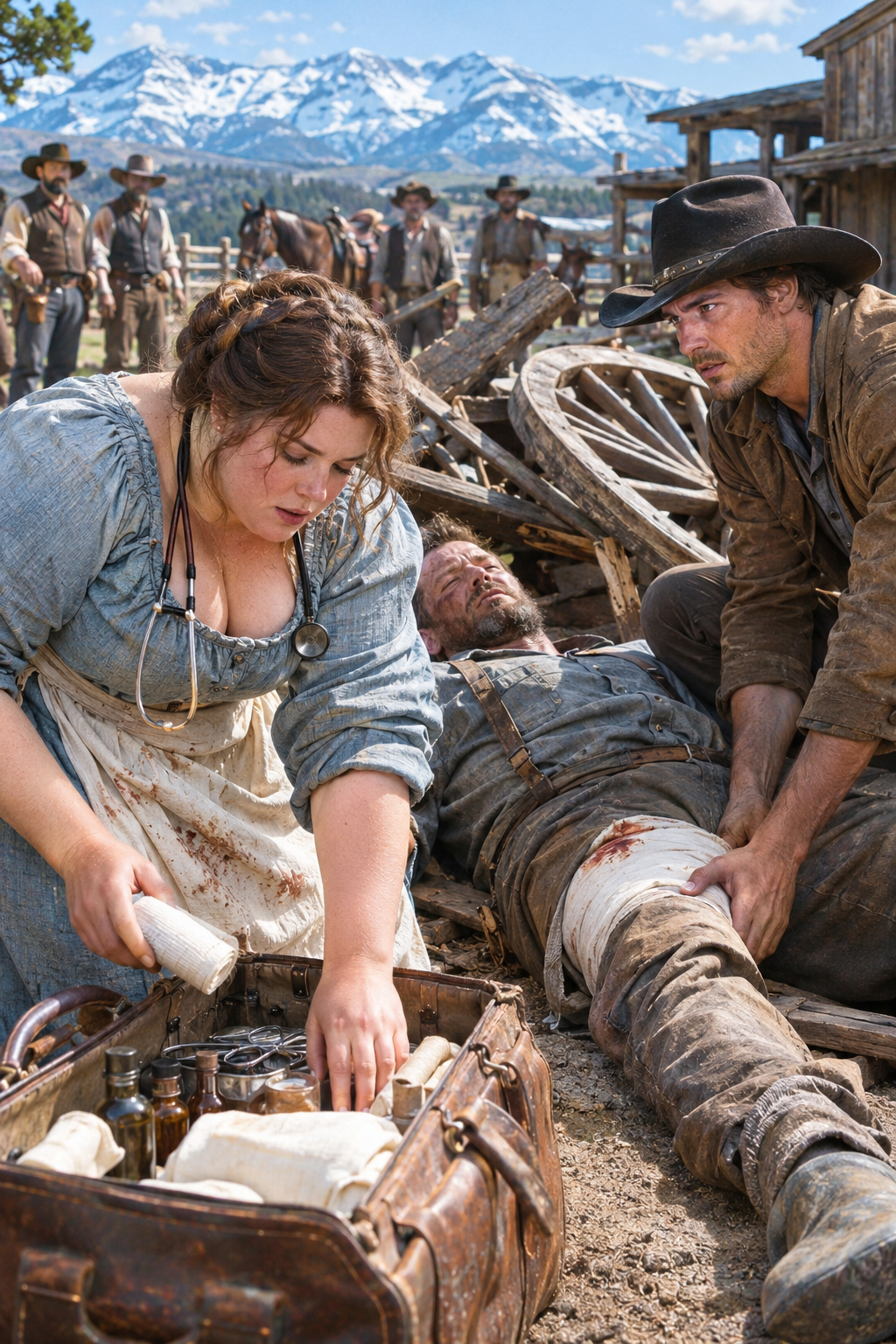
The moment I opened my medical trunk beside an overturned wagon, my husband stared at me with disgust, unaware his mail-order bride was a disgraced doctor.
Dr. Charles Hargrove stood beneath our porch lantern with the same polished smile I remembered from St. Louis, but something in his eyes told me he had not crossed half the country to make peace.
For seven years, I had feared that man more than death itself.
Now he was standing outside the home where I had finally begun to feel safe, carrying a black medical bag and looking at my husband as though I were a troublesome possession he had come to reclaim.
“Mrs. McCall,” he said pleasantly, removing his hat. “Or should I still call you Miss Foster?”
Daniel moved in front of me before I could answer.
“You know my wife?”
Hargrove’s smile widened.
“Unfortunately, I know her rather well.”
The words struck me with familiar humiliation, but this time I was not standing alone in a hospital corridor surrounded by men who had already decided I was guilty.
I was standing on my own porch, with my husband’s shoulder inches from mine and a frightened young ranch hand fighting for his life inside our bunkhouse.
“What are you doing here?” I asked.
Hargrove glanced past me toward the farmhouse.
“I received word that an unqualified woman was practicing medicine on this property, and I thought it wise to intervene before another unfortunate death occurred.”
My stomach tightened.
Nobody outside the ranch knew what had happened to Thomas, and the accident had occurred only hours earlier.
Someone had sent Hargrove here before the wagon overturned.
Daniel seemed to recognize the same troubling detail.
“Who told you there was an injured man?”
For the first time, Hargrove’s expression faltered.
“I heard there had been an accident in the district.”
“Then you heard wrong,” Daniel replied. “You came here knowing my wife’s name.”
The doctor slowly replaced his hat.
“I see she has already begun filling your head with stories.”
I remembered the hospital corridors, the whispered accusations, and the terrible morning when I had been ordered to surrender my instruments.
For years, those memories had made me shrink whenever anyone questioned my judgment.
But Thomas was still waiting for help, and I had no intention of wasting another moment defending myself to the man who had ruined me.
“If you truly came as a physician,” I said, “then there’s a patient inside who needs you.”
Hargrove studied me for a long moment.
Then he stepped past Daniel and followed us toward the bunkhouse.
Thomas lay beneath a clean blanket, his injured leg supported by folded bedding, his face pale but his breathing steadier than before.
I had controlled the bleeding and dressed the wound, yet I knew he remained in danger from infection and the damage caused by the crushing weight.
Hargrove examined him without speaking.
When he finally straightened, his expression was colder than before.
“Who performed this treatment?”
“I did.”
He looked at the dressings, then at the instruments arranged beside the bed.
“You should never have attempted this without a licensed physician present.”
“And you should never have delayed treating Margaret Collins,” I answered.
The room became completely silent.
Daniel stood near the door, while two ranch hands watched from beside the stove.
Hargrove’s fingers tightened around his medical bag.
“Be careful, Hannah.”
I had heard that warning before.
In St. Louis, it had meant that my employment, reputation, and livelihood depended upon keeping my mouth shut.
Here, it sounded different.
Here, it sounded like fear.
Thomas stirred beneath the blanket and whispered my name.
I bent toward him immediately.
“You’re going to be all right, Thomas. We’re getting you proper care.”
His eyes moved toward Hargrove.
“Don’t let him send you away, ma’am.”
Those simple words nearly brought me to tears.
Hargrove closed his bag.
“The patient needs further treatment, but I will not work under the direction of a woman who has already demonstrated such reckless judgment.”
Daniel stepped forward.
“Then you can leave.”
The doctor turned sharply.
“You would dismiss the only physician available?”
“I would dismiss any man who uses a dying worker to punish my wife.”
I stared at Daniel.
Only an hour earlier, he had struggled to understand who I really was.
Now he was standing between me and the man who had spent years teaching me to be ashamed of my abilities.
Hargrove looked from Daniel to me, calculating.
Finally, he agreed to examine Thomas further, but I refused to leave the bunkhouse.
We worked in strained silence, and when he confirmed that Thomas needed more extensive treatment than we could safely provide there, Daniel arranged for a wagon to carry him to the nearest properly equipped medical facility.
Hargrove departed shortly afterward, claiming he needed to collect additional supplies from town.
Before leaving, he leaned close enough that only I could hear him.
“You should have stayed in Missouri, Hannah.”
I met his eyes.
“And you should have told the truth about Margaret.”
His expression changed.
For one brief second, the confidence disappeared completely.
Then he climbed into his carriage and drove into the darkness.
I stood watching until the wheels vanished beyond the cottonwood trees.
Daniel came beside me.
“That man is hiding something.”
“Yes,” I whispered. “And I think he’s frightened someone will finally discover it.”
We returned to the farmhouse after midnight.
Ellie had fallen asleep on the kitchen bench, her little hands curled around the rag doll I had sewn for her during my first week at the ranch.
Daniel lifted her gently and carried her upstairs.
I remained at the table with Margaret’s letter spread before me.
The paper smelled faintly of old lavender.
I remembered Margaret wearing the same fragrance during her hospital visits, when she had spoken excitedly about the nursery she was preparing for her baby.
She had been twenty-six years old.
She had trusted the people who promised to protect her.
And somewhere between her first cry for help and her final silence, that trust had been betrayed.
When Daniel returned, he placed a cup of warm coffee beside me.
“You haven’t slept.”
“I don’t think I can.”
He sat across from me.
For several minutes, neither of us spoke.
Then he said something I had not expected.
“When my first wife died, I blamed myself for not noticing how sick she was.”
I looked up.
Daniel rarely spoke about his late wife, Rebecca.
He had told me only that she had died of pneumonia when Ellie was three.
“I was out checking cattle during a storm,” he continued. “Rebecca told me she was feeling better, and I believed her because I wanted to.”
His voice grew rough.
“By the time I returned, she could barely breathe.”
I reached across the table.
“Daniel, you couldn’t have known.”
“Maybe not. But guilt doesn’t always care about what a person could have known.”
He looked at Margaret’s letter.
“I think you’ve been carrying someone else’s guilt for a very long time.”
The words broke something open inside me.
I began crying before I could stop myself.
Daniel moved beside me and wrapped his arms around my shoulders.
He did not ask me to be strong.
He did not tell me everything would be fine.
He simply held me until the trembling passed.
The following morning, Thomas was transported under careful supervision to a physician in Cheyenne, where better facilities were available.
I sent detailed notes describing his injuries and treatment, along with a request that the receiving doctor watch closely for complications.
Watching the wagon disappear down the road frightened me more than I wanted to admit.
I had done everything I could, but medicine had taught me that effort and survival were not always the same thing.
Daniel stood beside me.
“You saved his life long enough to give him a chance.”
I wanted to believe him.
Before noon, we rode into town together.
I carried Margaret’s letter, the mysterious warning, and every surviving document from my medical trunk.
Our first stop was the telegraph office.
The operator, a thin man named Samuel Price, recognized Daniel immediately.
When I showed him the warning addressed to me, he adjusted his spectacles.
“That came through yesterday evening, ma’am.”
“Who sent it?”
He examined the message.
“Eleanor Collins. St. Louis.”
My heart lurched.
The woman who had signed Margaret’s letter as Eleanor Whitcomb had apparently used her maiden name for the telegram.
“Was there another message?” I asked.
Samuel hesitated.
“There was one addressed to Dr. Whitcomb, but I can’t disclose its contents without permission.”
Daniel leaned forward.
“Is Dr. Whitcomb related to Eleanor Collins?”
Samuel looked surprised.
“He’s her husband.”
I gripped the counter.
Eleanor had married a physician and moved west.
That explained the shared surname, but it raised another question.
Why had she warned me not to trust a man approaching our ranch while her own husband was suddenly missing?
Samuel studied my expression, then lowered his voice.
“Dr. Whitcomb left town yesterday morning after receiving a telegram, but he returned late last night.”
“Where is he now?”
“At his office, I believe.”
We found Dr. Andrew Whitcomb preparing to leave again.
He was a quiet, gray-haired man with tired eyes and ink stains on his cuffs.
The moment I introduced myself, he closed the office door.
“My wife has been searching for you for nearly two years.”
I felt the room tilt.
“Why?”
He opened a drawer and removed a small parcel wrapped in brown paper.
“Because she discovered that her sister’s death was not investigated honestly.”
Inside were copies of hospital records, financial ledgers, and several letters written by Margaret’s husband, Edward Collins.
Andrew explained that Eleanor had inherited Margaret’s writing desk after Edward died from influenza the previous winter.
While repairing a broken drawer, she discovered the hidden compartment Margaret had described.
The documents inside revealed years of unauthorized transfers from the Collins family estate.
The money had been directed into business accounts controlled by a man named Frederick Bell.
Bell was Hargrove’s brother-in-law.
I turned the pages slowly.
Some transactions were dated months before Margaret’s death.
Others continued afterward.
“Did Edward know?”
Andrew shook his head.
“Not until much later. By then, he had been convinced that Margaret’s concerns were symptoms of nervous illness.”
I remembered Hargrove dismissing Margaret’s fears during her final hospital visit.
He had called her emotional.
Overwrought.
Unstable.
Words that sounded medical enough to silence a frightened woman.
“But this doesn’t prove he caused her death,” I said.
“No,” Andrew answered. “It doesn’t.”
He reached for another document.
“This may help explain why he blamed you.”
It was a copy of the original treatment notes from Margaret’s delivery.
My handwriting appeared throughout the early pages, recording the signs of obstructed labor and the worsening condition I had repeatedly reported.
Beside one entry, written in Hargrove’s unmistakable script, were the words: “Continue observation.”
The instruction was timed nearly two hours after I had first requested immediate intervention.
I stared at the page.
In the official hospital report, that entry had been removed.
Instead, the final account claimed I had failed to recognize the danger until it was too late.
My hands began shaking.
“He changed the records.”
Andrew nodded.
“Eleanor found a duplicate notebook kept by the attending nurse. The nurse died three years ago, but her notes survived among her personal papers.”
I pressed my fingers against my mouth.
For seven years, I had remembered every minute of Margaret’s suffering.
I had questioned my judgment thousands of times.
Now the truth lay before me in ordinary black ink.
I had recognized the emergency.
I had asked for help.
And the man responsible for making the final decision had ignored me.
Daniel moved closer.
“Can we prove the records were altered?”
Andrew looked toward the window.
“With the original hospital register, yes. But Hargrove still controls access to those archives through his associates.”
“Then we need someone with authority to obtain them,” Daniel said.
Andrew nodded.
“I’ve already contacted an attorney in St. Louis. Eleanor is preparing sworn statements.”
A sudden noise outside interrupted him.
A horse whinnied sharply.
Then someone shouted from the street.
We hurried to the window.
Hargrove’s carriage stood outside the office.
Two men were climbing down beside it.
One wore a dark traveling coat.
The other carried a leather document case.
Andrew’s face drained of color.
“That’s Frederick Bell.”
I felt a cold certainty settle over me.
The man whose accounts had received the missing money had followed Hargrove all the way to Wyoming.
Daniel quietly moved me away from the window.
“We’re leaving through the back.”
But before we reached the rear door, someone knocked.
Three slow knocks.
Then Hargrove’s voice sounded from the hallway.
“Andrew, I know she’s in there.”
Dr. Whitcomb looked at me.
“Take the papers.”
He opened a narrow door leading into the storeroom.
Daniel guided me through, and we emerged into the alley behind the building.
We had barely reached our horses when Hargrove appeared at the corner.
“Hannah!”
I turned.
He stood several yards away, breathing heavily.
Bell followed behind him.
“You don’t understand what you’re doing,” Hargrove said.
I tightened my grip on the parcel.
“I understand enough.”
He looked toward Daniel.
“Your wife has stolen confidential medical records.”
Daniel stepped between us.
“Then you can explain that accusation to the sheriff.”
Bell’s expression hardened.
“Those documents belong to the Collins estate.”
“Then perhaps you can explain why money from that estate appears in your accounts,” I replied.
For a moment, nobody moved.
Then Bell reached into his coat.
Daniel immediately pulled me backward.
But Bell produced only a folded legal notice.
He held it toward us.
“This woman is accused of unlawfully practicing medicine and causing a patient’s death in Missouri.”
I stared at the paper.
The accusations were familiar.
The timing was not.
“You’ve waited seven years to bring charges?”
Hargrove’s voice became almost gentle.
“Come back to St. Louis voluntarily, Hannah, and this can be handled quietly.”
There it was.
The same offer he had made after Margaret died.
Silence in exchange for safety.
Submission in exchange for a future.
I looked at the document, then at the man holding it.
“No.”
Hargrove’s smile disappeared.
“You have no idea what you’re risking.”
“Yes,” I answered. “For the first time, I do.”
Daniel helped me onto my horse.
We rode directly to the sheriff’s office, where we presented the papers and described everything that had happened.
Sheriff Walter Briggs was a practical man who disliked complicated disputes, especially those involving wealthy outsiders.
But he understood the difference between a legal accusation and a threat.
He examined Bell’s notice carefully.
“This isn’t an arrest warrant,” he said.
“It’s a statement prepared by a private attorney.”
Bell had no authority to take me anywhere.
For the first time that day, I could breathe.
The sheriff agreed to safeguard copies of the documents while Andrew contacted the proper authorities in Missouri.
He also warned Hargrove and Bell against interfering with witnesses.
The men departed town that afternoon.
But I knew they had not surrendered.
Three days later, a letter arrived from Cheyenne.
Thomas Reed had survived the journey.
His condition remained serious, but the physician treating him believed he had a reasonable chance of recovery.
I read the letter twice before handing it to Daniel.
Then I walked behind the barn and cried with relief.
Ellie found me sitting on an overturned bucket.
She climbed into my lap without asking permission.
“Are you sad, Mama Hannah?”
I wrapped my arms around her.
“No, sweetheart. I’m grateful.”
She studied my face.
“Can people cry when they’re grateful?”
“Sometimes those are the biggest tears.”
She leaned against my chest.
Then she asked a question I would remember for the rest of my life.
“Are you going to stop being a doctor because people were mean to you?”
I looked toward the mountains.
For years, I had told myself that hiding my knowledge was the price of beginning again.
But Thomas had nearly died because I hesitated to reveal what I knew.
Margaret had died while powerful men dismissed what I knew.
And now a little girl was asking whether fear would decide the rest of my life.
“No,” I whispered. “I don’t think I am.”
The following weeks changed everything.
Andrew Whitcomb returned to regular practice and began visiting the ranch whenever his patients required assistance.
He invited me to work alongside him within the limits permitted by territorial law, reviewing cases, assisting with treatment, and continuing my medical studies.
I accepted.
At first, the townspeople whispered.
Some remembered the accusations circulating about me.
Others wondered why Daniel had married a woman with such a troubled past.
But when a rancher’s wife developed a dangerous fever, Andrew asked me to help monitor her condition.
When a child suffered a badly broken arm, I assisted with the treatment.
And when an elderly widow could not afford a physician’s visit, I rode with Andrew to her cabin and stayed until her breathing eased.
I did not pretend that kindness erased the legal barriers facing women in medicine.
I knew I would need recognized credentials and official authorization before I could practice independently.
But I had stopped apologizing for knowing how to help.
Meanwhile, Eleanor continued gathering evidence in St. Louis.
The original hospital register was eventually secured through legal proceedings.
A former clerk admitted that Hargrove had ordered changes to the official report after Margaret’s death.
Another witness confirmed that Bell had transferred money from the Collins estate into accounts controlled by Hargrove’s associates.
The evidence did not establish that Margaret had been deliberately killed.
That question remained painfully uncertain.
But it established something equally important.
Hargrove had concealed his delay, falsified the medical account, and used my reputation to protect his own.
When the Missouri authorities reopened the investigation, Hargrove resigned from his hospital position.
Bell faced proceedings over the missing estate funds.
The story spread through newspapers across several states.
For weeks, strangers wrote letters to our ranch.
Some apologized for believing the accusations.
Others asked whether I intended to return to St. Louis.
I did not know what to tell them.
Then, one cold morning in early autumn, Daniel found me standing beside the kitchen window with a letter from Eleanor in my hands.
The final paragraph contained words I had waited seven years to read.
The hospital’s governing board had formally withdrawn its accusations against me.
My name had been cleared.
I should have felt triumphant.
Instead, I sat down at the table and wept.
Because clearing my name did not bring Margaret back.
It did not restore the years I had spent frightened of my own abilities.
And it did not erase the memory of her final moments.
Daniel knelt beside my chair.
“What’s wrong?”
I handed him the letter.
He read it silently.
Then he looked at me.
“You did it, Hannah.”
I shook my head.
“Margaret is still dead.”
His expression softened.
“I know.”
“Her little boy grew up without his mother.”
“I know.”
“And I spent seven years believing I had failed her.”
Daniel took my hands.
“Then don’t spend the next seven years believing the truth means nothing.”
I looked at him through tears.
He brushed a loose strand of hair away from my face.
“You can’t change what happened to Margaret. But you can decide what happens to the next person who needs you.”
That evening, I opened my medical trunk and removed the journal I had carried from St. Louis.
Between its pages lay a faded photograph of Margaret holding her newborn nephew during a family gathering.
I had kept it because she had given it to me during one of her appointments, laughing that she hoped her own baby would be just as beautiful.
I placed the photograph beside my desk.
Not as a reminder of failure.
As a reminder of why I had begun studying medicine.
Winter arrived early that year.
The first heavy snowfall covered the ranch buildings in white, and the cattle gathered close to the sheltered pastures.
Thomas returned home shortly before Christmas, walking with a cane and carrying a letter from the physician who had treated him.
His leg would never be quite the same, but he was alive.
When he stepped into our kitchen, Ellie ran toward him.
I stood beside the stove, unable to speak.
Thomas removed his hat.
“Mrs. McCall, I came to thank you.”
I shook my head.
“You don’t owe me anything.”
He smiled.
“That’s where you’re wrong.”
He reached into his coat and produced a small wooden box.
Inside lay a silver watch that had belonged to his father.
“I don’t have much,” he said. “But my father always told me that when someone gives you back your future, you ought to remember them.”
My throat tightened.
I tried to refuse.
Thomas gently closed my fingers around the box.
“Please.”
I accepted it.
Not because I needed a reward.
But because I finally understood that allowing someone to express gratitude could be its own kind of kindness.
Later that night, after Thomas had gone, Daniel led me toward the old storage building behind the farmhouse.
He had spent weeks repairing its roof and replacing the broken windows, refusing to explain what he intended to do with it.
Now he opened the door.
Inside stood a sturdy examination table, clean shelves, a washstand, and a small stove.
A cabinet held fresh bandages and carefully arranged medical supplies.
I stared at the room.
“Daniel?”
He looked almost embarrassed.
“Andrew says there are families around here who travel half a day for medical attention.”
I turned toward him.
“He also says you’re the finest medical assistant he’s ever worked with.”
I covered my mouth.
Daniel continued.
“I thought this could be a place where you work with him while you finish whatever qualifications the territory requires.”
For a moment, I couldn’t speak.
Then I noticed a small wooden sign leaning against the wall.
Its painted letters read:
HANNAH McCALL — MEDICAL ROOMS
I ran my fingers over my married name.
Daniel stood quietly beside me.
“I didn’t want to put it outside until you decided.”
I turned toward him.
“Why would you do all this?”
He smiled sadly.
“Because when I married you, I thought I was bringing someone into my life who needed a home.”
He took my hand.
“I didn’t understand that you were bringing something into ours that we needed just as much.”
I stepped into his arms.
For the first time since our wedding, I kissed him without wondering whether he would someday regret choosing me.
The following spring, Andrew helped me complete the applications and examinations required to obtain formal recognition of my medical training.
My experience was extensive, but I still had to prove my knowledge to officials who were not accustomed to examining women.
I studied late into the night after Ellie had gone to bed.
Daniel listened patiently while I explained anatomy over supper, even when he understood almost none of it.
And when the final approval arrived, he opened the letter with me.
I had earned the authority to practice medicine in the territory.
I was no longer hiding behind another physician’s name.
I was Dr. Hannah McCall.
On the morning we placed the sign outside the medical rooms, half the ranch gathered to watch.
Thomas stood beside the doorway with his cane.
Andrew smiled proudly.
Ellie wore her best blue dress and carried a small bouquet of wildflowers.
Daniel held the ladder while I secured the sign.
When I stepped down, Ellie threw her arms around my waist.
“Does this mean you’re really a doctor now?”
I knelt before her.
“I was always a doctor in my heart, sweetheart. Now I have the papers to prove I can practice here.”
She considered that carefully.
Then she smiled.
“I knew you were one when you saved Thomas.”
Everyone laughed.
I looked toward Daniel.
He was watching me with an expression I had once believed I would never see directed toward me again.
Pride.
Not suspicion.
Not pity.
Pride.
Months later, Eleanor visited Wyoming with Margaret’s son, Samuel.
He was eight years old, only a little older than Ellie, with his mother’s dark eyes and his father’s quiet smile.
I had feared meeting him.
I thought he might look at me and see the woman who had failed to save his mother.
Instead, he approached me carrying a small bundle wrapped in blue cloth.
“Aunt Eleanor said you knew my mama.”
I knelt before him.
“Yes, Samuel. I did.”
“Was she kind?”
I felt tears gathering.
“She was one of the kindest people I ever met.”
He unfolded the cloth.
Inside was a little embroidered handkerchief.
Margaret had stitched flowers around its edges.
“Aunt Eleanor said Mama wanted you to have this.”
I took it carefully.
Samuel looked at me with solemn curiosity.
“Did you try to help her?”
For a moment, the years fell away.
I saw Margaret lying in the hospital bed.
I heard her asking whether her baby would survive.
I remembered the terrible helplessness of knowing what needed to be done and being denied the authority to do it.
Then I looked into her son’s eyes.
“Yes,” I whispered. “I tried with everything I had.”
Samuel nodded.
“Aunt Eleanor said Mama would have liked you to keep helping people.”
I pressed the handkerchief against my chest.
And something inside me finally grew quiet.
That evening, Eleanor and I sat together on the porch while the children played beneath the cottonwood trees.
She told me about Samuel’s childhood, about the stories Margaret’s family shared, and about the years they had spent searching for answers.
We spoke honestly about the investigation.
Hargrove’s misconduct had been established, and the altered records had exposed his efforts to escape responsibility.
But no court had proved that he intentionally caused Margaret’s death.
I had learned to live with that uncertainty.
Some truths could be established through documents and testimony.
Others remained buried with the people who might have explained them.
Eleanor took my hand.
“My sister trusted you, Hannah.”
I looked toward the fading sunlight.
“I wish I could have saved her.”
“So do I.”
We sat silently for a while.
Then Eleanor squeezed my fingers.
“But I don’t believe Margaret would want the worst day of your life to become the whole story of it.”
Across the yard, Ellie and Samuel were laughing as Daniel showed them how to lead a gentle old pony.
Thomas stood nearby, pretending to be frightened whenever the animal snorted.
The sound of their laughter drifted toward us on the warm evening breeze.
I thought about the woman I had been when I first arrived at the McCall ranch.
I had stepped down from the stagecoach carrying one suitcase, a hidden medical trunk, and enough shame to fill a lifetime.
I had believed that being loved required becoming someone smaller.
Someone quieter.
Someone who never reminded the world of the mistakes it had accused her of making.
But Daniel had not fallen in love with the woman I pretended to be.
He had fallen in love with the woman who opened her trunk when another human being needed help.
And Ellie had loved me long before she understood why I was afraid.
That night, after our guests had gone to bed, Daniel found me standing inside the medical rooms.
The silver watch Thomas had given me rested beside Margaret’s photograph.
Her embroidered handkerchief lay carefully folded inside my journal.
Daniel slipped his arms around me.
“Any regrets?”
I thought about St. Louis.
About the years of hiding.
About the terrible moment when I believed my husband’s love would disappear the instant he discovered my past.
Then I looked around the little room he had built for me.
“Only that I spent so long believing I had to earn the right to begin again.”
Daniel kissed my forehead.
“You never had to earn that.”
Outside, the Wyoming night stretched wide and peaceful beneath a thousand stars.
I closed the journal and turned down the lamp.
The following morning, someone knocked on the medical room door just after sunrise.
A young woman stood on the porch holding a feverish baby against her shoulder.
Her dress was worn, her boots were muddy, and her eyes carried the exhausted fear I knew so well.
“I’m sorry to come so early,” she whispered. “They told me there was a woman doctor here.”
I looked at the child, then at the frightened mother.
For one brief moment, I remembered Margaret.
Not her death.
Her hope.
I opened the door wider.
“You’ve come to the right place.”
And as the woman stepped inside, I understood something I had spent seven years trying to learn.
A person’s worth is not determined by the lies others tell about them, and courage is not the absence of fear but the decision to do what is right while fear is still present.
I could not bring Margaret back.
I could not reclaim every stolen year.
But I could honor her memory through every life I tried to protect, every frightened patient I treated with dignity, and every person who needed someone willing to listen.
I had traveled west believing I was running away from the woman I used to be.
Instead, I had finally found the place where I could become her again.
And when Daniel appeared in the doorway carrying fresh water, with Ellie smiling behind him, I knew that the greatest gift my new family had given me was not forgiveness for a crime I had never committed.
It was the freedom to stop hiding from the truth.
My name was Hannah McCall.
I was a wife, a mother, and a physician.
And for the first time in my life, I no longer needed anyone else’s permission to be proud of who I was.
THE END.