The moment a ranch hand called me a “fat, useless bride” in front of fourteen men, my new husband looked away, unaware I knew his ranch’s darkest secret.
I stared at the second signature beneath my father’s name, feeling the cold Wyoming rain slide down my neck.
The handwriting belonged to a man I had never met, yet his name had already changed the course of my life.
Thomas Mercer.
Ethan’s father.
The same man whose portrait hung above the fireplace in the house I had begun calling home.
For several seconds, nobody spoke, and the only sound came from the rain striking the wooden porch.
Then Ethan reached for the document, but Grant pulled it away.
“Not until she understands what she’s holding,” Grant said.
Ethan’s eyes darkened.
“Grant, don’t make this worse.”
“Worse?” I whispered, looking between them.
“How much worse can it possibly get?”
Grant unfolded the old deed beneath the porch lantern.
My father’s name appeared beside Thomas Mercer’s, followed by a description of the land, the original purchase price, and an agreement concerning inheritance.
Then I saw the words that made my knees weaken.
Upon the death of either original partner, his ownership interest shall pass to his lawful heirs.
My fingers tightened around the railing.
“My father owned part of this ranch?”
Grant nodded slowly.
“Half of it, Mrs. Mercer.”
I turned toward Ethan.
“Did you know?”
He hesitated just long enough to break my heart.
“I knew your father had been my father’s partner.”
“That wasn’t my question.”
His expression crumpled.
“I found a copy of the partnership agreement six months ago, but I didn’t know this deed existed.”
I wanted to believe him, but trust was suddenly a luxury I could no longer afford.
“So you found his daughter, wrote her beautiful letters, and brought her here as your wife?”
“Clara, please.”
“Was that easier than telling me I might have inherited half your land?”
He opened his mouth, then closed it.
And somehow, his silence answered more than his words ever could.
I stepped away from him.
For three weeks, I had defended my place in a household where I might already have had a legal right to stand.
I had cooked until my hands ached, memorized fourteen men’s habits, and thanked my husband for every small kindness.
Now I wondered whether those tender moments had been genuine or merely another way to keep me comfortable.
“I need to be alone,” I said.
Ethan moved toward me.
“Clara, we need to talk.”
“No, Ethan, you needed to talk six months ago.”
I walked inside before either man could stop me.
That night, I slept in the small guest bedroom at the end of the hallway.
Through the walls, I heard Ethan pacing until long after midnight.
I cried quietly into my pillow, not because of the land, but because I had begun loving a man who had hidden the truth from me.
The following morning, I found a breakfast tray outside my door.
Beside it lay a note in Ethan’s handwriting.
“I cannot ask you to trust me today, but I will give you every document I have and answer every question.”
I read it twice.
Then I carried the tray downstairs without touching the food.
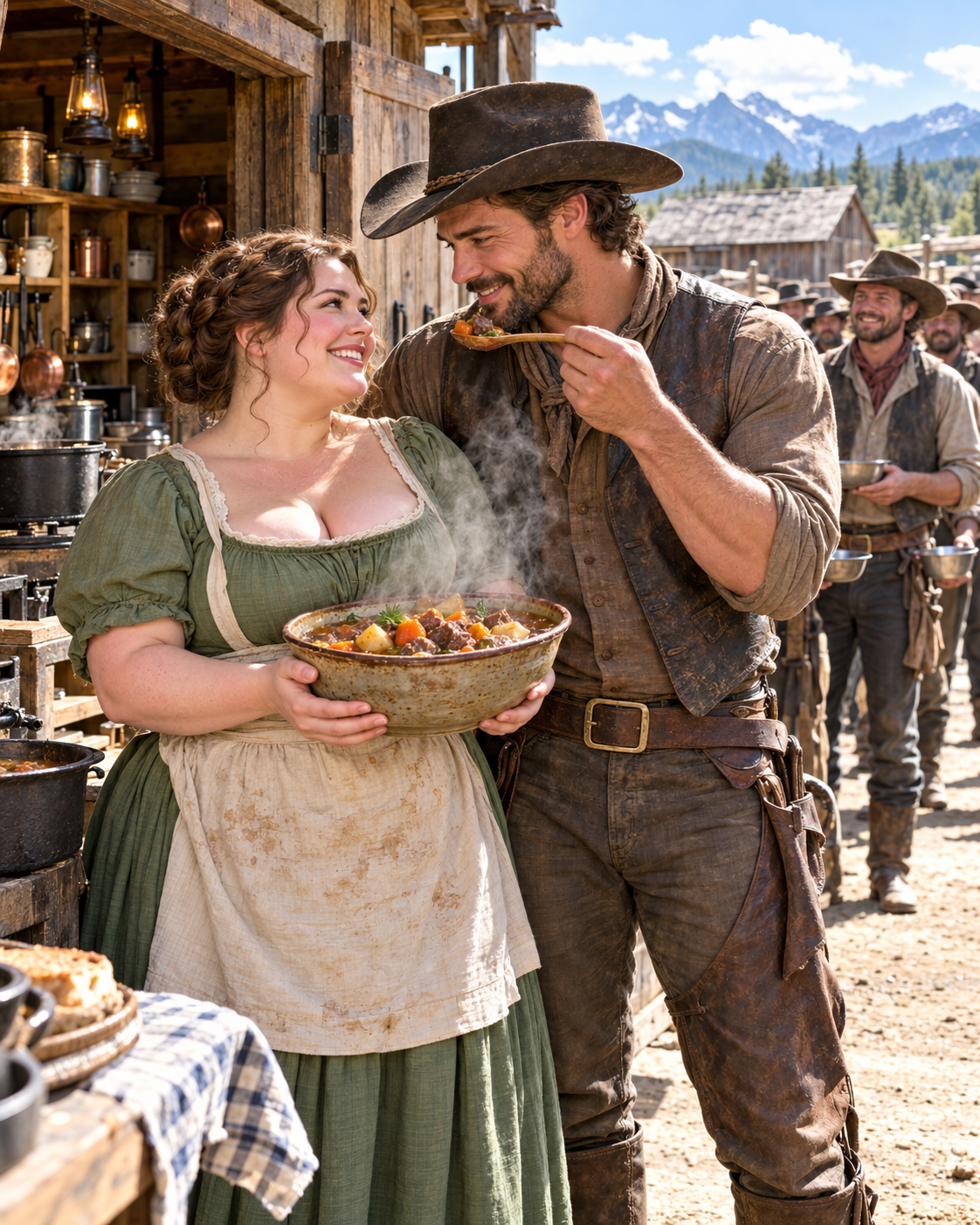
In the kitchen, fourteen men waited in unusual silence.
Grant stood beside the stove, his hat twisting between his hands.
“Mrs. Mercer, I’m sorry for how I treated you when you arrived.”
His apology caught me completely unprepared.
“I judged you before you spoke a word, and I reckon I’ve been wrong about plenty more.”
I studied his weathered face.
“Why are you telling me this now?”
He glanced toward the door.
“Because I knew your father.”
The room seemed to tilt beneath my feet.
“You knew him?”
Grant nodded.
“I was seventeen when he worked this ranch, and he was the first man who ever gave me an honest day’s wages.”
I pulled out a chair.
“Then sit down, Mr. Hollis, because you have a great deal to tell me.”
The other ranch hands quietly carried their plates outside.
Grant remained at the table, staring at his rough hands.
“Your father, Samuel Whitmore, was a good man, Mrs. Mercer, but goodness doesn’t always protect a man from greed.”
He explained that Samuel and Thomas had purchased Cedar Ridge together when the ranch consisted of little more than a barn and several hundred acres.
Samuel managed the accounts and livestock purchases.
Thomas negotiated cattle contracts and dealt with the bank.
For years, their partnership prospered.
Then a brutal winter killed nearly a third of their herd.
Money disappeared from the ranch accounts, and Thomas accused Samuel of taking it.
“My father would never steal,” I said.
“I know that.”
“Then why didn’t anyone defend him?”
Grant’s face reddened.
“Because the man who held the records told us Samuel was guilty.”
“Who?”
Grant looked toward the window.
“Silas Vane, the ranch bookkeeper.”
I recognized the name immediately.
Silas was the polished, silver-haired gentleman who had visited Ethan twice since my arrival.
He always smiled, spoke gently, and watched me with an attention I found uncomfortable.
“He’s still working here?”
“Not exactly,” Grant answered.
“He runs the bank in town now, and he still handles some of the ranch’s financial business.”
A chill passed through me.
“Does Ethan know what you’re telling me?”
“He knows Vane kept the books, but he doesn’t know everything I remember.”
“Why not?”
Grant lowered his head.
“Because I was afraid.”
His confession hung between us.
And for the first time, I understood that this ranch contained more than one person haunted by silence.
That afternoon, Ethan brought three heavy account ledgers into the parlor.
He placed them on the table and stepped backward.
“Everything I found is here.”
I examined the papers while he stood near the fireplace.
“I never knew your father personally,” he said.
“Mine told me Samuel stole from him and disappeared before the sheriff could arrest him.”
“My father didn’t disappear, Ethan.”
“I know.”
“He went home to Missouri, where he spent the rest of his life believing he had failed his family.”
Ethan’s face tightened.
“I was fourteen when he left, Clara, and I believed what my father told me.”
I opened the first ledger.
“Then why did you begin looking for me?”
He drew a long breath.
“After my father died, I discovered letters he’d hidden inside his desk.”
“What letters?”
“Some were from your father, asking for an independent examination of the accounts.”
I looked up sharply.
“And the others?”
Ethan swallowed.
“One was written by my father shortly before he died.”
He handed me a folded sheet of paper.
The handwriting was shaky, and several words had been crossed out.
At the bottom was a sentence that made my chest ache.
“I fear I condemned an innocent man because admitting the truth would have destroyed everything I owned.”
I pressed the letter against my knees.
“Your father knew?”
“I think he suspected.”
“And he did nothing?”
Ethan looked at the floor.
“Yes.”
Anger rose through me, sharp and hot.
“Then why didn’t you tell me when you found it?”
“Because I was ashamed of what my family might have done.”
“Shame doesn’t give you the right to hide another person’s inheritance.”
“I understand that now.”
I wanted to shout at him.
Instead, I asked the question that had been poisoning my thoughts.
“Did you marry me to keep the ranch?”
Ethan’s eyes filled.
“No, Clara, but I would be lying if I said the inheritance question never frightened me.”
His honesty hurt, yet it was the first thing that felt solid beneath my feet.
“I wrote because I wanted to meet the daughter of the man my family had wronged,” he continued.
“I thought I could help you without dragging you into everything that happened here.”
“And then?”
“Then your letters made me laugh again.”
His voice broke.
“You wrote about burning an entire batch of bread because you were reading a novel behind the pantry door.”
Despite myself, I remembered that letter.
“You said you once tried to milk a bull.”
“I was nine, and it was dark.”
A reluctant smile touched my lips before disappearing.
Ethan came no closer.
“Somewhere between your first letter and your arrival, I stopped thinking about making amends and started imagining a life with you.”
I looked at him for a long moment.
“Perhaps you did love me, Ethan, but you still let me enter this marriage without knowing the truth.”
He nodded.
“I did.”
“And I don’t know whether I can forgive that.”
He accepted those words without argument.
For the next several days, we lived like polite strangers.
I continued feeding the ranch hands, but I no longer joined Ethan at supper.
He never demanded my company.
Instead, he began helping with the morning chores before leaving for the pastures.
One evening, I discovered he had repaired the loose kitchen steps without mentioning it.
Another morning, he left fresh flour beside the stove after hearing me complain about the shortage.
I noticed every kindness.
But I refused to mistake kindness for accountability.
On the fifth morning, Silas Vane arrived in a shining black carriage.
He entered the cookhouse carrying a bouquet of white roses.
“My dear Mrs. Mercer, I hear you’ve brought remarkable improvements to Cedar Ridge.”
I wiped flour from my hands.
“Good morning, Mr. Vane.”
His smile never reached his eyes.
“I also understand you’ve discovered some unfortunate old papers.”
My stomach tightened.
“Have I?”
“Family disputes can become terribly unpleasant, especially when property is involved.”
I placed the rolling pin on the table.
“That depends on who has something to hide.”
His expression changed for a fraction of a second.
Then he chuckled.
“Your father was an emotional man, Mrs. Mercer, and his financial troubles were well documented.”
“Perhaps you could show me those documents.”
Silas straightened.
“I’m afraid the records are far too old.”
“Then how can you be certain?”
The smile disappeared.
“You would be wise not to disturb matters better left buried.”
I stepped toward him.
“My father is buried, Mr. Vane, but his name doesn’t have to remain there with the lies told about him.”
He left the roses on the table and walked out without another word.
That afternoon, I burned them in the stove.
The following day, a rider arrived from town carrying a letter addressed to Ethan.
I was preparing supper when I heard a crash from the ranch office.
I hurried down the hallway.
Ethan stood beside his desk, staring at the broken remains of a glass.
“What happened?”
He handed me the letter.
The bank demanded immediate repayment of an outstanding ranch loan.
Unless payment was received within thirty days, Cedar Ridge could be seized.
I looked up.
“Who signed this?”
“Silas Vane.”
My heart began pounding.
“How much does the ranch owe?”
Ethan gave me the figure.
It was enough to destroy everything the ranch hands depended upon.
“But we’ve never missed a payment,” he said.
“Vane claims the bank has found irregularities that allow him to demand the entire balance.”
I stared at the paper.
“How convenient.”
Ethan sank into his chair.
“If we lose Cedar Ridge, fourteen families could suffer.”
I thought of Samuel’s little sister, Walter’s medicines, and the men who had slowly become my friends.
Then I thought of my father, disgraced by financial records that someone else controlled.
“Silas is doing it again,” I whispered.
Ethan looked up.
“What?”
“He’s using a bank ledger to take away someone’s life.”
That night, I spread the old ranch accounts across the dining table.
I had managed boarding houses long enough to recognize when numbers had been made to tell a false story.
Money never simply vanished.
Someone recorded it, moved it, or deliberately concealed where it went.
Ethan sat beside me while I compared purchases, payments, and dates.
Hours passed.
The candles burned low.
Then I noticed something strange.
Several cattle sales recorded as losses appeared in a separate receipt book as profitable transactions.
I checked the dates.
They matched exactly.
“Ethan, look at this.”
He leaned closer.
“Those cattle were sold twice?”
“No, they were recorded twice, and the difference disappeared.”
We found four more entries bearing similar discrepancies.
All had been approved by Silas Vane.
Ethan stared at the figures in disbelief.
“These were my father’s accounts.”
“Yes, but the same handwriting appears in the newer ledgers.”
He reached for another volume.
Slowly, his face drained of color.
“He’s still doing it.”
Before midnight, we had uncovered years of suspicious payments and unexplained transfers.
Enough to warrant an investigation.
But there was one problem.
The records could establish financial misconduct without necessarily proving what happened to my father.
I sat back, exhausted.
“We need something that connects Silas to the original accusation.”
Grant, who had been listening from the doorway, suddenly spoke.
“I might know where to find it.”
Ethan turned.
“Grant?”
The older cowboy hesitated.
“Your father kept a locked strongbox beneath the office floorboards.”
“I searched that office after he died,” Ethan said.
“Not the new office.”
Grant looked toward the abandoned cabin beyond the north pasture.
“The original one.”
The next morning, Ethan, Grant, and I rode toward the cabin.
Wind swept across the grasslands, bending the golden stalks beneath a darkening sky.
The building stood crooked against the hills, its windows broken and roof sagging.
Inside, dust covered everything.
Grant knelt beside the old fireplace.
“Thomas moved the ranch office after Samuel left.”
He pried up a loose floorboard.
Beneath it sat a rusted iron box.
My heart hammered as Ethan lifted it into the light.
The lock broke beneath Grant’s hammer.
Inside were letters, receipts, and a small leather notebook.
I opened the notebook with shaking hands.
On the first page, someone had written the words, “Private records of S. Vane.”
For several minutes, I could barely breathe.
The pages contained dates, sums of money, and names of merchants who had received payments that never reached the official ranch accounts.
Near the middle was an entry from the year my father lost everything.
“Whitmore discovers discrepancy; Mercer informed; transfer remaining funds before examination.”
My eyes filled with tears.
“He knew my father discovered the missing money.”
Ethan turned the page.
There, written in the same deliberate hand, was another sentence.
“Thomas agrees Whitmore must leave before the bank learns the truth.”
Ethan staggered backward.
“My father helped him.”
Grant bowed his head.
“He knew something was wrong, son.”
For a long time, Ethan said nothing.
Then he whispered, “He let an innocent man take the blame.”
I rested a hand against the notebook.
“And my father carried that shame until he died.”
A floorboard creaked behind us.
We turned.
Silas Vane stood in the doorway, holding a revolver.
“Put the notebook down.”
His voice had lost every trace of its usual courtesy.
Ethan immediately moved in front of me.
“Silas, put the gun away.”
“Your father should have burned that box when he had the chance.”
Grant slowly raised his hands.
“You followed us.”
“I’ve spent twenty years protecting what belongs to me.”
I looked at the weapon, then at the bitter old man holding it.
“You stole from this ranch.”
Silas laughed without humor.
“I kept this ranch alive when two fools were too proud to understand business.”
“You destroyed my father’s reputation.”
“Your father discovered too much.”
The confession struck me like a physical blow.
Ethan took one careful step forward.
“Silas, everyone knows we came here, and the sheriff will hear what you’ve done.”
Silas raised the revolver higher.
“The sheriff won’t hear anything if this cabin catches fire with all of you inside.”
He reached toward a lantern beside the door.
Before he could touch it, a sharp crack sounded outside.
The horse tied beside the cabin reared violently, startled by thunder.
Silas glanced toward the window.
Grant lunged.
The gun fired.
For one terrible instant, the world seemed to stop.
Then Ethan cried out and collapsed against the wall.
“Ethan!”
I dropped beside him as blood spread across his upper arm.
Grant wrestled Silas to the floor, knocking the revolver beneath the fireplace.
I pressed my apron against Ethan’s wound.
“Look at me,” I begged.
His eyes opened.
“I’m all right.”
“Don’t you dare lie to me now.”
Despite his pain, a faint smile crossed his face.
Outside, hoofbeats thundered toward the cabin.
Two ranch hands appeared with the county sheriff, whom Ethan had asked to follow us at a distance in case the trip proved dangerous.
Within minutes, Silas Vane was bound and disarmed.
The sheriff collected the notebook and documents while Grant explained what had happened.
I barely heard them.
All I could see was Ethan’s pale face.
He reached for my hand.
“Clara, I’m sorry.”
Tears slipped down my cheeks.
“You can apologize when you’re well enough to annoy me again.”
His fingers tightened around mine.
For the first time since the truth came out, I held on.
Ethan survived.
The bullet had torn through the flesh of his upper arm without striking bone.
For two weeks, I changed his bandages, brought him soup, and endured his complaints about being trapped indoors.
Sometimes we spoke about the past.
Sometimes we simply sat together.
One evening, he took my hand.
“Clara, there’s something I need to say.”
I looked at him over my sewing.
“I’ve learned to be suspicious of sentences that begin that way.”
He smiled sadly.
“I’ve contacted an attorney in Cheyenne.”
My needle stopped moving.
“Why?”
“To have your father’s ownership interest formally recognized.”
I stared at him.
“Ethan, the ranch could lose everything to the bank.”
“The authorities are examining the loan documents, but even if Cedar Ridge is all I have left, half of it should have been yours.”
I studied his face.
“You’re willing to give up half your home?”
He shook his head.
“It was never entirely mine to give.”
Something inside me softened.
Not because he had found a perfect answer.
But because, at last, he was telling the truth even when it cost him something.
The investigation stretched into autumn.
Records recovered from Silas’s office revealed stolen ranch payments, falsified loans, and evidence that he had used his position at the bank to conceal years of fraud.
The bank’s directors suspended the foreclosure while independent examiners reviewed the accounts.
Silas was formally charged, though his eventual punishment would be decided in court.
Thomas Mercer’s old letters and Silas’s notebook also helped establish that my father had been falsely accused.
When the sheriff read the findings aloud in town, I stood beside Ethan in the courthouse.
Several men who had once believed Samuel Whitmore guilty lowered their eyes.
An elderly merchant approached me afterward.
“Your father helped my family survive a terrible winter,” he said.
“I should have spoken for him when people turned against him.”
I swallowed hard.
“Why didn’t you?”
The old man looked ashamed.
“Because I was frightened of losing my business.”
I thought of Ethan’s silence on the day I arrived.
Then I thought of Grant’s silence twenty years earlier.
And finally, I understood how easily wrongdoing could spread when decent people chose safety over courage.
“Fear can explain silence,” I told the merchant.
“But it doesn’t erase what silence costs.”
He nodded through tears.
That evening, I visited the small churchyard outside town.
I carried a handful of wildflowers and a copy of the statement clearing my father’s name.
There was no grave bearing his name in Wyoming.
He rested hundreds of miles away in Missouri.
Still, I knelt beneath the cottonwood trees and whispered into the wind.
“They know the truth now, Papa.”
For years, I had wondered whether my father had been disappointed in the life he left behind.
Now I knew he had endured humiliation to protect the daughter he loved.
“I wish you’d told me,” I whispered.
“But I understand why it hurt.”
Footsteps approached through the fallen leaves.
Ethan stood several feet away, holding his hat.
“May I join you?”
I nodded.
He knelt beside me.
For a long while, neither of us spoke.
Then Ethan placed a small silver pocket watch on the grass.
“My father kept this locked away.”
I recognized it immediately.
My father had carried it when I was little, letting me listen to its ticking while he told bedtime stories.
I opened the case.
Inside, scratched into the silver, were three words.
“For my Clara.”
My tears fell onto the glass.
“How did you find it?”
“It was among the belongings the attorney recovered from my father’s estate.”
Ethan’s voice trembled.
“I’m sorry it took so long to come home.”
I leaned against him and cried for the little girl who had lost her father, for the woman who had spent years believing herself unwanted, and for the love that had nearly been destroyed by secrets.
Winter arrived early that year.
Snow covered the pastures, and smoke rose from the cookhouse chimney every morning.
The bank withdrew its demand for immediate repayment after its review uncovered the fraudulent entries.
The old deed underwent legal examination, and my father’s ownership interest was eventually recognized, giving me a rightful stake in Cedar Ridge.
But the greatest change had little to do with the land.
One evening, I gathered the ranch hands around the dining table.
“I have something to tell you gentlemen.”
Grant leaned back in his chair.
“If you’re planning to stop making biscuits, Mrs. Mercer, I may have to find another job.”
Everyone laughed.
I smiled.
“Actually, I intend to make more biscuits, but I want to do something else as well.”
I explained my plan to expand the cookhouse into a proper kitchen and establish a small fund for ranch families facing illness or hardship.
No worker would have to choose between medicine and feeding his children.
And no hungry child would be turned away from my table.
Samuel stared at me with wide eyes.
“Even my sister, ma’am?”
“Especially your sister.”
Walter removed his spectacles and wiped them with a trembling hand.
Grant cleared his throat.
“My wages can help start the fund.”
One by one, the others offered what they could.
Some promised money.
Others offered labor, firewood, or supplies.
Ethan watched quietly from the doorway.
Later, when the last man had gone, he wrapped his arms around me.
“You’ve changed this place.”
I leaned against his chest.
“No, Ethan, I think these men were always capable of kindness.”
“They just needed someone to show them how.”
I shook my head.
“They needed someone willing to expect it from them.”
He kissed my forehead.
“And what about me?”
I turned to face him.
“You needed to learn that protecting the people you love sometimes means risking the peace you’ve grown comfortable with.”
He smiled sadly.
“I’ll spend the rest of my life remembering that.”
Months earlier, I might have accepted those words as another promise.
Now I had seen him speak before judges, surrender his claim to land, and face the ugliness of his family’s past.
He had not become perfect.
Neither had I.
But we had begun building something stronger than the beautiful letters that first brought us together.
We were building a marriage where difficult truths could finally be spoken.
On Christmas morning, fourteen ranch hands crowded into the dining room beneath garlands of evergreen.
Grant arrived carrying a wooden box wrapped in brown paper.
“This is for you, Mrs. Mercer.”
Inside was a beautifully carved sign.
He had worked on it for weeks, assisted by several of the younger men.
The words were simple.
“CLARA’S TABLE — THERE IS ALWAYS ROOM FOR ONE MORE.”
My throat tightened.
I looked around at the men who had once laughed at me.
Some were smiling.
Others looked embarrassed by their own tenderness.
Grant stepped forward.
“I know I can’t undo what I said when you arrived.”
“No,” I answered softly.
“You can’t.”
He lowered his eyes.
“But I hope I’ve become a better man since then.”
I placed a hand on his arm.
“That matters more than pretending it never happened.”
Across the room, Ethan was watching us.
His eyes shone.
Later that evening, when the house grew quiet, he led me onto the porch where our story had nearly fallen apart.
Snow drifted softly across the yard.
He took my hands in his.
“Clara, I know our marriage began with a truth I should have told you.”
I nodded.
“And I know love doesn’t erase what I did.”
“No,” I whispered.
“It doesn’t.”
He reached into his coat and withdrew a small velvet box.
Inside lay a plain gold wedding ring.
The one I wore had been purchased before I knew the truth.
“This time,” he said, “I want you to have a choice.”
My heart began to pound.
“I am not asking you to forget the past, or to stay because of a deed, a promise, or a name.”
He lifted the ring toward me.
“I’m asking whether you would choose to be my wife, knowing everything you know now.”
Tears filled my eyes.
I thought of the frightened woman who had arrived with a battered suitcase and a desperate hope of belonging.
She had believed that being loved meant being accepted despite her size, her age, or the judgments of strangers.
But the truth was deeper.
Love was not a reward for becoming smaller, quieter, or easier to please.
Love was the freedom to stand fully in one’s own worth and still reach for another person’s hand.
I looked into Ethan’s eyes.
“Yes,” I whispered.
“But this time, we begin with the truth.”
He slid the ring onto my finger.
Then he kissed me beneath the falling snow, gently enough to feel like a question and warmly enough to feel like home.
In the spring, we planted an apple tree beside the cookhouse in memory of my father.
Beneath it, Ethan placed a small wooden marker.
“Samuel Whitmore — His Good Name Restored.”
I stood beside him as the first green leaves trembled in the wind.
“Do you think he would have forgiven your father?” Ethan asked.
I considered the question carefully.
“I don’t know.”
He looked down.
“But I think he would have wanted us to make something better from what they left behind.”
Ethan took my hand.
Together, we watched the ranch hands laughing in the yard while children chased one another between the fences.
Cedar Ridge was no longer the place where I had arrived as an unwanted stranger.
It was a place where people were learning that respect could not be measured by appearance, wealth, or the power a person held over others.
And sometimes, when the evening wind moved through the apple tree, I imagined my father’s voice telling me how proud he was.
I never became the small, delicate woman those ranch hands might have expected.
I remained Clara Whitmore Mercer, broad-hipped, strong-handed, stubborn, and entirely unwilling to apologize for the space I occupied.
I had come to Wyoming hoping someone would finally choose me.
Instead, I learned that the most important choice had always been my own.
I could choose dignity over shame, courage over silence, and forgiveness without surrendering the truth.
And on the day our first apple blossoms opened, Ethan wrapped his arms around my waist and whispered something I would carry for the rest of my life.
“You were never too much, Clara.”
I turned in his embrace as sunlight spilled across the hills.
“You were simply waiting for a place where nobody asked you to be less.”
I smiled through my tears.
Then I looked toward the cookhouse, where fourteen men were already gathering for supper, and understood what home truly meant.
It wasn’t the land beneath our feet, the name written on a deed, or even the vows we had spoken.
It was the place where truth could stand in the open, where kindness became a daily choice, and where nobody had to earn the right to belong.
And for the first time in my life, I wasn’t afraid of taking up space.
Because I finally knew I deserved every inch of it.
THE END.