The men at Mercer Creek Ranch had seen drifters come and go before, but none of them looked quite like the woman who walked through the gate that dusty afternoon.
Mabel placed one finger beside a faded line of handwriting near the bottom of the survey.
“This one,” she said.
Everett Crowley did not move.
The paper had been filed forty-three years earlier, when Silas’s father was still a young man and most of the county roads were little more than wagon tracks. It showed Mercer Creek not merely as a stream crossing the ranch but as part of a recorded water easement attached permanently to the Mercer parcel.
Crowley recovered quickly. “Old filings get superseded.”
“Sometimes,” Mabel replied.
She removed another document from the folder.
“But not by a survey that references the wrong section number.”
The county deputy nearest her frowned and leaned over the hood.
Crowley reached for the paper. Mabel placed her palm across it before he could take it.
“You can look,” she said. “You don’t get to carry it away.”
Silas said nothing, but Mabel could feel the tension in him.
For three days, Crowley had been applying pressure through letters, courthouse notices, and men who appeared near Mercer Creek claiming to be conducting measurements. Silas had slept little. Nearly four hundred head of cattle depended on that water, and autumn had already dried most of the smaller ponds across the range.
Crowley looked toward the man with the leather case.
“Mr. Bell?”
The man cleared his throat. “The county’s current plat map still shows the disputed channel outside the Mercer water allocation.”
“Current map,” Mabel said. “Yes.”
She pulled out a third page.
“This is the map it was copied from.”
The page was newer than the first but older than the county map. A red pencil mark ran along the edge of the creek.
“The copying error happened in 1898. Whoever redrew the parcel shifted the section line east by nearly two hundred feet. Every map after that repeated the mistake.”
Crowley smiled again, though there was less confidence in it.
“A pencil mark isn’t law.”
“No,” Mabel said. “But the original deed is.”
Silas finally looked at her.
She had not told him about the deed.
Mabel took a breath and opened the weathered folder all the way.
Inside lay a folded sheet with a cracked county seal.
She had found it in a box of tax receipts stored beneath the stairs in the Mercer house. Silas’s mother had saved everything—feed invoices, veterinary bills, land assessments, even handwritten correspondence from a surveyor who had worked for the county in the 1880s.
The deed referenced a stone marker at the western bend of Mercer Creek.
Mabel had gone looking for it before dawn the previous Saturday.
Buried under brush and half covered by soil, the stone was still there.
So were the initials carved into its face.
Crowley’s jaw tightened.
“You’ve been trespassing beyond Mercer’s legal boundary.”
Mabel looked him directly in the eye.
“No. I was standing on it.”
For a moment nobody spoke.
Wind moved through the cottonwoods along the creek.
A horse stamped near the corral.
Then Crowley laughed.
It was a short, humorless sound.
“You think this changes anything? County records recognize the modern plat. Mercer can spend two years arguing over an antique deed while his cattle die in two months.”
There it was.
Not a denial.
A threat.
Silas stepped forward, but Mabel caught his sleeve.
Crowley noticed.
“I’ll make the same offer,” he said. “Sell me the western acreage and sign over the creek access. I’ll allow Mercer Ranch continued water use for five years.”
“Allow?” Silas said.
Crowley ignored him.
“Five years is generous. After that, perhaps we’ll negotiate.”
Silas’s face reddened.
“My father watered cattle from that creek before you learned to spell your own name.”
“And your father is dead,” Crowley replied.
The words changed the air.
One of the ranch hands near the barn muttered something under his breath.
Mabel spoke before Silas could.
“Then you won’t mind explaining this to Judge Harland.”
For the first time, Crowley’s confidence slipped visibly.
“You haven’t filed anything.”
“Not yet.”
Mabel gathered the documents.
“But the courthouse opens at eight tomorrow.”
Crowley stared at her for several seconds, then closed his leather case.
“You’re making a mistake, Miss Whitlock.”
“I’ve seen this mistake before,” she said. “That’s why I’m not making it again.”
He climbed into the automobile without another word.
The deputies followed more slowly.
Before the second deputy entered the car, he turned to Mabel.
“Bring originals tomorrow,” he said quietly.
Then they drove away.
Silas waited until the automobile disappeared beyond the ridge.
“How long have you known?”
“About the deed? Three days.”
“And you didn’t tell me?”
“I wasn’t sure it would hold.”
He looked hurt rather than angry.
“I thought we were standing together in this.”
“We are.”
“Standing together generally means telling the other person where the ground is.”
Mabel accepted the rebuke.
“You’re right.”
Silas exhaled and rubbed a hand across his gray beard.
Then his voice softened.
“Did your brother have papers like these?”
Mabel looked toward the creek.
“No.”
That answer carried more weight than anything else she could have said.
Her brother Thomas had been twenty-eight when he bought forty acres in Nebraska. He had planted corn, built a house with his own hands, and believed hard work was enough protection for an honest man.
It wasn’t.
A neighboring company challenged his road access. Then came a revised survey. Then legal fees. By the time Thomas understood that the dispute was designed to exhaust him rather than defeat him outright, he had borrowed against the farm to pay attorneys.
He lost the farm anyway.
Six months later, he was working in a grain warehouse in Omaha.
Mabel had never forgotten the day he handed over the keys.
“I kept thinking,” she told Silas, “that if one of us had understood the paperwork sooner, maybe things would’ve been different.”
Silas nodded.
“Then tomorrow we make it different.”
They reached the courthouse shortly after sunrise.
By eight o’clock, Crowley was already there.
That worried Mabel.
Men like Everett Crowley did not arrive early unless they believed the morning belonged to them.
Judge Nathaniel Harland was not holding formal court that day, but the dispute had grown serious enough for the county clerk to arrange an emergency hearing in a narrow upstairs room.
Crowley brought an attorney from Cheyenne named Walter Pryce.
Silas brought Mabel.
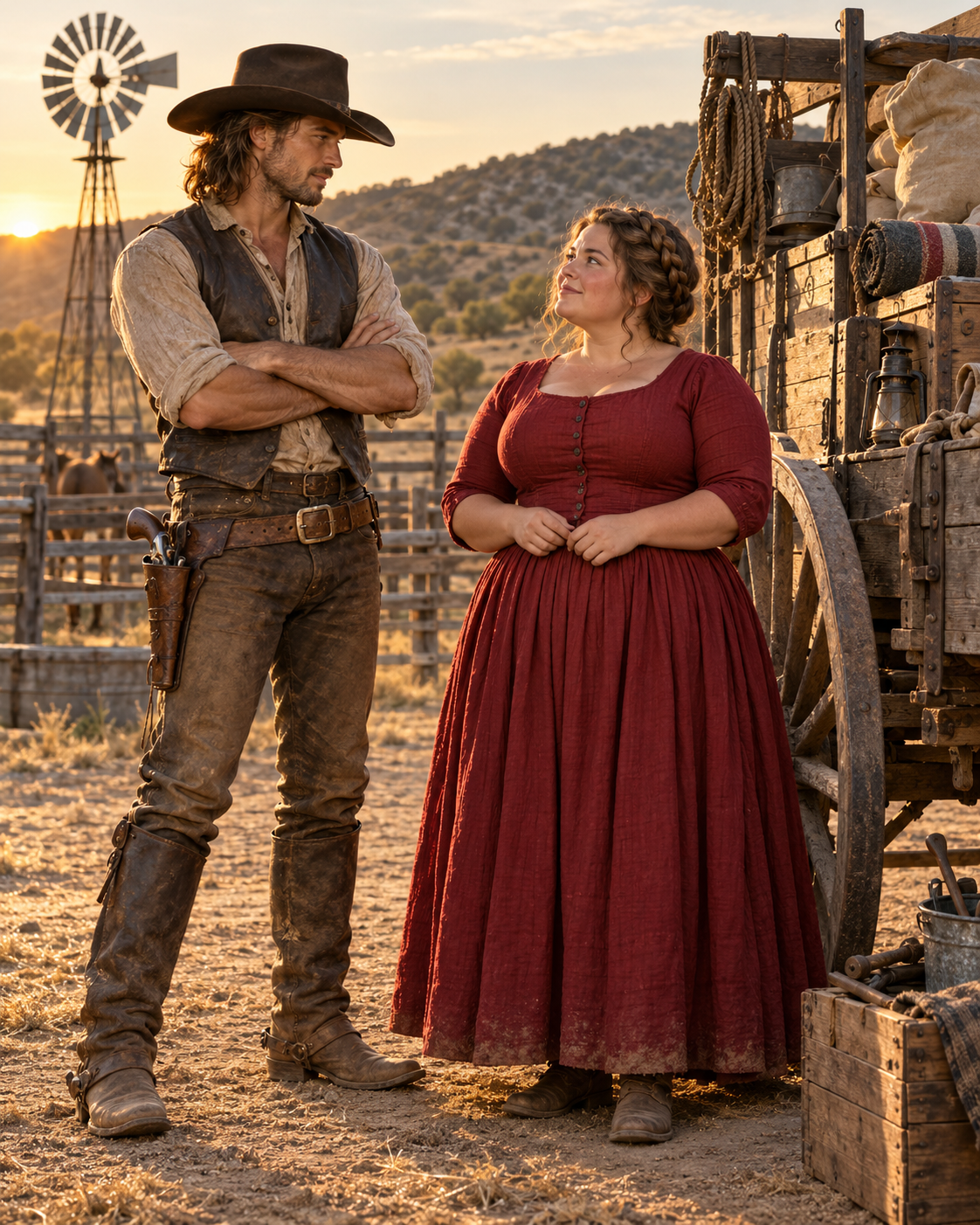
Pryce noticed immediately.
“Mr. Mercer,” he said, “is Miss Whitlock your legal counsel?”
“No.”
“Then perhaps she should wait outside.”
Silas pulled out a chair.
“She stays.”
Judge Harland entered ten minutes later.
He was a thin man with silver spectacles and the tired expression of someone who had spent three decades listening to neighbors argue about fences.
Pryce presented Crowley’s case first.
The modern county plat showed the western branch of Mercer Creek crossing a parcel recently purchased by a development company represented by Crowley. Under the map, Mercer Ranch possessed no independent right to divert water beyond a limited livestock allowance.
If enforced immediately, the ranch’s irrigation channel could be closed.
Mabel listened without interruption.
Then Judge Harland turned to Silas.
“Mr. Mercer?”
Silas nodded toward her.
“Mabel.”
She stood.
Pryce objected immediately.
“She is not counsel.”
“No,” Judge Harland said, “but she can testify to what she found.”
Mabel placed the original deed, historical survey, tax records, and photographs of the boundary stone on the table.
Then she explained the chain.
One document at a time.
No theatrics.
No accusations.
Only dates.
Measurements.
Names.
The longer she spoke, the quieter the room became.
The 1898 map contained the error.
A 1903 tax assessment still described the original boundary.
A 1911 irrigation filing referenced the Mercer easement.
A 1926 county road survey referenced the same stone marker Mabel had photographed.
Four separate records, created decades apart, supported the same boundary.
Crowley’s attorney began flipping through his papers faster.
Then Mabel produced one final item.
A certified copy of a transaction filed only six months earlier.
Crowley’s development company had purchased the neighboring parcel using a legal description that referenced the old stone boundary.
Judge Harland looked over his spectacles.
“Mr. Pryce, your client’s own purchase description appears to recognize the boundary Miss Whitlock describes.”
Pryce stood.
“We’ll need time to examine that.”
Crowley whispered sharply in his ear.
Mabel watched them.
Something was wrong.
Crowley looked angry, but not frightened.
He should have been frightened.
Instead, he seemed to be calculating.
Judge Harland issued a temporary order preventing either party from altering the creek or irrigation channels until the title question could be formally resolved.
It was not victory.
But Mercer Creek would keep flowing.
Outside the courthouse, Silas allowed himself a smile.
“You did it.”
“Not yet.”
“What are you seeing?”
“Crowley expected that hearing to go badly.”
Silas frowned.
“He looked ready to bite through the table.”
“Not the same thing.”
Mabel turned toward the courthouse windows.
“He came prepared for another move.”
They discovered it two nights later.
At half past one in the morning, a ranch hand named Eli knocked violently on the Mercer house door.
“Creek’s dropping.”
Mabel was out of bed in seconds.
By lantern light, they rode west.
The water level had fallen nearly a foot.
Upstream, beyond the disputed boundary, someone had constructed a temporary dam from timber, canvas, and packed earth.
Silas swore.
“He can’t do this. The judge ordered—”
“Crowley knows.”
Which meant Crowley either believed nobody could prove he was responsible or didn’t care.
They followed wagon tracks from the dam toward the northern road.
The tracks disappeared where the ground turned rocky.
But Mabel found something else.
A broken brass button beside a cottonwood.
Stamped into its face were the letters C.L.S.C.
Crowley Land Survey Company.
Silas wanted to ride directly into town.
Mabel stopped him.
“If we accuse him tonight, he says somebody stole a button.”
“So we let him drain us dry?”
“No.”
She turned to Eli.
“Wake everyone.”
Before sunrise, Mercer Ranch was working like an army.
The men dismantled only the portion of the obstruction necessary to restore natural flow, careful not to disturb the surrounding tracks. Mabel photographed the structure with a borrowed camera. Eli rode to fetch the deputy who had quietly advised her at the ranch.
By eight o’clock, Deputy Warren stood at the dam.
He examined the tracks, the button, and the timber.
“You recognize this lumber?” Mabel asked.
He did.
A construction yard in town had sold a large load of identical cut pine two days earlier.
The buyer was Crowley Land Survey Company.
That afternoon, Crowley was summoned back to court.
He denied ordering the dam.
His attorney called the evidence circumstantial.
Then a young man named Daniel Rusk walked into the sheriff’s office.
Rusk worked for Crowley’s survey crew.
He was nineteen.
And terrified.
Crowley had ordered him and three others to build the obstruction after midnight.
“Why come forward?” Deputy Warren asked.
Rusk stared at the floor.
“Mr. Crowley said nobody would lose anything. He said the ranch was already his, legally speaking.”
He swallowed.
“But when we blocked the water, there were cattle standing downstream. I kept thinking what would happen if the creek stayed dry.”
Crowley was charged with violating the court order and interfering with a recognized waterway.
Still, he did not surrender.
Instead, he attacked Mabel.
Within a week, stories began circulating through town.
She was a drifter.
A fraud.
A woman pretending to understand law.
Crowley suggested she had planted the brass button.
Someone told the newspaper that Mabel had been dismissed from a previous ranch for theft.
None of it was true.
Some people believed it anyway.
At the general store, conversations stopped when she entered.
At church, two women moved to another pew.
Mabel pretended not to notice.
But Silas did.
“You can leave,” he told her one evening.
They were sitting on the porch as the first snow clouds gathered beyond the mountains.
She looked at him.
“That sounds like firing.”
“It isn’t.”
“Then what is it?”
“Permission.”
“For what?”
“To decide this isn’t your fight.”
Mabel looked across the dark pasture.
“That’s how people like Crowley win.”
Silas waited.
“They make the cost of standing up higher than the cost of walking away,” she continued. “Most people aren’t cowards. They’re tired. They’ve got families. Bills. Crops. Animals. They can’t spend every morning at a courthouse.”
Silas nodded slowly.
“My brother couldn’t.”
“And you think staying here fixes what happened to him?”
“No.”
Her answer surprised him.
“Nothing fixes that.”
She looked toward Mercer Creek, silver beneath the moonlight.
“But maybe it means I learned something from it.”
The formal land hearing began three weeks later.
By then, winter had reached the county.
Snow covered the courthouse steps.
Ranchers came from fifty miles away to watch.
Crowley had enemies.
He also had friends.
More importantly, he had money.
His attorney challenged every document Mabel had found.
He questioned the stone marker.
He questioned the surveys.
He questioned whether decades of water use could establish rights when modern records suggested otherwise.
For two days, the arguments went back and forth.
On the third morning, Pryce introduced a surprise witness.
An elderly former county clerk named Samuel Dodd.
Dodd claimed the 1898 map had not contained an accidental error.
According to him, Silas’s grandfather had privately agreed to shift the boundary in exchange for grazing rights.
There was no signed agreement.
But Dodd claimed he had seen one as a young clerk.
Crowley’s side suddenly had a story explaining everything.
Silas leaned toward Mabel.
“Can he sink us with that?”
“If the judge believes him.”
Dodd appeared credible.
He remembered names.
Dates.
Old county officials.
Under questioning, he described the supposed agreement in convincing detail.
Then Mabel noticed his hands.
He kept rubbing his thumb against the side of his index finger.
She had seen that habit before.
Her brother used to do it while trying to remember numbers.
Not when he was lying.
When he was trying to repeat something exactly.
Mabel wrote three words on a scrap of paper and slid it to Silas.
Ask about winter.
Silas looked confused.
But when his turn came to question Dodd, he followed her advice.
“You said the agreement was signed in February of 1898?”
“Yes.”
“At the Mercer ranch?”
“Yes.”
“You rode there?”
“I did.”
“What was the weather?”
Pryce objected.
Judge Harland allowed the question.
Dodd hesitated.
“Cold.”
“Snow?”
“Some.”
“How much?”
“I couldn’t say.”
Silas looked at Mabel.
She handed him a county ledger.
The winter of 1898 had brought the worst blizzard in thirty years.
From January 28 through February 19, the road between town and Mercer Ranch had been officially closed.
Three people had died attempting the journey.
Silas asked Dodd again.
“You rode twelve miles through that?”
The old man stared at the ledger.
His thumb stopped moving.
“I may have remembered the month incorrectly.”
Now Mabel stood.
“Do you remember where the agreement was kept?”
Dodd looked at Pryce.
Judge Harland told him to answer.
“The county archive.”
“Which building?”
“The old courthouse.”
Mabel opened another record.
The old courthouse had burned in 1901.
Nearly every land agreement stored there was destroyed.
Conveniently, Dodd’s alleged document could never be produced.
Then she asked the question that ended it.
“Mr. Dodd, when did Mr. Crowley first contact you?”
Silence.
Pryce objected.
The judge overruled him.
Dodd’s shoulders collapsed.
“Last month.”
“And did he tell you the date of the supposed agreement?”
Another silence.
“Yes.”
The courtroom erupted in whispers.
Judge Harland called for order.
Dodd was not arrested that day.
But his testimony was ruined.
Crowley’s face had gone pale.
Mabel thought the fight was finally over.
She was wrong.
At noon, while the courthouse recessed, Crowley found her alone near the rear stairwell.
“You enjoy this?”
“No.”
“You’ve made yourself very important to Mercer.”
“This isn’t about being important.”
“Everything is about being important to someone.”
He stepped closer.
“I checked into your brother.”
Mabel’s expression changed.
Crowley smiled.
“Thomas Whitlock. Nebraska.”
She said nothing.
“He didn’t merely lose his farm, did he?”
Mabel felt cold.
Crowley continued.
“He signed it away.”
“He was cornered.”
“He signed.”
“He had debts because men kept dragging him into court.”
“Still signed.”
Crowley leaned closer.
“You’ve spent years telling yourself someone stole that farm because the alternative is admitting your brother gave up.”
Mabel’s hand tightened around the stair rail.
For one terrible second, she was back in Nebraska watching Thomas place his keys on a lawyer’s desk.
Crowley saw the pain in her face and mistook it for weakness.
“He quit,” Crowley said.
Mabel looked at him.
Then she understood something she should have understood long before.
Crowley believed endurance and justice were the same thing.
If a person could be exhausted into surrender, then in Crowley’s mind the surrender made the theft legitimate.
That was the principle beneath everything he did.
Mabel’s voice was steady when she answered.
“My brother signed because you can make a man choose between losing his land today and losing his family slowly.”
Crowley’s smile faded.
“That doesn’t make people like you right.”
She walked back into the courtroom.
That afternoon, Judge Harland ruled.
The original Mercer deed remained controlling.
The historical surveys, tax assessments, irrigation filings, physical boundary marker, and Crowley’s own recent purchase documents all supported the Mercer claim.
The modern plat contained a copying error.
Mercer Creek Ranch retained its water easement.
Crowley’s neighboring parcel had no authority to block, divert, or restrict the ranch’s established access.
Silas closed his eyes.
Eli slapped another ranch hand on the shoulder.
Someone in the back of the courtroom began applauding before the judge demanded silence.
Mabel remained seated.
She had imagined victory feeling larger.
Instead, it felt quiet.
Like a door finally closing.
Outside, snow was falling.
Crowley passed her on the courthouse steps accompanied by his attorney.
He stopped only once.
“This county will forget you.”
“Probably.”
“You’ll leave eventually.”
“Probably.”
Crowley studied her, searching for anger and finding none.
Mabel looked toward Silas and the ranch hands waiting beside the wagon.
“But Mercer Creek will still be there.”
Crowley walked away.
The criminal case over the illegal dam continued separately. Daniel Rusk testified. So did the lumber merchant. Crowley eventually paid a substantial fine and lost his surveying license in the county.
Within a year, he moved west.
People told different stories about where he went.
Mabel never cared enough to find out.
Spring returned slowly.
Snow melted from the foothills, filling Mercer Creek until it ran fast and clear through the ranch.
Calves appeared across the pasture.
Grass returned.
Fence repairs began again.
Life became ordinary.
Mabel discovered she liked ordinary more than she expected.
One afternoon, nearly a year after she had first walked through the Mercer gate, Silas found her repairing a ledger at the kitchen table.
He placed a document in front of her.
She looked down.
It was a partnership agreement.
Mabel stared at him.
“What’s this?”
“You can read.”
“I can.”
“Then read.”
The agreement granted her a share of Mercer Creek Ranch.
Not wages.
Not a temporary managerial bonus.
Ownership.
She pushed the paper back.
“No.”
Silas raised an eyebrow.
“No?”
“I didn’t do all this for land.”
“I know.”
“Then why?”
“Because a ranch shouldn’t belong only to the people whose names happened to be on it first.”
She looked at him.
Silas pulled out a chair.
“My father built part of this place. I built part. Eli built part. Those men out there built part. You saved the water that keeps all of it alive.”
He tapped the agreement.
“Ownership ought to follow responsibility sometimes.”
Mabel read the document again.
Her eyes stopped at the description of the western boundary.
It referenced the old stone marker beside Mercer Creek.
She smiled.
“You had this drawn up correctly?”
“I’ve learned to fear inaccurate paperwork.”
She laughed.
It was one of the few times Silas had heard her do so.
She signed.
Years later, travelers passing through the county would sometimes hear the story of Mercer Creek Ranch.
Depending on who told it, the story changed.
Some said Mabel Whitlock was a legal genius.
Others claimed she had discovered a secret deed hidden in a wall.
A few insisted she had faced Everett Crowley in the road with a rifle, which never happened but improved every time the story was repeated.
The truth was less dramatic and more important.
Mabel had paid attention.
She had read what others ignored.
She had measured what others assumed.
She had preserved records when someone else depended on confusion.
And when pressure came, she had refused to confuse exhaustion with defeat.
Years after Crowley left, Mabel traveled to Nebraska.
She found her brother living outside Omaha with his wife and two daughters.
Thomas had never bought another farm.
For years, Mabel had imagined telling him everything—how she had beaten a man like the ones who took his land, how she had saved a ranch, how she had finally won the fight they once lost.
When the moment came, none of that seemed necessary.
They sat together on his porch after supper.
Thomas asked whether she was happy.
Mabel looked across the small garden his daughters had planted.
“Yes.”
He smiled.
“Then you did better than I did.”
Mabel shook her head.
“No.”
Thomas looked at her.
“You taught me what happens when decent people don’t know the rules being used against them.”
“That doesn’t sound like much of a gift.”
“It was enough.”
He was quiet for a moment.
“I always thought you blamed me.”
“For losing the farm?”
He nodded.
Mabel looked at her brother carefully.
“I blamed the people who knew exactly how tired you were and decided that made you easy to take from.”
Thomas stared at the ground.
Then she added, “But I spent too many years thinking saving someone else’s land might somehow change what happened to yours.”
“Did it?”
“No.”
She smiled.
“It changed what happened next.”
When Mabel returned to Wyoming, Mercer Creek was shining beneath the late-summer sun.
Silas was waiting near the gate.
“You staying this time?” he asked.
Mabel looked across the pasture, the cattle, the cottonwoods, and the creek that had nearly been taken by a line drawn in the wrong place on a forgotten map.
“I think so.”
Together they rode toward the ranch house.
Behind them stood the weathered boundary stone, still half buried beside the water.
Mabel never had it moved.
She never had it polished.
She never replaced it with anything newer.
To anyone passing by, it looked insignificant.
But that was precisely why she kept it.
Because the greatest threats to ordinary people rarely announce themselves with gunfire or thunder.
Sometimes they arrive quietly, inside a contract nobody reads, on a map nobody checks, beneath a signature made by someone who is too tired to keep fighting.
And sometimes protection begins just as quietly—with one person willing to look closer, ask one more question, and refuse to walk away merely because someone powerful expects them to.
Mercer Creek endured not because Silas Mercer was stronger than Everett Crowley.
It endured because knowledge had finally stood beside courage.
And Mabel Whitlock had learned that defending what matters does not always mean holding on to the past.
Sometimes it means understanding the past well enough to make certain the future does not repeat it.
For a while, Mabel believed that was where the story ended.
Crowley was gone. Mercer Creek was safe. The cattle had water, the deeds were corrected, and the county finally recognized the boundary that should never have been questioned in the first place.
But land had a long memory.
And so did people.
Two years after Everett Crowley left the county, Mercer Creek Ranch had changed in ways Mabel could not have imagined when she first arrived carrying a single worn bag.
The herd had grown.
The north pasture had been repaired.
A new irrigation gate stood where the old timber diversion had nearly failed years earlier.
Silas had added a second barn, and Eli now supervised most of the younger hands.
Mabel kept the books, managed the range, handled land filings, and still rode fences herself whenever she felt people were becoming too comfortable with the idea that paperwork alone could protect a ranch.
Silas teased her about it.
“You know,” he told her one morning, “most owners eventually stop fixing fence posts.”
“Then most owners eventually stop knowing which fence posts need fixing.”
He had no answer to that.
The county had changed too.
After the Mercer dispute, ranchers began checking old deeds and water agreements that had gone unread for decades. Some discovered mistakes. Others discovered rights they had never known they possessed.
The courthouse started keeping duplicate land records in a fireproof room.
Judge Harland pushed for new survey standards.
Even Deputy Warren claimed the county had become more careful about property disputes.
“It only took nearly destroying one ranch,” he told Mabel.
“People learn slowly.”
“They learn faster when money is involved.”
“That too.”
The most unexpected change came from outside Mercer Creek.
Letters began arriving.
At first there were only one or two.
A widow in Colorado whose neighbor claimed part of her grazing land.
A farmer in Kansas who had received a notice about a road easement he did not understand.
A family in Nebraska fighting over irrigation rights.
None of them knew Mabel personally.
They had simply heard about the woman at Mercer Creek who had stopped a land agent with old records and patience.
Mabel answered every letter she could.
She never pretended to be an attorney.
Instead, she told people what questions to ask.
Find the oldest deed.
Compare legal descriptions.
Check tax records.
Look for survey markers.
Do not sign anything under pressure.
Do not assume a government map is correct merely because it is newer.
And above all, do not wait until someone else defines the problem for you.
Silas noticed how much time she spent at the kitchen table at night.
“You’re running half the West from that chair.”
“Only the confused half.”
“That is half the West.”
Then, one October afternoon, a letter arrived that Mabel did not answer immediately.
The envelope came from Montana.
The handwriting belonged to Daniel Rusk.
Mabel remembered him instantly.
The nineteen-year-old survey hand who had helped build Crowley’s illegal dam.
The young man who had later walked into the sheriff’s office and told the truth.
Daniel was older now.
He had become a licensed surveyor.
His letter was short.
Miss Whitlock,
I don’t know whether you remember me.
I do.
I am writing because I was offered work by a company purchasing ranch land outside Helena. They are paying well, but I believe they are doing the same kind of thing Mr. Crowley did.
They buy small parcels, challenge neighboring boundaries, and force families into settlements.
I have seen three surveys I believe were intentionally drawn to create disputes.
I don’t know what to do.
If I quit, someone else will do the work.
If I stay, I may become part of it.
I thought you might understand.
Daniel Rusk
Mabel read the letter twice.
That night she sat on the porch long after everyone else had gone to bed.
Silas eventually joined her.
“You’ve got the look.”
“What look?”
“The one that usually costs me money.”
She handed him the letter.
He read it slowly.
“What are you going to tell him?”
“I don’t know.”
“That would be a first.”
She ignored the remark.
“I can tell him to quit.”
“Would that help?”
“Maybe.”
“Would it stop the company?”
“No.”
Silas handed the letter back.
“Then perhaps that’s not the question.”
Mabel understood.
She wrote Daniel the next morning.
She told him not to destroy anything.
Not to steal.
Not to accuse anyone publicly without proof.
She told him to preserve copies of every survey he was legally entitled to access, document every correction request, and keep careful notes of who gave which instructions.
Then she told him to speak to an attorney and, if warranted, the proper authorities.
At the bottom, she added one sentence.
Leaving keeps your hands clean.
Staying long enough to tell the truth may keep someone else’s land from being stolen.
Daniel stayed.
Six months later, a state investigation began.
The company collapsed under evidence of fraudulent surveys, intimidation, and coordinated attempts to force ranchers into selling.
Several men went to prison.
Daniel testified.
Years later, he became county surveyor.
When he wrote Mabel again, he enclosed a photograph of himself standing beside a newly installed stone boundary marker.
On the back he had written:
This one is where it belongs.
Mabel kept the photograph in her desk.
By then, Silas was getting older.
He would never admit it.
His knees bothered him in winter.
He spent more time on the porch and less time on horseback.
One spring morning, he tried mounting a horse and nearly fell.
Mabel caught the reins before he hit the ground.
Silas looked furious.
“Don’t.”
“Don’t what?”
“Look at me like that.”
“Like what?”
“Like I’m old.”
“You are old.”
“I hired you for your tact.”
“You hired me because your irrigation pipe was broken.”
He laughed despite himself.
But the truth could not be avoided.
Time was moving.
One evening, Silas called Mabel, Eli, and the senior ranch hands into the house.
On the table lay several legal documents.
Mabel recognized the format immediately.
A succession agreement.
Silas had reorganized Mercer Creek.
Part of the land would remain with his extended family.
Part would belong to Mabel.
Long-serving ranch hands would receive profit shares.
A portion along the creek would be placed under permanent conservation restrictions so no future owner could sell away the water access independently from the ranch.
Mabel read the clause twice.
“You did this because of Crowley.”
“I did this because of us.”
Silas leaned back.
“A ranch is vulnerable when everything depends on one owner making one good decision after another forever. That’s not realistic.”
Eli smiled.
“You’ve finally admitted you make bad decisions.”
“I hired you.”
The room laughed.
Then Silas became serious.
“What happened here shouldn’t depend on another Mabel Whitlock showing up at the right time.”
That sentence stayed with her.
They signed the agreement the following week.
Silas died four years later.
He went quietly in his sleep after an ordinary day.
He had inspected calves in the morning, complained about the price of feed at noon, argued with Eli about a broken wagon wheel in the afternoon, and eaten two pieces of apple pie after supper despite claiming he wanted only one.
Mabel found him the next morning.
For the first time in years, she did not know what to do.
She had faced courts.
Threats.
Fraud.
Drought.
Bad winters.
Injured cattle.
Broken equipment.
None of those things prepared her for a silent chair on an empty porch.
The funeral drew nearly the entire county.
Judge Harland came, older and walking with a cane.
Deputy Warren came.
Daniel Rusk traveled down from Montana.
Families Mabel barely knew arrived because Silas had once lent them cattle, repaired a fence, cosigned a loan, or simply refused payment when times were hard.
Thomas came from Nebraska with his daughters.
After the burial, Mabel stood beside the Mercer family plot looking toward the hills.
Thomas joined her.
“You going to stay?”
“That question follows me around.”
“You never answer it.”
Mabel looked toward the ranch house.
“Yes.”
Thomas smiled.
“Good.”
“But differently.”
That summer, Mabel made the biggest change Mercer Creek had seen in decades.
She opened a small office in one of the unused buildings near the main road.
Above the door, she hung a simple wooden sign.
MERCER LAND & RANGE RECORDS
Ranchers began bringing deeds.
Farmers brought contracts.
Widows brought tax notices.
Young couples brought land-purchase agreements they barely understood.
Mabel did not represent them in court.
She did not claim expertise she did not possess.
She helped them organize.
She taught them how to read legal descriptions.
She explained what questions to take to surveyors and attorneys.
She showed people how to preserve records before disputes began.
Daniel sent surveying manuals.
Judge Harland sent old county references.
A young attorney from town volunteered one afternoon a week.
Eventually, what had started as Mabel answering letters became something larger.
People came before trouble arrived.
That mattered to her more than winning another dramatic fight ever could.
One day, a young woman named Clara arrived at the office.
She could not have been more than twenty-three.
Her father had died and left her a small cattle property west of town.
A neighboring company had offered to buy it.
The offer seemed generous.
Too generous.
Clara placed the contract on Mabel’s desk.
“They said I need to sign by Friday.”
Mabel looked at the first page.
“When did they give it to you?”
“Yesterday.”
“And why Friday?”
“They said the offer expires.”
Mabel leaned back.
“Do you want to sell?”
Clara hesitated.
“I don’t know.”
“Then don’t sign anything until you do.”
“They said I could lose the offer.”
“You might.”
Clara looked worried.
Mabel continued.
“But an offer disappearing is not the same thing as an opportunity disappearing.”
She turned to the legal description.
There it was.
A narrow access clause.
Small.
Ordinary-looking.
Easy to miss.
The sale would give the company not only Clara’s south pasture but a permanent right of way across the remaining ranch to a water source used by three neighboring properties.
Mabel felt something cold move through her.
Different names.
Different company.
Same method.
She showed Clara the clause.
The young woman stared at it.
“They didn’t mention that.”
“Most dangerous sentences aren’t mentioned.”
“What should I do?”
“Get a lawyer.”
“Can you tell me whether it’s legal?”
“No.”
“Can you tell me whether you’d sign it?”
Mabel smiled faintly.
“I can tell you I wouldn’t sign something I didn’t understand.”
Clara returned a week later with an attorney.
Then two neighboring ranchers joined the discussion.
The sale did not happen.
Instead, the three families created a shared access agreement protecting the water corridor from separate purchase.
Nobody went to court.
Nobody threatened anyone.
There was no dramatic showdown.
And Mabel considered it one of the best victories of her life.
Years passed.
The story of Everett Crowley slowly became county history.
Children who had not been born during the dispute heard exaggerated versions from grandparents.
In one version, Mabel chased Crowley off the ranch with a shotgun.
In another, she discovered a map hidden inside a Bible.
Someone once claimed Silas had punched Crowley outside the courthouse.
Mabel corrected the story whenever she heard it.
“No guns.”
People looked disappointed.
“No fistfight either.”
More disappointment.
“What happened, then?”
“Records.”
Nobody liked that answer as much.
But Mabel did.
Because the truth mattered.
Crowley had not been defeated by a heroic moment.
He had been defeated by hundreds of ordinary decisions made carefully.
A receipt saved.
A marker noticed.
A map compared.
A witness questioned.
A young worker choosing to speak.
A rancher refusing to sign under pressure.
That was how real protection usually worked.
Not dramatically.
Repeatedly.
By the time Mabel reached her sixties, she rode less and delegated more.
Eli’s son managed the herd.
Clara, the young woman who had once brought in the dangerous contract, became one of the county’s most respected land attorneys.
Daniel Rusk visited every summer.
Thomas’s daughters spent several seasons at Mercer Creek and learned enough about ranching to decide they preferred city life.
Mabel never held that against them.
One August evening, Clara found Mabel sitting near the creek beside the old stone marker.
“You know they’re going to name something after you eventually.”
“No.”
“They already discussed it.”
“Then stop them.”
“I don’t control the county board.”
“You’re an attorney. I assumed you controlled everything.”
Clara sat beside her.
The creek moved slowly through the grass.
“You ever wish you’d done something else?”
Mabel considered the question.
“Yes.”
Clara looked surprised.
“What?”
“I wish I’d understood sooner that I didn’t have to spend my whole life fighting the same fight my brother lost.”
Clara waited.
Mabel touched the rough top of the boundary stone.
“For years, I thought everything I did had to answer what happened to him.”
“And it didn’t?”
“No.”
She looked across the pasture.
“It became something else.”
“What?”
“A way of making sure people weren’t alone when it happened to them.”
Clara was quiet.
“That seems better.”
“It is.”
The sun dropped behind the hills.
Somewhere toward the barns, a gate slammed.
Voices carried across the pasture.
Life continuing.
Mabel looked toward the ranch house.
Silas’s porch chair was still there.
Nobody had moved it.
She thought about the first afternoon she had arrived.
She had wanted a job.
Nothing more.
She had believed survival meant becoming useful enough that nobody could easily send her away.
Mercer Creek taught her something different.
Belonging did not come from being needed.
It came from choosing responsibility and allowing others to choose it with you.
Years later, when Mabel finally died, Mercer Creek did not collapse without her.
That would have been the wrong ending.
The ranch continued.
The water continued.
The office continued.
The records were maintained.
Young ranchers still came through the door carrying contracts.
Surveyors still checked old markers.
Families still argued over fences because some things in the American West would apparently never change.
But they argued with better information.
On the wall inside the land office hung three framed items.
The first was the original photograph of the old Mercer boundary stone.
The second was Daniel Rusk’s photograph from Montana, showing the new marker he had placed correctly.
The third was a handwritten note in Mabel’s own script.
It read:
Never let urgency make the decision that understanding should make.
Below it, Clara later added another line.
And never mistake paperwork for something less powerful than a weapon.
People often stopped to read those words.
Some smiled.
Others nodded.
A few copied them down.
Outside, Mercer Creek kept running through Wyoming grass beneath a wide American sky.
The ranch passed from one generation to another.
Names changed.
Buildings changed.
Fences changed.
But the water remained where it had always been.
And so did the lesson.
Power often depends on confusion.
It depends on people feeling too intimidated to ask questions, too tired to read carefully, or too isolated to resist pressure.
Crowley understood that.
For a long time, Mabel understood only the pain it caused.
Eventually, she learned the answer.
Knowledge shared is harder to exploit than knowledge held by one person.
Courage becomes stronger when it is organized.
And justice lasts longer when it is built into systems rather than depending on a single hero arriving at the right moment.
That became Mabel Whitlock’s true legacy.
Not that she saved Mercer Creek once.
But that she helped build a place capable of protecting itself after she was gone.
And perhaps that was the victory her brother’s lost farm had been pointing her toward all along.
You cannot always recover what was taken yesterday.
You cannot rewrite every unfair agreement or undo every moment when someone surrendered because they were exhausted.
But you can learn.
You can preserve.
You can teach.
You can make the next person harder to deceive.
And sometimes, that is how one loss stops becoming merely a wound.
It becomes a warning.
Then a lesson.
Then, if someone has the courage to pass it on, a kind of protection.
The old stone beside Mercer Creek remained half buried until long after everyone who remembered Everett Crowley was gone.
No monument was ever built around it.
No plaque explained its history.
Cattle walked past it.
Children sat on it.
Snow covered it every winter.
Spring water washed mud across its base.
It looked ordinary.
And that was fitting.
Because Mabel had learned that the things holding a life together are often ordinary too.
A document kept safely.
A promise honored.
A question asked at the right moment.
A neighbor willing to stand beside you.
A person who refuses to look away.
None of those things seem heroic while they are happening.
Only later do people realize they were the reason everything survived.
And so Mercer Creek survived.
Not untouched.
Not unchanged.
But wiser.
Which, Mabel would have said, was probably the best kind of ending anyone could hope for.
THE END.