The mechanic smashed my dead father’s dirt bike with a hammer, then told me I owed him $900 for wasting his time.
“That box,” Dale whispered, his voice trembling, “contains something your father never wanted his family to see.”
Cutter Malone stared at him without blinking.
“Open the door, Dale.”
“I’m trying to tell you—”
“And I’m telling you that whatever’s behind that door isn’t yours to hide.”
Dale looked toward the six bikers standing around him. None of them moved. They didn’t need to. Their silence seemed to fill every corner of the garage.
Finally, Dale inserted the key.
The lock clicked.
He pulled the heavy metal door open, revealing a narrow storage room crowded with engine parts, dusty tires, and shelves overflowing with cardboard boxes.
And there, beneath a hanging fluorescent light, stood my father’s Harley.
My breath caught.
I hadn’t seen it since the morning Dale hauled it away in his pickup truck. Mom had cried after he left, though she’d tried to hide it from us.
Dad called that motorcycle Blackbird.
He’d polished it every Sunday, even when he was too tired to ride. Sometimes he’d let my little brother, Noah, sit on the seat while he explained how every machine had a heartbeat.
“Listen carefully,” Dad used to say. “A good engine tells you what it needs. You just have to be patient enough to hear it.”
Now Blackbird stood inside Dale’s storage room with its license plate removed.
Something about that made my stomach twist.
“That’s my dad’s bike,” I said.
Cutter nodded slowly.
“I know.”
I looked at him.
“You’ve seen it before?”
“More times than I can count.”
He stepped closer, running his fingers along the faded silver eagle painted on the tank.
“Your father and I rebuilt this machine together. Took us almost two years.”
Dale cleared his throat.
“Look, nobody stole anything. Her mother signed an agreement.”
“Then show us,” Cutter said.
Dale reached toward the cardboard box.
But before he could touch it, I noticed something strange.
My mother’s name was written on the side in Dad’s handwriting.
Not Dale’s.
Dad’s.
I recognized those uneven capital letters immediately.
“Wait,” I said.
Everyone turned.
“That box belonged to my father.”
Dale’s expression tightened.
“Don’t touch it.”
Cutter looked at me.
“Do you want to open it?”
I nodded.
My hands shook as I lifted the cardboard flaps.
Inside were several photographs, a leather notebook, an old envelope, and a small metal tin.
On top lay a folded piece of paper.
Written across it were four words.
FOR ELENA AND THE KIDS.
I felt the room tilt beneath me.
Elena was my mother.
I reached for the paper, but Dale grabbed my wrist.
“That doesn’t belong to you!”
Before I could react, Cutter caught Dale’s arm.
“Let her go.”
Dale released me.
“You’re making a mistake,” he hissed.
Cutter’s voice dropped.
“You’re going to find out what a mistake really looks like if you put your hands on that child again.”
One of the bikers, a woman named Ruth who wore a red bandana beneath her helmet, stepped beside me.
“Take your time, sweetheart.”
I unfolded the paper.
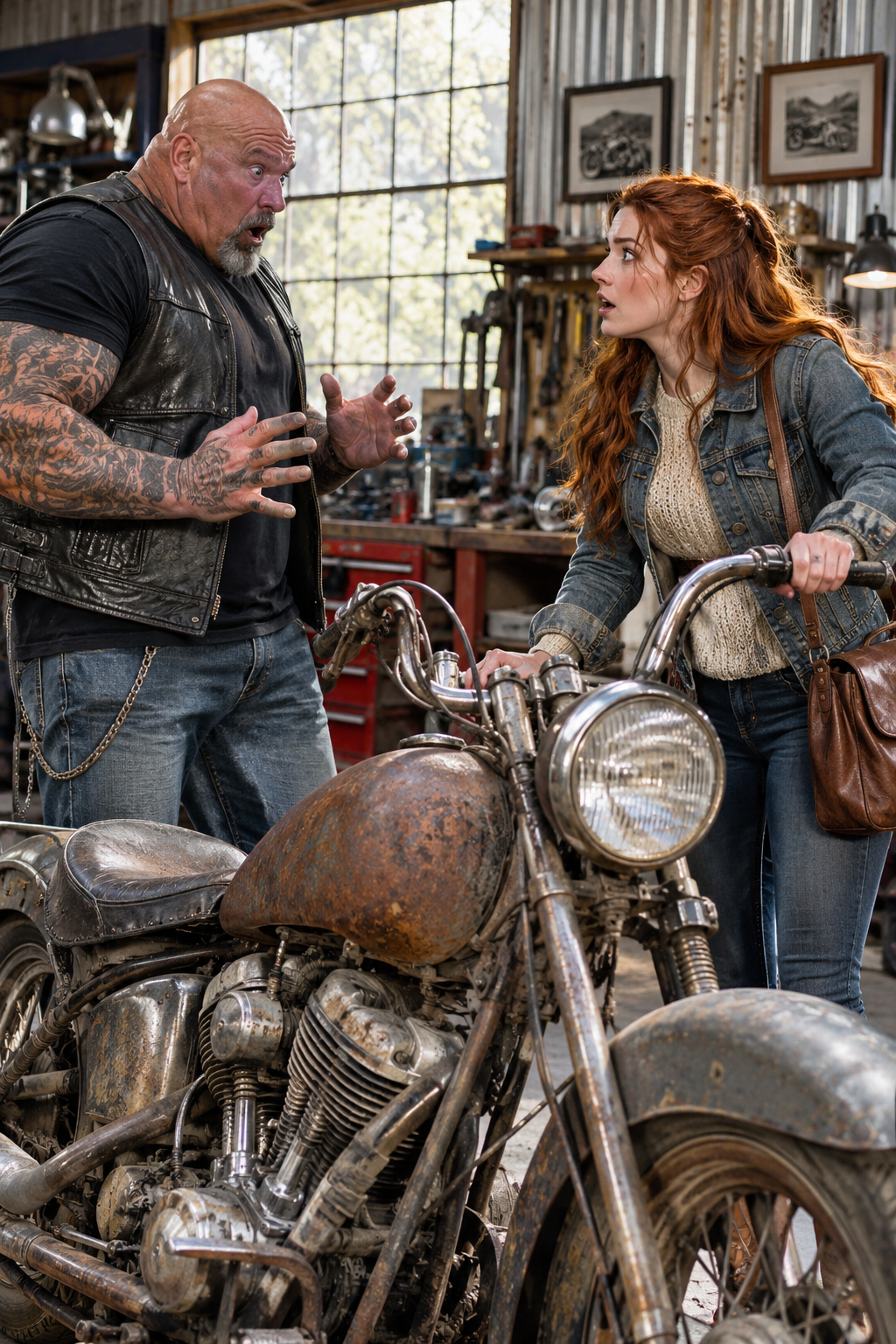
The first line made my chest ache.
“My beautiful Elena, if you’re reading this, it means I didn’t get to finish what I started.”
I covered my mouth.
Dad had written the letter three months before his death.
He explained that he’d been repairing Blackbird for one final journey, a trip he wanted our entire family to take when Noah was old enough.
He’d planned to buy a small trailer so Mom and Noah could follow while I rode the dirt bike beside him on the quieter back roads.
I remembered how often he’d talked about that summer.
I’d thought it was just another dream.
Then I reached the final paragraph.
“If something happens to me, don’t let anyone convince you that these motorcycles are worthless. Blackbird isn’t just a machine. Everything you need to protect our family is hidden where the eagle watches the road.”
I read that sentence twice.
Cutter leaned closer.
“May I?”
I handed him the letter.
He studied the final lines, and something flickered across his face.
“The eagle,” he murmured.
His eyes moved toward Blackbird’s fuel tank.
Dale suddenly lunged for the box.
Ruth stepped in front of him.
“Not happening.”
“That letter’s fake!” Dale shouted. “Daniel was a liar! He owed me money!”
Cutter looked up.
“What kind of money?”
Dale hesitated.
“Business money.”
“What business?”
“Parts. Repairs. Personal loans.”
“How much?”
“Twenty-seven thousand dollars.”
My heart stopped.
Twenty-seven thousand.
We barely had enough money for groceries.
Cutter stared at Dale.
“Daniel never borrowed that kind of money from you.”
“You don’t know everything about him!”
“Then show us the records.”
Dale opened his mouth, then closed it.
One biker named Marcus quietly took out his phone.
“I’m calling the sheriff.”
Dale’s eyes widened.
“You can’t just hold me here!”
“You’re free to speak to the sheriff,” Cutter replied. “And nobody’s stopping you from calling your own lawyer.”
Marcus stepped outside to make the call.
I kept staring at the box.
Beneath the notebook was an envelope with a county courthouse stamp.
Inside was a printed notice concerning a debt against Dad’s estate.
The signature at the bottom looked like my mother’s.
But something was wrong.
Mom always signed her name Elena M. Reyes.
This document said Elena Reyes.
And the handwriting looked stiff, almost carefully copied.
“Mom didn’t sign this,” I whispered.
Ruth took a photograph of the document without removing it from the box.
“Let’s have her confirm that.”
Dale started pacing.
“This is ridiculous. You’re letting a teenager tell you what’s legal?”
Cutter ignored him.
He crouched beside Blackbird, studying the eagle painted on the tank.
Then he smiled sadly.
“Daniel, you stubborn son of a gun.”
He pointed toward the eagle’s right wing.
“See that little silver screw?”
I nodded.
“Your father used to hide spare keys behind that emblem. Said nobody ever noticed the obvious.”
He looked at me.
“This is your family’s motorcycle. You should be the one to check.”
Ruth handed me a small screwdriver from the workbench.
I loosened the screw.
The emblem lifted away, revealing a narrow compartment beneath it.
Inside was a tiny waterproof pouch.
Dale made a strangled sound.
“No.”
I pulled the pouch free.
There was a folded document inside.
And a small black memory card.
Cutter took one look at the document and went completely still.
“What is it?” I asked.
He swallowed.
“It’s a bank receipt.”
I watched his face.
“For what?”
Cutter turned it around.
The amount printed near the bottom was $38,500.
My knees weakened.
“Thirty-eight thousand?”
“Thirty-eight thousand five hundred,” Ruth confirmed.
The receipt showed a transfer from Daniel Reyes to a business account belonging to Pritchard Custom Motors.
The date was two weeks before Dad died.
Dale backed toward the office.
“That was payment for parts.”
Cutter shook his head.
“No, Dale.”
His voice sounded almost broken.
“That was the money Daniel was saving to open his own motorcycle shop.”
I stared at him.
“Dad wanted a shop?”
Cutter nodded.
“He wanted a place where kids could learn mechanics without paying a fortune. Especially kids whose families couldn’t afford vocational training.”
My father had spent sixteen years working at a lumber mill. He repaired neighbors’ cars in our driveway on weekends, often refusing payment.
I thought he was simply being generous.
I never knew he’d been building a future around it.
“Why would he send Dale the money?” I asked.
“That’s what we need to find out.”
The answer came from the leather notebook.
Its pages were crowded with Dad’s handwriting, careful calculations, and lists of equipment.
Near the back, one entry had been underlined three times.
“Pritchard agrees to purchase equipment for Reyes Community Garage. Funds held in business account until building lease approved.”
Beneath it was another sentence.
“Dale refuses to provide receipts. Says money already spent. Meeting with lawyer Friday.”
The date was September 18.
Dad died on September 19.
My skin turned cold.
I’d always believed his death was a terrible accident.
He’d been driving home on the old county road during a thunderstorm when his pickup went off a bridge.
The police said he’d probably lost control on the wet pavement.
What if there was more to it?
I looked at Cutter.
“Do you think Dale had something to do with Dad dying?”
Nobody answered.
Then Dale spoke.
“I didn’t kill your father.”
The words came too quickly.
Too loudly.
Nobody had accused him of murder.
Not yet.
Cutter’s expression changed.
“Interesting choice of words.”
Dale wiped sweat from his forehead.
“Everybody knows what happened. Daniel drove too fast in the rain.”
I thought of Dad’s truck.
He’d never driven recklessly, especially on that road.
And the night he died, he’d promised to be home before seven.
He’d called Mom at six fifteen.
I remembered because I’d been sitting beside her at the kitchen table.
His last words to me were, “Keep Noah out of trouble until I get there.”
Then he laughed.
That was the last time I’d heard his voice.
Suddenly the black memory card felt impossibly heavy in my hand.
“What’s on this?” I asked.
Dale looked toward the garage entrance.
And ran.
He shoved past a rolling toolbox, sending wrenches crashing across the concrete.
One of the bikers moved instinctively toward the door, but Cutter raised a hand.
“Don’t chase him.”
Dale sprinted outside, jumped into his pickup, and slammed the door.
The engine roared.
He reversed so violently that the truck struck a stack of old tires.
Then he sped out of the parking lot.
For several seconds, nobody spoke.
Ruth looked at Cutter.
“We could’ve stopped him.”
“And risked someone getting hurt?” Cutter replied. “The sheriff can handle Dale.”
Marcus returned from outside.
“Deputy says he’s on his way.”
Cutter pointed toward the road.
“Tell him Dale just fled in a blue Ford pickup.”
I looked down at the broken dirt bike.
Dad’s motorcycle lay scattered across the concrete like something nobody could ever put together again.
For the first time since entering the garage, I started crying.
Not quietly.
Not politely.
I cried so hard I could barely breathe.
Cutter knelt beside me.
“I’m sorry,” he said.
I wiped my face.
“Why?”
“Because your father was my friend, and I should’ve checked on his family after he died.”
“You didn’t know.”
“I knew enough to make a phone call.”
He looked at the shattered engine.
“And because nobody should’ve treated you this way.”
I wanted to tell him it was okay.
But it wasn’t.
Nothing had been okay for a long time.
Mom worked double shifts at the nursing home. Noah still struggled to walk after the accident that shattered his leg. Every month, another bill appeared.
We’d sold Dad’s tools, his fishing boat, and most of the furniture from his workshop.
When Dale offered to take Blackbird in exchange for settling an old repair debt, Mom had been too exhausted to fight.
And now I was standing in a stranger’s garage with a broken motorcycle and evidence that someone might have stolen everything Dad had worked for.
“What happens now?” I whispered.
Cutter placed a hand on my shoulder.
“Now we find the truth.”
The sheriff arrived twenty minutes later.
Sheriff Rebecca Hayes was a tall woman with silver-streaked hair and eyes that seemed to notice everything.
She listened while Cutter explained what had happened.
Then she turned to me.
“Did Dale break the motorcycle deliberately?”
“Yes, ma’am.”
“Did he threaten you?”
“He said I owed him nine hundred dollars. Then he smashed the bike when I told him I couldn’t pay.”
She wrote everything down.
Next, Ruth showed her the photographs of the disputed paperwork.
Sheriff Hayes examined the document and asked whether my mother could come to the garage.
I called home.
Mom answered on the fourth ring.
“Sweetheart, where are you? I’ve been worried sick.”
I tried explaining, but my voice broke.
Cutter gently took the phone.
“Mrs. Reyes? My name is Cutter Malone. I was a friend of Daniel’s.”
There was a long silence.
Then Mom said something I couldn’t hear.
Cutter’s eyes softened.
“Yes, ma’am. That Cutter.”
Another pause.
“No, your daughter is safe. But we need to talk about your husband’s motorcycles.”
Mom arrived with Noah thirty minutes later.
He climbed carefully from our old sedan, leaning on his crutches.
The moment he saw Blackbird, his face lit up.
“Dad’s bike!”
Then he spotted the pieces of the dirt bike.
His smile vanished.
“Lucy?”
He looked at me.
“What happened?”
I couldn’t answer.
He limped toward the wreckage and picked up the broken handlebar.
“Dad fixed this for us.”
“I know.”
“You promised we’d ride it together.”
“I know, Noah.”
His lower lip trembled.
Then, in a tiny voice, he asked, “Does this mean Dad’s really gone?”
Those words hurt worse than anything Dale had said.
Because for Noah, that motorcycle hadn’t just been a machine.
It had been proof that a piece of Dad was still waiting for us.
I knelt beside him.
“No,” I whispered. “It means somebody broke something Dad loved. But they can’t break what he gave us.”
Noah buried his face against my shoulder.
Behind us, Cutter turned away.
I saw him wipe his eyes.
Mom confirmed immediately that the signature on the debt document wasn’t hers.
She also explained that Dale had presented another paper at our kitchen table, saying Blackbird would cover a supposed repair balance.
He’d rushed her through the signature while Noah was crying in pain after physical therapy.
She hadn’t received a copy.
Sheriff Hayes made notes and arranged for both motorcycles and the documents to be preserved as evidence.
But the memory card was the biggest mystery.
One of the bikers offered a laptop.
The sheriff stopped him.
“We need to preserve it properly. If there’s evidence on that card, I don’t want anybody accidentally changing it.”
She sealed it in an evidence envelope.
Then she looked at Mom.
“Mrs. Reyes, I think you and your children should come to the station tomorrow morning.”
Mom clutched my hand.
“Are we in trouble?”
“No,” the sheriff said gently. “But I suspect somebody has been taking advantage of your family.”
That night, sleep refused to come.
I lay awake listening to Noah breathe in the next room.
At two in the morning, I heard Mom crying softly in the kitchen.
When I went downstairs, she was sitting at the table with Dad’s letter.
“I didn’t know,” she whispered.
“About the shop?”
She nodded.
“He told me he was saving for something special. I thought maybe it was a vacation.”
She pressed the letter against her chest.
“Your father always dreamed too big.”
I sat beside her.
“Maybe he wasn’t dreaming too big.”
Mom looked at me.
“Maybe he just didn’t get enough time.”
The next morning, Sheriff Hayes called with news.
Investigators had recovered deleted recordings from the memory card.
Dad had apparently used a small helmet camera to document his restoration projects.
Most of the files were ordinary garage videos.
But one recording, made the afternoon before he died, showed a confrontation inside Dale’s shop.
The sheriff let Mom and me watch an authorized copy at the station.
Dad appeared on the screen, looking tired but calm.
Dale stood behind his counter.
“You’ve had my money for six weeks,” Dad said. “Either show me the equipment you bought or return every penny.”
Dale laughed.
“You think you can walk in here and threaten me?”
“I’m not threatening you. I’m giving you one more chance to make this right.”
“You’ll ruin me.”
“You made your own choices, Dale.”
Then Dad said something that made my blood run cold.
“I found the other accounts. You’re taking money from people who trust you.”
Dale’s face twisted.
“You should’ve minded your own business.”
Dad reached for the camera.
The recording ended.
Sheriff Hayes paused the screen.
“We’ve also found evidence that Dale submitted false invoices to several customers. Your father’s transfer appears to have funded purchases unrelated to the community garage.”
Mom stared at Dad’s frozen face.
“Was Daniel going to report him?”
“That’s what the records suggest.”
I asked the question I’d been afraid to say aloud.
“Did Dale kill him?”
The sheriff’s expression grew serious.
“We’re reviewing the accident investigation. But I won’t tell you something we haven’t proved.”
For three days, we waited.
Dale had disappeared.
His shop was closed, his phone disconnected, and his pickup had been found abandoned near the interstate.
Then, on Thursday afternoon, Cutter arrived at our house.
He wasn’t alone.
Ruth and Marcus followed him carrying several large boxes.
Noah watched from the porch.
“What’s all that?”
“Parts,” Cutter answered.
“For what?”
Cutter smiled.
“For a motorcycle that deserves another chance.”
My heart jumped.
“The dirt bike?”
“Every piece we could save.”
Ruth set down a box.
“We’ve got a few mechanics who owe your dad favors.”
Marcus grinned.
“And a few who just like proving bullies wrong.”
For the first time in months, Noah laughed.
But Cutter wasn’t smiling when he turned to Mom.
“There’s something else.”
He handed her an envelope.
Inside was a check for $4,200.
Mom stared at it.
“What is this?”
“Donations from people Daniel helped over the years.”
She immediately tried to return it.
“We can’t accept—”
“Elena,” Cutter interrupted gently, “your husband spent his whole life helping people who needed it. Please don’t deny them the chance to honor him.”
Mom’s eyes filled.
“We don’t know how to repay you.”
“You don’t have to.”
That afternoon, our driveway filled with motorcycles.
Neighbors came outside to watch.
Men and women in leather jackets carried tools into Dad’s old workshop, swept the floor, and began sorting the parts.
For the first time since his funeral, the garage sounded alive.
Metal clicked.
Engines turned.
People laughed.
And Noah sat beside Cutter, learning how to clean a carburetor.
I thought that was the happiest moment the week could possibly bring.
I was wrong.
At six that evening, Sheriff Hayes called.
They’d found Dale.
He’d been arrested in a motel two counties away.
But that wasn’t the shocking part.
Investigators had recovered a second recording from a damaged dash camera belonging to a delivery truck that passed the bridge the night Dad died.
It showed a blue pickup following Dad’s truck.
For several minutes, the pickup stayed dangerously close.
Then, just before the bridge, it swerved into Dad’s lane.
Dad’s truck veered toward the shoulder.
The recording went dark behind a curve.
The pickup’s license plate was visible.
It belonged to Dale.
Mom sank into a chair.
I felt as though the floor had disappeared.
Cutter gripped the back of the kitchen counter.
“Dear God.”
The sheriff explained that investigators were reconstructing the collision and reviewing Dale’s statements.
They had reason to suspect he’d deliberately forced Dad off the road.
And now they had something else.
A message recovered from Dale’s deleted phone records.
Sent to an acquaintance less than an hour after the crash.
“Daniel won’t be bothering me anymore.”
I couldn’t speak.
For a year, I’d blamed the rain.
I’d blamed the bridge.
Sometimes, in my worst moments, I’d even blamed Dad for leaving us.
Now I understood there might have been someone else responsible.
Someone who’d come to our house after the funeral.
Someone who’d shaken Mom’s hand and said he was sorry.
Someone who’d taken Dad’s Harley while knowing exactly what had happened that night.
The next few weeks became a blur of interviews, lawyers, and court hearings.
Dale eventually admitted during a recorded interview that he’d followed Dad that evening, intending to frighten him into keeping quiet about the stolen money.
He claimed he hadn’t meant for Dad to crash.
But investigators found evidence that he’d deliberately forced his truck toward Dad’s vehicle and then left the scene without calling for help.
He was charged with serious offenses connected to Dad’s death, along with fraud, forgery, and theft.
At the preliminary hearing, I watched Dale enter the courtroom wearing handcuffs.
He looked smaller than I remembered.
Without the garage, the tools, and the power he’d held over us, he was just a frightened man facing the consequences of his choices.
For a moment, he looked directly at me.
I expected to feel satisfaction.
Instead, I felt exhausted.
Because nothing he suffered could bring Dad home.
Nothing could give Noah back the night he’d waited by the window for headlights that never appeared.
Nothing could return the birthdays Dad had missed or the hundreds of ordinary mornings when Mom had needed his hand in hers.
Justice mattered.
But it wasn’t magic.
It couldn’t erase grief.
Months later, Dale accepted a plea agreement. He pleaded guilty to causing Dad’s death through his deliberate driving, leaving the crash scene, and multiple financial crimes.
The judge sentenced him to prison.
Money recovered from his assets and a restitution order would help compensate our family, although much of the debt remained difficult to collect.
When the hearing ended, a reporter approached me outside the courthouse.
“Lucy, do you forgive Dale Pritchard?”
I looked at the camera.
I was seventeen by then.
Still young enough to feel frightened by microphones, but old enough to understand that some questions didn’t have simple answers.
“I don’t know,” I said.
The reporter seemed disappointed.
I continued.
“Maybe someday I will. But forgiveness isn’t something people can demand from the people they’ve hurt. Right now, I just want my family to heal.”
Cutter stood beside me, his hand resting lightly on my shoulder.
He didn’t say a word.
He didn’t need to.
By the following spring, something extraordinary had happened.
The town council approved the lease of an abandoned service station on the edge of Mill Creek.
Several local businesses donated equipment.
A retired mechanic offered free weekend classes.
An attorney helped Mom establish a nonprofit organization using Dad’s original plans.
And with recovered funds, donations, and countless hours of volunteer labor, the old building slowly became something beautiful.
A real workshop.
With clean floors, bright lights, organized tools, and a sign above the entrance.
DANIEL REYES COMMUNITY GARAGE.
FREE MECHANICS CLASSES FOR YOUNG PEOPLE.
On opening day, more than two hundred people gathered outside.
Some had known Dad for decades.
Others had never met him.
All of them had come because they’d heard his story.
Cutter gave a short speech.
He told everyone about the night Dad had dragged him from a burning truck.
He described Daniel as the kind of man who never asked whether somebody deserved help before offering it.
Then Cutter looked at me.
“Lucy, would you like to say a few words?”
My heart hammered.
I walked toward the microphone, holding a photograph of Dad standing beside Blackbird.
For a moment, I couldn’t speak.
Then I saw Noah in the front row.
He was standing without his crutches.
His leg had healed enough that he could walk short distances on his own.
Mom stood beside him, smiling through tears.
And behind them were six bikers who’d walked into a garage when I needed someone to stand up for me.
I took a breath.
“My dad used to say broken things weren’t always finished things.”
The crowd fell silent.
“He said sometimes you just needed to understand what went wrong, find the right tools, and have enough patience to try again.”
I looked toward the workshop.
“For a long time, I thought he was only talking about motorcycles.”
My voice trembled.
“But now I think he was talking about people, too.”
A few people wiped their eyes.
“When Dad died, our family fell apart. We thought we’d lost everything. And when somebody destroyed his dirt bike, I thought they’d destroyed the last piece of him I could hold on to.”
I paused.
“But I was wrong. Dad didn’t leave us only motorcycles. He left us kindness. He left us people who remembered him. And he left us something worth building.”
I looked at Cutter.
“Sometimes the person who helps you today is someone you helped years ago, without ever knowing your kindness would find its way home.”
Cutter lowered his head.
I finished with the words I wished Dad could hear.
“This garage belongs to every kid who’s ever been told they’re not worth the trouble. Here, you don’t have to be rich to learn. You don’t have to be perfect to belong. And you never have to be ashamed of asking for help.”
The applause seemed to shake the building.
Then Cutter smiled.
“There’s one more thing.”
The workshop doors opened.
Marcus and Ruth rolled out a motorcycle covered in a blue tarp.
Noah grabbed my arm.
“Lucy!”
I knew before they removed the cover.
My father’s dirt bike.
Restored.
Its frame had been repaired, the engine rebuilt, and the damaged parts replaced.
The original faded lettering remained on the fuel tank, carefully preserved beneath a fresh protective finish.
I walked toward it, hardly believing what I was seeing.
Cutter handed me a key.
“We saved every original piece we safely could,” he said. “And we made sure the important parts of your dad’s work are still here.”
I ran my fingers along the handlebars.
Near the ignition was a small engraved plate.
BUILT BY DANIEL.
REBORN BY FRIENDS.
RIDE WITH HEART.
Noah was crying.
So was Mom.
I looked at Cutter.
“How can I ever thank you?”
He smiled.
“Make sure the next kid who walks into a garage needing help gets treated better than you did.”
Then he handed me Dad’s old riding gloves.
Mom had found them in a drawer and given them to Cutter to clean.
The leather was worn, the fingertips darkened from years of repairs.
I slipped them on.
They were too big.
Just as they’d been when Dad first taught me to ride.
Outside, the crowd stepped aside.
I pushed the motorcycle into the sunshine.
Noah climbed onto the seat behind me after Cutter checked his helmet and helped him settle safely.
I turned the key.
The engine coughed once.
Twice.
Then it roared to life.
Noah wrapped his arms around my waist.
“Lucy?”
“Yeah?”
“Do you think Dad can hear us?”
I looked toward the clear blue sky.
For a moment, I remembered being eight years old, sitting on this same motorcycle with Dad behind me.
His hands had covered mine on the handlebars.
“Don’t look down,” he’d told me. “Look where you want to go.”
I swallowed the lump in my throat.
“I don’t know, Noah.”
He held me tighter.
“But I think he’d be proud.”
We rode slowly around the closed parking area while everyone cheered.
Cutter watched from beside Blackbird, which had also been legally returned to our family and restored to working condition.
For a brief, impossible moment, I could almost imagine Dad standing there among them.
Smiling.
Arms folded.
Ready to tell me I’d forgotten to check the tire pressure.
Years later, people would ask me about that day in Dale Pritchard’s garage.
They’d ask whether I was terrified when those six motorcycles appeared.
Whether Cutter really looked as intimidating as everyone said.
Whether watching Dale go to prison made me feel better.
I’d tell them the truth.
Yes, I was scared.
Yes, Cutter was enormous.
And no, prison didn’t make the pain disappear.
But the question I always wished they’d ask was what happened afterward.
Because the most important part of the story wasn’t the man who destroyed something precious.
It was the people who chose to rebuild it.
Over the following years, hundreds of teenagers learned mechanics at the Daniel Reyes Community Garage.
Some became professional technicians.
Some found apprenticeships.
Some simply discovered that they were capable of things nobody had ever taught them to believe.
And every year, on the anniversary of the garage’s opening, Noah and I rode Dad’s motorcycles together.
We never rode far.
Just enough to feel the wind, hear the engines, and remember the man who’d started it all.
Sometimes, after the riders went home, I’d stay behind to sweep the workshop floor.
And whenever a frightened kid appeared at the doorway holding a broken part, embarrassed because they had no money, I’d smile and say the words I wished somebody had said to me when I was sixteen.
“Come on in. Let’s see what we can fix.”
Because Dad was right.
A broken thing isn’t always a finished thing.
And sometimes the greatest legacy a person leaves behind isn’t something they owned, built, or saved.
It’s the kindness they put into the world—and the people who carry it forward long after they’re gone.
But there was one final chapter to my father’s story that none of us could have imagined.
It happened five years after the day Cutter Malone walked into Dale Pritchard’s garage.
I was twenty-two, working full-time at the Daniel Reyes Community Garage, when a young boy appeared at our door carrying a rusted motorcycle helmet.
He couldn’t have been older than thirteen.
His jacket was torn, his sneakers were soaked from the rain, and he looked as though he hadn’t eaten a proper meal in days.
“Are you Lucy Reyes?” he asked.
“That’s me.”
He hesitated before holding out the helmet.
“My grandfather told me to give you this.”
I examined it carefully.
It was black, with a faded silver eagle painted on one side.
The same eagle that had decorated Dad’s Harley.
“Who’s your grandfather?”
The boy lowered his eyes.
“Dale Pritchard.”
For a moment, I couldn’t move.
The workshop noises seemed to disappear around me.
Dale.
The man who had destroyed my father’s motorcycle.
The man whose actions had taken my father away from us.
The man who had stolen our money and nearly ruined our lives.
And now his grandson was standing in the very garage my father had dreamed of building.
“What’s your name?” I asked.
“Ethan.”
“Why did your grandfather send you here?”
Ethan swallowed.
“He didn’t, exactly. I found this among his things. There was a letter with your name on it.”
He reached into his pocket and handed me a folded envelope.
My name was written across the front.
Inside was a letter from Dale.
His handwriting was shaky.
He explained that he’d been diagnosed with a serious illness while serving his sentence.
He knew he might never leave prison.
He didn’t ask for forgiveness.
Instead, he described one final act of dishonesty that had haunted him.
Years before Dad died, Dale had stolen a small notebook from his workshop.
It contained designs for inexpensive engine modifications that could help teenagers build reliable motorcycles using discarded parts.
Dale had kept it because he believed the ideas might someday make him money.
He’d never used them.
The notebook, he wrote, was hidden inside the helmet’s lining.
My hands trembled as I examined the old helmet.
Underneath the padding was a carefully folded collection of yellowed pages.
I recognized Dad’s handwriting immediately.
There were diagrams, measurements, notes, and sketches.
And on the final page, written in blue ink, was a sentence.
“Every kid deserves the chance to build something better than what they were handed.”
I sat down.
For several minutes, I couldn’t say anything.
Then Ethan spoke.
“My mom says my grandfather was a terrible man.”
I looked up.
“Your grandfather did terrible things.”
Ethan nodded.
“She says people will always hate our family because of him.”
Something in his voice broke my heart.
I remembered being sixteen, standing in that garage, feeling powerless and ashamed.
I remembered the way Dale had looked at me as though my poverty made me worthless.
And suddenly I understood what Dad would have wanted me to do.
I placed the notebook on the workbench.
“Ethan, do you like motorcycles?”
His face brightened slightly.
“Yes, ma’am.”
“Have you ever worked on one?”
“No. Nobody wants to teach me.”
I pulled an empty chair beside mine.
“Then you’ve come to the right place.”
He stared at me.
“But you know who my grandfather is.”
“I do.”
“And you know what he did.”
“I’ll never forget it.”
His eyes filled with tears.
“Then why would you help me?”
I looked at the photograph of Dad hanging above the workbench.
“Because you aren’t responsible for the choices he made.”
Ethan began crying.
Quietly at first.
Then he covered his face with both hands.
I waited until he was ready to speak.
“My grandfather told me nobody would ever give me a chance,” he whispered.
I placed a clean wrench on the table between us.
“Well, he was wrong.”
That afternoon, I taught Ethan how to remove a damaged spark plug.
He listened carefully, asking questions and writing down everything he learned.
When he finally got the old engine to start, his smile filled the entire workshop.
And for the first time, I understood something that had taken me years to learn.
Justice had protected my family.
Love had helped us rebuild.
But choosing not to pass our pain to another innocent person was how we finally broke the cycle.
A few months later, Ethan became one of our most dedicated students.
He eventually helped Noah design a program that provided free tools and training to teenagers from struggling families.
On the wall beside Dad’s photograph, we framed the final page of his notebook.
And beneath it, I placed another small sign.
It read:
“Your past may explain where you began, but your choices determine where you go.”
Cutter visited the garage the following summer.
His beard had turned almost completely white, and he walked more slowly than he used to.
He watched Ethan helping a younger student repair a bicycle.
Then he turned toward me.
“Who’s the kid?”
I told him.
Cutter listened without interrupting.
When I finished, he looked toward Dad’s photograph.
“Daniel would’ve liked that.”
I smiled.
“I think so, too.”
Cutter placed his weathered hand on my shoulder.
“You know, Lucy, I spent years thinking your father saved my life the night he pulled me out of that truck.”
“He did.”
Cutter shook his head gently.
“No. He did more than that. He showed me what kind of man I wanted to become.”
He looked across the workshop, where Ethan was patiently showing another child how to use a wrench.
“And now you’re doing the same thing.”
That evening, after everyone had gone home, I stood alone in the garage.
Blackbird rested beside the dirt bike, their polished fuel tanks reflecting the golden light.
I thought about the day Dale had smashed Dad’s motorcycle.
I’d believed that moment marked the end of everything my father had left behind.
But it had actually been the beginning of something much greater.
A community.
A second chance for hundreds of children.
A future built from the kindness of a man who had never expected anything in return.
I switched off the lights and stepped outside.
Above the entrance, Dad’s name glowed beneath the porch lamp.
For the first time in years, I didn’t wish I could go back and change the past.
I only wished I could tell him what his dream had become.
Then I remembered something he’d said when I was little.
“Lucy, you don’t have to fix the whole world. Just take care of the piece of it that’s right in front of you.”
I smiled through my tears.
“That’s what we’re doing, Dad.”
And as I locked the workshop doors, I finally understood the greatest lesson my father had left me.
The things we own can be stolen. The things we build can be destroyed. Even the people we love can be taken from us. But kindness, once given, can travel farther than we ever imagined.
Sometimes it returns when we need it most.
Sometimes it reaches someone we’ve never met.
And sometimes, if we’re brave enough, it even reaches the family of someone who hurt us.
Because the strongest people aren’t always the ones who fight the hardest.
Sometimes they’re the ones who have every reason to become bitter, yet choose to remain kind.
And that was how my father’s story truly ended.
Not with a broken motorcycle.
Not with revenge.
But with another frightened child walking into a garage and discovering that his future could be different from his past.
THE END.