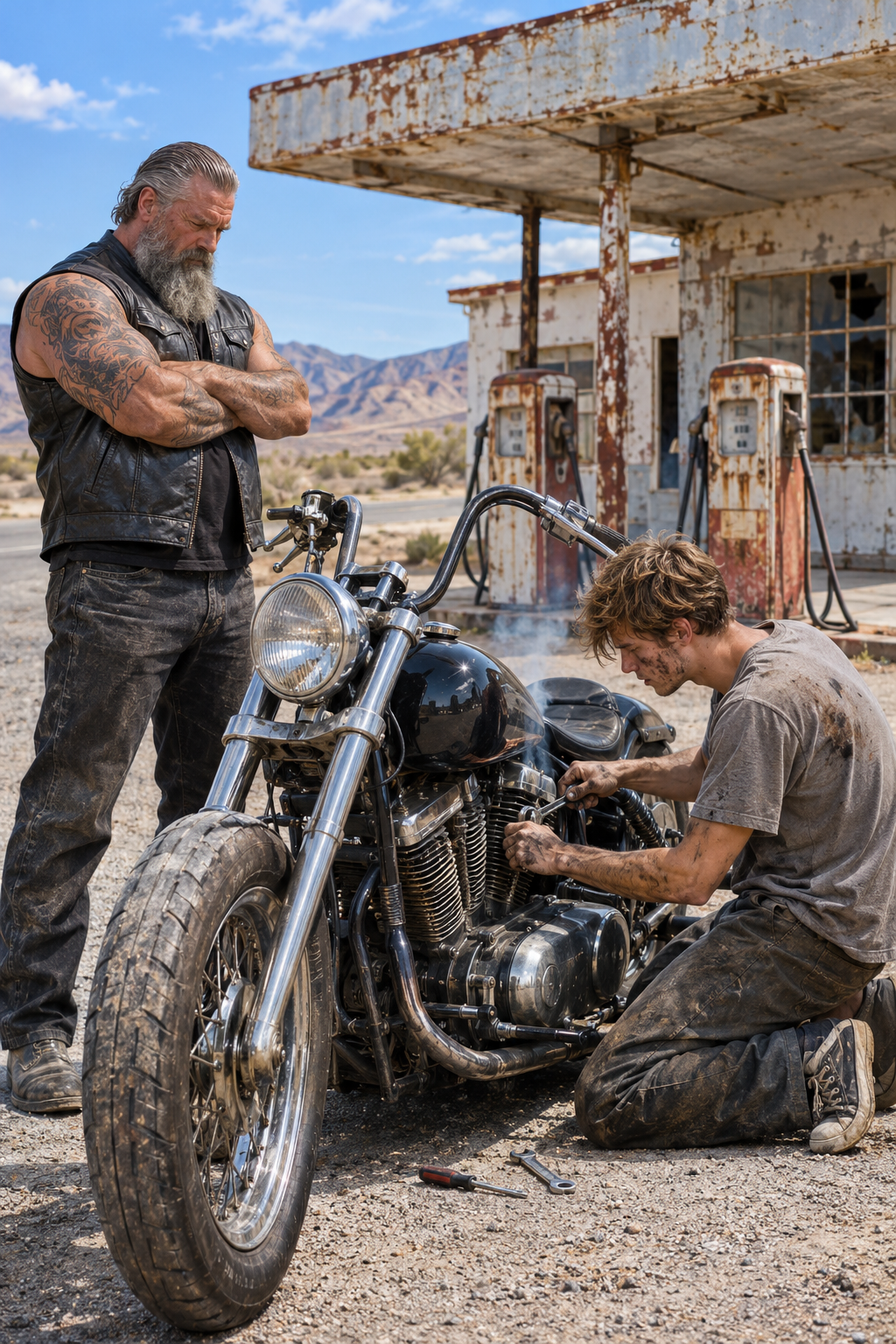
The man on the Harley-Davidson stared at the skinny 14-year-old boy holding a wrench. “You fixed something three grown mechanics couldn’t touch?”
“The boy’s been taken,” the voice said. “Someone saw a black van pull up behind the repair shop twenty minutes ago. Three men dragged him inside. He was bleeding, John.”
John Callahan felt the blood drain from his face.
“Who took him?”
“We don’t know. But there’s something else. The van belongs to a company registered under the name Richard Mercer.”
John closed his eyes.
For seventeen years, he had prayed he would never hear that name again.
“John?” the caller asked. “Are you still there?”
John gripped the phone so tightly his knuckles turned white.
“Find out where they’re taking him. And tell the police everything you know.”
He ended the call and turned toward the 312 bikers waiting outside.
The club president, Marcus “Bear” Sullivan, studied his expression.
“What’s wrong?”
John swallowed.
“Richard Mercer has the boy.”
Bear’s face changed instantly.
“Mercer? I thought that bastard was in prison.”
“He got out eight months ago.”
Bear looked toward the motorcycles.
“Then this isn’t about a stolen lighter anymore, is it?”
John shook his head.
“No. It’s about something that happened seventeen years ago. Something I should have told the truth about a long time ago.”
Across town, Leo woke to the smell of gasoline.
His wrists were tied behind a wooden chair. A single lightbulb swung above his head, illuminating a warehouse filled with dismantled motorcycles and rusting machinery.
His left eye was swollen. Blood had dried beneath his nose.
He tried to move, but pain shot through his ribs.
“Finally awake.”
A tall man stepped out of the shadows.
He wore an expensive gray suit, polished shoes, and a gold watch that looked strangely out of place in the filthy warehouse.
In his hand was John’s silver Zippo.
“Do you know who I am?” the man asked.
Leo shook his head.
“My name is Richard Mercer.”
He flicked the lighter open.
A small flame danced between them.
“Seventeen years ago, John Callahan destroyed my life. Now he’s going to pay for it.”
Leo stared at him.
“I don’t know anything about that.”
Mercer smiled.
“Of course you don’t. You’re just a homeless little mechanic who happened to meet the wrong man.”
He crouched until their faces were level.
“But John gave you this lighter. And that makes you important.”
Leo looked at the silver object.
“Why?”
Mercer’s smile vanished.
“Because that lighter belonged to someone John couldn’t save.”
He snapped it shut.
“And I intend to remind him.”
Outside the warehouse, Vince leaned against the black van, smoking nervously.
He hadn’t expected things to go this far.
Stealing a lighter was one thing. Kidnapping a fourteen-year-old boy was another.
He had watched Mercer strike Leo simply because the child refused to answer questions.
Now the boy was tied to a chair inside a building that smelled of fuel.
Vince pulled out his phone.
He stared at the emergency number.
Then he remembered Mercer’s warning.
“If you betray me, your family pays first.”
Vince put the phone away.
For the first time in his life, he understood what real cowardice felt like.
Meanwhile, John stood inside the clubhouse, surrounded by men who had followed him through storms, funerals, and thousands of miles of open highway.
Bear folded his arms.
“Tell us everything.”
John looked at the photograph of Leo on his phone.
The boy had been smiling beside the Harley after fixing its fuel line. John had taken the picture without realizing how much it would come to mean.
“Seventeen years ago,” John began, “I worked at a motorcycle repair shop in Sacramento. My best friend was a mechanic named Daniel Bennett.”
He paused.
“Daniel was the finest mechanic I ever knew. He could listen to an engine for ten seconds and tell you exactly what was wrong.”
Bear frowned.
“Bennett?”
John nodded.
“He had a wife named Sarah. And they were expecting their first child.”
The room grew quiet.
“Richard Mercer owned a transportation company. He was using our shop to hide stolen motorcycles and move illegal cargo. Daniel discovered it. He found records, photographs, everything.”
“What happened?” Bear asked.
“Mercer offered him fifty thousand dollars to stay silent.”
“And Daniel refused?”
John’s voice broke.
“He told Mercer that no amount of money could buy his conscience.”
Three days later, the shop burned down.
Daniel survived, but a young employee named Thomas Reed died in the fire.
John had been inside when the flames started.
He remembered the smoke, the screaming, and Daniel pulling him through a broken window.
He remembered something else too.
A silver Zippo lighter lying beside the back door.
“Mercer had given that lighter to his brother,” John explained. “His brother used it to start the fire. Daniel found it afterward and kept it as evidence.”
Bear looked confused.
“Then why did you have it?”
“Because Daniel gave it to me before the trial. He said if anything happened to him, I should make sure the truth survived.”
John lowered his head.
“But I failed him.”
Mercer’s men had threatened Sarah and the unborn baby.
John had been terrified.
When prosecutors asked him to identify the men he had seen outside the shop, he claimed he couldn’t remember their faces.
Daniel testified anyway.
Mercer was eventually convicted on multiple charges, but his brother disappeared, and the arson case remained unresolved.
John had spent seventeen years carrying the shame of his silence.
“Daniel never forgave me,” he whispered. “And I never blamed him.”
Bear stared at him.
“John, what’s the boy’s last name?”
John looked up slowly.
“I never asked.”
A terrible possibility settled over the room.
John grabbed his phone and called the county social services office.
After explaining the emergency, he was directed to the detective handling Leo’s disappearance.
The detective couldn’t disclose the boy’s entire file, but he confirmed one detail.
Leo’s full name was Leonard Daniel Bennett.
John nearly dropped the phone.
Daniel’s son.
The child he had promised to protect before fear destroyed their friendship.
For several seconds, John couldn’t speak.
Then he whispered, “Dear God.”
Bear placed a hand on his shoulder.
“Now we know why Mercer took him.”
John shook his head.
“No. Mercer doesn’t know who Leo really is. Not yet.”
He looked toward the highway.
“And we have to reach that boy before he finds out.”
Inside the warehouse, Leo was trying to understand why Mercer kept asking about his father.
“What was your father’s name?” Mercer demanded.
Leo hesitated.
“Daniel.”
“Daniel what?”
Leo stared at the floor.
Mercer grabbed his chin.
“Answer me.”
“Bennett. Daniel Bennett.”
The lighter slipped from Mercer’s fingers.
It struck the concrete with a sharp metallic sound.
For a moment, the man seemed unable to breathe.
Then he began laughing.
It was a terrible sound, empty of happiness.
“Daniel Bennett,” he repeated. “Of all the miserable children in California, John Callahan found Daniel Bennett’s son.”
Leo pulled against the ropes.
“You knew my dad?”
Mercer approached him slowly.
“Oh, I knew him.”
“What did you do to him?”
Mercer smiled.
“Your father was a stubborn man. He believed doing the right thing would protect him.”
Leo felt his stomach tighten.
“My father died in a car accident.”
“Is that what they told you?”
The warehouse seemed to tilt.
Leo remembered the rainy night two years earlier.
A police officer standing outside their apartment.
His mother collapsing against the kitchen counter.
The closed coffin at the funeral.
He remembered being told that his father had lost control of his truck on a mountain road.
Mercer leaned closer.
“Your father was still asking questions about my business. Even after all those years.”
Leo’s heart hammered.
“You’re lying.”
“Am I?”
Mercer reached into his jacket and pulled out a photograph.
It showed Daniel standing beside a blue pickup truck.
The same truck he had been driving the night he died.
Beside him stood a man Leo recognized immediately.
John Callahan.
On the back of the photograph was a handwritten date.
Three days before the accident.
Leo stared at it.
“John knew my father?”
Mercer nodded.
“He knew him very well.”
Leo felt something inside him crack.
The man who had rescued him on the roadside had known his father.
And he hadn’t said a word.
“Why didn’t he tell me?”
Mercer crouched again.
“Because adults are very good at hiding things from children.”
He placed the photograph in Leo’s lap.
“Especially when they’re ashamed.”
At that moment, a phone rang.
Mercer answered.
A voice informed him that hundreds of motorcycles had left the Hells Angels clubhouse.
Mercer’s expression darkened.
“Good,” he said. “Let them come.”
He walked toward a metal cabinet and removed a small black device.
Leo watched him connect wires to a container near the warehouse’s rear wall.
The smell of gasoline suddenly made sense.
“You’re going to burn this place,” Leo whispered.
Mercer looked over his shoulder.
“Your father ruined my empire. John ruined my reputation. Tonight, I’m going to erase both of their legacies.”
He pressed a button.
A red light appeared on the device.
Leo’s breath caught.
Mercer smiled.
“Forty minutes.”
Then he walked outside and locked the door.
On the highway, 312 motorcycles moved beneath the morning sun.
They weren’t riding toward a battle.
John had made that clear before anyone started an engine.
“No weapons. No revenge. We find the boy, we help the police, and we bring him home.”
Bear had nodded.
“And if Mercer tries to stop us?”
John’s answer had been simple.
“We don’t give him another victim.”
The riders spread into organized groups, coordinating with law enforcement and searching industrial areas where Mercer’s company had once operated.
Some were veterans. Some were mechanics. Others were teachers, truck drivers, nurses, and retired firefighters.
They shared one purpose.
A frightened child was missing.
And no child should have to face the darkness alone.
Twenty minutes into the search, John’s phone rang.
An unfamiliar number appeared.
He answered immediately.
“Callahan.”
“It’s Vince.”
John recognized the name from the photograph of the stolen lighter.
His jaw tightened.
“Where is Leo?”
Vince’s voice trembled.
“Mercer has him at an old warehouse near Route 16. I didn’t know he was going to hurt the kid.”
“Give me the address.”
Vince did.
Then he whispered, “There’s something else. Mercer brought fuel containers inside. I think he’s planning to burn the building.”
John’s heart stopped.
“Is the boy alive?”
“He was when I left.”
“Listen carefully,” John said. “Call 911. Tell them everything. Then get away from that building.”
Vince hesitated.
“Mercer will kill me.”
John looked at the road ahead.
“Then give yourself a chance to become a better man before he does.”
The call ended.
John immediately relayed the location to the police.
Bear accelerated beside him.
“How far?”
“Eighteen miles.”
Bear looked at the speedometer.
“We’ll get there.”
John shook his head.
“We have to get there in time.”
Inside the warehouse, Leo struggled against the ropes.
His wrists burned.
His shoulders ached.
The red light on the device blinked steadily.
Thirty-two minutes.
He looked around desperately.
A broken motorcycle engine sat on a workbench nearby. Beneath it lay several discarded tools.
Too far away.
He twisted his chair.
One leg scraped across the concrete.
He tried again.
The chair tipped.
Leo crashed onto his side, crying out as pain exploded through his ribs.
For several seconds, he couldn’t move.
Then he heard his father’s voice in his memory.
“Machines don’t give up, Leo. They just tell you what needs fixing.”
His father used to say that whenever a repair seemed impossible.
Leo closed his eyes.
He remembered their little garage.
The smell of engine oil.
His father’s rough hands guiding his smaller ones.
“First rule of fixing anything,” Daniel would say. “Don’t panic. Understand the problem.”
Leo opened his eyes.
The rope around his wrists was tight, but the wooden chair was old.
One of its back supports had already cracked when he fell.
He shifted his weight and slammed the chair against the floor.
Once.
Twice.
On the third attempt, the weakened support snapped.
Leo pulled one arm free.
He untied the other and crawled toward the workbench.
Twenty-six minutes.
He reached the black device and examined it without touching the wires.
He knew engines.
He knew electrical systems.
But this was different.
One wrong move could kill him.
He searched for a safe way to disconnect the power, then stopped.
The device was unfamiliar, and the fuel containers made any mistake too dangerous.
His father had taught him another rule.
“Knowing when not to touch something is part of being a good mechanic.”
Leo backed away.
He needed an exit.
The front door was locked.
The windows were covered with metal bars.
At the rear stood a large rolling garage door, secured by a rusted chain.
Beside it was an old hydraulic lift.
Leo studied the mechanism.
Its motor had been removed, but the manual release was still attached.
He grabbed a steel rod from the workbench and worked at the damaged chain bracket.
His hands shook.
His injured ribs screamed.
Then something moved.
A bolt came loose.
He tried again.
The bracket shifted another inch.
For the first time since waking in the warehouse, Leo felt hope.
Outside, Mercer stood beside his car, speaking to his remaining men.
“When Callahan arrives, keep him occupied. I want him to see the building before it goes up.”
One thug shifted uneasily.
“Boss, there’s a kid inside.”
Mercer turned.
“And?”
The man said nothing.
Mercer smiled coldly.
“That’s what I thought.”
Then the sound came.
At first, it was faint.
A distant rumble rolling across the hills.
Mercer looked toward the highway.
The sound grew louder.
Hundreds of engines, moving together.
His smile disappeared.
A moment later, motorcycles began appearing along the road.
Dozens.
Then hundreds.
The riders slowed as they approached the industrial district.
John rode at the front, with Bear beside him.
Police cruisers were already converging on the warehouse.
Mercer stared in disbelief.
He had expected frightened men seeking revenge.
Instead, he saw disciplined riders keeping the access roads clear for emergency vehicles.
John stopped his Harley outside the police perimeter.
He removed his helmet.
“Where’s the boy?” he demanded.
Mercer stood near the warehouse entrance.
“Still inside.”
John took a step forward.
A police officer held out his arm.
“Sir, stay back.”
Mercer raised the silver Zippo.
“Looking for this, Callahan?”
John froze.
Mercer laughed.
“Seventeen years, and you still carry Daniel Bennett’s little souvenir.”
John’s voice was barely audible.
“Let Leo go.”
“Did you tell him who you are?”
John said nothing.
“Did you tell him how you abandoned his father?”
John’s face twisted with pain.
“No.”
Mercer spread his arms.
“Then perhaps the boy deserves to know.”
Suddenly, a metallic crash echoed from inside the warehouse.
Everyone turned.
A narrow gap appeared beneath the rear garage door.
Then a small, grease-covered hand reached through.
“HELP!”
John recognized the voice.
“LEO!”
The boy’s face appeared beneath the door.
“There’s something inside! A device! And gasoline!”
Mercer spun around.
“No!”
He rushed toward the rear entrance, but two officers intercepted him.
He struggled violently.
One officer forced him to the ground.
Another secured his hands.
Meanwhile, John ran toward the garage door with Bear and two firefighters.
Leo was pushing against the damaged bracket from inside.
“Stand back, son!” Bear shouted.
They lifted the door just enough for a firefighter to crawl beneath it.
The firefighter reached Leo and pulled him toward the opening.
But as the boy slid across the concrete, his shirt caught on a jagged piece of metal.
He screamed.
John dropped to his knees.
“Leo, look at me!”
The boy’s frightened eyes met his.
“I’m here,” John said. “You’re not alone.”
The firefighter freed the fabric.
Strong hands reached beneath the door.
Leo was pulled into the sunlight.
John caught him before he hit the ground.
For one brief moment, the world went silent.
Then the firefighter shouted.
“EVERYONE BACK! NOW!”
John lifted Leo into his arms and ran.
Bear followed.
The police ordered everyone away from the building.
Seconds later, a violent explosion tore through the warehouse.
A wall of heat rolled across the yard.
Windows shattered.
Flames burst through the roof.
John fell behind a concrete barrier, shielding Leo with his body.
Debris rained around them.
When the noise finally faded, John slowly raised his head.
Leo was trembling against his chest.
But he was breathing.
He was alive.
John held him tighter.
And for the first time in seventeen years, he began to cry.
The paramedics arrived within minutes.
Leo had two cracked ribs, a mild concussion, and deep bruises around his wrists.
But he would recover.
John sat beside the ambulance, refusing to leave until the doctors assured him the boy was safe.
Leo watched him quietly.
Then he asked the question John had been dreading.
“You knew my dad, didn’t you?”
John lowered his eyes.
“Yes.”
“Were you his friend?”
John swallowed.
“He was my best friend.”
Leo looked away.
“Then why didn’t you tell me?”
John sat down beside him.
“Because I was ashamed.”
He told Leo everything.
About the repair shop.
About Mercer.
About the fire.
About his failure to stand beside Daniel when his friend needed him most.
He didn’t make excuses.
He didn’t blame fear or circumstances.
He simply told the truth.
When he finished, Leo stared at his hands.
“My dad always said that good people make mistakes.”
John nodded slowly.
“He was right.”
Leo’s voice cracked.
“But he also said good people have to fix them.”
John covered his face.
Those had been Daniel’s exact words.
Years earlier, after John had apologized for refusing to identify Mercer’s men, Daniel had said them before walking away.
Now his son was repeating them.
John wiped his eyes.
“I know.”
Leo looked at him.
“Did you have something to do with his accident?”
The question struck John like a hammer.
“No, Leo. I swear I didn’t.”
He took a shaky breath.
“But I met him three days before he died. He told me he had discovered new evidence against Mercer. He wanted my help.”
“And?”
“I promised I’d call him the next morning.”
John stared at the pavement.
“I didn’t.”
Leo’s eyes filled with tears.
“Why?”
“Because I was afraid again.”
For a long moment, neither spoke.
Then Leo whispered, “I don’t know if I can forgive you.”
John nodded.
“You don’t have to.”
He stood slowly.
“But I’m going to help find out what happened to your father. Whether you forgive me or not.”
Three days later, investigators discovered something extraordinary.
The explosion had destroyed much of the warehouse, but firefighters recovered a fireproof metal cabinet from a reinforced office.
Inside were financial records, photographs, and several encrypted storage devices.
One folder contained documents connected to Daniel Bennett’s death.
The evidence suggested his truck had been deliberately sabotaged.
Even more disturbing was a series of payments made to a mechanic shortly before the accident.
The investigation was reopened.
Mercer faced new charges connected to Leo’s kidnapping and the warehouse explosion, while detectives examined the older crimes.
Vince surrendered to police and gave a full statement.
He admitted stealing the lighter, assaulting Leo, and helping transport him to the warehouse.
He also described Mercer’s threats and the device he had seen inside.
His cooperation did not erase what he had done.
But it helped investigators understand the sequence of events.
Weeks later, prosecutors uncovered enough evidence to charge Mercer in connection with Daniel’s death.
John testified.
This time, he answered every question.
Even the ones that made him look like a coward.
Especially those.
When the defense attorney asked why he had remained silent for so many years, John looked toward Leo, sitting beside a social worker in the courtroom.
“Because I was afraid,” he said.
“And what changed?”
John’s voice steadied.
“A fourteen-year-old boy showed me that courage isn’t the absence of fear. It’s doing what’s right while you’re still afraid.”
Months passed.
Leo recovered physically, though nightmares sometimes woke him in the middle of the night.
John visited whenever he was allowed.
He brought books about engines, old motorcycle magazines, and eventually a small toolbox.
But Leo barely looked at it.
One afternoon, John found him sitting outside the temporary foster home, holding his father’s bent wrench.
“I can’t fix it,” Leo whispered.
John sat beside him.
“Some things can’t be repaired the way they were.”
Leo’s eyes filled.
“It’s the last thing he gave me.”
John examined the wrench.
The handle was twisted, the metal scarred by Vince’s boot.
He turned it over carefully.
“Then maybe we shouldn’t repair it.”
Leo frowned.
“What do you mean?”
“Maybe we should preserve it.”
The following Saturday, John took Leo to a small machine shop owned by an elderly mechanic named Frank.
Together, they cleaned the wrench, removed the rust, and polished the metal without erasing its scars.
Frank built a wooden display case.
Beneath the wrench, Leo placed a photograph of his father.
On a small brass plate, he engraved six words:
“Broken things can still have value.”
When John saw it, he couldn’t speak.
By winter, the legal proceedings had reached their conclusion.
Mercer was convicted of kidnapping, arson-related offenses, and crimes connected to Daniel’s death. He received a lengthy prison sentence.
For Leo, the verdict brought relief, but not the happiness he had imagined.
His father was still gone.
His mother, who had died after a long illness the previous year, was still gone.
No courtroom could bring them back.
One evening, he asked John a question.
“What happens to me now?”
John had been waiting for it.
He had spent months completing background checks, attending parenting classes, and working with social services.
He had rearranged his house.
Turned his spare bedroom into a room with a proper bed, a desk, and shelves for Leo’s tools.
But he knew the decision wasn’t his alone.
“That depends,” John said.
“On what?”
“On whether you’d like to come live with me.”
Leo stared at him.
“Really?”
John nodded.
“I can’t replace your father. And I wouldn’t try.”
His voice trembled.
“But I can give you a home. And I can promise you’ll never have to sleep behind an abandoned repair shop again.”
Leo looked down.
“What if I mess things up?”
John smiled sadly.
“Then we’ll fix them together.”
The boy’s face crumpled.
He stepped forward and wrapped his arms around John.
For a long time, neither let go.
The adoption process took longer than either expected.
There were interviews, inspections, court hearings, and difficult questions about John’s past.
But he answered them honestly.
The same man who had once hidden from responsibility now welcomed every opportunity to prove he could carry it.
When the judge finally approved the adoption, Leo asked if he could keep his father’s last name.
John answered before the judge could speak.
“Absolutely.”
Leo smiled.
“Then I want to be Leonard Daniel Bennett Callahan.”
John lowered his head, overcome with emotion.
The judge smiled.
“I think we can arrange that.”
One year after the morning 312 motorcycles rode toward the warehouse, John and Leo stood outside a newly renovated building.
It was the same abandoned repair shop where Leo had once slept.
But everything had changed.
The broken windows had been replaced.
The walls were painted.
The roof no longer leaked.
A bright sign hung above the entrance.
BENNETT’S GARAGE.
Underneath, smaller letters read:
“Every Child Deserves a Place to Belong.”
John had purchased the property with his savings.
Members of the motorcycle club had volunteered thousands of hours repairing it.
Local businesses donated equipment.
Teachers offered tutoring.
Retired mechanics volunteered to teach practical skills.
The garage became a free training center for homeless and at-risk teenagers.
Young people could learn basic repairs, receive meals, find mentors, and connect with social workers who could help them find safe housing.
John insisted on one rule.
“No child works here to earn the right to be cared for. Help comes first.”
On opening day, more than two hundred people gathered outside.
Among them stood Vince.
He had been released under strict supervision while awaiting the final resolution of his case.
He approached Leo hesitantly.
In his hands was a small wooden box.
“I know I don’t deserve your forgiveness,” Vince said.
Leo watched him carefully.
Vince opened the box.
Inside lay several tools.
Some were new.
Others had been carefully restored.
“I found what I could from that night,” Vince explained. “I couldn’t save everything.”
He swallowed.
“I’m sorry.”
Leo looked at the tools.
Then at the man who had once terrified him.
For a moment, the old fear returned.
But Leo was no longer the helpless boy trapped behind a repair shop.
He stood straighter.
“You hurt me,” he said.
Vince nodded.
“I know.”
“And you broke things that mattered more than money.”
“I know.”
Leo closed the box.
“I hope you become a better person.”
Vince’s eyes filled.
“Thank you.”
Leo shook his head gently.
“I’m not saying everything is okay. I’m saying you still have a choice about who you become.”
Vince nodded and walked away.
John had watched the exchange from a distance.
When Leo returned, he placed a hand on the boy’s shoulder.
“Your father would have been proud.”
Leo looked toward the garage.
“I hope so.”
John smiled.
“I know so.”
Later that afternoon, as the crowd began to leave, Leo noticed a small boy standing near the entrance.
He couldn’t have been older than eleven.
His clothes were dirty.
His shoes were held together with tape.
He stared through the open doors at the motorcycles and tools.
Leo approached him.
“Hey. You like engines?”
The boy nodded nervously.
“Ever worked on one?”
“No.”
“Want to learn?”
The boy hesitated.
“I don’t have any money.”
Leo felt a familiar ache in his chest.
He remembered a lonely California road.
A broken Harley-Davidson.
A stranger who had asked how much he owed.
Leo smiled.
“You don’t need money here.”
The boy looked at him suspiciously.
“What’s the catch?”
Leo crouched to his level.
“No catch. What’s your name?”
“Ethan.”
“Well, Ethan, I’m Leo.”
He held out his hand.
“And I think we have a motorcycle that could use your help.”
The boy took it.
As they walked inside, John watched from the doorway.
Bear stood beside him.
“You did a good thing, brother.”
John shook his head.
“No. Daniel’s son did.”
Bear smiled.
“Sometimes that’s how it works. One person saves another, and the kindness keeps moving.”
John reached into his pocket.
The silver Zippo had been returned to him after the investigation.
Its surface was scratched.
The engraving had faded.
But it still worked.
He turned it over in his hand.
For seventeen years, it had reminded him of guilt.
Now it reminded him of a promise finally kept.
Leo approached, wiping grease from his fingers.
“John?”
“Yeah, son?”
“Can I see the lighter?”
John handed it to him.
Leo studied the engraving.
For the first time, he understood the words carved into the silver.
“Brotherhood Is a Promise, Not a Patch.”
He looked up.
“Was this really my dad’s?”
John nodded.
“He carried it for years.”
Leo closed his fingers around it.
“Then I want to keep it.”
John smiled.
“It’s yours.”
Leo slipped the lighter into his pocket.
Then he looked at the motorcycles parked outside.
“Do you think I’ll ever ride one?”
John laughed.
“When you’re old enough, properly trained, and wearing a helmet.”
Leo grinned.
“Deal.”
The following spring, John took Leo to visit his father’s grave.
They brought flowers and the restored wrench in its wooden case.
Leo knelt beside the headstone.
For several minutes, he said nothing.
Then he began speaking softly.
“Hi, Dad. I fixed another engine yesterday. You would’ve liked it.”
John stood a respectful distance away.
Leo continued.
“I have a room now. And a family. And a place where kids who don’t have anywhere else to go can learn the things you taught me.”
His voice trembled.
“I still miss you. Every day.”
He touched the headstone.
“But I’m not alone anymore.”
When he stood, John stepped forward.
Together, they placed the flowers beside Daniel’s name.
John looked at the grave.
“I’m sorry it took me so long, old friend.”
The wind moved gently through the trees.
John took a breath.
“I couldn’t change what I did. But I finally stopped running from it.”
Leo slipped his hand into John’s.
They stood together beneath the afternoon sunlight.
Two people who had lost more than they thought they could survive.
Two people who had discovered that family wasn’t always something life gave you.
Sometimes it was something you built, one act of courage at a time.
As they walked back toward the Harley, Leo stopped.
“John?”
“Yes?”
“Do you think broken people can be fixed too?”
John considered the question.
Then he looked at the boy who had once repaired his motorcycle for nothing more than a ride to safety.
“I think people are different from machines,” he said. “We don’t always go back to being exactly who we were.”
Leo waited.
“But we can become someone worth being. Even with the scars.”
Leo smiled.
And together, they rode home.
Years later, people would remember the story of 312 bikers who came together to rescue one homeless child.
They would talk about the thunder of motorcycles, the burning warehouse, and the powerful man brought to justice.
But those weren’t the details Leo remembered most.
He remembered his father’s hands guiding a wrench.
He remembered John kneeling beside him after the explosion.
He remembered a bedroom door that locked from the inside, a warm meal waiting downstairs, and someone who noticed when he didn’t come home on time.
Most of all, he remembered the day a stranger offered him something he hadn’t dared to ask for.
A place to belong.
And that became the true legacy of Bennett’s Garage.
Not the motorcycles.
Not the tools.
Not even the 312 riders.
It was the children who walked through its doors believing they were worthless and left knowing they mattered.
Because the greatest thing John Callahan ever did wasn’t gathering hundreds of men to save a boy.
It was staying after the danger had passed.
It was showing up on ordinary mornings, keeping difficult promises, admitting painful mistakes, and choosing love when nobody was watching.
And the greatest thing Leo ever repaired wasn’t a Harley-Davidson engine.
It was the broken chain of fear, silence, and abandonment that had followed his family for seventeen years.
He couldn’t bring back the people he had lost.
But he could make sure their kindness survived.
Sometimes, saving a life begins with a heroic act.
But changing a life requires something much harder.
It requires being there tomorrow.
And the day after that.
And every day that follows.
That was the promise behind the silver lighter.
And at last, it had been kept.
Twenty years later, a familiar silver Zippo lighter rested inside a glass display case at Bennett’s Garage.
Beside it stood an old, bent wrench and a faded photograph of two men smiling in front of a motorcycle repair shop.
The inscription beneath them read:
“Some people leave us memories. Others leave us a reason to become better.”
Leo Bennett Callahan was thirty-four now.
He had grown into a strong, quiet man with his father’s patient hands and John’s stubborn determination.
Bennett’s Garage had expanded into twelve training centers across California, helping thousands of homeless and disadvantaged teenagers find stability, education, and meaningful work.
But Leo still spent most mornings in the original garage.
He preferred the smell of engine oil to the comfort of an office.
And whenever a frightened child walked through the door, he made sure to be the first person who welcomed them.
One rainy November afternoon, Leo received a phone call that made his entire world stop.
John had suffered a massive heart attack.
By the time Leo reached the hospital, Bear was waiting outside the intensive care unit.
His old friend looked smaller than Leo remembered.
“Where is he?” Leo demanded.
Bear placed a hand on his shoulder.
“He’s still fighting, son.”
Leo pushed through the doors.
John lay motionless beneath white sheets, surrounded by machines.
His hair had turned completely gray. The strong hands that once held a Harley’s handlebars now rested weakly beside him.
Leo sat down and took one of those hands.
“Hey, old man,” he whispered. “You promised we’d rebuild that ’68 Harley together.”
John’s eyelids fluttered.
A faint smile crossed his face.
“You still… owe me… a fuel line.”
Leo laughed through his tears.
“Yeah. I guess I do.”
John struggled to breathe.
“Listen to me, Leo.”
“Don’t talk. Save your strength.”
But John gently squeezed his hand.
“I spent so many years thinking I had ruined everything. Then you came along.”
Leo shook his head.
“You saved me.”
John smiled.
“No, son. We saved each other.”
He looked toward the window, where rain traced silver lines down the glass.
“Promise me something.”
“Anything.”
“Keep the garage open. Even when it gets hard. Especially then.”
Leo’s voice broke.
“I promise.”
John closed his eyes.
“And remember… nobody is beyond hope.”
Those were the last words John Callahan ever spoke.
He passed away peacefully just before sunrise.
Three days later, motorcycles began arriving from every direction.
They came from California, Nevada, Arizona, Oregon, and states much farther away.
Men and women who had never met John traveled hundreds of miles because they had heard what he had done for one forgotten child.
At the funeral, 312 motorcycles led the procession.
The exact number that had ridden to save Leo twenty years earlier.
Behind them followed hundreds more.
Leo stood beside John’s coffin, holding the silver Zippo.
When it was time to speak, he unfolded a small piece of paper.
But after looking at the words, he slowly folded it again.
“I wrote a speech,” he began. “I wanted to explain what kind of man John Callahan was.”
He looked at the sea of leather jackets and tearful faces.
“But I realized I couldn’t explain him by talking about the day he saved my life.”
Leo paused.
“Because that wasn’t the day he became my father.”
The crowd grew silent.
“He became my father when he stayed up all night helping me study for a test. When he taught me to drive. When he showed up at my graduation and cried louder than anyone else.”
A few people smiled through their tears.
“He became my father when I made mistakes and he refused to give up on me.”
Leo looked down at the lighter.
“He taught me that love isn’t proven by one extraordinary moment. It’s proven by thousands of ordinary ones.”
His voice trembled.
“And he taught me that the past doesn’t have to decide the future.”
After the funeral, Leo returned to Bennett’s Garage.
He placed John’s photograph beside Daniel’s.
Two fathers.
Two men who had shaped his life in different ways.
And beneath their pictures, he added a new inscription:
“Blood gives us our beginning. Love gives us our belonging.”
That evening, Leo was preparing to close when he noticed someone standing outside.
A teenage girl, perhaps fifteen, stood beneath the streetlight.
Her backpack was torn.
Her shoes were soaked.
She looked exhausted and frightened.
Leo opened the door.
“Can I help you?”
The girl hesitated.
“I heard you fix things here.”
Leo nodded.
“We do.”
She pulled a small broken music box from her backpack.
“It belonged to my mom.”
Her voice cracked.
“She died last month. I don’t have any money, but I thought maybe…”
She couldn’t finish.
Leo looked at the music box.
Then he looked at the girl.
For a moment, he was fourteen again, standing beside a broken Harley-Davidson on a lonely California road.
He remembered the hunger.
The fear.
The terrible feeling that nobody in the world cared whether he lived or died.
And he remembered a stranger who had stopped long enough to change everything.
Leo stepped aside and opened the door wider.
“Come inside,” he said gently. “Let’s see what we can do.”
The girl stared at him.
“You’ll really help me?”
Leo smiled.
“Of course.”
“But I can’t pay you.”
He shook his head.
“You don’t owe me anything.”
She stepped into the warmth of the garage.
Leo switched on the workbench lamp and carefully opened the music box.
A tiny spring had slipped out of place.
It would take only a few minutes to repair.
But Leo understood that the broken mechanism wasn’t the most important thing in the room.
He glanced at the girl’s trembling hands.
“Have you eaten today?”
She shook her head.
Leo set down his screwdriver.
“Then we’ll take care of that first.”
Outside, the rain continued falling.
Inside, the garage lights burned warmly against the darkness.
And somewhere between the smell of fresh coffee, the quiet ticking of an old clock, and the gentle sound of a repaired music box, another frightened child discovered that the world still held kindness.
The silver lighter remained in its glass case.
The bent wrench remained beside it.
And the promise made so many years ago continued to live.
Not because 312 motorcycles had once thundered down a California highway.
Not because a powerful criminal had finally faced justice.
But because one act of compassion had become a lifetime of service, and that lifetime had inspired countless others.
John Callahan was gone.
Daniel Bennett was gone.
But the love they had given Leo had not disappeared.
It had simply found new hands.
And that was the beautiful truth Leo carried for the rest of his life:
We cannot always save the people we love, and we cannot undo every mistake we’ve made. But we can choose what happens to the love they leave behind.
We can bury it with our grief.
Or we can pass it forward.
And sometimes, all it takes to change the course of someone’s life is a simple act of kindness, offered at the exact moment they have stopped believing kindness exists.
Because the most powerful legacy we leave behind is not the money we earn, the things we own, or even the stories people tell about us.
It is the hope we give to someone who has none.
And as long as that hope continues from one person to another, the people who taught us how to love are never truly gone.
THE END.