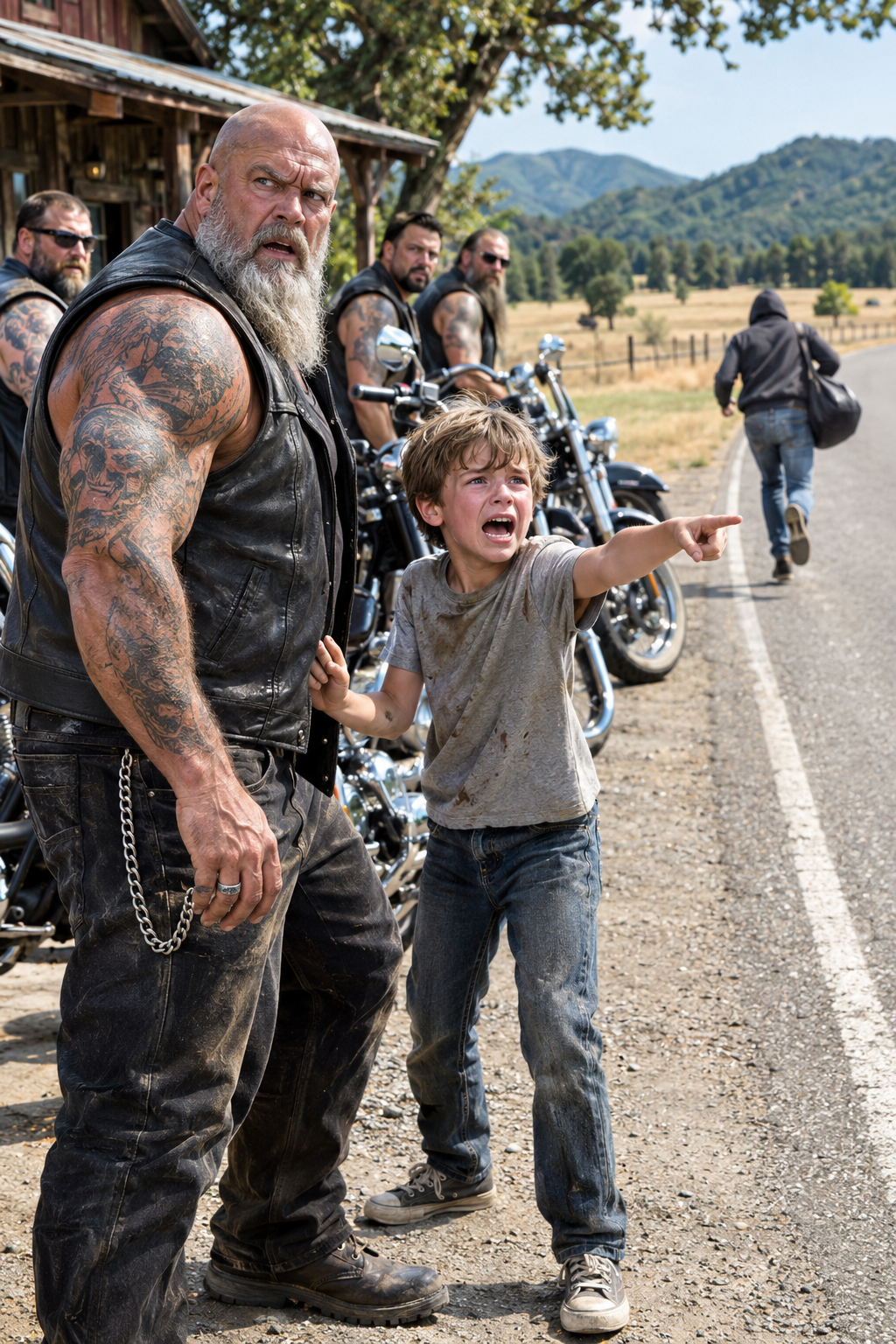
The man in the black leather vest grabbed his wallet, opened it, and suddenly went pale. Ten-year-old Daniel had just watched a stranger steal something that meant far more than money.
“The photograph,” Daniel answered, his voice barely above a whisper. “I think he dropped your photograph.”
For a moment, Bear forgot how to breathe.
“Where?” he demanded.
“Near the grocery store. Beside the big green dumpster. I saw something fall from his hand, but I didn’t know what it was until you told me about your daughter.”
Bear was already moving.
“Wait!” his friend Marcus shouted. “The police are on their way. We should let them handle this.”
But Bear couldn’t stop. He had spent eleven years protecting that photograph from rain, fire, accidents, and everything else life had thrown at him. The thought of it lying in a dirty alley, being crushed beneath someone’s shoes, was unbearable.
Daniel ran after him.
The grocery store was only two blocks away. By the time they reached the alley, Bear’s chest was heaving. He searched the pavement, pushing aside cardboard boxes and empty bottles.
“Over here!” Daniel called.
Something small and white was sticking out beneath a flattened soda can.
Bear dropped to his knees.
His enormous hands trembled as he lifted the object.
It was a photograph.
But it wasn’t his.
The picture showed a teenage boy standing beside a yellow bicycle, smiling at the camera. On the back, someone had written three words in blue ink.
Come home, Ethan.
Bear stared at the handwriting.
Something about those words made his stomach tighten.
“Is it yours?” Daniel asked.
Bear shook his head.
“No, buddy. But I think we just found something important.”
Marcus arrived moments later with two other bikers. Bear handed him the photograph.
“Look at the bicycle.”
Marcus examined it carefully.
“Yellow frame. Bent front wheel.”
“The same bicycle on the thief’s car,” Daniel whispered.
Before anyone could respond, a police cruiser pulled into the alley.
Officer Elena Ramirez stepped out, followed by her partner. She listened as Daniel explained everything he had witnessed.
When Bear showed her the photograph, her expression changed.
“Where did you find this?”
“Right there,” Daniel answered, pointing beneath the dumpster.
Ramirez turned the picture over and read the message.
Then she exchanged a troubled glance with her partner.
“Ethan,” she murmured. “That name sounds familiar.”
She pulled out her radio.
“Dispatch, check recent missing-person reports involving a teenage boy named Ethan. Approximately fifteen to seventeen years old.”
Static crackled.
Then a voice answered.
“Stand by.”
Bear watched her face.
“Officer, what’s going on?”
Ramirez hesitated.
“Three days ago, a sixteen-year-old boy named Ethan Miller was reported missing. His mother said he disappeared after leaving school. According to the report, he was riding a yellow bicycle.”
Daniel felt cold despite the afternoon sunshine.
“Does it have a bent wheel?”
Ramirez looked at him sharply.
“How did you know that?”
“Because I saw it.”
The officer immediately reached for her radio again.
“Dispatch, we may have a connection to the Miller missing-person case. Send another unit to the abandoned gas station.”
Bear looked down at the photograph.
He had come looking for the last picture of his daughter.
Instead, he might have stumbled into another parent’s nightmare.
And suddenly, finding his wallet no longer seemed like the most important thing in the world.
Twenty minutes later, Bear and Daniel stood behind the police barricade near the old gas station.
Daniel’s mother, Sarah, had arrived after Marcus called the diner. She was frightened and furious at first, but after hearing what had happened, she wrapped an arm around her son and stayed beside him.
“You should have waited for me,” she whispered.
“I know, Mom.”
“You scared me.”
“I’m sorry.”
Sarah kissed the top of his head.
“I’m proud that you spoke up, Daniel. But next time, you stay somewhere safe and let the police do their job.”
Daniel nodded.
Across the street, the blue car sat behind the abandoned building.
Its left taillight was broken.
A yellow bicycle was strapped to the back.
But the driver’s door was open, and the thief was nowhere to be seen.
Two officers searched the vehicle while another examined the building.
Bear stood motionless, watching.
Then Officer Ramirez approached.
“We found your wallet.”
Bear’s heart jumped.
“Was the picture inside?”
Ramirez’s expression answered before her words did.
“No. The wallet was empty.”
Bear looked away.
She continued gently. “We’re still searching. The suspect may have discarded the contents.”
Bear nodded, but his shoulders sank.
Daniel noticed something else.
“Officer, why would someone steal a wallet and take a bicycle belonging to a missing boy?”
“That’s what we’re trying to determine.”
At that moment, a police officer emerged from the building carrying a small backpack.
Ramirez walked over.
The officer opened it.
Inside were a school notebook, a cracked cellphone, and a folded gray sweatshirt.
On the notebook’s cover, someone had written:
ETHAN MILLER — GRADE 10.
Sarah tightened her grip on Daniel’s shoulder.
“Is the boy here?” Bear asked.
“We haven’t found him,” Ramirez replied.
Then Daniel noticed a familiar symbol on the backpack.
A little silver star had been drawn beside Ethan’s name.
He stared at it.
“Wait,” he said.
Everyone turned.
“I’ve seen that star before.”
Ramirez crouched in front of him.
“Where?”
“On the window of the blue car. There was a sticker shaped like a star, but part of it was scratched off.”
“Are you sure?”
Daniel nodded.
“And there was something written underneath it.”
“What did it say?”
Daniel closed his eyes, trying to remember.
He pictured the car pulling away from the grocery store, the sunlight flashing against the rear window.
Then the words came back.
“Second chances.”
Bear’s head snapped up.
“What?”
“That’s what it said. Second Chances.”
Marcus suddenly looked at Bear.
“Doesn’t that sound like the old youth shelter outside town?”
Bear frowned.
The Second Chance Center had closed two years earlier after losing its funding. It stood beside an abandoned warehouse near the river.
Bear knew the place well.
His motorcycle club had once donated winter coats there.
Ramirez immediately radioed dispatch.
Within minutes, officers were heading toward the building.
But as they prepared to leave, Bear’s phone rang.
An unfamiliar number appeared on the screen.
He answered.
“Hello?”
For several seconds, there was only breathing.
Then a man’s voice spoke.
“You want your little girl’s picture back?”
Bear’s blood turned cold.
“Who is this?”
“You shouldn’t have brought the police into this.”
Bear looked toward Ramirez and raised his hand.
The officer immediately signaled for silence.
“Listen,” Bear said carefully. “I don’t care about the money. Just give me the photograph.”
The caller laughed.
“You think this is about money?”
Bear felt the ground shift beneath him.
“What do you want?”
“Tell your biker friends to stop looking for me. And tell the police to stay away from the river.”
Bear’s eyes moved toward Marcus.
The river.
The abandoned shelter.
The caller continued.
“Otherwise, someone else is going to lose a child today.”
The line went dead.
For a moment, nobody spoke.
Ramirez had heard enough through the phone’s speaker to understand.
She immediately called for additional units.
Bear stood staring at his screen.
He had spent eleven years believing the worst thing that could happen to a father had already happened to him.
Now a stranger had threatened another child.
And Bear knew exactly what that meant.
“I’m going with you,” he said.
Ramirez shook her head.
“No. You’re staying here.”
“He has my daughter’s picture.”
“And possibly a missing teenager. If you go charging into that building, you could get somebody killed.”
Bear opened his mouth, then stopped.
He looked at Daniel.
The boy was standing beside his mother, frightened but determined.
For the first time that afternoon, Bear understood something.
His anger could not be allowed to become more important than someone else’s safety.
He slowly removed his helmet.
“Then bring that boy home,” he said.
Ramirez nodded.
“We’ll do everything we can.”
The police left with their sirens off.
Bear watched until the last cruiser disappeared.
Then he sat on the curb.
Daniel approached quietly.
“Mr. Bear?”
“Yeah, buddy?”
“Can I ask you something?”
“Anything.”
“What’s your daughter’s name?”
Bear looked toward the cloudy sky.
“Lily.”
“That’s a pretty name.”
“She was a pretty girl.”
He smiled faintly.
“She had these ridiculous red rain boots. Wore them everywhere. Even when it wasn’t raining.”
Daniel sat beside him.
“She sounds funny.”
“She was.”
Bear’s smile faded.
“Lily had a heart condition. We knew she was sick, but the doctors thought she had more time.”
He swallowed.
“On her seventh birthday, I took her to the park. She made me push her on the swings until my arms hurt. Then she asked me to take a picture.”
“The one in your wallet?”
Bear nodded.
“She was wearing a yellow dress. Her hair was flying everywhere. She looked so happy.”
He rubbed his hands together.
“Three weeks later, she was gone.”
Daniel didn’t know what to say.
Bear continued.
“After the funeral, I stopped taking pictures. Stopped celebrating birthdays. I even stopped going to that park.”
“Why?”
“Because I thought being happy again would mean I’d forgotten her.”
Daniel considered this.
Then he said something Bear would remember for the rest of his life.
“Maybe Lily wouldn’t want you to stop being happy.”
Bear looked at him.
Daniel shrugged.
“If she loved making you smile, maybe she’d be sad that you don’t do it anymore.”
Bear’s eyes filled.
He had heard comforting words from priests, counselors, relatives, and friends.
But somehow, a ten-year-old boy had reached a place inside him that nobody else could touch.
Before Bear could answer, Marcus’s phone rang.
It was Officer Ramirez.
They had found something at the abandoned shelter.
But it wasn’t Ethan.
Inside the building, officers discovered a mattress, food wrappers, and several photographs taped to the wall.
One showed Ethan standing beside a man in a gray jacket.
Another showed the same man outside a school.
And beneath the photographs was a handwritten message.
He knows what happened.
Ramirez sent Marcus a picture of the note.
Bear stared at the screen.
“What does that mean?”
“We don’t know yet,” Ramirez replied. “But we have reason to believe Ethan may have witnessed something serious.”
“Is he alive?”
“We’re treating this as an active rescue operation.”
Then she added something that made Bear’s heart pound.
“We found another photograph on the floor.”
“Of Ethan?”
“No.”
There was a pause.
“It’s a little girl in a yellow dress.”
Bear stopped breathing.
“Does she have red boots?”
Ramirez hesitated.
“Yes.”
Bear grabbed Marcus’s arm to steady himself.
It was Lily.
His Lily.
The photograph had been taken from his wallet and carried to the shelter.
But why?
The answer began to emerge an hour later.
Police identified the thief as Calvin Rourke, a thirty-eight-year-old man with a history of burglary and fraud.
Rourke had once worked as a maintenance contractor at the Second Chance Center.
Recently, investigators had been examining financial records connected to the shelter’s closure.
Thousands of dollars intended for vulnerable teenagers had disappeared.
Ethan Miller, who had volunteered at the shelter, had discovered documents suggesting Rourke’s involvement.
According to messages recovered from Ethan’s damaged phone, the boy had arranged to meet someone who promised to expose the theft.
Instead, he vanished.
Rourke had apparently taken Ethan’s bicycle and belongings while searching for evidence the teenager might have hidden.
But one question remained.
Why had he stolen Bear’s wallet?
The answer came from a security camera outside the grocery store.
The footage showed Rourke approaching Bear’s motorcycle.
He noticed a small leather pouch attached to the bike.
Inside was a folded flyer from a charity motorcycle ride supporting children’s hospitals.
Rourke examined it, then looked toward Bear.
On the flyer was Bear’s full name.
And beneath it, the name of the motorcycle club.
The same club that had donated money to the Second Chance Center years earlier.
Rourke had recognized Bear.
He believed the bikers were helping investigate the missing funds.
The wallet theft was an impulsive attempt to obtain identification and possibly intimidate Bear.
But when Daniel shouted, Rourke panicked.
He fled, taking the wallet with him.
The photograph became a convenient weapon when he realized how much it meant to its owner.
Yet Rourke had made one enormous mistake.
He had underestimated a child who paid attention.
By late afternoon, police had traced Rourke’s phone to an industrial area near the river.
Bear waited with Daniel and Sarah at the diner.
The motorcycle club remained nearby, but Marcus had instructed everyone to cooperate with police and avoid interfering.
At six seventeen, Ramirez called.
“We found Ethan.”
Bear stood.
“Is he okay?”
There was a long silence.
“He’s alive. He’s being taken to the hospital.”
Bear closed his eyes.
“Thank God.”
“But Rourke escaped before we secured the building.”
Bear’s relief vanished.
Ramirez continued.
“Ethan was locked inside a storage room. He’s dehydrated and frightened, but he was able to speak.”
“What did he say?”
“He said Rourke was looking for a flash drive containing financial records. Ethan hid it before he was taken.”
“Where?”
“We’re still working on that.”
Then Ramirez lowered her voice.
“Bear, there’s something else. Ethan said Rourke plans to leave town tonight.”
Bear glanced toward Daniel.
The boy was watching him closely.
“Do you have any idea where he’d go?”
“Not yet.”
Bear hung up.
Outside, rain began tapping against the diner’s windows.
Daniel watched the drops race down the glass.
Then he suddenly stood.
“The bicycle.”
Bear turned.
“What about it?”
“The bent wheel.”
“We already told the police.”
“No,” Daniel said. “I mean, why would he keep it?”
Bear frowned.
Daniel continued.
“If someone was trying to hide a kidnapped boy, why would he drive around with the boy’s bicycle tied to his car? Wouldn’t that make him easier to find?”
Marcus leaned forward.
“That’s a good question.”
“Maybe he couldn’t leave it behind,” Daniel said. “Maybe there was something inside it.”
Bear stared at him.
Then he remembered Ethan’s missing flash drive.
Marcus immediately called Ramirez.
Within minutes, an officer examined the bicycle at the impound lot.
The front wheel was bent, but the frame had a small removable plastic cap near the handlebars.
Inside the hollow tube was a flash drive wrapped in electrical tape.
Daniel had been right.
The drive contained bank statements, forged invoices, and recorded conversations.
Enough evidence to expose the theft of nearly two hundred thousand dollars from the shelter.
But there was more.
One recording captured Rourke speaking with an unidentified partner.
The voice mentioned a delivery scheduled for Saturday night.
At an old shipping terminal.
Exactly where Rourke’s phone had last been detected.
Police immediately prepared to intercept him.
Meanwhile, Bear received another call from an unknown number.
This time, Rourke sounded furious.
“You think you’re clever?”
Bear said nothing.
“I know the police found the drive.”
“Then you know it’s over.”
Rourke laughed bitterly.
“Nothing’s over until I say it is.”
A sharp metallic sound echoed in the background.
Bear heard engines.
Then Rourke spoke again.
“Your daughter’s picture is in my pocket. If I disappear, it disappears with me.”
Bear’s jaw tightened.
“You don’t have to do this.”
“You don’t get to tell me what I have to do.”
“I’m not talking about the photograph anymore.”
There was silence.
Bear took a slow breath.
“There’s a sixteen-year-old boy in a hospital because of you. You’ve stolen money from children who had nowhere else to go. But you still have a choice about what happens next.”
Rourke scoffed.
“Save your speeches.”
“I’m asking you to stop before somebody gets hurt.”
For a moment, Bear thought he heard hesitation.
Then Rourke whispered, “Too late.”
The call ended.
Bear immediately passed the information to Ramirez.
Police moved toward the terminal.
Rain poured across the deserted docks.
Inside a rusting warehouse, Rourke was loading a duffel bag into a white delivery van.
His partner, a former accountant named Victor Hale, stood beside him.
They had planned to escape with the remaining stolen money.
But Victor had seen the police lights approaching.
“You said nobody knew!” he shouted.
“Shut up and get in!”
Victor backed away.
“I’m not going to prison for you.”
Rourke pulled a handgun from his jacket.
Victor froze.
“Get in the van.”
Outside, officers surrounded the building.
Ramirez spoke through a loudspeaker.
“Calvin Rourke, this is the police. Put down your weapon and come outside with your hands visible.”
Rourke grabbed Victor by the collar.
“Move!”
They stumbled toward the van.
An engine roared.
The vehicle smashed through a wooden loading door, sending splinters flying.
Officers scrambled out of its path.
The van swerved across the wet pavement, struck a concrete barrier, and spun toward the edge of the dock.
Its rear wheels slipped over the side.
For one terrifying second, the vehicle balanced above the black river.
Then the front wheels lifted.
The van plunged into the water.
Ramirez shouted for rescue equipment.
Officers rushed toward the edge.
Inside the sinking van, Victor struggled to open his door.
Rourke’s handgun had fallen beneath the seat.
Water rushed through the shattered windshield.
Victor escaped through the passenger window.
But Rourke was trapped.
His seat belt had jammed.
The van sank deeper.
He screamed for help.
A rescue officer reached the water with a flotation device, but the current was pulling the vehicle away.
For several agonizing seconds, only bubbles rose to the surface.
Then a rescue diver disappeared beneath the water.
Thirty seconds passed.
Forty.
Fifty.
Finally, two figures broke the surface.
The diver had Rourke beneath one arm.
Officers hauled them onto the dock.
Rourke coughed violently, vomiting river water onto the concrete.
He was alive.
And as Ramirez placed him under arrest, something slipped from his soaked jacket.
A small photograph.
Its edges were torn.
Its colors had begun to bleed.
But the little girl in the yellow dress was still smiling.
Ramirez carefully picked it up.
The next morning, Bear sat alone in his kitchen.
He hadn’t slept.
At eight thirty, someone knocked on his door.
It was Officer Ramirez.
She held a clear protective sleeve.
Inside was Lily’s photograph.
Bear accepted it with trembling hands.
For several moments, he couldn’t speak.
The picture was damaged.
A dark stain covered part of the sky behind Lily.
One corner had been ripped away.
But her face remained untouched.
Her bright eyes.
Her crooked smile.
Her ridiculous red rain boots.
Bear pressed his hand over his mouth.
“Thank you,” he whispered.
Ramirez smiled.
“You should thank Daniel. Without him, we might never have connected Rourke to Ethan.”
Bear nodded.
“I will.”
Before leaving, Ramirez handed him another envelope.
“Ethan’s mother asked me to give you this.”
Inside was a handwritten letter.
Bear unfolded it.
Dear Mr. Bear,
I don’t know how to thank someone for helping save my son’s life. Ethan told me the police found him because a little boy noticed something everyone else missed, and because a group of strangers refused to look away.
For three days, I imagined every terrible thing that could have happened to my child. Last night, I held him again.
I understand that you lost your daughter. I cannot pretend to know that pain. But I want you to know that because of you and Daniel, another mother gets to watch her child grow up.
I hope that brings you some peace.
With all my gratitude,
Rebecca Miller.
Bear read the letter twice.
Then he sat down and cried.
Not the quiet tears he had shed at the diner.
These were the deep, painful sobs of a man who had spent eleven years carrying grief like a punishment.
For the first time, he allowed himself to feel something alongside the sorrow.
Relief.
Gratitude.
And the fragile beginning of hope.
Three days later, Bear visited the hospital.
Ethan was sitting upright in bed, his left wrist wrapped in a bandage.
His mother stood beside him.
When Bear entered, Ethan looked nervous.
“Are you the biker?”
Bear smiled.
“Depends. Are you the kid who hid a flash drive inside a bicycle?”
Ethan laughed.
“Yeah.”
“Pretty smart hiding place.”
“Didn’t feel smart when he caught me.”
Bear pulled up a chair.
“You did something brave.”
Ethan looked down.
“I was scared the whole time.”
“Being brave doesn’t mean you aren’t scared.”
Bear leaned forward.
“It means you do the right thing even when you are.”
Ethan was quiet for a moment.
Then he asked, “Did you get your daughter’s picture back?”
Bear reached into his vest.
He showed him the damaged photograph.
Ethan studied Lily’s smiling face.
“She looks happy.”
“She was.”
“I’m glad you found her.”
Bear looked at the boy.
“So am I.”
Before leaving, he made Ethan a promise.
The motorcycle club would help reopen the Second Chance Center.
The stolen funds, once recovered through the legal process, could eventually be returned to their intended purpose.
But the bikers wouldn’t wait for that.
They would raise money themselves.
Ethan smiled.
“Can I help?”
Bear grinned.
“Kid, I think you’ve already earned a place on the team.”
Two weeks later, the town gathered for a charity motorcycle ride.
More than three hundred riders arrived from neighboring counties.
Local businesses donated food.
Families lined the streets.
Volunteers sold handmade bracelets and baked goods.
At the center of it all stood Daniel.
He wore a small black vest that Marcus had made especially for him.
On the back were two embroidered words.
HONORARY RIDER.
Bear knelt in front of him.
“Got something for you, buddy.”
He handed Daniel a little wooden box.
Inside was a silver compass.
Engraved on the back were the words:
The right direction begins with courage.
Daniel’s eyes widened.
“Is this really mine?”
“Sure is.”
“Why a compass?”
Bear smiled.
“Because you reminded a whole lot of grown men how to find their way.”
Daniel hugged him.
Bear held the boy tightly.
For one brief moment, he remembered Lily throwing her arms around his neck after he gave her a birthday present.
The memory hurt.
But this time, he didn’t push it away.
He let it stay.
Later that afternoon, Bear stood on a small stage before the crowd.
He had never enjoyed public speaking.
His hands were shaking as he approached the microphone.
“Eleven years ago,” he began, “I lost my daughter.”
The crowd fell silent.
“After that, I convinced myself that my life had ended too. I kept breathing. I kept working. I kept riding. But somewhere inside, I stopped living.”
He looked toward Daniel.
“Then a ten-year-old boy shouted because he saw something wrong.”
Bear paused.
“That shout helped save another child. It brought a frightened mother back to her son. And it reminded me that even when we can’t change what happened yesterday, we can still change what happens tomorrow.”
Several people wiped their eyes.
Bear reached into his vest and removed Lily’s photograph.
“For eleven years, I carried this picture because I was afraid of losing the last piece of my little girl.”
His voice broke.
“But I’ve realized something.”
He looked at the photograph.
“Lily was never just a picture.”
A tear rolled down his cheek.
“She was kindness. She was laughter. She was the little girl who used to give away her birthday candy because she couldn’t stand seeing another child without any.”
Bear smiled through his tears.
“And if I want to keep her memory alive, I need to do more than protect a photograph.”
He turned toward the crowd.
“I need to live the way she taught me.”
The applause began slowly.
Then it grew until the entire street seemed to shake.
Daniel stood beside his mother, clapping harder than anyone.
But the most important moment came after the crowd had gone home.
Bear returned to the park where he had taken Lily’s last birthday photograph.
For eleven years, he had avoided that place.
Now he walked through its gates carrying a small bouquet of yellow flowers.
The swings moved gently in the evening breeze.
Children laughed near the climbing frame.
A little girl in red rain boots ran past him, chasing her father.
Bear stopped.
His heart twisted.
For a second, he almost turned away.
Then he heard Lily’s voice in his memory.
Higher, Daddy! Push me higher!
He closed his eyes.
And smiled.
He sat on the bench beside the swings and took out the photograph.
The damaged edges no longer bothered him.
He studied his daughter’s face, remembering the way she laughed with her whole body, the way she sang off-key, and the way she always believed people could become better than they were.
“I miss you, sweetheart,” he whispered.
The wind rustled through the trees.
“I’ve missed you every single day.”
He placed the flowers beside the bench.
“But I think I’m ready to do something good with all this love I’ve been carrying.”
Six months later, the Second Chance Center reopened.
Its freshly painted walls were covered with photographs of volunteers, teenagers, families, and community members who had helped rebuild it.
The center offered tutoring, counseling, hot meals, and emergency assistance to young people who needed somewhere safe.
Ethan became one of its first youth volunteers.
Marcus organized free motorcycle maintenance classes.
Sarah helped coordinate weekend meals.
And Daniel visited whenever his homework was finished.
But the most meaningful addition was a small room near the entrance.
Above its doorway hung a wooden sign.
LILY’S ROOM.
Inside were books, art supplies, board games, and comfortable chairs.
It was a place where children could laugh, create, and feel safe.
On one wall hung a framed photograph of a little girl wearing a yellow dress and red rain boots.
Not the damaged original.
Bear kept that safely at home.
This was a restored copy, surrounded by colorful drawings made by the children.
Beneath it was a simple inscription.
In memory of Lily Bennett, who believed every child deserved a reason to smile.
On opening day, Daniel found Bear standing alone in the room.
“Are you sad?” the boy asked.
Bear considered the question.
“A little.”
“Because you miss Lily?”
“Always.”
Daniel looked around at the books and drawings.
“Then why are you smiling?”
Bear placed a hand on his shoulder.
“Because I finally understand something, buddy.”
“What?”
“Missing someone and being happy don’t have to be opposites.”
Daniel thought about that.
Then he nodded.
“I think Lily would like this room.”
Bear looked at the photograph.
“I think she would, too.”
Just then, a little girl entered, holding a broken toy airplane.
“Excuse me,” she said shyly. “Can somebody help me fix this?”
Bear knelt.
“Let’s have a look.”
One wing had snapped off.
He examined it carefully.
“I think we can fix that.”
The girl smiled.
“Really?”
“Really.”
Daniel hurried to fetch the glue from the craft table.
Together, they repaired the little airplane.
When it was finished, the girl lifted it above her head and ran around the room, laughing.
Bear watched her.
For the first time in eleven years, the sound of a child’s laughter didn’t make him think only about what he had lost.
It reminded him of what he could still give.
That evening, as Bear prepared to leave, Daniel stopped him at the door.
“Mr. Bear?”
“Yeah, buddy?”
“Do you think one person can really change the world?”
Bear glanced back at Lily’s Room.
He thought about a stolen wallet, a frightened teenager, a grieving mother, and a little boy who had refused to stay silent.
Then he smiled.
“Maybe not the whole world at once.”
He gently tapped the silver compass hanging from Daniel’s neck.
“But you can change somebody’s world. And sometimes, that person goes on to change somebody else’s.”
Daniel grinned.
“Like a chain?”
“Exactly like a chain.”
Outside, the evening sunlight spilled across the motorcycles parked along the street.
Bear put on his helmet.
For years, he had ridden to escape his memories.
Now, as he started his engine, he knew he was riding toward something.
A future.
A purpose.
A life that still had room for love.
And tucked safely inside his vest was the photograph of a little girl whose smile had survived the worst day of his life.
The picture had once been the only thing he believed he had left of her.
Now he knew better.
Her love was in every meal served at the shelter, every frightened teenager given a second chance, every child who walked into Lily’s Room and found a reason to smile.
The photograph could fade.
Its paper could tear.
Time could soften every color.
But the kindness Lily had inspired would continue moving from one life to another.
And it had all begun because one small boy had noticed something wrong and found the courage to speak.
Sometimes, the greatest heroes don’t wear uniforms or capes. Sometimes, they’re ten years old, standing outside a diner, doing the right thing when it would be easier to look away.
And sometimes, the best way to honor someone we’ve lost is not to spend the rest of our lives guarding what remains of the past, but to turn the love they gave us into hope for someone else’s future.