The mafia boss grabbed my wrist and whispered, “If you touch that bed, you won’t leave this house alive.” But when I saw what was crawling beneath his father’s antique headboard, I realized someone had been missing the truth for five years.
Jinarro reached for the folder.
But before his fingers touched the final page, the doctor snatched it from the security chief’s hands.
“That’s enough,” he said sharply. “Mr. Vital is in no condition to deal with this.”
The room went silent.
I had spent fourteen years crawling through basements, abandoned buildings, and houses where people preferred blaming ghosts rather than admitting they had rats. And if there was one thing I’d learned, it was that people who had nothing to hide rarely panicked when someone turned on the lights.
“Give him the folder,” I said.
The doctor looked at me as though a cockroach had suddenly learned to speak.
“Miss Doraththa, you are an exterminator. Stay within your profession.”
“Funny,” I replied. “That’s exactly what I’m trying to do.”
Jinarro slowly rose from the floor.
Even weakened, he was an intimidating man. Six feet three, broad shoulders, dark eyes that seemed accustomed to making people regret their decisions.
“Dr. Bellini,” he said quietly. “Give me the folder.”
The doctor hesitated.
That hesitation told me more than any explanation could have.
Finally, he handed it over.
Jinarro opened the last page.
I watched his face change as he read the signature.
Then he whispered a name.
“Uncle Salvatore.”
A guard near the doorway crossed himself.
I looked between them.
“I’m guessing that’s not good.”
Jinarro stared at the document.
“Salvatore Vital was my father’s younger brother. He controlled the household after my father died.”
“Where is he now?”
“He lives in the east wing.”
I glanced toward the windows, where lightning illuminated the sprawling mansion.
“Of course he does.”
Jinarro turned another page.
His jaw tightened.
“These inspections were requested by my father before his death.”
“Apparently,” I said.
“He complained about insects in his bedroom. He said something was crawling inside the walls.”
The doctor cleared his throat.
“Your father suffered from severe anxiety during his final months. We’ve discussed this many times.”
Jinarro looked up.
“My father was diagnosed with anxiety because you told us he had anxiety.”
Bellini’s expression hardened.
“Are you questioning my medical judgment?”
“No,” Jinarro answered. “I’m questioning why you never told me about these inspection requests.”
Before the doctor could respond, something cracked behind us.
A sharp wooden snap.
Everyone turned.
The loosened panel on the headboard shifted outward.
A cluster of spiders scattered across the carved surface.
One guard swore and jumped backward.
I raised my flashlight.
“Don’t touch anything.”
Inside the exposed cavity, beneath the webs and egg sacs, I noticed a narrow strip of black material.
It wasn’t part of the furniture.
I leaned closer.
A cable.
And attached to it was a small metallic cylinder.
My pulse quickened.
“Mr. Vital, I need you to call someone who understands electronics.”
Jinarro approached.
“What is that?”
“I don’t know yet. But spiders didn’t install it.”
For the first time, Dr. Bellini looked genuinely frightened.
And then the lights went out.
The entire mansion plunged into darkness.
Someone screamed downstairs.
A gun clicked behind me.
“Everybody stay where you are!” the security chief shouted.
Thunder shook the windows.
I dropped to one knee, gripping my flashlight.
Then I heard something that made the hair on my arms rise.
Footsteps.
Not outside the bedroom.
Inside the wall.
Three slow, deliberate footsteps.
Then silence.
“Did you hear that?” I whispered.
Jinarro answered immediately.
“Yes.”
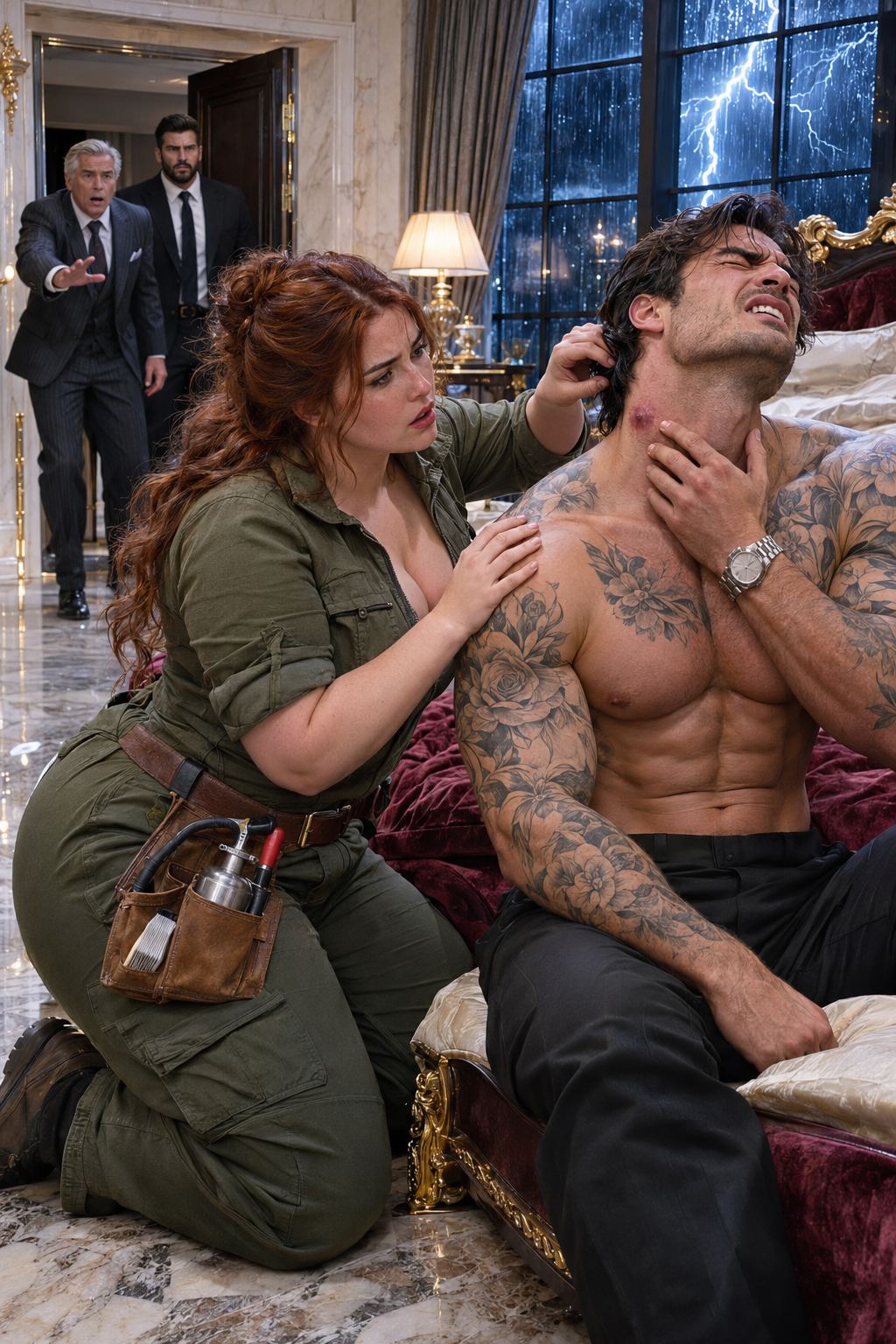
The doctor said nothing.
The emergency lights flickered on, bathing the bedroom in dim red.
Jinarro turned toward the security chief.
“Marco. Lock down the house.”
Marco pressed his earpiece.
“Already trying, sir. The internal communications are down.”
A guard rushed into the room.
“Boss, the backup generator’s been disabled.”
Jinarro’s expression became dangerously calm.
“Disabled?”
“Yes, sir. Someone cut the control wiring.”
I looked at the exposed headboard.
Then at the doctor.
“Interesting timing.”
Bellini stepped backward.
“This is ridiculous. You cannot possibly believe—”
“Marco,” Jinarro interrupted. “Take the doctor downstairs.”
Bellini’s face drained of color.
“Jinarro, listen to me.”
“Now.”
Two guards approached.
But before they could reach him, Bellini pulled a small pistol from inside his medical bag.
Everything happened at once.
A guard lunged.
Bellini fired.
The gunshot exploded through the bedroom.
A mirror shattered.
I threw myself behind an upholstered chair.
Jinarro grabbed Bellini’s wrist and slammed it against the doorframe.
The pistol fell.
Marco kicked it away.
Within seconds, the doctor was pinned to the floor.
His glasses lay broken beside him.
Nobody spoke.
Then Jinarro crouched.
“Why?”
Bellini stared at the carpet.
“Because you should have stayed sick.”
The words seemed to drain the air from the room.
Jinarro went completely still.
“What did you say?”
Bellini closed his eyes.
“You weren’t supposed to start asking questions.”
I felt a cold sensation settle in my stomach.
Five years.
Five years of unexplained pain, sleepless nights, and doctors insisting the most feared man in the city couldn’t trust his own mind.
This wasn’t simply a neglected pest problem.
Someone had built an entire prison around Jinarro Vital.
And convinced him that the prison existed only inside his head.
“Get him out,” Jinarro ordered.
Marco hauled the doctor upright.
But Bellini suddenly began laughing.
It wasn’t a pleasant sound.
“You think finding a few spiders changes anything?”
He looked directly at Jinarro.
“Your father discovered the truth, too.”
Jinarro seized his collar.
“What truth?”
Bellini smiled through bloodied lips.
“Ask your uncle what happened to your mother.”
Jinarro froze.
For the first time since I’d entered the mansion, I saw something worse than anger in his eyes.
Fear.
“My mother died when I was nine.”
Bellini said nothing.
“Car accident,” Jinarro continued.
The doctor tilted his head.
“That’s what they told you.”
Marco dragged him away before Jinarro could reach him again.
For several seconds, the only sound was rain hammering the windows.
Then Jinarro turned toward me.
“Can you open the rest of that headboard?”
I studied the antique wood.
“Yes. But I need better light and proper equipment. And nobody should be sleeping in this room.”
He nodded.
“Whatever you need.”
I hesitated.
“Mr. Vital, you should understand something. Finding spiders doesn’t prove they caused every symptom you’ve experienced. And whatever Bellini did, you need an independent doctor to examine you.”
“I understand.”
“Good.”
He stared at the bed.
“Because I intend to find out what else has been hiding here.”
Twenty minutes later, I was kneeling beside the headboard with a portable work light, a screwdriver, and two sealed collection containers.
The storm had intensified.
The road remained underwater.
And somewhere inside the mansion, a man who had apparently helped destroy Jinarro’s life was being held under guard.
I removed the next panel.
More webs.
More egg sacs.
A dead mouse.
Then something unexpected.
A narrow wooden compartment, concealed behind a false backing.
Inside sat a small black recording device.
Its casing was dusty, but a thin wire connected it to the cylinder I’d discovered earlier.
Marco, who had returned with a battery-powered lamp, leaned forward.
“That’s a surveillance microphone.”
I stared at him.
“You’re telling me somebody bugged a dead man’s bed?”
“Apparently.”
Jinarro took the device carefully.
A tiny label on its underside displayed a serial number.
Marco photographed it.
Then I noticed another detail.
The compartment extended farther into the headboard than it should have.
I tapped the wood.
Hollow.
“There’s another space behind this one.”
Jinarro stepped closer.
“Open it.”
I loosened four screws.
The backing came free.
And something fell into my lap.
A small leather notebook.
Its cover was cracked.
The initials embossed on the front read A.V.
Jinarro made a sound I will never forget.
Not a gasp.
Not a cry.
Something between the two.
“My father’s initials.”
He reached for the notebook with trembling fingers.
Inside were handwritten entries.
Dates.
Names.
Financial figures.
And, on the final pages, increasingly desperate notes.
Jinarro read aloud.
“Salvatore has been moving money through the charitable foundation. I confronted him today. He denied everything.”
He turned the page.
“Bellini insists the crawling sensations are stress. But I found another insect near the bed. I have requested an independent inspection.”
Another page.
“My medication has changed again. I feel weaker every morning.”
Jinarro stopped reading.
His hands were shaking.
I gently took the notebook before he could drop it.
The final entry was dated three days before his father’s death.
The handwriting was uneven.
“If anything happens to me, the evidence is beneath the angel. Do not trust Salvatore. Do not trust Bellini.”
I looked at Jinarro.
“Beneath the angel?”
His eyes moved toward the fireplace.
Above it hung a massive oil painting of a woman in a white dress.
An angel-shaped brooch glittered at her throat.
“My mother,” he whispered.
The painting was beautiful.
But something about its frame bothered me.
There were faint scratches around the lower edge.
Recent scratches.
“Has that painting always been there?”
Jinarro nodded.
“My father refused to move it.”
I stood.
“Then maybe we should.”
Marco and another guard carefully lifted the portrait from its hooks.
Behind it was a small wall safe.
Jinarro stared at it.
“I’ve never seen that before.”
The safe had an old-fashioned combination dial.
Marco examined it.
“We can bring in a locksmith once the roads clear.”
I looked at the notebook again.
There was a number written inside the back cover.
Four digits.
Underneath it, one sentence.
The day she gave me my greatest gift.
I showed Jinarro.
His expression softened.
“My birthday.”
He turned the dial.
The lock clicked.
Inside was a thick envelope, a flash drive, and a photograph.
Jinarro picked up the photograph first.
It showed his mother standing beside a dark-haired man holding a newborn baby.
The man wasn’t his father.
Jinarro stared at the image.
“Who is that?”
Marco leaned closer.
Then his face went pale.
“Sir, that’s Salvatore.”
Jinarro looked as though someone had struck him.
“No.”
On the back of the photograph, written in delicate blue ink, were six words.
Our son deserves to know someday.
The silence that followed felt heavier than the storm.
Jinarro sank into a chair.
“My uncle?”
Nobody answered.
He looked at the photograph again.
“Salvatore is my father?”
I wished I could give him certainty.
But I couldn’t.
“A photograph isn’t proof,” I said gently. “Neither is a message without context.”
Jinarro looked at me.
For a moment, I expected him to explode.
Instead, he nodded.
“Then we’ll find proof.”
Marco connected the flash drive to a disconnected security laptop.
It contained scanned bank records, audio recordings, and several video files.
The first recording showed an elderly man seated at a desk.
Jinarro’s father.
Antonio Vital.
He looked exhausted.
His hands trembled as he adjusted the camera.
“If you’re watching this,” Antonio began, “then I failed to protect you.”
Jinarro leaned forward.
Antonio continued.
“Salvatore has been stealing from the foundation for years. When I discovered the transfers, he threatened to expose a secret about your birth.”
Jinarro gripped the edge of the desk.
“Your mother loved me,” Antonio said. “But before our marriage, she had a relationship with my brother. When she became pregnant, neither of us knew with certainty who your biological father was.”
Jinarro closed his eyes.
“I chose to raise you because you were my son in every way that mattered.”
My throat tightened.
Antonio paused, struggling for breath.
“I never wanted your life defined by a question of blood.”
The video flickered.
“Your mother died after discovering Salvatore’s financial crimes. The official investigation called it an accident. I no longer believe that conclusion.”
Jinarro’s eyes opened.
Antonio leaned closer to the camera.
“I’ve hidden the evidence. If I survive long enough, I’ll take it to the authorities.”
The recording ended.
Nobody moved.
Then Jinarro whispered, “He knew.”
I sat beside him.
“He loved you.”
Jinarro covered his face.
For several seconds, the man who controlled half the city’s criminal underworld cried like a child.
And nobody dared look away.
Eventually, he wiped his eyes.
“Marco. Bring Salvatore here.”
Marco hesitated.
“Sir, he’s not in his rooms.”
Jinarro looked up.
“What?”
“We checked the east wing after the power failure. His guards are gone.”
A distant explosion shook the mansion.
The windows rattled.
Somewhere downstairs, an alarm began screaming.
Marco’s radio crackled.
“Fire in the east corridor! Someone’s trying to reach the garage!”
Jinarro stood.
“Salvatore.”
I grabbed his arm.
“Wait.”
He turned.
“Doraththa—”
“If your uncle has been hiding this for five years, he knows more about this house than you do. Running after him blindly is exactly what he wants.”
Jinarro stared at me.
Then he looked toward Marco.
“Get everyone away from the fire. Call emergency services again.”
Marco nodded and hurried out.
I glanced at the open headboard.
Something still bothered me.
The footsteps inside the wall.
The disabled generator.
The microphone.
Then I remembered the floor plan I’d seen in the maintenance folder.
“Jinarro, where does the old servants’ passage lead?”
He frowned.
“What passage?”
I pulled out the folder.
A faded architectural drawing showed a narrow corridor running behind the upstairs bedrooms.
One entrance opened near the east wing.
Another led to the old cellar.
And a third ended directly behind Antonio’s headboard.
Jinarro stared.
“My father never told me about that.”
“Maybe he didn’t know.”
I traced the route with my finger.
“Or maybe somebody made sure he couldn’t use it.”
A muffled thud came from behind the wall.
We looked at each other.
Then a woman’s voice whispered through the wood.
“Help me.”
I froze.
Jinarro grabbed the flashlight.
“Who’s there?”
No answer.
Then another whisper.
“Please.”
I pressed my ear against the panel.
The voice sounded weak.
Terrified.
And very close.
“There’s someone trapped back there.”
Jinarro called for a guard.
Together, we removed the remaining wooden backing.
Behind it was a narrow access hatch.
A stale wave of air rolled into the bedroom.
I shone my flashlight through.
A woman lay on the stone floor of the passage.
Her wrists were bound.
Her face was bruised.
She looked about sixty.
Jinarro dropped to his knees.
“Maria?”
The woman began crying.
“Jinarro.”
He crawled through the opening and cut her restraints with a pocketknife.
I helped him pull her into the bedroom.
She was shaking violently.
“Who is she?” I asked.
“My childhood nanny. She disappeared after my father died.”
Maria clutched Jinarro’s shirt.
“I didn’t disappear. Salvatore took me.”
Jinarro stared at her.
“For five years?”
She nodded.
“He kept me in a property outside the city. He brought me here tonight because he thought I knew where Antonio hid the recordings.”
I felt sick.
Maria’s eyes moved toward the open safe.
Then she began sobbing harder.
“Antonio tried to save you. He knew they were poisoning him.”
Jinarro went rigid.
“Poisoning?”
“Bellini changed his medication. Salvatore made sure no one questioned it.”
She looked at the bed.
“And when you began complaining about the same crawling sensations, they used the spiders to convince everyone you were losing your mind.”
I felt a chill.
“Did they deliberately introduce the infestation?”
Maria nodded uncertainly.
“I heard Salvatore tell Bellini to keep the room exactly as it was. He said the insects were useful.”
I looked toward the headboard.
The infestation was real.
But the suffering it caused had become a weapon.
Not because spiders obeyed anyone.
Because frightened people could be manipulated into believing they were helpless.
Suddenly, footsteps thundered outside.
Marco appeared.
“Sir! Salvatore has taken the south garage. He’s holding two staff members hostage.”
Jinarro stood.
His expression turned cold.
“Where?”
“Near the underground exit.”
I grabbed my equipment case.
“Then we need another way down.”
Marco looked at me.
“Why are you bringing that?”
“Because unlike you gentlemen, I actually know how to navigate a filthy crawlspace.”
Neither man laughed.
I considered that a compliment.
The servants’ passage was barely three feet wide.
It smelled of mildew, dust, and old insulation.
My knees protested immediately.
Being a plus-size woman in a narrow tunnel wasn’t glamorous.
But I’d spent years learning how to move through spaces designed by people who apparently believed all maintenance workers were built like broomsticks.
I knew how to shift my weight.
How to brace my shoulders.
How to keep breathing when the walls felt too close.
Jinarro followed behind me.
Marco stayed upstairs to coordinate the evacuation.
Halfway through the passage, we heard voices beneath us.
Salvatore.
“You should have destroyed the notebook years ago!”
Another man answered.
“We thought the room was secure.”
Bellini.
I stopped.
Jinarro nearly collided with my boots.
Through a ventilation grille, we could see the garage below.
Salvatore stood beside a black SUV.
Bellini was with him.
Two terrified housekeepers knelt nearby.
A guard lay unconscious against the wall.
Salvatore held a pistol.
Bellini carried a small metal case.
Jinarro’s face hardened.
“How did Bellini get free?”
I whispered, “Doesn’t matter. We need to get those women out.”
There was a maintenance ladder leading to a storage room beside the garage.
I pointed toward it.
“If we can reach that room, there’s a fire alarm and an emergency door.”
Jinarro looked at me.
“You’ve been here less than three hours.”
“I read building plans. It’s a habit.”
We crawled toward the ladder.
Then the old wooden support beneath my knee cracked.
I dropped several inches.
The passage groaned.
Jinarro grabbed the back of my work jacket.
“Doraththa!”
“I’m fine!”
The wood split farther.
For one terrifying second, I felt the floor give way.
Then Jinarro pulled me backward with both hands.
We collapsed against the wall.
My heart hammered.
“Are you hurt?” he asked.
“Only my dignity.”
He gave a breathless laugh.
It was the first genuine laugh I’d heard from him.
Then we kept moving.
The storage room was dark.
I descended the ladder and found the emergency exit.
Locked.
Of course.
I searched the shelves.
Old cleaning supplies.
Paint cans.
A rusted toolbox.
Then I spotted a red fire extinguisher.
I checked its gauge.
Still pressurized.
Jinarro climbed down.
“What are you planning?”
“Something extremely unprofessional.”
I positioned myself beside the garage door.
Through the narrow window, I could see Salvatore pacing.
Bellini was arguing with him.
“We need to leave now,” Bellini hissed.
“Not without the drive,” Salvatore snapped.
“The police are coming!”
Salvatore grabbed him by the throat.
“You told me the boy would never recover!”
Jinarro’s expression changed.
The boy.
Even now, Salvatore couldn’t bring himself to call him by his name.
I whispered, “When I open the door, get the hostages behind cover.”
Jinarro nodded.
I pulled the fire alarm.
A piercing siren erupted through the garage.
Salvatore spun around.
“What the hell?”
I kicked the door open and discharged the extinguisher toward the floor between him and the hostages.
A white cloud swallowed the space.
The housekeepers screamed.
Jinarro rushed forward.
“Get down!”
A gunshot cracked.
Concrete shattered beside the doorway.
I ducked.
Another shot.
Then a heavy impact.
When the powder began settling, Jinarro had tackled Salvatore behind the SUV.
The pistol skidded across the floor.
Bellini ran toward the exit.
I stepped into his path.
He stared at me.
“Move!”
I raised the extinguisher.
“Doctor, I have had a very long night.”
He lunged.
I swung the metal cylinder into his shoulder.
He stumbled and fell against a stack of tires.
Before he could rise, Marco burst through the side entrance with three guards.
“Hands where I can see them!”
Bellini froze.
Across the garage, Salvatore struggled beneath Jinarro.
“You ungrateful bastard!” he shouted.
“Everything you have exists because of this family!”
Jinarro pinned his wrist.
“You killed my father.”
Salvatore laughed bitterly.
“Your father was weak.”
Jinarro’s fist tightened.
For a moment, I thought he would kill him.
And I knew nobody in that garage would stop him.
“Jinarro,” I said.
He didn’t look at me.
“Jinarro, listen.”
Salvatore spat blood.
“Do it. Prove you’re a Vital.”
Jinarro raised his fist.
I stepped closer.
“Your father spent his last days trying to protect the truth. Don’t let this man decide who you become.”
His arm trembled.
Salvatore smiled cruelly.
“You think mercy makes you strong?”
Jinarro slowly lowered his fist.
“No,” he said. “But choosing what happens next does.”
He stood and stepped away.
“Marco. Restrain him. Keep the evidence secure for the police.”
Salvatore’s smile vanished.
“You can’t do this!”
Jinarro looked down at him.
“I just did.”
By dawn, the storm had weakened.
Police vehicles lined the driveway.
Paramedics treated Maria and the injured guard.
The two housekeepers were safe.
Bellini and Salvatore had been taken into custody.
The flash drive, notebook, surveillance equipment, and maintenance records were secured as evidence.
Investigators would still need to determine exactly what had happened to Antonio Vital and whether the earlier deaths and medical records had been falsified.
But for the first time in five years, the truth had somewhere to go besides a locked bedroom.
An independent physician examined Jinarro and arranged further testing for possible spider bites, medication effects, and other causes of his symptoms.
Nobody called him crazy.
Nobody told him to stop asking questions.
And nobody tried to force him back into that bed.
I was packing my equipment when Jinarro found me in the entrance hall.
He looked exhausted.
His expensive shirt was torn.
There was dried blood on his knuckles.
But something about him had changed.
He looked lighter.
“Doraththa.”
I turned.
“If you’re about to complain about the damage to the headboard, I’m going to need a lawyer.”
He smiled.
A real smile.
“I wanted to thank you.”
“You can thank me by paying the invoice.”
“I intend to.”
He handed me an envelope.
Inside was a check.
I looked at the amount.
Then looked again.
“Mr. Vital, I remove pests. I don’t purchase small islands.”
“You saved my life.”
I shook my head.
“I found an infestation. The rest happened because you finally listened.”
He studied me.
“Most people in this house were afraid to contradict Bellini.”
“I’ve been underestimated my entire life,” I replied. “After a while, you stop waiting for permission to be right.”
His eyes softened.
“Was it difficult?”
I laughed.
“Being a woman in pest control? Being plus-size? Walking into houses where customers ask when the real technician is arriving?”
He looked embarrassed.
“I’m sorry.”
“Don’t be. You weren’t the one asking.”
I closed my equipment case.
“But I’ll tell you something. People see my body before they see my work. They decide what I can do before I’ve even opened my toolbox.”
I glanced toward the staircase.
“Your doctor did the same thing to you. He decided what your pain meant before he bothered to look for a cause.”
Jinarro nodded slowly.
“Different reasons. Same mistake.”
“Exactly.”
He looked toward the portrait of his mother, now resting against the wall.
“There’s something else I need to ask.”
I waited.
“What if Salvatore really is my biological father?”
The question hung between us.
I thought about Antonio’s video.
The trembling hands.
The tired eyes.
The man who had hidden evidence in his own bedroom because he was desperate to protect a son he loved.
“Then you’ll have learned something about your biology,” I said. “Not about your worth.”
Jinarro swallowed.
“Antonio raised me.”
“He loved you.”
“He protected me.”
“He tried.”
Jinarro looked down.
“I spent five years thinking he’d abandoned me. Thinking he’d died because I wasn’t strong enough to save him.”
I stepped closer.
“Your father left you something more important than a fortune.”
“What?”
“The truth that you were loved without conditions.”
For a long moment, he said nothing.
Then he nodded.
Three months later, I received a letter.
Not an email.
Not a phone call.
An actual handwritten letter on thick cream-colored paper.
It was from Jinarro.
The investigations were continuing.
Salvatore and Bellini faced serious charges, and authorities were reviewing Antonio’s death and the circumstances surrounding Jinarro’s mother’s fatal crash.
Independent testing had also identified evidence that Jinarro’s prescribed medications had been improperly altered.
His doctors were helping him recover.
The mansion’s entire pest-control system had been replaced.
The antique bed had been removed for evidence processing.
And Jinarro had moved into a smaller house overlooking the sea.
But that wasn’t the part that made me cry.
The final paragraph read:
Doraththa, I spent most of my life believing power meant making people fear me. My father tried to teach me otherwise, but I was too angry to listen. You reminded me that real strength means protecting people, even when nobody is watching. I’ve begun dismantling the criminal operations I inherited and cooperating with investigators. It won’t erase what I’ve done, but I intend to spend the rest of my life doing better.
I also established a foundation in Antonio’s name to provide independent medical evaluations for people whose symptoms have been dismissed, along with training scholarships for women entering skilled trades.
The first scholarship bears your name. I hope you don’t mind.
I sat at my kitchen table, staring at those words.
Then I laughed.
Then I cried.
Because for years, people had treated me like I was too big, too loud, too ordinary to matter.
I’d been told to choose a more feminine profession.
I’d been laughed at when I climbed ladders.
I’d been ignored when I warned property owners about dangers they didn’t want to acknowledge.
And yet, one rainy night, inside a mansion filled with powerful men, the person who noticed the truth was the woman everyone had underestimated.
A week later, Jinarro invited me to the foundation’s opening ceremony.
I almost didn’t go.
Fancy events weren’t my thing.
I owned exactly one formal dress, and it had been hanging in my closet since my cousin’s wedding.
But I went.
And when Jinarro introduced me, he didn’t call me brave.
He didn’t call me extraordinary.
He simply said, “This is Doraththa. She’s the professional who saw what the rest of us refused to see.”
The room applauded.
I looked at the young women sitting in the front row, recipients of the first training scholarships.
One of them was a plus-size girl with nervous eyes and tightly clasped hands.
After the ceremony, she approached me.
“Miss Doraththa?”
“Yes, sweetheart?”
She hesitated.
“Do you really think someone who looks like me can do this kind of work?”
I looked at her.
And suddenly, I saw myself twenty years earlier.
The same uncertainty.
The same fear of being laughed at.
The same desperate hope that someone might finally say yes.
I took her hands.
“Listen carefully. Your body is not an apology. Your appearance is not a qualification. And your dreams don’t require permission from people who have never had the courage to pursue their own.”
Her eyes filled with tears.
“Then what do I need?”
I smiled.
“Good training. The right equipment. Patience. And the courage to trust what you know.”
She hugged me.
And in that moment, I understood something that had taken me most of my life to learn.
I hadn’t walked into Jinarro Vital’s mansion to become a hero.
I’d gone there to do a job.
To inspect a problem.
To find the source.
To refuse to ignore what was right in front of me.
But sometimes, doing your job with integrity becomes the very thing that changes someone’s life.
And sometimes, the person everyone overlooks is the only one willing to look closely enough.
As I drove home that evening, my phone rang.
It was Jinarro.
“Doraththa,” he said, “I have a question.”
I smiled.
“Please tell me it’s not about spiders.”
He laughed.
“No. It’s about my father.”
“What about him?”
“I’ve been thinking about his last recording. He said he chose to raise me because I was his son in every way that mattered.”
I waited.
“Do you think he knew I’d eventually find it?”
I watched the sunset spread across the road ahead.
“I don’t know, Jinarro.”
There was a pause.
“But I think he hoped you would.”
He was quiet for a long time.
Then he whispered, “Thank you.”
When the call ended, I drove the rest of the way home with the windows down.
For once, the world felt peaceful.
And I thought about that antique bed.
For five years, it had held spiders, secrets, and the evidence of a terrible betrayal.
But the greatest danger in that room had never been the creatures crawling beneath the wood.
It had been the people who convinced a suffering man that his pain wasn’t real.
The people who used authority to silence questions.
The people who mistook fear for loyalty and control for love.
I learned something that night, and I’ve carried it with me ever since.
Never let someone’s title make you doubt what your own eyes can see. Never let someone’s judgment convince you that your worth is smaller than it is. And never underestimate the power of one ordinary person who refuses to look away.
Because sometimes, the truth doesn’t arrive with a badge, a fortune, or an impressive name.
Sometimes, it arrives wearing muddy work boots, carrying a flashlight, and refusing to leave until the job is done.
And sometimes, saving a life begins with something as simple as believing someone when they say they’re hurting.
The story has already reached its conclusion, but there was one final chapter I hadn’t expected.
Six months after that terrible night at the Vital mansion, I received a package with no return address.
Inside was a small wooden box.
And beneath its velvet lining was a letter written in Antonio Vital’s handwriting.
My hands trembled as I unfolded it.
The letter was addressed to whoever had finally uncovered the secrets hidden inside his bedroom.
Its final sentence made my eyes fill with tears.
“If you are reading this, then someone was brave enough to question what everyone else accepted. Please tell my son that the greatest inheritance I could ever leave him was not my wealth, but the freedom to become a better man than I was.”
I called Jinarro immediately.
He arrived at my workshop an hour later.
For several minutes, he simply held the letter without speaking.
Then he looked at me.
“I used to think my father left me an empire,” he whispered.
“And now?”
He smiled through his tears.
“He left me a choice.”
That evening, Jinarro made a decision that surprised the entire city.
He announced that the remaining criminal businesses connected to the Vital family would be shut down or surrendered to the authorities, and that he would accept responsibility for his own past.
It cost him his fortune, his influence, and many of the people who had once called themselves his friends.
But he didn’t regret it.
A year later, I visited him at the modest home where he now lived.
There were no armed guards.
No surveillance cameras watching every doorway.
No doctors telling him what he was allowed to feel.
Just a little garden, a wooden porch, and a photograph of Antonio Vital hanging above the fireplace.
Jinarro made us coffee.
Then he told me something I will always remember.
“Doraththa, I spent years believing that being feared meant being powerful. But the first night I truly felt safe was the night someone finally believed me.”
I looked at the photograph of his father.
Then at the man sitting across from me.
He wasn’t the same person I’d met during that thunderstorm.
And neither was I.
Because I’d finally stopped measuring my worth by how other people treated me.
I knew what I could do.
I knew what I had accomplished.
And I knew that being underestimated had never made me less capable.
Before I left, Jinarro walked me to my truck.
“Do you ever wonder what would have happened if you hadn’t noticed those spiders?” he asked.
I considered the question.
“Yes,” I admitted. “But I try not to live inside the things that might have happened.”
“Then what do you live by?”
I smiled.
“Pay attention. Tell the truth. Do the right thing, even when nobody thanks you.”
He nodded.
And as I drove away, I realized that was the real ending to our story.
Not the arrests.
Not the hidden inheritance.
Not even the secrets uncovered behind an antique headboard.
It was the fact that two people who had spent years being defined by other people’s judgments had finally learned to define themselves.
Because the greatest freedom in life isn’t having power over others. It’s having the courage to face the truth, take responsibility for your choices, and become someone you can respect when nobody else is watching.
And that is something no amount of money, fear, or influence can ever buy.
THE END.