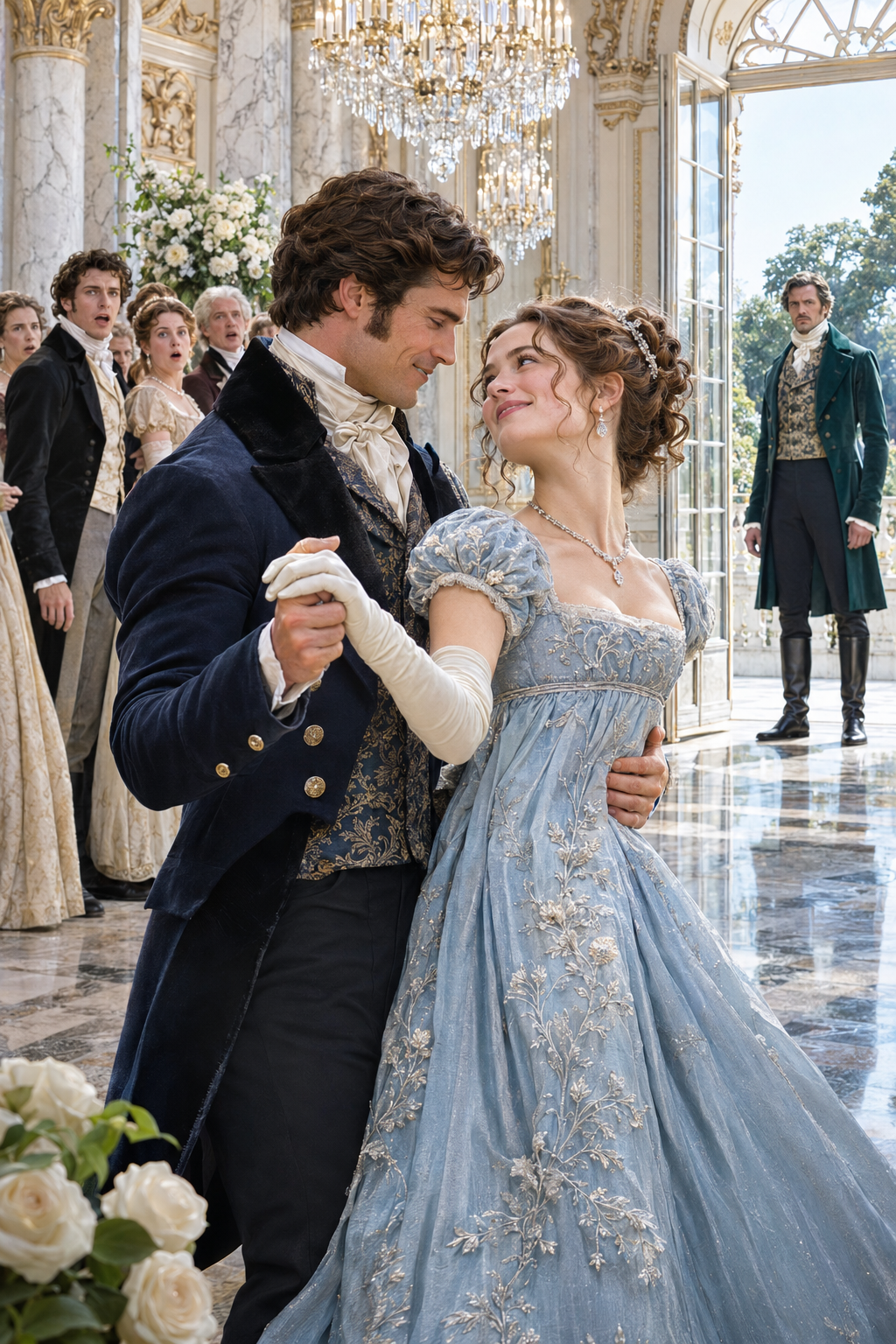
The lord tipped his glass, and red punch spilled down Oliver Ashdown’s white waistcoat. Then he laughed.
Diana’s heart began to pound as Theodore Ashdown, Duke of Westford, waited for her answer.
She had heard stories about him. Some called him the coldest gentleman in England. Others claimed he could ruin a family’s reputation with a single word. His fortune was immense, his influence unquestionable, and his patience notoriously short.
Yet the man standing before her did not look angry.
He looked troubled.
“Of course, Your Grace,” Diana replied, carefully lowering her eyes.
Theodore offered his arm, but she hesitated.
Across the ballroom, Oliver stood beside the musicians, still smiling to himself as he attempted to remember the steps of their dance.
“Will your brother be all right?” she asked.
Theodore followed her gaze.
“He will be better than he has been in years.”
Something softened in his voice.
Then he led her toward a quiet conservatory adjoining the ballroom.
Behind them, Lord Pembroke watched with narrowed eyes.
He had expected the Duke to reprimand the foolish young woman. Instead, Theodore appeared almost protective of her.
And Pembroke did not like surprises.
Inside the conservatory, moonlight fell across marble statues and flowering orange trees.
Theodore waited until the doors closed before speaking.
“Miss Croft, do you understand what you have done tonight?”
Diana straightened.
“If you intend to tell me that I have embarrassed your family, Your Grace, I assure you that was never my intention.”
“Embarrassed my family?”
His eyebrows rose.
“You defended my brother when everyone else chose to laugh at him.”
“Someone had to.”
“Why?”
The question startled her.
“Because he was being treated cruelly.”
“That is not an answer society usually considers sufficient.”
“Then perhaps society should reconsider its standards.”
For the first time that evening, Theodore smiled.
It was a small expression, almost reluctant, but it transformed his severe features.
“My brother has struggled since childhood,” he explained. “He understands the world differently. He sometimes needs more time to find his words, and unfamiliar situations can overwhelm him. People mistake these difficulties for a lack of intelligence.”
Diana listened without interrupting.
“After our parents died, I promised to protect him. I believed that keeping him away from unkind people was the only way.”
“And has that made him happy?”
Theodore looked toward the ballroom.
“No.”
“Then perhaps protection is not always the same as kindness, Your Grace.”
Her words struck him more deeply than she realized.
For years, Theodore had surrounded Oliver with servants, tutors, and carefully selected companions. He had given him everything except the freedom to experience the world.
Tonight, a stranger had shown him what was missing.
“I would like to offer you a position,” Theodore said.
Diana blinked.
“A position?”
“As my brother’s companion. Someone to accompany him to social engagements, encourage his interests, and help him gain confidence.”
She stared at him.
“Your Grace, I am not a governess.”
“I am aware.”
“Nor am I seeking employment through a ballroom acquaintance.”
“I meant no insult.”
“Then why offer it?”
Theodore hesitated.
“Because my brother trusted you within five minutes of meeting you. That is something I have not witnessed in years.”
Diana’s expression softened.
But before she could answer, the conservatory doors opened.
Lord Pembroke entered, followed by Lady Harcourt, the evening’s hostess.
“Your Grace,” Pembroke said smoothly. “Forgive the interruption, but I fear there is a delicate matter requiring your attention.”
Theodore’s face hardened.
“Speak.”
Pembroke glanced at Diana.
“It concerns Miss Croft’s father.”
The color drained from her cheeks.
“My father?”
“I understand he has recently been accused of misappropriating funds from the charitable trust administered by my family.”
Diana took a step backward.
“That is a lie.”
Pembroke sighed theatrically.
“I had hoped to spare you this embarrassment.”
“You know perfectly well my father is innocent.”
“Then perhaps you can explain why three thousand pounds have disappeared from the trust accounts.”
Theodore turned toward her.
“Is this true?”
Diana’s throat tightened.
Her father, Edmund Croft, had served as the trust’s secretary for twelve years. Three months earlier, irregularities had appeared in the accounts.
Edmund insisted that someone had altered the records.
But he possessed neither the money nor the influence to prove it.
Since then, creditors had begun appearing at their door, and former friends had stopped visiting.
“The money is missing,” Diana admitted. “But my father did not take it.”
Pembroke folded his arms.
“An admirable display of filial loyalty.”
“Enough,” Theodore said.
The single word silenced the room.
He looked at Pembroke.
“Has Mr. Croft been charged?”
“Not yet.”
“Then I suggest you refrain from presenting accusations as established facts.”
Pembroke’s smile tightened.
“Naturally, Your Grace.”
Theodore turned back to Diana.
“My offer remains.”
She stared at him in disbelief.
“You would employ the daughter of a suspected thief?”
“I would employ a woman who showed more honor in one evening than most of my acquaintances have demonstrated in a lifetime.”
For a moment, Diana could not speak.
Then she lifted her chin.
“I will consider your proposal.”
Pembroke’s eyes darkened.
He had intended to humiliate her.
Instead, he had brought her closer to the one man capable of threatening everything he had carefully concealed.
Three days later, Diana arrived at Westford House.
The mansion stood behind imposing iron gates in one of London’s most fashionable squares. Its marble entrance hall was larger than the entire ground floor of her father’s modest home.
Yet wealth was not what impressed her.
It was the sound of laughter.
Oliver came hurrying down the staircase, nearly stumbling in his excitement.
“Miss Croft! You came!”
“I promised I would.”
“Do you think we might dance again?”
“Certainly. But perhaps we should begin with a walk.”
Oliver considered this seriously.
“That sounds sensible.”
From the upper landing, Theodore watched them.
He had expected Diana to be intimidated by the grandeur of his household.
Instead, she appeared entirely comfortable discussing the weather with Oliver while ignoring the astonished servants.
Over the following weeks, something remarkable happened.
Oliver began leaving the house more often.
Diana accompanied him to bookshops, gardens, and small musical performances. She discovered that he possessed an extraordinary memory for melodies and could reproduce complicated compositions after hearing them only twice.
One afternoon, she found him sitting alone at the pianoforte.
“Would you play something for me?” she asked.
Oliver shook his head.
“People laugh when I make mistakes.”
“Then they are listening for the wrong things.”
He studied her face.
“You will not laugh?”
“Never at your mistakes.”
Slowly, he placed his fingers on the keys.
The music that followed was breathtaking.
Diana stood motionless as a delicate melody filled the drawing room.
Unbeknownst to either of them, Theodore had stopped outside the open door.
He listened in astonishment.
His brother had been given piano lessons as a child, but the tutors had declared him incapable of serious musical study.
Now Oliver was playing a composition of astonishing beauty.
When the final note faded, Diana whispered, “Oliver, did you compose that yourself?”
He nodded shyly.
“I hear music in my head sometimes.”
Theodore stepped into the room.
“Why have you never told me?”
Oliver looked frightened.
“Father said it was foolish. He said gentlemen should concern themselves with important matters.”
Theodore felt an old wound reopen.
Their father had been a stern man who considered Oliver an embarrassment.
Theodore had spent years trying to compensate for that cruelty.
Yet he had unknowingly continued part of the same pattern, deciding what Oliver could and could not accomplish.
“Then Father was wrong,” Theodore said quietly.
Oliver stared at him.
“Truly?”
“Truly.”
Diana watched the brothers embrace.
For the first time, she understood that beneath Theodore’s formidable exterior lived a man carrying more guilt than pride.
And that realization frightened her.
Because she was beginning to care for him.
Their growing closeness did not go unnoticed.
Lady Beatrice Langley, a wealthy widow who had long hoped to become the next Duchess of Westford, began visiting more frequently.
She was beautiful, elegant, and possessed a talent for making insults sound like compliments.
“Miss Croft,” she remarked one afternoon, “how fortunate that His Grace has provided you with respectable employment. I imagine your circumstances have been terribly difficult.”
Diana smiled politely.
“His Grace has been generous.”
“Indeed. Though one must be careful that generosity is not mistaken for affection.”
Theodore entered just in time to hear the remark.
“Affection is not something I consider shameful, Lady Beatrice.”
The widow’s smile faltered.
“Naturally, Your Grace.”
He turned toward Diana.
“Would you join me in the library? There is something I wish to show you.”
The library contained thousands of books, but Theodore led her to a small writing desk.
Upon it lay several sheets of music.
“Oliver’s compositions,” he explained. “I have arranged for a respected music master to examine them.”
Diana’s eyes brightened.
“He will be delighted.”
“He has you to thank.”
“No, Your Grace. He has always possessed the gift. He merely needed someone to listen.”
Theodore studied her.
“You have a habit of making extraordinary things sound simple.”
“And you have a habit of making simple things unnecessarily difficult.”
He laughed.
It was a warm, genuine sound.
Diana realized she had never heard it before.
Their eyes met.
For one dangerous moment, neither looked away.
Then Theodore stepped closer.
“Diana…”
A knock interrupted them.
The butler appeared, carrying a sealed letter.
“Forgive me, Your Grace. This has arrived from Lord Pembroke’s solicitor.”
Theodore broke the seal.
As he read, his expression changed.
“What is it?” Diana asked.
He hesitated.
“Your father has been arrested.”
The world seemed to tilt beneath her feet.
“No.”
“I am afraid so.”
Diana snatched the letter from his hand.
The accusation was explicit.
Edmund Croft had allegedly forged signatures, falsified financial records, and stolen three thousand pounds intended for widows and orphaned children.
A hearing had been scheduled.
Unless the missing funds could be accounted for, he faced imprisonment and disgrace.
Diana gripped the desk.
“My father would sooner starve than steal from children.”
“I believe you.”
She looked up.
“Then help me prove it.”
Theodore did not hesitate.
“I will.”
That evening, he summoned his solicitor, Mr. Whitcombe.
Together, they examined every document Diana possessed.
Receipts, correspondence, account books, and copies of letters covered the library table.
For hours, they found nothing.
Then Diana noticed something peculiar.
One receipt bore her father’s signature beside a payment authorized on the fifteenth of March.
“That cannot be right,” she whispered.
Theodore leaned closer.
“Why?”
“My father was ill that week. He never left our house.”
“Could someone have brought the document to him?”
“No. He could barely hold a spoon.”
Whitcombe examined the signature.
“It is remarkably convincing.”
Diana shook her head.
“But it is not his.”
She pointed to the final letter.
“My father always finishes his name with an upward stroke. This one curves downward.”
Theodore studied the document.
A faint smile appeared.
“Miss Croft, I believe you have just given us our first real clue.”
Their investigation led them to the charitable trust’s former clerk, Samuel Briggs.
Briggs had disappeared shortly after the financial irregularities were discovered.
Pembroke claimed the man had emigrated to America.
But Theodore’s inquiries revealed that Briggs had recently been seen near a coaching inn outside London.
Theodore intended to investigate alone.
Diana refused.
“This concerns my father.”
“And it may be dangerous.”
“Then you had better ensure I remain safe.”
He stared at her.
“Do you always argue with dukes?”
“Only when they are being unreasonable.”
Despite himself, Theodore smiled.
The following morning, they traveled together in an unmarked carriage.
At the coaching inn, they discovered Briggs hiding in a small upstairs room.
The man looked exhausted and terrified.
When Theodore introduced himself, Briggs attempted to flee.
Diana stepped into his path.
“Mr. Briggs, an innocent man may go to prison because of what you know.”
Briggs froze.
“You do not understand.”
“Then explain it.”
He glanced toward the window.
“If I speak, Pembroke will destroy me.”
Theodore’s expression darkened.
“What has Lord Pembroke done?”
Briggs sank into a chair.
“The money was never stolen by Mr. Croft.”
Diana’s breath caught.
“Who took it?”
“Pembroke.”
Silence filled the room.
Briggs continued in a shaking voice.
“His lordship had accumulated enormous gambling debts. He ordered me to transfer the trust’s money into an account controlled by one of his associates.”
“Why did you obey?” Theodore demanded.
“Because he threatened my wife and children.”
Briggs covered his face.
“Afterward, he made me forge Mr. Croft’s signature.”
Diana felt both relief and fury.
“Will you testify?”
Briggs shook his head violently.
“He has men watching my family.”
Theodore leaned forward.
“Then I will place your family under my protection.”
Briggs looked up.
“You would do that?”
“Yes. But you must tell the truth.”
For several moments, the clerk remained silent.
Then he nodded.
“I will testify.”
Diana nearly wept.
But their relief lasted only minutes.
As they descended the inn’s staircase, a stable boy rushed through the entrance.
“Your Grace! Someone has cut the carriage harness!”
Theodore immediately turned toward Diana.
“Stay inside.”
Before she could answer, a gunshot shattered the morning air.
Glass exploded beside them.
Theodore seized Diana and pulled her behind a heavy wooden counter.
A second shot struck the doorframe.
Screams erupted from the courtyard.
Theodore drew a small pistol from his coat.
“Remain here.”
Diana caught his sleeve.
“Do not leave me.”
Their eyes met.
For an instant, the danger surrounding them disappeared.
“I will come back,” he promised.
Then he stepped outside.
The next few minutes passed in terrifying confusion.
Diana heard shouting, pounding footsteps, and the crash of something heavy against the stable doors.
When silence finally fell, she ran into the courtyard.
Theodore stood beside the carriage, blood staining his sleeve.
“Theodore!”
She rushed toward him.
“It is only a graze,” he said.
But her hands trembled as she examined the wound.
“You could have been killed.”
His expression softened.
“So could you.”
Without thinking, she embraced him.
Theodore went still.
Then his uninjured arm closed around her.
For one stolen moment, neither cared who might be watching.
“I thought I had lost you,” Diana whispered.
Theodore lowered his face toward her hair.
“And I discovered that the thought of losing you frightens me more than anything else in this world.”
She lifted her head.
Their lips were inches apart.
Then Briggs appeared in the doorway.
“Your Grace, we must leave. One of the attackers escaped.”
Theodore reluctantly released her.
But something between them had changed forever.
Back in London, the evidence against Pembroke began to accumulate.
Whitcombe located the bank records.
Briggs provided a sworn statement.
And Theodore discovered that Pembroke had recently sold several valuable properties to conceal his financial ruin.
Yet Pembroke was far from defeated.
Two nights before Edmund Croft’s hearing, Diana received a letter.
It contained only a few lines.
“If you wish your father to live long enough to clear his name, come alone to the abandoned chapel on Blackthorn Road. Tell the Duke nothing.”
Diana stared at the paper.
She knew it was a trap.
But the threat against her father was too terrible to ignore.
She considered telling Theodore.
Then she remembered the blood on his sleeve.
If Pembroke was desperate enough to order an attack in daylight, what might he do to Theodore next?
That night, Diana slipped from Westford House.
She left a note explaining that she had gone to protect her father, but deliberately omitted her destination.
The abandoned chapel stood beyond the city, surrounded by overgrown trees.
Inside, a single lantern burned.
Pembroke waited beside the altar.
“Miss Croft. How touching that you came.”
“Where is my father?”
“Quite safe, for the moment.”
“What do you want?”
Pembroke smiled.
“Your cooperation.”
He produced a document.
“You will sign a statement declaring that Samuel Briggs confessed to inventing his accusations against me. You will also claim that the Duke offered him money to provide false testimony.”
Diana stared at him.
“You intend to destroy Theodore.”
“I intend to preserve my reputation.”
“And if I refuse?”
Pembroke’s smile vanished.
“Your father will suffer an unfortunate accident before his hearing.”
Diana’s blood turned cold.
“You are a monster.”
“Perhaps. But a practical one.”
He placed a pen before her.
“Sign.”
Diana looked at the document.
Every instinct urged her to refuse.
But her father’s life hung in the balance.
Slowly, she reached for the pen.
Then a familiar voice sounded from the chapel entrance.
“Do not touch that paper, Diana.”
Theodore stood beneath the ruined archway.
Beside him were Whitcombe, two constables, and Oliver.
Diana stared.
“Oliver?”
Her young friend smiled nervously.
“I saw you leaving. You looked frightened, so I told Theodore.”
Pembroke stepped backward.
“This is a private conversation.”
“Not anymore,” Theodore replied.
Pembroke suddenly seized Diana, dragging her against him.
A pistol appeared in his hand.
“Stay where you are!”
The constables froze.
Theodore’s face turned white.
“Release her.”
“Put down your weapons.”
Theodore slowly placed his pistol on the floor.
Pembroke tightened his grip.
“You think your title makes you untouchable, Westford? You think everyone must bow before you?”
“No,” Theodore answered. “I think you have mistaken fear for respect.”
Pembroke pressed the pistol closer to Diana.
“One more word and she dies.”
From the shadows near the side aisle, Oliver watched the scene unfold.
His hands were trembling.
Loud voices frightened him. Sudden violence made it difficult to think.
But he saw Diana’s terrified face.
He remembered the ballroom.
He remembered her hand reaching for his when everyone else had turned away.
And he knew he could not abandon her.
Quietly, Oliver moved toward the old bell rope hanging beside a cracked stone pillar.
He pulled with all his strength.
The enormous chapel bell rang.
Its thunderous sound startled everyone.
Pembroke flinched.
Diana twisted free.
Theodore lunged forward.
The pistol discharged, sending a bullet into the ceiling.
Dust and broken plaster rained down.
A moment later, Pembroke lay pinned beneath Theodore while the constables seized his weapon.
Diana collapsed against a pew.
Oliver rushed toward her.
“Did I do the right thing?”
She caught his hands.
“You saved my life.”
Oliver’s eyes filled with tears.
“I was afraid.”
“So was I.”
“But I did it anyway.”
Diana embraced him.
“That is what courage means.”
Theodore approached slowly.
His face was pale, and his hands were shaking.
For several seconds, he simply looked at Diana.
Then he knelt before her.
“I nearly lost you.”
She touched his cheek.
“I am here.”
“Do not ever believe you must face danger alone.”
“I wanted to protect you.”
“And I wanted to protect you. Perhaps we must learn that loving someone does not mean deciding everything for them.”
Diana stared at him.
“Loving?”
Theodore drew a trembling breath.
“Yes, Diana. Loving.”
He took her hand.
“I have spent most of my life believing that duty was enough. Duty to my family, my title, and my brother. I thought affection made a man vulnerable.”
“And now?”
“Now I know that a life without love is merely a collection of responsibilities.”
Tears gathered in her eyes.
“Theodore…”
“I love you. Not because you rescued Oliver from humiliation, or because you possess courage beyond anything I have known. I love you because you remind me of the man I should have been.”
He paused.
“And because I cannot imagine a future in which you are not beside me.”
Diana laughed through her tears.
“You choose a very strange place for a declaration.”
“I seem to have developed a talent for unfortunate timing.”
“Then allow me to improve it.”
She leaned forward and kissed him.
Behind them, Oliver clapped delightedly.
Whitcombe discreetly turned away.
And for the first time in many years, Theodore Ashdown felt entirely free.
The hearing took place two days later.
Samuel Briggs testified.
The forged signatures were examined.
The bank records exposed the missing funds, and Pembroke’s own written threats confirmed his attempts to silence witnesses.
Edmund Croft was publicly cleared of every accusation.
Pembroke was committed for trial on charges of fraud, conspiracy, and attempted murder.
His influential friends vanished almost overnight.
Those who had laughed at Oliver in the ballroom now spoke solemnly about justice and honor.
Diana found their sudden change less impressive than they intended.
Her father, however, was overwhelmed.
When Theodore visited the Croft household to request Diana’s hand in marriage, Edmund studied him carefully.
“Your Grace, my daughter has no fortune.”
“I know.”
“She has no connections worth mentioning.”
“I know that as well.”
“And she has a regrettable tendency to speak her mind.”
Theodore smiled.
“That is among her finest qualities.”
Edmund leaned back.
“Then perhaps you are worthy of her after all.”
Their wedding took place in the spring.
It was not the grand spectacle London society expected.
Diana requested a modest ceremony attended by family and close friends.
Oliver stood beside Theodore as his brother’s closest companion.
When the bride entered the church, Oliver began to cry.
Theodore leaned toward him.
“Are you unhappy?”
Oliver shook his head.
“No. I am happy. I simply have too much happiness inside.”
Theodore squeezed his shoulder.
“I understand.”
Months later, Oliver performed his first public piano recital at a charitable concert organized by Diana.
The hall was filled with people who had once dismissed him as incapable.
As he approached the instrument, his hands began to shake.
He looked toward the front row.
Diana smiled.
Theodore nodded encouragingly.
Oliver sat down.
Then he began to play.
The melody was the same one Diana had first heard in the drawing room, but now it had grown into something magnificent.
There were passages of sorrow, moments of hesitation, and sudden bursts of extraordinary beauty.
When the final note faded, the audience remained silent.
Oliver’s face fell.
He thought he had failed.
Then one person stood.
It was Theodore.
A second followed.
Then another.
Within moments, the entire hall rose in applause.
Oliver stared in astonishment.
For so long, he had believed that the world contained only two kinds of people: those who laughed at him and those who pitied him.
Now he discovered a third.
People who admired him.
After the concert, he approached Diana.
“Do you remember our first dance?”
“How could I forget?”
“I was so frightened.”
“I know.”
He smiled.
“But you were not.”
Diana shook her head.
“Oh, Oliver. I was terrified.”
His eyes widened.
“Really?”
“Of course. I knew everyone was watching. I knew they might laugh at me too.”
“Then why did you dance?”
Diana looked across the room.
Theodore was speaking with her father, his face bright with a happiness that had once seemed impossible.
She turned back to Oliver.
“Because sometimes doing the right thing matters more than being accepted by the wrong people.”
Oliver considered her answer.
Then he reached into his coat and produced a folded sheet of music.
“I wrote something for you.”
Diana opened it.
Across the top, in Oliver’s careful handwriting, were four words.
The Lady Who Danced.
Her eyes filled with tears.
“It is beautiful.”
“I wanted you to know,” Oliver said, “that you did not simply teach me to dance.”
“What did I teach you?”
He smiled.
“That I was worth dancing with.”
Years passed.
Diana and Theodore transformed part of the Westford estate into a school where children with different learning needs could receive education, encouragement, and the freedom to discover their talents.
Oliver became its most beloved music teacher.
He never became a man who found every conversation easy, nor did he cease to feel overwhelmed in crowded rooms.
But he no longer believed those difficulties made him less deserving of friendship, respect, or happiness.
And Theodore learned to stop measuring his success by how completely he could shield those he loved from the world.
Instead, he helped them find the strength to meet it.
One autumn evening, long after their wedding, Theodore found Diana standing on the terrace overlooking the gardens.
Music drifted through the open windows.
Inside, Oliver was teaching a young boy to play the piano.
The child had struggled for months to speak confidently in front of others.
Yet at the instrument, his fingers moved with growing certainty.
Theodore slipped an arm around Diana’s waist.
“Do you ever wonder what would have happened if you had walked away that night?”
She rested her head against his shoulder.
“Sometimes.”
“I would never have known you.”
“Oliver might never have played for an audience.”
“And I might have spent the rest of my life believing that keeping people safe was the same as helping them live.”
Diana turned toward him.
“Then I suppose we were all rather fortunate.”
Theodore smiled.
“Fortunate?”
“Yes.”
He kissed her forehead.
“My darling, you challenged a powerful lord, risked your reputation, uncovered a criminal conspiracy, and somehow persuaded the most stubborn duke in England to fall in love.”
Diana laughed.
“When you put it that way, perhaps fortune had very little to do with it.”
From inside the house came a burst of laughter.
Oliver had made a mistake at the piano, and instead of shrinking with embarrassment, he was laughing alongside his pupil.
Diana listened with a peaceful smile.
She remembered the frightened young man standing beneath the chandeliers, his waistcoat stained red, his eyes lowered beneath the weight of other people’s cruelty.
She remembered the silence of the ballroom, the mocking whispers, and the terrible certainty that offering her hand might cost her everything.
Yet that small decision had changed more lives than she could ever have imagined.
Theodore took her hand.
“May I have this dance, Your Grace?”
Diana raised an eyebrow.
“Here? Without music?”
He drew her closer.
“There is music.”
She listened.
Beyond the terrace, Oliver’s piano filled the evening air.
And beneath the golden autumn sky, the Duke and Duchess of Westford began to dance.
Not because anyone was watching.
Not because society expected it.
But because they were happy.
And somewhere inside the house, a young boy who had once believed himself incapable of learning played a beautiful melody while his teacher encouraged him with infinite patience.
The world had not become entirely kind.
There would always be people like Pembroke, who confused power with superiority and cruelty with strength.
There would always be those who judged a person’s worth by wealth, appearance, title, or ability.
But Diana had learned something more important.
Cruelty often depends upon the silence of those who know better.
And kindness, when joined with courage, can break that silence.
A single hand extended in friendship cannot repair every injustice.
Yet it can give someone the courage to stand taller, speak louder, and believe in possibilities they had never dared imagine.
That evening, as the final notes of Oliver’s music floated into the garden, Diana understood the true meaning of the choice she had made years before.
She had entered that ballroom as a penniless young woman whom society considered insignificant.
She had left it having changed the course of three lives, including her own.
And she had done so without wealth, influence, or a powerful family name.
She had possessed only compassion and the courage to act upon it.
Sometimes, the greatest transformations begin not with grand speeches or extraordinary victories, but with one ordinary person refusing to look away when another human being is treated as though they do not matter.
For in the end, the measure of a person’s greatness is not how many people bow before them.
It is how many people find the courage to stand because of them.