The little girl placed her last dollar and three coins on the table in front of the most frightening biker in the diner.
John gripped the phone so tightly that his knuckles turned white.
“Are you absolutely sure?” he asked. “After all these years?”
The voice on the other end belonged to a man named Robert Hayes, an old friend of Bear’s who owned several properties outside Phoenix.
“I’m sure, John. The place has been sitting empty for almost three years. I’ve been trying to find someone willing to take care of it. But there’s something else you should know.”
John glanced toward Sarah and Zoe.
The little girl was carefully cutting her pancakes into tiny pieces, saving half of them on a napkin.
“What’s that?”
“The property belonged to a woman named Margaret Bennett.”
John went completely still.
For several seconds, he didn’t speak.
Bear noticed the color draining from his friend’s face.
“John?” Robert asked. “You still there?”
“Margaret Bennett?” John repeated quietly. “Are you certain?”
“Positive. She passed away four years ago. Her relatives never claimed the property, and the estate eventually transferred to a charitable trust. I was appointed to manage it.”
John slowly lowered himself into a chair.
Across the diner, Zoe was offering her mother the last piece of pancake.
And suddenly, John understood why something about that little girl had felt strangely familiar.
“Robert,” he said, his voice trembling, “I need you to hold that property. Don’t promise it to anyone.”
“Why?”
“Because I think Margaret’s family just walked into my life.”
Bear watched John end the call.
He had known the giant biker for twenty-three years. He had seen him break up bar fights, pull injured strangers from burning cars, and stand beside dying brothers in hospital rooms.
But he had never seen him look frightened.
“What’s going on?” Bear whispered.
John didn’t answer immediately.
Instead, he reached into his leather vest and removed a small, weathered photograph.
It showed a young woman standing beside a motorcycle, smiling into the sunlight.
On the back, in faded blue ink, were five words.
For Johnny, who deserves kindness.
John stared at the picture until the letters blurred.
Then he walked toward Sarah.
“Ma’am,” he said gently, “you mentioned that your mother passed away.”
Sarah nodded.
“Four years ago.”
“Was her name Margaret Bennett?”
The fork slipped from Sarah’s fingers.
It struck the plate with a sharp metallic sound.
“How do you know my mother’s name?”
John placed the old photograph on the table.
Sarah picked it up.
Her expression changed from confusion to disbelief.
“Oh, my God,” she whispered. “That’s my mother.”
Zoe leaned closer.
“Grandma?”
Sarah turned the picture over.
When she read the handwriting, tears immediately filled her eyes.
“Where did you get this?”
John pulled out the chair opposite her.
“Your mother saved my life thirty-one years ago.”
The entire diner seemed to fall silent.
Even the bikers stopped moving.
John looked toward the dusty highway outside, as though the past were waiting somewhere beyond the glass.
“I was nineteen,” he began. “Angry at the world. My father had thrown me out, my mother was gone, and I was sleeping behind gas stations. I thought being tough meant never needing anybody.”
He smiled sadly.
“One night, I tried to steal food from a little roadside grocery store. The owner caught me and called the police.”
Sarah held the photograph against her chest.
“Your mother worked there,” John continued. “She convinced the owner not to press charges. Then she bought me dinner with money she couldn’t afford to spend.”
Zoe listened with wide eyes.
“What happened next?”
“She gave me a job fixing things around her house. Paid me fairly. Made sure I ate. When I told her I wanted to become a mechanic, she helped me find an apprenticeship.”
John swallowed.
“Without Margaret, I probably wouldn’t be alive today.”
Sarah wiped her cheeks.
“She never told me.”
“That sounds like her. She didn’t help people because she wanted credit.”
He looked down at Zoe.
“And now her granddaughter walks into a diner and tries to give away her last dollar to a frightening old biker.”
Zoe frowned.
“You’re not frightening.”
A few of the men laughed softly.
John smiled, but his eyes remained wet.
“Your grandmother used to say something to me. She said, ‘The world has enough people who teach others to be afraid. Be somebody who teaches them to be kind.’”
Sarah covered her face.
“That was her favorite saying.”
For a moment, nobody spoke.
Then Bear’s phone rang again.
He glanced at the screen and stepped toward the entrance.
When he returned, his expression was troubled.
“John, we have a problem.”
John stood.
“What kind?”
Bear lowered his voice.
“Robert checked the estate paperwork. The property can be used for housing, but there’s a deadline. The trust board is voting tomorrow morning on whether to sell it.”
John’s jaw tightened.
“To whom?”
“A development company. They’ve offered cash.”
Sarah overheard.
“What property?”
John hesitated.
“Your mother left behind a small roadside motel called the Sunrise Haven. It closed years ago. Robert believes the charitable trust might let us operate it again.”
Sarah stared at him.
“The Sunrise Haven?”
“You know it?”
She nodded slowly.
“My mother used to take me there when I was little. She said someday she wanted to turn it into a place where families could stay when they had nowhere else to go.”
John looked at Bear.
Bear looked back.
Neither man needed to say what they were thinking.
But before they could discuss it, a sharp voice interrupted them.
“Well, isn’t this a touching little reunion?”
A man stood near the diner entrance wearing a tailored gray suit and polished shoes completely unsuited to the desert dust.
Sarah turned.
Her face went pale.
“No,” she whispered.
The man smiled.
“Hello, Sarah.”
Zoe immediately slid closer to her mother.
John noticed.
“Do you know this gentleman?”
Sarah’s hands began trembling.
“That’s Daniel Mercer.”
The man stepped forward.
“I’m her husband.”
“Ex-husband,” Sarah corrected.
Daniel’s smile hardened.
“Not until the court finishes the paperwork.”
John moved slightly between Daniel and the booth.
“Something we can help you with?”
Daniel examined John’s tattoos with open disgust.
“I came for my wife and daughter. This is a family matter.”
Zoe clutched Sarah’s sleeve.
“Mommy, I don’t want to go.”
Daniel’s eyes narrowed.
“Zoe, come here.”
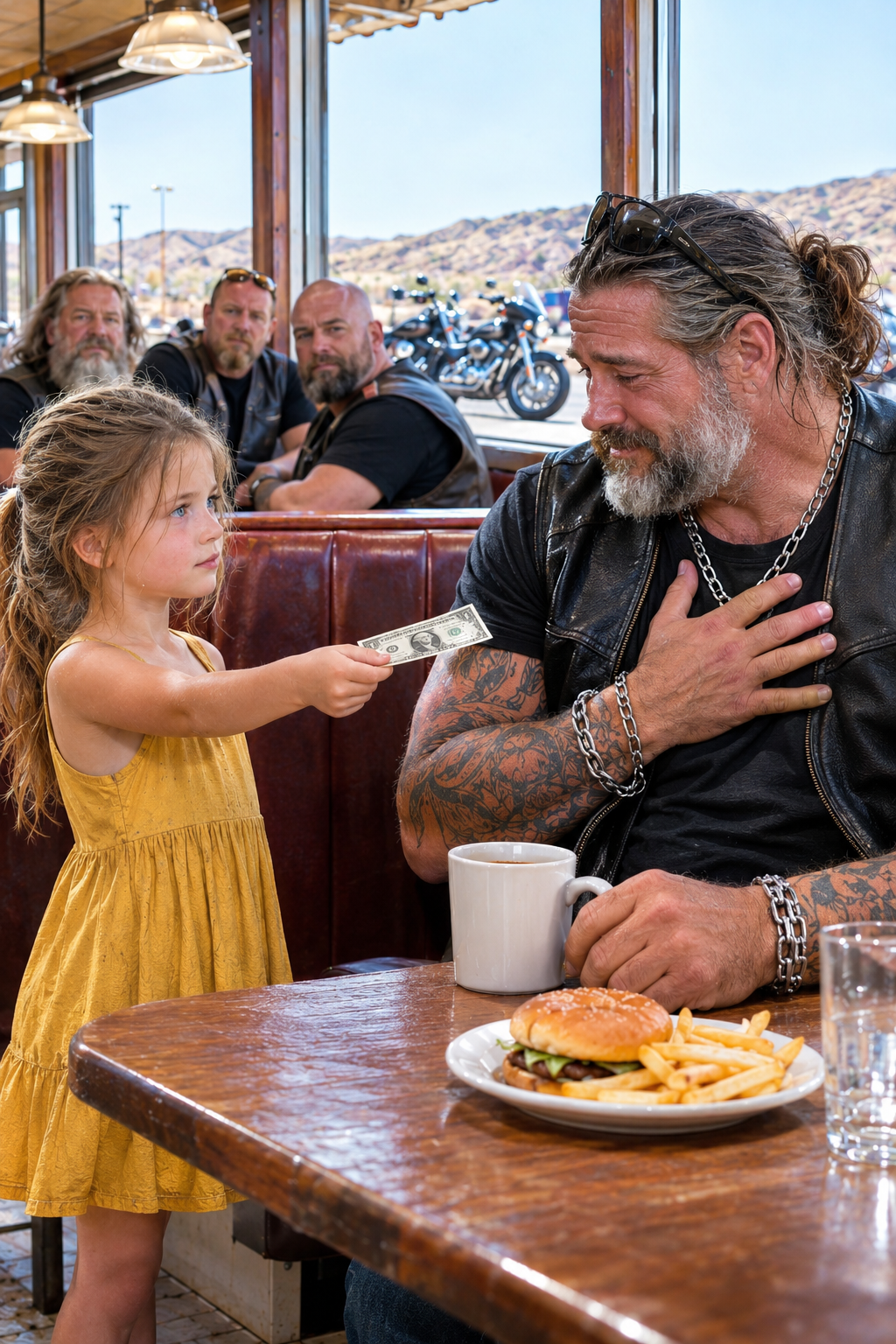
The little girl shook her head.
John remained calm.
“The child said no.”
Daniel laughed coldly.
“And who exactly are you? Some criminal playing hero?”
Bear took one step forward, but John raised a hand.
“I’m someone asking you to lower your voice.”
Daniel leaned close.
“You have no idea who you’re dealing with.”
“Maybe not,” John answered. “But I know what a frightened child looks like.”
Sarah stood.
“Daniel, please leave us alone.”
“You think you can disappear with my daughter and steal my money?”
“I didn’t steal anything.”
“You took the car.”
“The car was in both our names!”
Daniel smiled.
“And now it’s back where it belongs.”
John’s expression darkened.
“You had their car taken?”
Daniel shrugged.
“I recovered my property.”
Sarah’s voice broke.
“Zoe’s schoolbooks were inside. Her clothes. Her medicine for her asthma. Everything.”
Daniel waved dismissively.
“Then perhaps you should have thought about that before running away.”
The temperature in the diner seemed to drop.
John stepped closer.
“You knew they were sleeping in that car?”
Daniel said nothing.
“You knew your eight-year-old daughter had nowhere to sleep?”
“Stay out of my business.”
John’s voice became dangerously quiet.
“A little girl just tried to give me her last dollar because she thought I looked lonely. She has more decency in one finger than you’ve shown since walking through that door.”
Daniel’s face reddened.
He reached for Zoe’s arm.
Before he could touch her, Sarah pulled her daughter behind her.
“Don’t!”
The waitress, whose name was Maria, immediately moved to the counter and called the sheriff.
Daniel looked around at the bikers.
“You people think you can intimidate me? I have lawyers.”
“Good,” Bear replied. “You’ll probably need one.”
Daniel turned toward the door.
“This isn’t over, Sarah. You won’t keep her from me.”
He left without another word.
Only when his car disappeared did Sarah finally collapse into her chair.
Zoe began crying.
John knelt beside her.
“Hey, sweetheart. Look at me.”
“Is Daddy going to take Mommy away?”
John felt something twist inside his chest.
He wanted to promise that no one would ever hurt them again.
But he had learned long ago that promises meant nothing unless a person was prepared to keep them.
“Your mommy has people helping her now,” he said. “And we’re going to make sure she gets the right kind of help.”
Sarah shook her head.
“You don’t understand. Daniel has money. Friends. He knows people in the county.”
“What about your family?”
“My mother was the last person I could turn to.”
John looked toward the photograph.
“Not anymore.”
The sheriff arrived fifteen minutes later.
Her name was Elena Ruiz, and she knew John well enough to understand that a diner full of bikers did not necessarily mean trouble.
After hearing Sarah’s account, she photographed the messages Daniel had sent and took down information about the vehicle.
She also explained that Sarah needed urgent legal assistance to protect herself and Zoe.
“I can help you contact a domestic violence advocate,” Elena said. “They can arrange safe housing and connect you with a lawyer.”
Sarah looked embarrassed.
“I can’t afford an attorney.”
“You may qualify for free legal help,” Elena replied. “And you don’t have to face this alone.”
John nodded.
“Whatever she needs, we’ll help her get there.”
But the sheriff had another piece of news.
“Daniel Mercer owns Mercer Development,” she said. “He’s been trying to buy several properties along the highway.”
Bear froze.
“Does that include the Sunrise Haven?”
Elena looked surprised.
“How did you know?”
John turned toward Bear.
The pieces were suddenly fitting together.
Daniel hadn’t just appeared at the diner by chance.
He had been tracking Sarah.
And the property they were discussing was the very property his company wanted.
That evening, Sarah and Zoe were settled into a secure family shelter arranged through Elena’s contacts.
The bikers didn’t ask where it was.
John understood that real protection sometimes meant respecting the things you weren’t allowed to know.
Before Zoe left, she reached into her pocket.
She placed the dollar and three coins back into John’s palm.
“I want you to keep them,” she whispered.
“Why?”
“Because Grandma helped you once. And now you’re helping us. Maybe the money will remind you.”
John closed his fingers around the coins.
“I’ll treasure it.”
Zoe hugged him.
For the first time in years, Big John found himself afraid of letting someone down.
At sunrise, fourteen motorcycles rolled into Phoenix.
John and Bear entered the charitable trust’s office wearing clean shirts beneath their leather vests.
Waiting inside were Robert Hayes, three board members, and an attorney.
And at the far end of the conference table sat Daniel Mercer.
He smiled when he saw John.
“Well. The circus has arrived.”
John ignored him.
The board chairwoman, Patricia Wells, opened a folder.
“Gentlemen, Mercer Development has offered $280,000 for Sunrise Haven. Unless you can provide a credible alternative, we intend to approve the sale.”
Bear cleared his throat.
“We want to operate the motel as transitional housing for families in crisis.”
Patricia studied him.
“With what funding?”
John placed an envelope on the table.
“Forty-three members of our club raised $19,600 overnight.”
Daniel laughed.
“You’re going to renovate an entire motel with twenty thousand dollars?”
John looked at him.
“No. We’re going to start with it.”
Daniel leaned back.
“Admirable. Completely unrealistic.”
Patricia sighed.
“Mr. Walker, this property requires substantial repairs. The roof leaks. The electrical system needs updating. The insurance alone—”
“We know,” John interrupted gently. “And we have licensed contractors willing to inspect it, volunteers ready to work, and a nonprofit housing organization interested in discussing a partnership.”
Robert nodded.
“I’ve spoken with the organization’s director. She can meet us this afternoon.”
Daniel’s smile faded.
Patricia frowned.
“That still doesn’t solve the financial problem.”
John reached into his vest.
He removed Margaret’s photograph.
Then he laid it beside an old letter Robert had found in the estate records.
“This woman owned Sunrise Haven,” John said. “Her name was Margaret Bennett. Thirty-one years ago, she saved a hungry kid nobody else wanted.”
He paused.
“That kid was me.”
The room grew quiet.
“Margaret wanted this motel to help families who had nowhere to go. She didn’t live long enough to make it happen. But yesterday, her granddaughter gave away her last dollar because she believed a stranger deserved kindness.”
John’s voice thickened.
“I’m not asking you to ignore your responsibilities. I’m asking you to give us a chance to honor hers.”
Patricia read the letter.
Margaret had written it shortly before her death.
If Sunrise Haven can someday become a refuge for people starting over, then every struggle I faced to keep it will have been worthwhile.
For a long moment, Patricia said nothing.
Then Daniel stood abruptly.
“This is absurd. Sentiment doesn’t pay property taxes.”
“No,” John said. “But neither does destroying every decent thing someone leaves behind.”
Daniel slammed his hand onto the table.
“You have no legal claim to that property!”
“Neither do you,” Patricia replied sharply. “Please sit down.”
The board requested a private discussion.
Twenty minutes later, Patricia returned.
“We’ve decided to postpone the sale for sixty days,” she announced. “If you can submit an adequately funded, legally sound operating plan, we’ll consider a lease to a qualified nonprofit.”
Bear released a breath.
John nodded gratefully.
It wasn’t victory.
But it was a door opening.
And John intended to walk through it.
The next two weeks became a whirlwind.
The motorcycle club cleaned debris from Sunrise Haven. Contractors inspected the roof and wiring. Local businesses donated beds, paint, and supplies.
A regional charity agreed to help coordinate the project if safety inspections, permits, and a sustainable budget could be secured.
Sarah wanted to help, too.
Despite everything she’d suffered, she knew how a motel worked.
She understood scheduling, cleaning standards, inventory, and the hundred invisible details that made guests feel welcome.
When John offered her a paid position helping prepare the property, she hesitated.
“I don’t want charity forever.”
John smiled.
“Good. Because I’m offering you a job.”
Sarah started crying.
But this time, her tears were different.
For the first time in months, she could imagine a future.
Then, on the seventeenth night, disaster struck.
A fire broke out in one of Sunrise Haven’s storage buildings.
By the time firefighters arrived, flames were climbing through the roof.
John and Bear watched helplessly as years of stored furniture turned to ash.
Fortunately, no one was injured.
But the damage threatened the entire project.
The following morning, a fire investigator discovered evidence suggesting that the blaze had been deliberately started.
John already suspected who might be responsible.
But suspicion wasn’t proof.
Daniel arrived that afternoon.
He stood behind the temporary fence, staring at the blackened building.
“What a shame,” he said.
John approached him.
“Did you come to enjoy the view?”
Daniel smiled.
“I came to remind you that my offer still stands.”
“Get off the property.”
“Careful, John. Anger makes people reckless.”
John looked at the burned structure.
For one terrible second, he imagined grabbing Daniel by the collar.
Instead, he stepped away.
Margaret had spent years teaching him that strength wasn’t measured by how much damage a man could cause.
Sometimes it was measured by how much damage he refused to cause.
That night, John sat alone outside the motel.
His brothers had gone home.
The desert wind carried the smell of burned wood.
He stared at Zoe’s dollar and three coins.
“What am I supposed to do now, Margaret?” he whispered.
A truck pulled into the driveway.
It was Maria, the waitress from the diner.
She climbed out holding a cardboard box.
“I heard what happened,” she said.
John stood.
“Maria, you didn’t have to come.”
“Yes, I did.”
She handed him the box.
Inside were envelopes.
Hundreds of them.
“People heard about the little girl who gave her last money to a biker,” Maria explained. “I told the story at church. Someone posted it online after checking with Sarah. Then people started asking how to help.”
John opened the first envelope.
Twenty dollars.
The second contained fifty.
The third held a handwritten note.
My mother and I lived in our car when I was nine. Someone helped us. Please use this to help another family.
John looked up.
“How much is here?”
Maria smiled through tears.
“Just over eighty-six thousand dollars.”
John sat down hard.
For several seconds, he couldn’t speak.
“And there’s more,” Maria continued. “A roofing company offered materials. An electrician wants to donate labor. A local furniture store is sending beds.”
John began laughing.
Then, unexpectedly, he began to cry.
Maria sat beside him.
“Your little friend started something bigger than she knows.”
But the greatest surprise came three days later.
Sheriff Ruiz called John.
“We found something,” she said.
A security camera at a nearby gas station had recorded a truck leaving the motel access road shortly before the fire.
The vehicle belonged to a subcontractor who had recently worked for Mercer Development.
Investigators interviewed the driver.
Faced with evidence, he admitted he had been paid to start the fire.
He also provided messages linking the payment to Daniel’s operations manager.
Further investigation uncovered communications suggesting Daniel himself had authorized the scheme.
Daniel was arrested on charges related to the arson conspiracy.
He denied wrongdoing, and the case would still have to go through court.
For Sarah, the news brought relief, but not instant peace.
She knew legal proceedings could take months.
With help from an attorney, she continued pursuing protective orders and custody arrangements based on Zoe’s safety.
John never pressured her to speak publicly.
He knew that surviving something difficult was not the same as wanting the world to know about it.
As autumn approached, Sunrise Haven began to change.
The burned storage building was cleared and replaced with a small playground.
Fresh paint covered the walls.
Every room received clean bedding, working locks, and bright curtains.
A local nonprofit secured operational funding, and the trust approved a long-term lease after the required inspections and agreements were completed.
Sarah became the property’s operations manager.
Her first official paycheck arrived on a Friday afternoon.
She stared at it for almost a minute.
Then she walked outside and found John repairing a porch railing.
“John?”
He looked up.
“Everything okay?”
She held out the check.
“I wanted to show you something.”
He smiled.
“Looks like you’ve earned yourself a living.”
Sarah laughed.
“It’s more than that.”
She glanced toward Zoe, who was drawing butterflies on the sidewalk with colored chalk.
“For months, I woke up every morning wondering what I was going to lose next. Now I wake up thinking about what I can build.”
John put down his hammer.
“That’s what your mother wanted for you.”
Sarah shook her head gently.
“No. It’s what she wanted for everyone.”
Three months after Zoe walked into the diner, Sunrise Haven welcomed its first families.
There was a young mother with two boys who had escaped an unsafe home.
An elderly man who had lost his apartment after a long hospitalization.
And a father with a teenage daughter who had been sleeping in a borrowed van after losing his job.
Each family received a room, support from trained staff, and assistance developing a plan toward stable housing.
The motel wasn’t a miracle cure.
Jobs still had to be found. Court dates still had to be attended. Bills still had to be paid.
Some days were frustrating.
Some families moved forward quickly.
Others needed more time.
But nobody was asked to prove their worthiness by telling the worst story of their life.
On opening day, the parking lot filled with motorcycles, pickup trucks, and ordinary family cars.
Maria brought pancakes.
Bear brought a ridiculous oversized ribbon.
Sheriff Ruiz stood near the entrance, smiling.
And Zoe wore a new yellow dress.
Her shoes were clean.
Her hair was tied into two bright ribbons.
John stood beside her beneath a freshly painted wooden sign.
SUNRISE HAVEN.
A place to begin again.
Patricia, the trust chairwoman, handed Zoe a pair of scissors.
“Would you like to do the honors?”
Zoe looked at John.
“Can you help me?”
“Always, sweetheart.”
Together, they cut the ribbon.
The crowd erupted in applause.
But Zoe wasn’t finished.
She tugged John’s vest.
“I have something for you.”
From a small envelope, she removed a drawing.
It showed a giant biker sitting at a diner table beside a little girl.
Above them was a bright yellow sun.
Underneath, in uneven handwriting, were the words:
Sometimes the biggest people have the softest hearts.
John stared at the picture.
Then he lifted Zoe into his arms.
“That’s the best thing anybody’s ever given me.”
She giggled.
“Even better than my dollar?”
John smiled.
“Almost.”
Later that evening, after everyone had gone home, John found Sarah standing beneath the motel sign.
She was holding Margaret’s photograph.
“I spent so long being angry,” she said quietly. “Angry that my mother died. Angry that Daniel took so much from us. Angry that I couldn’t give Zoe the childhood she deserved.”
John stood beside her.
“You had every reason to be hurt.”
Sarah nodded.
“But my daughter never stopped believing people could be good.”
She turned toward him.
“How do you teach a child that?”
John looked through the window of the common room.
Zoe was helping one of the younger children put together a puzzle.
“I don’t think you taught her with words,” he said. “You taught her by the way you lived when everything was falling apart.”
Sarah smiled through tears.
“I thought I had failed her.”
“You kept her safe as best you could. You stayed beside her. You showed her love when you had almost nothing else to give.”
John paused.
“And somehow, she had enough love left over for a stranger.”
Sarah rested her head briefly against his shoulder.
“Thank you for seeing us.”
John shook his head.
“No, Sarah. Thank Zoe for seeing me.”
A year later, Sunrise Haven had helped twenty-seven families move into stable housing.
Sarah and Zoe now lived in a modest house nearby.
Zoe was thriving at school, and she had developed an unusual habit.
Every Saturday, she visited the motel with her mother and left little handwritten cards on the pillows of newly arriving families.
You are safe here.
You matter.
Tomorrow can be better.
John kept the original dollar and three coins in a small glass frame above his workshop desk.
Underneath them, he had attached a brass plaque.
It read:
The greatest gift I ever received was given by someone who had almost nothing.
One afternoon, a young biker visiting the workshop noticed the frame.
He pointed at it and laughed.
“John, why do you have a dollar and some change hanging on your wall? You’ve got motorcycles worth fifty thousand dollars sitting outside.”
John wiped grease from his hands.
“Because those coins taught me something those motorcycles never could.”
The young man frowned.
“What’s that?”
John looked toward the photograph of Margaret Bennett hanging beside the frame.
Then he smiled.
“That kindness isn’t measured by what you have left after giving.”
He tapped the glass gently.
“It’s measured by what you’re willing to share when giving costs you something.”
At that moment, the workshop door swung open.
Zoe came running inside, carrying a paper bag.
“Big John!”
He turned just in time to catch her in a hug.
“What have you got there, sunshine?”
“Pancakes!”
John laughed.
“Pancakes? At three in the afternoon?”
“Mommy made them. She said you’ve been working all day, and you probably forgot lunch.”
Zoe opened the bag and handed him a carefully wrapped stack.
Then she looked at the young biker.
“Have you eaten?”
He blinked.
“Uh, not yet.”
Without hesitation, Zoe divided the pancakes in half.
“Here. You can have some of mine.”
John watched the young man accept them.
For a heartbeat, he was back in that little desert diner, looking at a hungry child who had offered him everything she possessed.
Only now, the little girl was smiling.
She had a home.
Her mother had a future.
And the kindness that once cost her a dollar and three coins had become a refuge for strangers.
John put his arm around Zoe’s shoulders.
“You know something, sweetheart?”
“What?”
“Your grandma would be very proud of you.”
Zoe considered that for a moment.
Then she looked up at him.
“Do you think she would be proud of you, too?”
John felt tears gather in his eyes.
He looked at Margaret’s picture one final time.
Thirty-one years ago, she had given a lost young man a meal, a job, and a reason to believe his life mattered.
For decades, he had wondered whether he’d ever truly repaid her.
Now he understood.
Kindness wasn’t a debt to be settled.
It was a gift meant to keep traveling.
“Yes, sweetheart,” he whispered. “I think maybe she would.”
Outside, the desert sun dipped toward the horizon, painting the sky gold.
And somewhere along that lonely highway, another frightened family was making its way toward Sunrise Haven, not yet knowing that a warm bed, a hot meal, and a second chance were waiting for them.
All because one hungry little girl had looked at the most frightening man in a diner and decided he deserved kindness.
The world will always have people who mistake compassion for weakness, who believe power means controlling others, and who measure a person’s value by the money in their pocket.
But real strength is often much quieter.
Sometimes it looks like a tired mother protecting her child.
Sometimes it looks like a group of intimidating bikers choosing generosity over indifference.
And sometimes it looks like an eight-year-old girl placing her last dollar and three coins on a stranger’s table.
You may never know how far one act of kindness will travel.
You may never see every life it touches.
But the smallest gift, given with a sincere heart, can become the beginning of something extraordinary.
Because kindness doesn’t become smaller when we share it.
It grows.
And sometimes, the person you think you’re saving is the very person who ends up saving you.
But John would soon discover that even the happiest endings sometimes have one final chapter waiting to be written.
It began on a cold December morning, nearly two years after Zoe had first walked into the diner.
A letter arrived at Sunrise Haven.
There was no return address, only John’s name written carefully across the envelope.
Inside was a single sheet of paper.
Dear Mr. Walker,
My name is Emily Carter. My mother stayed at Sunrise Haven last winter with my little brother and me. You probably don’t remember us, but I remember you.
Before we came there, I thought people only helped you when they wanted something in return.
At Sunrise Haven, nobody asked us to be grateful every second. Nobody made us feel ashamed. You just let us be a family again.
My mother has a job now. We have our own apartment. And last week, I got accepted into college.
I wanted to tell you because my mother says hope is something people can give each other.
You gave us ours back.
John read the letter three times.
Then he folded it and placed it beside Zoe’s framed dollar.
Bear entered the workshop a few minutes later.
“What’s that?”
John handed him the letter.
Bear read it silently.
When he finished, he cleared his throat.
“Not bad for a bunch of old bikers, huh?”
John smiled.
“Not bad at all.”
But that afternoon, something happened that neither man could have anticipated.
A black sedan pulled into the parking lot.
An elderly gentleman stepped out, wearing a dark coat and carrying a leather briefcase.
He introduced himself as Thomas Bennett.
John froze at the surname.
“Bennett?”
The man nodded.
“Margaret Bennett was my younger sister.”
John stared at him.
Sarah had always believed that her mother had no surviving close relatives.
Thomas seemed to understand his confusion.
“Margaret and I hadn’t spoken in nearly forty years,” he explained. “We argued about something foolish when we were young. Pride kept us apart. Then pride turned into shame, and shame turned into silence.”
He looked toward the motel.
“I heard about this place through a newspaper article. I’ve spent the last several months trying to find the courage to come.”
John invited him inside.
Sarah arrived shortly afterward.
When Thomas saw her, his face crumpled.
“You look exactly like your mother did at your age.”
Sarah stood motionless.
“You’re my uncle?”
Thomas nodded, tears rolling down his cheeks.
“If you’ll allow me to be.”
For a long moment, Sarah couldn’t speak.
Then she crossed the room and embraced him.
Thomas began sobbing.
“I’m so sorry,” he whispered. “I should have been there. For Margaret. For you.”
Sarah held him tighter.
“We can’t change yesterday.”
“No,” he replied. “But perhaps we can do something about tomorrow.”
Thomas opened his briefcase.
Inside were documents showing that he had established a charitable fund after selling his business.
He explained that he had no children and had spent years wondering what to do with his savings.
Then he looked around the room.
“I think I’ve finally found the answer.”
He offered Sunrise Haven a substantial endowment, administered through its nonprofit partner, to support its operations and help families transition into permanent housing.
John stared at the documents.
“Thomas, this is an extraordinary amount of money.”
The elderly man smiled sadly.
“My sister spent her whole life helping people with what little she had. I spent mine accumulating things I didn’t need.”
He glanced at Margaret’s photograph.
“I’d like to learn from her while I still have time.”
The donation changed everything.
Sunrise Haven was able to expand its services, establish a small education fund, and hire another social worker.
But John insisted on one condition.
Every family who received assistance would be treated with dignity, never as a project or a number.
Thomas agreed without hesitation.
Over the following months, he became a familiar face at the motel.
He helped Zoe with her homework.
He told Sarah stories about Margaret as a young girl.
And every Sunday, he sat with John beneath the old cottonwood tree behind the building.
They spoke about regrets, second chances, and how strange it was that one small act of kindness could reconnect people separated by decades.
One spring afternoon, Thomas asked John a question.
“Do you ever wonder what would have happened if Zoe hadn’t walked into that diner?”
John considered it.
“All the time.”
“And?”
John looked toward the playground.
“Maybe we’d all still be walking around carrying the same pain, never realizing somebody else could help us put it down.”
Thomas nodded thoughtfully.
“My sister used to say that people spend too much of their lives waiting for the perfect moment to do something good.”
John laughed softly.
“She told me that, too.”
“She was right.”
“Yes,” John said. “She usually was.”
Five years after Sunrise Haven opened, the town organized a celebration in its honor.
By then, more than one hundred families had passed through its doors.
Some had found jobs.
Some had returned to school.
Some had reunited with relatives.
Others had simply discovered the stability they needed to begin healing.
Not every story had unfolded perfectly.
There had been setbacks, difficult goodbyes, and heartbreaking losses.
But there had also been birthdays, graduations, new apartments, and countless ordinary mornings that once seemed impossible.
John had grown older.
His beard was almost entirely gray, and his knees complained whenever he climbed off his motorcycle.
Zoe was thirteen now, taller and more confident, but she still called him Big John.
During the celebration, she stepped onto a small wooden stage.
She wore a yellow dress, just as she had on the day they met.
Only this one was clean, bright, and chosen for a happy occasion.
She held a folded piece of paper.
“Five years ago,” she began, “my mom and I didn’t have anywhere to live.”
The crowd grew quiet.
“I remember being hungry. I remember being scared. But I also remember my mom telling me that being poor didn’t mean we had nothing to give.”
Zoe looked toward John.
“So I gave a stranger my last dollar.”
Several people smiled through tears.
“I thought I was helping him. But he helped us. Then other people helped. And those people helped even more people.”
She paused.
“I used to think heroes were people who saved the world all at once.”
Her eyes moved across the audience.
“Now I think heroes are people who notice when someone needs help and decide not to look away.”
John lowered his head.
Bear squeezed his shoulder.
Zoe smiled.
“And I learned something else. You don’t have to wait until you’re rich, powerful, or grown up to make a difference.”
She lifted her chin.
“Sometimes you just have to be kind with what you have.”
The applause lasted nearly a minute.
Afterward, Zoe ran off the stage and threw her arms around John.
“Did I do okay?”
John laughed through his tears.
“Sweetheart, you did better than okay.”
She pulled back and studied his face.
“Why are you crying?”
“Because I’m getting old.”
Zoe grinned.
“You were already old when I met you.”
Bear burst out laughing.
Even John couldn’t help joining in.
That evening, after the celebration ended, John walked alone into the common room of Sunrise Haven.
On the wall hung photographs of families, volunteers, and staff members who had helped build the place.
At the center was Margaret Bennett’s portrait.
Beneath it was a simple inscription.
No act of kindness is ever truly lost.
John stood before it for a long time.
Then he took Zoe’s original dollar and three coins from his pocket.
He had carried them in their little glass case for years, but that morning he had decided they belonged somewhere else.
He placed the case on a small shelf beneath Margaret’s photograph.
Beside it, he left a handwritten note.
This began with a hungry child who still believed she had something to give.
May everyone who enters these doors remember that they do, too.
As John turned to leave, he heard footsteps.
Sarah stood in the doorway.
“Zoe said I’d find you here.”
John smiled.
“Just putting something where it belongs.”
Sarah noticed the glass case.
Her expression softened.
“You kept them all these years.”
“Every single coin.”
She approached the photograph.
“My mother would have loved this place.”
John nodded.
“She would have loved the woman you’ve become.”
Sarah wiped a tear from her cheek.
For a while, they stood together in comfortable silence.
Then Sarah asked, “Do you think people really change, John?”
He thought about the angry nineteen-year-old boy who had once believed the world owed him something.
He thought about Thomas, who had spent decades trapped by pride before finding the courage to make peace with his past.
He thought about Sarah, who had transformed fear into strength.
And he thought about a little girl who had never needed to change her heart at all.
“Yes,” he answered. “I do.”
Sarah looked at him.
“What makes you so sure?”
John smiled toward Margaret’s photograph.
“Because somebody once believed I could.”
Outside, Zoe called for them.
The evening sky glowed orange over the desert.
Children were laughing near the playground.
Dinner was being prepared in the common kitchen.
And somewhere in one of the rooms, a frightened mother was telling her child that tomorrow might finally be better.
John stepped outside with Sarah beside him.
Zoe ran toward them, carrying three paper cups of lemonade.
“I saved you some!”
John accepted a cup.
“Still taking care of everybody, huh?”
Zoe shrugged.
“Somebody has to.”
John chuckled.
Then he looked around at everything that had grown from a handful of coins, a plate of pancakes, and one extraordinary act of compassion.
For most of his life, he had believed that leaving something behind meant building a business, earning money, or having his name remembered.
Now he understood that a person’s greatest legacy could be something much simpler.
A child who felt safe.
A mother who regained her independence.
A stranger who learned to trust again.
A family that finally had a place to call home.
And people who would carry kindness into lives he would never get to see.
John raised his lemonade toward the fading sun.
“To Margaret,” he whispered.
Sarah raised her cup.
“To second chances.”
Zoe smiled and lifted hers highest of all.
“To being nice to people.”
Their cups touched.
And Big John, the man everyone had once feared, knew that his life had become something far greater than he had ever imagined.
Not because he had saved a little girl.
But because a little girl had reminded him that the world could still be saved, one small act of kindness at a time.
THE END.