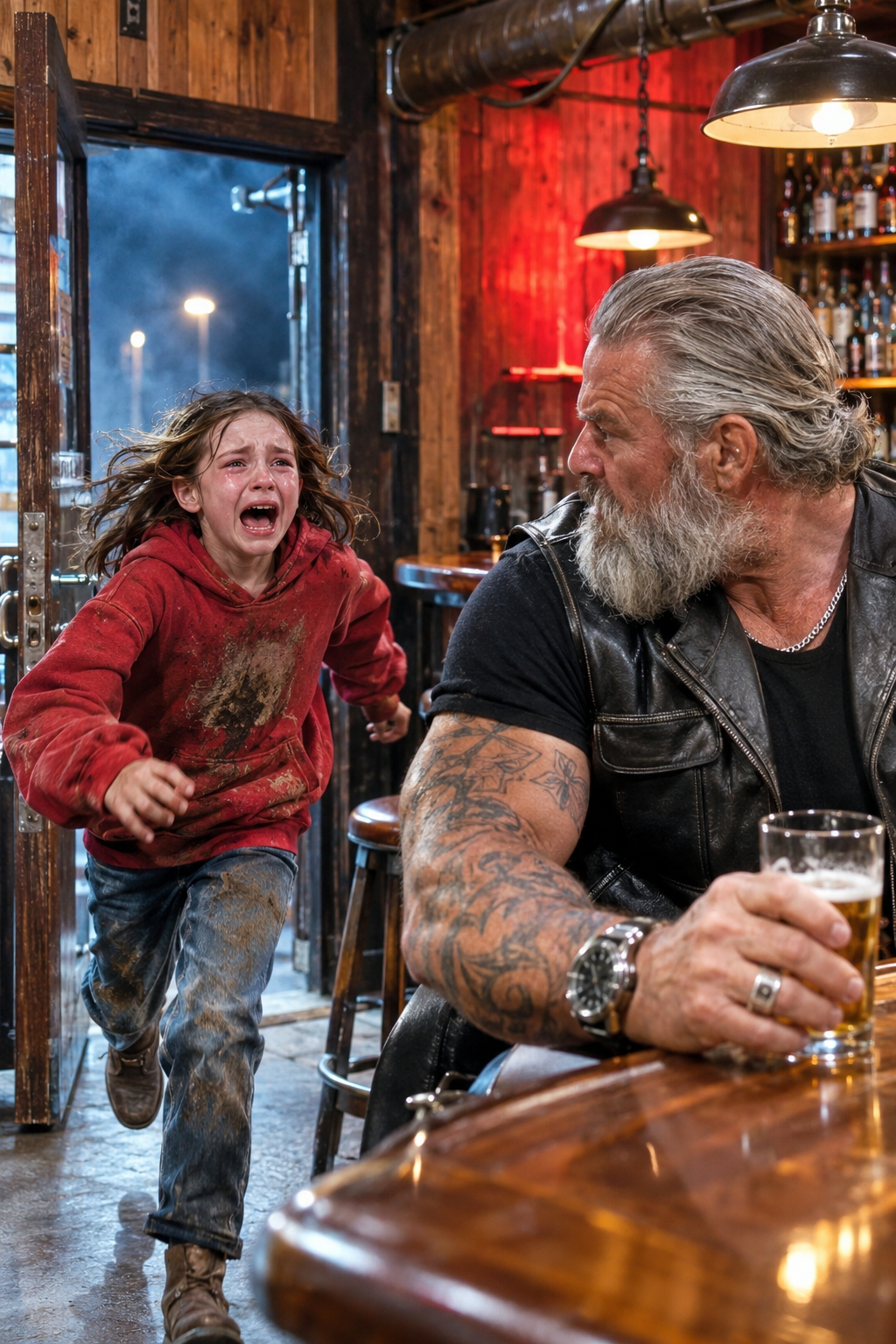
The little girl burst into the biker bar barefoot, shaking so badly she could barely stand.
The second message contained a photograph.
It showed three children sitting on the floor of a dimly lit room, their wrists bound with plastic ties. A boy with dark curls stared directly at the camera. Beside him, a little girl in a yellow dress held a stuffed rabbit against her chest.
But it was the third child who made Colt’s blood turn cold.
A red-haired girl, no older than seven, wore a silver butterfly necklace.
Colt recognized that necklace.
He had bought one exactly like it for his daughter, Emma, on her seventh birthday.
For a moment, the tavern disappeared around him.
He was standing in a hospital hallway again, listening to a doctor explain that a drunk driver had killed his little girl twelve years earlier.
Colt gripped the counter until his knuckles whitened.
“Boss?” asked Mason, his oldest friend. “What is it?”
Colt turned the phone toward him.
“Those kids are alive. And somebody’s expecting Raymond to deliver another one.”
Across the room, Raymond stopped struggling.
For the first time since entering the tavern, he looked genuinely frightened.
Not of the bikers.
Of whoever had sent that message.
“You’re making a terrible mistake,” Raymond whispered.
Colt approached him.
“Then start explaining.”
Raymond swallowed.
“You don’t understand who you’re dealing with.”
“Then help me understand.”
Raymond looked toward the windows, where the afternoon sky was turning gray.
“If I talk, they’ll kill me.”
Colt leaned closer.
“And if you don’t, those children might die.”
Before Raymond could answer, his phone vibrated again.
This time, the message contained only six words.
“Delivery delayed. We are coming.”
Mason read it over Colt’s shoulder.
“Coming here?”
Raymond closed his eyes.
“Oh, God.”
A heavy silence settled over the Iron Horse Tavern.
Then Colt made a decision.
“Mason, lock the back entrance. Bear, get everyone away from the windows. Danny, call the sheriff again and tell them we’ve got multiple kidnapped children.”
Sadie sat behind the counter, wrapped in a blanket that smelled faintly of coffee.
She had been watching Colt the entire time.
“Are they going to hurt us?” she asked.
Colt turned.
His expression softened immediately.
“Not if I can help it, Peanut.”
The nickname slipped out naturally.
Sadie’s eyes filled with tears.
“That’s what my daddy says.”
Colt felt something break inside his chest.
He hadn’t called anyone by a childhood nickname in twelve years.
He crouched beside her.
“Then your daddy and I already have something in common.”
Sadie reached for his hand.
And Colt realized that whatever happened next, he would not let go of hers.
Outside, two black pickup trucks appeared at the far end of the highway.
They slowed as they approached the tavern.
Then continued past.
Mason watched them disappear.
“Could be nothing.”
“Could be,” Colt replied.
But he didn’t believe it.
Ten minutes later, Sheriff Daniel Reeves arrived with three deputies.
Reeves was a broad-shouldered man in his fifties, with a reputation for being fair and stubborn.
He entered the tavern, surveyed the restrained Raymond, and looked at Colt.
“Tell me nobody’s dead.”
“Nobody’s dead,” Colt answered. “But three children might be if we waste time.”
Reeves examined Raymond’s identification cards and the messages.
His expression changed.
“Where did you get this?”
“His jacket.”
Reeves studied the photograph.
Then he stepped away and made a phone call.
Colt could hear only fragments.
“Possible trafficking operation… multiple minors… immediate assistance.”
When Reeves returned, he looked directly at Raymond.
“Raymond Keller. We’ve been looking for you for eight months.”
Raymond’s shoulders sagged.
“You’ve got the wrong man.”
“Funny. That’s what you said in Wyoming before you disappeared.”
Reeves ordered his deputies to take Raymond into custody.
But as they moved him toward the door, Sadie suddenly screamed.
“Don’t!”
Everyone froze.
Sadie pointed at Raymond’s boots.
“His phone! The other phone!”
Raymond’s face drained of color.
Reeves searched him again.
Inside a hidden compartment in his left boot was a second phone.
Its screen was already glowing.
A live location-sharing application showed a blinking red dot.
The Iron Horse Tavern.
And beneath it, a message.
“Tracker confirmed. Twelve minutes.”
Reeves looked up sharply.
“Everybody away from the front.”
The sheriff immediately radioed for additional units and instructed his deputies to secure the building.
Colt watched Sadie trembling beneath her blanket.
“How did you know about the phone?”
Sadie stared at her scraped knees.
“He used it when he thought I was asleep.”
“What did he say?”
She hesitated.
Then whispered, “He said he had to take me to the place where the trains don’t stop.”
Reeves turned around.
“What?”
“The place where the trains don’t stop,” Sadie repeated. “He said the other kids were waiting there.”
Mason frowned.
“There hasn’t been a passenger train through this county in thirty years.”
Colt looked at him.
“But freight trains still run.”
Something clicked.
Twenty miles north of town stood an abandoned grain-processing facility beside a private railway spur.
Locals called it Deadman’s Crossing.
The trains never stopped there anymore.
At least, not officially.
Colt looked at Reeves.
“There’s an old grain elevator off County Road Nine.”
Reeves was already reaching for his radio.
“Dispatch, get me everything on the Deadman’s Crossing property.”
Raymond suddenly began shaking his head.
“No. Don’t send anyone there.”
Reeves faced him.
“Why?”
“Because if they see police coming, they’ll move the children.”
“Who will?”
Raymond said nothing.
Then a deafening crash shook the tavern.
A pickup truck had slammed into a parked motorcycle outside.
The truck stopped sideways across the entrance.
Its doors flew open.
Two men wearing dark jackets stepped out.
One raised a handgun.
“DOWN!” Reeves shouted.
A gunshot shattered the front window.
Glass exploded across the floor.
Colt threw himself over Sadie, shielding her with his body.
Mason dragged a nearby waitress behind the counter while the deputies took cover.
Another shot struck the wooden doorframe.
Reeves shouted commands and returned fire from behind a heavy table.
One attacker stumbled backward, dropped his weapon, and collapsed beside the truck.
The second scrambled into the driver’s seat.
The engine roared.
The pickup reversed, struck a fence, and sped toward the highway.
Within seconds, it was gone.
The entire attack had lasted less than a minute.
But the tavern looked like a battlefield.
Broken glass covered the floor.
Smoke drifted through the entrance.
Someone was crying.
Colt slowly lifted himself off Sadie.
“Are you hurt?”
She shook her head.
Then she noticed blood soaking through his sleeve.
“You’re bleeding.”
Colt glanced down.
A shard of glass had sliced his upper arm.
“Just a scratch.”
Sadie began crying harder.
“You got hurt because of me.”
Colt took her small hands.
“Listen carefully, sweetheart. You didn’t make anyone do this. The men who came here made their own choices.”
He gently wiped a tear from her cheek.
“And protecting a child is never something a good man regrets.”
Reeves approached, his face grim.
The injured attacker was alive and receiving emergency medical care under guard.
But the sheriff had worse news.
“Dispatch checked the property. Deadman’s Crossing was purchased six months ago by a private transportation company.”
“Who owns it?” Colt asked.
Reeves hesitated.
“According to the paperwork, a company registered under the name of Walter Hensley.”
Mason went completely still.
“Hensley?”
Colt turned toward him.
“You know him?”
Mason’s voice was barely audible.
“Everybody knows him.”
Walter Hensley was the county’s wealthiest businessman.
He donated money to schools, sponsored children’s hospitals, and appeared every Christmas on television handing out presents to disadvantaged families.
His smiling face hung on billboards across Montana.
Three years earlier, he had personally funded a new playground in memory of Colt’s daughter.
Colt felt sick.
“You’re telling me that man owns the place?”
Reeves nodded.
“On paper, yes. That doesn’t prove he’s involved.”
But Raymond had heard the name.
And his reaction told Colt everything.
The kidnapper began laughing.
It was a strange, broken sound.
“You people have no idea.”
Reeves stepped closer.
“Then tell us.”
Raymond looked at Sadie.
Then at Colt.
“They told me she was just another delivery.”
Colt’s jaw tightened.
“Another?”
Raymond stared at the floor.
“I’ve transported seven children.”
Nobody spoke.
“Where are they now?” Reeves demanded.
“I don’t know where all of them went.”
“How many are at the grain elevator?”
Raymond hesitated.
“Five. Maybe six.”
Sadie suddenly stood.
“The boy in the picture is named Noah.”
Everyone turned toward her.
“He told me through the wall. When Raymond locked me in that room, I heard him talking.”
Colt knelt.
“What else did Noah say?”
Sadie closed her eyes, struggling to remember.
“He said his sister was there too. Her name is Lily. And he said they were going somewhere on a big truck tonight.”
Reeves checked his watch.
“Tonight?”
Raymond’s breathing became shallow.
“Seven o’clock.”
It was already 4:42.
Less than two and a half hours remained.
Reeves ordered a coordinated response with state police and federal agents.
The injured attacker was taken away in an ambulance.
Raymond was placed in a patrol vehicle under armed guard.
But Colt knew one thing.
If Hensley had people watching the tavern, he would know the police had found the children.
And desperate criminals made dangerous decisions.
Colt approached Reeves.
“Let us help.”
The sheriff shook his head.
“Absolutely not.”
“We know those back roads better than anyone.”
“You’re civilians, Colt.”
“We’ve ridden this county for twenty years.”
“And I won’t have you turning a rescue into a gunfight.”
Colt looked toward Sadie.
She was sitting beside the waitress, carefully holding a paper cup of hot chocolate.
“Then don’t send us into the building. Let us help you find another way in.”
Reeves considered him.
Finally, he said, “Maps. Access roads. Anything you know. But nobody moves without my authorization.”
Colt nodded.
That was enough.
For the next thirty minutes, the Iron Horse Tavern became an improvised command center.
Mason spread old county maps across a table.
Bear, who had worked as a railway mechanic before retiring, identified a maintenance road that crossed behind the grain elevator.
Another biker named Luis remembered a drainage tunnel running beneath the property.
“I used to fish near there as a kid,” he said. “The tunnel opens into a creek bed.”
Reeves contacted the responding tactical team and relayed the information.
Then something unexpected happened.
Sadie climbed off her stool and approached the map.
She studied it carefully.
“That’s the place,” she whispered.
Colt looked down.
She was pointing to the grain elevator.
“How do you know?”
“Because I saw that tall building through a window. It had a broken red light on top.”
Reeves crouched beside her.
“Sadie, were you inside that building?”
She nodded.
“For one night.”
“Can you remember anything else?”
Sadie looked frightened.
Colt squeezed her hand.
“Only if you want to, Peanut.”
She took a breath.
“There was a blue door. And a room with yellow walls. The other kids were there.”
“Did you see anyone besides Raymond?”
“A lady.”
Reeves leaned forward.
“What lady?”
“She had black hair. She gave us sandwiches.”
“Do you know her name?”
Sadie thought for several seconds.
“Raymond called her Miss Claire.”
Mason’s expression changed.
“Claire Hensley?”
Walter Hensley’s daughter.
A respected social worker.
The director of a charitable organization that helped vulnerable families.
Reeves slowly stood.
“Nobody outside this room hears that name until we have evidence.”
But the discovery raised a terrifying possibility.
The kidnappers might have been using charitable programs to identify children whose families were struggling.
Children who could disappear without attracting immediate attention.
Colt looked at Sadie.
“How did Raymond find you?”
“At the playground,” she whispered. “He said Mommy sent him because she had an accident.”
Colt closed his eyes.
He could imagine how frightened she had been.
How badly she must have wanted to believe him.
Then Sadie added something that changed everything.
“The lady with black hair told Raymond not to take me.”
Reeves turned.
“What?”
“She was angry. She said I wasn’t supposed to be there.”
“Why?”
Sadie swallowed.
“Because my mommy knows her.”
The room fell silent.
Before anyone could ask another question, the tavern telephone rang.
Danny answered.
His expression changed immediately.
“Colt. It’s for you.”
“Who is it?”
“A woman named Laura Holloway.”
Colt crossed the room in three strides.
“Hello?”
A woman’s desperate voice came through the receiver.
“Is my daughter there?”
Colt looked toward Sadie.
“Yes, ma’am. She’s safe.”
The woman began sobbing.
“Oh, thank God. Please, please let me hear her voice.”
Colt handed the phone to Sadie.
“Peanut, somebody wants to talk to you.”
Sadie lifted the receiver.
“Mommy?”
The scream on the other end was heartbreaking.
Sadie’s face crumpled.
“Mommy, I was brave. I did what you told me. I ran when I could.”
Laura cried so hard she could barely speak.
“You were so brave, baby. Daddy and I are coming.”
Sadie pressed the receiver against her cheek.
“Mommy, can you bring my shoes?”
Everyone in the room looked away.
Even Reeves wiped his eyes.
After the call, Sadie seemed calmer.
But Colt noticed that she kept glancing toward the windows.
“What’s wrong, sweetheart?”
She whispered, “What if the other kids don’t have shoes either?”
Colt looked at the sheriff.
And in that moment, the rescue became something more than a police operation.
It became a promise.
At 5:36, Reeves received a call from the tactical commander.
Officers had reached the outskirts of Deadman’s Crossing.
Thermal imaging showed movement inside the building.
A large delivery truck was parked near the loading dock.
And there were at least four armed adults on the property.
The commander wanted to wait for additional personnel.
Reeves agreed.
But then a second report arrived.
The truck’s engine had started.
“They’re moving early,” Reeves said.
Colt felt his stomach tighten.
“How long until the tactical team can intervene?”
“Minutes, if they get a clear opportunity.”
Mason pointed at the map.
“That truck only has two ways out. The main highway or the old service bridge.”
Reeves immediately relayed the information.
Then his radio crackled.
“Unit Seven to command. Truck moving toward north gate. We have visual.”
A pause.
“Possible children inside.”
Colt could hear the urgency in the officer’s voice.
Then another transmission.
“North gate blocked. Suspects reversing.”
Reeves grabbed the radio.
“Maintain containment. Do not fire toward the cargo area.”
The next thirty seconds seemed endless.
Finally, the commander’s voice returned.
“Truck stopped. Two suspects surrendering. Tactical team moving toward the building.”
Colt exhaled.
But Reeves wasn’t smiling.
“There’s still someone inside.”
At Deadman’s Crossing, the rescue team entered through the loading dock while another unit secured the rear exits.
They found three children locked inside a storage room.
A fourth child was hiding beneath a staircase.
The fifth was Noah.
He was discovered in the back of the truck, holding his little sister Lily so tightly that rescuers had to reassure him several times before he would release her.
But there was one problem.
The woman with black hair was missing.
So was Walter Hensley.
At 6:18, Reeves received another call.
The tactical commander had found a hidden office beneath the grain elevator.
Inside were photographs, forged adoption documents, financial records, and lists of children.
Some names had been crossed out.
Others had dates beside them.
And one photograph had been pinned to a corkboard.
Sadie Holloway.
Underneath it were three words.
“Priority. Personal request.”
Colt stared at the photograph when Reeves showed him the evidence.
“Personal request?”
Reeves looked deeply troubled.
“Someone specifically ordered Sadie’s abduction.”
“Who?”
“We’re working on it.”
Then the sheriff’s phone rang again.
This time, it was Laura Holloway.
She and Sadie’s father, Michael, had arrived at a police station twenty miles away.
But Laura wasn’t calling to ask about her daughter.
She was calling to confess something.
Three weeks earlier, Laura had worked as an accountant for Walter Hensley’s charitable foundation.
She had discovered unexplained payments to transportation companies and adoption agencies that didn’t exist.
When she questioned Claire Hensley, Claire told her to forget what she’d seen.
Laura refused.
She copied the financial records.
Then she contacted a federal investigator.
Two days later, Sadie disappeared.
Colt felt cold anger rising through him.
“They took her to silence her mother.”
Reeves nodded grimly.
“And Claire apparently knew exactly why.”
At 6:41, state police located Walter Hensley’s vehicle near a private airstrip.
He was preparing to board a small aircraft.
Officers arrested him before takeoff.
But Claire remained missing.
The following morning, investigators found her hiding in a motel outside Billings.
She surrendered without resistance.
During questioning, Claire admitted that she had helped organize transportation and falsify records.
But she insisted she had never intended for Sadie to be harmed.
She claimed her father had ordered the kidnapping after learning that Laura possessed evidence.
Investigators did not accept that explanation as an excuse.
Neither did Colt.
By sunrise, all six children recovered from Deadman’s Crossing were receiving medical care.
Authorities began identifying additional victims connected to the documents.
The investigation spread across several states.
For the first time in years, families who had been living without answers began receiving phone calls.
Some brought relief.
Others brought painful truths.
But the silence surrounding the missing children had finally been broken.
Three days later, Colt sat alone inside the Iron Horse Tavern.
The shattered windows had been replaced.
The blood had been cleaned away.
The motorcycles were parked outside as usual.
Yet nothing felt the same.
On the counter sat a small pink ribbon.
Sadie had lost it during her escape.
Colt held it between his fingers.
He was thinking about Emma.
About the birthday party she never got to have.
About the bicycle still hanging in his garage.
About the years he’d spent believing that the only thing left of fatherhood was grief.
The tavern door opened.
Colt looked up.
Sadie stood in the doorway.
This time, she wore clean jeans, a bright yellow jacket, and a brand-new pair of red sneakers.
Behind her stood Laura and Michael Holloway.
Michael was a tall man with exhausted eyes.
He crossed the room and stopped in front of Colt.
For several seconds, neither man spoke.
Then Michael extended his hand.
“I don’t know how to thank you.”
Colt shook it.
“You don’t have to.”
Michael’s voice cracked.
“She told us what happened. She told us you believed her.”
Colt glanced at Sadie.
“She made it pretty hard not to.”
Laura stepped forward.
“She said you called her Peanut.”
Colt looked embarrassed.
“It just came out.”
Laura smiled through her tears.
“She likes that.”
Sadie approached him carrying a folded piece of paper.
“I made you something.”
Colt carefully unfolded it.
It was a drawing.
A huge man with a gray beard stood beside a little girl wearing a pink sweater.
Behind them were motorcycles, a bright yellow sun, and six smaller figures holding hands.
At the top, written in uneven purple letters, were the words:
“THE PEOPLE WHO DIDN’T LOOK AWAY.”
Colt stared at the drawing.
His vision blurred.
“That’s beautiful, Peanut.”
Sadie pointed at one of the figures.
“That’s Noah. And that’s Lily. And those are the other kids.”
Then she pointed to the huge man.
“That’s you.”
Colt smiled.
“Figured that one out.”
Sadie looked at him seriously.
“Mommy says heroes don’t always wear capes.”
Colt chuckled.
“Good thing. I’d look ridiculous in one.”
Sadie giggled.
Then her expression changed.
“Can I ask you something?”
“Anything.”
“Why did you help me?”
Colt hesitated.
There were many answers.
Because she was frightened.
Because she was innocent.
Because no child should have to beg strangers for safety.
But there was another reason.
A reason he’d kept buried for twelve years.
Colt reached into his vest and removed a small photograph.
It showed a smiling little girl with blond pigtails, sitting on a motorcycle.
“This was my daughter, Emma.”
Sadie studied the picture.
“She’s pretty.”
“She was.”
“Where is she?”
Colt swallowed.
“She died a long time ago.”
Sadie’s smile disappeared.
“I’m sorry.”
“Thank you, sweetheart.”
She looked at the photograph again.
“Did you love her a lot?”
Colt nodded.
“More than anything.”
Sadie thought about that.
Then she said something he would remember for the rest of his life.
“Maybe you helped me because you still have all that love, and you needed somewhere to put it.”
Colt couldn’t speak.
He had spent twelve years treating his love for Emma like a wound that would never close.
But this little girl had somehow understood something he’d never allowed himself to believe.
Love didn’t disappear when the person you loved was gone.
It remained.
Waiting to become something else.
Colt pulled Sadie into a gentle hug.
And for the first time since Emma’s funeral, he cried without trying to hide it.
Six months passed.
The investigation into Walter Hensley’s operation resulted in numerous arrests.
Several accomplices agreed to cooperate with prosecutors.
Authorities located more missing children, though not every case had a happy ending.
The survivors began the long process of healing.
Some struggled with nightmares.
Some feared strangers.
Some couldn’t sleep without a light on.
Sadie was among them.
But she had her parents.
She had counselors who helped her understand what had happened.
And she had a group of unlikely friends who never forgot her.
Every Saturday afternoon, Michael brought her to the Iron Horse Tavern for pancakes.
The bikers pretended to complain about the tradition.
But nobody ever missed it.
Bear learned to make pancakes shaped like motorcycles.
Mason kept a box of crayons behind the bar.
Danny installed a little bookshelf filled with children’s stories.
And Colt began smiling more often.
One afternoon, Sadie noticed an empty space on the tavern wall.
“Why don’t you put pictures there?”
Colt shrugged.
“Never thought about it.”
Sadie looked at the drawing she’d given him, now framed beside the counter.
“You could put pictures of kids who need help.”
That evening, Colt called Sheriff Reeves.
He had an idea.
With help from local businesses, social workers, and the sheriff’s department, the Iron Horse Riders established a nonprofit organization.
They called it Emma’s Promise.
Its purpose was simple.
To help protect vulnerable children, support families searching for missing loved ones, and provide practical assistance to survivors.
The bikers raised money through charity rides.
They delivered supplies to shelters.
They helped fund counseling and emergency transportation.
They also worked with trained professionals to teach children how to recognize dangerous situations and ask trusted adults for help.
The first fundraising ride attracted forty motorcycles.
The second attracted more than two hundred.
By the following summer, riders came from five states.
But Colt never forgot why it had started.
On the first anniversary of Sadie’s escape, the Iron Horse Tavern held a special gathering.
Families filled the parking lot.
Children played beneath colorful balloons.
A large banner stretched across the entrance.
“EVERY CHILD DESERVES TO BE HEARD.”
Among the guests were Noah and Lily.
They had reunited with their grandparents and were slowly rebuilding their lives.
Noah was still quiet around strangers.
But when he saw Sadie, he ran across the parking lot.
“You came!”
Sadie hugged him.
“I told you I would.”
Lily, now seven, held the same stuffed rabbit from the photograph.
She approached Colt shyly.
“Are you the motorcycle man?”
Colt knelt.
“Guilty.”
She handed him a tiny paper butterfly.
“My grandma helped me make it.”
Colt accepted it carefully.
“Thank you, sweetheart.”
Lily pointed toward the silver butterfly necklace around her neck.
“Sadie said your daughter liked butterflies.”
Colt nodded.
“She sure did.”
Lily smiled.
“Then this one’s for her.”
Colt looked down at the paper butterfly.
For a moment, the noise of the celebration faded.
He imagined Emma standing beside him.
Laughing.
Running through the sunshine.
Growing up in a world where she had been given more time.
The ache was still there.
It always would be.
But it no longer felt like the only thing left.
Later that afternoon, Colt stood before the crowd.
He had never liked public speaking.
His hands trembled slightly as he unfolded a sheet of paper.
Then he looked at Sadie sitting between her parents.
He put the paper away.
“A year ago,” he began, “a little girl walked through that door barefoot.”
The crowd grew quiet.
“She was scared. She was hurt. And she needed someone to believe her.”
Colt paused.
“I used to think being strong meant never letting anybody see you cry. I thought being tough meant handling everything yourself.”
He glanced toward his fellow bikers.
“Turns out I had it backward.”
A few people smiled.
“Real strength is knowing when somebody needs your help and refusing to look away.”
His voice grew steadier.
“We didn’t save those children by ourselves. The sheriff’s department, investigators, rescue teams, doctors, counselors, and families all played their parts.”
He looked at Reeves.
“And we learned something important. Good intentions aren’t enough. Protecting children means listening carefully, acting responsibly, and getting the right people involved.”
Then Colt turned toward Sadie.
“But sometimes, it starts with something much smaller.”
He smiled.
“Sometimes, it starts with believing one frightened little girl.”
The crowd rose to its feet.
Applause echoed across the parking lot.
Sadie ran toward him and wrapped her arms around his waist.
Colt lifted her gently.
“Did I do okay?” he whispered.
Sadie grinned.
“You did great, Grandpa Colt.”
The nickname caught him completely off guard.
The crowd laughed.
Michael smiled.
Laura wiped her eyes.
And Colt, the man who had once believed his heart could never hold another piece of happiness, laughed until tears rolled down his cheeks.
That evening, after the celebration ended, Colt returned to the tavern.
He hung Lily’s paper butterfly beside Emma’s photograph.
Then he placed Sadie’s drawing underneath.
For a long time, he stood looking at them.
Twelve years earlier, he had lost his daughter.
He couldn’t change that.
He couldn’t rewrite the accident or recover the birthdays they had missed.
But he could choose what to do with the years still ahead of him.
He could let grief close every door.
Or he could use the love that remained to open doors for someone else.
Outside, a motorcycle engine rumbled to life.
Mason appeared in the doorway.
“You coming, brother?”
Colt glanced once more at Emma’s photograph.
“Yeah,” he said softly. “I’m coming.”
He switched off the lights.
But before leaving, he noticed something taped beside the entrance.
A small handwritten sign.
Sadie had made it that afternoon.
It read:
“IF YOU ARE SCARED, YOU CAN COME INSIDE.”
Colt smiled.
He left the sign exactly where it was.
Because the Iron Horse Tavern had become more than a place where bikers gathered.
It had become a reminder that kindness could appear in the most unexpected places.
That courage sometimes arrived barefoot, trembling, and barely tall enough to reach a doorknob.
And that the strongest people in the world weren’t necessarily those who could win a fight.
They were the ones who recognized someone else’s fear and chose to make that person feel safe.
Years later, people would still tell the story of the little girl who ran into a biker bar and changed an entire community.
Some would remember the gunshots.
Others would remember the arrests.
But Colt would always remember something different.
A frightened child standing in a doorway.
A tiny voice asking to be believed.
And the moment he realized that saving someone else could never erase his own loss, but it could give his remaining life a purpose.
Because sometimes, the greatest thing we can do for another human being is not to promise that the world will never hurt them.
It is to make sure that when they finally find the courage to ask for help, someone is there to listen.
And sometimes, that single act of compassion can save far more than one life.
And the story of Sadie Holloway did not end with the rescue, the arrests, or even the founding of Emma’s Promise.
Because fifteen years later, on a cold November afternoon, a young woman wearing a silver butterfly necklace walked through the doors of the Iron Horse Tavern.
She was twenty-one years old now.
Her name was Sadie Holloway.
And in her hands, she carried an envelope that would bring Colt to tears one more time.
The tavern had changed over the years. The walls were covered with photographs of charity rides, rescued children, and families reunited after unimaginable heartbreak.
But one picture still occupied the most important place behind the counter.
A little girl in a torn pink sweater, standing beside a giant biker with a gray beard.
Underneath were the words:
“THE DAY EVERYTHING CHANGED.”
Colt was seventy-three now. His beard had turned completely white, and arthritis made it difficult for him to ride his motorcycle.
But his eyes still brightened whenever Sadie visited.
“Well, look what the wind dragged in,” he said, rising slowly from his chair.
Sadie smiled.
“Hey, Grandpa Colt.”
He opened his arms.
She hugged him tightly, just as she had when she was six.
But this time, she was the one holding him steady.
“I have something to tell you,” she whispered.
Colt pulled back.
“You’re not getting married, are you? Because I haven’t approved anybody yet.”
Sadie laughed.
“No. Something better.”
She handed him the envelope.
Inside was a letter from a prestigious university.
Colt adjusted his glasses and began reading.
His hands trembled.
Sadie had graduated with honors.
She had completed her training in social work and child protection.
And she had just been accepted into a graduate program specializing in trauma recovery for children.
At the bottom of the letter was a handwritten note from Sadie.
“I chose this path because one day, when I was six years old, someone believed me.”
Colt lowered the paper.
For several seconds, he couldn’t speak.
Then he looked at her.
“Peanut, you did all this?”
Sadie nodded.
“I want to help children who are afraid to tell their stories. Children who think nobody will listen.”
Colt’s eyes filled with tears.
“Your parents must be proud.”
“They are.”
She squeezed his hand.
“But I wanted you to know first.”
Colt looked toward Emma’s photograph on the wall.
For years, he had wondered what his daughter might have become if she’d lived.
A teacher, perhaps.
A nurse.
Maybe someone who spent her life helping others.
He would never know.
But standing before him was a young woman whose future had been given back to her because people had chosen to act.
And somehow, that knowledge brought him peace.
Sadie followed his gaze.
“Do you still miss her?”
“Every day,” Colt answered.
Sadie nodded.
“I think she’d be proud of you.”
Colt smiled through his tears.
“I hope so, sweetheart.”
Outside, the first snowflakes began falling over the Montana highway.
Sadie walked to the entrance and stopped beside the little sign she had made fifteen years earlier.
The paper had yellowed, and the purple letters had faded.
But the words were still readable.
“IF YOU ARE SCARED, YOU CAN COME INSIDE.”
She touched the frame gently.
“Grandpa Colt?”
“Yeah, Peanut?”
“Can we keep this here forever?”
Colt joined her at the doorway.
He looked at the sign, then at the young woman beside him.
“As long as these doors are open,” he said, “that promise stays.”
Sadie rested her head against his shoulder.
And together, they watched the snow fall.
Neither of them knew how many more children Emma’s Promise would help, how many frightened families would find support, or how many lives might change because someone decided to listen.
But they knew something important.
Fifteen years earlier, Sadie had entered that tavern believing the world was filled with people who wanted to hurt her.
She had discovered that it was also filled with people willing to protect her.
Now she was ready to become one of them.
And that was the greatest gift Colt could ever have received.
Not gratitude.
Not recognition.
Not the title of hero.
But the knowledge that the little girl he had once protected had grown into someone who would protect others.
Because the true measure of kindness is not simply what it changes in the moment.
It is what continues to grow long after that moment has passed.
One act of courage can save a life.
One act of compassion can restore hope.
And one person who chooses to believe a frightened child can inspire that child to spend a lifetime making sure others are heard.
That was Emma’s legacy.
That was Sadie’s promise.
And that was the story of the Iron Horse Tavern.
A place where the world once expected to find only rough men, loud motorcycles, and trouble.
But where a little girl found something far more powerful.
She found safety.
She found love.
And she found people who showed her that even after the darkest moments, a life filled with purpose, kindness, and hope could still be waiting on the other side of the door.
THE END.