The little boy pressed eight crumpled dollars into the biker’s hand and whispered, “Please take it. You need gas more than I need dinner.”
The landlord stood on the porch, holding a thick manila envelope in one hand and a small cardboard box in the other.
Grip opened the door wider.
“Can I help you?”
The landlord, a narrow-faced man in his late fifties, looked past him toward Philip’s mother.
“I’m here to finish what I started yesterday. You have until midnight to clear the property.”
Philip immediately grabbed his mother’s hand.
“Please, mister. We won’t make trouble. We just need a little more time.”
The landlord ignored him and placed the cardboard box on the porch.
“These are the belongings I found in the basement. Apparently, your late husband left some things behind.”
Philip’s mother went completely still.
“My husband?”
The landlord nodded and handed her the envelope.
“He owed the previous owner of this property money. I found some documents among his things. You might want to read them before you start arguing about the eviction.”
Grip noticed the woman’s fingers trembling as she opened the envelope.
Inside were several old receipts, a folded photograph, and a handwritten letter.
She read the first page.
Then her knees nearly gave out.
“What’s wrong?” Grip asked.
She looked up, tears streaming down her cheeks.
“This house… My husband paid for this house.”
The landlord frowned.
“That’s impossible. The property belongs to me.”
“No,” she whispered. “He told me he had arranged everything before he died.”
She unfolded another document.
It was a signed purchase agreement, dated six years earlier. It showed that Philip’s father had paid the previous owner for the property in full.
But there was something else.
A second document, stamped by a lawyer, indicated that the property had been placed in a trust for Philip.
The landlord snatched the papers.
“Where did you get these?”
“They were in the box you brought,” she replied.
He scanned the pages, and the color drained from his face.
Grip stepped forward.
“What’s going on?”
The landlord tried to gather the papers.
“It’s a misunderstanding. These documents are old. They don’t change anything.”
Grip held out his hand.
“Then you won’t mind if we have a lawyer look at them.”
The landlord hesitated.
For the first time, Grip noticed something beyond anger in his expression.
Fear.
He quickly shoved the papers back into the envelope.
“Tomorrow. I’ll come back tomorrow.”
Then he turned and walked away.
Grip watched him disappear down the street.
Something was terribly wrong.
And whatever it was, it was much bigger than an unpaid rent bill.
“Mom?” Philip whispered. “Does this mean we can stay?”
His mother pulled him into her arms.
“I don’t know, sweetheart.”
Grip looked at the envelope.
“Then let’s find out.”
He called Bear.
“Change of plans. I need a lawyer. Someone who knows property law. And I need him here tonight.”
Bear answered without asking questions.
“Give me twenty minutes.”
Twenty minutes later, headlights began appearing at the end of the street.
One motorcycle.
Then five.
Then twenty.
Soon, the quiet neighborhood was filled with the deep rumble of engines.
Philip stood at the window, watching in disbelief.
Motorcycles lined both sides of the road. Their riders wore leather vests bearing the same emblem: a large bear surrounded by the words IRON BROTHERHOOD MC.
Some were enormous men with beards and tattoos. Others were older, their hair gray, their faces weathered by years of riding.
But every one of them had come for the same reason.
Bear stepped through the front gate.
He was a massive man with a gray beard and a scar running from his eyebrow to his cheek.
“Grip!”
The two men embraced.
Then Bear looked at Philip.
“So this is the young man who tried to buy gasoline for a stranger?”
Philip nodded shyly.
Bear crouched.
“Son, I hear you gave away your dinner money.”
“I didn’t want his motorcycle to be stuck.”
Bear looked at Grip.
“Where did you find this kid?”
“Standing beside my bike. Hungry, broke, and somehow richer than every millionaire I’ve ever met.”
Bear smiled.
Then his expression turned serious.
“What’s the emergency?”
Grip explained the documents and the landlord’s strange behavior.
Bear listened carefully.
When Grip finished, Bear looked toward the kitchen table.
“Where’s the envelope?”
Philip’s mother handed it over.
Bear examined the paperwork, then called someone.
“Renee? It’s Bear. I need you to come down here. Bring your property records experience. We’ve got something interesting.”
A woman answered through the phone.
“Give me thirty minutes.”
Bear turned to the other riders.
“Brothers, we’ve got two jobs tonight. First, make sure this family has somewhere safe to sleep. Second, find out why a landlord is trying to throw a child out of a house his father apparently purchased.”
One of the bikers raised his hand.
“What about the eviction?”
Bear looked at the front door.
“Nobody is putting this family on the street tonight.”
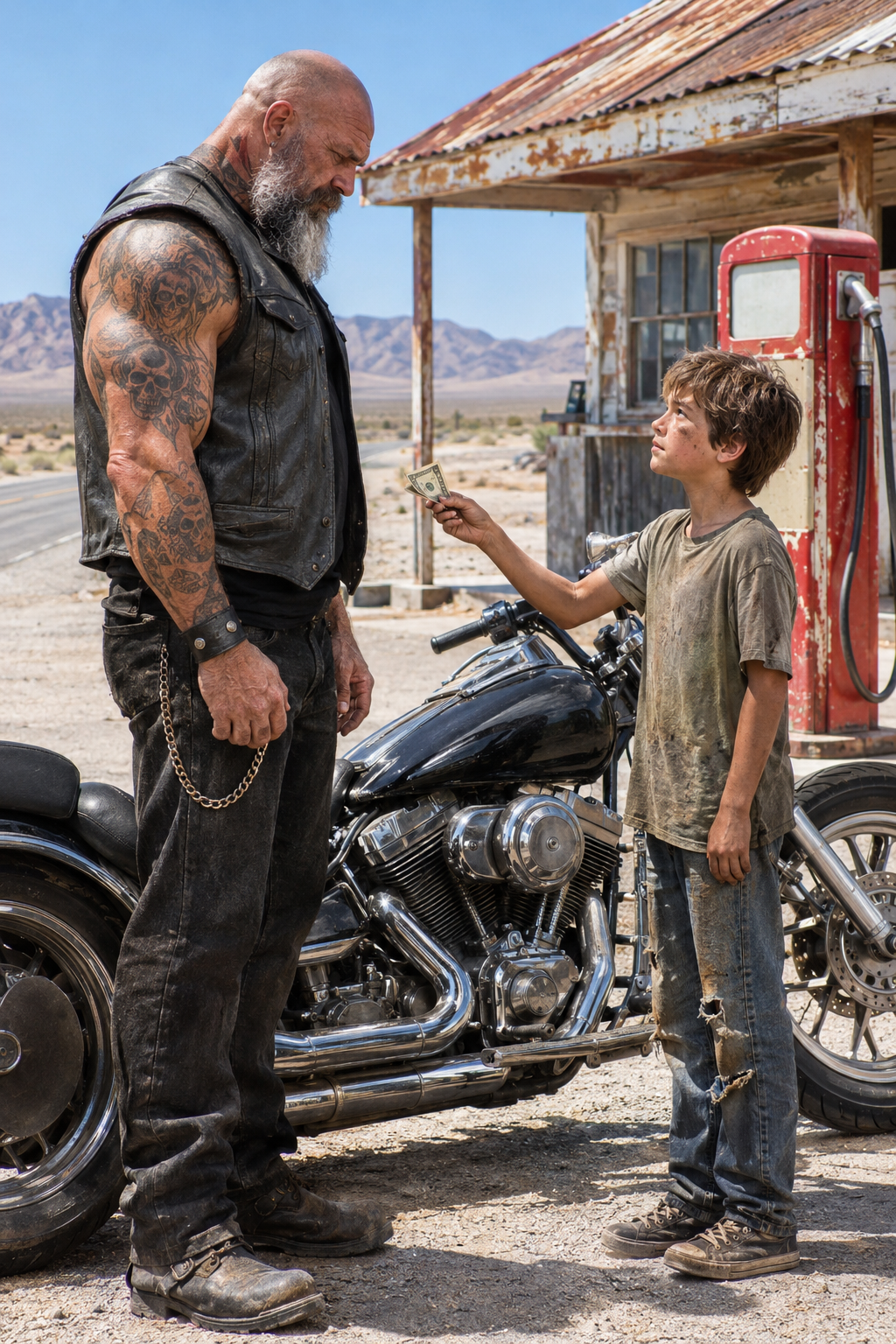
The next morning, Philip woke up to the smell of pancakes.
For a moment, he thought he was dreaming.
He walked into the kitchen and found three bikers preparing breakfast.
One was flipping pancakes.
Another was making eggs.
The third was attempting to operate a toaster and losing badly.
“Morning, little man!” the first biker shouted.
Philip rubbed his eyes.
“Where’s my mom?”
“Getting some rest. She hasn’t slept properly in days.”
Philip looked at the table.
There was enough food for an entire family.
“Is all this for us?”
The biker grinned.
“Unless you know another hungry family hiding in the kitchen.”
Philip smiled for the first time in days.
His mother appeared a few minutes later.
When she saw the table, she stopped.
“Oh, you didn’t have to do all this.”
The biker shrugged.
“Lady, we once rode eight hundred miles to deliver a birthday cake to a little girl. Making breakfast is nothing.”
She laughed softly.
It was the first genuine laugh Grip had heard from her.
But the moment didn’t last.
A black SUV pulled up outside.
A woman in her forties stepped out carrying a leather briefcase.
Behind her was a young man holding a laptop.
Bear introduced her as Renee, an attorney who had helped the club with several legal matters.
Renee examined the documents carefully.
After nearly an hour, she looked up.
“I need to ask you something. Did your husband ever tell you why he bought this house?”
Philip’s mother shook her head.
“He said he wanted to make sure we always had a home. He worked construction for years and saved everything he could.”
Renee turned another page.
“Your husband didn’t just buy this property. He established a trust for your son, and the paperwork suggests the house was supposed to be protected until Philip turned eighteen.”
Grip leaned forward.
“So the eviction is illegal?”
“Possibly. But I need to verify the title, the trust registration, and the transfer history before making that claim.”
She pointed to a date on one document.
“There’s another problem. The previous owner transferred the property to a company shortly after your husband’s death. That company later sold it to the current landlord.”
Philip’s mother frowned.
“Can they do that?”
“Not if the trust was valid and properly recorded.”
Renee typed something into her laptop.
Then she stopped.
Her eyes narrowed.
“Wait a minute.”
“What?” Bear asked.
She enlarged a scanned document.
“The company that sold this property…”
She looked at Grip.
“It’s registered to the landlord’s brother.”
The room went silent.
Renee continued.
“And according to these records, the landlord’s brother was also the lawyer who handled your husband’s estate.”
Philip’s mother covered her mouth.
“No. That can’t be true.”
Renee’s expression hardened.
“I don’t want to jump to conclusions. But someone may have deliberately transferred a property that was already held in trust.”
Grip slowly stood.
“So this wasn’t an eviction.”
Renee shook her head.
“No. If the documents are genuine, this may be fraud.”
By noon, the landlord returned.
This time, he wasn’t alone.
Two men in expensive suits accompanied him.
He knocked loudly.
Grip opened the door.
“Morning.”
The landlord looked irritated.
“I need to speak with the woman who lives here.”
“She’s busy.”
“This is a legal matter.”
Renee stepped forward.
“Excellent. I’m an attorney. You can speak with me.”
The landlord’s expression changed.
“Who are you?”
“Renee Mitchell. I represent the interests of the child named in these documents.”
She held up a copy of the trust agreement.
The landlord stared at it.
“I’ve already told you. Those papers are invalid.”
“Then you should have no objection to explaining why your company attempted to sell property that may have been held in trust.”
One of the men behind him shifted uncomfortably.
The landlord swallowed.
“This is a private family matter.”
“No,” Renee replied. “It became a legal matter when you attempted to remove a minor from his home.”
The landlord raised his voice.
“You people don’t understand how business works.”
Grip folded his arms.
“Maybe. But we understand when someone is being pushed around.”
The landlord pointed at him.
“You’re interfering with a property dispute.”
Bear appeared behind Grip.
“So are you.”
The landlord glanced at the crowd of bikers gathering outside.
He lowered his voice.
“Listen. I’ll give you until the end of the week. But after that, the eviction stands.”
Renee calmly shook her head.
“You’re not issuing any more notices until the ownership dispute is resolved. Any attempt to remove the occupants could become evidence in court.”
The landlord turned sharply.
“You’ll regret this.”
Renee smiled without warmth.
“That’s what people usually say when they realize they’ve been caught.”
He walked away.
But as he reached his SUV, his phone rang.
Grip couldn’t hear the conversation.
He could, however, see the landlord’s face.
And when the man looked back toward the house, his expression was no longer angry.
It was desperate.
That evening, Philip found Grip sitting on the front steps.
The big biker was staring at the sunset, turning a small object between his fingers.
It was an old photograph.
Philip sat beside him.
“Is that your family?”
Grip looked down.
The picture showed a younger version of himself standing beside a woman and a little girl.
“Yeah. My wife and daughter.”
“Where are they?”
Grip took a long breath.
“My daughter died twelve years ago.”
Philip lowered his eyes.
“I’m sorry.”
Grip nodded.
“Me too, kid.”
He put the photograph away.
“My daughter was eight. Her name was Lily.”
Philip looked at him.
“Was she nice?”
Grip smiled sadly.
“She was the kind of kid who would give away her lunch to somebody who forgot theirs. She once gave her favorite jacket to a boy at school because he was cold.”
Philip smiled.
“Sounds like my mom.”
“She probably would have liked your mom.”
For a while, neither spoke.
Then Philip asked a question that caught Grip off guard.
“Is that why you helped us?”
Grip looked at him.
“What do you mean?”
“Because I reminded you of your daughter?”
Grip stared at the little boy.
Maybe, he thought.
Maybe that was part of it.
But it wasn’t the whole truth.
“Your kindness reminded me of something I almost forgot.”
“What?”
“That the world doesn’t become better because someone is strong. It becomes better because someone decides to use their strength to protect somebody weaker.”
Philip considered that.
Then he reached into his pocket.
He pulled out a folded piece of paper.
“What’s this?” Grip asked.
Philip unfolded it.
It was a drawing of a motorcycle with a huge rider sitting on it.
Above the drawing, in crooked letters, were the words:
THE MAN WHO HELPED US.
Grip stared at it.
For a moment, he couldn’t speak.
Then he folded the paper carefully and placed it inside his leather vest.
“I’m keeping this forever.”
Three days later, Renee received a call from the county property office.
The trust had been properly registered.
The original purchase agreement was legitimate.
And the transfer to the landlord’s brother had been completed without the required authorization.
The property had never legally belonged to the landlord.
But the story was about to become even darker.
The county clerk had discovered that the same company had transferred several other properties over the previous five years.
All belonged to families who had recently lost a parent or spouse.
In every case, the original owner had been promised that the property would be protected for their children.
In every case, the paperwork had mysteriously disappeared.
Renee immediately contacted the authorities.
An investigation began.
The landlord was summoned for questioning.
His brother was placed under investigation.
And two weeks later, police discovered a storage unit containing original trust agreements, forged signatures, and financial records documenting millions of dollars in suspicious transactions.
Philip’s father hadn’t been the only victim.
There were seventeen families.
Seventeen children who had been robbed of homes their parents had worked their entire lives to provide.
When Grip heard the news, he sat silently for several minutes.
Then he called Bear.
“Get the brothers together.”
“What’s going on?”
“We’re going to find those families.”
Bear understood immediately.
“Already on it.”
Over the following weeks, the Iron Brotherhood became something the town had never seen before.
The bikers didn’t just attend court hearings.
They helped families locate missing documents.
They connected people with lawyers.
They repaired damaged houses, delivered groceries, and helped parents find jobs.
They raised money for legal expenses and made sure no child went to bed hungry while the investigation continued.
Grip personally visited every one of the seventeen families.
Some welcomed him with tears.
Others were too frightened to trust anyone.
One elderly woman slammed her door in his face.
Grip didn’t get angry.
He returned the following morning with groceries and left them on her porch.
By the third visit, she invited him inside.
By the fourth, she was telling him stories about her late husband.
And by the fifth, she had become one of the club’s loudest supporters.
The bikers discovered something important during those visits.
Most of the families didn’t need someone to rescue them forever.
They needed someone to stand beside them long enough to help them stand again.
And that became the club’s new mission.
Six weeks after Philip offered his eight dollars, the case reached its first major hearing.
The courtroom was packed.
Philip sat between his mother and Grip.
Bear occupied the seat behind them, wearing a suit that looked painfully uncomfortable.
Renee presented the evidence.
The original purchase agreement.
The registered trust.
The forged documents.
The financial transfers.
The testimonies of the affected families.
The landlord’s attorney argued that his client had purchased the property in good faith.
But Renee had one final piece of evidence.
A recording.
It had been recovered from the landlord’s office computer during the investigation.
In it, the landlord was speaking to his brother.
“Just get the boy and his mother out before anyone starts digging through the old files,” he said.
His brother answered:
“What if they find the trust?”
The landlord laughed.
“They won’t. That little boy doesn’t even know what his father left him.”
The courtroom fell silent.
Philip looked at his mother.
She squeezed his hand.
Grip felt something tighten in his chest.
The landlord had known.
He had known a child was about to lose the only home his father had left him.
And he had tried to take it anyway.
The judge reviewed the evidence before making a decision.
The eviction was suspended.
The property’s ownership was referred for formal restoration under the trust.
The suspected fraudulent transfers were referred to the appropriate authorities for further investigation.
It wasn’t the end of the legal battle.
But it was the first time in months that Philip’s mother could breathe without fear.
Outside the courthouse, Philip ran toward Grip.
“Does this mean we’re going home?”
Grip knelt.
“It means nobody gets to throw you out tomorrow.”
Philip threw his arms around him.
Grip hugged him tightly.
And for the first time in twelve years, he felt something inside him begin to heal.
Three months later, the investigation produced its final breakthrough.
The landlord and his brother were charged with multiple offenses related to the fraudulent property transfers.
The court ordered the restoration of the seventeen properties to their rightful beneficiaries, subject to the completion of the legal process.
Philip’s family was officially recognized as the rightful beneficiary of their home.
The day Renee delivered the news, Philip’s mother cried so hard that she could barely stand.
She held the documents against her chest.
“My husband did this for us,” she whispered.
Philip wrapped his arms around her.
“He wanted us to have a home, Mom.”
She kissed his forehead.
“He did, sweetheart. He really did.”
Grip stood quietly by the kitchen doorway.
He had come to expect tears in that house.
But these were different.
They weren’t tears of fear.
They were tears of relief.
That afternoon, Bear arrived with something in the back of his pickup truck.
A brand-new refrigerator.
Behind him were several bikers carrying boxes of groceries, furniture, and household supplies.
Philip ran outside.
“What’s all this?”
Bear grinned.
“Housewarming gifts.”
Grip raised an eyebrow.
“That’s a refrigerator, not a housewarming gift.”
Bear shrugged.
“It’s a very cold housewarming gift.”
Everyone laughed.
Then Philip noticed something else.
A small wooden sign.
It read:
THE LILY AND PHILIP COMMUNITY FUND
He looked confused.
Grip stepped forward.
“We’re starting something new.”
“What is it?”
“A fund to help families who are going through difficult times. Food, emergency housing, school supplies, legal assistance. Whatever we can reasonably do.”
Philip looked at the sign.
“Why is my name on it?”
Grip knelt beside him.
“Because this whole thing started with you.”
“But I only gave you eight dollars.”
Grip smiled.
“Exactly.”
He paused.
“Sometimes the smallest thing a person gives can become something much bigger than they ever imagined.”
A year passed.
The old house looked different.
The broken fence had been repaired.
The peeling paint had been replaced.
The garden was full of flowers, and Philip’s mother had planted vegetables along the side of the house.
Philip was doing well in school.
He had made friends.
He was eating regularly.
And every Sunday, the Iron Brotherhood came over for dinner.
They had become part of the family.
Somehow, the little kitchen that had once been nearly empty now struggled to hold all the food.
There were always too many chairs, too many plates, and too much laughter.
But the most remarkable change was in Philip himself.
He had started a small project at school called Eight Dollars, One Kindness.
The idea was simple.
Every student received a small envelope and was encouraged to use whatever they could spare to help someone in need.
Some donated money.
Others donated food, books, or clothes.
A few simply volunteered their time.
Philip kept a notebook documenting every act of kindness.
By the end of the school year, the project had helped more than sixty families.
When the principal asked Philip to speak at the school assembly, he was terrified.
He stood on the stage, gripping the microphone with both hands.
Hundreds of students looked up at him.
His mother sat in the front row.
Grip and Bear stood near the back, wearing their leather vests.
Philip took a breath.
“A year ago, I had eight dollars,” he began.
“It’s not a lot of money. I was saving it to buy food because my mom and I didn’t have much.”
The auditorium became quiet.
“One day, I saw a man whose motorcycle had run out of gas. I thought he needed help more than I needed my dinner.”
He looked toward Grip.
“I gave him my money. I didn’t know who he was. I didn’t know he would help us. I just knew somebody needed something, and I had a little bit I could share.”
He paused.
“My dad used to tell me that being poor doesn’t mean you have nothing to give.”
His voice trembled slightly.
“I didn’t understand what he meant until that day.”
Philip looked across the room.
“Sometimes people think they have to be rich to help others. They think they need lots of money, lots of time, or lots of power.”
He shook his head.
“But I learned that kindness doesn’t wait until you have everything. It starts with what you have.”
He looked down at the little notebook in his hands.
“And sometimes, when you help one person, that person helps another. Then another person helps somebody else. And before you know it, something small becomes something huge.”
The auditorium erupted in applause.
Grip wiped his eyes and pretended he had something in them.
Bear leaned toward him.
“Got dust in there, brother?”
“Shut up.”
But Bear was crying too.
After the assembly, Philip ran outside.
Grip was standing beside his motorcycle.
The same motorcycle that had run out of gas a year earlier.
Philip approached him with a familiar expression.
“Hey, Grip?”
“What’s up, little man?”
Philip held out a folded envelope.
Grip stared at it.
“What’s that?”
“Something for you.”
Grip opened it.
Inside was eight dollars.
Four wrinkled one-dollar bills and two two-dollar bills.
Grip looked at Philip.
“What’s this for?”
Philip smiled.
“Gas money.”
Grip laughed.
“Kid, I think I’ve got enough gas money now.”
“I know.”
Philip looked down for a moment.
“It’s not really for gas. I just wanted to give you back the eight dollars.”
Grip shook his head.
“You don’t owe me anything.”
“I know. But you gave me something much bigger than money.”
Philip reached into his backpack and pulled out another piece of paper.
It was a drawing.
This time, it showed a little boy standing beside a huge biker, surrounded by seventeen houses.
Above them were the words:
ONE SMALL ACT CAN CHANGE A WHOLE WORLD.
Grip stared at the picture.
Then he carefully placed the eight dollars inside his leather vest, right beside the photograph of his daughter.
Two children.
Two different stories.
One reminder.
He looked at Philip.
“Your father would be proud of you.”
Philip smiled.
“I think he’d like you too.”
Grip laughed softly.
“Yeah. I hope so.”
Then he climbed onto his motorcycle.
The engine roared to life.
But before he rode away, he looked back at the boy.
“Remember something, Philip.”
“What?”
“Never let the world convince you that being kind makes you weak. It takes more courage to help someone when you have nothing than it does to help when you have everything.”
Philip nodded.
Grip gave him a final wave and rode down the street.
That evening, Grip returned to the clubhouse.
The brothers were gathered around a long table, eating dinner and arguing about an upcoming charity ride.
Bear noticed the folded bills tucked into Grip’s vest.
“What’s that?”
Grip pulled them out.
“Eight dollars.”
Bear laughed.
“You still carrying that kid’s money?”
Grip shook his head.
“Not his money. A reminder.”
He placed the bills on the table.
Then he looked around at the men who had become his family.
“Twenty-three years on the road, and I thought I understood what brotherhood meant. I thought it was about having someone’s back when things got rough.”
He paused.
“Turns out, it’s also about remembering the people who don’t have anybody standing behind them.”
Bear raised his glass.
“To Philip.”
The others lifted theirs.
“To Philip!”
Grip looked at the eight dollars.
He remembered the hungry little boy who had offered him everything he had.
A boy who didn’t know that his father had left him a house.
A boy who didn’t know that a stranger could become family.
A boy who had no idea that eight dollars could bring 186 people together and eventually help seventeen families reclaim their homes.
And Grip understood something he wished he had learned years earlier.
Sometimes the world doesn’t need another powerful person.
It needs someone willing to notice when another human being is hurting.
It needs someone willing to stop.
Someone willing to listen.
Someone willing to give, even when giving is difficult.
Because kindness is not measured by the size of what leaves your hands.
It is measured by the hope it places in someone else’s heart.
That night, Grip placed the eight dollars in a small wooden frame beside his daughter’s photograph.
He wrote three words underneath them:
NEVER STOP GIVING.
And beneath those words, in smaller letters, he added:
Because you never know how far one small act of kindness might travel.
THE END