The kitchen key was sitting on the table, right beside a ledger that made Jesse Dalton’s stomach turn. When he understood what his father had done, Anna Whitaker was already gone.
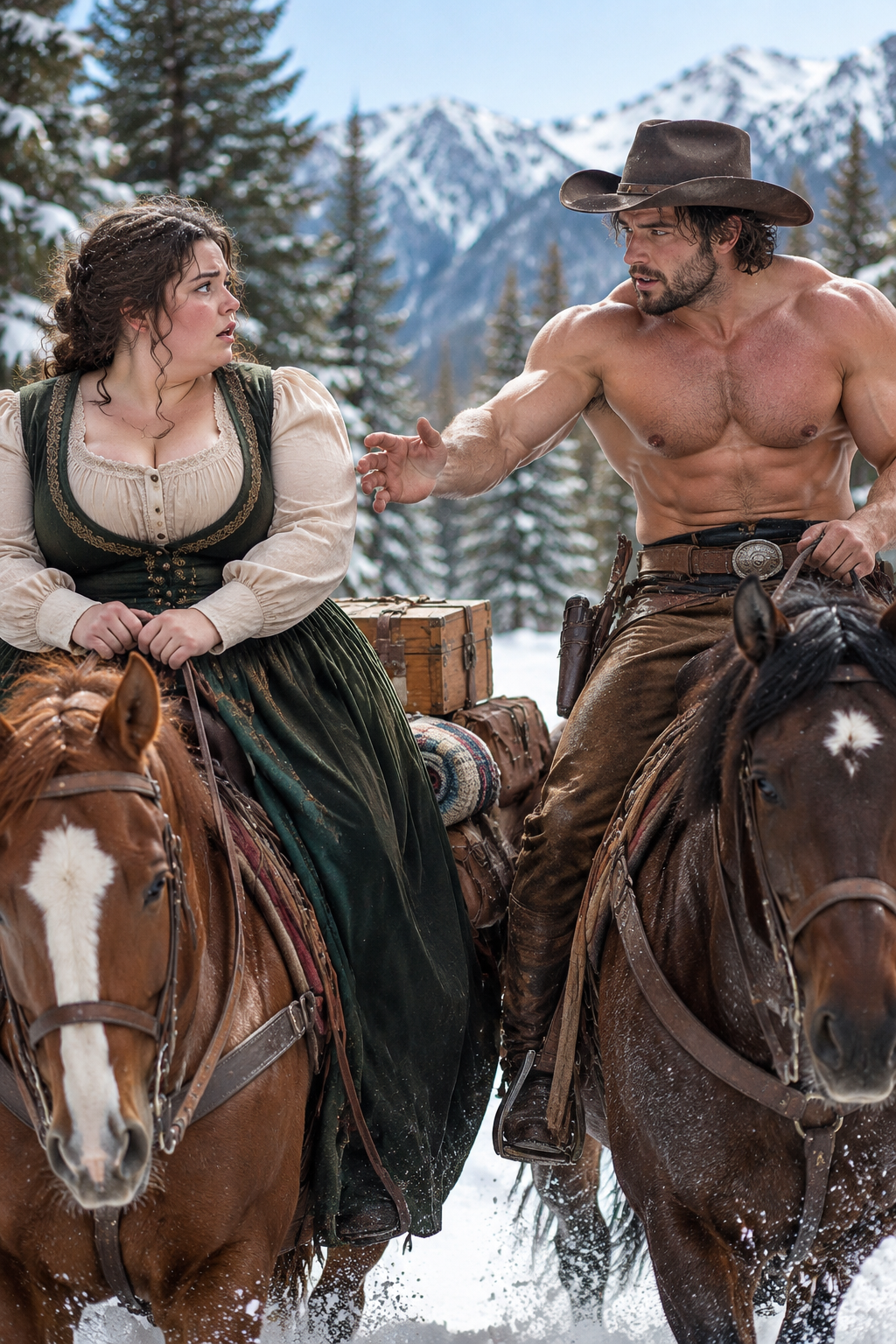
The snow was falling so hard that Jesse could barely see ten feet ahead. His horse struggled along the narrow mountain trail, its hooves slipping against the frozen ground.
Ahead of him, Anna Whitaker stood motionless, one hand gripping the reins of her tired horse.
When she turned and saw Jesse, her expression changed from surprise to something much harder to read.
“Jesse? What are you doing here?”
He pulled his horse to a stop, breathing heavily.
“Trying to keep you from getting yourself killed.”
Anna looked past him toward the trail behind them.
“You shouldn’t have come. The storm is getting worse.”
“I know.”
“Then go back.”
“Not without you.”
For several seconds, neither spoke. The wind swept between them, carrying loose snow across the trail.
Anna finally shook her head.
“You don’t understand. I can’t go back there.”
Jesse reached inside his coat and pulled out the ledger.
“I know what my father did.”
Her eyes dropped to the book.
“What is that?”
“Your records. I found them on the kitchen table.”
Anna stared at him.
“I left those for your father.”
“Why?”
“Because I wanted him to know I wasn’t leaving without paying what I owed.”
Jesse opened the ledger and held it toward her.
“Anna, you paid it months ago.”
She looked away.
“I know.”
Jesse stopped.
For a moment, he thought he had misunderstood.
“You knew?”
Anna’s eyes filled with tears, but she didn’t let them fall.
“I figured it out in October. I had been keeping track of every hour, every meal I cooked, every load of wood I carried. The numbers stopped making sense.”
“Then why did you stay?”
She looked at him with an expression he would remember for the rest of his life.
“Because your father told me that if I left before the account was settled, he would tell people my father had died owing money and that I had run away from the responsibility.”
Jesse felt something tighten in his chest.
“He couldn’t do that.”
“He could make people believe it. That’s what frightened me.”
Anna adjusted the scarf around her neck.
“My father was a good man, Jesse. He worked hard. He never borrowed money without intending to repay it. I couldn’t bear the thought of people remembering him as someone who had cheated your family.”
Jesse looked down at the ledger.
The debt had been ninety dollars.
The work she had done was worth two hundred and forty.
And somehow, she had still believed she wasn’t free.
“I’m sorry,” he whispered.
Anna shook her head.
“You didn’t do it.”
“But I knew something was wrong. I saw the way he kept changing the receipts. I should have asked you.”
“You were afraid of him.”
“That’s no excuse.”
Before Anna could answer, a loud crack echoed from somewhere above them.
They both looked toward the mountain.
A section of snow had broken loose on the upper slope.
“Anna, we need to move,” Jesse said.
She glanced toward the narrow pass.
“I was almost through.”
“Not anymore. Look.”
A fresh curtain of snow was beginning to slide down the distant hillside.
Jesse pointed toward a small timber shelter farther along the ridge. It had once been used by ranch hands during winter storms.
“There’s a shelter about half a mile from here. We can wait there until the worst passes.”
Anna hesitated.
“Your father will come looking for you.”
“Let him.”
“Jesse, you don’t know what you’re saying.”
“I know exactly what I’m saying.”
He held out his hand.
“Please.”
For the first time since leaving the ranch, Anna allowed herself to cry.
She took his hand.
Together, they made their way toward the shelter.
Neither of them knew that Harold Dalton had already discovered the empty ledger, the missing kitchen key, and the truth about the debt.
And he was not prepared to let either of them walk away.
The shelter was smaller than Jesse remembered.
Its wooden walls had gaps between the boards, and the old roof creaked whenever the wind pushed against it. But it was better than being caught outside.
Jesse helped Anna inside and secured the door with a piece of timber.
He found an old blanket and placed it around her shoulders.
“Are you hurt?”
“No.”
“Your hands are freezing.”
“They’ll be fine.”
He sat across from her and took off his gloves.
For a while, they listened to the storm.
Then Anna spoke.
“Why did you really come after me?”
Jesse looked up.
“I told you. Because the trail is dangerous.”
“That isn’t the whole reason.”
He rubbed his hands together.
“No. It isn’t.”
He looked at her carefully.
“When I found your ledger, I realized something. You weren’t just paying off a debt. You were carrying the entire ranch on your shoulders.”
Anna lowered her eyes.
“Someone had to.”
“That’s what you always say.”
“Because it’s true.”
“No, Anna. It isn’t.”
She looked at him.
Jesse continued.
“My father has employees. He has money. He has land. He has everything he needs to take care of himself. You were the one person who never had anyone looking out for her.”
Anna swallowed.
“I learned to look after myself.”
“I know. But that doesn’t mean you should have had to do everything alone.”
For a moment, her expression softened.
Then she turned toward the small window.
“You don’t know what it was like when your father first offered me the work.”
“Tell me.”
“He came to our little house after my father died. He said he was willing to help me settle the debt. He told me I could work at the ranch instead of paying the money in cash.”
Jesse listened without interrupting.
“I was grateful. I had nowhere else to go. I thought he was being kind.”
“He should have been.”
“He was, at first. But after a few months, he began saying I wasn’t doing enough. He added meals to the account. Then supplies. Then things I had never received.”
Jesse’s jaw tightened.
“Did you ever see the original receipt?”
Anna nodded.
“I did. It was folded inside my father’s old Bible. Ninety dollars. Nothing more.”
“Do you still have it?”
Anna reached into the inside pocket of her coat.
She pulled out a small piece of paper, folded carefully into quarters.
The edges were worn, but the writing remained clear.
Jesse took it gently.
It was an acknowledgment of the original debt, signed by Harold Dalton.
Ninety dollars.
Nothing about interest.
Nothing about additional charges.
Nothing about eleven months of labor.
“This proves everything,” Jesse said.
Anna shook her head.
“It proves what he promised. It doesn’t prove what he did afterward.”
“The ledger does.”
“Your father could say I wrote it myself.”
Jesse studied the pages.
“Then we’ll find the other records.”
Anna looked at him.
“What other records?”
“The ranch books. The receipts. The payment records. If my father has been changing your balance, he must have kept the original figures somewhere.”
“Jesse, you can’t go against him like that.”
“Why not?”
“Because he’s your father.”
Jesse stared at the floor.
“I know.”
The words came out more quietly than he intended.
“My mother died when I was young. After that, it was just the two of us. He raised me. He taught me to ride, to work, to manage the ranch.”
He paused.
“I spent years believing that because he was my father, he couldn’t be wrong about the important things.”
Anna said nothing.
“But lately, I’ve started wondering how many things I’ve never questioned.”
The storm rattled the shelter.
Anna slowly reached for the ledger.
“Maybe you should go home, Jesse.”
He looked at her.
“Do you want me to?”
She didn’t answer immediately.
Then she whispered, “No.”
It was the first honest answer either of them had given that morning.
Jesse moved closer, but he didn’t touch her.
“Then I won’t leave you.”
Outside, the wind continued to howl.
And far below the ridge, another rider was making his way up the mountain.
Harold Dalton had never been a patient man.
He had built his ranch through hard work, sharp decisions, and an ability to recognize when someone could be useful to him.
He had also grown accustomed to getting his way.
When he discovered Anna’s ledger, his first reaction had been anger.
His second had been fear.
He knew exactly what the numbers meant.
The original debt had been settled long before winter.
He had deliberately altered the accounts, telling himself that keeping Anna at the ranch was necessary. His wife had died years earlier, his household had become difficult to manage, and the ranch had been losing money.
Anna had made everything easier.
She was dependable, quiet, and hardworking.
At first, he had told himself he was only asking her to stay a little longer.
Then a little longer became another month.
And another.
He had convinced himself that the extra labor was fair compensation for the food and shelter she received.
But deep down, he knew the truth.
He had taken advantage of a young woman who trusted his word.
What frightened him most was not the possibility of losing Anna’s help.
It was the possibility of Jesse finding out.
He had already noticed his son’s growing concern.
He had seen the way Jesse looked at Anna, the way he found reasons to spend time near the kitchen, and the way he had begun questioning the ranch accounts.
Now both of them were gone.
Harold saddled his horse and headed toward the mountain.
He told himself he was going to bring Jesse home.
But he knew there was something else he needed to do.
He needed to stop the truth from spreading.
By late afternoon, the storm had weakened.
Jesse stepped outside the shelter to examine the trail.
The snow was still falling, but the worst of the wind had passed.
He looked toward the lower slope.
A rider was approaching.
At first, he couldn’t make out who it was.
Then he recognized the dark coat and broad shoulders.
His father.
Jesse returned to the shelter.
“Anna, we have company.”
Her face went pale.
“Who?”
“Harold.”
She stood immediately.
“I’m leaving.”
“Wait.”
“No, Jesse. I can’t face him.”
“You don’t have to face him alone.”
“He’ll blame you for this.”
“Let him.”
Anna grabbed her small bundle.
Jesse gently blocked the doorway.
“Listen to me. You don’t owe him anything anymore.”
Before she could answer, a horse stopped outside.
The door opened.
Harold stepped inside, brushing snow from his coat.
His eyes moved from Jesse to Anna.
“So this is where you went.”
Jesse stood between them.
“She’s not coming back to the ranch.”
Harold gave a short laugh.
“That’s not your decision.”
“It is if you’re asking me to help you hold her there.”
Harold’s expression hardened.
“Be careful, Jesse.”
“No. You be careful.”
The older man looked toward Anna.
“You left without permission.”
Anna stared at him.
“I never needed your permission.”
For a moment, Harold seemed genuinely surprised.
Then he looked at the ledger in Jesse’s hand.
“Give me that.”
“No.”
“That’s ranch property.”
“It has her records in it.”
“It contains false numbers.”
Anna stepped forward.
“I wrote every single one of them myself.”
Harold turned toward her.
“You’ve been keeping accounts behind my back?”
“I’ve been keeping track of my work.”
“You were given a place to stay. You were fed. You were treated fairly.”
Anna’s voice trembled, but she held her ground.
“I was told I owed ninety dollars. I worked eleven months. I earned two hundred and forty dollars after the debt was paid. You know that.”
Harold’s face reddened.
“You have no idea what it costs to run a ranch.”
“Then why didn’t you show me the real account?”
He opened his mouth.
Nothing came out.
Jesse took the original receipt from his coat.
“Because there isn’t a real account that supports what you’ve been telling her.”
Harold stared at the paper.
“Where did you get that?”
“Anna had it all along.”
The older man stepped forward.
“Give it to me.”
Jesse didn’t move.
“It’s not yours to take.”
Harold’s voice dropped.
“You are embarrassing this family.”
Jesse looked at him steadily.
“No. I’m trying to stop us from becoming the kind of family that cheats people who trust us.”
The words seemed to strike harder than a shout.
Harold looked away.
Then he turned toward the doorway.
“Get on your horse, Jesse. We’re going home.”
Jesse glanced at Anna.
“I’m not leaving her.”
“She’s not your responsibility.”
“No,” Jesse replied. “She’s her own person. That’s the point.”
Harold’s face darkened.
For several seconds, the two men stared at each other.
Then Harold said something that neither Jesse nor Anna expected.
“You think you know everything about what happened here?”
Jesse frowned.
“What does that mean?”
Harold looked toward Anna.
“Your father didn’t tell you everything, did he?”
Anna went still.
“What are you talking about?”
Harold took a breath.
“Your father and I had an agreement before he died.”
Anna’s face drained of color.
“What agreement?”
Harold hesitated.
Jesse immediately stepped forward.
“Whatever you’re about to say, you’d better have proof.”
Harold looked at his son.
Then he reached inside his coat and pulled out a small envelope.
The paper was old and yellowed.
Anna recognized her father’s handwriting on the front.
Her name.
She took one step toward it.
“Where did you get that?”
“Your father gave it to me shortly before he died.”
Anna’s hands began to shake.
“Why didn’t you give it to me?”
Harold looked down.
“Because I wasn’t sure what I was supposed to do with it.”
Jesse’s expression hardened.
“You had eleven months to figure that out.”
Harold handed the envelope to Anna.
She opened it carefully.
Inside was a letter written in her father’s familiar handwriting.
Her eyes moved across the first few lines.
Then she covered her mouth.
“Anna?” Jesse asked.
She couldn’t speak.
The letter explained that her father had borrowed ninety dollars from Harold to pay for medicine and repairs after a difficult season.
He had intended to repay it in cash, but Harold had refused.
Instead, the two men had discussed a different arrangement.
Her father would provide work and supplies to the Dalton ranch during the next harvest season.
The value of that work would settle the debt.
But Anna’s father had become seriously ill before the agreement could be completed.
He had written the details down and asked Harold to honor their arrangement.
At the bottom of the letter was a final sentence.
If anything happens to me, please make sure Anna never feels that she has to sacrifice her future for a debt that has already been settled.
Anna read it twice.
Then she looked up.
“Was this true?”
Harold didn’t answer.
“Was my father’s work already counted toward the ninety dollars?”
Harold looked at the floor.
“Yes.”
Jesse stepped back as if someone had struck him.
“So the debt was settled before she ever arrived?”
Harold nodded slowly.
Anna’s knees nearly gave way.
Eleven months.
Eleven months of believing she was honoring her father’s name.
Eleven months of exhausting herself because she thought it was the right thing to do.
She looked at Harold.
“You knew?”
“I knew about the agreement.”
“And you let me work?”
Harold’s face tightened.
“I thought you would only stay a few weeks. The ranch was struggling. I needed help.”
“You could have told me.”
“I should have.”
“But you didn’t.”
He looked at her.
“No.”
The silence that followed was heavier than the storm.
Jesse felt anger rise inside him, but beneath it was something worse.
Disappointment.
His father had not made a mistake.
He had made a choice.
And then he had repeated it every day for nearly a year.
Anna folded the letter and placed it carefully inside her coat.
She looked toward the doorway.
“I want to go.”
Jesse nodded.
“I’ll take you wherever you want.”
Harold moved aside.
For once, he did not try to stop her.
The three of them rode down the mountain together, but they did not travel as a family.
Jesse rode beside Anna.
Harold followed several yards behind.
By the time they reached the ranch, the sky had begun to clear.
The familiar buildings looked different to Anna.
The kitchen where she had spent countless mornings preparing meals.
The barn where she had carried feed through the snow.
The small room where she had slept, always believing that she was one step closer to freedom.
She dismounted and handed Jesse the reins.
“I want my things.”
“I’ll get them.”
“No.”
She looked at him.
“I can do that myself.”
He nodded.
She walked into the house.
Harold remained outside.
Jesse turned toward his father.
“You need to explain everything.”
“I know.”
“Not to me. To her.”
Harold lowered his eyes.
“I know.”
When Anna returned, she carried a small suitcase and her father’s Bible.
She stopped beside Harold.
“I don’t hate you,” she said quietly.
He looked up.
“But I don’t trust you. And I don’t want to work here again.”
Harold nodded.
“I understand.”
“No,” Anna replied. “I don’t think you do.”
She took a breath.
“You didn’t just take my time. You made me believe that my father’s memory depended on how much suffering I was willing to accept.”
Harold looked as though he wanted to speak.
But Anna continued.
“My father taught me to keep my promises. He never taught me to let someone use those promises against me.”
Then she turned and walked toward her horse.
Jesse watched her go.
For the first time in his life, he understood that doing the right thing did not always mean staying where you had been raised.
Sometimes it meant walking away from what you had always known.
The next morning, Anna left the Dalton ranch.
Jesse rode with her as far as the small town of Mill Creek.
He helped her find a room at the local boardinghouse and carried her suitcase upstairs.
The room was simple, with a narrow bed, a small desk, and a window overlooking the main street.
Anna stood by the window for a long time.
“I haven’t had a room of my own in almost a year,” she said.
Jesse smiled faintly.
“You deserve one.”
She turned toward him.
“What happens now?”
“That’s up to you.”
He reached into his pocket and placed a folded paper on the desk.
It was a copy of the ledger, along with a statement confirming that her debt had been settled before she began working at the ranch.
“I want you to have this,” he said.
“Why?”
“Because if anyone ever questions your father’s name, you can show them the truth.”
Anna touched the paper.
“Thank you.”
Jesse hesitated.
“There is something else.”
She looked at him.
“My father is going to repay you for the work you did after the debt was settled.”
Anna shook her head.
“I don’t want his money.”
“It’s not charity. It’s payment for labor he accepted.”
“I know.”
“Then let him pay what he owes.”
She looked down.
After a moment, she nodded.
“All right.”
Jesse smiled.
It was not a complete victory.
But it was a beginning.
For the next several weeks, Anna found work at a small general store.
The owner, Mrs. Bennett, needed someone who could keep accounts, manage supplies, and help customers.
Anna was good at all three.
She rented a modest cottage on the edge of town and slowly began to build a life that belonged entirely to her.
Jesse visited when he could.
At first, he always had a practical reason.
He brought firewood.
He repaired a loose hinge.
He delivered a package from the ranch.
But eventually, the reasons became less important.
They would sit on her porch and talk about ordinary things.
Sometimes they laughed.
Sometimes they sat quietly.
Anna began to realize that the man who had once seemed so distant had been paying attention all along.
And Jesse discovered that he could be honest without being cruel, strong without being controlling, and loyal without agreeing with everything his father did.
Their friendship grew naturally.
Neither rushed to call it something more.
Both had learned that trust was not something that could be demanded.
It had to be earned.
Meanwhile, the Dalton ranch began to change.
Without Anna, the house became difficult to manage.
Harold hired two workers to handle the kitchen and household chores, but they did not stay long.
The first left after three weeks.
The second lasted less than a month.
Neither worked the way Anna had.
Jesse refused to return to the ranch until his father agreed to review the accounts.
Harold initially resisted.
Then the bank sent a notice about overdue payments.
The ranch had been losing money for longer than Harold admitted.
The false receipts were only one part of a larger problem.
He had been making poor financial decisions, hiding them from Jesse, and relying on other people to fill the gaps.
Jesse insisted that every account be examined by an independent bookkeeper.
Harold reluctantly agreed.
The review uncovered several questionable charges, unpaid wages, and records that had been altered.
It was an uncomfortable process.
But it was necessary.
Harold had to repay Anna for her additional labor.
He also had to settle outstanding payments with two former ranch workers whose wages had been delayed.
The ranch survived, though it was smaller and more difficult to run than before.
For the first time, Harold began to understand that the way he treated people had consequences beyond a single argument.
One evening in early spring, Jesse came to Anna’s cottage carrying a wooden box.
“I found something in the old storage room,” he said.
Anna invited him inside.
He placed the box on the table.
Inside were several old photographs, a few letters, and a small silver pocket watch.
Anna recognized it immediately.
“My father’s watch.”
Jesse nodded.
“It was in the envelope drawer with the original account records.”
She picked it up carefully.
The metal was scratched, and the glass had a small crack.
But it was unmistakably his.
“Why did your father have this?”
Jesse looked uncomfortable.
“Your father may have left it as security when he borrowed the money. My father kept it after the agreement was made.”
Anna turned the watch over.
On the back were her father’s initials.
She held it against her chest.
“I thought it was gone.”
Jesse watched her quietly.
“He should have given it back.”
Anna wiped her eyes.
“Yes. He should have.”
She placed the watch beside the letter.
For several minutes, neither spoke.
Then Jesse said, “There’s something I want to ask you.”
She looked up.
“Go ahead.”
“I don’t want to keep finding excuses to visit.”
A small smile appeared on her face.
“Then don’t.”
He laughed softly.
“I’d like to take you to dinner. Not because I owe you anything. Not because of the ranch. Just because I enjoy being with you.”
Anna looked at him for a long moment.
Then she nodded.
“I’d like that.”
It was a simple answer.
But for both of them, it meant a great deal.
Their first dinner took place at a small restaurant near the town square.
There was no grand declaration, no expensive gift, and no promise that life would suddenly become easy.
They talked about books, horses, family, and the kind of future they each hoped to build.
Jesse told her that he wanted to turn part of the ranch into a proper training program for young workers.
Anna suggested that he should offer written agreements and fair wages from the beginning.
He smiled.
“I knew you’d have something to say about the accounts.”
She laughed.
“Someone has to make sure you don’t turn into your father.”
The joke made them both pause.
Then Jesse smiled again.
“I’ll try not to.”
As spring turned into summer, their relationship deepened.
Anna continued working at the general store, and Jesse visited regularly.
He never asked her to return to the ranch.
He never suggested that she owed him her time.
When he wanted to see her, he asked.
When she was busy, he accepted it.
And when she needed space, he gave it to her.
Those small things mattered more than any grand gesture.
They were the foundation of something neither of them had expected to find.
Harold watched the changes from a distance.
He had not become a different man overnight.
There were days when his pride returned, when he wanted to blame Jesse for challenging him or Anna for leaving.
But the truth was becoming harder to avoid.
The ranch had survived without Anna.
And the people who worked there were doing better because they were being paid fairly and treated with respect.
One afternoon, Harold visited Mill Creek.
He found Anna outside the general store, arranging a display of fresh produce.
She looked up when she heard his footsteps.
“Mr. Dalton.”
“Anna.”
He removed his hat.
“I wanted to speak with you.”
She set down the basket.
“About what?”
“About the money. I’ve arranged the full payment for the extra work you did. And I’ve included the amount for the time you were kept after the original agreement had already been completed.”
Anna nodded.
“Thank you.”
He held out an envelope.
She accepted it.
For a moment, Harold seemed unsure what to say.
Then he spoke.
“I know an apology doesn’t repair what happened.”
“No, it doesn’t.”
“I’ve been thinking about your father.”
Anna looked at him.
“He was a good man.”
“Yes,” Harold said. “He was.”
He lowered his eyes.
“I should have honored his agreement. I should have returned his watch. And I should never have made you feel responsible for something he had already settled.”
Anna remained quiet.
Harold took a breath.
“I was wrong.”
The words were difficult for him.
Anna could see that.
But she also knew that admitting wrongdoing did not erase it.
“I appreciate you saying that,” she replied.
“I don’t expect you to forgive me.”
“That’s good.”
He looked surprised.
Anna continued.
“Forgiveness isn’t something you can collect like a debt. And I won’t pretend everything is fine just because you’ve finally told the truth.”
Harold nodded slowly.
“I understand.”
“Then start by treating the people who work for you fairly.”
“I will.”
She looked at him.
“Do it even when nobody is watching.”
Harold put his hat back on.
“I’ll try.”
Then he walked away.
That evening, Jesse came to the cottage.
Anna told him about the conversation.
He listened carefully.
“Do you think he meant it?”
“I think he meant it today.”
Jesse nodded.
“That’s a start.”
She smiled.
“You sound like your mother might have.”
He looked surprised.
“What makes you say that?”
Anna picked up the pocket watch from the table.
“I found one of her letters in the box. She wrote that your father was always stubborn, but that he had a good heart when he allowed himself to use it.”
Jesse smiled sadly.
“I remember her saying something like that.”
“Maybe he can still become the man she believed he could be.”
Jesse sat beside her.
“Maybe.”
Then he took her hand.
“Whatever happens with him, I want you to know something.”
“What?”
“I don’t want you to feel that you have to prove anything to me. You don’t have to work for my approval. You don’t have to stay because you feel responsible for me.”
Anna looked into his eyes.
“I know.”
“Good.”
She squeezed his hand.
“And I don’t want you to feel that loving someone means agreeing with everything they do.”
Jesse smiled.
“That’s going to take some practice.”
She laughed.
They sat together as the evening light faded.
A year passed.
The Dalton ranch was smaller, but it was healthier.
The accounts were kept honestly.
Workers received clear agreements, fair wages, and regular days off.
Jesse took on more responsibility and began building a reputation as a fair employer.
Harold remained difficult at times, but he had learned to listen more often.
He never became the man he had been before.
Perhaps that was the most important change.
He had finally begun to understand that authority was not the same as respect.
And respect could not be forced.
It had to be earned.
Anna’s life changed too.
She eventually left the general store to open a small bookkeeping and supply business of her own.
Farmers and shop owners began coming to her because they trusted her careful records.
She helped several families organize their accounts and understand agreements before signing them.
Whenever someone came to her feeling trapped by a debt, she listened.
She never told them to ignore their responsibilities.
She simply reminded them to know their rights, keep their records, and never accept another person’s version of the truth without checking the numbers.
The lesson had cost her eleven months of her life.
She wanted others to learn it without paying the same price.
One autumn evening, Jesse took Anna back to the mountain trail where he had first caught up with her.
The storm had long since passed.
The trees were golden, and the air carried the smell of fallen leaves.
They stopped beside the old timber shelter.
Anna looked at the doorway.
“I remember thinking I would never see this place again.”
Jesse smiled.
“I remember thinking I might never catch up with you.”
She laughed.
“You almost didn’t.”
He looked toward the mountain pass.
“I was afraid.”
“Of losing me?”
“Of reaching you too late. And of discovering that I had been too late to do the right thing for a long time.”
Anna took his hand.
“You came when it mattered.”
He turned toward her.
“I want to ask you something.”
She raised an eyebrow.
“Another dinner?”
“Something a little more serious.”
He reached into his coat and pulled out a small box.
Anna’s eyes widened.
“Jesse…”
He opened it.
Inside was a simple ring.
“I don’t want to offer you a home in exchange for your work,” he said. “I don’t want to promise you a life where you have to depend on me. I want to build a life with you, where we both have a voice, where we both have choices, and where neither of us has to stay out of fear.”
His voice softened.
“Will you marry me?”
Anna looked at the ring.
Then she looked at the man standing before her.
She remembered the boy who had quietly brought her coffee during the coldest days of winter.
The young man who had questioned his own father when doing so would have been easier.
And the man who had ridden into a dangerous storm simply because he believed she deserved to be free.
“Yes,” she whispered.
Then she smiled through her tears.
“Yes, Jesse. I will.”
They married the following spring in a small ceremony near the ranch.
There were no grand decorations.
A few flowers lined the porch, and the people who mattered most stood together beneath the warm afternoon sun.
Harold attended.
He sat quietly in the second row, holding his hat in both hands.
When Anna approached, he stood.
“Your father would have been proud of you,” he said.
She smiled.
“I think he would have been proud of both of us for different reasons.”
Harold lowered his head.
“I hope I can keep earning your trust.”
“You can start by keeping your promises.”
“I will.”
And this time, Anna believed he understood what those words meant.
After the ceremony, Jesse and Anna walked together toward the edge of the property.
The ranch stretched across the valley, its barns and fields glowing in the afternoon light.
Jesse stopped beside the old kitchen entrance.
The place where Anna had once left her key.
“I kept that key,” he said.
Anna looked at him.
“Why?”
“Because it reminds me of the day everything changed.”
She smiled.
“You should have thrown it away.”
“Maybe.”
He placed the old key in her palm.
“But I thought you should decide what happens to it.”
Anna turned it over once.
Then she walked to the kitchen door, unlocked it, and placed the key on the shelf inside.
She didn’t need to keep it.
She didn’t need to prove she belonged there.
And she certainly didn’t need to carry a debt that had never truly been hers.
She closed the door and returned to Jesse.
They walked toward the house together.
For years, Anna had believed that honoring her father’s memory meant paying every dollar someone claimed he owed.
But she had finally learned something more important.
A promise is worth keeping only when it is built on truth.
Hard work deserves respect, not exploitation.
And kindness is not measured by how much someone can endure in silence.
The greatest freedom is not simply leaving a place where you were treated unfairly.
It is learning that you never have to surrender your dignity to deserve a place in this world.
That was the lesson Anna carried with her for the rest of her life.
And it was the lesson Jesse made sure the Dalton ranch would never forget.
THE END.