The king’s son had bitten every woman sent to care for him.
The word struck King Bram harder than any blade that had ever touched his skin.
For several seconds, he could only stare at his son, who clung to Rowena’s sleeve as though the entire castle might collapse around them.
“Mother?” Bram repeated, his voice barely audible.
Leyon lowered his head, his dark hair falling across the patches of fur along his cheeks.
Behind the king, Lord Varrick took one careful step toward the doorway.
“Your Majesty, the prince has suffered greatly. We must not mistake his fevered memories for—”
“Close the door,” Bram said.
Varrick stopped.
The king did not look at him.
“Close it. And remain where I can see you.”
The guard obeyed, shutting the heavy oak door with a dull thud that seemed to settle into the very foundations of the castle.
Rowena felt Leyon flinch beneath her hand.
She began humming again, softly enough that the melody belonged only to the space between them.
Bram sank to one knee.
“Leyon, your mother died six winters ago.”
The boy’s head lifted.
His golden eyes searched his father’s face with an expression that made Bram forget how to breathe.
Then Leyon shook his head.
Once.
Firmly.
Rowena opened her palm.
The brass key lay against her skin, its little blue thread darkened by years of handling.
Bram’s gaze fell upon it.
“Where did you get that?”
“Your son gave it to me.”
The king reached forward, then stopped when Leyon immediately drew back.
Rowena waited until the boy’s breathing settled before holding the key closer.
Bram studied the knot around its handle.
A faint change crossed his face.
He knew that knot.
Queen Elara had tied blue thread around everything she feared losing: her garden shears, her writing case, the little silver bell beside her bed.
She had laughed when Bram teased her about it.
“Some things are worth finding again,” she had told him.
Now a piece of blue thread lay between his son’s trembling fingers and a servant’s roughened palm.
Bram stood.
“Where does this key belong?”
Leyon pointed toward the western wall.
Varrick’s face tightened.
“The old passages are unsafe, Your Majesty.”
“Then you should have had them repaired.”
“They were sealed for the protection of the royal family.”
“Whose protection?”
Varrick did not answer.
The silence told Bram more than an explanation might have.
He turned to the guard.
“Fetch Captain Orin. Tell him to bring six men he trusts and no one from the council.”
The guard hesitated.
His eyes moved toward Varrick.
Bram noticed.
“Did you hear me?”
“Yes, Your Majesty.”
When the door opened, Rowena saw Varrick’s hand slip briefly beneath his cloak.
A small metallic click followed.
She looked toward his wrist.
A silver signet ring had been turned inward, hiding the crest carved into its face.
It was a tiny movement.
But Leyon saw it too.
He recoiled so violently that the basin overturned, sending water across the stone floor.
Rowena caught him before his claws struck the wall.
“It’s all right,” she whispered.
But his eyes were fixed on Varrick’s ring.
And Rowena understood that the boy had not been frightened by the lord’s voice.
He had recognized something.
Captain Orin arrived beneath a sky heavy with thunder.
He was an old soldier whose left knee had never properly healed after the northern wars, and whose loyalty to Bram had survived more than one disastrous royal decision.
When the king explained what Leyon had said, Orin listened without interruption.
Then he glanced at Varrick.
“Shall I take Lord Varrick to his chambers?”
“No,” Bram replied. “He comes with us.”
Rowena rose carefully, Leyon’s hand still caught in her apron.
The boy refused to release it.
One of the soldiers stepped forward.
“Your Majesty, the prince should remain here.”
Leyon bared his teeth.
Rowena rested a hand against his shoulder.
“He knows the way,” she said.
Bram looked at his son.
For years, every conversation about Leyon had taken place over the boy’s head.
Physicians had discussed his body.
Advisers had discussed his inheritance.
Noblewomen had discussed his behavior.
Almost no one had thought to ask what he wanted.
“Will you show us?” Bram asked.
Leyon studied him for a long moment.
Then he nodded.
They left the nursery together.
The western corridors were colder than the rest of the palace.
Rainwater traced thin silver lines down the windows, and the torches bent whenever the wind entered through the cracks.
Leyon walked close to Rowena, occasionally brushing his claws against the stone.
At the entrance to the abandoned chapel, he stopped.
A marble statue of the late queen stood beneath an archway, her hands folded over a carved rose.
Someone had placed fresh flowers at its feet.
Bram noticed them.
“No servants are assigned to this wing.”
Orin examined the stems.
“They were cut this morning.”
Varrick shifted.
“Some of the household remain devoted to Her Majesty’s memory.”
“Then why are there no footprints in the dust?”
Rowena’s quiet question drew everyone’s attention downward.
A narrow strip of clean stone ran along the base of the statue.
Someone had been moving it.
Orin pressed against the marble.
Nothing happened.
Rowena looked at the key, then at the rose carved between the queen’s fingers.
There was a small opening beneath one petal.
She inserted the key.
A soft click sounded.
The statue moved inward.
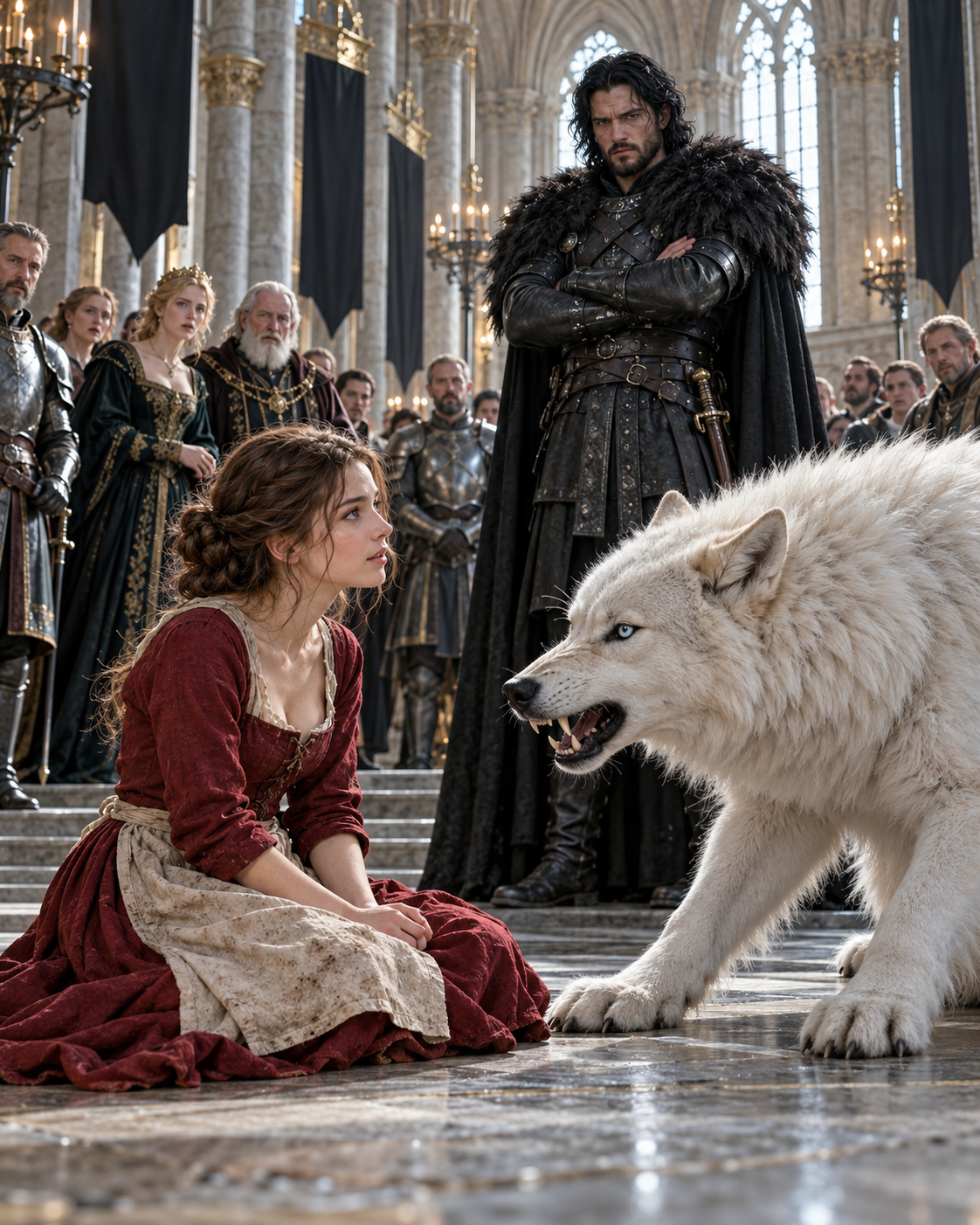
Behind it, stone steps descended into darkness.
The air rising from below smelled of damp earth, old candles, and something sharper.
Medicine.
Leyon made a small sound in his throat.
Rowena crouched beside him.
“Do you want to stop?”
He looked down the staircase.
His fingers trembled.
Then he took her hand.
“Please.”
That one word was enough.
The staircase twisted far beneath the chapel.
Water dripped somewhere beyond the walls, and the soldiers’ boots echoed against the uneven steps.
Bram carried a torch.
He remembered the passages from his childhood, when his father had warned him that the oldest chambers beneath the castle belonged to a time of superstitions and cruelty.
Later, Elara had asked him to reopen them.
She believed forgotten places should be examined rather than feared.
Bram had refused.
There had been a war to settle, a harvest to protect, noble houses threatening rebellion.
He had always found another matter more urgent.
Now his son walked beneath the earth with scars around his wrists.
At the bottom stood an iron door.
Three deep grooves crossed its surface.
Beside it hung a rusted bell.
Leyon stopped breathing evenly.
Rowena knelt.
“What is it?”
The boy stared at the bell.
“Bad sound.”
Varrick spoke quickly.
“These chambers once housed unstable prisoners. Their records were destroyed years ago.”
Orin lifted his torch toward the iron frame.
“The hinges were oiled recently.”
Bram turned.
“Explain that.”
Before Varrick could answer, a faint sound rose from the other side.
Three notes.
A pause.
Then three more.
Rowena felt the blood drain from her face.
It was the beginning of her washing song.
But the melody was slower.
Exhausted.
As though the singer could barely draw enough breath to finish it.
Leyon pressed both hands against the door.
“Mother.”
Bram stepped forward.
“Elara?”
The singing stopped.
For a terrible moment, there was only dripping water.
Then a woman’s voice answered.
“Bram?”
The torch shook in the king’s hand.
He reached for the lock.
Varrick moved with sudden speed.
A narrow blade flashed from beneath his sleeve.
“Do not open that door.”
Captain Orin seized his arm before the weapon reached Bram.
Metal struck stone.
Varrick twisted, but the captain drove him against the wall and pinned his wrist behind his back.
The soldiers raised their swords.
Bram barely looked at him.
“Open it.”
Orin took the key from Rowena.
The lock resisted, its ancient mechanism grinding beneath the pressure.
Then the bolt slid free.
Bram pushed the door inward.
The chamber beyond was small and painfully clean.
A narrow bed stood beside a table covered with books, folded linen, and empty medicine bottles.
A single candle burned behind a glass shield.
And beside the bed stood a woman in a faded blue dress.
Her hair, once dark, had turned silver at the temples.
Her face was thinner than Bram remembered.
But he knew the way she held her hands together when she was trying not to tremble.
“Elara.”
The woman looked at him.
For a moment, neither moved.
Then her gaze passed over his shoulder.
She saw Leyon.
The sound that escaped her was scarcely more than a breath.
“My boy.”
Leyon surged forward.
Rowena released his hand.
The queen dropped to her knees just as her son reached her.
He collapsed against her, his clawed fingers catching in the fabric of her dress.
Elara wrapped both arms around him.
She did not recoil from his fur.
She did not examine his teeth.
She pressed her cheek against his tangled hair and began singing the melody that had guided him through the darkness.
Rowena turned away.
Bram remained standing in the doorway, unable to take another step.
Six winters ago, he had watched a sealed coffin carried through the cathedral.
He had mourned a woman whose grave he visited every spring.
He had spoken to a stone bearing her name.
And all that time, she had been beneath his own home.
Elara lifted her eyes toward him.
“You came.”
Bram opened his mouth.
Nothing emerged.
Finally, he whispered, “I buried you.”
Her gaze moved toward Varrick, who stood restrained between two soldiers.
“No,” she answered. “You buried what they told you was mine.”
The truth did not arrive all at once.
It came in broken pieces, carried by a woman who had spent six years learning to survive without certainty that anyone would believe her.
Elara had discovered the old royal records shortly after Leyon’s fourth birthday.
For generations, the royal bloodline had carried an inherited ability to shift between human and beast.
In some children, the change came gently.
In others, it emerged during illness or fear.
The old records described patience, warmth, familiar voices, and the presence of trusted family as the safest ways to help a frightened child return to himself.
But they also described methods devised by rulers who had wished to turn that gift into a weapon.
Iron restraints.
Isolation.
Painful sounds.
Forced transformations.
Elara had ordered the records sealed and the underground chambers destroyed.
Varrick had refused.
He believed a prince who could be made obedient through terror would give the kingdom a weapon no neighboring crown could resist.
When Elara threatened to expose him, he arranged her disappearance.
A physician declared her dead.
A coffin was sealed before Bram could see her face, supposedly because of a contagious illness.
The king had believed the report.
For years, Varrick had insisted that Leyon’s worsening condition required increasingly severe treatment.
And whenever the boy began to recover, another session below ground sent him spiraling back into fear.
Bram listened without moving.
On the table lay several small wooden toys.
One was a horse with a broken leg.
Another was a bird carved from a piece of old furniture.
Elara had made them for her son.
Varrick had occasionally brought Leyon to the chamber, believing that threatening his mother would keep him compliant.
But the visits had also allowed Elara to teach him the washing song and, eventually, slip him the key.
She had not known whether he understood.
She had only hoped he might someday find someone who would listen.
Rowena looked at the queen.
“How did you know that song?”
Elara managed a tired smile.
“My mother taught it to me. She worked in the palace laundry before my father married her.”
Rowena remembered learning the same melody from an elderly washerwoman, one who said it had been passed from hand to hand for generations.
It was not a royal song.
It belonged to the people whose work kept the castle standing.
And it had reached a prince when the finest physicians in the kingdom could not.
Bram sat slowly on the edge of the bed.
“Why did I never see?”
Elara looked at him for a long moment.
“Because you trusted the people who spoke with certainty.”
Her voice held no anger.
That made the words harder to bear.
Varrick did not remain silent for long.
When the soldiers prepared to escort him upstairs, he began to laugh.
A dry, strained sound.
“You think this ends with my arrest?”
Bram turned.
“It ends with a trial.”
“A trial before which court?”
Varrick straightened despite Orin’s grip.
“Half the council signed the orders. Three noble houses financed the treatments. Your own physicians supplied the medicines.”
Bram’s expression hardened.
“Then they will answer too.”
“And when the nobles withdraw their soldiers from your borders?”
Varrick’s voice grew stronger.
“When the grain convoys stop? When your enemies learn that the crown prince cannot control his own body?”
He leaned forward.
“You will discover how expensive mercy can become.”
Bram stepped close enough that Varrick finally fell silent.
“I already know the cost of your kind of strength.”
The king glanced toward his wife and son.
“I have paid it for six years.”
He ordered Orin to take the lord into custody and seize every council record connected to the underground chambers.
But Varrick had not been bluffing.
Before they reached the chapel, the castle bells began ringing.
Not the measured bells of an approaching visitor.
The urgent, uneven alarm reserved for rebellion.
A soldier came running down the steps.
“Your Majesty, armed men have gathered in the eastern courtyard.”
“Whose banners?”
“House Merrow and House Cael.”
Bram knew both families.
Both had supported Varrick’s proposal to remove Leyon from the line of succession.
From above came a sudden crash.
Then shouting.
Orin drew his sword.
“They’re trying to seize the prince.”
Leyon crouched beside Elara, the fur along his spine rising.
Rowena looked at the bell hanging near the iron doorway.
She understood, suddenly, why the boy feared its sound.
Varrick’s supporters knew exactly how to make him lose control.
And if they could provoke him in front of the court, they would have the excuse they needed to declare him dangerous.
They took the narrow service staircase toward the old kitchen.
Orin sent two soldiers ahead and kept the others close around the queen.
Bram carried Leyon’s wooden bird in one hand and a sword in the other.
For the first time, Rowena noticed how heavily the king walked.
He had been awake through the night.
He had discovered that his wife was alive, that his closest adviser had betrayed him, and that his son had endured years of suffering beneath his roof.
Yet there was no time to understand any of it.
At the top of the stairs, the kitchen door stood open.
The hearth had been abandoned.
A pot of porridge boiled over, hissing as it struck the coals.
Beyond the kitchens, armed voices filled the passage.
Orin raised his hand.
“Wait.”
A young kitchen servant stumbled through the doorway.
Blood marked his forehead.
“They’re bringing the silver bell,” he gasped.
Leyon’s body tightened.
Elara held him close.
Bram looked at Rowena.
“What bell?”
She remembered the way the prince had reacted to the metal sound in Varrick’s sleeve.
“The one they used below,” she said.
Before anyone could move, a clear ringing note cut through the corridor.
Leyon screamed.
His back arched.
His fingers lengthened, claws tearing through the fabric at Elara’s shoulder.
The second note came.
He broke free.
A soldier raised his weapon instinctively.
“Don’t!” Rowena shouted.
Leyon struck the kitchen table, splintering its edge.
His body shook with the unfinished shift, caught painfully between boy and beast.
Bram reached for him.
Leyon recoiled, knocking a chair across the floor.
Then the third note sounded.
The prince lunged toward the corridor.
Rowena stepped into his path.
For an instant, she saw nothing familiar in his eyes.
Only terror.
His claws struck her shoulder.
Pain burned down her arm.
She stumbled but did not retreat.
Behind her, Bram shouted for the soldiers to lower their swords.
Rowena could barely hear him.
She sank slowly to the floor.
Not because she was unafraid.
Her hands were shaking so badly she could hardly hold them still.
But she remembered the nursery.
The basin.
The bread.
The way Leyon had approached when no one demanded anything from him.
So she sat down on the cold kitchen stones.
And began to sing.
Her voice cracked on the first line.
Leyon snarled.
Another bell rang.
She kept singing.
Elara knelt beside her, joining the melody with a voice worn thin by years underground.
Two women sang an ordinary washing song while armed men struggled in the corridor beyond.
Leyon’s claws scraped against the stone.
His shoulders heaved.
Then his head turned.
He recognized his mother’s voice.
His breathing slowed.
Rowena extended her uninjured hand.
The boy crept toward them, every movement unsteady.
When he finally touched her fingers, she felt how violently he was trembling.
“It’s all right,” she whispered. “You can come back when you’re ready.”
Leyon pressed his forehead against her palm.
The fur began to recede.
Slowly.
Painfully.
And this time, no one tried to force the change.
The fourth bell never rang.
Bram had walked into the corridor and found the nobleman holding it.
Lord Cael stood behind a line of armed retainers.
He wore a silver chain of office and the confident expression of a man who believed the king’s grief had made him weak.
“Your Majesty,” Cael said, “for the protection of the realm, we must take custody of the prince.”
Bram looked at the bell.
“Put it down.”
“The child is unstable.”
“Put it down.”
Cael smiled thinly.
“You cannot rule through sentiment.”
Bram advanced.
Two retainers moved to block him.
Orin stepped beside the king, followed by the royal guards.
For a moment, steel hovered inches from steel.
Then Bram spoke.
“My son is not your prisoner.”
Cael lifted the bell again.
Before he could strike it, a voice came from the kitchen doorway.
“Stop.”
Everyone turned.
Queen Elara stood beneath the arch.
Her faded dress hung loosely from her shoulders, and her silver-streaked hair had been hastily tied behind her head.
She looked nothing like the painted queen in the throne room.
But Bram saw several older soldiers lower their weapons in recognition.
Cael stared.
“Your Majesty?”
Elara stepped forward.
“Do you remember the oath you swore when my son was born?”
Cael said nothing.
“I remember it.”
She looked toward the soldiers behind him.
“You promised to protect the royal family. Were you told that meant frightening a child until he could no longer speak?”
A young retainer slowly lowered his sword.
Then another.
Cael’s expression changed.
He glanced toward the courtyard, where his supporters waited.
But the advantage he had brought into the castle was slipping away.
Bram held out his hand.
“The bell.”
Cael hesitated.
Orin took one step forward.
At last, the nobleman surrendered it.
Bram examined the polished silver object.
It was small enough to fit in his palm.
He wondered how many nights his son had awakened at the memory of its sound.
Then he placed it on the floor and crushed it beneath his heel.
The clear metal cracked.
A broken note rang once against the stones.
From the kitchen, Leyon flinched.
But Rowena’s song continued.
And the sound faded.
The trial began eleven days later.
The noble houses demanded a private hearing.
Bram refused.
He ordered the great hall opened to the families of the castle servants, the royal soldiers, the townspeople, and anyone whose testimony concerned the underground chambers.
The records revealed more than even Elara had suspected.
Children born with unusual shifting abilities had been taken from villages over many years.
Some had been trained through fear.
Others had disappeared from the official registers entirely.
Varrick had hidden his work behind royal authority, using the king’s seal on documents Bram had never personally examined.
Several physicians confessed.
Others fled.
Lord Cael attempted to deny his involvement until a former stable boy presented a ledger containing payments for the iron restraints.
The boy had kept it because he could not forget the sounds that came from beneath the chapel.
Bram listened to every witness.
He did not hide behind the throne when they described what had happened.
On the seventh day of the trial, an elderly servant stepped forward.
Her hands were bent with arthritis.
She had once been responsible for cleaning the chambers below.
“I tried to tell someone,” she said.
Bram looked at her.
“Who?”
“Three officials, Your Majesty.”
“And what did they say?”
“That I was only a servant.”
The king lowered his eyes.
For the first time, he understood that Varrick’s cruelty had not survived merely because one man was powerful.
It had survived because too many people had been taught that certain voices did not matter.
When the verdicts were delivered, Varrick and his principal accomplices were stripped of their titles and sentenced to imprisonment under the laws they had violated.
The remaining conspirators faced judgment according to their roles.
But Bram knew punishment could not restore the lost years.
He ordered the hidden chambers closed as prisons and opened for investigation.
He established protections for children with shifting blood, forbidding forced transformations and punishment-based treatment.
Most importantly, he required reports of abuse to be heard regardless of the speaker’s rank.
The decrees were written in the language of kings.
But their beginning had been a maid asking a frightened boy whether he wanted some bread.
Healing did not come with the verdict.
For weeks, Leyon still woke screaming.
Sometimes he would not allow Bram inside his room.
Sometimes the smell of medicine sent him beneath the bed.
There were mornings when his hands changed without warning, and nights when he refused to speak at all.
Elara stayed near him whenever he wished.
But even she could not erase six years of fear with a single embrace.
Rowena remained his permanent keeper.
She refused a grand apartment near the royal chambers, asking instead for two small rooms beside the nursery, where she could rest without being far from him.
The king offered her silk dresses.
She requested warm blankets for the children found in the old records.
He offered her gold.
She asked for repairs to the servants’ quarters and proper wages for the laundry workers.
Bram granted both.
Yet Rowena never pretended she could mend everything.
She made mistakes.
Once, she reached too quickly for a broken cup, and Leyon hid from her for an entire afternoon.
Another day, exhausted after a sleepless night, she spoke sharply when he overturned his supper.
The boy went silent.
Rowena knelt beside the scattered food.
“I was tired,” she said. “But I should not have spoken to you that way.”
Leyon watched her carefully.
Adults in his life had always demanded apologies.
He had rarely heard one offered.
After a while, he pushed a piece of bread toward her.
They ate together on the floor.
And the following morning, he let her brush the tangles from his hair.
Bram began visiting every evening.
At first, he stayed near the door.
Sometimes Leyon ignored him.
Sometimes he asked him to leave.
The king obeyed.
It was the hardest kind of patience he had ever practiced.
One winter evening, Bram arrived carrying the little wooden bird Elara had carved underground.
He had repaired its broken wing.
Leyon examined it without speaking.
Then he looked at his father’s hands.
“You fixed it?”
“I tried.”
“The wing is crooked.”
Bram glanced at the bird.
“Yes,” he admitted.
Leyon turned it over.
For a moment, Bram expected him to throw it aside.
Instead, the boy placed it beside his pillow.
“You can try again tomorrow.”
Bram smiled.
Not the formal smile he wore before ambassadors.
A small, uncertain smile that belonged only to a father.
“I would like that.”
Spring returned slowly to the kingdom.
The first roses opened beneath the windows where Elara had once kept her garden.
She began walking there with Leyon in the mornings, sometimes accompanied by Rowena, sometimes alone.
The boy still preferred quiet places.
He disliked crowds and sudden noises.
But he had begun to laugh again.
The sound surprised everyone the first time they heard it.
A little kitchen girl had dropped a sack of flour, covering herself from head to toe.
Leyon had stared at her.
Then he laughed so hard that his pointed ears trembled.
The girl laughed too.
Before long, the entire kitchen joined them.
No one called him feral that day.
No one called him dangerous.
They simply called him Leyon.
One afternoon, Bram found Rowena sitting beneath an apple tree while the prince attempted to teach a young dog to fetch a stick.
The dog had little interest in the lesson.
It preferred chewing the king’s discarded glove.
Leyon protested.
The dog wagged its tail.
Bram watched for a while before sitting beside Rowena.
“You could have asked me for a title,” he said.
Rowena smiled faintly.
“And what would I do with one?”
“You would have influence.”
She looked toward the boy chasing the dog through the grass.
“I already have a responsibility.”
Bram followed her gaze.
“I thought being king meant having the strength to make others obey.”
Rowena said nothing.
He watched Leyon stop running when the dog became frightened by a falling branch.
The boy crouched and waited.
After a moment, the animal approached him again.
Bram’s expression softened.
“I think I was mistaken.”
Rowena folded her hands in her lap.
“Perhaps strength is knowing when not to use it, Your Majesty.”
The king considered her words.
Then he stood and walked toward his son.
Leyon looked up.
“Father, the dog won’t listen.”
Bram knelt beside him.
“Have you tried asking?”
Leyon frowned.
“Dogs don’t understand asking.”
“Neither did I, for a very long time.”
The boy studied his father.
Then he held out the stick.
“Will you help me?”
Bram took it.
“Yes.”
A year after the hidden chamber was opened, the kingdom gathered for the spring festival.
Bram had arranged a ceremony in the great courtyard, not to celebrate military victory or royal conquest, but to announce the opening of a sanctuary for children who had suffered under the old laws.
Physicians trained in compassionate care would work alongside families, teachers, and those who understood shifting blood from experience.
The sanctuary would bear no king’s name.
Elara had chosen its title.
The House of Open Doors.
Rowena stood near the garden archway, watching workers arrange benches beneath the flowering trees.
She wore a simple blue dress.
Leyon had insisted upon it.
“Mother says blue means you can find someone again,” he had explained.
She had laughed, then cried quietly after he left the room.
At the ceremony, Bram spoke before nobles and servants alike.
He did not describe himself as the man who had saved his son.
Instead, he told them how he had failed to hear him.
He spoke of the danger of power without accountability, of cruelty disguised as duty, and of the terrible ease with which frightened people could be silenced.
Then he invited Rowena forward.
She hesitated.
The entire courtyard turned toward her.
Bram stepped down from the dais.
“I once believed my son needed someone strong enough to control him,” he said.
His voice carried clearly across the stones.
“But he needed someone willing to understand him.”
He extended his hand.
Rowena approached, her fingers trembling slightly.
The king bowed.
A real bow.
Deep enough that the crown upon his head caught the sunlight.
A murmur moved through the gathered nobles.
Rowena stood motionless.
Then Leyon slipped out from beside his mother.
He crossed the courtyard and took Rowena’s hand.
With his other hand, he reached for Bram’s.
The king looked down.
Leyon’s fingers were still different from those of other children.
His nails curved slightly.
A faint line of dark fur remained near his wrist.
But his grip was steady.
“Father,” he whispered.
Bram bent closer.
“Yes?”
“Can we go home now?”
The king glanced at the great castle rising behind them.
For a moment, he thought of the underground chamber, the sealed coffin, the years of silence.
Then he looked at Elara, standing beneath the roses.
He looked at Rowena, whose scarred hand rested gently over his son’s.
And he understood that the building behind him had never been enough to make a home.
“Of course,” he answered.
Leyon smiled.
They walked together through the courtyard as the bells began to ring.
The boy stopped at the first note.
Bram felt his hand tighten.
Rowena looked toward him, ready to lead him somewhere quiet.
But Leyon remained where he was.
He listened.
The bells sounded again, warm and clear beneath the afternoon sky.
They were not the sharp silver notes of the chamber below.
These were the great bells of the city, rung by people who had come to celebrate the sanctuary’s opening.
Elara approached and knelt beside him.
“Would you like them to stop?”
Leyon thought for a moment.
Then he shook his head.
“No.”
He looked toward the tower.
“They sound different.”
Rowena brushed a strand of hair from his forehead.
“Yes,” she said softly. “They do.”
The bells continued.
And for the first time, Leyon heard them without hiding.
That evening, the royal family ate together in a small room overlooking the gardens.
There were no courtiers.
No physicians.
No guards standing over the prince.
Only warm bread, roasted apples, a bowl of soup, and a wooden bird with a slightly crooked wing.
Leyon sat between his parents.
Rowena occupied the chair beside him.
Halfway through supper, the boy reached for his father’s hand beneath the table.
Bram did not speak.
He simply held it.
Outside, the last sunlight settled across the castle walls.
Somewhere in the servants’ quarters, a woman began singing an old washing song.
Leyon listened, then quietly joined in.
His mother smiled.
Rowena continued eating.
And Bram, who had once believed that love could be measured by everything he provided, finally understood that sometimes it was measured by the things he allowed another person to give.
Time.
Space.
A choice.
A voice.
The freedom to be frightened without being punished for it.
Years later, when Leyon became king, people would remember him for many things.
They would speak of his fairness, his careful judgment, and his unusual willingness to listen before issuing an order.
But in the oldest portraits of his reign, one small detail remained that no painter was permitted to remove.
Beside the throne stood a plain wooden chair.
Its surface was worn.
Its legs were uneven.
It had once belonged to a scullery maid.
And whenever a frightened child, a poor servant, or a powerless stranger came before the king, Leyon would ask that the chair be brought forward.
He would wait until they were seated.
Then he would listen.
Because the most important lesson he had learned had not come from a crown, a sword, or a royal tutor.
It had come from a woman who entered a locked room with nothing but warm water, a piece of bread, and the patience to see a frightened child where everyone else had seen a monster.
And in the end, that was how a broken royal family began to heal.
Not through the power to command.
But through the courage to be gentle.
THE END.