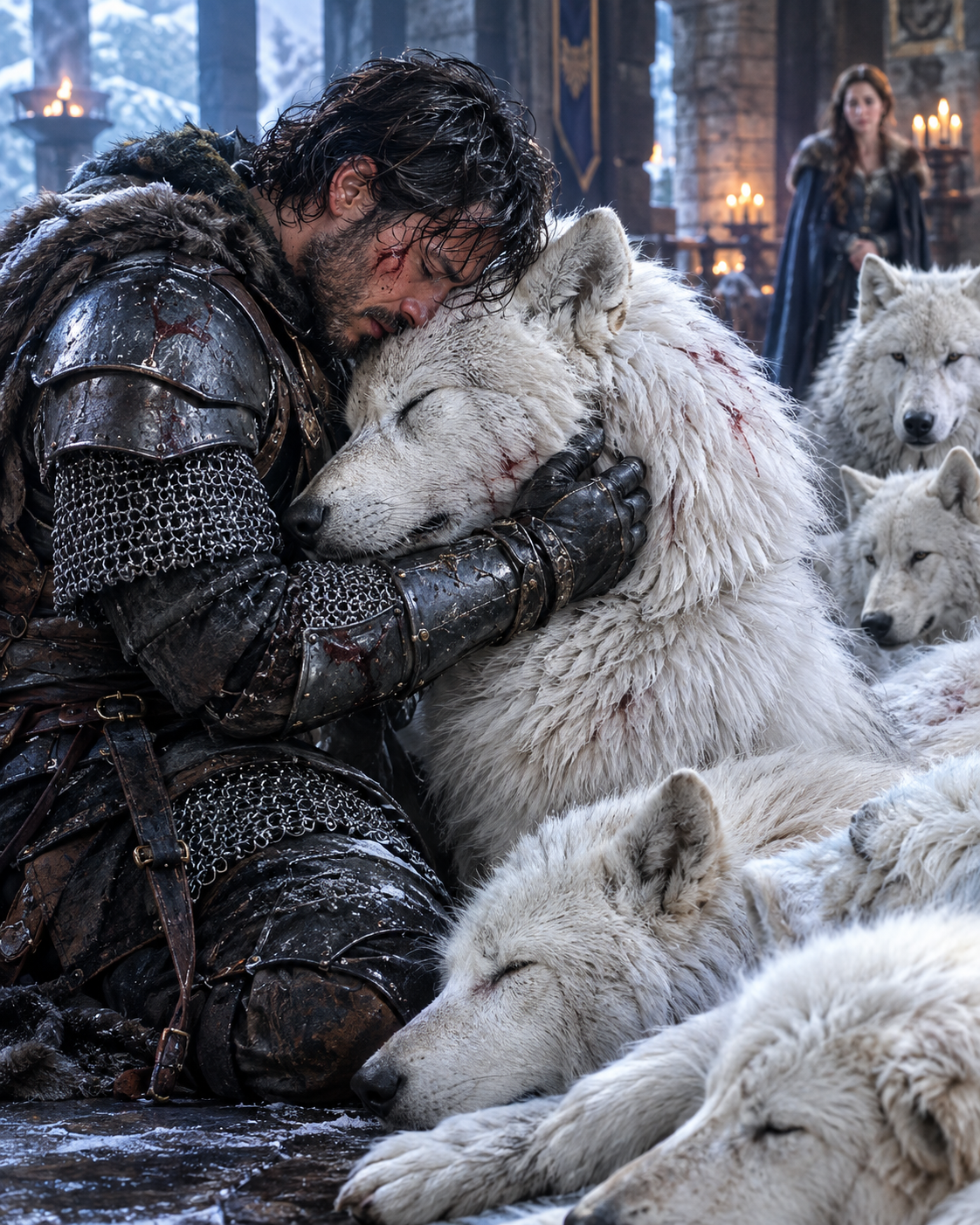
The king was not supposed to be crying.
And Oren stepped forward.
Not toward Varick.
Toward them.
For one terrible heartbeat, Alera thought she had been wrong about everything.
The old wolf moved into the storm with his head lowered, snow gathering along the ridge of his spine. One by one, the glowing eyes between the trees shifted toward him.
Varick’s smile widened.
“There,” he said softly. “Even the king’s beast knows when a cause is lost.”
Alera did not answer.
Something in Oren’s posture had changed.
He was no longer the weak animal she had dragged through the mountain wind. His legs still trembled, and the poison had stolen much of his strength, but his ears were high now. His tail was rigid.
He took three steps toward the wild wolves.
Then stopped.
A low sound rolled from his chest.
Not fear.
A command.
The forest answered.
The first wolf emerged from between the pines.
It was enormous, its coat nearly white, one ear torn away and an old scar running across its muzzle. Another followed. Then five more.
Then ten.
Varick’s men raised their crossbows.
“Hold,” Varick ordered.
The white wolf approached Oren until their noses were almost touching.
For several seconds, neither animal moved.
Then Oren lowered his head.
Alera’s heart sank.
But the white wolf did something she had never seen a wild animal do.
It lowered its head lower.
Behind it, every wolf in the forest did the same.
Varick’s expression vanished.
Oren turned.
He looked at Alera.
Then at Varick.
And growled.
The mountain exploded.
Wolves came out of the trees like pieces of the storm itself.
Men shouted. Crossbows snapped. Horses screamed and reared.
Varick stumbled backward as one of his guards disappeared beneath gray bodies.
“Alera!” someone yelled.
She dropped instinctively.
An arrow passed over her shoulder.
Oren struck the archer before he could fire again.
Alera ran.
She did not know where she was going. The world had become white snow, dark blood, teeth, steel, and terrified voices.
Then a hand seized the back of her cloak.
She spun.
Varick.
His face was no longer calm.
“You foolish little—”
Alera drove her knee into him.
His grip loosened.
She tore free, but not before he ripped the medicine satchel from her shoulder.
“No!”
Varick staggered back with the satchel clutched in one hand.
For the first time, Alera understood.
He had not come to kill her.
He had come for the antidote.
Varick smiled through bleeding lips.
“Let the wolves have me,” he said. “The king will still die.”
Then he threw the satchel over the cliff.
Alera watched it disappear into the white emptiness.
Everything inside her stopped.
The antidote.
The roots.
The glass vials.
The only chance Kaelen had.
Gone.
Varick turned to run.
Oren hit him from the side.
They disappeared together into the snow.
Alera crawled to the edge of the cliff.
Far below, through the moving curtain of white, something dark struck a shelf of rock.
The satchel.
It had not fallen all the way.
There was no path down.
No rope.
No time.
Behind her, Varick screamed.
Alera tore off her gloves and began climbing.
The rock was buried beneath ice. Her fingers slipped twice in the first few feet.
Someone shouted her name.
She ignored it.
She lowered herself onto a narrow ledge and searched for the next handhold.
Her fingers were already numb.
Below her, the satchel rested against a broken pine branch jutting from the cliff.
Twenty feet.
Perhaps thirty.
She could reach it.
She had to.
The king had hours.
Maybe less.
Alera descended.
The wind struck the cliff face and tried to tear her away. Ice cut through the skin of her palms.
She reached another ledge.
Then another.
The satchel was close now.
Five feet.
She stretched.
Her fingers brushed leather.
The branch cracked.
Alera lunged.
She caught the strap.
The branch broke.
Her feet vanished beneath her.
For an instant she hung over open air, one hand gripping a ridge of ice, the other holding the satchel.
“Alera!”
Oren’s head appeared above the cliff.
Blood stained his muzzle.
He barked once.
Then a rope dropped beside her.
She grabbed it.
Hands pulled.
By the time she reached the top, she could barely feel her arms.
Three of Varick’s men were dead. The others had fled into the storm.
Varick remained alive.
Barely.
He was on his knees with the white wolf standing behind him and Oren in front.
Alera opened the satchel.
One vial had shattered.
Two were intact.
Enough.
She nearly laughed.
Instead, she looked at Varick.
He stared back at her with hatred so complete that it almost looked peaceful.
“You think you saved him?” he whispered.
Alera froze.
Varick began laughing.
“Oren.”
The old wolf’s ears shifted.
Varick spat blood into the snow.
“You should ask why the king was poisoned at the council table.”
Alera said nothing.
“Silverthorn does not dissolve in wine,” Varick continued. “It must be prepared. Heated. Mixed with marrow oil.”
His smile returned.
“Someone inside the royal household made it.”
Alera felt the cold reach deeper than her bones.
“You.”
“No.”
“You ordered it.”
“Yes.”
Varick leaned closer.
“But I did not prepare it.”
Oren snarled.
Varick looked toward him.
“And I certainly did not pour it.”
A horn echoed somewhere below the mountain.
Royal soldiers.
Varick heard it too.
His expression changed.
He reached inside his coat.
Oren lunged.
Too late.
Varick drove a small blade into his own throat.
Alera caught him as he fell.
His blood was hot against her frozen hands.
“Who?” she demanded.
Varick’s eyes fluttered.
“Who poured it?”
His mouth moved.
Alera lowered her ear.
One word escaped him.
“Home.”
Then Lord Varick died.
They reached the castle shortly after midnight.
The northern gates opened only when Captain Rovan threatened to execute the gatekeeper personally.
Alera remembered almost nothing of the final journey.
Only Oren beside her.
Only the two surviving vials hidden beneath her coat.
Only Varick’s final word repeating in her mind.
Home.
The castle corridors were strangely quiet.
Too quiet.
Servants avoided her eyes.
Guards stood in pairs at every doorway.
When Alera entered the king’s chamber, she understood why.
Kaelen looked dead.
His skin had turned the color of ash. Dark veins showed beneath his throat.
A priest stood beside the bed.
Queen Mother Lysandra sat nearby, perfectly still.
And beside the window stood Chancellor Merrow.
The king’s oldest adviser.
The man who had served Kaelen’s father.
Alera crossed the room.
“I have the antidote.”
Lysandra rose so quickly her chair fell backward.
Merrow did not move.
Alera noticed that.
She noticed everything now.
The antidote required heat.
A clean cup.
Six drops of distilled spirit.
She worked without speaking.
Kaelen’s pulse was faint beneath her fingers.
“Drink,” she whispered.
He did not respond.
She lifted his head and poured the medicine between his lips.
Nothing.
Then he swallowed.
Once.
Again.
Alera waited.
Minutes passed.
No change.
Lysandra began praying.
Oren lay beside the bed with his head on Kaelen’s boot.
Then the king inhaled sharply.
His entire body seized.
The priest stepped back.
“Hold him!” Alera shouted.
They did.
Kaelen convulsed once, twice, then became still.
Alera pressed her fingers to his neck.
There.
A beat.
Stronger.
Another.
The dark veins began slowly receding.
Lysandra covered her face.
Alera nearly collapsed.
The king would live.
Then Chancellor Merrow said, “Thank the gods.”
Alera turned.
His words were correct.
His face was correct.
But his hands were not.
He was gripping the windowsill so hard that his knuckles had turned white.
Home.
Alera looked at the table beside the king’s bed.
There was a cup.
Beside it lay a small silver spoon.
The smell was faint.
Marrow oil.
Her stomach tightened.
Merrow saw her looking.
Their eyes met.
And Alera knew.
He knew that she knew.
She said nothing.
Not yet.
Kaelen woke the following evening.
His first word was not a command.
It was a name.
“Oren?”
The wolf immediately lifted his head.
Kaelen’s hand found the animal’s fur.
Only then did he open his eyes.
Alera was seated beside the bed.
“You look terrible,” he murmured.
“So do you.”
The corner of his mouth moved.
Then he remembered.
The council.
The poison.
Varick.
His expression hardened.
“Tell me.”
Alera told him everything.
The ambush.
The wolves.
The cliff.
Varick’s death.
His final word.
She also told him about Merrow.
Kaelen listened without interrupting.
When she finished, he stared toward the fire.
“No.”
Alera waited.
“Merrow raised me after my father died.”
“I know.”
“He taught me to read treaties. He taught me strategy. He stood beside me at my coronation.”
“I know.”
Kaelen looked at her.
“You are asking me to believe he tried to murder me.”
“No.”
Alera held his gaze.
“I’m asking you to find out whether he did.”
That answer seemed to hurt him more.
The next morning, Kaelen summoned the council.
He was too weak to stand for long, but he refused to conduct the meeting from his bed.
The great hall filled before sunrise.
Nobles whispered.
Guards watched every door.
Merrow stood at Kaelen’s right hand as he had for fifteen years.
Alera remained near the back.
Oren lay beside the throne.
Kaelen addressed the room.
“Lord Varick is dead.”
Murmurs spread.
“He was responsible for an attempt on my life.”
Silence followed.
Merrow bowed his head.
“A terrible betrayal, Majesty.”
Kaelen looked at him.
“Yes.”
Then he lifted a small glass vial.
“But Varick did not act alone.”
Merrow’s face remained calm.
Kaelen continued.
“The poison used against me required preparation within these walls.”
Several nobles began looking at one another.
“I have therefore ordered every chamber, kitchen, storeroom, and private office searched.”
Merrow’s eyes changed.
Only slightly.
But Alera saw it.
The great doors opened.
Captain Rovan entered carrying a wooden box.
He placed it before the throne.
Inside lay silverthorn.
Marrow oil.
A mortar.
And letters bearing Varick’s seal.
The hall erupted.
Merrow did not.
Kaelen descended the steps slowly.
“Your rooms,” he said.
Merrow looked at the evidence.
Then at the king.
“At last,” he whispered.
Kaelen stopped.
Merrow began laughing.
Not loudly.
Not madly.
It was worse than that.
He sounded relieved.
“You were never meant to survive your father.”
Kaelen’s face emptied.
Guards moved forward.
Merrow raised one hand.
“Come closer and three members of this council die before you reach me.”
Nobody moved.
Alera saw it then.
Several servants around the room had their hands beneath their robes.
Varick had not built a conspiracy.
Merrow had.
“You poisoned my father?” Kaelen asked.
Merrow smiled.
“Your father poisoned this kingdom.”
The room became utterly still.
“He spent farmers’ blood on southern wars. He starved villages to build fortresses. He called it strength.”
Merrow’s voice sharpened.
“I spent thirty years repairing what your family destroyed.”
“And Varick?”
“A useful animal.”
Merrow shrugged.
“He believed he was going to become king.”
Alera understood suddenly.
Varick had not been the architect.
He had been bait.
“If you hated the crown,” Kaelen said, “why serve it?”
“Because crowns cannot be destroyed from outside.”
Merrow looked around the hall.
“They must be hollowed from within.”
One of the servants moved.
Oren stood.
Alera saw steel flash.
She shouted.
Chaos broke loose.
The servant rushed Kaelen.
Oren intercepted him.
Another assassin struck Captain Rovan.
Nobles scattered.
Merrow ran.
Alera followed.
She did not think.
Perhaps that was why she caught him.
He fled through the western corridor and down the old servants’ stairs.
Alera remained twenty paces behind.
“Merrow!”
He glanced back.
“You should have remained a healer!”
“I am!”
She followed him into the abandoned chapel beneath the castle.
Merrow stopped near the altar.
Snow blew through the broken windows.
There was nowhere else to run.
Alera entered carefully.
“You think saving him makes you righteous?” he asked.
“No.”
“You think Kaelen is different from his father?”
“I think he can choose to be.”
Merrow smiled sadly.
“You are young.”
“And you are afraid.”
His smile vanished.
Alera moved closer.
“You had decades to change this kingdom,” she said. “You had the king’s ear. You had influence. Knowledge. Power.”
“I tried.”
“No. You manipulated.”
“I prevented wars.”
“You created assassinations.”
“I saved thousands.”
“You murdered people you decided were acceptable losses.”
Merrow’s eyes hardened.
“That is what rulers do.”
Alera shook her head.
“No. That is what men say when they become the thing they once hated.”
For the first time, Merrow looked wounded.
Then he drew a dagger.
Alera had no weapon.
He advanced.
“You have no idea how kingdoms survive.”
“Maybe.”
She stepped backward.
“But I know how poison works.”
Merrow stopped.
Alera pointed to his hand.
A thin red line crossed his palm.
During the search, Captain Rovan had deliberately coated the evidence box with a harmless blue marking powder.
But Alera had added something else.
Not poison.
A sleeping tincture absorbed through broken skin.
Merrow looked at his hand.
His knees weakened.
He lunged anyway.
Alera twisted aside.
The dagger struck stone.
Merrow collapsed.
She caught him before his head hit the floor.
“You poisoned me,” he muttered.
“No.”
She lowered him carefully.
“I healed the kingdom.”
Merrow lived.
Kaelen insisted on it.
That surprised everyone.
Especially Merrow.
He was tried publicly.
So were the nobles who had funded him and the officers who had helped hide Varick’s crimes.
The trial lasted twelve days.
On the thirteenth, Kaelen entered the great square before thousands of people.
Alera stood near the steps.
Oren sat beside her.
The king did not wear his crown.
That surprised everyone too.
“My father harmed this kingdom,” Kaelen said.
The crowd went silent.
“Some of the accusations against him are true.”
Uneasy murmurs spread through the square.
Kaelen continued.
“I could bury those truths. I could execute everyone who speaks them. Kings before me have done both.”
He looked toward Merrow, standing in chains.
“But a throne protected by lies eventually becomes a prison.”
No one moved.
“So the records will be opened.”
Several nobles went pale.
“Taxes imposed during the southern campaigns will be reviewed. Lands seized illegally will be returned where claims can be proven. Veterans abandoned after those wars will receive support from the royal treasury.”
Alera watched the faces in the crowd change.
Suspicion.
Disbelief.
Hope.
Kaelen took a breath.
“Merrow believed this kingdom could only change through blood.”
He looked at his former adviser.
“I intend to prove him wrong.”
Merrow was sentenced to life imprisonment.
Not because Kaelen forgave him.
But because death would have made him a martyr.
Months passed.
Winter loosened its grip.
The roads opened.
Fields appeared beneath the melting snow.
Alera intended to return to her village.
She told the king so one morning.
“No,” Kaelen said.
She stared at him.
“That sounded suspiciously like an order.”
“It was.”
“Then my answer is still no.”
Oren, lying near the fireplace, opened one eye.
Kaelen sighed.
“I need a royal healer.”
“You have seven.”
“I need one who argues.”
“You have an entire council.”
“They argue badly.”
Alera tried not to smile.
Kaelen became serious.
“Stay.”
That word returned her instantly to the night she had first seen him kneeling beside Oren.
Stay.
But it sounded different now.
Not desperate.
Not afraid.
An invitation.
“For one year,” she said.
“Two.”
“One.”
“Eighteen months.”
“Twelve.”
“Fourteen.”
“Fine.”
Kaelen smiled.
Oren thumped his tail.
Alera stayed.
Not because she trusted kings.
She did not.
She stayed because she had learned that power was most dangerous when surrounded only by people who feared challenging it.
During that year, she argued with Kaelen often.
She fought for village physicians to receive royal training.
She demanded winter medicine stores in northern settlements.
She convinced the crown to abolish a law that prevented common healers from treating nobles without permission.
Kaelen complained every time.
Then signed nearly everything.
Oren grew slower.
That spring, he stopped climbing the eastern stairs.
By summer, he needed help standing.
Alera knew what was coming long before Kaelen allowed himself to know.
One evening, they carried Oren beyond the castle walls to the hill overlooking the northern forest.
The old wolf lay between them in the grass.
The sunset turned the mountains gold.
Kaelen kept one hand in Oren’s fur.
Exactly as he had that first night.
“He found me when I was fourteen,” Kaelen said.
Alera listened.
“My father had sent me into the northern woods as punishment. I was supposed to learn courage.”
He laughed without humor.
“I got lost.”
Oren’s ears twitched.
“He was caught in a hunter’s trap. I freed him. Then he followed me home.”
Kaelen looked toward the horizon.
“My father said affection made a ruler weak.”
Alera said nothing.
“He told me I should have killed Oren and worn his skin.”
Oren breathed slowly.
“So I kept him out of spite.”
Alera smiled.
“For fifteen years?”
“Eventually it became something else.”
The light faded.
Oren lifted his head once.
He looked at Alera.
Then at Kaelen.
His tail moved against the grass.
Once.
Kaelen whispered, “Stay.”
Alera closed her eyes.
Oren exhaled.
And did not breathe again.
The king cried.
This time, he did not hide.
Alera did not look away.
Neither did the guards standing at a distance.
Neither did the servants who later learned what had happened.
And when stories spread that King Kaelen had wept openly for an old wolf, something strange occurred.
No rebellion began.
No enemy invaded.
No one thought him weaker.
Instead, villagers began leaving small carvings of wolves at the castle gates.
Soldiers placed them beside the names of fallen friends.
Children left flowers.
Years later, people would remember the winter of the silverthorn poison as the moment Kaelen’s reign truly began.
Not because he survived.
Not because Varick died.
Not because Merrow fell.
But because afterward, the king stopped believing strength required silence.
He learned that trust was not the absence of betrayal.
It was the courage to remain open after betrayal had taught you to close.
Alera learned something too.
Saving a life was not always the same as healing it.
Sometimes healing meant cutting poison from a wound.
Sometimes it meant exposing a truth everyone preferred buried.
Sometimes it meant standing before a powerful man and telling him he was wrong.
And sometimes it meant sitting beside someone you could not save, refusing to leave them alone.
On the first anniversary of Oren’s death, Kaelen and Alera returned to the northern hill.
A stone stood there now.
No royal title was carved into it.
No heroic words.
Only a wolf beneath a winter tree.
Kaelen placed his hand against the stone.
“Do you think he knew?” he asked.
“Knew what?”
“That night. When you found us.”
Alera looked at him.
“That you were going to save him?”
“No.”
Kaelen smiled faintly.
“That I needed saving too.”
Alera looked toward the northern mountains.
Somewhere beyond them, wolves began to howl.
One voice.
Then another.
Then dozens.
Kaelen listened.
So did Alera.
The sound rolled across the valley like something ancient refusing to be forgotten.
“Yes,” she said at last.
“I think he knew.”
And far beneath them, in villages that had survived wars, taxes, hunger, betrayal, and winter, lamps began appearing one by one in the gathering darkness.
Not because the kingdom had become perfect.
It had not.
Perhaps it never would.
But people had begun to believe that a wound acknowledged could be treated.
That a truth spoken could be survived.
That power could learn mercy without surrendering strength.
And that even in the coldest season, the choice of where to stand still mattered.
Years earlier, on a mountain swallowed by snow, a pack of wolves had been given that choice.
They had chosen Oren.
Later, Alera would understand why.
Loyalty was never truly obedience.
It was recognition.
The wolves had not followed the strongest creature in the forest.
They had followed the one who had spent a lifetime proving what he would protect.
And in the end, perhaps kingdoms were not so different.
People did not need rulers who never cried.
They needed rulers who remembered what was worth crying for.
They did not need leaders incapable of fear.
They needed leaders who could feel fear and still choose what was right.
Above the valley, the wolves continued howling.
Kaelen stood beside the healer who had once entered his chamber and seen the secret he most feared anyone discovering.
Alera stood beside the king whose life she had saved, but whose greatest change had been his own choice.
Neither spoke.
They did not need to.
Between them stood an empty place in the grass.
It hurt.
It always would.
But not every pain was poison.
Some wounds were simply proof that something had mattered.
And as night settled over the kingdom, the last light remained on the mountain peaks longer than anywhere else.
Then, slowly, it disappeared.
Not into darkness.
Into dawn waiting on the other side.
Then, slowly, it disappeared.
Not into darkness.
Into dawn waiting on the other side.
For a while, that was enough.
The kingdom healed in small ways first.
A bridge rebuilt before winter.
A grain tax reduced in three northern provinces.
A soldier returning home with a pension instead of an empty promise.
A village healer receiving books that had once been reserved for royal physicians.
None of it was glorious.
None of it inspired songs.
But Alera came to understand that the most important changes rarely did.
They happened in ledgers, kitchens, muddy roads, crowded infirmaries, and rooms where someone powerful finally listened to someone who had never been allowed to speak.
Kaelen changed too.
Not quickly.
Not perfectly.
There were days when anger made him sound like his father.
Days when fear made him secretive.
Days when old instincts returned and he tried to command his way through problems that could not be commanded away.
On those days, Alera argued with him.
Sometimes loudly.
Once, she threw a council report at his head.
It missed.
Mostly.
“You are the least respectful royal healer in recorded history,” Kaelen told her afterward.
“You keep records of that?”
“I am considering creating one.”
“Make sure you spell my name correctly.”
He laughed.
That became rare during the third year.
Because the east began burning.
At first, they received reports of border raids.
Then burned farms.
Then entire towns emptied overnight.
The eastern lords blamed raiders from across the river.
Merchants blamed soldiers.
Soldiers blamed rebels.
Everyone blamed someone.
Kaelen refused to send an army until he knew the truth.
His council hated that decision.
“We appear weak,” Duke Halvern warned.
“We appear cautious,” Kaelen replied.
“To our enemies, those are the same thing.”
Kaelen leaned back in his chair.
“My father thought so too.”
The duke said nothing after that.
Alera was present when the first survivor arrived.
A boy.
Twelve years old at most.
His clothes were black with ash.
He had walked for six days.
He collapsed at the castle gate clutching a small wooden carving.
A wolf.
Alera treated his burned hands herself.
When he woke, he refused food until he had spoken to the king.
Kaelen came to the infirmary.
The boy stared at him for a long time.
Then asked, “Do kings keep promises?”
Kaelen did not answer immediately.
“Good ones try.”
“My father said you promised the eastern villages soldiers if the raids grew worse.”
“I did.”
“They grew worse.”
Kaelen’s face changed.
Alera saw it.
Not anger.
Guilt.
The boy reached beneath his shirt and pulled out a folded piece of cloth.
Inside was a royal seal.
Kaelen recognized it.
“So did my father,” the boy whispered.
“What happened?”
“They came at night.”
“Who?”
The boy shook his head.
“They wore our armor.”
Silence filled the infirmary.
“Our armor?” Kaelen asked.
“Royal armor.”
Alera felt something cold move through her.
The boy continued.
“They said the king had ordered us removed.”
Kaelen stood.
“Who led them?”
“I don’t know.”
“Think.”
The boy closed his eyes.
“One of them had a black ring.”
Alera stopped breathing.
So did Kaelen.
Merrow had worn a black iron ring for almost thirty years.
After his imprisonment, it had disappeared.
The dungeon was empty when they reached it.
No broken lock.
No murdered guards.
No tunnel.
Merrow had simply walked out.
Captain Rovan examined the cell.
“He had help.”
“Obviously,” Kaelen snapped.
“From inside the castle.”
That was worse.
Again.
Alera watched Kaelen’s face close.
She knew that expression now.
The walls coming back.
The doors locking.
The part of him that believed trust was a mistake preparing to take control.
“Everyone leaves,” Kaelen said.
The guards hesitated.
“Now.”
They obeyed.
Only Alera remained.
Kaelen turned toward the window.
“I was a fool.”
“No.”
“I kept him alive.”
“Yes.”
“I gave him a chance to do this.”
“You gave the kingdom a trial instead of an execution.”
“And now children are burning.”
Alera let the words sit.
There were moments when healing meant speaking.
There were moments when it meant waiting until another person had finished bleeding.
Kaelen struck the stone wall with his fist.
“I should have killed him.”
“Maybe.”
He looked at her.
She rarely gave him the answer he expected.
Alera continued.
“Maybe killing him would have prevented this.”
Kaelen stared.
“And maybe executing him would have convinced every follower he had that he was right about you.”
“That doesn’t help.”
“It isn’t supposed to.”
She stepped closer.
“There are no decisions that guarantee we never suffer again.”
Kaelen looked away.
“There are only decisions we can live with after suffering comes.”
The king was silent.
Then he asked, “What would you do?”
“Find him.”
“And then?”
Alera thought of Varick dying in the snow.
Merrow collapsing beneath the chapel.
Oren on the northern hill.
“Make sure the truth survives longer than he does.”
They rode east with eight hundred soldiers.
Alera went with them.
Kaelen protested.
She ignored him.
He stopped protesting after the second day.
The devastation worsened as they traveled.
Burned barns.
Abandoned mills.
Bodies buried beside roads because the ground inside the villages had been too hot to enter.
But there were clues.
The attacks were precise.
Grain stores were destroyed.
Bridges were damaged but not completely ruined.
Royal tax offices were burned first.
This was not war.
It was theater.
Merrow wanted people angry.
Hungry.
Afraid.
He wanted Kaelen to send soldiers.
Then he wanted those soldiers to look exactly like the monsters villagers already believed them to be.
“He’s building a rebellion,” Rovan said.
“No,” Alera replied.
They turned toward her.
“He’s building an excuse for one.”
Kaelen understood.
“He wants me to retaliate.”
“Yes.”
“And every innocent person killed becomes proof that he was right.”
That evening, Kaelen changed his orders.
The army would not seize villages.
They would bring food.
Repair roads.
Treat the injured.
Any soldier who stole from a civilian would be arrested.
Any officer who struck a prisoner would lose command.
Some commanders protested.
Kaelen replaced them.
Within a week, people began talking.
Within two, witnesses began appearing.
Within three, they had a location.
Merrow had taken an abandoned fortress above the River Sareth.
Two thousand men had joined him.
Some were criminals.
Some were former soldiers.
Many were farmers who had lost homes.
That was what frightened Alera most.
Not everyone following Merrow was evil.
Many were simply wounded.
And wounded people could be taught to mistake revenge for justice.
Kaelen surrounded the fortress.
Merrow expected an attack.
None came.
One day passed.
Then two.
Then five.
On the sixth morning, Kaelen walked alone into the valley beneath the fortress walls.
Alera nearly killed him herself.
“You promised me you would not do anything idiotic.”
“I promised nothing of the kind.”
“You implied it.”
“I am a king. Implication is an important diplomatic tool.”
“If you die, I will resurrect you specifically to murder you.”
He smiled.
Then he walked forward.
Merrow appeared on the battlements.
He looked older.
Thinner.
But his voice still carried.
“You finally learned to bring an army.”
Kaelen stopped in the open field.
“I brought food.”
Laughter came from the walls.
Merrow did not laugh.
“You burned your own eastern villages,” Kaelen shouted.
“I burned symbols of your rule.”
“With people inside them.”
“Revolutions are not clean.”
“No.”
Kaelen’s voice hardened.
“They are often dirtied by men who want power and call the blood necessary.”
Merrow raised a hand.
Archers appeared.
Alera felt Rovan tense beside her.
Kaelen did not move.
“You can kill me,” the king called.
“Then what?”
Merrow stared down.
“You think this ends with you?”
“No.”
Kaelen removed his sword.
He placed it on the ground.
Then removed his crown.
A murmur moved across both armies.
Alera understood before anyone else.
Kaelen placed the crown beside the sword.
“I am not asking them to choose between you and a king.”
He pointed toward the fortress.
“I am asking them to choose between a future and a grave.”
Merrow’s jaw tightened.
Kaelen continued.
“To every man and woman behind those walls: leave now, surrender your weapons, and you will be judged individually.”
Shouting erupted.
Merrow turned toward his followers.
“Do not listen!”
“No one will be executed merely for standing there!” Kaelen shouted.
“You hear him?” Merrow roared. “He offers mercy because he fears us!”
Kaelen looked up.
“No.”
His voice became quieter.
Somehow, that made everyone listen.
“I offer mercy because fear is how you built this army.”
Merrow froze.
“You found grieving fathers and told them whom to hate. You found hungry farmers and told them violence would feed their children. You found soldiers abandoned by my father and told them every man wearing a crown was the same.”
Kaelen looked toward the walls.
“My father failed many of you.”
The valley became silent.
“So did I.”
Alera saw soldiers glance at one another.
Kaelen continued.
“I promised protection to villages that burned before my soldiers arrived.”
The boy in the infirmary returned to Alera’s mind.
“I cannot undo that.”
He looked at Merrow.
“But neither can he.”
Merrow stepped forward.
“I can destroy the system that caused it!”
“And what will you build afterward?”
Merrow had no answer.
Kaelen waited.
That silence did more damage than any siege weapon could have done.
The first rebel surrendered before sunset.
Then twelve more.
By midnight, hundreds had left the fortress.
Merrow began executing deserters.
That ended it.
The gates opened from inside.
The final battle lasted less than twenty minutes.
Merrow fled to the highest tower.
Alera found him there.
Of course she did.
Perhaps some stories could only end where they had truly begun.
With a healer facing a man who believed death was the fastest answer.
Merrow stood beside the edge.
Below them, the river thundered against black rock.
“You again,” he said.
Alera was breathing hard.
“You sound disappointed.”
“I should have killed you in the chapel.”
“Yes.”
“You ruined everything.”
“No.”
She stepped closer.
“You did.”
Merrow laughed.
“Still preaching.”
“Still listening?”
“No.”
He drew a sword.
Alera stopped.
“I am not fighting you.”
“Then you die.”
“Maybe.”
Merrow frowned.
She looked at the sword.
“You spent your entire life trying to force everyone into two choices.”
“Stand with you or against you. Obey or die. Burn the old world or serve it.”
His grip tightened.
“You mistake conviction for madness.”
“No.”
Alera shook her head.
“I mistake certainty for blindness.”
Footsteps sounded behind her.
Kaelen entered the tower.
Blood stained his sleeve, but he was standing.
Merrow smiled.
“There he is.”
Kaelen looked at Alera.
“Are you hurt?”
“No.”
“Good.”
Merrow laughed.
“You see? Always the healer. Always the wounded king.”
Kaelen stepped beside her.
“No guards?” Merrow asked.
“No.”
“Still trying to prove something?”
“No.”
Kaelen looked tired.
“I’m done proving things to you.”
Something about that broke Merrow’s composure.
“You think you won?”
“No.”
“You think feeding a few villages changes what monarchy is?”
“No.”
“You think laws will save people?”
“No.”
Each answer seemed to infuriate him more.
“Then what do you believe?”
Kaelen looked toward the open sky beyond the tower.
“That nothing saves people forever.”
Merrow stared.
“Not kings. Not laws. Not revolutions.”
Kaelen looked back at him.
“Which is why every generation has to choose again.”
Merrow’s sword lowered slightly.
“Choose what?”
“What kind of people they are willing to become.”
For a moment, no one spoke.
Then Merrow attacked.
Not Kaelen.
Alera.
Kaelen moved first.
Steel struck steel.
Merrow was faster than his age suggested.
Kaelen was still weak from the battle.
Their blades crashed against the stone wall.
Merrow drove him backward.
Alera saw an opening.
A fallen dagger lay near the stairs.
She could take it.
She could end this.
One strike.
After everything Merrow had done, no court in the kingdom would condemn her.
She reached for the dagger.
Then stopped.
Because suddenly she understood the final trap.
Merrow wanted someone to become him.
Maybe not politically.
Maybe not publicly.
But in that private moment when violence began to feel pure.
Necessary.
Simple.
Alera kicked the dagger over the edge.
Merrow saw.
His face twisted.
“Coward.”
“No,” she said.
“I’m refusing you.”
Kaelen knocked the sword from Merrow’s hand.
It skidded across the tower.
Merrow stumbled backward.
His heels reached the edge.
Kaelen could have pushed him.
He did not.
Merrow looked down at the river.
Then at the king.
“You should kill me.”
“I know.”
“If you imprison me, others will come.”
“Probably.”
“If you exile me, I will return.”
“Probably.”
“If you let me live, I will spend every breath trying to destroy you.”
Kaelen nodded.
“I believe you.”
Merrow smiled.
“Then do it.”
Kaelen looked at him for a long time.
“No.”
Merrow’s smile vanished.
“I will not make your death the foundation of my reign.”
Rage transformed his face.
He lunged.
Not toward Kaelen.
Toward the edge.
Alera moved.
She caught his wrist.
For an impossible second, Merrow hung above the river.
He looked up at her.
Shock.
Then hatred.
“Let go.”
Alera’s shoulder screamed.
Kaelen grabbed her arm.
Together, they held him.
“Let me go!” Merrow shouted.
“No,” Alera gasped.
“Why?”
The question tore out of him.
Not angry this time.
Desperate.
“After everything I did, why?”
Alera looked into the face of the man who had poisoned a king, burned villages, manipulated thousands, and nearly destroyed a kingdom in the name of saving it.
“Because mercy that only applies to the innocent isn’t mercy.”
Merrow stared at her.
Something in his face broke.
Not redemption.
Not repentance.
Something smaller.
Perhaps simply the realization that he had failed to make them like him.
They pulled him up.
Merrow was imprisoned again.
This time, far from the capital.
No secret tunnels.
No loyal guards.
No political visitors.
But Kaelen ordered something unusual.
Every month, Merrow received copies of new laws, tax reforms, village reports, trial records, and petitions.
“Why?” Alera asked.
Kaelen looked at the stack of documents.
“Because he spent his life believing change was impossible without blood.”
He handed the papers to a messenger.
“I want him to live long enough to see himself proven wrong.”
Ten years passed.
Then fifteen.
The kingdom was still imperfect.
There were corrupt officials.
Bad harvests.
Border disputes.
Two attempted coups.
A plague that killed thousands despite everything Alera and the royal physicians did.
There were days when progress seemed like a story people told themselves because reality was unbearable.
But there were other days.
Days when children from mining villages entered the royal academy.
Days when soldiers refused illegal orders because the law protected them for doing so.
Days when farmers stood before judges and won cases against nobles.
Small things.
Dangerous things.
Hopeful things.
Alera became Royal Physician in title, though she hated the ceremony.
Kaelen never married.
Not for lack of proposals.
Rumors filled the capital for years.
Neither he nor Alera ever answered them.
Their relationship belonged to them.
That was enough.
On the twentieth anniversary of the winter Oren chose the wolves, Kaelen woke before sunrise.
Alera found him preparing a horse.
“You are too old to sneak out of your own castle.”
“I am forty-nine.”
“Ancient.”
“You are older than I am.”
“Which is how I recognize decay.”
They rode north.
No escort.
No banners.
They reached Oren’s hill as the sun rose.
The stone had weathered.
Moss grew along the carved wolf.
Someone had left fresh flowers.
Someone always did.
Kaelen sat in the grass.
Alera lowered herself beside him more carefully than she once would have.
For a while, they watched the valley.
“I received a letter yesterday,” Kaelen said.
“From whom?”
“Merrow.”
Alera turned.
She had not heard that name spoken aloud in years.
“What did he say?”
Kaelen removed a folded page from his coat.
He did not hand it to her.
Instead, he looked toward the mountains.
“Three words.”
Alera waited.
“What were they?”
Kaelen smiled faintly.
“I was wrong.”
Alera breathed out.
“That must have hurt him.”
“Probably more than prison.”
They laughed.
Then Kaelen’s expression softened.
“He died last night.”
Alera looked at the stone wolf.
She expected satisfaction.
It did not come.
Only sadness.
Not for Merrow exactly.
For all the years he had spent refusing to believe another path existed.
“What a waste,” she whispered.
Kaelen nodded.
“Yes.”
Below them, the kingdom was waking.
Smoke rose from chimneys.
Bells sounded in a distant village.
A wagon moved along the rebuilt northern road.
Life.
Ordinary, stubborn life.
Kaelen touched the wolf carved into the stone.
“I used to think ruling meant preventing bad things from happening.”
“And now?”
“Now I think it means deciding what you do after they happen.”
Alera smiled.
“That sounds almost wise.”
“Almost?”
“Don’t become arrogant.”
He laughed.
The sound carried into the morning air.
Years later, when King Kaelen finally died, he did so in his own bed with the windows open toward the northern mountains.
Alera was there.
So were dozens of people he had loved.
He was not afraid at the end.
Or perhaps he was.
But he no longer believed courage required pretending otherwise.
His final request surprised no one who truly knew him.
“Take me to the hill.”
They buried him beside Oren.
Not in the royal crypt.
Not beneath a golden statue.
On a quiet northern hill where wolves could sometimes be heard after dark.
Alera outlived him by seven years.
She spent them teaching.
Every healer who studied beneath her learned the same first lesson.
Not how to stop bleeding.
Not how to identify poison.
Not how to set a broken bone.
Those lessons came later.
The first lesson was always this:
“Before you heal a wound, you must be willing to see it.”
Her students did not always understand.
Not at first.
Eventually, they did.
When Alera died, the kingdom offered her a tomb beside kings.
Her students refused.
They knew better.
They buried her on the hill too.
Three stones stood there beneath the northern sky.
A wolf.
A king.
A healer.
No one was placed above another.
Centuries passed.
The castle changed.
Dynasties ended.
Borders moved.
Names were forgotten.
The old monarchy itself eventually disappeared, not in war, but through laws passed slowly by descendants who had learned that no institution deserved to survive merely because it was old.
The hill remained.
Travelers still climbed it.
Children asked why a wolf had been buried beside a king.
Parents told them the story.
Not always correctly.
Stories change.
Some claimed Oren had been the king of wolves.
Some said Alera had defeated an army alone.
Some insisted Kaelen had never lost a battle.
Those parts were myths.
But the heart of the story survived.
A king once cried for something he loved.
A healer saw him and did not mistake tenderness for weakness.
A wolf chose loyalty without being commanded.
A traitor believed pain justified cruelty.
And a kingdom learned, slowly and imperfectly, that strength did not mean becoming harder than everything that tried to break you.
Sometimes strength meant remaining capable of mercy.
Sometimes courage meant admitting that the people you loved could die.
That the systems you trusted could fail.
That the choices you made could be wrong.
And then choosing again.
Better.
Generations later, carved beneath the three stones, someone added a final inscription.
No historian knew who wrote it.
Perhaps that was fitting.
It read:
A wound hidden becomes poison.
A wound faced can become wisdom.
And beneath those words, smaller:
Choose what you protect.
For in the end, that is what you become.
Every winter, snow covered the inscription.
Every spring, it appeared again.
And on certain nights, when the moon hung low above the northern forest, wolves still gathered near the hill.
They never approached the stones.
They simply stood beneath the trees.
Watching.
Waiting.
Remembering something older than crowns.
Then one wolf would lift its head.
Another would answer.
And another.
Until the entire valley was filled with their voices.
Not mourning.
Not warning.
Something between the two.
A reminder.
That power passes.
That fear passes.
That even grief, eventually, changes shape.
But the consequences of our choices travel farther than we ever live to see.
And somewhere beyond the mountains, dawn would begin.
Slowly.
Quietly.
As it always had.
As it always would.
THE END.