The hospital was about to send the man who fixed every kid’s bicycle in our neighborhood to a facility 100 miles away.
“Before we begin,” Dr. Mitchell said, closing Jason’s medical file, “I need everyone to understand that Mr. Whitaker’s condition may make it impossible for him to return to independent living.”
Ray stopped halfway into his chair.
“Impossible?” he repeated. “You haven’t even given him a week.”
The doctor folded his hands.
“Mr. Whitaker has suffered a significant stroke. He has difficulty speaking, weakness on his right side, and episodes of agitation. We cannot base medical decisions on what a child believes he understands.”
Owen stood beside the conference table, clutching the blue notebook against his chest.
For a moment, nobody spoke.
Then Owen asked a question that made the entire room uncomfortable.
“Have any of you actually asked Jason what he wants?”
The hospital administrator, a woman named Patricia Collins, leaned forward.
“We’ve attempted to communicate with Mr. Whitaker several times.”
“How?”
Patricia glanced at the doctor.
“We’ve spoken with him.”
Owen shook his head.
“That isn’t the same thing.”
Ray looked down at the boy.
Owen continued, his voice trembling but determined.
“When my grandpa had his stroke, everybody talked around him because he couldn’t get his words out. They thought he didn’t understand. But he understood every single word.”
Dr. Mitchell sighed.
“Owen, I appreciate your concern, but—”
“Then let me show you.”
Owen opened the notebook.
Inside were pages of carefully recorded bicycle repairs, each written in Jason’s unmistakably neat handwriting.
August 3. Emma Rodriguez. Rear brake cable. No charge.
August 10. Lucas Bennett. New chain. No charge.
August 17. Owen Hargrove. Front tire. No charge.
Beside Owen’s name, Jason had written something that made the boy swallow hard.
Kid says he wants to be an engineer. Save the good tools for him someday.
Owen hadn’t known about that.
He stared at the words before turning the notebook toward the doctor.
“Jason remembers things. He keeps records. And yesterday, he told me about a deadline that nobody else knew about.”
Dr. Mitchell examined the lease renewal and cashier’s check.
“I understand this paperwork is important, but it doesn’t establish his current decision-making capacity.”
“Then ask him questions,” Owen said.
“That’s what we intend to do during his evaluation.”
“No,” Owen replied. “Ask him questions he can actually answer.”
Patricia’s expression softened slightly.
“What do you suggest?”
Owen took a breath.
“Bring him here. Ask him yes-or-no questions. Give him time. And don’t treat him like he’s stupid just because his mouth doesn’t work right.”
Ray’s jaw tightened as he fought a smile.
Dr. Mitchell looked toward the social worker, Denise Parker.
Denise had been silent throughout the meeting.
Finally, she said, “Actually, there is a distinction worth making here.”
Everyone turned.
“Difficulty producing speech after a stroke doesn’t automatically mean someone lacks decision-making capacity. We should request a formal communication assessment before making assumptions.”
Dr. Mitchell frowned.
“We’ve already requested neurological consultation.”
“But not a dedicated speech-language evaluation,” Denise replied.
The administrator looked at her notes.
“That could delay the transfer.”
“Good,” Owen said.
Patricia looked startled.
Owen stared straight at her.
“Because if you send him away tomorrow, how is he supposed to fix everything by Saturday?”
“Fix what?” Dr. Mitchell asked.
Owen lifted the blue notebook.
“His garage. His whole life.”
The room fell quiet.
But just as Denise began writing a new recommendation, the conference room door opened.
A nurse stepped inside.
“Doctor, I’m sorry to interrupt. There’s been an incident in Mr. Whitaker’s room.”
Ray was standing before she finished speaking.
“What happened?”
“He tried to get out of bed. He’s extremely upset. Security has been called.”
Owen’s stomach dropped.
“Did somebody tell him about the transfer?”
The nurse hesitated.
“Yes.”
Owen ran.
Ray followed him down the corridor, his heavy boots striking the polished floor.
When they reached Jason’s room, two security guards stood near the bed.
Jason was half upright, his right arm trembling, his face twisted with frustration.
A plastic water cup lay on the floor.
“Sir, you need to calm down,” one guard said.
Jason tried to speak.
“Home. Blue. No!”
His voice broke.
Owen squeezed between the guards.
“Jason!”
The big biker turned immediately.
His eyes found the boy.
Owen approached slowly.
“It’s okay. I’m here.”
Jason’s breathing was fast and uneven.
Owen took his left hand.
“They’re not sending you anywhere today. We’re going to make them listen.”
Jason’s grip tightened.
Then he lifted his shaking hand toward the notebook Owen carried.
“Saturday,” he whispered.
“I know. The lease.”
Jason shook his head.
Owen froze.
“The lease isn’t what you’re worried about?”
Jason shook his head again.
Ray stepped closer.
“Brother, we’ve got the check. I’ll mail everything myself. Your garage is safe.”
Jason’s face crumpled.
“No,” he struggled.
Owen felt his own heart beating faster.
Something was wrong.
They had solved the wrong mystery.
He remembered the first words Jason had spoken.
Blue. Saturday. Cold.
The blue notebook explained one word.
The lease explained the September deadline.
But what about cold?
And why Saturday?
Owen looked at Jason.
“Is there something else in the garage?”
Jason nodded.
“Something important?”
Another nod.
“Something that could get ruined?”
Jason squeezed his hand.
Owen turned toward Ray.
“We need to go back.”
Ray looked at the doctor, who had followed them into the room.
“Can somebody stay with him while we check?”
Dr. Mitchell nodded.
But as Owen reached the doorway, Jason made a desperate sound.
“Kids.”
Owen stopped.
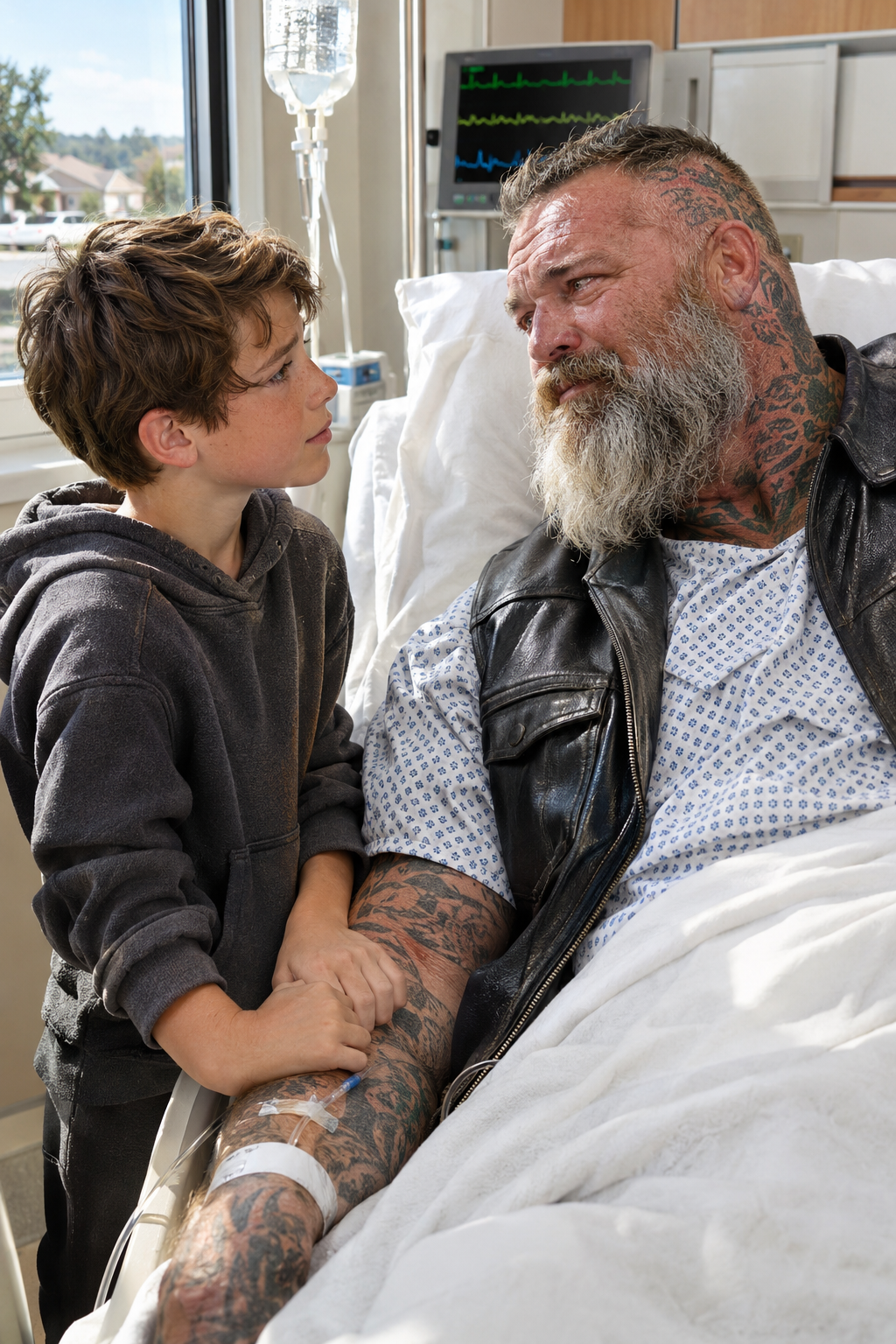
Jason’s eyes were wide with terror.
“Kids. Cold. Saturday.”
Ray stared at him.
Then something changed in the older biker’s expression.
“Dear God,” he whispered.
“What?” Owen asked.
Ray grabbed his phone.
“Jason’s Saturday program.”
“What program?”
Ray looked at the boy.
“The one he never told anyone about.”
Twenty minutes later, Ray’s motorcycle roared into the alley behind Jason’s garage.
Owen rode in the back seat of Ray’s pickup, driven by another club member named Marcus.
The garage looked exactly as it always had.
A faded American flag hung beside the door.
Three children’s bicycles waited against the fence.
A wooden sign above the entrance read:
WHITAKER’S WHEELS — EVERY KID DESERVES A RIDE.
Ray unlocked the door.
Inside, the familiar smell of rubber, grease, and coffee surrounded them.
Sunlight fell across the workbench where Owen had found Jason unconscious.
For one frightening second, the boy saw it all again.
Jason lying on the concrete.
The stretched-out hand.
The terrible silence.
Marcus noticed Owen hesitate.
“You okay, little man?”
Owen nodded.
“Let’s find what he’s talking about.”
They searched the garage.
The blue notebook contained dozens of repairs, but nothing about a Saturday program.
Ray opened filing cabinets.
Marcus checked the storage shelves.
Owen inspected the workbench.
Then he noticed something strange.
A blue strip of electrical tape had been stuck to the edge of a drawer.
Beneath it, Jason had written three words in black marker.
SATURDAY. COLD STORAGE.
Owen shouted.
“Ray!”
The men hurried over.
Owen pulled the drawer open.
Inside lay a small brass key, a folded receipt, and a photograph.
The photograph showed Jason standing beside eight smiling children in front of an old warehouse.
Every child held a bicycle.
On the back, someone had written:
September Hope Ride. Year Four.
Ray stared at the picture.
“I’ve seen that warehouse.”
He unfolded the receipt.
It was for a rented refrigerated storage unit on the industrial side of town.
The rental expired on August 31.
Marcus frowned.
“Why would Jason need refrigerated storage for bicycles?”
Owen studied the photograph.
Then he noticed the children were wearing identical blue wristbands.
He turned the picture over again.
Under the original writing, nearly hidden by a coffee stain, were four more words.
For the children of Mercy.
“Mercy?” Owen asked.
Ray went very still.
“Mercy Children’s Center.”
“What’s that?”
“A shelter,” Ray said quietly. “For kids whose families don’t have a safe place to stay.”
Marcus looked at the receipt.
“Then what’s in the storage unit?”
Ray shook his head.
“I don’t know.”
But Owen was already moving toward the door.
They reached the warehouse district shortly before noon.
The storage facility stood behind a chain-link fence, its concrete walls streaked with rust.
A woman at the front desk examined Jason’s rental agreement.
“Mr. Whitaker hasn’t been here this week,” she said. “We tried calling him yesterday.”
“Why?” Ray asked.
“His unit’s refrigeration system failed. The backup system is maintaining the temperature for now, but the building’s owner has ordered the older units cleared by Saturday evening.”
Owen’s heart sank.
“What does he keep in there?”
The woman looked uncertain.
“I can’t disclose a customer’s belongings.”
Ray showed her a photograph of Jason in his hospital bed and explained what had happened.
Her expression changed.
“Oh, my goodness.”
She picked up the phone.
After speaking with her manager, she escorted them to a row of temperature-controlled storage rooms.
Jason’s key opened Unit 14.
When the heavy metal door swung open, nobody moved.
There were no bicycles.
Instead, the room contained dozens of insulated medical transport boxes, sealed containers, and shelves of carefully labeled nutritional supplies.
A whiteboard stood against the wall.
At the top, Jason had written:
MERCY CHILDREN’S CENTER — SEPTEMBER FIRST.
Below that were delivery schedules, contact numbers, and handwritten reminders.
Marcus stared at the shelves.
“What is all this?”
Ray read one of the labels.
“Specialized nutrition.”
Owen found a folder hanging beside the door.
It contained invoices from a licensed medical supplier and paperwork identifying Mercy Children’s Center as the receiving organization.
A letter explained that a donor-funded delivery of temperature-sensitive nutritional products had been temporarily stored there while Mercy’s new refrigeration equipment was being installed.
Jason had volunteered to coordinate the storage and transportation.
The supplies were intended for children with complex medical needs.
At the bottom of the letter was a warning.
Storage conditions must remain within the specified temperature range. Any interruption requires immediate assessment by the supplier before distribution.
Owen looked toward the temperature display.
A yellow warning light was blinking.
“Ray?”
Ray followed his gaze.
The screen showed that the backup system was struggling.
Marcus immediately called the supplier listed on the paperwork.
Ray called Mercy Children’s Center.
Within minutes, they learned the truth.
Jason had been organizing a major charity event for Saturday, August 30.
The September Hope Ride was supposed to raise money for Mercy’s children, deliver twenty refurbished bicycles, and coordinate the transfer of essential nutritional supplies before the storage lease expired.
Jason had spent eight months arranging everything.
But after his stroke, nobody knew where the supplies were.
The shelter’s director, Evelyn Brooks, had been desperately trying to reach him.
And the charity event had nearly been canceled.
“The children have been waiting for those bicycles all summer,” Evelyn said over the phone.
“Some of them have never owned anything that belonged only to them.”
Ray swallowed.
“And the medical supplies?”
“Those matter even more. Our supplier was trying to locate the shipment. We’ll send an authorized transport team immediately.”
Owen stood beside the open storage unit.
For the first time, he understood why Jason had been crying.
He hadn’t been afraid of losing his garage.
He’d been afraid of failing the children.
By three o’clock, the supplier’s transport crew had arrived.
They checked the temperature records and separated the containers that required further inspection.
Nothing would be distributed until its safety was confirmed.
The remaining supplies were transferred to approved refrigeration equipment.
Evelyn drove over herself.
She was a tall woman in her fifties with tired eyes and a voice that sounded as though she had spent years comforting frightened children.
When Ray explained how Owen had uncovered the storage location, she knelt in front of the boy.
“Jason never told you about Mercy?”
Owen shook his head.
“He only talked about bikes.”
Evelyn smiled sadly.
“That’s Jason. He never wanted anybody to know how much he did.”
She opened her purse and took out a folded photograph.
It showed a younger Jason sitting on hospital steps beside a little girl with bright blue ribbons in her hair.
Owen looked at the picture.
“Who’s she?”
Evelyn’s smile disappeared.
“His daughter.”
Ray slowly lowered his head.
He knew the story.
But Owen didn’t.
“Her name was Lily,” Evelyn continued. “She was nine years old when she died.”
Owen felt something tighten in his chest.
“What happened?”
“She had a serious heart condition. Jason and his wife spent years taking her to appointments and hospitals. They lost almost everything trying to care for her.”
Evelyn glanced at the photograph.
“Lily loved bicycles. She couldn’t always ride very far, but her father built her a special blue bike so she could join the other children.”
Owen stared at the little girl’s smile.
“After Lily died, Jason’s marriage fell apart. He stopped talking to most people. He spent years blaming himself for things he couldn’t control.”
Ray rubbed a hand over his face.
“He joined our club because he needed people who wouldn’t give up on him.”
“And the bicycle repairs?” Owen asked.
Evelyn nodded.
“Lily once told him every kid should get to feel the wind in their face. Jason never forgot.”
Owen looked down at the photograph again.
Suddenly, the enormous tattooed man who frightened the neighbors seemed very different.
Every repaired chain.
Every patched tire.
Every Saturday spent kneeling beside a child’s bicycle.
They weren’t just acts of kindness.
They were Jason’s way of keeping a promise to his daughter.
That evening, Owen returned to the hospital with Ray and Evelyn.
Jason was awake.
His eyes brightened when he saw them.
Owen hurried to his bedside.
“We found it.”
Jason stared.
“The cold storage. The Mercy supplies. The Saturday ride.”
Tears immediately spilled down Jason’s cheeks.
Owen smiled.
“Everything that needed checking is being handled by the supplier. Mercy knows where it all is now.”
Jason closed his eyes.
His shoulders loosened for the first time in days.
Ray leaned closer.
“And the garage lease is taken care of, brother. I mailed the papers by tracked overnight delivery.”
Jason’s lips moved.
“Thank… you.”
Evelyn reached for his hand.
“You’ve taken care of our children for years, Jason. Now you need to let us take care of you.”
For a moment, the room felt peaceful.
Then Dr. Mitchell stepped through the doorway.
His expression was serious.
“Mr. Whitaker, we need to discuss tomorrow’s plans.”
Ray stiffened.
“You’re not still transferring him?”
The doctor raised a hand.
“The transfer recommendation has been put on hold. But I need to be clear. Mr. Whitaker’s medical condition remains serious.”
Owen looked at him.
“Did he get the communication evaluation?”
“Yes,” Dr. Mitchell replied.
The doctor pulled a chair beside Jason’s bed.
“A speech-language pathologist spent nearly an hour with him this afternoon. She found that while his ability to produce language is significantly impaired, he understands much more than his earlier assessments suggested.”
Owen felt a rush of relief.
“She also established a reliable way for him to answer structured questions using a communication board.”
Dr. Mitchell turned toward Jason.
“We owe you an apology.”
The room went silent.
“We interpreted your frustration as confusion. And we allowed our assumptions to affect how we approached your care.”
Jason watched him carefully.
The doctor continued.
“Your speech impairment does not, by itself, mean you are incapable of making decisions. We will assess each decision with appropriate communication support.”
Ray crossed his arms.
“And the transfer?”
“We’re arranging a rehabilitation consultation and reviewing options closer to home. Mr. Whitaker will be involved in those decisions.”
Jason’s eyes filled again.
Owen squeezed his hand.
But the doctor wasn’t finished.
“There’s something else.”
He looked at Ray.
“Jason will need substantial rehabilitation. We don’t know how much movement or speech he’ll recover. Returning to work in the garage may take a long time, and he may need ongoing assistance.”
Jason looked toward the window.
For the first time that day, the hope in his face dimmed.
Owen knew what he was thinking.
The bicycles.
The Saturday mornings.
The children waiting outside his garage.
The life he had built with his hands.
And now those hands might never work the same way again.
That night, Owen couldn’t sleep.
He sat at his bedroom desk with Jason’s blue notebook open in front of him.
His mother had allowed him to borrow it after Ray brought over a copy of the pages needed for Saturday’s event.
Owen counted the names.
Seventy-three children.
Seventy-three bicycles repaired since January.
He turned another page.
One hundred and twelve repairs the previous year.
And nearly every entry ended the same way.
No charge.
Owen ran his finger over the words.
Then he reached for a blank sheet of paper.
At the top, he wrote:
JASON FIXED OUR BIKES. NOW IT’S OUR TURN.
By midnight, he had written the message six times.
The next morning, Owen’s mother drove him around the neighborhood.
They taped his handwritten notices to community bulletin boards and delivered copies to families who knew Jason.
At first, the response was small.
Mrs. Rodriguez promised to bake cookies.
Mr. Bennett offered to bring folding tables.
A mechanic from the next street said he could help repair bicycles.
Then something unexpected happened.
Emma Rodriguez’s father posted a picture of Owen’s sign on the neighborhood Facebook group.
Within two hours, hundreds of people had seen it.
By lunchtime, the story spread across town.
Parents shared photographs of their children riding bicycles Jason had repaired.
One woman described how he had secretly replaced her son’s stolen bicycle.
A father remembered Jason refusing payment after repairing a wheelchair-accessible bicycle for his daughter.
A retired teacher wrote that Jason had been buying helmets for children whose families couldn’t afford them.
People who had spent years avoiding the tattooed biker suddenly realized how little they knew about him.
But not everyone was pleased.
That afternoon, a local businessman named Harold Price arrived at Jason’s garage.
Harold owned several properties nearby and had been trying to purchase the lot for months.
He examined the crowd gathering outside.
“You can’t operate a public event here without permission,” he told Ray.
Ray stepped forward.
“We’re organizing volunteers. The charity ride is using approved routes and the shelter’s event space.”
Harold folded his arms.
“This neighborhood has standards. We can’t have a motorcycle gang turning the street into a circus.”
Owen, standing nearby with a box of donated helmets, heard every word.
“Jason isn’t a circus,” he said.
Harold looked down.
“This is an adult conversation.”
Owen lifted his chin.
“Then maybe the adults should talk about what he’s actually done.”
Ray placed a hand on Owen’s shoulder.
But Harold wasn’t finished.
“I’ve heard plenty about Whitaker. Loud motorcycles. Tattoos. Questionable company. The neighborhood would be better off with a proper business here.”
A voice spoke from behind him.
“Like the business that repaired my daughter’s brakes for free?”
Mrs. Rodriguez stood beside the gate.
“And bought my grandson a bicycle?” Mr. Bennett added.
Another neighbor stepped forward.
“And fixed my husband’s mobility scooter when the repair shop wanted three hundred dollars?”
Harold looked around.
More people were gathering.
Parents.
Grandparents.
Children holding bicycle helmets.
Even some neighbors who had previously complained about Jason’s motorcycle.
Mrs. Rodriguez moved closer.
“You know what I find interesting, Harold? You keep telling us what this neighborhood needs. But Jason has spent ten years quietly giving it exactly that.”
Harold’s face reddened.
He muttered something about permits and walked away.
Owen watched him leave.
Then he looked at Ray.
“Do you think Jason knows how many people care about him?”
Ray gazed at the growing crowd.
“I don’t think he has any idea.”
Saturday morning arrived beneath a bright blue sky.
At eight o’clock, motorcycles began rolling into the Mercy Children’s Center parking lot.
Not dozens.
Hundreds.
Riders came from neighboring towns, motorcycle clubs, veterans’ organizations, and independent riding groups.
Some wore leather jackets covered in patches.
Others arrived in ordinary work clothes.
A few brought trailers loaded with donated bicycles.
By nine o’clock, the shelter’s courtyard was filled with families.
Twenty refurbished bicycles stood in a perfect row, each decorated with a blue ribbon.
A volunteer had tied a small tag to every handlebar.
For Lily. Keep riding.
Owen stood beside the bicycles, staring at the scene.
He had never seen so many people come together for one person.
Ray approached him.
“You ready, kid?”
Owen nodded.
“Is Jason coming?”
Ray’s smile faded.
“The doctors say he needs to stay in the hospital.”
Owen looked disappointed.
“But they agreed we could bring the event to him afterward.”
The charity ride began at ten.
Police officers escorted the motorcycle procession through town.
Residents lined the sidewalks, waving.
Children cheered as the riders passed.
Owen rode in Marcus’s pickup at the front of the procession, holding Jason’s blue notebook carefully on his lap.
At Mercy, the volunteers presented the repaired bicycles to the children.
A little boy named Daniel, who was seven, stood beside a red bicycle and refused to touch it.
Evelyn crouched beside him.
“What’s wrong, sweetheart?”
Daniel whispered, “Do I have to give it back?”
“No,” Evelyn said softly. “It’s yours.”
Daniel stared.
“Forever?”
“Forever.”
The boy placed both hands on the handlebars.
Then he burst into tears.
Owen watched from across the courtyard.
He suddenly understood something Jason had always known.
Sometimes a bicycle wasn’t just a bicycle.
Sometimes it was freedom.
Sometimes it was dignity.
Sometimes it was the first thing a child had ever been allowed to call their own.
At noon, Evelyn announced the fundraising results.
The crowd quieted.
“Our original goal was to raise fifteen thousand dollars for Mercy Children’s Center.”
She paused.
“As of this morning, we’ve raised forty-eight thousand, six hundred and twenty dollars.”
The courtyard erupted in cheers.
Ray lifted both arms.
Owen could hardly believe it.
Then Evelyn raised her hand again.
“And a local rehabilitation foundation has offered a matching grant for eligible donations made through tomorrow evening.”
More applause followed.
But Owen was thinking about Jason.
He wished the biker could hear all of this.
At two o’clock, the riders arrived outside the hospital.
They had coordinated with the hospital administration to gather in an approved parking area, keeping the emergency entrance clear.
The motorcycles parked in neat rows.
Hundreds of riders removed their helmets.
Families stood holding handmade signs.
And on the third floor, Jason Whitaker sat in a wheelchair beside a large window.
Owen stood next to him.
“You should look outside.”
Jason turned his head.
His eyes widened.
Below them stood more people than he could count.
Blue ribbons fluttered from motorcycle handlebars.
Children held bicycles over their heads.
A enormous banner stretched between two trees.
WE’VE GOT YOUR BACK, JASON.
Jason covered his mouth with his left hand.
He began to cry.
Not the angry, frightened tears Owen had seen earlier.
These were different.
They came from a place so deep that no words could have explained them.
Ray stood beside the wheelchair.
“Every one of those people came for you, brother.”
Jason shook his head slowly.
His lips trembled.
“Why?”
Ray smiled.
“Because you spent so many years showing up for them.”
Then the hospital administrator entered the room.
Patricia Collins carried an envelope.
“Mr. Whitaker, I have something for you.”
She placed it on his lap.
Inside was a letter signed by the landlord.
Jason read it slowly with Owen’s help.
The lease renewal had been accepted.
But there was an additional paragraph.
The landlord had learned about Jason’s community work and agreed to extend the garage lease for five years, with a reduced rent during his rehabilitation.
Jason stared at the page.
His hand trembled.
“Home,” he whispered.
Owen nodded.
“Your garage is safe.”
Ray leaned closer.
“And it gets better. We’ve got six volunteer mechanics who want to help keep Saturday repairs going while you recover.”
Jason looked up sharply.
Ray grinned.
“Sorry, brother. Looks like your little one-man operation just became a team.”
Jason laughed.
It was a rough, uneven sound.
But it was unmistakably laughter.
The weeks that followed were not easy.
Jason couldn’t suddenly walk across his garage or lift a bicycle onto a workbench.
Some mornings, he struggled to say his own name.
Other days, frustration overwhelmed him when a simple movement refused to happen.
Rehabilitation was exhausting.
There were setbacks.
There were tears.
And there were moments when he wondered whether all his effort would ever be enough.
But every Tuesday and Thursday, Owen visited after school.
Sometimes they practiced words.
Sometimes Owen read from the blue notebook.
And sometimes they simply sat together, watching bicycles roll past the rehabilitation center window.
A speech-language pathologist taught Jason to use a tablet-based communication system.
His physical and occupational therapists helped him rebuild strength and find new ways to perform familiar tasks.
Ray installed a ramp at the garage.
Marcus lowered one of the workbenches.
Volunteers organized tools within Jason’s reach.
Slowly, the garage began changing.
Not because Jason was being replaced.
Because the people who loved him were making room for the person he was becoming.
Three months after the stroke, on a chilly November Saturday, Owen pushed open the garage door.
Inside, the volunteers were repairing six bicycles.
Children waited outside with their parents.
And behind the lowered workbench sat Jason Whitaker.
His right hand was still weak.
His speech was still slow.
But his left hand held a wrench, and his eyes shone with concentration.
Owen grinned.
“Morning, Jason.”
Jason looked up.
“Morning… engineer.”
Owen laughed.
“You remembered.”
Jason reached beneath the workbench and pulled out a small wooden box.
Inside was a beautiful set of precision tools, carefully cleaned and arranged.
A brass plate on the lid read:
OWEN HARGROVE — KEEP ASKING QUESTIONS.
Owen stared at it.
“Jason, these are yours.”
Jason shook his head.
“Yours… now.”
Owen’s eyes burned.
He remembered the hospital conference.
The adults talking over Jason.
The nurse dismissing his words.
The security guards mistaking his fear for aggression.
And the moment Jason had grabbed his wrist because he desperately needed someone to understand.
Owen closed the box carefully.
“Can I ask you something?”
Jason nodded.
“Were you scared when you couldn’t talk?”
Jason looked at him for a long time.
Then he reached for his tablet.
He typed slowly, one letter at a time.
The voice from the device spoke.
“I was scared nobody would listen.”
Owen swallowed.
Jason typed again.
“But you did.”
For a moment, neither of them moved.
Outside, a bicycle bell rang.
A child laughed.
Ray called for another wrench.
Life continued around them, noisy and ordinary and beautiful.
Owen wiped his eyes.
“You know what my grandpa used to say?”
Jason tilted his head.
“He said being strong doesn’t mean you never need help. It means you aren’t ashamed to let people care about you.”
Jason smiled.
Then he reached out his left hand.
Owen took it.
Years later, Owen would remember that moment more clearly than almost anything else from his childhood.
Not the motorcycles.
Not the fundraiser.
Not even the hospital conference where he’d stood against a room full of adults.
He would remember a huge tattooed man sitting behind a workbench, using a tablet to say the words his mouth couldn’t form.
And he would remember the lesson Jason taught him without ever intending to.
A person’s worth isn’t measured by how clearly they speak, how quickly they walk, what clothes they wear, or how frightening they might appear to strangers.
Sometimes the people who look the toughest have the gentlest hearts.
Sometimes the person everyone dismisses is the one who has spent years holding a community together.
And sometimes the greatest act of courage isn’t roaring down a highway on a powerful motorcycle.
It’s a frightened ten-year-old boy refusing to leave a hospital room until somebody listens.
The following spring, a new sign appeared above the garage.
WHITAKER’S WHEELS & THE LILY PROJECT.
EVERY KID DESERVES A RIDE.
EVERY VOICE DESERVES TO BE HEARD.
On the first Saturday after the sign went up, Owen arrived early and found Jason waiting with two cups of hot chocolate.
The biker handed him one.
Then he pointed toward a little girl standing beside a bicycle with a broken chain.
Owen picked up his new tools.
“Think I can fix it?”
Jason smiled.
“Try.”
The girl watched anxiously as Owen knelt beside her bicycle.
“Don’t worry,” he told her. “We’ll figure it out together.”
And from his place behind the workbench, Jason watched the boy who had once saved his life begin carrying his kindness forward.
Because the most important things we leave behind are rarely the things we own.
They are the people we’ve helped, the hope we’ve restored, and the compassion we’ve taught others to pass along.
Jason had spent years fixing broken bicycles.
But when his own life fell apart, the very people he’d helped became the ones who put the pieces back together.
And it all began because one little boy understood something the grown-ups had forgotten.
Just because someone struggles to speak doesn’t mean they have nothing to say. And just because the world stops listening doesn’t mean their voice has stopped mattering.
Five years later, Owen Hargrove stood outside Whitaker’s Wheels, holding a thick envelope in his trembling hands.
He was fifteen now, taller than his mother and almost as tall as Ray. But whenever he stepped into Jason’s garage, he still felt like the ten-year-old boy who had once knelt beside a fallen biker and called for help.
The garage looked different these days.
There were new workbenches, an accessible entrance, and a bright blue mural of a little girl riding a bicycle beneath a sky full of stars.
Underneath the mural were the words:
“Kindness doesn’t end with us. It travels through us.”
Jason had chosen those words himself.
He was sixty-one now. His right hand had never fully recovered, and speaking still required patience. But he had learned to repair bicycles using specially adapted tools, and every Saturday, he supervised a small army of volunteers.
More than six hundred bicycles had passed through the garage since his stroke.
And not one child had ever been turned away because their family couldn’t pay.
Owen stepped inside.
Jason was sitting at his workbench, helping a young boy adjust a bicycle chain.
When he saw Owen, his face brightened.
“Engineer,” he said slowly.
Owen smiled.
“Not quite yet.”
He held up the envelope.
“But I got something in the mail.”
Jason immediately put down his wrench.
Owen opened the letter and read aloud.
“Dear Mr. Hargrove, congratulations. We are pleased to inform you that you have been accepted into the National Youth Engineering Scholars Program, with a full scholarship for the summer.”
Jason stared at him.
Then his face broke into the widest smile Owen had ever seen.
He stood carefully, using the edge of his workbench for balance.
Owen rushed forward.
But Jason waved him off.
“I… got… this.”
He took three slow steps.
Then he wrapped his arms around the boy.
Owen hugged him tightly.
Neither spoke for a long moment.
Finally, Jason whispered, “Proud… of you.”
Owen swallowed hard.
“Couldn’t have done it without you.”
Jason shook his head.
He reached for his communication tablet and typed.
“You did the work. I only helped you believe you could.”
Owen read the words twice.
Then he looked around the garage.
There was something he hadn’t told Jason yet.
Something he’d been planning for months.
“Actually,” he said, “there’s another reason I came.”
Jason raised an eyebrow.
Owen took a folded blueprint from his backpack and spread it across the workbench.
It showed a new kind of bicycle.
Three wheels.
An adjustable seat.
Modified handlebars.
A lightweight frame designed for children with limited mobility.
Jason leaned closer.
Owen pointed to the drawing.
“It’s called the Lily Rider.”
Jason stopped breathing for a moment.
“I’ve been designing it for almost a year,” Owen continued. “I want kids who can’t use regular bicycles to experience what other kids do. The freedom. The wind. All of it.”
Jason slowly touched the name printed across the top.
LILY RIDER — PROTOTYPE ONE.
Owen watched his face.
“I used some of the ideas from that old blue bicycle you built for your daughter. Ray showed me the photographs.”
Jason closed his eyes.
For several seconds, he said nothing.
Then he opened them and looked at Owen.
“Why?”
Owen smiled through gathering tears.
“Because you told me every kid deserves a ride.”
Jason’s left hand covered his mouth.
Owen continued.
“And because Lily deserves to keep changing lives.”
That summer, the first Lily Rider was built in the garage.
It wasn’t perfect.
The steering needed adjustment.
The seat was uncomfortable.
The first chain slipped off during testing.
But Owen refused to give up.
Jason sat beside him through every setback.
Sometimes he offered advice.
Sometimes he simply watched.
And whenever Owen became frustrated, Jason tapped the old blue notebook sitting on the shelf.
It was their reminder that worthwhile things often required patience.
By August, the prototype was ready.
The first child to try it was a nine-year-old girl named Grace, who had spent most of her childhood watching other children ride bicycles from the sidewalk.
Her mother helped her into the adjustable seat.
Owen checked the safety straps.
Jason inspected the wheels one final time.
Then Grace placed her hands on the handlebars.
“Can I really ride it?” she whispered.
Owen knelt beside her.
“That’s what we built it for.”
He gave the bicycle a gentle push.
Grace began pedaling.
Slowly at first.
Then faster.
Her mother pressed both hands over her mouth.
Grace turned a corner, laughing so loudly that everyone in the garage stopped working.
“Mom! Look at me!”
Her mother was crying.
“I see you, sweetheart!”
Grace completed a full circle and returned to Owen.
“Can I go again?”
Owen laughed.
“As many times as you want.”
Jason watched from his wheelchair beside the garage door.
There were tears on his cheeks.
But he was smiling.
Later that afternoon, when everyone had gone home, Owen found him sitting beneath Lily’s mural.
The setting sun painted the garage walls gold.
Owen pulled up a chair.
“Do you think she’d like it?”
Jason looked toward the painted little girl.
He was quiet for a long time.
Then he answered, slowly but clearly.
“She… would… love… it.”
Owen nodded.
Jason reached for the blue notebook.
Its pages were worn now, the corners soft from years of use.
He opened it to the very first page.
There, in handwriting faded by time, was a single sentence.
A promise Jason had written after his daughter’s funeral.
“If I can’t give Lily more days, I’ll spend mine giving other children more joy.”
Owen read it silently.
Then Jason turned to the final page.
He picked up a pen.
His right hand trembled too much to hold it steadily, so he used his left.
The letters were uneven, but Owen could read every word.
“Lily, I kept my promise.”
He paused.
Then he added:
“And now Owen will carry it farther than I ever could.”
Owen felt tears sliding down his face.
“Jason, you know I’m not going anywhere, right?”
Jason smiled.
“I know.”
“You’re still going to be stuck with me every Saturday.”
Jason laughed softly.
“Good.”
Outside, the evening breeze stirred the blue ribbons tied to the fence.
A bicycle bell rang somewhere down the street.
And for a brief moment, Owen imagined a little girl riding through the sunlight on a blue bicycle, laughing as her father ran beside her.
He understood then that some promises don’t end when the person who inspired them is gone.
They become bigger.
They find new hands.
New hearts.
New ways to make the world kinder.
Jason Whitaker had once believed that losing his daughter meant losing the best part of himself.
But through every bicycle he repaired, every child he helped, and every person he inspired, Lily’s love had continued to grow.
And Owen, the little boy who had once refused to let the world ignore a broken man’s voice, had become living proof that compassion can change more than one life.
It can change generations.
Years later, people would remember Jason as the biker who fixed bicycles for free.
They would remember Owen as the boy who saved him.
But the truth was more beautiful than either story alone.
Jason had given Owen a purpose.
Owen had given Jason a second chance.
And together, they had given countless children something neither money nor medicine could provide on its own.
The feeling that they mattered.
That they belonged.
That someone believed their happiness was worth fighting for.
Because kindness is never truly small.
A repaired bicycle can become a friendship.
A friendship can become a rescue.
A rescue can become a movement.
And one child who chooses to listen can remind an entire community what it means to be human.
Never underestimate the power of showing up for someone. You may think you’re only fixing a small part of their world, when in truth, you’re giving them the strength to keep going.
And sometimes, when life finally turns around, the person you once helped will be the one who carries your dreams farther than you ever imagined.