The Hells Angels biker stopped in the pouring rain when he saw a waitress eating lunch behind a dumpster. What she tried to hide beneath her napkin made him turn off his motorcycle.
The photograph showed a little boy sitting in a hospital bed, smiling weakly beneath a blue blanket. A stuffed dinosaur rested against his chest, and a thin oxygen tube ran beneath his nose.
But it wasn’t the boy who made Hammer’s blood run cold.
It was the man standing beside the bed.
Richard Miller.
The owner of Miller’s Diner.
And in his hand was an envelope bearing the logo of a charity Hammer knew all too well.
The Iron Hearts Children’s Fund.
Hammer had helped establish that fund seven years earlier, after losing his eight-year-old daughter, Emily, to a congenital heart condition. Every year, his motorcycle club raised thousands of dollars for families whose children needed life-saving treatment.
The photograph had been taken at a charity presentation three months earlier.
And according to the accompanying paperwork, Richard Miller had accepted eighteen thousand dollars on behalf of Lily’s son.
Hammer stared at the screen.
“Tell me that money went to the hospital,” he said.
His friend, Daniel Brooks, remained silent.
“Daniel.”
“I checked the hospital’s financial records through their billing department. There’s no corresponding payment from the fund.”
Hammer felt something heavy settle inside his chest.
“Where did it go?”
“That’s what we need to find out.”
Hammer enlarged the photograph.
The little boy looked about six years old. His hair was brown and slightly messy, and his smile was the kind children gave when they were trying to reassure frightened adults.
Emily had smiled like that.
Even when she was hurting.
Even when the doctors stopped promising things would get better.
Hammer placed his phone facedown on the table.
“Find the original donation records,” he said quietly. “Every signature. Every transfer.”
Daniel studied his friend.
“Hammer, if Miller took that money, this could get ugly.”
Hammer looked toward the rain streaking down the window.
“Then we’ll make sure it gets handled the right way.”
The following morning, Lily arrived at the diner twenty minutes before her shift.
Her son, Noah, had spent most of the night coughing. His medication had been adjusted again, and the pediatric cardiologist wanted additional testing before determining whether he could undergo the next procedure.
Lily had nodded through the doctor’s explanation, pretending she understood everything.
What she understood perfectly was the amount printed at the bottom of the latest hospital statement.
$37,840.
That was what remained after insurance payments and previous assistance.
Her apartment rent was overdue.
Her electricity bill carried a final notice.
And Noah had asked whether they could buy a small Christmas tree that year.
She had told him they would see.
It was the same answer she gave whenever she couldn’t bear to say no.
When she entered the diner, Richard Miller was waiting beside the register.
“You’re late.”
Lily glanced at the clock.
“I’m early, Mr. Miller.”
“Then you can start by cleaning the grease trap.”
She swallowed.
“That’s usually maintenance’s job.”
“Are you refusing?”
“No, sir.”
She tied on her apron and headed toward the kitchen.
Twenty minutes later, Hammer walked through the front door.
He was accompanied by two men wearing leather jackets, both broad-shouldered and considerably younger than him.
Lily recognized Hammer immediately.
He had returned twice since their encounter behind the dumpster, always ordering coffee and leaving generous tips.
She approached his table.
“Morning. Coffee?”
“Please.”
She poured three cups.
Hammer noticed the dark circles beneath her eyes.
“How’s your little boy?”
Lily hesitated.
“He’s hanging in there.”
“What’s his name?”
“Noah.”
Hammer nodded.
“Good name.”
For the first time that morning, Lily smiled.
“He thinks he’s a superhero.”
“Does he?”
“He says his heart has to work harder because it’s stronger than everybody else’s.”
Hammer looked down at his coffee.
For a moment, he couldn’t speak.
Then he said, “Sounds like a brave kid.”
Lily’s smile trembled.
“He is.”
Before she could say more, Miller appeared.
“Lily! Table seven needs cleaning!”
She hurried away.
One of Hammer’s companions, a biker called Bear, leaned forward.
“You want me to say something?”
Hammer shook his head.
“Not yet.”
Bear knew that tone.
It meant Hammer was holding back something much larger than anger.
By Friday, Daniel had uncovered enough information to make the situation considerably worse.
The Iron Hearts Children’s Fund had approved a grant specifically for Noah’s medical expenses. Its standard procedure required direct payment to approved medical providers.
But three months earlier, Miller had submitted paperwork presenting his diner as the organizer of a local fundraising campaign. He had included a forged-looking authorization form claiming that Lily had requested reimbursement through the diner for expenses she had already paid.
The grant had been deposited into a business account controlled by Miller.
Within two days, most of the money had been transferred elsewhere.
Daniel obtained copies of the documents from the fund’s records.
One page carried Lily’s signature.
Except Hammer could tell something was wrong.
The handwriting looked stiff, carefully copied.
And the date was impossible.
Lily had been working a double shift that day, according to the diner records.
More importantly, she had never mentioned receiving any charitable assistance.
Hammer asked Daniel to arrange a meeting with the fund’s attorney.
He wanted the evidence preserved before Miller learned he was being investigated.
Meanwhile, the purchase negotiations continued through a separate company.
Miller had no idea who was behind the offer.
He only knew someone was willing to buy his failing diner for enough money to clear his business debts and leave him with a comfortable profit.
That made him unusually cheerful.
For two days, he stopped yelling at employees.
Then the hospital called Lily during the Saturday lunch rush.
She answered in the supply closet.
The nurse’s voice was gentle.
“Noah’s oxygen levels have been dropping. His cardiologist wants him admitted for monitoring.”
Lily gripped the phone.
“Is he going to be okay?”
“We’re taking every precaution, but we need you here.”
She rushed into Miller’s office.
“My son needs to go to the hospital. I have to leave.”
Miller looked up from his paperwork.
“Again?”
“Please. They’re admitting him.”
“You know what your problem is, Lily?”
She stood motionless.
“You think every personal emergency means the rest of the world should rearrange itself for you.”
Her eyes filled.
“He’s six years old.”
“And I’m running a business.”
“I can ask Margaret to cover.”
“Margaret’s already doing her own work.”
Lily looked at the clock.
The hospital was forty minutes away by bus.
She had twelve dollars in her purse.
“Mr. Miller, please.”
He leaned back.
“If you walk out during lunch, don’t bother coming back.”
For several seconds, Lily heard nothing except the hum of the refrigerator outside his office.
Then she untied her apron.
Her hands were shaking.
“I’m sorry,” she whispered.
Miller shrugged.
“Your choice.”
Lily walked through the dining room, trying not to cry in front of everyone.
She had almost reached the door when Hammer stood up.
“Lily.”
She stopped.
“Is Noah alright?”
She tried to answer, but her throat closed.
Hammer understood immediately.
“Come on.”
She blinked.
“What?”
“I’ll drive you.”
“I can’t ask you—”
“You didn’t.”
He turned toward Bear.
“Get the truck.”
Bear was already reaching for his keys.
Lily stared at the leather-clad men surrounding her.
She had spent years hearing people warn her about men like them.
Yet the only person who had offered to help her that afternoon was the enormous biker with the gray beard and scarred hands.
Miller stormed from his office.
“What’s going on?”
Hammer faced him.
“Her son needs the hospital.”
“That’s between me and my employee.”
“Not anymore.”
Miller’s face reddened.
“You don’t get to interfere with my business.”
Hammer’s voice remained calm.
“You’re right. I don’t own this place.”
Something in the way he said it made Miller hesitate.
Hammer turned away.
“Lily, let’s go.”
The ride to the hospital took twenty-six minutes.
Bear drove carefully through the rain while Lily sat beside Hammer in the back seat.
She kept twisting the strap of her purse around her fingers.
“What if he gets worse?”
Hammer looked at her.
“Then we make sure he’s where the doctors can help him.”
“You don’t understand.”
He was silent for a moment.
Then he said, “I understand more than you think.”
Lily turned toward him.
Hammer pulled a small photograph from his wallet.
A little girl with blond curls grinned at the camera, missing one front tooth.
“That’s Emily,” he said. “My daughter.”
Lily smiled sadly.
“She’s beautiful.”
“She was.”
The single word changed everything.
Lily’s expression softened.
“I’m so sorry.”
Hammer looked at the photograph.
“She had a heart condition too. Different from Noah’s. We spent years in hospitals, waiting rooms, and places where every ringing phone made us afraid.”
Lily covered her mouth.
“How old?”
“Eight.”
The truck was quiet.
Hammer put the photograph away.
“After she passed, I thought there wasn’t anything useful left for me to do. Then some brothers from my club started raising money for families with sick kids.”
He looked at Lily.
“Helping didn’t bring Emily back. But it gave me a reason to keep showing up.”
Lily wiped her cheeks.
“I don’t know how you survived that.”
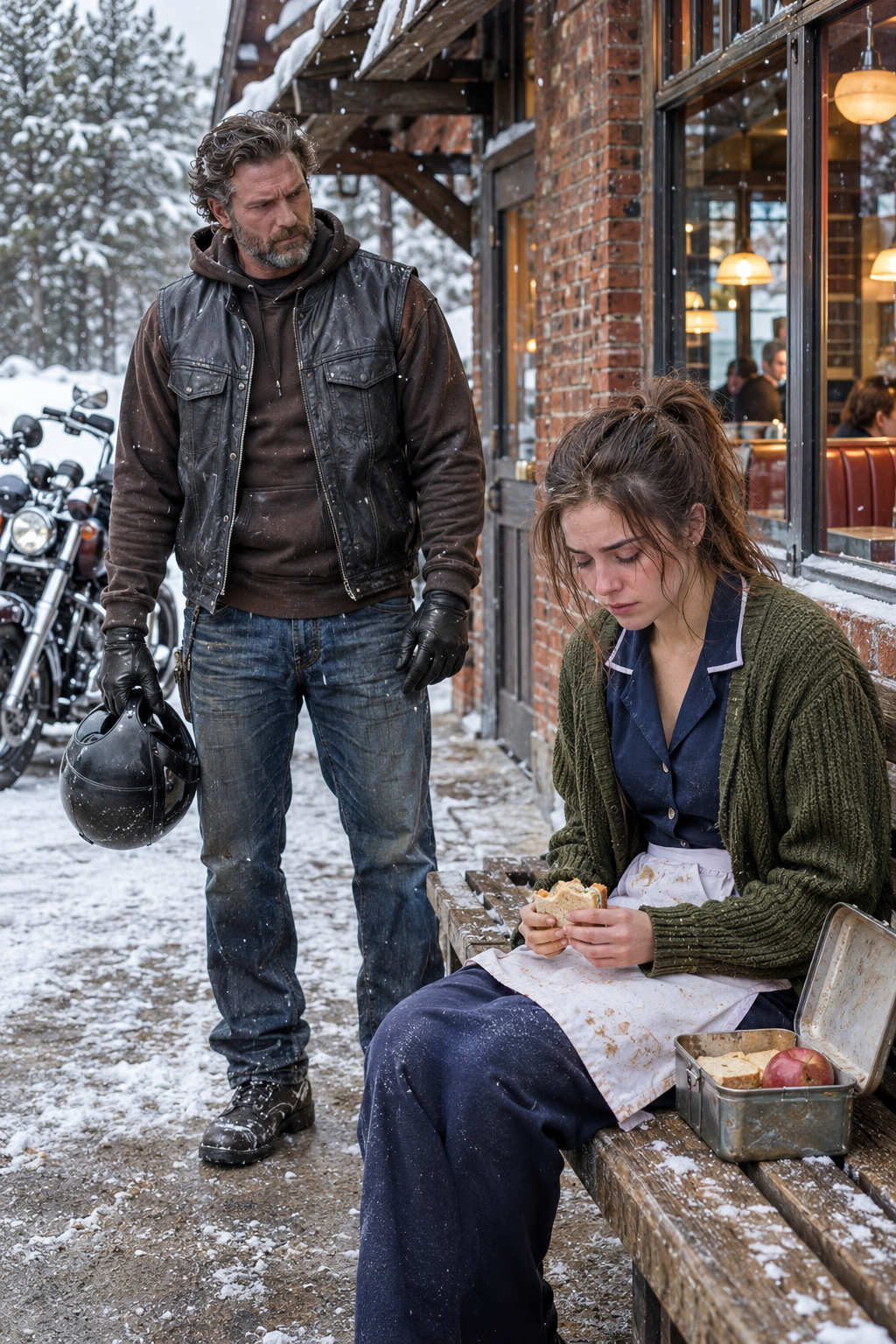
Hammer stared through the windshield.
“Some days, I barely did.”
At the hospital, Noah was awake but exhausted.
His small chest rose beneath the blanket while a monitor blinked beside him.
When Lily entered, he reached for her.
“Mommy.”
She crossed the room and kissed his forehead.
“I’m here, sweetheart.”
“I got scared.”
“I know, baby.”
Hammer remained near the doorway.
Noah noticed him.
“Who’s the giant?”
Lily let out a surprised laugh.
“That’s Mr. Hammer. He helped Mommy get here.”
Noah studied him.
“Is Hammer your real name?”
“Close enough.”
“Are you a motorcycle guy?”
“Sure am.”
Noah’s eyes widened.
“Do you have a loud one?”
“The loudest.”
“Cool.”
Hammer stepped closer.
Noah held up his stuffed dinosaur.
“This is Captain Rex. He’s not scared of needles.”
Hammer nodded solemnly.
“Sounds like someone I should know.”
Noah pushed the dinosaur toward him.
“You can hold him.”
For a moment, Hammer looked like a man who had forgotten how to breathe.
Emily had owned a stuffed rabbit she carried into every hospital appointment.
He gently took the dinosaur.
“Thank you, buddy.”
Noah smiled.
“You’re welcome.”
Later, when Noah fell asleep, Lily sat beside Hammer in the hallway.
“I lost my job today,” she admitted.
Hammer didn’t look surprised.
“Miller fired you?”
“He said if I left, I shouldn’t come back.”
“Did you sign anything?”
“No.”
“Good.”
She looked at him.
“Why?”
“Because there’s something you need to know about that diner.”
Hammer took out his phone and showed her the charity photograph.
Lily stared at the image.
“That’s Noah.”
“I know.”
“Why is Mr. Miller standing there?”
“Do you recognize the envelope?”
She shook her head.
Hammer explained the grant.
The eighteen thousand dollars.
The paperwork.
The signature.
Lily’s face went pale.
“I never got that money.”
“I believe you.”
“I never signed anything.”
“That’s what we suspected.”
She stood abruptly.
“That money could have paid for his treatment!”
Her voice broke.
“Three months ago, the hospital told me we needed another specialist. I couldn’t afford the deposit. I had to postpone the appointment.”
Hammer felt his stomach tighten.
“Did Miller know?”
She stared at him.
“He asked why I needed another advance that same week.”
The hallway seemed suddenly colder.
Lily sank back into her chair.
“He knew.”
Hammer wanted to tell her everything would be fine.
But he had heard too many promises made in hospital corridors.
Instead, he told her the truth.
“We have an attorney reviewing the records. We’re going to find out exactly what happened.”
She looked at him through her tears.
“Why are you doing all this?”
Hammer glanced toward Noah’s room.
“Because someone should have helped you sooner.”
On Monday morning, Richard Miller arrived at the diner expecting to sign the preliminary sale agreement.
Instead, he found Daniel Brooks sitting at a corner table with a woman in a dark blue suit.
Hammer stood beside the counter.
Miller stopped.
“What are you doing here?”
Daniel rose.
“Mr. Miller, I’m Daniel Brooks. We’ve spoken several times about the purchase.”
Miller looked confused.
“You’re the buyer?”
“I’m representing the buyer.”
Hammer stepped forward.
“That would be me.”
Miller stared at him.
Then he laughed.
“You?”
“That’s right.”
“You ride motorcycles.”
Hammer nodded.
“Among other things.”
Miller glanced between the three visitors.
“Is this some kind of joke?”
The woman in the blue suit opened a folder.
“My name is Rebecca Hayes. I’m legal counsel for the Iron Hearts Children’s Fund.”
Miller’s smile vanished.
Rebecca placed copies of the grant application on the table.
“We need to discuss the funds issued for Noah Carter’s medical expenses.”
Miller glanced toward the kitchen.
“I don’t know what you’re talking about.”
“Eighteen thousand dollars was deposited into your business account following an application submitted under Lily Carter’s name.”
“She authorized it.”
Rebecca slid another paper forward.
“Ms. Carter disputes that signature. We’ve also obtained records indicating the money was not used for its stated purpose.”
Miller straightened.
“Are you accusing me of stealing?”
“I’m informing you that the fund has referred the matter to the appropriate authorities.”
Miller’s face changed from pale to furious.
“You can’t prove anything.”
Hammer remained motionless.
Rebecca closed the folder.
“That will be determined through the investigation.”
Daniel stood.
“Until this matter is resolved, our purchase offer is suspended.”
Miller’s expression flickered.
“Suspended?”
“We won’t complete a transaction involving undisclosed financial liabilities.”
Miller leaned toward Hammer.
“You set me up.”
Hammer shook his head.
“No. You made your own decisions.”
Miller pointed toward the door.
“Get out.”
Hammer glanced around the diner.
Margaret was standing near the kitchen, holding a coffee pot.
The older cook watched silently.
Several customers had stopped eating.
Hammer lowered his voice.
“You had a woman working herself sick while her little boy needed treatment. You had a chance to help her. Instead, you used her situation.”
Miller opened his mouth.
Hammer continued.
“Whatever happens next, you’ll answer for what you actually did. Not what I feel like doing to you.”
Then he walked out.
By Wednesday, the story had spread through the small town.
Investigators began examining the charity grant, the authorization form, and the transfers from Miller’s business account.
Further records showed that part of the money had gone toward a personal vehicle payment and several overdue gambling-related debts.
Miller claimed it had all been a bookkeeping misunderstanding.
But his former office assistant provided investigators with an email in which he instructed her to file the charity paperwork without contacting Lily.
The case was now much more than a dispute over accounting.
Meanwhile, Lily faced a different crisis.
Noah’s doctors had stabilized him, but his condition required additional intervention at a specialized children’s cardiac center.
An experienced surgeon believed Noah might be a candidate for a procedure that could substantially improve his quality of life.
There was no guarantee.
There would be risks.
There would be months of recovery and follow-up appointments.
But for the first time in nearly a year, Lily heard a doctor describe a genuine path forward.
Then the hospital’s financial coordinator explained which expenses insurance would not cover.
Lily felt the familiar panic returning.
That evening, she sat alone in the family waiting room.
Hammer found her staring at the floor.
“Doctor gave us some hope,” she said.
“That’s good.”
“It is.”
She laughed bitterly.
“Except hope apparently comes with a price tag.”
Hammer sat beside her.
“Tell me.”
She explained everything.
The out-of-network costs.
Temporary housing near the specialist center.
Transportation.
Time away from work.
When she finished, Hammer nodded.
“We’ll look at what assistance is available.”
Lily shook her head.
“I can’t keep accepting help from you.”
“Why not?”
“Because I can’t pay you back.”
Hammer rested his elbows on his knees.
“Lily, do you think every person who helps somebody expects a receipt?”
She looked away.
“I’ve learned that most people eventually want something.”
Hammer considered that.
“Then here’s what I want.”
She turned toward him.
“I want you to stop believing you’re supposed to carry an impossible weight by yourself.”
Her eyes filled.
He continued.
“And if someday you’re able to help someone else, do it. That’s all.”
For several seconds, she couldn’t answer.
Then she whispered, “I don’t know how to trust something good anymore.”
Hammer nodded.
“Then don’t force yourself. Let people prove they mean what they say.”
Two weeks later, Miller’s Diner closed temporarily.
Its owner had been charged in connection with the charity funds, and the growing investigation had exposed serious problems with the business’s accounts.
The bank moved to recover what it was owed.
Hammer and Daniel returned to the negotiating table, this time through the lender and the appropriate legal representatives.
They purchased the diner after reviewing the outstanding obligations and arranging for the employees’ unpaid wages to be addressed.
Hammer insisted on one particular condition.
Every existing employee who wanted to return would be offered a job under the new management.
Margaret nearly cried when she heard.
The cook, Frank, asked whether his kitchen equipment would finally be repaired.
Hammer looked at the broken refrigerator.
“That thing should have been replaced years ago.”
Frank laughed.
“You’re already my favorite boss.”
But Hammer had no intention of running a restaurant himself.
He didn’t know much about inventory management, breakfast service, or scheduling waitresses.
He knew people.
And he knew that Lily had spent years keeping that diner functioning while Miller took credit.
One afternoon, after Noah’s transfer to the specialist hospital had been arranged, Hammer invited Lily to the diner.
She arrived wearing jeans and an old sweater, visibly nervous.
The building was quiet.
Workers were repainting the walls and installing new lights.
The greasy kitchen floors had been cleaned.
A new refrigerator stood beside the prep counter.
Even the booths had fresh upholstery.
Lily looked around in astonishment.
“What happened?”
Hammer smiled.
“New ownership.”
“Who bought it?”
“I did.”
Lily stared.
“You bought the diner?”
“With some help.”
“But why?”
Hammer looked around.
“Figured the place deserved a better future.”
She slowly approached the counter.
Her fingers brushed the spot where Miller used to slam down her timecard.
For a moment, she seemed very far away.
Then she asked, “Who’s going to manage it?”
Hammer handed her a folder.
“I was hoping you would.”
Lily blinked.
“What?”
“General manager. Proper salary. Health benefits. Predictable schedule. Paid leave. Training and support from someone who actually knows the restaurant business.”
She opened the folder with trembling hands.
Inside was a detailed employment offer.
The salary was nearly three times what she had been earning.
Lily stared at the number.
“This can’t be right.”
“It is.”
“I’ve never been a manager.”
Hammer smiled.
“You’ve been managing around a bad manager for years. You just weren’t getting paid for it.”
She shook her head.
“Hammer, I don’t have a business degree.”
“Neither do most people who know how to treat others decently.”
He became serious.
“You know the staff. You know the customers. You know what was wrong here. Daniel has arranged for an experienced restaurant consultant to train you.”
Lily looked down at the contract.
“Is this because of Noah?”
“Noah’s part of why I noticed you. But this job is because you’ve earned the chance to do it.”
Tears slipped down her cheeks.
“I don’t know what to say.”
“You don’t have to decide today.”
She looked up.
“There’s one thing I want to change.”
Hammer raised an eyebrow.
“Already?”
“Employee breaks. Nobody eats behind the dumpster anymore. And if someone’s child is sick, they shouldn’t have to choose between their job and their family.”
Hammer extended his hand.
“Sounds like I’ve found my manager.”
Lily shook it.
For the first time in months, she felt something beyond exhaustion.
She felt capable of imagining tomorrow.
The weeks that followed were a whirlwind.
Noah underwent his procedure at the specialized cardiac center.
Hammer drove Lily to the hospital and stayed in the waiting room through the long hours.
Bear arrived with coffee.
Then another biker came carrying sandwiches.
By lunchtime, seven members of the club were sitting quietly in the corridor.
Lily looked around at them.
“You don’t all have to stay.”
Bear shrugged.
“We’ve got nowhere more important to be.”
But when the surgeon finally entered the waiting room, Lily nearly collapsed from fear.
Hammer stood beside her.
The doctor removed his surgical cap.
“The procedure went as planned.”
Lily pressed both hands over her mouth.
“He’s okay?”
“He’s stable. The next several days are very important, but we’re pleased with how things went.”
Lily began to cry.
Not the silent tears she’d learned to hide.
This time, she cried openly, bending forward as months of fear poured out of her.
Hammer placed a steady hand on her shoulder.
She turned and hugged him.
“Thank you,” she whispered.
He held her gently.
“He’s a fighter.”
Noah’s recovery wasn’t easy.
There were difficult nights, painful rehabilitation sessions, and moments when Lily worried every small setback meant disaster.
But gradually, the monitors became less frightening.
Noah began sitting up for longer periods.
Then walking down the hallway.
Then arguing with the nurses about whether superheroes were allowed to eat extra pudding.
One afternoon, Hammer entered Noah’s room carrying a small box.
“What’s that?” Noah asked.
“A present.”
Inside was a miniature motorcycle, painted bright blue.
Noah gasped.
“It’s awesome!”
Hammer sat beside him.
“There’s something else.”
He took out a little metal badge shaped like a heart with wings.
It read, “Iron Hearts Junior.”
Noah examined it carefully.
“Am I really in your club?”
“Honorary member.”
“Do I get a motorcycle?”
“When you’re old enough and your mom says yes.”
Noah looked at Lily.
“Can I?”
She laughed.
“Ask me again in about twelve years.”
Hammer grinned.
“Fair enough.”
Then Noah held out his stuffed dinosaur.
“Captain Rex wants a badge too.”
Hammer pretended to consider the request.
“We’ll have to put him through training.”
Noah giggled so hard that Lily had to remind him not to overdo it.
Hammer watched them, his smile softening.
Something in that room had begun to heal inside him too.
Not the loss of Emily.
That would always remain.
But the belief that he could never again experience joy without betraying her memory.
Three months after the procedure, the diner reopened.
Its new name was Emily’s Table.
The sign above the entrance featured a small heart beside the lettering.
Inside, the walls were painted warm cream, the booths were comfortable, and the menu included affordable meals for families.
Hammer had reserved one corner of the restaurant for something special.
A shelf held small boxes of crackers, fruit, and prepared sandwiches.
Beside it stood a simple sign:
“If you’re hungry, please take a meal. No explanation needed.”
Lily had designed the program herself.
A portion of the diner’s profits would support the meal shelf, with customers also able to make voluntary contributions.
No one would be photographed.
No one would be questioned.
No one would be embarrassed.
On opening morning, people lined up outside before sunrise.
Local families came.
Hospital nurses arrived in their uniforms.
Teachers, construction workers, and retirees filled the booths.
Nearly forty motorcycles stood parked along the street.
Margaret moved between tables with a smile that hadn’t appeared on her face in years.
Frank shouted cheerful complaints from the kitchen.
Lily wore a crisp blue blouse and a manager’s name tag.
For the first time, the name tag didn’t feel like a reminder of how little control she had over her life.
It felt like a beginning.
At eleven o’clock, Hammer stepped outside to speak with reporters who had heard about the restaurant’s transformation.
One asked whether the diner was named after his daughter.
Hammer nodded.
“She loved pancakes.”
A few people laughed softly.
“Every Saturday, she wanted chocolate-chip pancakes with extra strawberries. Didn’t matter whether it was freezing outside or the middle of summer.”
His voice grew quieter.
“I couldn’t give her all the years she deserved. But I can make sure the love she left behind keeps doing something useful.”
A reporter asked about Richard Miller.
Hammer’s expression became serious.
“That’s for the courts to handle. Today is about the people who work here and the families this place can serve.”
He returned inside before anyone could ask another question.
Lily was waiting beside the counter.
“Noah wants you.”
Hammer followed her toward the back booth.
Noah sat between two nurses who had attended the opening.
His cheeks had more color now.
He still tired easily, but his doctors were encouraged by his progress.
In front of him stood a plate of chocolate-chip pancakes with strawberries.
“Mr. Hammer!” Noah called.
“What’s up, buddy?”
Noah pointed to the plate.
“Mom said these were Emily’s favorite.”
Hammer nodded slowly.
“They were.”
Noah pushed the plate toward him.
“Then you should have the first bite.”
Hammer looked at Lily.
She was crying again, but smiling.
He sat beside Noah and accepted the fork.
“Alright,” he said softly. “One bite.”
Noah watched as Hammer tasted the pancake.
“Good?”
Hammer smiled.
“Best I’ve had in years.”
Across town, Miller’s criminal case continued.
The evidence eventually led to a guilty plea for fraud-related charges, restitution obligations, and a sentence determined by the court.
The recovered funds were returned through the charity’s established procedures, and the organization tightened its payment controls to prevent a similar misuse.
Lily was never required to confront Miller personally.
She had already spent enough of her life being frightened of him.
When she learned the outcome, she was standing in the diner’s kitchen, reviewing next week’s schedule.
She listened quietly, thanked Rebecca for calling, and returned to work.
For the first time, Richard Miller’s choices no longer controlled her future.
Six months later, Emily’s Table was doing better than anyone had expected.
Its breakfast business was strong.
Families appreciated the welcoming atmosphere.
Hospital staff often stopped by after long shifts.
And the meal shelf helped people quietly through difficult weeks.
Lily had introduced an emergency leave policy and created a small employee assistance fund.
She also worked with Daniel to establish clear financial procedures so every donated dollar could be accounted for.
Sometimes people asked how she had gone from eating crackers behind a dumpster to managing one of the most popular diners in town.
She never pretended she’d done it alone.
But she also didn’t call herself lucky.
Luck hadn’t worked the late shifts.
Luck hadn’t learned the books, trained the staff, negotiated with suppliers, or kept the restaurant running during difficult weeks.
Someone had opened a door.
Lily had done the work of walking through it.
One rainy afternoon, almost exactly a year after Hammer first found her behind the dumpster, he pulled his motorcycle into the diner parking lot.
He removed his helmet and noticed a young woman sitting beneath the rear awning.
She wore a faded waitress uniform from another restaurant.
Beside her was a small paper bag.
Her shoulders shook as she quietly cried.
Hammer started toward her.
Then the back door opened.
Lily stepped outside carrying two containers of hot food.
She sat beside the woman.
They spoke for several minutes.
Hammer couldn’t hear their words.
He watched Lily offer the woman a meal, listen without interrupting, and eventually hand her a small card.
The young woman looked at the card.
Then she covered her face and cried harder.
Lily put an arm around her shoulders.
A moment later, they stood together and went inside.
Hammer waited until Lily returned.
“Everything alright?” he asked.
Lily nodded.
“Her name’s Sarah. She lost her apartment after her husband left. She’s been sleeping in her car and trying to keep her job.”
Hammer glanced toward the door.
“What did you give her?”
“A meal. Some information about local housing assistance. And an interview for an opening we have.”
He smiled.
“Sounds familiar.”
Lily looked toward the sky.
Rainwater ran from the awning in silver streams.
“A year ago, I was sitting right there.”
“I remember.”
“I thought nobody saw me.”
Hammer said nothing.
She turned toward him.
“You did.”
He looked uncomfortable.
“I just stopped for coffee.”
Lily laughed.
“You don’t even like diner coffee.”
Hammer chuckled.
“Still don’t.”
Then she grew serious.
“I used to believe being strong meant never needing anyone. I thought asking for help made me a failure.”
“And now?”
“Now I think strength sometimes means letting someone stand beside you until you can stand on your own.”
Hammer nodded.
“Your boy doing alright?”
“He’s wonderful. He had his checkup yesterday. The doctors are pleased. He still needs monitoring, but he ran across the playground last week.”
Her smile widened.
“Only for a little while, but you should’ve seen him.”
Hammer felt his eyes sting.
“I’m glad.”
Lily hesitated.
“There’s something else.”
She reached into her pocket and pulled out a small photograph.
It showed Noah standing in front of the diner, grinning beside his blue toy motorcycle.
On the back, in crooked handwriting, were the words:
“Thank you for helping my heart.”
Hammer stared at the picture.
For several seconds, he couldn’t trust his voice.
Then Lily handed him a second envelope.
Inside was a drawing.
A little girl with golden hair stood beside a smiling boy, surrounded by hearts and motorcycles.
At the top, Noah had written:
“Emily and me are on the same team.”
Hammer pressed his lips together.
His shoulders trembled.
Lily placed her hand over his.
“He’s asked a lot about her.”
Hammer closed his eyes.
For years, he’d avoided speaking Emily’s name because every memory felt like reopening a wound.
Now, somehow, a little boy who had never met her had given him permission to remember her with happiness.
He carefully folded the drawing and placed it inside his jacket.
“Tell Noah,” he whispered, “that Emily would have liked him.”
Lily smiled through her tears.
“I think she would have loved him.”
That evening, Hammer stayed for dinner.
He sat in the corner booth with Lily and Noah, listening to the boy explain an elaborate story about Captain Rex saving an entire city from a giant robot.
Noah’s laughter filled the restaurant.
Margaret brought extra napkins.
Frank delivered a plate of fresh pancakes even though nobody had ordered dessert.
Outside, the rain continued falling.
But inside, the lights were warm.
And every table was full.
When Hammer finally stood to leave, Noah ran over and hugged his waist.
“Are you coming back tomorrow?”
Hammer ruffled his hair.
“Wouldn’t miss it, buddy.”
He walked outside and paused beside his motorcycle.
Across the parking lot, a woman he had never met was helping Sarah carry a bag of groceries toward her car.
Inside, Lily was teaching a new employee how to close the register.
Near the entrance, a tired construction worker quietly took a sandwich from the meal shelf.
Nobody stared.
Nobody asked him to explain.
Hammer looked up at the glowing sign.
Emily’s Table.
He thought of the years he’d spent believing the world had taken everything from him.
He thought about a little girl who had loved pancakes, a frightened mother eating crackers in the rain, and a small boy who believed his damaged heart was actually a superhero’s heart.
Then Hammer understood something he wished he’d known years earlier.
Grief didn’t have to be the end of love.
Sometimes it was the place where love learned to become something new.
He started his motorcycle.
Before pulling away, he looked through the diner’s window one last time.
Lily was laughing.
Noah was waving.
And the little restaurant that had once been a place of humiliation had become a place where people could begin again.
Hammer raised his hand in farewell.
He couldn’t save everyone.
He couldn’t erase every hardship.
He couldn’t bring his daughter home.
But he could notice the person nobody else noticed.
He could offer help without demanding gratitude.
And he could teach others to do the same.
Because the greatest acts of kindness aren’t always the ones that make headlines.
Sometimes they begin when one person stops in the rain, looks beyond someone else’s worn-out shoes and tired eyes, and decides that another human being deserves to be seen.
And sometimes, when that kindness is given with dignity instead of pity, it doesn’t end with the person who receives it.
It grows.
It spreads.
It becomes a warm meal, a second chance, a rescued childhood, or a hand reaching toward someone who thought they had been forgotten.
That was the legacy Hammer wanted Emily to have.
Not a monument.
Not a grand speech.
But a world made a little kinder because she had once been in it.
And every time someone walked through the doors of Emily’s Table and found a place to belong, her love lived on.