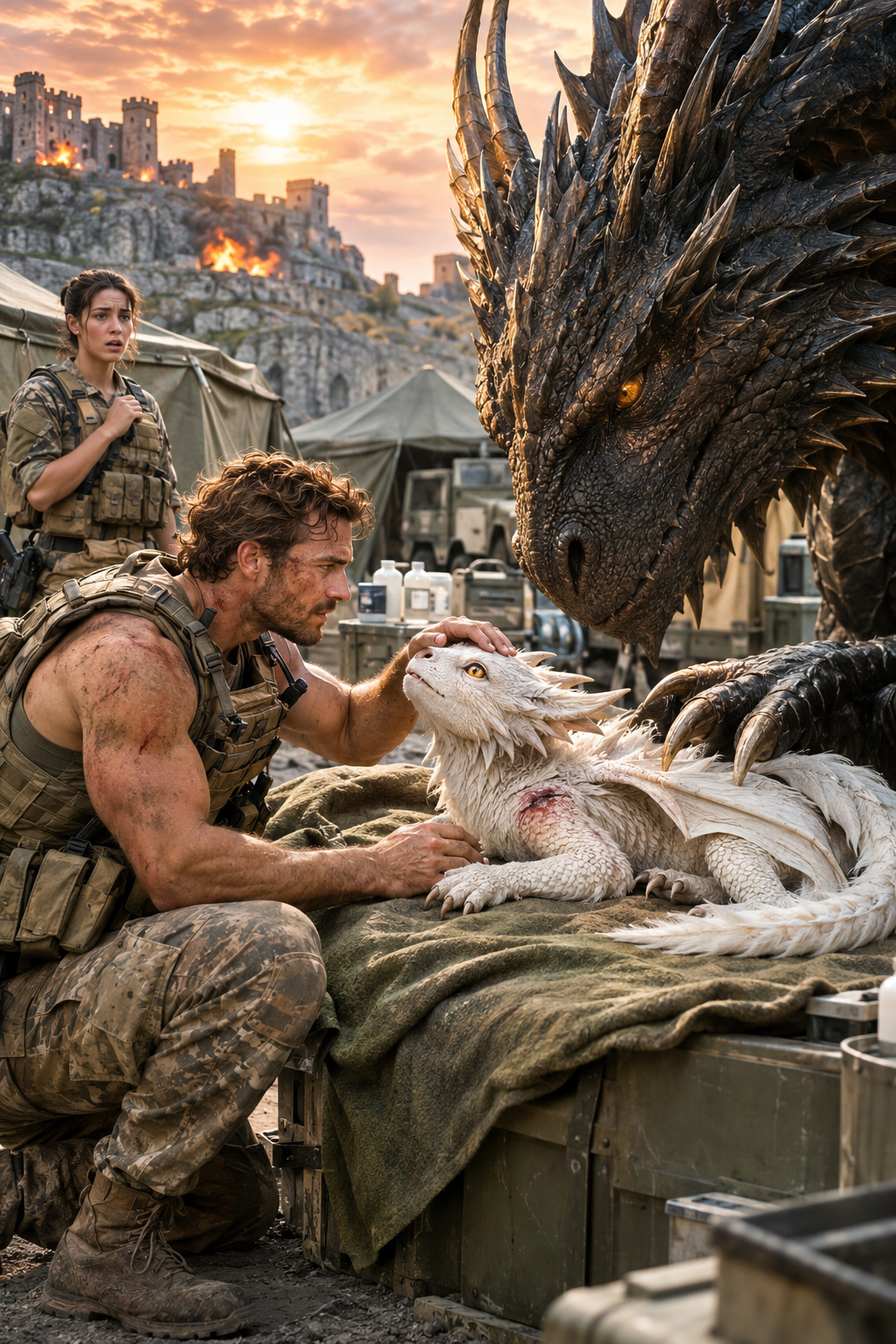
The giant Draxi war beast walked straight toward our field hospital at dawn, carrying something in its jaws.
Park pointed to a thin silver wire buried beneath the collar’s outer casing. It pulsed with a faint blue light, synchronized with the violent contractions running through Anvil’s enormous body.
“If we cut this wire,” she said, her voice trembling, “the collar won’t just shut down. It’ll send every bit of stored energy straight into his nervous system.”
I stared at her.
“You’re telling me it’s designed to kill him?”
“I’m telling you Verak never intended to let this creature survive disobedience.”
Another explosion struck the eastern barricade. The ground lifted beneath our boots, and a shower of dirt rattled against the medical tent.
Outside, Anvil released a deep, tortured growl.
Ember answered with a frightened cry.
I looked through the entrance and saw the enormous beast standing over his daughter, shielding her with his scarred body while enemy artillery turned the valley into a field of burning craters.
For three days, I had watched this supposedly mindless weapon refuse food until Ember ate. I had seen him gently push wounded Marines toward the medical tent when they collapsed outside. Once, during a freezing night, he had curled his massive body around our damaged generator, protecting it from a storm so our life-support equipment would keep running.
He understood more about sacrifice than most people I had encountered in uniform.
And somewhere inside that collar, a monster had installed a punishment for loving his child.
“There’s another way,” I said.
Park looked at me sharply.
“Thomas, we don’t have time for miracles.”
“Then help me make one.”
I grabbed the portable scanner and pressed its sensor against the exposed mechanism.
A complex network appeared on the screen. The collar had three separate circuits. One controlled pain. Another transmitted commands directly into Anvil’s brain. The third connected both systems to a small device embedded beneath his scales.
That was what I had seen moving beneath the collar days earlier.
It wasn’t an insect.
It wasn’t a parasite.
It was a mechanical implant, working its way deeper into living tissue.
“Look,” I said. “The collar and the implant communicate through that central transmitter.”
Park studied the image.
“If we interrupt the signal before severing the power circuit, the implant might go dormant.”
“Might?”
She swallowed.
“Or it might interpret the interruption as an escape attempt and detonate.”
Before I could answer, a voice thundered through the hospital’s external speakers.
“Medic Reyes!”
Verak Os.
“I know what you’re attempting. Step away from my property, or I will make you watch your patients die.”
My radio crackled.
“Reyes, this is Commander Harlan. Get away from that creature immediately. We are evacuating the hospital.”
I glanced toward the treatment tents.
Thirty-seven wounded Marines lay inside. Eleven could not walk. Four depended on machines for every breath.
There was nowhere to evacuate them.
The only road out of the valley was already under enemy fire.
“Sir,” I answered, “we can’t move everyone.”
“Then we save whoever we can.”
I looked at Anvil.
The beast was staring at me through the smoke.
He had no idea what we were saying, but somehow I knew he understood the choice being made.
“We’re not leaving them,” I said.
“Reyes, that’s an order.”
“With respect, sir, my patients are still breathing.”
I switched off the radio.
Park stared at me.
“You realize you’ve just ended your military career?”
“Probably.”
She reached for the surgical instruments.
“Then I guess mine’s over too.”
We approached Anvil together.
He lowered himself onto the ground without being asked, his enormous head resting beside the hospital entrance.
Even wounded and frightened, he was trying to make himself less threatening.
I placed my palm against his cheek.
“Listen to me, big guy. I’m going to hurt you before I can help you. I need you to stay still.”
His glowing amber eye followed my hand.
Then he closed it.
For the first time since Verak appeared, Anvil stopped trembling.
He trusted me.
That frightened me more than the enemy army.
Because I wasn’t certain I deserved it.
Park connected our surgical battery to the collar’s transmitter.
“We have enough power for one electromagnetic pulse,” she said. “If we overload the communication circuit, we should get approximately ninety seconds before the backup system activates.”
“Ninety seconds to do what?”
“Remove the implant.”
I examined the scanner.
The device had attached itself around several major nerves near Anvil’s skull.
Removing it carelessly could paralyze him.
Leaving it meant certain death.
“Ninety seconds,” I repeated.
Park nodded.
Behind us, the valley erupted.
A shell struck the hospital’s western wall, sending fragments through the outer treatment tent.
Someone screamed.
I turned instinctively, but Sergeant Miller appeared through the smoke, carrying an injured technician.
“Reyes! We need you!”
I looked from the bleeding man to Anvil.
A medic’s worst nightmare wasn’t losing a patient.
It was having to choose which patient mattered more.
“Pressure dressing!” I shouted. “Tourniquet if the bleeding won’t stop! Get Lieutenant Chen to stabilize him!”
Miller hesitated when he saw the giant creature.
Then he nodded and ran.
Anvil opened one eye.
He had watched the entire exchange.
And slowly, with tremendous effort, he moved his massive front leg toward the injured technician, creating a barrier between the man and the next blast.
Park whispered, “He knows.”
I tightened my grip around the surgical cutter.
“Start the pulse.”
The collar flashed white.
Anvil’s body convulsed once, then went still.
“Signal interrupted!” Park shouted. “Ninety seconds!”
I cut through the thick outer casing.
Beneath it, blackened tissue surrounded a metal cylinder embedded deep beneath the scales.
The smell of burned flesh filled my respirator.
Anvil made a low sound, but he didn’t move.
I worked faster.
The implant was larger than expected, with six flexible metallic arms wrapped around the surrounding nerves.
“Seventy seconds!”
I severed the first two connections.
A warning light appeared on Park’s monitor.
“Thomas, something’s changing.”
The implant began vibrating.
Its surface unfolded, revealing a tiny red indicator.
“It’s arming itself!”
“Can you stop it?”
“I’m trying!”
I disconnected another arm.
Anvil’s breathing became shallow.
“Forty seconds!”
The entire hospital shook as another shell exploded nearby.
My surgical light went dark.
For one terrible moment, I couldn’t see anything.
Then Park activated her helmet lamp.
“Keep going!”
I found the final connection and slipped the cutter underneath it.
The implant tightened.
Anvil roared so violently that several nearby windows shattered.
“Twenty seconds!”
I cut.
The device came free in my hand.
For half a heartbeat, nothing happened.
Then its red indicator began flashing faster.
“Throw it!” Park screamed.
I hurled the implant toward the empty drainage trench beyond the barricade.
Park grabbed my vest and pulled me down.
A sharp explosion ripped through the trench, followed by a flash of electrical fire.
When I opened my eyes, Anvil was lying motionless.
His enormous chest wasn’t moving.
“Anvil?”
I scrambled toward him.
Blood seeped from the wound beneath his neck.
I pressed my hand against his scales, searching for the slow, powerful heartbeat I had learned to recognize during the previous three days.
Nothing.
“No,” I whispered.
Park checked the scanner.
Her expression told me everything.
“Thomas, he’s gone.”
Behind us, Ember cried.
It was a small, broken sound that cut through the explosions and shouting.
The golden cub stumbled out of the tent, dragging one injured leg.
She approached her father’s enormous head and pressed her nose against his closed eye.
Anvil didn’t respond.
Ember nudged him again.
Then she made a sound I had never heard from any creature before.
It wasn’t a roar.
It sounded almost human.
A child calling for a parent who would never answer.
I dropped beside Anvil’s chest.
“Park, get the cardiac stimulator.”
She stared at me.
“That equipment was built for humans.”
“Then we’ll adapt it.”
“Thomas—”
“Please.”
Something in my voice stopped her argument.
She ran.
I climbed onto Anvil’s massive shoulder and positioned myself over the thick scales protecting his heart.
Manual compressions were impossible. His chest was too large, his bones too strong.
But the Draxi had built him for war.
That meant his body had survived punishment no human could endure.
I wasn’t going to declare him dead until I had exhausted every possibility.
Park returned with the portable stimulator and two emergency power cells.
We attached the electrodes to exposed tissue between the scales.
“Charging,” she said.
I leaned close to Anvil’s ear.
“You don’t get to leave her, big guy. Not after everything you’ve done.”
“Ready.”
“Clear!”
His body jerked.
The monitor remained flat.
We tried again.
Nothing.
Then a third time.
Ember climbed onto his foreleg and pressed her forehead against his skin.
I lowered my head.
For the first time since the war began, I prayed.
Not for victory.
Not for survival.
For one father to have another morning with his child.
The monitor flickered.
A single pulse appeared.
Then another.
Park gasped.
“Thomas!”
Anvil’s chest rose.
A terrible, ragged breath escaped his jaws.
His eyes opened.
And Ember practically threw herself against his face.
I laughed and cried at the same time.
Anvil’s enormous tongue brushed his daughter’s head.
Then his gaze found mine.
I placed my trembling hand against his cheek.
“Welcome back.”
But our moment of relief lasted only seconds.
The hospital speakers crackled again.
Verak’s voice had changed.
The amusement was gone.
“You have destroyed military property worth twelve million credits.”
I stood slowly.
“Your property has a daughter.”
“Then you have destroyed a weapon and stolen its offspring.”
Anvil growled.
Verak continued.
“You think removing the collar makes him free? You know nothing about what that creature truly is.”
A holographic transmission appeared above the hospital’s communication tower.
Verak stood inside an armored command vehicle, surrounded by officers.
Behind him, dozens of cages lined a vast industrial chamber.
Inside those cages were creatures like Anvil.
Some were smaller.
Some were larger.
All wore metal collars.
My stomach turned.
Park stared at the hologram.
“Oh, God.”
Verak smiled coldly.
“You saved one beast, medic. I have hundreds.”
The image shifted.
A massive underground facility appeared beneath the mountains on the northern side of the valley.
Rows of restrained war beasts filled the chamber.
At the center stood an enormous incubator containing dozens of golden eggs.
Ember’s species.
Verak leaned closer to the camera.
“The cub was bred for the next generation of weapons. Her father escaped during transport. I allowed him to reach your hospital because I wanted to see whether your primitive medicine could repair her injuries.”
My blood went cold.
“You injured her deliberately?”
“An acceptable experiment.”
Anvil rose to his feet.
The ground trembled beneath him.
Verak watched with obvious satisfaction.
“There it is. That anger. That’s what makes his kind so useful.”
I stepped toward the hologram.
“You’re not getting either of them.”
“Then everyone in this valley dies.”
The transmission vanished.
A moment later, enemy artillery resumed.
Commander Harlan’s voice burst through my radio.
“Reyes! The eastern defenses have collapsed. We have ten minutes before they reach the hospital.”
I looked toward the northern mountains.
Somewhere beneath those rocks, hundreds of creatures were suffering beneath the same kind of collar we had just removed.
Verak wasn’t simply fighting a war.
He was manufacturing slaves.
And Anvil had escaped because he refused to let his daughter become one.
“Park,” I said quietly, “do we still have the implant?”
She stared at me.
“The one that exploded?”
“Did the explosion destroy its communication core?”
She considered that.
“Not necessarily. The core had independent shielding.”
I pointed toward the drainage trench.
“Find it.”
“Thomas, what are you thinking?”
I looked at Anvil.
“Verak controls an army through those devices. If we can access the system, maybe we can disable the collars.”
Park’s eyes widened.
“Across an entire army?”
“Across every creature connected to his network.”
She shook her head.
“The signal would have to be transmitted from somewhere close to the main command system.”
“The underground facility.”
“You want to break into the enemy’s breeding complex during an invasion?”
I glanced toward the wounded Marines.
“No. I want to stop the invasion before it reaches them.”
Park was silent.
Then Anvil stepped beside me.
His massive head lowered until his eye was level with mine.
He made a low, deliberate rumbling sound.
There was something different about him now.
Without the collar, his movements seemed more thoughtful, more controlled.
He wasn’t waiting for commands.
He was making decisions.
And the direction of his gaze told me exactly what he wanted.
The northern mountains.
His imprisoned family.
“You know where they are,” I whispered.
Anvil lowered his head once.
Park looked between us.
“Did that thing just answer you?”
“Looks like it.”
Another explosion shook the hospital.
Miller came running through the smoke.
“Commander says we’re surrounded! The northern road is the only route they haven’t closed!”
I looked at the Marines gathering behind him.
Exhausted men and women, many wounded themselves, were preparing to defend patients who couldn’t escape.
They had spent months being told that the Draxi were monsters.
Now the largest monster they had ever seen stood beside their medic, protecting the wounded.
I turned toward Miller.
“I need volunteers.”
He glanced at Anvil.
“For what?”
“To free an army.”
The silence that followed lasted only a second.
Then Miller smiled.
“I knew following you was going to get weird.”
Within minutes, we had a plan.
It wasn’t a good plan.
But it was the only one we had.
Park recovered the implant’s communication core from the trench. The casing was cracked, but its memory circuits remained intact.
She connected it to a portable field computer and discovered that all the collars received synchronization signals from a central control system beneath the mountain.
The same system controlled the facility’s security gates.
“If we can insert a shutdown command,” she explained, “we could disable the neural restraints and open the cages simultaneously.”
“Could Verak reverse it?”
“Not if we physically disconnect the master transmitter afterward.”
Miller checked his rifle.
“Getting inside is the hard part.”
I looked at Anvil.
“Not necessarily.”
The beast lowered himself beside me.
His body was enormous enough to carry several Marines.
And unlike our vehicles, he knew the mountain paths.
I secured Ember inside the hospital’s reinforced recovery chamber.
She resisted immediately, crying when she realized her father was leaving.
Anvil approached her and touched his forehead against hers.
For several seconds, neither moved.
Then he gently pushed her toward me.
It took everything I had not to break down.
“I’ll bring him back,” I promised.
Anvil watched me with those ancient amber eyes.
He couldn’t understand every word.
But he understood promises.
We left the hospital through a narrow ravine shortly before sunrise.
Park rode behind Anvil’s shoulders, carrying the field computer. Miller and two Marines followed on a small reconnaissance vehicle, using the ravine’s natural cover.
I rode near Anvil’s neck.
Every movement of his powerful muscles reminded me how easily he could have crushed us.
Instead, he moved carefully, adjusting his steps whenever the terrain became rough.
Halfway through the ravine, we encountered an enemy patrol.
Three armored vehicles blocked the passage.
Miller raised his rifle.
Anvil stopped him with a low growl.
Then the beast stepped forward alone.
The soldiers immediately recognized him.
One shouted something in Draxi.
Another raised a control device.
Anvil stood still.
The soldier pressed the button.
Nothing happened.
He pressed it again.
Anvil opened his jaws and released a roar that echoed between the cliffs.
The soldiers abandoned their vehicles and fled.
Miller lowered his weapon.
“Remind me never to make him angry.”
We reached the mountain facility forty minutes later.
Its entrance was hidden beneath a massive natural overhang. Steel gates guarded a tunnel large enough for several tanks to enter side by side.
Beyond those gates, I heard something that made my skin crawl.
Crying.
Not human crying.
Hundreds of deep, frightened calls echoing through the mountain.
Anvil began trembling.
I placed a hand against his neck.
“We’re here.”
Park located an external maintenance terminal beside the gate.
“Give me five minutes.”
We didn’t have five minutes.
A security alarm sounded almost immediately.
Floodlights swept across the entrance.
Enemy soldiers appeared along the upper platforms.
Miller and his team took cover behind the rocks, exchanging fire with the defenders.
Anvil crouched protectively over Park while she worked.
“Come on,” she muttered, fingers racing across the controls.
The gate began opening.
Then the entire facility shook.
A massive armored vehicle emerged from the tunnel.
Verak Os stood on its upper platform.
His expression was almost delighted.
“Medic Reyes,” he called. “I hoped you’d come.”
I stared at him.
“You knew?”
“Of course. The creature always returns to its herd.”
He raised a different control device.
This one was larger than the first, connected to a military transmitter mounted on the vehicle.
“I no longer need his collar.”
Park’s screen flashed red.
“Thomas! He’s activating every implant inside the facility!”
The mountain filled with screams.
Behind the gates, hundreds of beasts convulsed against their restraints.
Anvil collapsed to his knees.
Although his implant was gone, the sound of the suffering creatures seemed to tear through him.
Verak smiled.
“Watch carefully. This is what happens when animals forget their purpose.”
I felt something inside me change.
Until that moment, I had thought of Verak as an enemy commander.
A cruel man, perhaps, but still a soldier.
Now I understood that his war had nothing to do with protecting his people.
He wanted power.
And he was willing to torture anything living to obtain it.
I stepped out from behind Anvil.
“Stop hurting them!”
Verak laughed.
“Or what, medic? Will you bandage me into submission?”
I raised my empty hands.
“I surrender.”
Park turned toward me.
“Thomas, don’t!”
I kept walking.
Verak watched suspiciously.
“You would surrender yourself for animals?”
“For innocent lives.”
He gestured to his guards.
Two soldiers descended from the platform and approached me.
I allowed them to take my weapon.
Then I looked directly at Verak.
“You’ve already lost.”
His smile disappeared.
“Explain.”
“Because you made one mistake.”
“And what would that be?”
“You assumed fear was stronger than love.”
Behind him, Park completed the connection.
Every light on the facility’s gate flashed blue.
Verak spun around.
“What have you done?”
The first restraint opened.
Then another.
Then hundreds.
A sound rose from beneath the mountain like thunder gathering beneath the earth.
The war beasts were waking.
And for the first time in their lives, nothing was telling them to obey.
Verak slammed his control device against the railing.
“Kill them!”
His soldiers hesitated.
Many were staring at the open cages.
From the darkness emerged a huge silver beast, her scales streaked with old scars.
Then a red one.
Then dozens more.
They moved slowly at first, confused by the absence of pain.
Some stumbled.
Others pressed their heads against the floor as though expecting punishment.
Anvil rose.
He stepped toward the entrance and released a deep, resonant call.
The silver beast answered.
Then the entire mountain answered.
I felt the sound in my chest.
It wasn’t rage.
It was recognition.
Anvil had returned.
And his people knew him.
Verak ordered his soldiers to fire.
Before anyone could obey, Anvil moved.
He surged forward, striking the armored vehicle with his shoulder.
The machine rolled onto its side, its weapons crushing against the stone.
Verak was thrown from the platform.
Miller and his Marines rushed forward, disarming the stunned guards.
I ran toward Park.
“Shut down the transmitter!”
“I’m trying!”
Her hands flew across the keyboard.
But Verak wasn’t finished.
He staggered to his feet and drew a small emergency controller from his belt.
Its display glowed crimson.
Park went pale.
“Thomas, that’s the termination system.”
I looked toward the cages.
“What does it do?”
“It kills every implanted beast at once.”
Verak raised the controller.
“If I cannot own them,” he snarled, “no one will.”
He pressed the activation switch.
A countdown appeared on Park’s screen.
Thirty seconds.
The freed creatures began collapsing.
Anvil roared and rushed toward Verak.
But the warlord had positioned himself behind a reinforced barrier.
“Twenty seconds!” Park shouted.
I grabbed her shoulder.
“Can you stop it?”
“Not remotely!”
She pointed toward a heavy power conduit running beneath the command platform.
“The shutdown signal travels through that cable. If we disconnect it, the command might fail.”
“Then disconnect it!”
“The access chamber is beneath the vehicle!”
I stared at the overturned machine.
Anvil had pinned it against the platform.
The conduit was trapped beneath tons of armor.
There wasn’t enough time to move it.
“Fifteen seconds!”
Anvil looked at me.
Then at the conduit.
He understood.
Before I could stop him, the enormous beast wedged his shoulder beneath the armored vehicle.
His muscles strained.
Blood seeped through the wound on his neck.
The vehicle shifted.
A few inches.
Then more.
“Anvil, stop!” I shouted.
He kept pushing.
The machine rose just enough to expose the conduit.
I dropped to my knees and crawled beneath it.
“Ten seconds!”
I found the cable.
Its outer casing was thicker than my wrist.
My cutter barely scratched it.
“Thomas!” Park screamed.
I looked up.
Anvil was trembling under the weight.
He couldn’t hold it much longer.
Then Miller slid beside me with a heavy rescue saw.
“Move!”
He drove the blade into the cable.
Sparks exploded.
“Five seconds!”
The saw jammed.
Miller cursed and pulled harder.
“Three!”
I grabbed the blade housing and helped him force it through.
“Two!”
The cable snapped.
Every screen went dark.
The countdown stopped.
For one horrible moment, silence filled the mountain.
Then the silver beast stood.
A red beast lifted its head.
Across the chamber, hundreds of creatures began breathing normally.
We had done it.
But above us, Anvil groaned.
The armored vehicle slipped.
I barely rolled clear before it crashed to the ground.
Anvil collapsed beside it.
His enormous body struck the stone with a sound I would never forget.
I scrambled toward him.
“Anvil!”
He lay on his side, breathing shallowly.
The wound beneath his neck had reopened.
His front leg was twisted at an unnatural angle.
And his eyes were losing their light.
Park arrived with the medical scanner.
She examined him quickly.
Then she looked at me.
“His heart is failing.”
I knelt beside his head.
“No. Not again.”
She shook her head.
“He’s lost too much blood. We need a transfusion, but we don’t have anything compatible.”
I looked around the chamber.
Hundreds of massive creatures stood watching.
Then the silver beast approached.
She was nearly Anvil’s size, with pale scars across her shoulders.
She lowered her head beside him and made a quiet sound.
Anvil opened one eye.
Their foreheads touched.
And something passed between them that I couldn’t explain.
The silver beast looked at me.
Then she extended her neck, exposing the thick vein beneath her scales.
Park stared.
“Thomas…”
I looked at the silver beast.
“You’re offering?”
She remained perfectly still.
Park examined her blood with the portable analyzer.
“Same species. Similar chemistry. We can run a compatibility test.”
The test took less than a minute.
The results appeared.
Compatible.
I nearly collapsed with relief.
We connected a sterile transfusion line.
The silver beast remained still while her blood flowed into Anvil.
Around us, the other creatures gathered silently.
Some touched him with their noses.
Others lowered their heads.
No one had commanded them.
They simply understood that one of their own was dying.
And they wanted to help.
After several minutes, Anvil’s heartbeat strengthened.
His breathing steadied.
Park smiled through tears.
“He’s going to make it.”
I pressed my forehead against his scales.
“You stubborn, magnificent animal.”
His enormous eye opened.
And for the first time, I saw something that looked almost like amusement.
Behind us, Miller approached with Verak in restraints.
The warlord’s face was twisted with hatred.
“You think you’ve won?” he spat. “Without those beasts, your forces will destroy my army. Thousands of Draxi soldiers will die.”
I stood slowly.
“Then tell them to surrender.”
“They would rather die.”
“Have you asked them?”
Verak said nothing.
Miller stepped forward.
“We intercepted your command transmissions. Your soldiers know what you’ve done here.”
Verak’s expression changed.
For the first time, I saw fear.
Miller continued.
“They know you used their families’ taxes to fund these experiments. They know you injured hatchlings to test medical recovery. And they know you planned to kill every creature in this facility rather than lose control.”
Outside, distant explosions continued.
But the rhythm of battle was changing.
Fewer shells.
Longer pauses.
Then silence.
My radio crackled.
Commander Harlan’s voice came through.
“Reyes, report.”
I swallowed.
“Sir, the control facility is secure. The war beasts are free.”
There was a long pause.
Then Harlan answered.
“Son, whatever you did up there, it worked.”
I looked toward the enormous creatures gathered around Anvil.
“What happened to the hospital?”
“The enemy advance stopped. Their forward units are surrendering. We’ve negotiated a temporary ceasefire.”
I closed my eyes.
“And the patients?”
“All accounted for.”
For several seconds, I couldn’t speak.
Then Harlan added something unexpected.
“Reyes, there’s someone here who wants to see you.”
A familiar cry sounded through the radio.
Ember.
I laughed.
“Tell her we’re coming.”
Three days later, Anvil returned to the field hospital.
He walked slowly, his injured leg supported by a medical brace constructed from salvaged vehicle parts.
The silver beast stayed beside him.
We had learned she was his mate.
The Draxi researchers had separated them years earlier and told each that the other had died.
She had spent those years restrained underground, forced to produce hatchlings for Verak’s breeding program.
Anvil had been used as a frontline weapon.
Ember was the first of their children he had ever managed to protect.
When the golden cub saw them approaching, she ran so quickly that Park nearly dropped her medical tray.
Anvil lowered himself.
Ember crashed into his chest.
The silver beast gently curled around them both.
For several minutes, the three creatures remained together, touching noses and making quiet sounds.
The Marines watched in silence.
Some smiled.
Others cried openly.
Even Commander Harlan removed his helmet.
I stood beside him.
“Sir, about disobeying your orders—”
He raised a hand.
“We’ll discuss that later.”
I nodded.
Then he added, “For the record, Reyes, I’ve never seen a soldier disobey orders for a better reason.”
The months that followed changed everything.
The evidence recovered from Verak’s facility triggered investigations throughout Draxi territory.
His officers testified against him.
Scientists confessed to years of forced breeding, neurological experimentation, and deliberate cruelty.
The warlord was tried by a joint tribunal.
The proceedings were broadcast across both civilizations.
For the first time, humans and Draxi citizens saw the creatures they had been taught to fear not as weapons, but as families.
The testimony of the scientists was horrifying.
The recordings were worse.
But one image changed public opinion more than anything else.
A photograph taken by Corporal Park showed Anvil lying beside Ember while I changed her bandages.
His enormous head rested on the floor.
His eyes were fixed on his daughter.
And one scarred claw was curled gently around her tiny golden tail.
Millions of people saw that photograph.
Many had never imagined a Draxi war beast could feel love.
The image made their certainty impossible to maintain.
Within six months, the peace negotiations that had failed for years finally began making progress.
The war didn’t end overnight.
Too many people had suffered.
Too much hatred remained.
But the fighting stopped long enough for both sides to recognize something they had nearly forgotten.
The enemy could suffer too.
The enemy could love.
And sometimes the creatures we feared most were the ones who had been hurt the longest.
As for Anvil, he refused to leave the hospital until every injured creature from the facility had recovered.
We built a temporary sanctuary along the river, far from the front lines.
Park became its chief medical officer.
Miller organized security.
And I stayed as a veterinary medical liaison, learning everything I could from Draxi biologists who had opposed Verak’s experiments.
At first, the work felt impossible.
Their anatomy was unlike anything I had studied.
Their blood chemistry changed with age.
Their scales hardened in response to environmental conditions.
Even their heart rhythms shifted when they were distressed.
But they taught us.
And we listened.
One afternoon, nearly a year after Anvil first appeared at our hospital, I found Ember waiting outside my quarters.
She was no longer small enough to carry.
Her golden scales shimmered in the afternoon sunlight, and tiny ridges had begun forming along her back.
She gently pushed her head against my chest.
I smiled.
“What is it, little troublemaker?”
She turned toward the river.
Anvil stood beneath a grove of enormous blue-leafed trees.
His mate rested nearby.
Around them, dozens of young creatures played in the grass.
Ember nudged me again.
I followed her.
Anvil watched me approach.
His old wounds had healed, though the scars remained.
The metal collar was gone.
In its place, he wore nothing.
No chains.
No transmitters.
No commands.
He was simply a father watching his daughter grow.
I sat beside him.
For a long time, neither of us moved.
The river whispered over the stones.
The young beasts chased each other through the grass.
And far away, beyond the mountains, the last military outposts were being dismantled.
“You know,” I said quietly, “when you first walked into my hospital, I thought you were going to kill me.”
Anvil turned one amber eye toward me.
I laughed.
“Yeah, I know. Pretty embarrassing.”
He lowered his head until it rested beside my boots.
I placed my palm against his scales.
“I’ve been thinking about that day.”
His breathing deepened.
“I thought I was saving your daughter.”
I looked toward Ember, who was now tumbling through the grass with two other cubs.
“But the truth is, you saved a lot more than I did.”
Anvil lifted his head.
“Before you came, we were losing ourselves. Every day, we treated wounded people, sent them away, and waited for the next transport. We stopped asking why the fighting continued. We stopped seeing anything beyond the next emergency.”
I swallowed.
“Then you walked through our gate carrying your child, and suddenly the enemy had a face.”
Anvil watched me silently.
“No,” I corrected myself. “Not the enemy. A father.”
He gently pressed his forehead against my shoulder.
It was the same gesture he had made when I returned Ember to him after surgery.
Except this time, I understood it.
It wasn’t submission.
It wasn’t obedience.
It was trust.
A few weeks later, representatives from both civilizations gathered at the sanctuary to sign the final peace agreement.
Commander Harlan attended in full uniform.
Park stood beside the medical teams.
Miller brought a group of Marines who had once pointed rifles at Anvil.
And standing beyond the gathering, beneath the blue-leafed trees, were hundreds of freed war beasts.
No one had forced them to attend.
They came because Anvil came.
When the ceremony ended, a young Draxi girl approached me.
She couldn’t have been older than ten.
She held a small drawing in her hands.
It showed a giant black beast carrying a golden cub toward a white medical tent.
Beside the tent stood a tiny human figure.
The girl pointed to the drawing.
“Is this really what happened?”
I knelt beside her.
“Yes.”
She looked toward Anvil.
“Were you afraid?”
“Terrified.”
“Then why did you help him?”
I thought about the question.
I remembered Park shouting warnings.
I remembered the commander’s orders.
I remembered the enormous jaws, the scarred scales, the blood on the golden cub, and the desperate look in Anvil’s eyes.
“Because his baby was dying,” I answered.
The girl considered that.
“But he could have hurt you.”
“Yes.”
“Then how did you know he wouldn’t?”
I smiled gently.
“I didn’t.”
She looked confused.
I continued.
“Sometimes doing the right thing means helping someone before you know whether they’ll ever be able to thank you.”
She lowered her eyes to the drawing.
“And sometimes,” I added, “the person everyone calls a monster is just someone who hasn’t been treated with kindness.”
The girl looked at Anvil again.
Then she walked toward him.
Her parents stiffened.
Several Marines instinctively stepped forward.
But Anvil merely lowered his enormous head.
The little girl reached out and touched his nose.
Ember bounded over and pressed her golden forehead against the girl’s shoulder.
Laughter spread through the gathering.
And in that moment, beneath a sky that had once been filled with warships, a human medic watched a Draxi child embrace the daughter of a creature both civilizations had once considered a weapon.
I realized something then.
The war had been fought with weapons powerful enough to destroy cities.
It had ended because enough people finally found the courage to see one another differently.
Years later, people would ask me about the battle at the mountain facility.
They wanted to hear about the explosions, the daring rescue, and the moment hundreds of war beasts broke free.
They wanted to know whether I felt like a hero.
I always told them the same thing.
I was a medic.
I saw a dying patient.
And I tried to save her.
Everything else happened because a father refused to abandon his child.
On the anniversary of the peace treaty, I returned to the old hospital grounds.
The tents were gone.
Wildflowers covered the craters.
A memorial stood where the emergency ward had once been.
Its inscription honored every life lost during the war, human and Draxi alike.
Anvil came with me.
His steps were slower now, but his eyes remained bright.
Ember walked beside him, nearly as large as her father.
We stopped at the place where he had first laid her at my feet.
For a moment, I could almost hear the old warning sirens.
The shouting.
The fear.
The desperate rhythm of a tiny heartbeat fading beneath my hands.
Anvil lowered his head.
I touched the scar where his collar had once been.
“You’re free, old friend.”
He turned toward Ember.
She pressed her nose against his.
Then he looked at me.
And I understood that freedom had never been the only thing he wanted.
He had wanted his daughter to live long enough to see a world where she would never wear a collar.
A world where her children would not be raised for war.
A world where strength could mean protecting life instead of taking it.
We stood together until sunset painted the valley gold.
Then Ember nudged me toward the path, impatient to return home.
I laughed and followed.
Behind us, the memorial caught the last light of day.
And I thought about how close I had come to obeying that first order.
Step away.
Leave the animal.
Protect yourself.
Had I done so, Ember would have died.
Anvil would have remained a slave.
Hundreds of creatures might never have escaped.
And the war might have continued for years.
Instead, I had knelt beside a frightened child who happened to have golden scales.
That was all.
One decision.
One act of compassion.
One moment when I chose to see a life instead of an enemy.
And somehow, that small decision had changed an entire world.
Because the greatest victories are not always won by those who carry the strongest weapons.
Sometimes they begin when someone lowers a rifle, opens their hands, and chooses to heal what others have been taught to destroy.
And sometimes the most powerful creature on a battlefield is not the one capable of killing thousands.
It is a father who carries his dying child through enemy lines, trusting that somewhere among strangers, there might still be one person willing to help.
Years passed, but I never forgot the morning Anvil carried Ember into our field hospital. Even after the war ended, even after the peace treaty transformed the valley into a sanctuary, I sometimes woke in the middle of the night hearing the desperate cries of a father who thought he was losing his child.
I had grown older. My hands weren’t as steady as they once were, and the scars from the mountain battle still ached when the weather turned cold. But I remained at the sanctuary, working alongside Park and the new generation of human and Draxi healers.
Ember had grown into a magnificent golden beast, larger than most military transports. She had inherited her father’s strength and her mother’s gentle nature. Young Draxi children often climbed onto her back, laughing as she carried them across the grassy fields.
Anvil, however, was slowing down.
His old injuries had never completely healed. Some mornings, he struggled to stand, and the enormous creature who had once overturned an armored vehicle now needed several moments to rise from his sleeping place.
I examined him regularly, adjusting his treatments and monitoring his heart.
One evening, Park joined me outside the medical building.
“Thomas, we need to talk about Anvil.”
I already knew what she was going to say.
“How long?”
She looked toward the distant trees, where Anvil rested beside his mate.
“His heart is weakening. The damage from the neural implant is progressing. We can keep him comfortable, but we can’t reverse everything.”
I nodded slowly.
For years, I had saved patients by refusing to surrender when their hearts stopped.
But there was one battle even the best medic couldn’t win forever.
Time.
That night, I sat beside Anvil beneath the same blue-leafed trees where we had spent so many peaceful afternoons.
He opened one amber eye when I approached.
“Hey, big guy.”
His tail moved slightly.
I sat against his shoulder and watched the stars emerge above the valley.
“You know, I never told you something.”
He remained still.
“When you first walked into that hospital, I was afraid I wouldn’t be able to save Ember. I thought you’d tear me apart if she died.”
Anvil released a quiet rumble.
“But when her heart stopped, you didn’t attack. You waited. You trusted me even when I didn’t trust myself.”
I swallowed.
“That changed the way I understood courage.”
For a long time, we remained together in silence.
Then Anvil gently lowered his enormous head into my lap.
I rested my hand against his scales.
“Whatever happens, your family will be safe. I promise.”
His breathing slowed.
And somehow, I felt that he understood.
The following morning, something extraordinary happened.
Hundreds of war beasts began arriving at the sanctuary.
Some traveled from distant mountain settlements. Others came from forests, deserts, and coastal regions where they had built new homes after their liberation.
They gathered quietly around Anvil’s resting place.
No alarms sounded.
No commands were issued.
They simply came.
Park approached me, visibly shaken.
“Thomas, how did they know?”
I looked across the gathering.
“I don’t think we understand everything about how they communicate.”
Near the front stood a massive red beast who had once been imprisoned beside Anvil. Behind him were younger creatures who had never worn collars, their scales gleaming in colors I had never seen during the war.
Ember approached her father and pressed her forehead against his.
Then the others began lowering their heads.
One after another.
Not in submission.
In respect.
I realized that Anvil had become something far greater than a survivor.
He was the living memory of their freedom.
That afternoon, Commander Harlan arrived. He had retired several years earlier, but he still visited the sanctuary whenever he could.
He stood beside me, looking at the enormous gathering.
“All those years ago,” he said quietly, “I ordered you to step away from that beast.”
“I remember, sir.”
“I thought I was protecting my men.”
“You were.”
He shook his head.
“No, Thomas. I was protecting them from something I didn’t understand.”
I looked at him.
Harlan continued, “You saw what the rest of us couldn’t. And because you did, thousands of lives were saved.”
I smiled faintly.
“Anvil did most of the work.”
The old commander laughed.
“Then I suppose I owe him an apology.”
He walked toward Anvil, removed his cap, and placed one hand against the creature’s enormous forehead.
“I’m sorry, old soldier.”
Anvil opened his eyes.
Then, with the last of his familiar strength, he gently nudged Harlan’s chest.
The commander stumbled backward and laughed through his tears.
“Still a stubborn beast.”
That evening, Anvil stood up.
It was the first time he had risen without assistance in several weeks.
Ember immediately moved beside him, ready to support his weight.
But Anvil refused.
He walked slowly toward the hill overlooking the sanctuary.
His mate followed on one side.
Ember followed on the other.
And behind them came hundreds of creatures, moving together through the golden evening light.
I followed at a distance.
At the top of the hill, Anvil stopped.
Below us stretched the valley that had once been torn apart by artillery.
The old battlefield had become a place of healing.
Children played beside the river.
Medical buildings stood where military bunkers had once been.
Human and Draxi families worked together in gardens planted over the ruins.
Anvil looked across it all.
Then he turned toward Ember.
She lowered her head.
He touched his forehead to hers, holding the gesture for a long time.
His mate approached next, resting her scarred face against his.
Finally, Anvil looked at me.
I stepped forward.
“Hey, old friend.”
He lowered his head until his eye met mine.
For a moment, I saw the same expression I had witnessed all those years earlier.
Not fear.
Not pain.
Trust.
I placed my hand against his forehead.
“You did it,” I whispered. “She’s safe. They’re all safe.”
Anvil released one final, deep rumble.
Then he slowly lay down in the grass.
Ember curled beside him.
His mate rested her head against his shoulder.
The evening wind moved through the blue leaves.
And beneath a sky that was finally peaceful, Anvil closed his eyes.
His breathing became slower.
Then softer.
Until it stopped.
I remained beside him long after the sun disappeared.
For the first time in my life, I didn’t reach for a medical instrument.
I didn’t call for a stimulator.
I didn’t demand another miracle.
I simply held my friend’s head and let him rest.
There are moments when love means fighting with everything you have to save someone.
And there are moments when love means accepting that someone has fought long enough.
Anvil had given everything.
His strength.
His freedom.
His body.
His heart.
And in the end, he had lived long enough to see the world he wanted for his daughter.
The following morning, the sanctuary was silent.
Every creature gathered on the hill.
Human and Draxi representatives stood together.
There were no military banners.
No speeches about victory.
No celebration of war.
Instead, Ember stepped forward carrying a small piece of broken metal in her jaws.
It was a fragment of the collar Anvil had worn during his captivity.
She placed it beside his resting place.
Then she crushed it beneath one enormous golden claw.
The sound echoed across the valley.
One by one, the other liberated creatures approached and laid down pieces of the collars they had kept as reminders of their suffering.
Soon, a mountain of broken metal stood beside the hill.
Park looked at me.
“What should we do with them?”
I watched Ember standing beside her father’s resting place.
“Build something.”
Months later, a monument rose above the sanctuary.
It was made entirely from the melted remains of those collars.
The metal had once been used to control living creatures through pain.
Now it formed the image of a father gently touching his newborn daughter’s forehead.
At the base, we engraved a simple message:
“Strength is not the power to command another life. It is the courage to protect one.”
The monument became a place where children from both civilizations came to learn about the war and the peace that followed.
I often visited with Ember.
She would rest beside the statue while I told stories about her father.
Sometimes I told the children about the battle beneath the mountain.
Sometimes I described how Anvil protected wounded Marines from falling debris.
But the story they loved most was the simplest.
The morning a terrifying war beast walked into an enemy hospital carrying his dying baby.
One little boy once asked me, “Were you the hero?”
I looked at Ember.
She lowered her golden head and nudged my shoulder.
I smiled.
“No. I was just the man who opened the door.”
The boy frowned.
“Then who was the hero?”
I rested my hand against Ember’s scales.
“Her father.”
The child considered this carefully.
“But he was a monster, wasn’t he?”
I shook my head.
“That’s what people called him when they were afraid.”
“Then what was he really?”
I looked toward the monument, remembering the enormous black creature who had once lowered his head before a frightened Marine medic.
“He was a father who loved his daughter.”
The boy smiled.
And I realized that perhaps this was Anvil’s greatest victory.
A new generation was growing up without automatically fearing what looked different.
They were learning to ask questions before judging.
To recognize suffering before assigning blame.
To understand that kindness was not weakness and mercy was not surrender.
Many years later, when my own time at the sanctuary was nearly finished, Ember visited me one final evening.
She was magnificent now, her golden scales marked with age and experience.
Behind her walked two young cubs.
One had shimmering silver scales.
The other was black.
The black cub was smaller than his sister, but his amber eyes were unmistakable.
I stared at him.
Ember gently nudged the little creature toward me.
He approached cautiously, sniffed my hand, and pressed his forehead against my palm.
I began to cry.
“Well,” I whispered, “look at you.”
The cub made a soft rumbling sound.
Exactly like his grandfather.
Ember lowered herself beside me, watching as the little one curled against my legs.
I looked into her golden eyes.
“You remembered.”
She touched her nose against my shoulder.
Outside my window, the sun was setting over the peaceful valley.
I thought about the frightened young medic I had once been.
The man who believed saving a life meant stopping blood loss, repairing wounds, and restarting a failing heart.
Those things mattered.
They always would.
But Anvil had taught me something greater.
Sometimes saving a life meant refusing to see another living being as an enemy.
Sometimes healing began with a single act of trust.
And sometimes the smallest patient could change the fate of an entire world.
The little black cub lifted his head and looked at me.
I smiled through my tears.
“Your grandfather was the bravest creature I ever knew.”
He blinked.
“And one day, when you’re older, I’ll tell you how he carried your mother through a battlefield because he believed someone would help.”
The cub settled against me.
Ember rested her enormous head beside the window.
And as darkness gently covered the sanctuary, I understood that Anvil had never truly disappeared.
He lived in his daughter’s compassion.
In the freedom of every creature born without a collar.
In the peace between two civilizations.
And in a small black cub who had never known the meaning of chains.
That was the world Anvil had fought to create.
And it was worth every sacrifice.
Because the truest measure of a life is not how much power we possess, how many battles we win, or how deeply others fear us.
It is how many lives become safer, kinder, and freer because we were here.
Anvil had entered my life as a creature everyone called a monster.
He left it as the greatest teacher I had ever known.
And whenever someone asked me what finally ended our terrible war, I never spoke first of generals, armies, or treaties.
I told them about a father, a dying child, and the moment a frightened medic chose compassion over fear.
Because sometimes, the first step toward changing the world is simply refusing to turn away from someone who needs our help.
THE END.