The first time I served dinner at Black Pine Camp, Foreman Lawson dumped my stew into the snow and laughed, unaware I had already discovered why the men were starving.
The sentence would not leave me alone.
“You were never supposed to find the first one.”
I read it again until the letters blurred.
Then I turned the page.
There were no more entries.
Only numbers.
Names.
Dates.
Locations.
At first, they looked meaningless, scattered across the yellowed paper like the private calculations of a man who had expected never to be questioned.
Then I saw the pattern.
Black Pine was not the beginning.
It was one line in a much larger operation.
I sat on the rotten floorboards until the afternoon light disappeared between the trees.
There were names from camps I recognized.
Iron Ridge.
Pine Hollow.
Silver Creek.
North Fork.
Some of those camps had closed decades ago.
Others had grown into towns.
And beside each name were figures representing supplies that had supposedly been delivered.
The same thing happened every time.
Meat.
Flour.
Coffee.
Coal.
Medicine.
Equipment.
Thousands of dollars at a time.
But the numbers on the other side of the ledger told a different story.
Some shipments had been delivered twice on paper.
Others had never arrived.
A few had been charged to camps that didn’t even exist yet.
I felt the old cold return to my hands.
Lawson hadn’t been stealing from one camp.
He had been part of something much larger.
I slipped the notebook into my coat.
I had spent years telling myself that Black Pine had been a closed chapter.
A cruel man had been exposed.
The company had corrected its system.
The workers had been protected.
I had built a career from the lesson.
But now I understood something I had failed to see.
The system I created had not ended the problem.
It had only made it harder to hide.
Whoever had been behind Lawson might have disappeared.
Or they might have simply learned to steal differently.
I drove out of Black Pine before dark.
The road was little more than mud and gravel, and the forest seemed to close behind me as soon as I passed the last stand of pines.
At the edge of town, I stopped at a diner.
I ordered coffee and placed the notebook beside my cup.
For nearly twenty minutes, I stared at it without opening it.
Finally, I called the regional office.
An old colleague answered.
Her name was Margaret Hale.
She had worked with the timber company longer than I had and had retired several years earlier.
When she heard my voice, she laughed.
“You only call when something is wrong.”
“This time, something is very wrong.”
She stopped laughing.
“What happened?”
“I found Lawson’s ledger.”
There was silence.
Then she asked quietly, “Which one?”
My heart began beating faster.
“You know about it?”
“I know there were rumors.”
“What rumors?”
Margaret took a breath.
“Not over the phone.”
We agreed to meet the next morning.
She chose a small library two towns away, a place where nobody from the old company would think to look for us.
When I arrived, she was already waiting.
She looked older than I remembered, her silver hair pulled tightly behind her head.
I placed the notebook on the table.
Margaret did not touch it.
Instead, she stared at the cover.
“I was afraid this would surface someday.”
“You knew?”
“Not everything.”
“That isn’t an answer.”
“No,” she said. “It isn’t.”
She finally opened the ledger.
Her eyes moved across the pages.
Then she closed it.
“Where did you find this?”
“In the old kitchen wall.”
“The second notebook?”
I nodded.
She leaned back.
“Then Lawson wasn’t keeping records for himself.”
“Who was he keeping them for?”
Margaret looked toward the library windows.
“The people who owned the company.”
I felt a strange pressure in my chest.
“Carter?”
“No.”
“Then who?”
“The board.”
I stared at her.
“William Carter was the camp director.”
“He was also a man who believed the company could be better than the people running it.”
Margaret lowered her voice.
“There was an unofficial network inside the timber industry. It wasn’t one company. It was managers, warehouse owners, suppliers, foremen, accountants, and sometimes men on the board. They moved money through inflated invoices and false deliveries. Small amounts disappeared from one camp, larger amounts from another. Nobody noticed because every theft looked like a mistake.”
“And Lawson?”
“Lawson was useful.”
“Was he the one running it?”
Margaret shook her head.
“No. He was the kind of man people could blame.”
The words hit me harder than I expected.
A disposable man.
Someone cruel enough to make workers hate him, careless enough to leave evidence, but low enough on the ladder that his arrest would satisfy everyone.
I thought about the first night at Black Pine.
Lawson had dumped my stew into the snow.
He had laughed.
He had humiliated me.
At the time, I thought he was simply a bully.
Now I wondered whether that humiliation had been deliberate.
If he could frighten people into silence, he could protect a system.
Margaret reached into her bag and removed an envelope.
“I kept copies.”
She pushed them across the table.
Inside were old reports.
Audit summaries.
Letters.
Payment records.
One name appeared again and again.
Thomas Weller.
I knew the name.
Everyone in the regional timber industry knew it.
Weller had been chairman of the company during the years when Black Pine had been operating.
He had retired wealthy and respected.
He had funded schools.
Built a hospital wing.
Donated land to the county.
People spoke about him as if he had been a great man.
Margaret watched my face.
“You understand now why this was buried.”
“Because nobody wanted to accuse him.”
“Because nobody wanted to believe the man who built hospitals could have built his fortune by starving workers.”
I looked at the papers.
“How much?”
Margaret shook her head.
“We never found the total.”
“But you know it was enormous.”
“Yes.”
“How enormous?”
She looked at me.
“Enough to change the lives of every worker in this region.”
I closed my eyes.
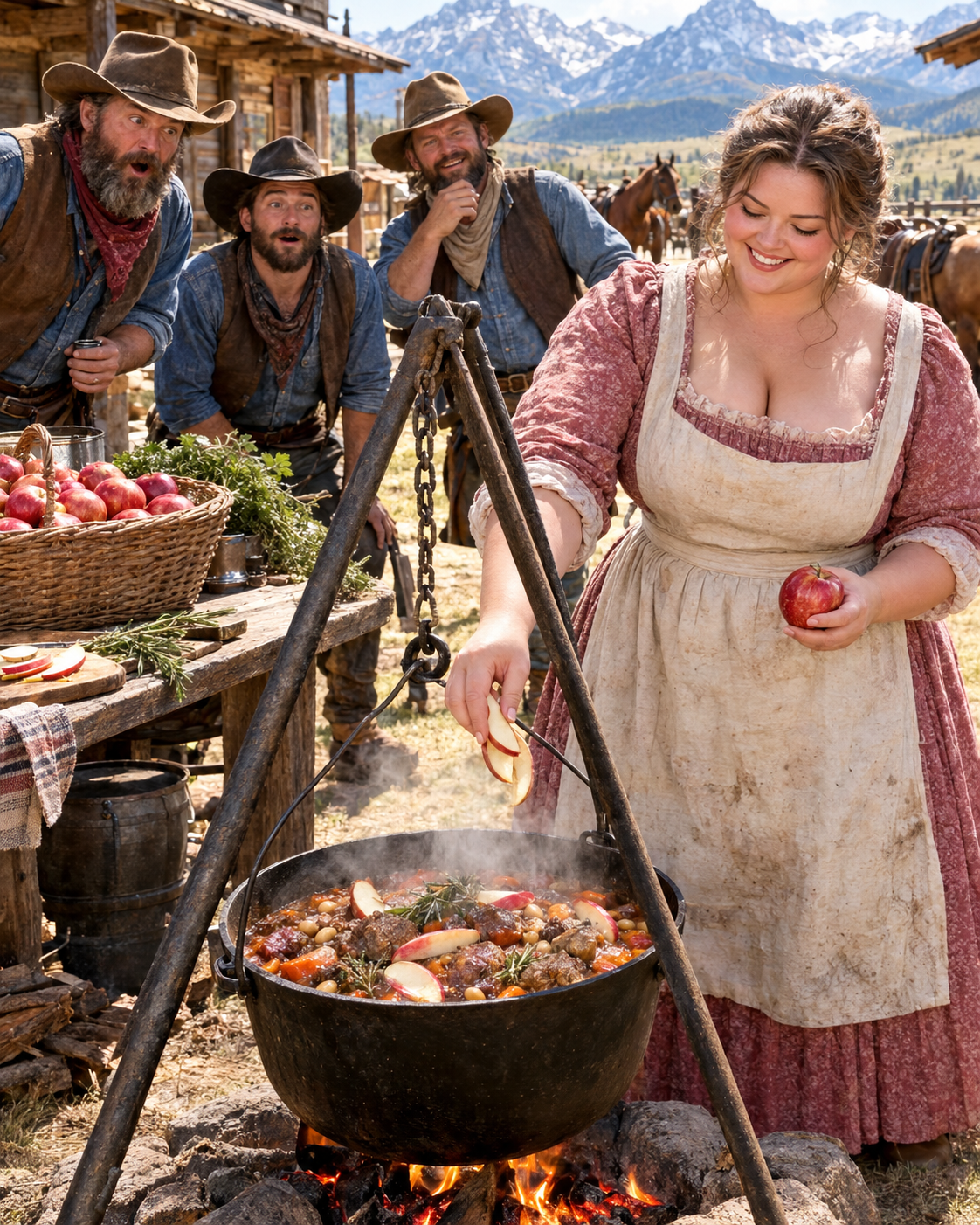
Suddenly, the apples came back to me.
The first dinner.
The men staring at the bowls.
Frank asking what was in the stew.
The way they ate as if somebody had given them permission to be human again.
I realized then that hunger had been part of the business model.
Keep costs low.
Keep workers exhausted.
Keep them grateful for whatever arrived.
And make sure nobody had enough time or energy to ask where the missing food went.
I opened my eyes.
“What happened to Weller?”
“Dead.”
“How long?”
“Twenty-two years.”
“And the others?”
“Some died. Some retired. Some changed companies.”
“And some?”
Margaret looked directly at me.
“Some are still alive.”
For the next three weeks, we worked in secret.
We found old invoices.
We contacted retired workers.
We searched county archives.
We spoke to widows whose husbands had once worked in camps that no longer existed.
At first, people were reluctant.
Then the memories began spilling out.
A camp where workers were promised fresh meat but received beans for six months.
Another where the medicine cabinet was always empty despite invoices showing regular deliveries.
A winter when three men nearly froze because coal had been delivered on paper but never reached the camp.
A foreman who disappeared after complaining about missing wages.
The stories were different.
The pattern was the same.
The theft had never been about money alone.
Money had been the easiest thing to measure.
The real damage was measured in broken bodies, ruined marriages, children who grew up without fathers, and men who learned to accept suffering because they believed nobody would listen.
Then we found the name we had been looking for.
Arthur Bell.
Warehouse supervisor.
The man who had worked with Lawson.
He was still alive.
He was living alone in a small house near Lake Superior.
When I called, he hung up.
I called again.
He refused to speak.
On the third attempt, I said one sentence.
“I found Lawson’s second ledger.”
There was a long silence.
Then Arthur said, “Come tomorrow.”
His house smelled of wood smoke and old paper.
Arthur was nearly ninety.
He walked with a cane and moved slowly, but his eyes were sharp.
When he saw the ledger, his face collapsed.
“You shouldn’t have found that.”
“I’ve heard that before.”
He gave a bitter laugh.
“Then you know what happens next.”
“I want the truth.”
“The truth doesn’t make people happy.”
“I’m not asking for happiness.”
He sat by the window.
For several minutes, he said nothing.
Then he began.
Lawson had been recruited when he was young.
He wasn’t the architect.
He was a courier.
He altered invoices.
He approved false shipments.
He paid warehouse workers to sign delivery forms.
In return, he received money and protection.
But every year, the operation grew.
Eventually, there were dozens of camps involved.
When one man became suspicious, they transferred him.
When another complained, they questioned his reliability.
When someone threatened to expose them, they made sure he could no longer find work.
“Why didn’t you leave?” I asked.
Arthur looked down at his hands.
“Because I was afraid.”
“Afraid of what?”
“Losing everything.”
I said nothing.
He continued.
“That is how corruption survives. Not because everyone is evil. Because enough ordinary people are frightened.”
He reached beneath his chair and pulled out a small wooden box.
Inside were letters.
“I kept these because I thought someday somebody would ask.”
One letter was from Lawson.
It was dated three days before he disappeared from Black Pine.
Arthur handed it to me.
The message was short.
“Carter knows.
The woman in the kitchen knows more than she should.
If they question me, I was acting alone.
Do not contact Weller.”
My stomach tightened.
“You knew Carter was investigating.”
Arthur nodded.
“Then why wasn’t he killed?”
Arthur looked at me strangely.
“Because Weller needed him.”
“For what?”
“To make the company look clean.”
I remembered Margaret’s words.
A man who believed the company could be better than the people running it.
Carter had been trapped between the truth and the men who controlled it.
That night, Arthur gave me one final piece of information.
“There is a storage facility beneath the old administrative building.”
“It was demolished.”
“Not the basement.”
“What is there?”
“Records.”
“Why didn’t anyone find them?”
“Because the entrance was sealed.”
“Where?”
Arthur pointed to a photograph hanging above his fireplace.
It showed the original Black Pine office.
A young Lawson stood in the back row.
Beside him was Thomas Weller.
And behind them was a wooden door.
Arthur tapped the photograph.
“Behind that wall.”
I drove to the site the next morning.
The old administrative building was gone.
Only a concrete foundation remained beneath weeds and moss.
I walked around the ruins until I found the wall shown in the photograph.
There was nothing there.
Then I noticed a row of stones that did not match the others.
I moved them aside.
Behind them was a rusted metal hatch.
My hands shook as I opened it.
A narrow stairway descended into darkness.
The air smelled of damp earth.
At the bottom was a steel door.
It was unlocked.
Inside were shelves.
Boxes.
Ledgers.
Thousands of pages.
For a moment, I simply stood there.
Then I understood.
The black ledger was not evidence.
It was an index.
The real records were here.
I spent two days photographing everything.
Names.
Payments.
Dates.
Signatures.
Instructions.
There were even handwritten notes from Weller.
One sentence appeared several times.
“Keep the camps hungry enough to reduce waste.”
Another read:
“Workers who believe supplies are abundant become difficult to control.”
I had to sit down.
For years, I had thought the theft was motivated by greed.
It was.
But greed had become something colder.
Control.
That was when I found the final file.
It was labeled BLACK PINE.
Inside was a report dated one month before I arrived.
The report mentioned Lawson.
It mentioned the missing supplies.
It mentioned Carter.
And then it mentioned me.
My name was written at the bottom.
I read the sentence twice.
“New kitchen employee should be monitored. She has demonstrated unusual attention to inventory.”
I stopped breathing.
They had noticed me before I found the ledger.
The first night Lawson laughed at me, he may already have known I was dangerous.
The stew had not been the beginning.
It had been a test.
I gathered every document I could safely carry and left.
But before I reached my car, I heard an engine.
A black sedan stopped on the road.
Two men stepped out.
One was older.
The other was younger.
Neither wore a company uniform.
The older man looked at me.
“You’ve been asking questions.”
I said nothing.
“You should stop.”
“Why?”
“Because some things are better left buried.”
I held the box tighter.
“That’s what you told everyone who was hungry.”
His expression changed.
Only slightly.
But I saw it.
Fear.
Not anger.
Fear.
I understood then that they weren’t protecting the past.
They were protecting themselves.
I turned toward the car.
The younger man stepped in front of me.
“Give us the documents.”
“No.”
He grabbed my arm.
I pulled away.
For a second, neither of us moved.
Then headlights appeared on the road.
A truck came around the bend.
The men stepped back.
The truck slowed.
Arthur Bell was behind the wheel.
I had never seen an old man drive that fast.
He stopped beside us and shouted, “Get in!”
I did.
Arthur slammed the truck into gear.
We disappeared down the road.
Neither of us spoke for several minutes.
Finally, Arthur said, “Now you understand why I waited forty years.”
I looked at him.
“No. I understand why you were afraid.”
He glanced at me.
“There is a difference.”
He was right.
Fear could keep a person alive.
But fear could also make a person cooperate with evil for so long that one day they could no longer remember where survival ended and cowardice began.
We delivered the records to federal investigators.
Then to the newspapers.
Then to every surviving union archive we could find.
The story broke across the region.
At first, people denied it.
Then the documents became impossible to ignore.
Names were published.
Companies were investigated.
Old bank accounts were traced.
Former executives were questioned.
Some died before they could face trial.
Others were charged.
Arthur testified.
Margaret testified.
I testified.
And eventually, the government opened a broader investigation into labor fraud across the timber industry.
The process took years.
Justice always does when the truth has been buried beneath decades of paperwork.
But something changed before the courts finished.
People began telling their stories.
Families brought out old pay stubs.
Widows brought letters.
Retired workers brought photographs.
They stood in public meetings and said, sometimes through tears, “This happened to my husband.”
“This happened to my father.”
“This happened to me.”
For the first time, they were not isolated stories.
They were one story.
A story about people who had been told they were disposable.
The company eventually created a compensation fund for surviving workers and their families.
It could never repay everything.
No amount of money could restore the years stolen from them.
But it was an acknowledgment.
A public admission that the suffering had been real.
Arthur lived long enough to see the first payments distributed.
He died the following winter.
At his funeral, I stood beside Margaret.
There were only thirty people there.
Some were family.
Some were former workers.
One was Frank.
He was older now, his hair completely white.
After the service, he came over to me.
“I never told you this,” he said.
“Told me what?”
“That first night at Black Pine.”
I smiled faintly.
“The stew?”
He nodded.
“I thought you were going to quit.”
“So did Lawson.”
Frank looked toward the cemetery.
“We all did.”
“Why?”
“Because nobody had ever stood up to him before.”
I looked at him.
“I didn’t feel brave.”
“You don’t have to feel brave.”
He smiled.
“You just have to do the right thing before fear talks you out of it.”
Years later, that sentence became the one I remembered most.
Not the lawsuits.
Not the headlines.
Not the promotions.
Not even the ledger.
That sentence.
You just have to do the right thing before fear talks you out of it.
I continued working in food and operations for the rest of my career.
I helped build systems that protected workers from fraud.
I trained managers to understand that numbers were not merely numbers.
A missing barrel of flour could mean an empty kitchen.
An empty kitchen could mean a hungry crew.
A hungry crew could mean an injured worker.
And an injured worker could mean a family losing everything.
Eventually, I wrote a small handbook based on what I had learned.
I called it The Black Pine Rule.
The first rule was simple.
“Count what arrives.”
The second was more important.
“Ask who pays when it doesn’t.”
The third was the one I wanted people to remember.
“Never confuse obedience with loyalty.”
Because loyalty to an organization does not mean protecting its secrets.
Loyalty means protecting the people who depend on it.
Many years after the investigation, I returned to Black Pine one last time.
The forest had swallowed almost everything.
The roads were gone.
The old camp existed only as broken foundations beneath moss.
I walked to the place where the kitchen had stood.
There was no table.
No stove.
No serving spoon.
Nothing remained except a few rusted nails in the soil.
I thought about the first bowl of stew.
I thought about Lawson throwing it into the snow.
At the time, I had believed he was trying to humiliate me.
Now I understood that he had accidentally given me the greatest gift of my life.
He had made me look closer.
He had made me notice what everyone else had learned to ignore.
I knelt and touched the earth.
Underneath the leaves, I found something small.
A piece of iron.
The old serving spoon.
I recognized it immediately.
I sat there holding it in my hands, listening to the wind move through the pines.
For a moment, I could almost hear the dining shack again.
The clatter of bowls.
The tired laughter.
Frank asking what was in the stew.
The men eating as if they had forgotten what it felt like to have enough.
And I realized something I wish I had understood much earlier.
The first thing corruption steals is rarely money.
It steals attention.
It teaches good people to stop looking.
It teaches workers to accept empty shelves.
It teaches managers to trust numbers they know are wrong.
It teaches witnesses to stay silent because speaking feels dangerous.
And once enough people stop looking, almost anything can disappear.
Food.
Money.
Truth.
Dignity.
Even a person’s belief that they matter.
I placed the spoon back on the ground.
Then I stood.
The sun was setting beyond the trees.
For decades, I had thought the story of Black Pine was about catching a thief.
It wasn’t.
It was about what happened when one ordinary person decided that a strange number was worth questioning.
That was all.
I hadn’t been a detective.
I hadn’t been powerful.
I hadn’t been brave.
I had simply noticed that the pantry should have been full.
Then I asked why it wasn’t.
That question opened a door.
Behind that door was a ledger.
Behind the ledger was a network.
Behind the network were decades of lies.
And behind all those lies were thousands of people who had spent years believing their suffering was invisible.
I learned that day that courage does not always arrive as a dramatic decision.
Sometimes it looks like counting every crate.
Sometimes it looks like refusing to sign a false form.
Sometimes it looks like asking one uncomfortable question when everyone else is pretending not to notice.
And sometimes, it looks like serving another bowl of stew after someone has thrown the first one into the snow.
Before I left, I turned back toward the trees.
The old camp was gone.
The men were gone.
Lawson was gone.
Weller was gone.
Almost everyone connected to the original scandal had disappeared into history.
But the lesson remained.
People can bury records.
They can destroy buildings.
They can change names and move money and wait for witnesses to grow old.
But truth has a strange habit of surviving.
Sometimes it survives in a ledger hidden behind a wall.
Sometimes in a photograph.
Sometimes in the memory of an old worker who still remembers what hunger felt like.
And sometimes it survives in something as simple as a recipe passed from one person to another.
Years after Black Pine closed, I taught my granddaughter how to make the same apple-braised beef.
She asked me why I always added the apples.
I smiled.
“Because once, a long time ago, I had very little food and a lot of hungry people.”
She laughed.
“That doesn’t explain anything.”
I handed her the spoon.
“No,” I said.
“But someday it might.”
She tasted the stew.
Then she smiled.
“It needs more salt.”
I laughed so hard that I had to sit down.
For the first time, I understood that this was how stories truly survived.
Not through monuments.
Not through names carved into stone.
But through small things passed from one generation to the next.
A recipe.
A warning.
A question.
A memory.
A refusal to look away.
And whenever I make that stew now, I remember the men at Black Pine.
I remember how quiet they were when I first arrived.
I remember how they lowered their eyes because they had been taught not to expect better.
Most of all, I remember the moment that changed everything.
Frank took another bite.
He looked around the table.
And slowly, almost cautiously, he smiled.
That smile was the first sign that the camp had not defeated them yet.
They were still hungry.
They were still tired.
They were still being robbed.
But they had not forgotten what dignity tasted like.
Neither had I.
And that is why, after all these years, I still believe the most dangerous person in any corrupt system is not always the strongest person.
Sometimes it is the person who notices something doesn’t add up.
The person who asks one question.
The person who counts.
The person who refuses to accept that an empty table is normal.
Because once someone begins looking closely, the darkness has nowhere left to hide.
And sometimes, all it takes to expose the truth is one woman, one ledger, and a bowl of stew that was never supposed to matter.
But it did.
It mattered enough to make hungry men remember their worth.
It mattered enough to make a thief afraid.
It mattered enough to uncover a secret buried for decades.
And it mattered enough to teach me the lesson I carried for the rest of my life:
Never underestimate the power of paying attention.
Because evil does not always enter through a broken door.
Sometimes, it slips quietly through a number on a page.
And sometimes, the smallest act of honesty is enough to leave the door open for the truth.
And sometimes, the smallest act of honesty is enough to leave the door open for the truth.
I did not know then that the lesson would follow me for the rest of my life.
I thought Black Pine had taught me how to recognize theft.
It had not.
It had taught me how to recognize silence.
Years later, when I was nearly seventy, I received a letter from a young woman who worked at a remote mining camp in Montana.
She had found irregularities in the food inventory.
At first, she thought she had made a mistake.
Then she counted again.
The numbers still didn’t match.
She was afraid to report it because her supervisor had warned her that people who caused trouble did not keep their jobs for long.
At the bottom of her letter, she wrote:
“I don’t know if I’m imagining things. What would you do?”
I read that sentence three times.
Then I smiled.
Not because the situation was funny.
Because I knew exactly what it felt like to stand beside a shelf and wonder whether you were seeing something nobody else wanted to see.
I wrote back.
“Count again.”
That was all.
Then I added:
“And when the numbers still don’t match, ask why.”
She eventually found that supplies were being diverted to a private contractor.
The supervisor was dismissed.
The workers received compensation.
She kept her job.
Years later, she sent me another letter.
Inside was a photograph of a kitchen table.
On it sat a pot of stew.
Beside the pot was a handwritten note:
“Thank you for teaching me to look.”
I kept that photograph beside my desk until the day I died.
Not because I thought I had saved anyone.
I hadn’t.
She had saved herself by choosing not to look away.
That was the real lesson of Black Pine.
No one person can protect every honest person in the world.
But one honest person can remind another that fear does not have to make the decisions.
And sometimes that is enough.
The world never became free of people like Lawson.
There will always be someone willing to falsify a number.
Someone willing to sign a dishonest form.
Someone willing to profit from another person’s silence.
There will always be people who convince themselves that what they are doing is harmless because someone else is doing worse.
But there will also always be people who notice.
People who count.
People who question.
People who refuse to accept an empty table as normal.
I think about that whenever I smell apples cooking with onions.
The scent carries me back through decades in an instant.
Back to a wooden dining shack buried beneath the Michigan pines.
Back to twenty exhausted men staring at me.
Back to Henry Lawson’s cruel laugh.
Back to a bowl of stew disappearing into the snow.
And then back to the moment Frank took his first bite.
He had looked around the room as if he had forgotten what a decent meal felt like.
Then he smiled.
It was a tiny thing.
Almost nothing.
But sometimes history turns on things that look like nothing.
A smile.
A question.
A signature refused.
A ledger opened.
A hand reaching beneath a loose shelf.
A person deciding that tomorrow might be different if they were willing to risk something today.
Black Pine taught me that courage rarely announces itself.
It doesn’t always feel like courage while you are doing it.
Most of the time, it feels like fear.
Your hands shake.
Your stomach tightens.
You wonder whether you are wrong.
You wonder whether everyone else knows something you don’t.
You wonder whether telling the truth will cost you more than remaining silent.
But there comes a moment when you have to decide which price you are willing to pay.
Silence has a price too.
I learned that from the men of Black Pine.
They paid it for years.
So did Arthur Bell.
So did Margaret.
So did countless families whose names never appeared in the newspapers.
They paid because they believed speaking would change nothing.
And perhaps, for a long time, it didn’t.
But one person spoke.
Then another.
Then another.
That is how the truth eventually wins.
Not all at once.
Not dramatically.
One voice at a time.
The last time I visited Black Pine, I brought my granddaughter with me.
She was twenty-four then, almost the same age I had been when I first arrived.
She walked beside me through the forest, stepping carefully over fallen branches.
“Was this really where the camp stood?” she asked.
“Yes.”
“It doesn’t look like much.”
“No.”
She looked around.
“It’s strange.”
“What is?”
“That something so important happened here, but there’s almost nothing left.”
I thought about that.
Then I told her the truth.
“Most important things don’t leave buildings behind.”
She looked at me.
“What do they leave?”
I handed her the old iron spoon.
She held it carefully.
“Stories,” I said.
We walked until we reached the clearing where the dining shack had once stood.
The trees had grown so thick that sunlight barely reached the ground.
I pointed toward a cluster of pines.
“That’s where Lawson threw the stew.”
She laughed.
“He really threw it?”
“Yes.”
“Why?”
“Because he wanted me to feel small.”
“Did it work?”
I considered the question.
“For a little while.”
She looked at the spoon.
“And then?”
“Then I got curious.”
She smiled.
“Curious?”
“Curiosity is sometimes more useful than courage.”
She laughed.
I sat on a fallen log.
“Your great-grandfather used to say that feeding hungry people was never a small thing.”
She looked at me.
“Was he right?”
“Yes.”
“Why?”
I looked toward the trees.
“Because hunger makes people believe they deserve less than they do.”
She was quiet.
Then she asked, “And what happened to the men?”
“Most of them went home.”
“Were they happy?”
“Some were.”
“Were they rich?”
I smiled.
“No.”
She frowned.
“Then what did they get?”
I looked at the spoon in her hands.
“They got to know that somebody had noticed.”
She didn’t understand at first.
But I knew she would someday.
Because sometimes dignity begins before circumstances change.
Sometimes it begins the moment someone says:
“I see what happened to you.”
“You were not imagining it.”
“You were not weak.”
“You were not asking for too much.”
“You deserved better.”
The men of Black Pine had spent years believing their hunger was simply the cost of working in the woods.
They had been taught that suffering was normal.
That was the greatest theft of all.
Not the flour.
Not the beef.
Not the money.
The belief that they were worth so little that nobody would care.
I stood and took the spoon back.
Then I placed it beneath the pine tree.
My granddaughter looked surprised.
“Why leave it here?”
“Because it belongs here.”
“Won’t someone take it?”
“Maybe.”
“Then why?”
I smiled.
“Because the point isn’t to keep the spoon.”
I looked at the empty clearing.
“The point is to remember what it means.”
She nodded slowly.
We walked back toward the car.
Halfway there, she stopped.
“Grandma?”
“Yes?”
“What if you hadn’t found the ledger?”
I turned around.
For a long moment, I said nothing.
Then I answered honestly.
“Someone else might have found it.”
“Who?”
“I don’t know.”
“Would they have done what you did?”
“I don’t know that either.”
She looked frustrated.
“That isn’t a very satisfying answer.”
“No.”
I smiled.
“But it’s the truth.”
Because the truth is rarely as neat as the stories we tell about it afterward.
There was no guarantee that I would succeed.
No guarantee the company would listen.
No guarantee Lawson would be exposed.
No guarantee the workers would ever receive justice.
I could have been fired.
I could have been threatened.
I could have been wrong.
I could have walked away.
That possibility matters.
Because bravery has no meaning if there is no choice.
I chose to stay.
That was all.
One choice.
Then another.
And another.
Until those choices became a life.
As I drove away from Black Pine for the final time, I looked in the rearview mirror.
The forest swallowed the clearing.
Within seconds, there was nothing but trees.
I thought about how easily history disappears.
A building falls.
A road vanishes.
A name fades.
A witness dies.
A ledger is forgotten.
And yet, somehow, the truth can survive all of it.
Not because truth is powerful.
But because people are.
People remember.
People tell their children.
People write things down.
People refuse to let suffering become invisible.
That evening, my granddaughter and I stopped at a small roadside restaurant.
She ordered soup.
I ordered apple-braised beef.
When the food arrived, she tasted it and smiled.
“You still make it the same way.”
“Yes.”
“Even after all these years?”
“Especially after all these years.”
She took another bite.
Then she looked at me.
“I think I understand now.”
“Understand what?”
“Why you never stopped cooking.”
I laughed softly.
“Maybe.”
Outside, the sun was setting.
For a moment, the glass reflected my face back at me.
I saw the young woman I had once been.
Twenty-five years old.
Alone.
Angry.
Afraid.
Standing in a kitchen full of hungry men.
Holding a serving spoon with trembling hands.
I wished I could speak to her.
I wished I could tell her that she did not need to know how the story would end.
She only needed to take the next right step.
That was all any of us could ever do.
Take the next right step.
Even when the road disappears.
Even when the forest is dark.
Even when the people around us tell us that nothing is wrong.
Especially then.
Because evil depends on ordinary people deciding that something is not their problem.
But so does goodness.
Goodness depends on someone deciding that it is.
The next time you see a number that doesn’t make sense, look again.
The next time someone tells you not to ask questions, ask why.
The next time you see a person being treated as though they don’t matter, remember that dignity is not something another person gets to give or take away.
And if you ever find yourself standing alone, afraid that speaking the truth will change nothing, remember Black Pine.
Remember the hungry men.
Remember the stolen supplies.
Remember the ledger hidden behind the wall.
Remember that corruption survived for years because people were convinced they were powerless.
Then remember what happened when one person finally looked closely.
The forest did not move.
The mountains did not shake.
No thunder sounded in the sky.
A woman simply opened a notebook.
And everything changed.
That is how the story of Black Pine ended.
Not with a courtroom.
Not with a fortune.
Not with revenge.
It ended with a lesson that was much harder to steal.
The knowledge that every person deserves to be seen.
Every worker deserves to be heard.
Every number deserves to be questioned.
And every empty table deserves an explanation.
I never saw Henry Lawson again.
Sometimes I wonder whether he ever understood what he had helped create.
Maybe he did.
Maybe he didn’t.
It no longer matters.
His name disappeared into the history books.
The people he tried to silence did not.
Their children grew up.
Their families survived.
Their stories were told.
And somewhere, in kitchens far from Black Pine, people still cook meals using recipes passed down from those who came before them.
That is what remains.
Not the thieves.
Not the money.
Not the buildings.
The people.
Their memories.
Their courage.
Their stories.
And the quiet insistence that tomorrow can be better than yesterday.
I once thought I had gone to Black Pine to find work.
I was wrong.
I went there to learn something.
I learned that hunger can be manufactured.
That silence can be purchased.
That fear can be organized.
But I also learned something stronger.
Truth can be shared.
Courage can spread.
And dignity, once remembered, is very difficult to steal again.
So when people ask me what happened at Black Pine, I never begin with Lawson.
I begin with the stew.
Because that is where the story really started.
A pot of cheap meat.
A few apples.
A room full of tired men.
And one ordinary person who decided that if she was going to feed them, she would at least make sure they had enough.
Sometimes, that is how change begins.
Not with a speech.
Not with power.
Not with someone important.
Sometimes it begins with a simple act of care.
And sometimes, if you follow that act far enough, it leads you straight to the truth.
That is the story I carried with me.
That is the story I gave to my granddaughter.
And that is the story I hope she gives to someone else someday.
Because the world will always have its hidden ledgers.
There will always be locked doors.
There will always be people who benefit when everyone else stays quiet.
But there will also always be someone willing to ask:
“Where did the food go?”
And once that question is asked, the people who have been hiding the truth should be afraid.
Not because the question is powerful.
But because the person asking it might keep asking.
And sometimes, one question is all it takes to bring an entire forest of lies crashing down.
THE END.