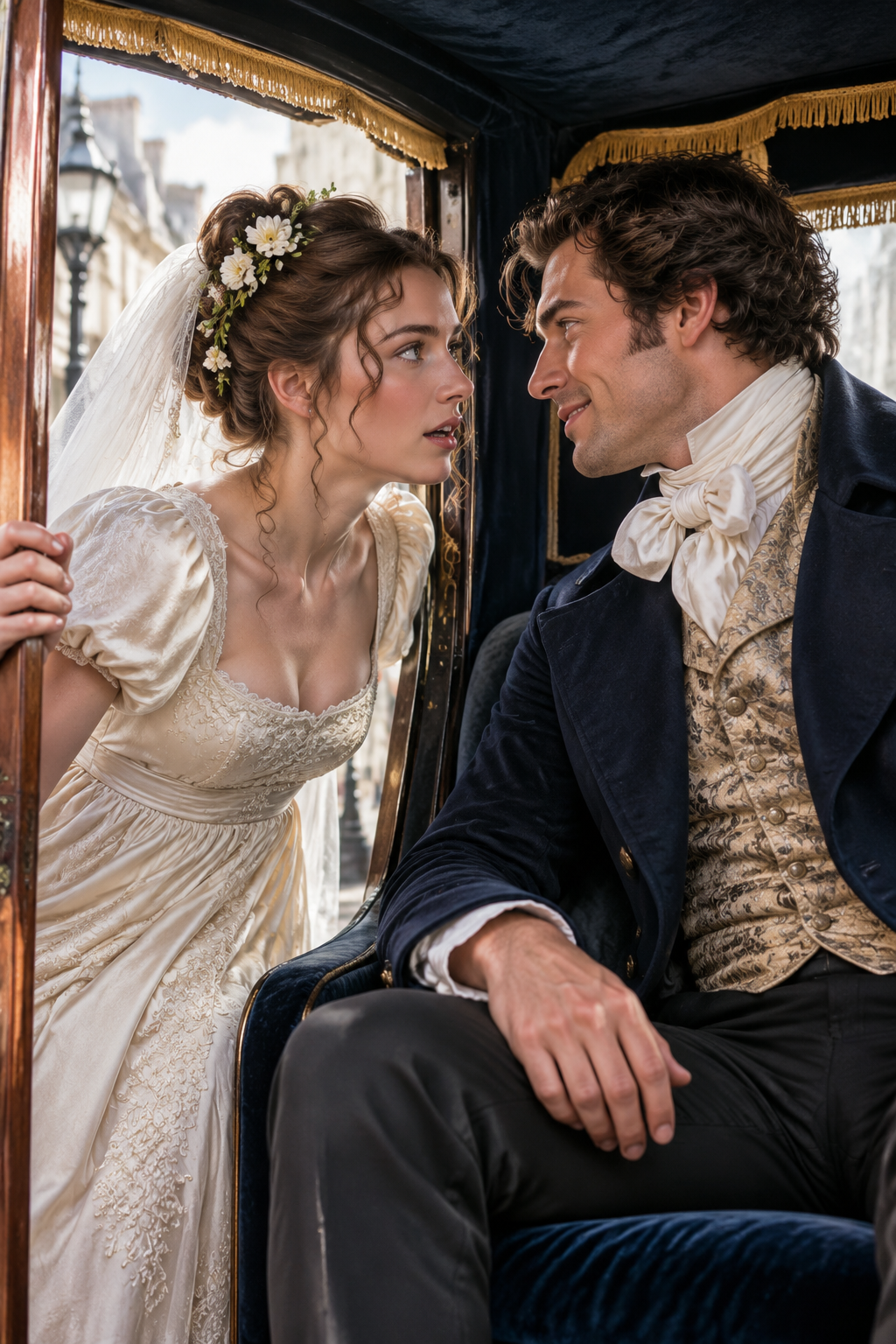
The first thing Nell Marsh did on her wedding day was climb into a stranger’s carriage.
For several seconds, neither Nell nor Owen moved. The rain beat steadily against the tall library windows, and between them lay two documents that should never have shared the same marks.
Nell placed Silas Rook’s letter beside the disputed debt agreement, aligning the edges beneath the candlelight.
Three faint indentations appeared along both sheets, followed by a slightly deeper impression where the pressure had faltered.
The marks were not identical in every respect, but their spacing was unmistakable.
Owen bent closer.
“Could another press have made them?”
“Possibly. But this particular defect is unusual. One of the pressure surfaces is uneven, and the paper has been compressed differently at that point.”
She ran a clean fingertip along the edge of the agreement without touching the damaged area.
“Someone has used the same equipment on papers supposedly prepared years apart.”
Owen examined the letter again.
“Rook owns a bindery?”
“Most merchants use someone else’s.”
“Then we find out whose.”
Nell shook her head.
“Not yet. If he discovers what we’re looking for, he’ll destroy whatever remains.”
Owen straightened. He had spent years negotiating contracts, receiving petitions, and watching powerful men disguise threats as polite invitations. Yet the woman standing before him had recognized a weakness in Rook’s scheme that every solicitor who had examined the documents had overlooked.
“Then what do you propose?”
Nell looked toward the unfinished book on her table.
“We let him believe his papers are safe.”
The following morning, Silas Rook arrived at Weldon House beneath a sky the color of pewter.
His carriage rolled through the iron gates shortly before ten, accompanied by a second vehicle carrying two leather document cases and a narrow-faced clerk.
From an upstairs window, Nell watched Rook descend.
He wore an expensive dark coat and carried himself with the easy assurance of a man accustomed to having doors opened before he reached them.
His clerk, by contrast, looked exhausted.
The younger man stumbled while lifting one of the cases, and Rook turned with a sharp movement.
Even through the glass, Nell recognized the reprimand in his expression.
She stepped away from the window.
On the table behind her lay three carefully prepared sheets, copies of the suspicious impressions she had taken the previous evening using thin tracing paper and graphite.
She had also written a brief account of her observations, distinguishing what she could prove from what she merely suspected.
Her hands had been steady throughout the work.
They became less steady when she heard Rook’s voice rising from the entrance hall.
“His Grace has always been generous with his hospitality.”
The sound brought back the cramped office where she had first seen her father’s supposed debt, the smell of spilled wine, and the way Rook had rested his hand over the ledger whenever she tried to read it.
She remembered his offer.
A marriage, he had said, would settle everything.
She remembered the heavy silence that followed when she refused.
Downstairs, Owen greeted his visitor in the morning room.
“Mr. Rook.”
“Your Grace. I trust my sister’s letter reached you.”
“It did.”
“She has been terribly distressed by your continued absence.”
Owen gestured toward a chair.
“I imagine she has questions.”
“Naturally. A gentleman cannot withdraw from an understanding between respectable families without inviting speculation.”
“An understanding is not the same as a marriage.”
Rook smiled, although his eyes remained cold.
“Perhaps not. But arrangements of this importance rarely concern only the two people involved.”
He seated himself and placed one leather case across his knees.
“Which brings me to the financial obligations attached to our families’ agreement.”
Owen accepted the documents without opening them.
“I have asked my solicitor to examine those obligations.”
Rook’s smile narrowed.
“An unnecessary expense, surely.”
“Then the examination should be brief.”
For the first time, Rook appeared uncomfortable.
He recovered quickly, reaching into his coat for another folded paper.
“Before we begin, there is a small personal matter I believe Your Grace should understand.”
Owen waited.
“A young woman employed in your household has caused considerable trouble.”
The room seemed to grow quieter.
Rook laid the paper on the table.
“Her name is Eleanor Marsh.”
Owen did not look toward the door.
“I know her.”
“Then you may also know that she fled a lawful marriage arrangement and abandoned substantial financial responsibilities.”
“Miss Marsh is employed here as a bookbinder.”
“She is a debtor.”
“That claim is disputed.”
Rook paused.
“Has she told you that?”
“Yes.”
“And you believed her?”
Owen opened the first document.
“I believe disputed accounts should be examined before judgments are made.”
Rook’s fingers tightened around his walking stick.
“With respect, Your Grace, you know very little about this woman.”
Owen looked up.
“Then I suggest you tell me something I can verify.”
Upstairs, Nell was listening from the small passage adjoining the library.
She had not intended to overhear the entire conversation. Owen had promised to summon her when the papers were ready, and she had intended to keep away until then.
But when Rook spoke her name, something compelled her to remain.
His voice carried through the partially open door.
“The girl’s father left obligations exceeding eight hundred pounds. I offered an honorable arrangement to spare her the consequences.”
Nell closed her eyes.
Eight hundred pounds.
Her father had died believing he owed less than one hundred.
Even after his death, Rook had continued adding charges to the account.
She had challenged the amounts, but his clerk always produced another entry, another signature, another explanation.
She opened her eyes and descended the stairs.
In the morning room, Rook was explaining the supposed debt when the door opened.
Nell entered without hesitation.
His sentence stopped.
For a moment, the practiced confidence disappeared from his face.
Then he rose.
“Miss Marsh.”
“Mr. Rook.”
His gaze traveled from her plain blue dress to the leather case in her hand.
“How fortunate. I had hoped we might settle this matter privately.”
“I tried that.”
“Your behavior at the church—”
“Was a refusal to marry you.”
Rook glanced toward Owen.
“Your Grace, you see the difficulty.”
Owen remained seated.
“Miss Marsh has asked to examine the documents.”
“The documents have already been examined.”
“Then another examination should cause no inconvenience.”
Nell approached the table.
Rook placed one hand over the leather case.
“These are private business records.”
“Records concerning my father’s estate and a debt you claim against me.”
“Precisely.”
“Then I should like to see them.”
For several seconds, he did not move.
Finally, he withdrew his hand.
“Very well.”
Nell opened the case.
Inside lay a ledger bound in dark brown leather, several receipts, and a folded agreement bearing her father’s name.
The sight of that signature made her throat tighten.
Her father had been a careful man, more accustomed to working with tools than handling contracts. He had borrowed money during a difficult winter, but he had kept notes of every payment in a little notebook Nell still possessed.
She laid the agreement beside her own copies.
“May I examine the binding of the ledger?”
Rook frowned.
“The binding?”
“Yes.”
“For what conceivable reason?”
“To determine whether it has been altered.”
His chair scraped against the floor.
“That is absurd.”
Nell lifted her gaze.
“Then you have nothing to fear.”
Owen spoke before Rook could answer.
“Let her examine it.”
Nell opened the ledger carefully.
Its pages were sewn through a series of evenly spaced holes. Most of the gatherings lay flat, but near the middle, one section sat fractionally higher than the others.
She turned several pages.
The paper changed.
The ink appeared similar, and the handwriting had been copied with considerable skill. But the newer sheets possessed a different texture, and their edges did not align perfectly with the surrounding pages.
Nell drew a slow breath.
“Someone has removed a gathering and inserted another.”
Rook laughed.
“You are making accusations based on the appearance of paper?”
“No. I am describing its construction.”
She turned the ledger sideways.
“The original sewing passes through these holes. But the pages containing my father’s later debts have a second set of pierced holes, partially concealed beneath the thread.”
Owen leaned forward.
Rook stood motionless.
“Those pages were sewn into another arrangement before being inserted here,” Nell continued. “The earlier binding was opened, and someone attempted to close it again.”
She indicated a narrow channel near the spine.
“Whoever did it used fresh adhesive. The old lining remains underneath.”
Rook recovered his voice.
“Books are repaired every day.”
“Yes. But this ledger was supposedly untouched since my father’s death.”
“Perhaps my clerk had it strengthened.”
“Then there should be an invoice for the repair.”
A silence followed.
The narrow-faced clerk near the doorway shifted his weight.
Nell noticed.
Rook noticed her noticing.
“Mr. Vale,” Rook said sharply, “fetch the carriage.”
The clerk hesitated.
“But, sir, the settlement papers—”
“Now.”
Owen rose.
“Your clerk may remain. We are not finished.”
Rook’s face darkened.
“I will not permit my employees to be interrogated in another man’s house.”
“No one has interrogated him.”
Nell closed the ledger.
“Not yet.”
She looked directly at the clerk.
“Mr. Vale, did you take this book to a binder?”
The young man stared at the floor.
Rook moved toward him.
“You need not answer.”
Owen stepped between them.
“Mr. Vale may speak for himself.”
For several agonizing seconds, the clerk said nothing.
Then he whispered, “Yes.”
Rook’s expression hardened.
“Be careful.”
Vale swallowed.
“Mr. Rook told me the spine had failed.”
“When?” Nell asked.
“Last spring.”
Nell felt the significance of those words settle around the room.
Her father’s supposed final agreement bore a date from nearly four years earlier.
“Which binder?” she asked.
Vale glanced at Rook.
“Mr. Fenwick. In Bell Street.”
Rook seized his walking stick.
“This ridiculous performance is over.”
He turned toward Owen.
“Your Grace, I came here in good faith to discuss our families’ future. Instead, I find myself subjected to accusations from a runaway bride and a disloyal clerk.”
Owen stood beside the table, his expression unreadable.
“You came here demanding money and threatening a woman in my employment.”
“I am protecting what is owed.”
“Then you should welcome a proper accounting.”
Rook looked toward Nell.
For an instant, she saw the same expression he had worn in his office months earlier, when she had discovered an unexplained charge and refused to accept his explanation.
“You have no idea what you are interfering with,” he said quietly.
Nell closed her leather case.
“Then I suggest you explain it.”
He did not.
Instead, he gathered his gloves and walked toward the door.
At the threshold, he stopped.
“You may discover that certain gentlemen are less willing to overlook scandal than others.”
His eyes moved toward Owen.
Then he left.
The sound of his carriage wheels lingered long after the vehicle disappeared beyond the gates.
Nobody in the morning room spoke immediately.
Vale remained near the fireplace, visibly trembling.
Owen poured him a glass of water.
“Sit down.”
The clerk obeyed.
Nell returned to the ledger.
“Mr. Vale, I need you to tell us exactly what happened to these pages.”
Vale pressed the glass between both hands.
“I carried the book to Fenwick’s shop. Mr. Rook gave me a packet of papers and instructed me to have them sewn into the old ledger.”
“Did Fenwick know the pages were false?”
“I don’t know. He was told the originals had been damaged.”
“Who prepared the new pages?”
Vale lowered his head.
“I copied them.”
Owen’s expression tightened.
“Under whose instructions?”
“Mr. Rook’s.”
The clerk’s voice almost failed.
“He said the entries were corrections. He said there had been errors in the accounts.”
Nell turned toward the window.
The garden beyond lay washed in gray light.
She had suspected the debt was fraudulent for months. Yet hearing the admission brought no immediate satisfaction.
Instead, she remembered her father’s last winter, when he had sold his good coat to pay a portion of what he believed he owed.
She remembered the strain in his voice when he told her there was no need to worry.
He had died apologizing for leaving her so little.
And now she was learning how much of that shame had been deliberately manufactured.
Owen approached quietly.
“Nell.”
She did not turn.
“Did your father ever receive a full accounting?”
“No.”
Her voice remained steady, though her fingers had begun to tremble.
“He asked for one. Rook said the records were too complicated for him to understand.”
Owen looked at the ledger.
“Then we find the originals.”
Vale lifted his head.
“There may be another book.”
Nell turned.
“What book?”
“The warehouse register. Every delivery and payment was entered separately before the amounts were transferred into the main accounts.”
“Where is it?”
Vale hesitated.
“In Rook’s cellar office. Unless he’s moved it.”
Owen reached for the bell.
“Then we need a solicitor and someone authorized to secure those records before they disappear.”
The investigation moved quickly, though not as quickly as Nell feared it needed to.
Owen’s solicitor, Mr. Harcourt, arrived that afternoon and listened while Vale repeated his statement.
The clerk signed a written account in the presence of witnesses.
Harcourt examined the altered ledger, Nell’s notes, and the suspicious letters.
He did not pretend the evidence was sufficient to settle every question.
“The physical alterations are compelling,” he said. “But we must establish which entries were changed, who authorized them, and whether the original accounts survive.”
Nell nodded.
“I understand.”
“Mr. Vale’s testimony gives us a starting point.”
Harcourt closed his notebook.
“And if Mr. Rook intends to remove or destroy the remaining records, we must act before he has the opportunity.”
By evening, letters had been dispatched to a magistrate and to the solicitor representing Nell’s father’s estate.
A formal demand was also prepared requiring Rook to preserve the relevant books and produce the original accounts.
Nell spent the following morning at Fenwick’s binding shop.
The elderly craftsman had known her father and remembered Nell from the years when she had helped repair hymnals and schoolbooks.
He greeted her warmly, then grew troubled when she explained why she had come.
“I thought the pages were replacement accounts,” he admitted after examining the ledger.
“Do you remember working on it?”
“Very clearly. The gentleman insisted that the book must appear as though it had never been opened.”
Nell watched him carefully.
“Did that seem unusual?”
“It did. But merchants are particular about the appearance of their records.”
Fenwick opened a drawer and removed a small invoice book.
He searched through several pages before stopping.
“There.”
The entry bore a date from the previous spring.
The same date Vale had given.
Beside it was a brief description of the work, including a note that the replacement pages had been supplied by the customer.
Nell felt the first genuine easing of the pressure that had lived beneath her ribs for months.
“May we have a copy?”
Fenwick nodded.
“And I will testify to the work if required.”
When Nell returned to Weldon House, another carriage stood before the entrance.
This one bore an elegant family crest.
Inside the drawing room, a young woman in a pale green traveling dress was speaking to Owen.
She was beautiful in a composed, almost severe way, with dark hair arranged neatly beneath a small hat.
At the sound of Nell’s footsteps, she turned.
Owen rose.
“Miss Marsh. May I introduce Miss Beatrice Rook?”
Nell stopped.
Silas Rook’s sister.
The woman Owen had been expected to marry.
Beatrice looked at Nell for a moment.
Then she set down her teacup.
“My brother told me you were here.”
Nell held her leather case closer.
“I imagine he said a great deal.”
“He did.”
Beatrice’s gaze moved toward Owen.
“Very little of it was useful.”
Owen looked surprised.
Beatrice rose.
“I came because Silas has demanded that I sign another marriage settlement.”
Owen’s expression changed.
“Another?”
“The figures have been revised.”
She reached into her reticule and withdrew a folded document.
“He says the adjustment is necessary because of a financial difficulty involving a deceased tradesman.”
Nell felt the blood drain from her face.
Beatrice noticed.
“The name is Marsh.”
The three of them stood in silence.
Then Beatrice placed the document on the table.
“I refused to sign it.”
Owen approached.
“Why?”
“Because the sum was different from the amount he mentioned last month. When I questioned him, he told me the details were beneath my concern.”
She looked toward Nell.
“I have spent most of my life being told that financial matters are beneath my concern.”
Her fingers tightened around the clasp of her reticule.
“I am beginning to find the phrase rather tiresome.”
Nell almost smiled.
But the document before them demanded her attention.
She opened it.
The proposed settlement included a payment to Rook’s commercial interests, described as compensation for obligations assumed during the arrangement of the marriage.
Among those obligations was a sum corresponding to the fraudulent debt.
Owen read the passage twice.
“He intended to use the marriage settlement to recover money he had invented.”
Harcourt, summoned from the library, examined the document.
“That is one possibility. We need the underlying accounts to establish precisely how these sums relate.”
Beatrice stood beside the window.
“Silas told me that if this marriage failed, the family would suffer.”
She looked toward Owen.
“Was there ever a moment when you intended to marry me?”
Owen did not evade her gaze.
“I intended to honor an arrangement I believed both families had made in good faith.”
“That wasn’t my question.”
He was silent for a moment.
“No.”
Beatrice exhaled.
“Good.”
Nell glanced up.
Beatrice’s smile was small and tired.
“I had hoped you would say that.”
For the first time, the two women looked at each other without the weight of Rook’s arrangements standing entirely between them.
Beatrice spoke quietly.
“My brother told me you had attempted to escape your obligations.”
Nell answered, “He tried to make marriage the price of my freedom.”
Beatrice lowered her eyes.
“He used a different argument with me.”
Over the next two days, the investigation uncovered more than either woman had anticipated.
The original warehouse register was not in Rook’s cellar when the authorized examination began.
Its shelf stood empty.
Rook claimed it had been lost during an earlier move.
But Vale remembered that the register had been transferred to a locked cabinet in Rook’s private office shortly before he visited Weldon House.
With the help of Harcourt and the magistrate’s officers, the book was eventually recovered from that cabinet, hidden beneath a stack of ordinary correspondence.
Rook had removed several loose receipts.
He had not removed the ledger itself.
The entries exposed a pattern of manipulation.
Payments made by Nell’s father had been recorded in the warehouse register but omitted from the later account.
Additional charges appeared only in the reconstructed ledger.
Several supposed advances had no corresponding delivery, receipt, or signature in the original records.
The handwriting on the inserted pages matched Vale’s admitted work.
And the disputed agreement bore physical marks consistent with the same binding equipment Fenwick had used the previous spring.
Harcourt cautioned Nell that the case would still require proper examination and testimony.
But there was now a clear chain of evidence.
Rook had not merely exaggerated a debt.
He had manufactured a financial obligation and attempted to use it to control a marriage, while preparing to conceal the invented sum within another family’s settlement.
When confronted with the original register, he accused Vale of incompetence.
When Fenwick’s invoice was produced, he blamed his bookbinder.
When Beatrice refused to support his account, he accused her of ingratitude.
By the end of the hearing, his explanations had contradicted one another so thoroughly that even his own solicitor ceased interrupting the witnesses.
Nell sat near the front of the room, her hands folded over the leather case she had carried into Owen’s carriage.
She watched Rook stand before the magistrate, still dressed with immaculate care.
His polished boots shone beneath the hem of his coat.
His gloves lay untouched on the table.
Yet the assurance he had worn so easily was gone.
The magistrate ordered the disputed financial claims examined further and referred the evidence of falsification and attempted coercion for prosecution.
Rook’s demands against Nell were suspended pending the proceedings.
Months later, after additional testimony and the examination of the recovered records, the false claim was formally defeated, and Rook was convicted of fraud and forgery.
His commercial reputation collapsed long before the final judgment was entered.
Creditors who had once competed for his favor began demanding their accounts.
Business partners withdrew.
And the carefully constructed authority he had used to intimidate others disappeared under the weight of his own records.
Nell did not attend every hearing.
She had no desire to spend the remainder of her life watching Silas Rook fall.
On the day the final decision reached Weldon House, she was in the library restoring a small volume of poetry.
Owen entered carrying a letter.
“It’s finished,” he said.
Nell laid down her needle.
“Is it?”
“The judgment is final. His claim against you has been rejected.”
She stared at the folded paper.
For months, she had imagined the moment when someone would tell her she owed nothing.
She had expected joy.
Perhaps tears.
Instead, she felt an unexpected quiet.
Outside, spring sunlight lay across the gardens, illuminating the first green leaves on the trees.
She looked at her hands.
The same hands that had repaired books in cramped rooms, counted borrowed coins, and held together the remnants of her father’s life.
They were no longer trembling.
“Thank you,” she said.
Owen stepped closer.
“You did this.”
“I had help.”
“Yes. But you found the first evidence. You understood what the rest of us overlooked.”
She looked toward the window.
“My father believed he had failed me.”
Owen said nothing.
“He spent his final months apologizing for debts he had already paid.”
Her voice tightened.
“I wish he could have known.”
Owen stood beside her.
After a moment, he said, “He knew his daughter.”
Nell closed her eyes briefly.
When she opened them, she was smiling through tears she made no attempt to hide.
The weeks that followed brought changes throughout Weldon House.
Beatrice Rook left for Bath to stay with an aunt who had long encouraged her to make decisions independently of her brother.
Before departing, she visited Nell in the library.
“I have something for you.”
She placed a narrow parcel on the restoration table.
Inside was a small set of finely made bookbinding tools.
Nell lifted one of the polished brass implements.
“They’re beautiful.”
“They belonged to my grandfather. He collected books and occasionally attempted to repair them himself.”
Beatrice smiled.
“He was apparently quite terrible at it.”
Nell laughed.
“Then perhaps he would approve of their finding better employment.”
“I hope so.”
Beatrice hesitated.
“My brother took much from both of us.”
Nell looked up.
“Yes.”
“But I don’t intend to spend another year arranging my life around what he did.”
Nell closed the wooden case.
“Neither do I.”
They embraced briefly at the door.
It was not a grand gesture.
Yet both women understood the significance of choosing their own futures after having nearly been traded through agreements neither had desired.
Owen, meanwhile, had his own work to do.
His withdrawal from the marriage arrangement became public knowledge, provoking predictable gossip among families who considered scandal more dangerous than dishonesty.
He endured the speculation without attempting to explain Nell’s presence at his estate.
When questioned, he stated simply that the proposed marriage had ended by mutual agreement and that Miss Marsh was an accomplished craftswoman whose work he valued.
He made no announcement beyond that.
Nell appreciated his discretion.
She also understood that gratitude was not the same as trust.
One evening, after the final damaged volume had been restored, Owen found her packing her tools.
The library smelled of fresh leather and drying paste.
Golden light stretched across the carpet.
He stopped in the doorway.
“Are you leaving?”
Nell tied a length of string around a bundle of linen thread.
“Yes.”
He nodded slowly.
“I thought you might.”
She looked up.
“The work is finished. And the debt is gone.”
“You have every right to go.”
“I know.”
He approached the table.
For a moment, he appeared uncertain, an expression she had rarely seen on the face of the Duke of Weldon.
“I owe you an apology.”
Nell remained still.
“I should have told you who I was. Not because my title entitled you to anything, but because withholding it deprived you of information that mattered to your choices.”
She studied him carefully.
He continued.
“I told myself that I wanted to be treated as an ordinary man. But I was asking you to trust someone whose circumstances I had deliberately concealed.”
Nell lowered her eyes toward the books.
“Do you know what frightened me most?”
Owen waited.
“When I discovered your name, I wondered whether everything had been another arrangement.”
His expression changed.
“The work. The wages. The conversations.”
She swallowed.
“I wondered whether I had been useful to you in some way I didn’t understand.”
He stepped back as though her words had struck him.
“I never intended that.”
“I believe you.”
She looked at him.
“But intentions do not always repair what actions damage.”
Owen nodded.
“No.”
For several moments, neither spoke.
Then Nell closed her case.
“I have been offered a position in York.”
He looked surprised.
“A bindery?”
“A small establishment near the cathedral. The proprietor is retiring and wishes to train someone to take over part of the business.”
“That sounds promising.”
“It is.”
She hesitated.
“I intend to accept.”
Owen drew a slow breath.
“Then I hope it brings you everything you deserve.”
There was no attempt to stop her.
No appeal to obligation.
No offer of money in exchange for remaining.
And precisely because he did not ask, Nell found it more difficult to leave than she had expected.
She departed Weldon House three mornings later.
Her carriage was modest, hired with money she had earned through her work.
Owen stood at the entrance as the driver secured her luggage.
Nell wore a dark traveling cloak and carried her leather case on her lap.
He approached the open door.
“May I write to you?”
She considered the question.
“You may.”
“And will you answer?”
“When I have something worth saying.”
A faint smile crossed his face.
“That seems fair.”
She held out her hand.
Owen took it gently.
For a moment, their fingers remained together.
Then he released her.
The carriage rolled away through the gates.
Nell did not look back until the house had nearly disappeared beyond the trees.
When she did, Owen was still standing on the steps.
York was colder than Nell remembered.
The narrow streets smelled of damp stone, baking bread, and smoke rising from workshop chimneys.
The bindery occupied two rooms above a stationer’s shop, where the windows rattled whenever carts passed along the cobbles.
Its owner, Mrs. Elspeth Ward, was a practical widow with keen eyes and a habit of speaking directly.
On Nell’s first morning, Mrs. Ward placed a damaged Bible on the table.
“Show me what you can do.”
Nell examined its spine.
“Who attempted the repair?”
“My nephew.”
“Does he work here?”
“Not anymore.”
Nell smiled.
By the end of the afternoon, Mrs. Ward had offered her a permanent position and a share of the earnings from any specialized restoration commissions she completed.
The work was demanding.
The rooms were small.
The wages required careful management.
But every morning, Nell unlocked the workshop door with her own key.
She ordered her materials.
She chose which commissions she could accept.
And when customers attempted to bargain unfairly, she looked them directly in the eye and explained the value of her labor.
Slowly, her name became known among collectors, churches, and private households needing damaged books restored.
She gained new clients through recommendations.
Mrs. Ward began leaving the most delicate work entirely in her care.
And the small sum Nell saved each month grew into something she had scarcely dared imagine.
Independence.
Owen wrote regularly.
His letters were neither extravagant nor overly familiar.
He told her about the estate, the repairs to a neglected tenant’s cottage, and the discovery of an ancient volume hidden behind a false panel in the library.
Sometimes he asked her advice about bindings.
Sometimes he wrote simply to describe an ordinary afternoon.
Nell answered when she wished.
She told him about Mrs. Ward, difficult customers, and a disastrous attempt to repair a book that had previously been mended with household glue.
Their letters grew longer.
They also grew more honest.
In one, Owen admitted that he had spent much of his life fulfilling expectations before questioning whether they were just.
In another, Nell confessed that she had initially mistaken his silence for arrogance, only later recognizing how often he struggled to find words that could not be misunderstood.
Neither mentioned marriage.
Neither made promises.
Then, almost a year after Nell had fled her wedding, Owen arrived in York.
He entered the bindery on a bright afternoon carrying a weathered book beneath one arm.
Mrs. Ward looked up from her desk.
“Can I help you?”
“I hope so.”
Nell turned at the sound of his voice.
For a moment, the workshop seemed to disappear around them.
Owen stood near the doorway in a plain dark coat, without a servant or any visible sign of his rank.
He looked slightly uncertain.
Nell set down her bone folder.
“Your Grace.”
He winced.
“Must we begin there?”
Mrs. Ward glanced between them.
Nell smiled.
“Mr. Blake, then.”
“That would be preferable.”
He placed the book on the table.
“I was hoping you could repair this.”
Nell opened the cover.
The binding was worn but sound.
She raised an eyebrow.
“There’s very little wrong with it.”
“I feared you might say that.”
“Did you travel all the way from Weldon for a repair that isn’t necessary?”
Owen looked toward Mrs. Ward, who had suddenly become deeply interested in arranging a stack of invoices.
“Not entirely.”
Nell closed the book.
“Then why are you here?”
He met her eyes.
“Because I wanted to see the life you built.”
She said nothing.
“And because I hoped there might be a place for me in it.”
The words hung quietly between them.
Outside, church bells rang across the city.
A cart rattled past the shop.
Nell remembered another morning, another set of bells, and the carriage that had carried her away from a future she had never chosen.
She studied the man before her.
“Do you understand what you’re asking?”
“I think so.”
“I will not abandon my work.”
“I wouldn’t ask you to.”
“And I will not become an ornament in a grand house.”
“I wouldn’t want you to.”
She folded her arms.
“You say that now.”
Owen accepted the challenge.
“Then judge me by what I do afterward.”
Nell looked at him for a long moment.
He did not reach for her hand.
He did not invoke his title.
He waited.
Finally, she smiled.
“Mrs. Ward,” Nell said, “I believe Mr. Blake requires tea.”
From behind the invoices came a satisfied voice.
“I thought he might.”
Their courtship unfolded without haste.
Owen returned to York whenever his responsibilities permitted.
Sometimes they walked beside the river.
Sometimes he sat quietly in the bindery while Nell worked.
He learned to distinguish good leather from poor, though he never mastered the art of sewing a straight line through a folded gathering.
Nell visited Weldon House occasionally but returned to York whenever her commissions required it.
When Owen eventually asked her to marry him, he did so in the garden behind Mrs. Ward’s shop, where the first roses of summer had begun to open.
There were no witnesses except a blackbird perched on the wall.
No settlements laid before her.
No families gathered to discuss financial advantage.
Owen held a simple ring in his hand.
“I love you,” he said. “But I don’t want you to answer because of what we have endured, or because you think I have earned a reward for helping you.”
Nell watched him.
“I want you to choose freely. Even if your choice is no.”
She looked at the ring.
Then at his face.
“Would you still come to York if I refused?”
“Yes.”
“Would you still write?”
“If you wished.”
“And would you still respect my work?”
“Always.”
Nell was silent for several seconds.
Then she reached for his hand.
“Yes, Owen.”
His breath caught.
She smiled.
“That is my answer.”
They married in a small ceremony attended by friends who knew them well.
Beatrice came from Bath and embraced Nell so fiercely that Owen laughed.
Mrs. Ward cried discreetly into a handkerchief while insisting that the wind was responsible.
And when the minister asked whether Nell came freely to the marriage, she answered clearly enough for everyone present to hear.
“I do.”
Her voice did not tremble.
Years later, visitors to Weldon House would discover that the magnificent library had acquired something unusual.
At one end, beyond the tall windows, stood a fully equipped bookbinding workshop.
Nell continued accepting commissions under her own name.
She trained apprentices, including young women who had been told that skilled trades were unsuitable occupations for them.
She paid them fairly.
She taught them to keep accurate accounts and to examine every agreement before signing.
And when one nervous apprentice asked why she insisted that every repaired book retain a record of the work performed, Nell showed her an old ledger kept safely in a cabinet.
“Because records matter,” she said.
The girl studied the worn leather cover.
“Even when the changes are very small?”
“Especially then.”
Sometimes Owen would find Nell working late, a candle burning beside her tools.
He would bring her tea and sit nearby with a book.
They spoke of ordinary things.
The weather.
The estate.
A troublesome tenant’s roof.
A new apprentice who had accidentally sewn an entire gathering backward.
And occasionally, when the library was quiet, Nell remembered the young woman who had climbed into a stranger’s carriage wearing a torn wedding gown.
That frightened woman had believed freedom meant escaping one terrible choice.
She had not yet understood that freedom also meant learning to make choices for herself, even when they were difficult.
One autumn evening, Nell finished restoring a small volume that had belonged to her father.
Its cover was plain brown leather, its pages softened by years of handling.
Inside the front board, beneath a carefully preserved lining, she placed a short handwritten note describing its history.
Owen watched from his chair.
“What did you write?”
Nell closed the cover gently.
“That it belonged to a good man who was made to believe he had failed.”
She ran her hand across the leather.
“And that his daughter eventually learned the truth.”
Owen reached for her hand.
Nell let him take it.
Beyond the windows, the trees moved softly in the evening breeze.
She thought of the false accounts, the frightened clerk, Beatrice’s refusal to sign, and all the people who had helped uncover what one powerful man believed he could conceal.
In the end, Rook had been defeated not by wealth or rank alone, but by careful work, honest testimony, and people willing to question what they had been told.
Nell placed her father’s book on the shelf beside the volumes she had restored during her first winter at Weldon.
Its spine fitted neatly among them.
Nothing about it suggested the long struggle that had brought it there.
But Nell knew.
Every repaired book carried a history.
Some bore the scars of neglect.
Others revealed the evidence of deliberate harm.
And a few, through patience and skilled hands, became strong enough to endure many more years.
She turned toward Owen, who was waiting with two cups of tea.
He smiled.
“Finished?”
Nell looked once more at the shelf.
“Yes.”
Then she crossed the room and took the cup he offered.
The woman who had once been told that her future belonged to someone else now possessed a life she had chosen, work she valued, and a love that asked for nothing she was unwilling to give.
And that, Nell understood, was the difference between being rescued and being free.
THE END.