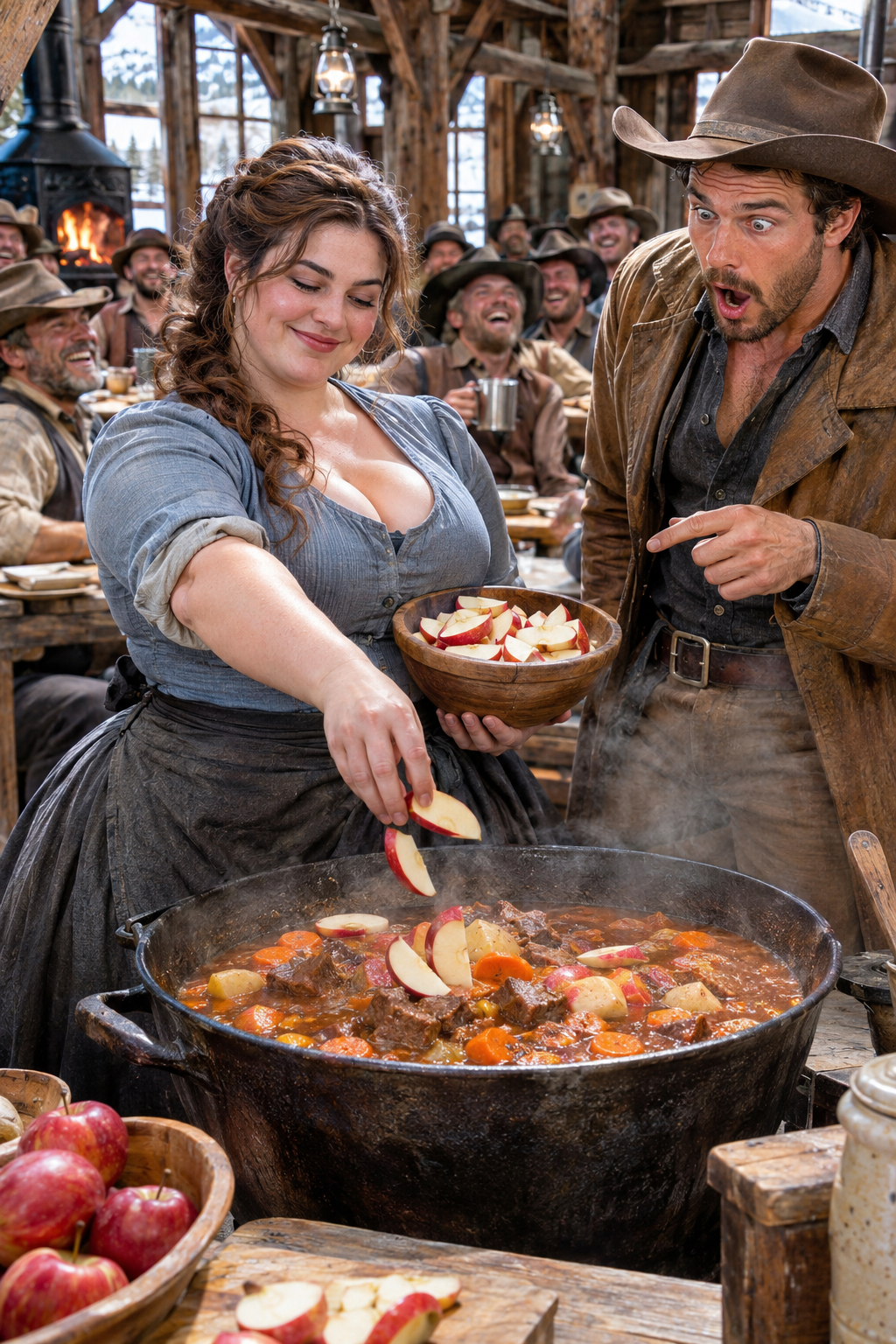
The first thing Molly Hayes heard when she entered the mountain logging camp was a man shouting, “We can’t eat another bowl of that slop!”
The lumberjack opened his hand, revealing a small brass pocket watch attached to a broken chain.
Molly recognized it immediately.
It belonged to Ben, the youngest worker in camp.
Jack took the watch and turned it over. The initials B.W. were engraved on the back.
“Where did you find this, Samuel?”
“Under the hauling platform. But that’s not all. I saw Ben coming out of the equipment shed last night, long after everyone had gone to bed.”
Several men exchanged uneasy glances.
“Where is he now?” Jack asked.
“His bunk is empty.”
Jack looked toward the surrounding forest. A cold wind moved through the towering pines.
“Find him.”
The men scattered, searching the cabins, stables, and surrounding trails. Molly remained beside Jack, watching him examine the watch.
“You don’t really believe Ben would do something like this, do you?”
“I believe someone is trying to destroy this camp.”
“But Ben nearly cried when Thomas broke his leg. He spent two nights helping me look after him.”
Jack slipped the watch into his pocket.
“Then I hope he has a good explanation.”
An hour later, two lumberjacks returned with Ben between them. His trousers were covered in mud, and there was a fresh scratch across his cheek.
“Found him down by the creek,” Samuel announced.
Ben looked frightened.
Jack dismissed the other men and led him into the office. Molly followed.
“Tell me where you were last night,” Jack said.
Ben swallowed. “In my bunk.”
“Samuel saw you near the equipment shed.”
The boy lowered his eyes.
Jack placed the pocket watch on the desk.
Ben’s face turned pale.
“Where did you get that?”
“Beside a chain someone nearly cut through.”
“I didn’t do it!”
“Then tell me the truth.”
Ben’s hands began trembling.
For several seconds, he said nothing. Finally, he reached inside his coat and pulled out a folded envelope.
“I was going to tell you, Mr. Jack. I swear.”
Jack opened it.
Inside were five twenty-dollar bills and a handwritten note.
LEAVE THE EAST GATE UNLOCKED AFTER DARK. THE REST IS NONE OF YOUR CONCERN.
Molly covered her mouth.
“Who gave you this?” Jack demanded.
“A man in town. He said he needed to collect something from the camp without bothering anybody.”
“And you believed him?”
Ben shook his head miserably.
“My mother’s sick. The doctor said she needs medicine we can’t afford. I thought if all I had to do was leave a gate open…”
His voice broke.
“I didn’t know anyone would get hurt.”
Jack stood and walked toward the window.
Outside, the men were preparing another hauling team. Every minute lost brought the camp closer to missing its deadline.
“Describe the man.”
“Tall. Gray coat. A scar near his left ear.”
Jack slowly turned around.
Molly noticed the change in his expression.
“You know him?”
“Victor Hale.”
The name seemed to darken the room.
Hale owned the largest lumber operation in the county. Two months earlier, he had offered to purchase Jack’s camp for less than half its value.
Jack had refused.
A week later, Hale had returned with another offer and a warning.
Small operations don’t survive hard winters, Jackson. Remember that.
Now his words carried an entirely different meaning.
“Why would he do this?” Molly asked.
“Because the railroad awarded us the timber contract he wanted. If we fail, he’ll take our place.”
Ben wiped his eyes with his sleeve.
“Are you going to send me to jail?”
Jack looked at him for a long moment.
“You made a terrible mistake.”
Ben nodded.
“But you’re going to help us put it right.”
The boy looked up in disbelief.
Jack pointed toward the envelope.
“Keep that money. Your mother needs her medicine. From now on, though, you tell me everything.”
Ben promised he would.
After he left, Molly studied Jack quietly.
“Most men would have thrown him out.”
“Most men have never been desperate enough to understand what desperation does to people.”
Molly smiled faintly.
“That doesn’t make what he did right.”
“No. But punishing him won’t repair those chains.”
That afternoon, Jack rode into town to speak with the sheriff.
He returned shortly before sunset, looking angrier than when he had left.
“The sheriff says there’s no proof Hale ordered anything,” he told Molly. “A boy accepting money and a description of a man aren’t enough.”
“So what do we do?”
“We finish the contract.”
Jack gathered the workers outside the dining hall and explained what had happened without revealing Ben’s involvement.
“We have six days,” he announced. “We need another hundred and eighty logs delivered to the railroad yard. Every piece of equipment gets checked twice. Nobody works alone.”
Samuel stepped forward.
“And if Hale comes after us again?”
Jack looked around at the men.
“Then we’ll be ready.”
For the next three days, the camp worked harder than it ever had.
Axes rang through the forest before sunrise. Horses dragged enormous trunks down frozen trails. Lanterns burned late into the evening as men repaired equipment and sharpened tools.
Molly prepared meals, treated injured hands, and carried hot coffee to workers who could barely keep their eyes open.
Even Thomas, unable to stand on his injured leg, sat outside the workshop repairing leather straps.
By the fourth evening, they were only forty logs short.
For the first time in weeks, Jack allowed himself to believe they might succeed.
Then the weather changed.
Heavy clouds gathered above the mountains, and rain began falling shortly after midnight.
By morning, the narrow creek had become a rushing river.
Jack was studying the hauling schedule when Samuel burst through the office door.
“The bridge!”
Jack grabbed his coat.
“What happened?”
“It’s gone!”
The wooden bridge connecting the camp to the railroad road had collapsed into the swollen river.
Jack and Molly hurried down the muddy trail.
When they reached the crossing, Jack stopped abruptly.
Broken beams floated downstream. One of the supporting posts leaned against the riverbank.
Samuel pointed toward it.
“Look at that.”
Jack crouched beside the timber.
Deep cuts marked the wood.
Someone had weakened the supports before the rain arrived.
Molly stared at the raging water.
“Is there another way across?”
“Not for loaded wagons. The northern road would take three days.”
They had less than two.
Behind them, the lumberjacks gathered silently.
One man removed his hat.
Another kicked a stone into the river.
“We’re finished,” someone muttered.
Jack said nothing.
He looked at the destroyed bridge, then at the exhausted men who had trusted him to keep the camp alive.
For the first time, Molly saw something in his face that frightened her more than the sabotage.
Defeat.
They returned to camp without speaking.
That evening, Victor Hale arrived in a polished carriage.
He stepped down wearing a clean gray coat and expensive leather gloves.
The scar near his left ear was unmistakable.
“Terrible weather,” he remarked. “I heard about your bridge.”
Jack stood on the office porch.
“News travels fast.”
“Bad news usually does.”
Hale removed an envelope from his coat.
“I’m prepared to renew my offer. Of course, given your present circumstances, the price will be considerably lower.”
Jack didn’t reach for it.
“Get off my property.”
Hale smiled.
“Think about your men. Winter is coming. Without that contract, you won’t be able to pay them.”
Molly stepped onto the porch.
“You seem awfully certain we won’t deliver.”
Hale glanced at her.
“I’m a businessman, madam. I recognize a lost cause when I see one.”
He placed the envelope on the railing.
“You have until tomorrow evening.”
As the carriage disappeared down the road, Jack picked up the offer.
The amount was barely enough to cover the camp’s debts.
He walked inside and closed the door.
Hours passed before Molly saw him again.
She found him sitting alone in the dining hall, staring at a cold cup of coffee.
“I’ve been doing the figures,” he said.
Molly sat across from him.
“And?”
“If we miss the deadline, the bank can take everything.”
She reached for his hand.
“Then we find another way.”
“There isn’t another way, Molly.”
“Have you asked the men?”
Jack frowned.
“What good would that do?”
“You’ve spent all this time trying to save them. Perhaps you should give them a chance to save you.”
Jack looked toward the empty tables.
Molly continued.
“You have thirty-two men who know these woods better than anyone. Surely one of them has an idea you haven’t considered.”
The following morning, Jack called a meeting.
He explained the financial situation honestly. He told the men about Hale’s offer and the deadline.
When he finished, nobody spoke.
Then an elderly lumberjack named Walter rose slowly.
“What about the old logging chute?”
Jack shook his head.
“It hasn’t been used in fifteen years.”
“Still there, though.”
Samuel leaned forward.
“The chute runs down to the river below the bridge.”
Walter nodded.
“And the river bends toward the railroad yard.”
Jack walked to the map hanging on the wall.
The old chute had once been used to send timber down the mountainside. From there, logs could float downstream to a collection point near the railroad.
It was dangerous. The chute needed repairs, and the river was running faster than usual.
But it was possible.
Jack turned toward Walter.
“How long to make it usable?”
“With every man working? Maybe eight hours.”
“We’d need a crew downstream to catch the logs,” Samuel added.
“And horses to haul them from the riverbank,” another man said.
Suddenly, everyone was talking.
Molly watched Jack’s expression change.
He took a pencil and began marking the map.
Within twenty minutes, the camp had a plan.
Nobody mentioned surrender again.
While the men gathered tools, Ben approached Molly near the kitchen.
“Miss Molly, there’s something I haven’t told Mr. Jack.”
She set down the bread she was cutting.
“What is it?”
“The night before the fire, I saw two men carrying barrels toward the old hunting cabin.”
“Did you recognize them?”
“One works for Mr. Hale. I saw him driving his carriage yesterday.”
Molly’s heart quickened.
“Show me.”
They followed a narrow trail into the forest.
The hunting cabin stood beneath several enormous pine trees, hidden from the main road.
Its door was secured with a rusty padlock.
Ben pointed toward the window.
“I saw them put things inside.”
Molly climbed onto an old stump and peered through the dirty glass.
Inside were cans of oil, several tools, and a wooden crate bearing the name of Hale’s lumber company.
There was also a familiar object lying on a table.
Thomas’s missing axe.
Molly climbed down.
“We need the sheriff.”
A branch snapped behind them.
“I’m afraid that won’t be possible.”
They turned.
Victor Hale stood on the trail with two men.
His pleasant expression was gone.
“You’ve become quite a nuisance, Mrs. Molly.”
One of his men grabbed Ben before he could run.
Hale approached the cabin and unlocked the door.
“Inside.”
Molly stepped in front of Ben.
“Let the boy go.”
“He’s already caused me enough trouble.”
“You won’t get away with this.”
Hale laughed quietly.
“By tomorrow, Jackson’s camp will belong to me. Nobody will care about a few missing tools.”
He ordered his men to push them into the cabin.
The door slammed shut.
A moment later, Molly heard the padlock click.
Through the window, she watched Hale disappear toward the road.
Ben sank onto the floor.
“This is all my fault.”
Molly knelt beside him.
“Feeling sorry won’t get us out of here. Help me find something we can use.”
They searched the cabin.
The windows were too small for Molly, but Ben might fit through one if they could remove the wooden frame.
She found a heavy iron tool beneath the table and began working at the boards.
Meanwhile, Jack and his men had nearly finished repairing the logging chute.
The first test log traveled down the slope and splashed into the river.
A distant cheer rose from the workers downstream.
Jack smiled.
“Get the next one ready!”
Samuel hurried toward him.
“Have you seen Molly?”
Jack looked around.
“She’s probably in the kitchen.”
“She isn’t. Ben’s missing, too.”
Jack’s smile vanished.
He returned to camp immediately.
Near the kitchen, he found muddy footprints leading toward the hunting trail.
He was about to follow them when a figure stumbled from the trees.
It was Ben.
Blood ran from a cut on his forehead.
“Mr. Jack!”
Jack caught him.
“Where’s Molly?”
“The cabin! Mr. Hale locked us inside. She helped me climb out the window.”
Jack grabbed his rifle from the office.
Samuel and three other men followed him.
When they reached the cabin, smoke was curling beneath the roof.
Hale’s men had returned.
One stood beside the door holding a burning torch.
Jack raised his rifle.
“Move away from that building!”
The man dropped the torch.
Samuel and the others rushed forward, overpowering him and his companion.
Jack smashed the padlock with the butt of his rifle.
“Molly!”
Smoke filled the cabin.
He found her crouched near the window, coughing violently.
He lifted her into his arms and carried her outside.
For several terrifying seconds, she struggled to breathe.
Then she opened her eyes.
“You took your time.”
Jack laughed despite the fear still gripping his chest.
“Don’t ever do that to me again.”
Molly pointed toward the cabin.
“The evidence, Jack. It’s inside.”
Samuel and another worker extinguished the small fire before it spread.
They recovered the crate, tools, oil cans, and a leather notebook containing payments made to Hale’s men.
One entry listed the bridge.
Another mentioned the storage shed.
Jack stared at the pages.
At last, they had proof.
But Victor Hale was nowhere to be found.
As Samuel prepared to take the prisoners into town, a distant shout came from the direction of the logging chute.
A worker appeared between the trees.
“Boss! Someone’s opened the holding gate!”
Jack’s blood ran cold.
Dozens of enormous logs were waiting behind that gate at the top of the chute.
If released together, they could destroy the entire structure.
Worse, several men were working below.
Jack ran.
When he reached the slope, the gate was already lifting.
Victor Hale stood beside the mechanism.
“HALE!”
The businessman turned.
“You should have accepted my offer!”
He pulled the release lever.
The gate swung open.
The mountain seemed to tremble.
Logs crashed against one another as they thundered down the wooden chute.
Workers scattered.
Jack spotted Walter near the bottom, struggling to move away from the rushing timber.
His boot was trapped between two beams.
“WALTER!”
Jack raced downhill.
Samuel shouted for the men to clear the area.
At the last possible moment, Jack reached Walter and pulled his boot free.
They threw themselves behind a large boulder as the first logs tore through the lower section of the chute.
Wood splintered.
The noise was deafening.
Then came a scream from above.
Hale had lost his footing on the wet platform.
He slid down the slope and caught a broken support beam just before reaching the moving logs.
“HELP ME!”
Jack looked up.
Hale hung above the chute, his legs swinging dangerously close to the timber.
Samuel grabbed Jack’s arm.
“Leave him! He tried to kill us!”
Jack watched the beam begin to crack.
Then he seized a rope.
“Hold the other end.”
Samuel stared at him.
“Jack, are you crazy?”
“Just hold it!”
Jack climbed toward Hale.
The businessman looked at him with wide, terrified eyes.
“Please!”
Jack threw the rope around Hale’s chest and pulled.
The beam broke.
For one horrifying moment, Hale dropped toward the rushing logs.
The rope tightened.
Samuel and the others dragged both men to safety.
Hale collapsed onto the muddy ground, shaking uncontrollably.
Jack stood over him.
“Why?” Hale whispered.
Jack wiped the rain from his face.
“Because I’m not you.”
Nobody spoke.
Below them, the last logs disappeared into the river.
The chute was damaged, but still standing.
Samuel examined the broken supports.
“We can repair it.”
Jack looked toward the darkening sky.
“How long?”
“Two hours.”
“Then we’d better get started.”
By sunset, the sheriff had arrived and arrested Hale and his accomplices.
The recovered notebook, along with Ben’s testimony, provided enough evidence to hold them.
As Hale was led away, he avoided looking at Jack.
The lumberjacks returned to work.
Lanterns illuminated the mountainside. Hammers struck nails. Men shouted instructions through the darkness.
Molly stood beside the chute, handing out coffee and bandages.
Just before midnight, the final log entered the river.
Downstream, the collection crew worked through the remaining hours of darkness.
When dawn broke, Jack and Molly arrived at the railroad yard.
The railroad inspector stood beside a clipboard, counting the timber.
Jack waited, barely breathing.
The inspector counted the last stack twice.
Then he looked up.
“One hundred and eighty. Every log accounted for.”
Samuel let out a triumphant yell.
The entire crew erupted into cheers.
Men embraced, tossed their hats into the air, and laughed until tears filled their eyes.
Jack stood motionless.
The inspector extended his hand.
“Congratulations, Mr. Jackson. You’ve fulfilled your contract.”
Jack shook it.
Then he turned toward Molly.
She was smiling.
He pulled her into his arms.
“We did it,” he whispered.
“No,” she answered, looking at the cheering workers. “They did it.”
Jack nodded.
She was right.
Three months later, the camp looked remarkably different.
A stronger bridge crossed the river. The storage shed had been rebuilt. New equipment replaced the damaged chains and harnesses.
The railroad, impressed by the camp’s determination, awarded Jack another contract.
Victor Hale was convicted for his crimes, and his lumber company was eventually sold to settle its debts.
Ben’s mother received the treatment she needed. When Ben tried to repay the money Hale had given him, Jack refused to accept it.
Instead, he offered the boy an apprenticeship in the workshop.
“Learn something useful,” Jack told him. “And remember what happens when easy money comes with difficult secrets.”
Ben never forgot.
One snowy evening, Molly found Jack standing outside the dining hall.
Through the windows, they could see the workers eating supper, laughing, and sharing stories.
Thomas was walking again. Walter was arguing good-naturedly with Samuel. Ben was helping serve the food.
Jack took Molly’s hand.
“You know, I used to think keeping this place alive meant never showing weakness.”
“And now?”
“Now I think the strongest thing a man can do sometimes is admit he needs help.”
Molly rested her head against his shoulder.
Snow fell gently across the camp, covering the scars left by the terrible weeks they had endured.
Jack had saved his business, but he understood that what he had gained was worth far more than any railroad contract.
He had earned the loyalty of men who knew he valued their lives above his profits. He had given a frightened boy the opportunity to become a better man. And when hatred had offered him the perfect excuse for revenge, he had chosen mercy instead.
Victor Hale had believed that wealth gave him power over others.
Jack had discovered something Hale never understood.
True strength wasn’t measured by how many people a man could control, how much land he owned, or how ruthlessly he defeated his enemies.
It was measured by the people who stood beside him when he had nothing left to offer except his trust.
Molly opened the dining hall door.
Warm light spilled across the snow.
“Come inside,” she said. “Everyone’s waiting.”
Jack smiled and followed her.
Behind them stood a forest that had weathered countless storms, its deepest roots holding firm beneath the frozen earth.
And inside that little lumber camp, thirty-two men and the woman who had helped save them gathered around a table, richer in everything that truly mattered than they had ever been before.
But the following spring brought an unexpected visitor to the camp.
Jack was repairing a fence near the stables when a carriage appeared on the newly rebuilt bridge.
A woman stepped down, holding the hand of a little girl.
Her dress was plain, and her shoes were worn. She looked around nervously before approaching him.
“Are you Mr. Jackson?”
Jack nodded.
“My name is Eleanor Hale.”
He lowered his hammer.
The woman noticed his expression.
“Victor Hale is my husband.”
Molly, who had been carrying a basket toward the kitchen, stopped when she heard the name.
Eleanor took a deep breath.
“I know what he did to you. I’m not here to defend him.”
She glanced at the little girl beside her.
“After the company was sold, we lost our house. I’ve been looking for work, but nobody in town will employ me.”
Jack remained silent.
“Someone told me you needed a seamstress to repair the workers’ clothing.”
Her voice grew quieter.
“I understand if you want me to leave.”
The little girl clutched her mother’s skirt.
Molly looked at Jack.
He set his hammer down.
“Can you sew heavy canvas?”
Eleanor blinked.
“Yes, sir.”
“Leather?”
“My father was a saddler. He taught me when I was young.”
Jack pointed toward the workshop.
“Speak to Thomas. He’ll show you what needs repairing.”
Eleanor stared at him.
“You’re giving me a job?”
“I’m giving you a chance to earn a living.”
Tears gathered in her eyes.
“After everything my husband did?”
Jack glanced at her daughter.
“Children shouldn’t have to pay for their parents’ mistakes.”
Molly approached and offered to show them around.
As the two women walked toward the cabins, Jack picked up his hammer again.
Samuel had witnessed the conversation from the stable doorway.
“You’ve got a strange way of treating your enemies, boss.”
Jack smiled.
“She isn’t my enemy.”
Within weeks, Eleanor became one of the most dependable workers in camp. Her daughter, Lucy, followed Molly everywhere, asking questions about cooking, flowers, and the horses.
For the first time since her husband’s arrest, Eleanor began sleeping peacefully.
Then, one afternoon, a letter arrived from the prison.
Victor Hale was seriously ill.
He had requested permission to see his wife and daughter, but Eleanor refused to go.
“He destroyed everything,” she told Molly. “Every time I look at Lucy, I remember what he nearly took from her.”
Molly listened without interrupting.
Finally, she said, “Forgiving someone doesn’t mean pretending they never hurt you. It means deciding their mistakes won’t control the rest of your life.”
Eleanor folded the letter and slipped it into her pocket.
Two days later, she traveled to the prison.
When she returned, something about her had changed.
“He apologized,” she told Molly. “For the first time in twelve years, he apologized without making excuses.”
She wiped her eyes.
“I don’t know whether he’ll ever become a better man.”
“That’s his responsibility,” Molly answered. “Not yours.”
Summer arrived, bringing warm mornings and longer working days.
The camp prospered.
Jack purchased additional horses and hired six more lumberjacks. He also established a small emergency fund for workers whose families faced illness or unexpected hardship.
Nobody would have to make the desperate choice Ben had made again.
One afternoon, Ben entered Jack’s office carrying a wooden box.
“What’s this?” Jack asked.
“Open it.”
Inside was the brass pocket watch Jack had recovered beside the damaged hauling equipment.
Its broken chain had been replaced.
Ben had polished the case until it shone.
“My father gave me that watch before he died,” Ben explained. “I thought I’d lost it forever.”
Jack smiled.
“Then why are you giving it to me?”
“Because you gave me something more important.”
Ben straightened his shoulders.
“You trusted me when I didn’t deserve it.”
Jack closed the box and handed it back.
“Keep it, son. One day, you’ll have someone of your own to pass it down to.”
Ben looked at him, struggling to speak.
Then he nodded.
Years passed.
The little lumber camp grew into one of the most respected operations in the region.
But Jack never forgot the winter when he had nearly lost everything.
He refused contracts that required his men to work under dangerous conditions. He paid fair wages, listened to complaints, and made certain every worker returned home safely whenever possible.
Molly established a small school for the workers’ children.
What began with four pupils around a kitchen table eventually became a proper schoolhouse with wooden desks, bookshelves, and a bell above the entrance.
Lucy Hale was among its first students.
Ben eventually became the camp’s youngest foreman.
On the morning Jack handed him the keys to the equipment shed, Ben stood staring at them.
“Are you sure?”
Jack laughed.
“I wouldn’t be giving them to you otherwise.”
Ben closed his fingers around the keys.
“I won’t let you down.”
“You might,” Jack answered.
Ben looked surprised.
“Everybody makes mistakes. What matters is whether you’re brave enough to admit them and wise enough to learn from them.”
Many years later, when Jack’s hair had turned gray and his hands could no longer swing an axe as they once had, he sat beside Molly on the porch overlooking the valley.
Below them, children played near the schoolhouse.
Smoke rose from the chimneys of the workers’ homes. Wagons crossed the bridge, carrying timber toward the railroad.
The forest stretched beyond the camp, green and magnificent beneath the afternoon sun.
“Do you ever wonder what would have happened if you’d accepted Hale’s offer?” Molly asked.
Jack chuckled.
“Sometimes.”
“And?”
“I probably would have spent the rest of my life wondering whether we could have saved this place.”
Molly slipped her hand into his.
“I’m glad you didn’t.”
Jack looked at the schoolhouse, the workshop, and the families walking along the road.
“So am I.”
A little boy suddenly came running toward the porch.
“Grandpa Jack! Grandpa Jack!”
It was Ben’s youngest son.
He climbed the steps and held up a broken wooden toy.
“Can you fix it?”
Jack examined the little wagon.
“One of the wheels is loose.”
“Can you make it like new?”
Jack smiled.
“Perhaps not like new. But we can make it strong again.”
The boy climbed onto his lap and watched as Jack carefully repaired the wheel.
Molly observed them with a quiet smile.
She remembered the damaged harness, the burning shed, the destroyed bridge, and the terrible night when everything had seemed hopeless.
Back then, she had wondered whether their lives would ever return to normal.
They hadn’t.
Their lives had become something better.
The hardships they had endured had taught them lessons that comfortable days never could.
They had learned that kindness was not weakness, that trust could rebuild what betrayal destroyed, and that courage sometimes meant offering a hand to the very person who had tried to bring you down.
As the sun disappeared behind the mountains, Jack finished repairing the toy.
“There you go.”
The boy inspected it excitedly.
“It’s even better than before!”
He jumped down and ran toward his father.
Jack watched him disappear along the path.
“Better than before,” he repeated softly.
Molly rested her head against his shoulder.
In the distance, the school bell rang, calling the children home.
Jack closed his eyes and listened.
He had once dreamed of building the largest lumber business in the county.
Instead, he had built something that would outlive every tree he had ever cut and every dollar he had ever earned.
A community.
A family.
A place where people understood that their worth was not determined by their mistakes, their poverty, or the misfortunes that had brought them together.
And long after Jack and Molly were gone, the people of that valley continued telling their story.
Not because Jack had defeated a wealthy enemy.
Not because he had saved a failing business.
But because, when the world had given him every reason to become bitter and cruel, he had chosen to remain a good man.
That was the legacy he left behind.
And it was worth more than all the timber in the forest.
THE END.