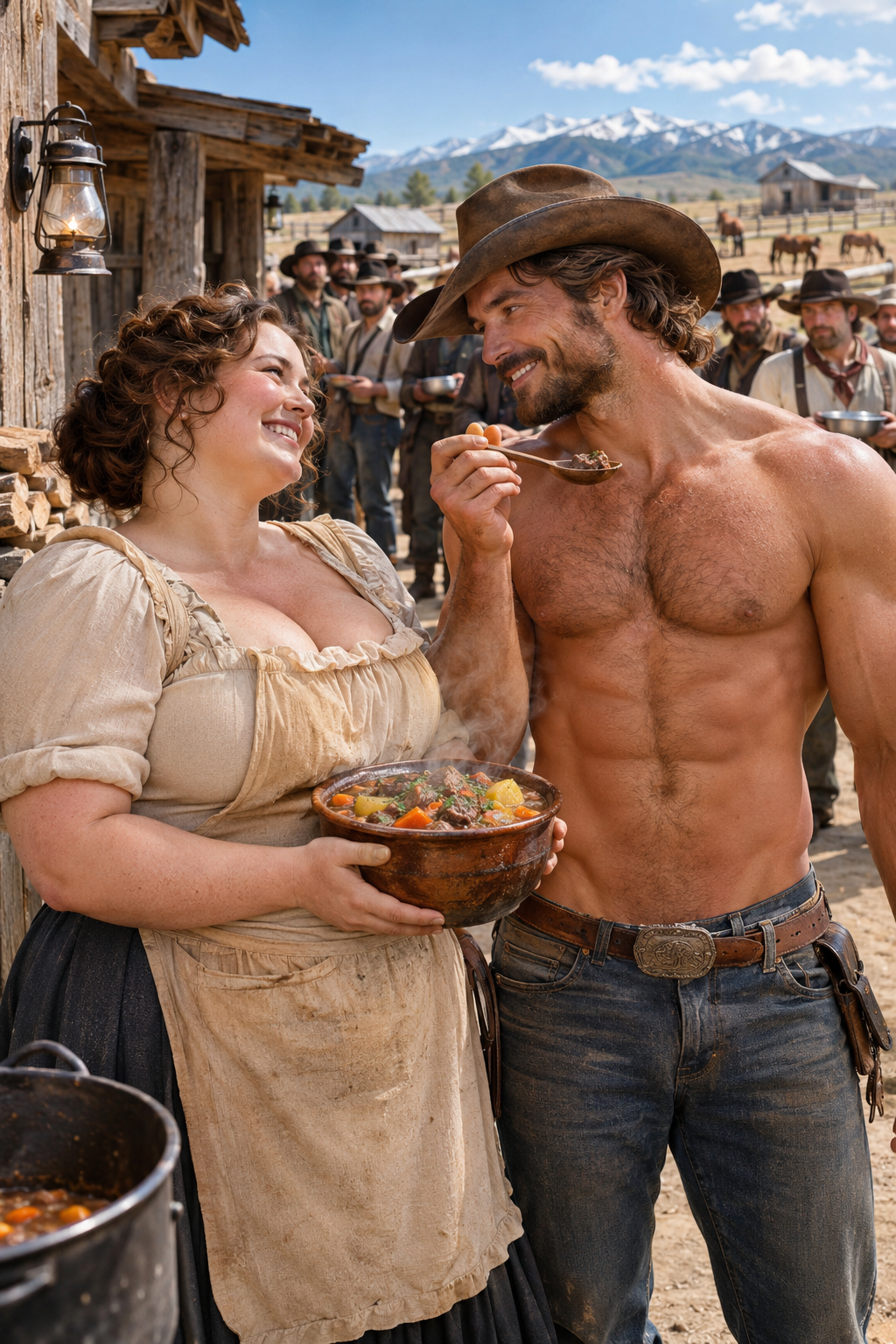
The first thing Emily Foster heard when she arrived at the Wyoming ranch to marry a man she had never met was laughter.
“I’m not the man you think I am,” Wade said quietly.
Emily stared at him, her eyes moving from his troubled face to the envelope in his hand.
“I don’t understand.”
Wade looked toward the window, where the morning sunlight fell across the distant mountains.
“When I placed that advertisement for a wife, I wasn’t entirely honest about why I needed one.”
Emily felt her heart sinking.
“Is there another woman?”
“No.” He answered so quickly that she almost believed him. “There hasn’t been another woman in years.”
“Then what is it?”
Wade handed her the envelope.
Inside was a letter from a bank in Cheyenne. Emily read the first few lines, and the color slowly drained from her face.
The Dalton Ranch was facing foreclosure.
Unless Wade paid eight thousand dollars before the first snowfall, the bank would seize everything.
“The ranch is failing?” she whispered.
“It has been for nearly two years.”
“Then why did you ask me to come?”
Wade’s jaw tightened.
“Because I thought having a wife might convince the bank I was building a stable household. The former manager told me they would look more favorably on a married rancher.”
Emily lowered the letter.
“So I was supposed to make you appear respectable.”
“That’s how it began.”
The words struck harder than she expected.
For the first time since arriving, Emily wished the cowboys had been right about her.
She wished she had turned around before ever stepping onto that porch.
“Was any of it real?” she asked.
Wade looked at her with unmistakable pain.
“I don’t know how to answer that.”
“Then perhaps you should think about it before asking another woman to marry you.”
She placed the letter on the bed and walked past him.
Wade didn’t try to stop her.
For the next two days, Emily spoke to him only when necessary.
She continued cooking, cleaning, and tending to the men, but something inside her had grown painfully quiet.
Hank noticed first.
“Boss do something wrong?” he asked while helping her carry firewood.
“That’s between Mr. Dalton and me.”
Hank scratched his beard.
“Well, whatever he did, he’s been walking around looking like somebody buried his favorite horse.”
Emily almost smiled.
“Perhaps he ought to learn to speak before it’s too late.”
Hank studied her for a moment.
“Ma’am, Wade Dalton can wrestle an angry bull, ride through a blizzard, and stare down an armed outlaw. But put a woman he cares about in front of him, and the man’s about as useful as a fence post.”
Emily looked away before Hank could see her expression.
That afternoon, she found Samuel sitting outside the stable, struggling to repair a broken harness.
“Tell me something,” she said, sitting beside him. “Has this ranch always been in trouble?”
Samuel stopped working.
“No, ma’am. Used to be the finest cattle operation in three counties.”
“What happened?”
“Bad luck. Bad weather. And a man who knew exactly where to put the knife.”
Emily turned toward him.
“What man?”
Samuel hesitated.
“Silas Mercer.”
The name meant nothing to her.
Samuel lowered his voice.
“Mercer owns half the businesses in town. Tried buying this ranch from Wade’s father years ago. Old Mr. Dalton wouldn’t sell.”
“And?”
“After Wade inherited the place, strange things started happening. Cattle disappeared. Supply wagons went missing. Contracts fell through. Then the bank started tightening its grip.”
Emily frowned.
“You believe Mercer was responsible?”
“I believe some men don’t take no for an answer.”
That evening, Emily sat alone at the kitchen table, studying the bank letter again.
Eight thousand dollars.
An impossible sum, perhaps.
But the numbers bothered her.
Her father had been a bookkeeper in Missouri. Before his death, he had taught her how to balance accounts, recognize false entries, and understand the difference between an unfortunate loss and deliberate theft.
The next morning, she found Wade in his office.
“I want to see your ledgers.”
He looked up in surprise.
“My what?”
“Your financial records. Purchases, sales, debts, everything.”
“Emily—”
“If I’m going to live here, I would prefer to know whether the roof is about to be taken from over my head.”
He studied her carefully.
“You’re still thinking of staying?”
“I haven’t decided.”
Wade stood and unlocked a wooden cabinet.
He placed three thick books before her.
“Everything is there.”
Emily opened the first ledger.
Within twenty minutes, she found something that made her stomach tighten.
Three separate payments had been recorded for winter feed that had never arrived.
Two cattle shipments had supposedly been rejected by buyers, yet the shipping fees had still been paid in full.
And one name appeared repeatedly beside suspicious transactions.
Thomas Reed.
“Who is Thomas Reed?” she asked.
Wade’s expression changed.
“My former foreman.”
“Where is he now?”
“Left six months ago. Said he found work in Montana.”
Emily slowly turned the ledger around.
“Then why were payments authorized under his name last month?”
Wade stared at the page.
For several seconds, neither spoke.
Then he reached for his coat.
“I’m going to town.”
“Not without me.”
“Emily, this could be dangerous.”
She stood.
“Then you had better make sure I have a good horse.”
For the first time in days, Wade smiled.
It was brief, reluctant, and completely unexpected.
And Emily hated how much it warmed her heart.
They rode into town beneath a sky heavy with gathering clouds.
At the bank, a narrow-faced clerk named Mr. Bell examined the ledgers with obvious discomfort.
“These entries appear legitimate,” he said.
“Then show us the corresponding receipts,” Emily replied.
Bell adjusted his spectacles.
“I’m afraid those records are confidential.”
“Confidential from the man whose money was taken?”
The clerk flushed.
Wade leaned forward.
“Get your manager.”
A door opened behind the counter.
A silver-haired gentleman stepped into the room.
“Is there a problem?”
Before Wade could answer, another voice spoke from the doorway.
“Well, well. Wade Dalton. I wondered how long it would take before you came begging.”
Silas Mercer entered wearing a fine black coat and polished boots.
His smile never reached his eyes.
Emily immediately understood why Samuel distrusted him.
“Mercer,” Wade said coldly.
Silas looked Emily up and down.
“And this must be your new bride.”
“Miss Foster,” Emily corrected.
“How charming. I hear you’ve been making quite an impression on the ranch hands.”
Emily held his gaze.
“I hope your information about cattle is more accurate than your information about me.”
The bank manager coughed to disguise a laugh.
Mercer’s smile vanished.
He turned toward Wade.
“I understand you’re having financial difficulties. My offer still stands.”
“The ranch isn’t for sale.”
“Everything is for sale, Dalton. The only question is whether you sell willingly or lose it when the bank takes possession.”
He stepped closer.
“Eight thousand dollars is a great deal of money for a man with nothing left.”
Emily felt Wade go rigid beside her.
But instead of arguing, she asked a question.
“Mr. Mercer, how do you know the exact amount of Mr. Dalton’s debt?”
Silence settled over the room.
Mercer blinked.
“Small town, Miss Foster. People talk.”
“About confidential banking matters?”
The manager’s expression hardened.
Mercer gave a thin smile.
“Careful, young lady. Wyoming can be an unforgiving place for strangers.”
Emily stepped toward him.
“So I’ve been told.”
Wade took her arm gently.
“We’re leaving.”
Outside, he helped her onto her horse.
“You shouldn’t have challenged him.”
“Someone needed to.”
“He’s dangerous.”
“So is a man who steals from people because he believes nobody will question him.”
Wade looked at her for a long moment.
Then he said something she hadn’t expected.
“My mother would have liked you.”
Emily’s anger softened.
“What was she like?”
“Stubborn. Brave. Always believed there was something worth saving, even when everyone else had given up.”
“She sounds remarkable.”
“She was.”
He glanced toward the mountains.
“She died when I was nineteen. My father followed six years later. Sometimes I think I’ve spent my whole life trying not to disappoint them.”
Emily felt a painful tenderness rise in her chest.
“Wade, losing a ranch wouldn’t mean you’ve disappointed anyone.”
He looked at her.
“Maybe not. But losing the people who depend on me would.”
On the ride home, the first snowflakes began to fall.
Three days later, a blizzard swept across the valley.
The wind screamed through the buildings, burying fences beneath drifts of snow.
By midnight, temperatures had fallen so sharply that water froze inside the barn.
Emily was carrying blankets to the bunkhouse when Hank burst through the door.
“Boss! We’ve got trouble!”
Wade appeared from the stable.
“What happened?”
“The north pasture fence is down. Cattle are scattering toward Blackwater Ravine!”
Wade swore under his breath.
Blackwater Ravine was a steep canyon. Any cattle driven into it during a storm could be lost.
He gathered six riders.
Emily watched them saddle their horses through the swirling snow.
“You can’t go out in this,” she said.
“If we don’t, we’ll lose half the herd.”
“Then take more men.”
“The others need to secure the barns.”
Wade tightened his saddle.
“Stay inside, Emily.”
She caught his arm.
“Promise you’ll come back.”
Something shifted in his expression.
For a moment, the wind seemed to disappear.
“I’ll do everything I can.”
Then he rode into the darkness.
Hours passed.
Emily kept the kitchen fire burning and prepared hot coffee, blankets, and bandages.
One by one, the riders returned.
Samuel came first, his beard frozen white.
Then Hank, leading two exhausted horses.
But Wade wasn’t with them.
“Where is he?” Emily demanded.
Hank avoided her eyes.
“He stayed behind. A calf got separated near the ravine.”
Emily stared at him.
“He went after one calf?”
“He thought he could bring it back.”
“How long ago?”
“Nearly two hours.”
The room seemed to tilt.
Emily grabbed her coat.
Hank blocked the doorway.
“Miss Emily, you can’t go out there.”
“Move.”
“You’ll freeze before you reach the north pasture.”
She looked him directly in the eyes.
“Then you’d better come with me.”
Hank hesitated.
Something in her expression convinced him arguing was pointless.
Within minutes, they were riding into the blizzard.
The storm swallowed the moon, leaving only a narrow circle of visibility around their lantern.
Emily could barely feel her fingers.
Twice, her horse stumbled in the deep snow.
Then she heard something.
A faint whinny.
“Hank!”
They stopped.
Another sound came through the wind.
A horse crying in distress.
They followed it toward the ravine.
Wade’s horse stood beside a fallen pine tree, trembling.
And beneath the branches lay Wade.
His right leg was trapped, his face pale from the cold.
“Wade!”
Emily dropped from her saddle and stumbled through the snow.
His eyes opened weakly.
“Emily?”
“I’m here.”
He tried to smile.
“Told you to stay inside.”
“And I told you to come back.”
Hank began cutting through the branches with his axe.
Emily removed her scarf and wrapped it around Wade’s face.
“Stay awake,” she ordered.
“Bossy woman,” he murmured.
“You haven’t seen anything yet.”
He caught her hand.
“Emily… if something happens—”
“Nothing is happening.”
“I need you to know… I didn’t ask you here just because of the bank.”
Tears burned her eyes.
“Then tell me when we’re home.”
His fingers tightened around hers.
“I started wanting you to stay the first morning you made breakfast. Not because you fed the men. Because you looked at all of us like we mattered.”
Emily pressed his hand against her cheek.
“You matter too, Wade Dalton.”
Hank finally freed his leg.
Together, they struggled to lift him onto a horse.
The journey back seemed endless.
By the time they reached the ranch, Wade had lost consciousness.
Emily worked through the night.
His leg was badly bruised, and his skin dangerously cold.
She warmed him slowly, dried his clothing, and kept him wrapped in blankets while Samuel helped tend the fire.
At dawn, Wade finally opened his eyes.
Emily was sitting beside his bed.
“You look terrible,” he whispered.
She laughed through exhausted tears.
“So do you.”
He looked down at their joined hands.
“Did you mean what you said?”
“That you matter?”
He nodded.
Emily lowered her eyes.
“Yes.”
Wade carefully reached toward her face.
“Then perhaps, when I’m strong enough to stand, I can ask you something properly.”
She smiled.
“Perhaps.”
But their moment was interrupted by a thunderous pounding at the front door.
Hank entered moments later, carrying a small leather satchel.
“Miss Emily, you’d better see this.”
Inside were several folded papers, a silver pocket watch, and a handwritten note.
Hank explained that he’d found the satchel caught beneath the fallen tree near the ravine.
Wade recognized the watch immediately.
“Thomas Reed,” he said.
Emily unfolded the note.
It contained instructions to drive a group of cattle through the north pasture on the night of the storm.
At the bottom was a signature.
Silas Mercer.
Wade pushed himself upright despite the pain.
“That fence didn’t fall by accident.”
Emily’s pulse quickened.
“No. Someone wanted the cattle driven into the ravine.”
But the most important discovery lay beneath the note.
A receipt.
It showed that Mercer had paid Thomas Reed two thousand dollars for what was described as the transfer of livestock.
The document listed Dalton cattle by their individual brands.
Emily stared at the paper.
“This proves he bought stolen cattle.”
Wade shook his head.
“Not necessarily. Mercer could claim Reed had authority to sell them.”
“Then we need Reed.”
Samuel appeared in the doorway.
“I might know where to find him.”
Everyone turned.
The old ranch hand removed his hat.
“There’s an abandoned mining camp east of Pine Creek. Saw smoke rising from the old cabins last week.”
Wade tried to stand.
Emily pushed him gently back against the pillows.
“You aren’t going anywhere.”
“Emily—”
“Your leg can barely support you.”
“Mercer won’t wait.”
“Then let someone else handle it.”
She turned toward Hank.
“Can you bring Reed back?”
Hank straightened.
“With pleasure.”
At sunrise, Hank and four riders departed for Pine Creek.
They returned the following evening.
But Thomas Reed wasn’t with them.
Instead, Hank carried a bloodstained hat.
“The cabin was empty,” he said grimly. “Signs of a struggle. Someone got there first.”
Emily felt a chill that had nothing to do with winter.
Then Samuel noticed something tucked inside the hatband.
A small folded paper.
On it, written in shaky handwriting, were five words.
“Mercer keeps records beneath mill.”
Wade stared at the note.
“The old grain mill?”
Hank nodded.
“Been abandoned for years.”
Emily unfolded the bank letter again.
Suddenly, she understood something.
“Mercer isn’t simply stealing cattle,” she said. “He’s creating debt, forcing ranchers into foreclosure, then buying their land.”
Wade looked at her.
“How can you be sure?”
“Because there are seven other ranches mentioned in the county notices. All lost to the same bank. All purchased by Mercer.”
Samuel whispered a curse.
Wade’s expression darkened.
“We need proof.”
Emily looked at the note.
“Then we know where to find it.”
That night, while Wade slept, Emily made a decision.
She dressed in dark riding clothes, packed a lantern, and slipped toward the stable.
But Hank was waiting.
“Didn’t think you were going without me, did you?”
Emily sighed.
“Does anyone on this ranch ever sleep?”
“Not when the lady of the house is planning something foolish.”
She gave him a sharp look.
“I’m not the lady of the house.”
Hank grinned.
“Could’ve fooled everybody.”
They rode toward the abandoned mill beneath a moonless sky.
The building stood beside a frozen creek, its broken windows dark and empty.
Hank remained outside with the horses while Emily slipped through a side entrance.
Inside, the air smelled of dust and old grain.
She found a staircase leading beneath the mill.
At the bottom was a locked wooden door.
Using a metal hairpin, she worked the mechanism until it clicked.
Beyond it lay a small office.
Shelves lined the walls.
And on a desk sat a thick black ledger.
Emily opened it.
Her breath caught.
Every stolen shipment was recorded.
Every false bank charge.
Every ranch forced into foreclosure.
There were names, dates, payments, and signatures.
Including those of Silas Mercer and the bank manager.
Emily quickly gathered the pages.
Then a voice spoke from the doorway.
“I wondered when you’d come looking.”
She froze.
Silas Mercer stood at the foot of the stairs, holding a revolver.
Beside him was Mr. Bell, the bank clerk.
Mercer smiled.
“Miss Foster. You really should have taken the money and gone home.”
Emily slowly lowered the papers.
“Where is Thomas Reed?”
Mercer’s expression didn’t change.
“Somewhere he won’t be talking.”
Bell looked away.
“You murdered him?”
“Now, now. Let’s not use unpleasant words.”
Mercer stepped closer.
“You’ve been a considerable nuisance, young lady.”
Emily swallowed.
Outside, she could hear the wind moving through the trees.
There was no sign of Hank.
“What do you intend to do?” she asked.
Mercer raised the revolver.
“I’m afraid this old mill is about to suffer a tragic fire.”
He gestured toward a stack of oil barrels.
“A careless lantern. A young woman trapped inside. Such a terrible accident.”
Emily forced herself to remain calm.
“You’ve made one mistake.”
Mercer laughed.
“Only one?”
“You assumed nobody would come looking for me.”
His smile faltered.
At that exact moment, a gunshot exploded outside.
Bell screamed.
Mercer spun toward the staircase.
Emily seized the lantern from the desk and hurled it at his arm.
The glass shattered against the wall.
Flames leaped across spilled oil.
Mercer cried out and dropped his revolver.
Emily grabbed the ledger and ran.
Bell lunged toward her, catching her sleeve.
The fabric tore.
She struck him with the heavy book and scrambled up the stairs.
Smoke poured through the doorway.
Outside, Hank was struggling with two armed men.
One lay unconscious in the snow.
The other raised his pistol.
“Hank!”
Emily shouted.
A second shot rang out.
The armed man collapsed.
Emily turned.
Wade Dalton sat astride a black horse, his injured leg strapped tightly against the saddle.
Behind him rode Samuel, four ranch hands, and Sheriff Collins.
For one stunned second, Emily could only stare.
Wade dismounted awkwardly and caught her in his arms.
“You stubborn, impossible woman,” he whispered.
She buried her face against his chest.
“You were supposed to be in bed.”
“And you were supposed to stop nearly getting yourself killed.”
Behind them, the sheriff’s deputies dragged Mercer and Bell from the burning mill.
The flames consumed the building, but Emily still held the ledger.
Every page that mattered was safe.
Sheriff Collins examined the documents beneath the lantern light.
“Well,” he said slowly, “looks like Mr. Mercer has been running a very expensive little scheme.”
Mercer struggled against his restraints.
“You can’t prove anything!”
Emily stepped forward.
“I believe I already have.”
Then a weak voice came from one of the wagons.
“She has.”
Everyone turned.
Thomas Reed lay beneath a blanket, his face battered but alive.
Samuel explained that they’d discovered him tied up in a storage shed behind the mill.
Reed looked at Wade with shame.
“I helped Mercer steal your cattle. Thought he’d pay me enough to leave the territory.”
He coughed painfully.
“When I tried to quit, he ordered his men to kill me.”
Wade’s jaw tightened.
“Why should I believe you?”
“Because I’ll testify. Against Mercer, Bell, and the bank manager. All of them.”
Sheriff Collins nodded.
“Then I suggest we get everybody back to town.”
Mercer was taken away in irons.
But as the sheriff prepared to leave, he turned toward Emily.
“Miss Foster, how did you know where to look?”
Emily glanced at the ledger in her hands.
“My father taught me something important.”
“What’s that?”
“That numbers may be written by dishonest men, but they don’t become honest just because someone puts them in a book.”
The sheriff laughed.
“Your father sounds like a wise gentleman.”
Emily smiled sadly.
“He was.”
The investigation that followed shook the entire county.
The bank manager was arrested.
Several stolen cattle herds were recovered.
And records from Mercer’s office revealed enough fraud to overturn multiple foreclosure proceedings.
But there was one problem.
The legal process would take months.
Wade’s payment deadline was less than two weeks away.
The bank’s temporary administrator refused to extend it until a judge had reviewed the evidence.
“We’ve got proof,” Wade argued.
“And you’ll have your hearing,” the administrator replied. “But until then, the existing debt remains payable.”
Emily watched Wade leave the bank with his shoulders bent beneath a burden she could almost feel.
That evening, he gathered the ranch hands in the bunkhouse.
“I won’t ask any of you to stay if the ranch closes,” he said. “You’ve worked hard, and I owe you wages I can’t promise I’ll be able to pay.”
Nobody spoke.
Then Samuel stood.
“I buried my wife on this land. Raised my boy here before he went east. I’m not leaving because some thief nearly stole the place.”
Hank rose beside him.
“Neither am I.”
One by one, the others stood.
Wade looked at them, unable to speak.
Emily watched from the doorway, her eyes burning.
Later that night, she sat beside him at the kitchen table.
“We still have eleven days,” she said.
“Eleven days to find eight thousand dollars.”
“Not necessarily.”
Wade looked up.
Emily opened her father’s old notebook, which she had carried all the way from Missouri.
“I’ve been studying the herd records. We have cattle ready for market, but we can’t afford to transport them by rail.”
“No.”
“Then we drive them.”
Wade stared.
“Across the mountain pass? In winter?”
“There’s a buyer in Laramie offering premium prices for healthy breeding stock. If we sell directly, we could raise enough to cover the debt.”
“The pass could be buried in snow.”
“Then we need to move before the next storm.”
He shook his head.
“It’s too risky.”
Emily leaned forward.
“Wade, you taught me that people depend on this ranch. But they also depend on you knowing when to fight.”
He studied the figures.
Slowly, his expression changed.
“It might work.”
“Then let’s make sure it does.”
The following morning, the Dalton Ranch came alive.
Every man had a task.
Hank organized the riders.
Samuel checked the horses.
Emily prepared food that would last several days on the trail.
And Wade, despite his injured leg, supervised every detail.
They moved ninety head of cattle through the eastern valley, following an old wagon trail toward Laramie.
The first day passed without trouble.
The second brought freezing rain.
By the third morning, clouds gathered over the mountains.
Wade watched them with growing concern.
“Storm’s coming.”
Hank looked toward the pass.
“We can turn back.”
Emily sat on her horse beside them.
“How far to the other side?”
“Six miles.”
“And how far back?”
“Fourteen.”
Wade looked at the herd.
The choice was terrible.
Then Samuel pointed toward the ridge.
“There’s an old shepherd’s shelter beyond the pass. If we can get the cattle through, we can hold there.”
Wade made his decision.
“Keep them moving.”
They pushed forward.
Snow began falling before noon.
The trail narrowed between steep slopes.
A frightened steer broke from the herd, sending several others scrambling toward the edge.
Hank raced after them.
Emily saw one of the younger riders lose control of his horse.
The animal slipped.
The boy tumbled into the snow, sliding toward the drop.
Without thinking, Emily spurred her horse forward.
She reached him just as he caught a protruding root.
“Grab my hand!”
The boy looked up, terrified.
“I can’t!”
“Yes, you can!”
She leaned dangerously from the saddle.
Their fingers touched.
Then Wade appeared beside her.
He caught the boy’s collar and hauled him onto solid ground.
For a moment, all three lay gasping in the snow.
Wade looked at Emily.
“You have a remarkable talent for terrifying me.”
She managed a breathless smile.
“And you have a remarkable talent for showing up when I need you.”
They reached the shelter after sunset.
The cattle survived.
So did every rider.
Two days later, they arrived in Laramie.
The buyer inspected the herd carefully.
Then he offered a price that made even Wade fall silent.
Nine thousand six hundred dollars.
After paying the riders’ expenses and transportation costs, they would have enough to save the ranch.
Wade stared at the signed contract.
For the first time in years, he looked like a man who could finally breathe.
But when he turned to Emily, his eyes held something deeper than relief.
“You did this.”
She shook her head.
“We did.”
He stepped closer.
“Emily, I need to ask you something.”
She smiled.
“Are you going to tell me to stay out of trouble again?”
“No.”
He reached into his coat and removed a small velvet box.
Inside lay a simple gold ring.
“It belonged to my mother.”
Emily’s breath caught.
Wade took her hand.
“I asked you here for the wrong reasons. I thought a wife might save my ranch. But somewhere along the way, you saved something far more important.”
His voice trembled.
“You reminded me how to hope.”
Tears filled Emily’s eyes.
“Wade…”
“I don’t want a marriage built on obligation, gratitude, or a desperate arrangement. I want a life with you because you’re the woman I love.”
He lowered himself carefully onto one knee.
“Emily Foster, will you marry me?”
For a moment, she couldn’t speak.
She remembered the laughter on the day she’d arrived.
The lonely room.
The mocking looks.
The nights she’d wondered whether she would ever truly belong anywhere.
Then she looked at the man kneeling before her.
A man who had learned to trust her strength.
A man who had finally allowed her to see his fears.
A man who wasn’t asking her to become someone else.
He was asking her to stay exactly as she was.
“Yes,” she whispered.
Wade blinked.
“Yes?”
She laughed through her tears.
“Yes, Wade Dalton. I’ll marry you.”
He rose and kissed her beneath the cold Wyoming sky.
And for the first time in her life, Emily felt that she had stopped running from the past and begun walking toward a future.
They returned to the ranch with money enough to pay the bank and settle the overdue wages.
When Wade placed the final payment on the administrator’s desk, the man counted it twice.
Then he stamped the papers.
“Congratulations, Mr. Dalton. Your ranch is secure.”
Wade took the documents.
But instead of putting them in his own pocket, he handed them to Emily.
She looked at him in surprise.
“These belong to you.”
He smiled.
“They belong to us.”
The wedding took place three weeks later, on a clear winter morning.
The ranch hands decorated the barn with pine branches and white ribbons.
Samuel walked Emily down the aisle.
Hank stood beside Wade, trying unsuccessfully to hide his tears.
When Emily reached the front, Wade took both her hands.
The preacher smiled.
“Are you ready?”
Wade looked at Emily.
“I’ve never been more certain of anything.”
Their vows were simple.
Their promises were not.
Wade promised to love her, honor her, and never again make decisions about her future without asking what she wanted.
Emily promised to stand beside him through hardship, prosperity, storms, and every uncertain season yet to come.
When the preacher pronounced them husband and wife, the barn erupted in cheers.
Hank whistled so loudly that several horses outside began neighing.
And when Wade kissed his bride, the same men who had once laughed at her arrival cheered louder than anyone.
That evening, as music filled the barn, Hank approached Emily with an embarrassed grin.
“Mrs. Dalton, I reckon I owe you an apology.”
“For what?”
He rubbed the back of his neck.
“That first day. I said you wouldn’t last three days.”
Emily raised an eyebrow.
“I remember.”
“Truth is, I thought you were too delicate for ranch life.”
“And now?”
Hank looked around at the warm barn, the laughing men, and Wade watching his wife with unmistakable pride.
“Now I reckon this ranch wouldn’t have lasted without you.”
Emily smiled.
“Then perhaps next time, Hank, you’ll give someone a chance before deciding what they can do.”
He tipped his hat.
“Yes, ma’am.”
Years passed.
The Dalton Ranch grew stronger.
The recovered money from Mercer’s fraudulent transactions eventually allowed Wade to purchase additional grazing land.
Emily established a small schoolhouse for the children of neighboring ranchers, teaching reading, arithmetic, and the bookkeeping skills her father had given her.
She insisted that girls learn everything the boys learned.
When someone questioned her decision, she merely smiled.
“Knowledge doesn’t become less useful because a woman possesses it.”
Wade supported her without hesitation.
Together, they built a home filled with laughter, hard work, and an affection that deepened with every passing season.
Eventually, two children joined their family.
A son with Wade’s dark eyes.
And a daughter with Emily’s determined expression.
One autumn evening, many years after Emily first arrived, their daughter asked a question while sitting beside her mother on the porch.
“Mama, is it true the cowboys laughed at you when you came here?”
Emily glanced toward the pasture.
Wade was teaching their son to ride, while Hank, older and grayer, shouted unnecessary advice from the fence.
“Yes, sweetheart. They did.”
“Weren’t you afraid?”
Emily considered the question.
“Terribly.”
“Then why didn’t you leave?”
She watched the sun settle behind the mountains.
“Because being afraid doesn’t always mean you’re in the wrong place. Sometimes it means you’re standing at the beginning of something important.”
The little girl frowned thoughtfully.
“But what if people say you can’t do something?”
Emily brushed a strand of hair from her daughter’s face.
“Then you listen carefully. Sometimes they may know something you don’t. But never let their doubts become the measure of your worth.”
Her daughter leaned against her shoulder.
“Is that how you saved the ranch?”
Emily smiled.
“No, darling. We saved the ranch because we learned to believe in one another.”
Wade approached the porch and slipped an arm around his wife’s shoulders.
“What are my girls talking about?”
“About the day Mama came here,” their daughter answered.
Wade chuckled.
“Ah. The day sixteen foolish men learned a very important lesson.”
Emily looked up at him.
“Seventeen, if I remember correctly.”
He laughed.
“Seventeen.”
Then he kissed her forehead.
Far beyond the ranch, the Wyoming wind moved through the golden grass, carrying the familiar scents of earth, pine, and approaching winter.
Emily thought about the frightened young woman who had stepped down from a wagon with nothing but a suitcase and a desperate hope for a better life.
That woman had believed she needed someone to give her a place in the world.
But she had discovered something far greater.
Belonging wasn’t something another person could simply hand her.
It was something built through courage, kindness, trust, and the willingness to stand firm when the world expected her to surrender.
And love, she had learned, was never about finding someone who could rescue you from every storm.
It was about finding someone willing to face the storm beside you.
As the evening settled over the Dalton Ranch, Emily rested her head against Wade’s shoulder.
She had arrived as a stranger whom everyone expected to leave.
She had stayed as a woman who knew exactly what she was worth.
And in the home they had built together, the laughter that once wounded her had become the sound of everything she had fought to find.
But the story of Emily Foster Dalton did not end with the saving of a ranch, a happy marriage, or the laughter of children beneath the Wyoming sky.
There was one final chapter waiting to be written, and it began on a bitter November morning, nearly twenty years after Emily first arrived at the Dalton Ranch.
A stranger appeared at their gate.
He was an elderly man wearing a worn brown coat, with a gray beard and trembling hands. His horse looked exhausted, and a deep scar ran along the side of his face.
Hank, now too old to ride cattle but still stubborn enough to argue with anyone, approached him cautiously.
“Can I help you?”
The stranger removed his hat.
“I’m looking for Mrs. Emily Dalton.”
Hank narrowed his eyes.
“Who’s asking?”
The man’s gaze wandered toward the large white house standing beyond the cottonwood trees.
“Tell her someone from Missouri has come to see her.”
When Emily stepped onto the porch a few minutes later, she stopped so suddenly that Wade, standing beside her, immediately reached for her arm.
The stranger looked up.
“Hello, Emily.”
Her lips parted.
For a moment, she could not breathe.
“Uncle Arthur?”
The old man lowered his head.
“I didn’t think you’d remember me.”
Emily descended the porch steps slowly.
Arthur Foster had been her father’s younger brother.
The last time she’d seen him, she was twenty-two years old, standing outside the small Missouri house where her father had died.
Arthur had promised to help her settle the debts.
Instead, he had vanished.
His disappearance had left her with nothing.
It was one of the reasons she’d answered Wade Dalton’s advertisement for a wife.
“You’re alive,” Emily whispered.
Arthur’s eyes filled with tears.
“Barely.”
Wade stepped forward.
“Emily, who is this man?”
She looked at her husband.
“Someone I thought I’d never see again.”
Arthur reached into his coat and withdrew a weathered leather envelope.
“I didn’t come to ask for money,” he said. “I came because there’s something you should have known twenty years ago.”
Emily stared at the envelope.
“What is it?”
Arthur’s voice broke.
“The truth about your father.”
They gathered inside the kitchen, where the fire crackled and the smell of fresh bread filled the room.
Their daughter, Clara, now nineteen, sat beside Emily. Their son, Benjamin, stood near the doorway with Wade.
Arthur held the envelope between both hands.
“Your father didn’t die owing money, Emily.”
Emily frowned.
“What are you talking about?”
“He left you an inheritance. A considerable one.”
The room fell silent.
Arthur continued.
“After his death, I discovered a savings account and several property deeds he’d placed in trust for you. I was supposed to deliver them when you turned twenty-three.”
Emily felt cold.
“Then why didn’t you?”
Arthur stared at the table.
“Because I was a coward.”
He explained that he’d fallen deeply into gambling debts. When he discovered the inheritance, he’d convinced himself that borrowing a portion would solve his troubles.
But he had lost everything.
Then, too ashamed to face Emily, he had fled Missouri.
For years, he’d drifted between towns, working wherever someone would hire him.
“I told myself you were better off believing the money had never existed,” he whispered.
Emily looked at him in disbelief.
“You let me believe I was completely alone.”
Arthur nodded, tears sliding down his cheeks.
“Yes.”
“You knew I had nowhere to go.”
“Yes.”
“And you still left?”
“I did.”
Wade’s expression hardened.
“Then why are you here now?”
Arthur opened the envelope.
“Because I finally found a way to make restitution.”
Inside were documents transferring a small Missouri property and the proceeds from its sale to Emily.
It wasn’t a fortune.
But it represented years of Arthur’s labor.
“I couldn’t recover everything,” he said. “But I spent the last eleven years saving what I could.”
Emily didn’t touch the papers.
For a long time, she simply watched the man who had helped destroy her old life.
Then she asked quietly, “Why tell me now?”
Arthur swallowed.
“Because I’m dying. The doctor says my heart won’t survive another winter.”
Clara drew a sharp breath.
Arthur looked at Emily.
“I don’t expect forgiveness. I only wanted you to know that your father loved you enough to make certain you’d be cared for. What happened afterward was my doing, not his.”
Emily rose from the table.
Without a word, she walked outside.
Wade followed her.
He found her standing beside the old cottonwood tree, watching the mountains through a curtain of falling snow.
“Emily?”
She wiped her cheeks.
“I spent years believing my father had left me nothing.”
Wade came closer.
“He left you more than money.”
“I know.”
She looked at him.
“But all those years, I thought I had no choice. I thought coming here was my only chance.”
Wade gently took her hands.
“And do you regret it?”
Emily looked toward their home.
She saw the warm kitchen windows, the stable where Wade had taught their children to ride, and the distant schoolhouse where generations of ranch children had learned to read.
“No,” she whispered. “Not one day.”
“Then Arthur’s betrayal didn’t determine the ending of your story.”
She looked up at him.
“You always know what to say.”
Wade smiled faintly.
“Not always. Took me a long time to learn.”
Emily laughed softly.
Then her expression grew serious.
“I don’t know if I can forgive him.”
“You don’t have to decide today.”
She rested her forehead against his chest.
For several moments, they stood together beneath the falling snow.
When Emily returned to the kitchen, Arthur was preparing to leave.
He looked exhausted.
“I’ve caused enough trouble,” he murmured.
Emily studied him.
“You can stay until the weather clears.”
Arthur looked up in surprise.
“Emily, I—”
“I’m not saying everything is forgiven.”
He nodded quickly.
“I understand.”
“But I won’t send a sick man into a Wyoming snowstorm.”
Arthur lowered himself into the chair, unable to hide his tears.
Over the following weeks, something unexpected happened.
Arthur became part of the quiet rhythm of the household.
He repaired broken furniture, helped Benjamin with the accounts, and told Clara stories about her grandfather.
Sometimes Emily listened from the doorway.
She learned that her father had loved singing while he worked.
That he’d once walked ten miles through a thunderstorm to bring medicine to a sick neighbor.
That he’d saved every spare coin because he dreamed of giving his daughter a life free from fear.
One evening, Arthur found Emily alone in the schoolhouse.
She was arranging books for the younger students.
“I remember your father teaching you arithmetic,” he said softly.
Emily continued stacking books.
“He told me numbers could reveal the truth when people wouldn’t.”
Arthur smiled sadly.
“He was proud of you.”
She stopped.
“He never got to see what I became.”
“No,” Arthur whispered. “But I think he’d recognize the woman standing here.”
Emily turned toward him.
For the first time since his arrival, she saw not merely the man who had betrayed her, but a frightened, aging human being who had spent decades carrying the weight of his choices.
“I can’t give you back the years we lost,” she said.
Arthur nodded.
“I know.”
“And I can’t pretend what you did didn’t hurt me.”
“I wouldn’t ask you to.”
Emily took a slow breath.
“But I don’t want the rest of my life shaped by anger over something I cannot change.”
Arthur’s face crumpled.
“Does that mean…?”
“It means I’m willing to begin again.”
He covered his face with both hands.
Emily stepped forward and embraced him.
Outside, snow gathered along the schoolhouse windows.
Inside, two people who had spent twenty years separated by shame and sorrow finally found the courage to meet each other honestly.
Arthur survived that winter.
He lived long enough to see Clara marry a young veterinarian from Cheyenne and Benjamin take over much of the ranch’s daily management.
He never stopped trying to make amends.
And Emily never forgot what he had done.
But she discovered that forgiveness did not require forgetting.
It required refusing to let yesterday’s pain steal tomorrow’s peace.
Years later, when Emily herself was an old woman, she sat on the same porch where Wade had first greeted her.
Her hair had turned silver.
Her hands were marked by decades of work.
And Wade, sitting beside her, still reached for those hands as though they were the most precious things in the world.
“Do you remember what Hank said the day I arrived?” she asked.
Wade chuckled.
“That you’d be gone in three days?”
“Yes.”
“He was wrong about plenty of things.”
Emily smiled.
“So were you.”
Wade turned toward her.
“I certainly was.”
She looked across the land.
The ranch had changed.
There were new barns, stronger fences, and fields where their grandchildren now played.
But the mountains remained the same.
The wind still carried the scent of pine.
And every winter, snow still transformed the valley into a world of white.
“Wade,” Emily said softly, “do you think we’ve lived a good life?”
He considered the question.
“We’ve made mistakes.”
“Quite a few.”
“We’ve lost people we loved.”
“Yes.”
“And there were times I thought we’d lose everything.”
Emily squeezed his hand.
“But we didn’t.”
Wade looked toward the house, where their family was gathering for supper.
“No,” he said. “Because whenever one of us forgot how to hope, the other remembered.”
Emily leaned against his shoulder.
For a while, neither spoke.
Then Wade smiled.
“You know, Mrs. Dalton, if I could go back to that first day, there’s something I’d do differently.”
“Oh?”
“I’d walk straight past those laughing fools, take your suitcase, and tell you right then that you were the best thing that would ever happen to this ranch.”
Emily laughed.
“But you didn’t know that yet.”
“No,” he admitted. “I didn’t.”
She looked into his eyes.
“Then I wouldn’t change a thing.”
Wade raised her hand and kissed it.
As the sun disappeared behind the Wyoming mountains, the house filled with laughter.
Not the cruel laughter that had greeted a frightened young woman so many years ago.
But the warm laughter of people who loved one another.
And Emily understood, perhaps more clearly than ever, the greatest lesson her extraordinary life had taught her.
A person’s worth is not determined by the welcome they receive, the fortune they inherit, or the judgment of those who underestimate them.
It is revealed in the courage to keep going, the kindness to help others despite personal hardship, and the strength to build something meaningful from an uncertain beginning.
Some people will doubt you.
Some will betray you.
Others may never recognize what you are capable of becoming.
But none of them gets to write the final chapter of your life.
That privilege belongs to you.
Emily Foster had arrived in Wyoming carrying one battered suitcase and a heart full of fear.
She had found love, built a family, saved a ranch, and transformed the lives of people who once believed she wouldn’t last three days.
Yet her greatest achievement wasn’t proving those people wrong.
It was learning that she had never needed their approval to be worthy in the first place.
And when the last golden light faded from the valley, Emily Dalton sat beside the man she loved, surrounded by the life they had built together.
She was no longer the frightened stranger standing before a house full of laughing cowboys.
She was home.
And this time, she knew that home was not merely a place where someone allowed you to stay.
It was a place where love was freely given, courage was shared, mistakes could be redeemed, and every person was valued for the strength of their heart.
THE END.