The first man to insult Helen Dawson in Wyoming did it right in front of her new husband. What hurt most was that her husband said absolutely nothing.
“Benjamin Voss wasn’t making a joke,” Owen said quietly. “He was reminding me of something.”
Helen stood in the kitchen doorway, her hands still damp from washing dishes.
“What exactly was he reminding you of?”
Owen glanced toward the dining room, where the ranch hands were pretending not to listen.
“He owns the bank note on this ranch. If I don’t pay him eight thousand dollars before spring, he’ll take everything.”
Helen studied her husband’s face.
“And that means he gets to insult your wife?”
Owen opened his mouth, then closed it.
“No,” he admitted. “It doesn’t.”
“Then perhaps you should remember that the next time he visits.”
She turned away before he could answer.
Behind her, Walter Briggs slowly rose from the table.
“Mrs. Fletcher,” he called.
Helen stopped.
“There’s something about that supper you ought to know.”
Walter stepped into the kitchen, carrying his empty bowl with both hands.
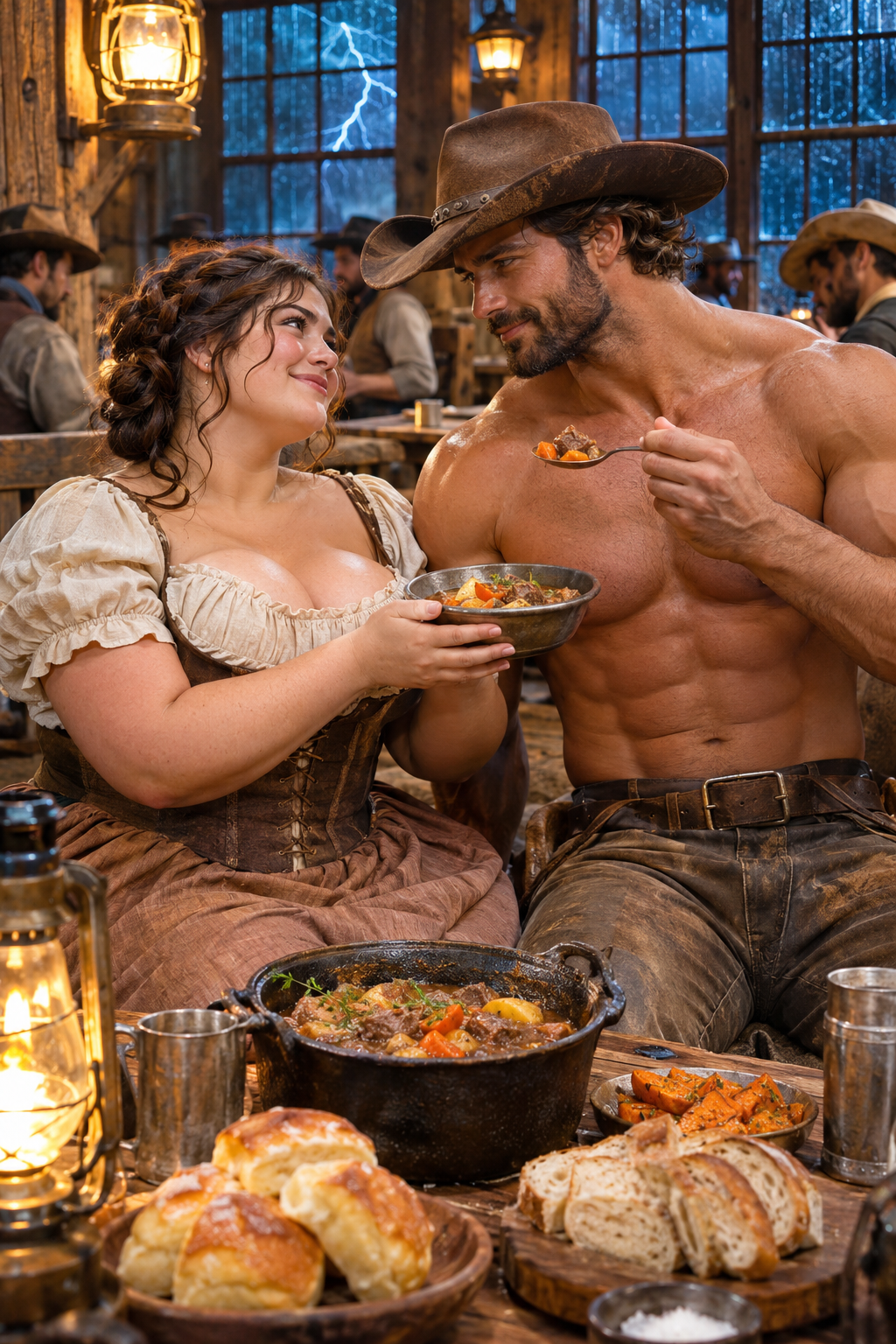
“My mother made that same stew when I was a boy. Barley, cornmeal dumplings, a little thyme if she had it. When winter got bad, she’d stretch one chicken across six suppers.”
His voice grew rough.
“She died when I was twelve. Fever took her before the snow melted.”
Helen softened.
“I’m sorry, Walter.”
He shook his head.
“For forty years, I couldn’t remember the sound of her voice. Tonight, when I tasted that stew, I remembered her standing over the stove, telling me there was always enough for one more hungry person.”
He placed the bowl carefully beside the sink.
“Thank you for giving me that back.”
For the first time since arriving in Wyoming, Helen felt something warm settle inside her chest.
Perhaps this house wasn’t entirely without kindness.
But kindness, she would soon learn, was not the same as safety.
The following morning, Helen rose before sunrise.
She found two more sacks of flour damaged by mice, a barrel of beans hidden behind broken furniture, and enough spoiled potatoes to feed a small army of pigs.
On a shelf near the back wall sat six unopened tins of peaches.
Their labels were identical to three empty tins beside the stove.
She carried one into the dining room.
“Owen, where do you purchase your supplies?”
“Voss Mercantile. Benjamin’s brother runs it.”
“And who checks the deliveries?”
Walter looked up from his coffee.
“Used to be me. Then Voss insisted his clerk handle the accounts when the bank extended Owen’s loan.”
Helen turned the tin over.
“This cost eighty cents?”
Owen nodded.
“In Nebraska, I paid twenty-five.”
“That can’t be right,” one cowboy muttered.
Helen took a pencil and began calculating.
By breakfast, she had discovered something far worse than expensive groceries.
The ranch was paying for supplies it had never received.
Three barrels of salt pork had been charged in October. Only one had arrived.
Twenty sacks of oats appeared in November’s ledger. Walter remembered unloading twelve.
And a shipment of winter blankets had been billed twice.
Owen stared at the figures.
“That’s nearly four hundred dollars.”
“Four hundred and thirty-seven,” Helen corrected. “And that’s only three months.”
Walter’s expression darkened.
“Voss has been bleeding us.”
Owen pushed away from the table.
“I’ll confront him.”
“No,” Helen said.
Three men turned toward her.
“If he’s cheating you deliberately, warning him now will give him time to destroy the evidence.”
Owen frowned.
“What do you suggest?”
“We count everything. We compare every bill. Then we find someone who isn’t afraid of Benjamin Voss.”
Walter smiled for the first time that morning.
“She’s been here one day, boss, and she’s already thinking clearer than the rest of us.”
Helen continued sorting invoices until noon.
She had worked as a bookkeeper for a dry-goods merchant in Nebraska, a fact she had mentioned in her letters to Owen.
Apparently, he had assumed she merely helped around the shop.
By afternoon, she had organized the pantry, established a rationing plan, and discovered that five chickens were still laying eggs behind the abandoned smokehouse.
She also discovered Lucy watching her from the staircase.
“Would you like to help?” Helen asked.
Lucy shrugged.
“Doing what?”
“Keeping these chickens from becoming the most spoiled creatures in Wyoming.”
The girl almost smiled.
Almost.
Together, they collected four eggs.
Lucy carried the basket as though it contained precious jewels.
“My mother used to let me gather eggs,” she whispered.
Helen didn’t ask what had happened to her parents.
Grief was a door that ought to open from the inside.
Instead, she said, “Then perhaps you can teach me how she did it.”
That evening, Lucy appeared in the kitchen without being called.
It was a small beginning.
Three days later, Benjamin Voss returned.
He arrived in a polished carriage despite the muddy roads, wearing a black wool coat and a smile that never reached his eyes.
Owen met him outside.
Helen watched from the window as Benjamin pointed toward the barn and spoke sharply.
Then the banker stepped into the house without removing his hat.
“Well, Mrs. Fletcher. Still here?”
Helen continued kneading bread.
“Apparently the wind hasn’t managed to carry me away.”
One ranch hand coughed into his sleeve.
Benjamin’s smile tightened.
“I hear you’ve been looking into the ranch accounts.”
“I’ve been looking into the pantry.”
“Same thing, I suppose.”
“Not quite. One contains food. The other contains charges for food that never arrived.”
The kitchen fell silent.
Benjamin walked closer.
“You ought to be careful with accusations, Mrs. Fletcher.”
“And you ought to be careful with bookkeeping, Mr. Voss.”
His eyes narrowed.
“Your husband understands our arrangement. Perhaps you should let him manage his own affairs.”
Helen wiped her hands on her apron.
“My husband can speak for himself.”
She looked toward Owen.
For one terrible moment, he stood frozen.
Then he removed his hat.
“My wife is correct,” he said.
Benjamin turned slowly.
“What?”
“We need answers about those bills.”
The banker gave a cold laugh.
“You’re questioning my honesty over a few sacks of flour?”
“I’m questioning the numbers.”
Benjamin’s expression changed.
“Very well. Then perhaps we should discuss your mortgage.”
He withdrew an envelope from his coat.
“Your payment is due in March. Considering your current financial condition, I see no reason to extend further credit.”
Owen’s face lost its color.
Benjamin placed the envelope on the table.
“And since your wife seems so fond of calculations, she can figure out how quickly you’ll be homeless.”
He walked out before anyone could respond.
That night, Owen found Helen sitting at the kitchen table, studying the mortgage papers.
“You should have let me handle him,” he said.
Helen looked up.
“Would you have?”
The question struck harder than anger.
Owen sat opposite her.
“I haven’t always been like this.”
“What changed?”
He stared at his hands.
“My brother died last winter. His wife followed three weeks later. Lucy came here with one suitcase and wouldn’t speak to anyone for months.”
Helen said nothing.
“I borrowed money to keep the ranch running while I handled their affairs. Then the cattle market fell. Benjamin offered to help.”
“And now he owns your silence.”
Owen looked at her.
“Yes.”
Helen folded the papers.
“My father used to say that a debt becomes dangerous when the person collecting it wants more than money.”
Owen lowered his head.
“I know I failed you that first morning.”
“Yes,” she answered.
“I was afraid provoking Benjamin would cost us the ranch.”
“And I was afraid I’d married a man who would let people hurt me whenever protecting me became inconvenient.”
He winced.
“I don’t know how to make that right.”
“Start by never asking me to become smaller so another man can feel powerful.”
Owen nodded slowly.
“I can do that.”
Helen wanted to believe him.
But promises were easy beside a warm fire.
The true test would come when keeping one carried a price.
Over the next two weeks, the ranch changed.
Helen turned wasted supplies into usable meals, repaired torn clothing, and established a written inventory.
She sold preserved apples and fresh bread to neighboring families, earning thirty-six dollars in her first week.
Walter repaired the old smokehouse, while two ranch hands built shelves for the pantry.
Even Lucy began laughing occasionally.
One evening, Owen found the girl asleep beside Helen on the sitting-room sofa, her head resting against Helen’s shoulder.
A half-finished sewing project lay across their laps.
Owen stood in the doorway for several minutes.
For months, Lucy had recoiled whenever anyone tried to comfort her.
Now she was sleeping peacefully.
Helen noticed him.
“There’s coffee in the kitchen,” she whispered.
Owen shook his head.
“I just wanted to say thank you.”
“For what?”
He looked at Lucy.
“For bringing life back into this house.”
Helen glanced down at the sleeping child.
“She’s the one doing the brave work.”
Owen smiled faintly.
“That sounds like something my brother would have said.”
The peaceful moment ended the following afternoon.
Walter rode in from the north pasture with a bloodied hand and a frightening discovery.
Someone had cut the wire along the western boundary.
Thirty-seven head of cattle were missing.
Owen immediately organized a search.
By sunset, they found hoofprints leading toward Voss property.
But the tracks vanished near a rocky creek.
“Rustlers,” one cowboy said.
Walter shook his head.
“Not ordinary rustlers. Whoever did this knew exactly where our weakest fence stood.”
Helen examined the map Owen had left on the table.
“Who knew the cattle were being moved to that pasture?”
“All our hands,” Owen replied. “And Benjamin. He inspected the place last week.”
A terrible possibility settled between them.
If Benjamin was stealing cattle while manipulating the accounts, he wasn’t merely collecting a debt.
He was destroying the ranch’s ability to repay it.
The next morning, Helen rode into town with Walter.
Owen objected.
“Benjamin won’t appreciate you digging around.”
Helen tightened the strap of her saddlebag.
“I’ve discovered he doesn’t appreciate much about me.”
“Then let me come.”
“You need to find those cattle.”
She paused.
“And Owen?”
“Yes?”
“Trust me to do something useful without standing over my shoulder.”
He stepped aside.
At the county clerk’s office, Helen requested copies of the mortgage filings and livestock liens.
The clerk, a nervous young man named Samuel Pike, hesitated when he saw Benjamin’s name.
“Mr. Voss does considerable business with this county.”
“Then I imagine his records are very organized.”
Samuel avoided her eyes.
Helen noticed a framed photograph behind his desk.
A woman stood beside him holding a baby.
“Your family?”
“My wife and daughter.”
“Beautiful little girl.”
Samuel smiled briefly.
Then Helen lowered her voice.
“Mr. Pike, I’m not asking you to break the law. I’m asking you to let me inspect records the law says I may inspect.”
He looked toward the door.
Finally, he retrieved a large leather ledger.
Helen spent two hours comparing dates.
Then she found something extraordinary.
Benjamin Voss had filed a second lien against the Fletcher ranch.
It claimed Owen had borrowed an additional two thousand dollars in September.
But Owen had been in Cheyenne that entire month attending his brother’s estate proceedings.
The signature looked convincing.
Too convincing.
Helen copied the entry carefully.
“Who witnessed this document?”
Samuel’s face grew pale.
“Benjamin’s brother.”
“And who certified it?”
Samuel swallowed.
“I did.”
Helen studied him.
“Did you see Owen Fletcher sign it?”
He didn’t answer.
That was answer enough.
Outside, Walter listened as she explained.
“Forgery,” he muttered.
“Likely. But we need proof.”
Walter mounted his horse.
“I know someone.”
He led her to a small house at the edge of town.
An elderly woman answered the door, her silver hair pinned neatly beneath a lace cap.
“Walter Briggs,” she exclaimed. “I thought you were dead.”
“Not yet, Margaret.”
She looked at Helen.
“And who’s this?”
“Owen Fletcher’s wife. She needs help.”
Margaret Ellis had once worked as the senior bookkeeper at Voss Mercantile.
Three years earlier, Benjamin had dismissed her after she questioned missing inventory.
She listened without interruption.
Then she disappeared into her bedroom.
When she returned, she carried a wooden box.
“I kept copies,” she said.
Inside were years of invoices, delivery receipts, and handwritten notes.
Helen felt her pulse quicken.
“Why didn’t you report him?”
Margaret’s eyes filled with bitterness.
“I tried. The sheriff said I was a disgruntled employee. Benjamin threatened to put my son out of work.”
She lifted a folded paper.
“But I kept this because I knew someday he’d go too far.”
The document was a letter from Benjamin instructing his brother to charge several ranches for undelivered supplies.
At the bottom stood Benjamin’s unmistakable signature.
Helen stared at it.
“This could change everything.”
Margaret shook her head.
“Not by itself. Benjamin has friends in every office between here and Cheyenne.”
“Then we’ll need someone outside his reach.”
Walter leaned forward.
“What about Judge Harrison?”
Margaret considered.
“He retired to Laramie last year.”
“He was honest,” Walter said.
“He still is,” Margaret replied. “And his daughter works with the territorial livestock association.”
For the first time, Helen saw a path through the darkness.
But Benjamin had been watching them.
That evening, a message arrived at the ranch.
Helen’s savings were gone.
Her suitcase had been opened, her dresses scattered across the bedroom floor, and the small envelope beneath them had vanished.
Lucy stood trembling in the doorway.
“I didn’t touch anything,” she whispered.
Helen knelt beside her.
“I know, sweetheart.”
But Lucy began crying.
“I saw a man upstairs.”
Helen’s heart stopped.
“What man?”
“He had a brown coat. He said Uncle Owen sent him to check the windows.”
“Did you recognize him?”
Lucy shook her head.
“He smelled like cigar smoke. And he had a silver ring shaped like a snake.”
Walter, standing behind Helen, went rigid.
“Daniel Voss,” he said.
Benjamin’s younger brother.
Owen immediately saddled his horse.
“I’ll bring the sheriff.”
Walter caught his arm.
“Sheriff Dalton plays cards with Benjamin every Saturday.”
“Then what do you suggest?”
“We protect this house first.”
That night, Owen moved two trusted men into the bunkroom nearest the house.
Walter checked every lock.
Helen sat beside Lucy until the child fell asleep.
Only then did she return to her room and look at the empty hiding place.
The stolen savings weren’t merely money.
They had been her last promise to herself that she could leave if she needed to.
Now someone had taken that choice.
Owen appeared in the doorway.
“Walter told me about the envelope.”
Helen turned.
“I had enough money to return to Nebraska.”
He remained silent.
“I kept it because I didn’t know whether I could trust you.”
His expression crumpled.
“I gave you reason not to.”
“Yes.”
He came no closer.
“I’ll replace every dollar.”
Helen shook her head.
“You don’t understand. It wasn’t just the money.”
Owen swallowed.
“It meant you could choose to stay.”
“And now?”
“Now I want you to have that choice again.”
He placed his own pocket watch on the dresser.
It was gold, worn smooth at the edges.
“My father’s watch. Worth more than your ticket, probably. Walter can sell it in town.”
Helen looked at him.
“That’s an heirloom.”
“So is a person’s freedom.”
Something shifted inside her.
For the first time, she saw not a frightened rancher trapped beneath another man’s thumb, but a man struggling to become better.
She didn’t take the watch.
Not yet.
Instead, she closed his fingers around it.
“Then help me make certain Benjamin never steals another woman’s choices.”
Two mornings later, Owen traveled to Laramie with Walter, carrying the copied mortgage record and Margaret’s documents.
Helen remained at the ranch to protect Lucy and organize the household.
Before leaving, Owen stood beside her on the porch.
“I should have defended you the first day.”
“Yes,” Helen said.
“I can’t change that.”
“No.”
“But I can decide who I am tomorrow.”
Helen looked at him for a long moment.
“Then come home as that man.”
He nodded and rode away.
By noon, the weather turned.
A fierce wind swept across the plains, carrying dust and the promise of snow.
Helen was closing the shutters when she spotted riders approaching.
Three men.
Benjamin Voss led them.
Daniel rode beside him.
The third man wore a sheriff’s badge.
Helen’s stomach tightened.
She sent Lucy upstairs and instructed the ranch hands to remain nearby.
Benjamin dismounted with a satisfied smile.
“Mrs. Fletcher. I understand your husband has left town.”
“He’ll return.”
“Perhaps. But there’s a matter of unpaid debt.”
He handed her a document.
Helen read it slowly.
It was an order authorizing seizure of ranch livestock under the disputed lien.
“You know this debt is fraudulent,” she said.
Benjamin shrugged.
“The courts recognize documents, not opinions.”
Sheriff Dalton stepped forward.
“Ma’am, we don’t want trouble.”
Helen looked at him.
“Then don’t cause any.”
Benjamin’s smile vanished.
“You have no authority here.”
“I have enough authority to refuse entry into my home.”
“This isn’t your home. It’s collateral.”
Helen folded the paper.
“Then you’ll need a lawful order identifying exactly what you may seize. This one mentions livestock. It doesn’t authorize you to search my house.”
Daniel’s eyes darted toward the staircase.
Helen noticed.
Suddenly, she understood.
The stolen money hadn’t been their only objective.
They were searching for something else.
Perhaps they believed she possessed evidence.
Benjamin stepped closer.
“You’re making a terrible mistake.”
“No,” Helen replied. “I made a mistake when I underestimated how desperate you are.”
He raised his hand.
The sheriff caught his wrist.
“Benjamin. Enough.”
From the barn, four ranch hands emerged.
Nobody drew a weapon.
Nobody needed to.
Benjamin looked from face to face.
Then he leaned toward Helen.
“Your husband will lose everything because of you.”
Helen met his eyes.
“If he loses this ranch by standing up to you, he’ll still have more than he did when he was afraid of you.”
Benjamin mounted his horse.
“This isn’t finished.”
The riders disappeared into the storm.
Helen thought the danger had passed.
She was wrong.
At dusk, Lucy vanished.
Helen discovered the girl’s bedroom empty, its window open, and a muddy bootprint beneath the sill.
On the bed lay a folded note.
Tell Owen to stop asking questions. Bring the original account papers to the old grain mill before midnight. Come alone.
Helen’s hands went cold.
For one terrible moment, she couldn’t breathe.
Then she noticed something beneath Lucy’s pillow.
A small cloth doll.
Lucy never went anywhere without it.
Helen pressed the doll against her chest.
“Walter,” she whispered, forgetting he was miles away.
But Walter wasn’t there.
Neither was Owen.
She was alone with a frightened child somewhere in the darkness and men who had already proven they would do anything to protect their secrets.
Helen called the ranch hands into the kitchen.
She showed them the note.
One young cowboy, Thomas Reed, reached for his rifle.
“No,” Helen said sharply.
“If we charge the mill, they may hurt her.”
“What do we do?”
Helen looked at the clock.
“We make them believe I’m coming alone.”
She sent Thomas riding toward Laramie with instructions to find Owen.
Then she chose two experienced hands, Caleb and Jonah, to follow at a distance.
She wrapped Margaret’s original documents in oilcloth and placed them inside her coat.
Before leaving, she took Lucy’s doll.
The road to the old mill cut through a narrow valley.
Snow began falling as Helen approached.
A lantern burned inside the abandoned building.
She dismounted and called out.
“I’m here.”
Daniel Voss emerged from the shadows.
“Where are the papers?”
“Where’s Lucy?”
He nodded toward the mill.
Helen heard a small voice.
“Aunt Helen?”
Her heart broke at the sound.
“I’m here, sweetheart.”
Inside, Lucy sat bound to a chair, frightened but unharmed.
Benjamin stood beside her.
“You’ve caused considerable trouble,” he said.
Helen kept her voice steady.
“Let her go.”
“First, the documents.”
She lifted the oilcloth packet.
Benjamin extended his hand.
Helen hesitated.
Then she noticed a heavy iron stove near the wall.
Its door stood open.
A small fire burned inside.
Benjamin wasn’t merely collecting evidence.
He intended to destroy it.
“You’ll release Lucy first,” she said.
Daniel laughed.
“You’re hardly in a position to negotiate.”
Helen looked at Benjamin.
“Do you know why Walter Briggs cried over my cooking?”
The question startled him.
“What?”
“Because his mother taught him that even when people have nothing, they still have something worth giving.”
Benjamin frowned.
“Have you lost your mind?”
“No. I’ve finally understood something.”
She held up the packet.
“You’ve spent years taking from people who trusted you. Money, cattle, dignity. And you think the whole world works that way.”
“Give me those papers.”
“But there’s one thing you can’t take.”
He stepped forward.
Helen threw the packet into the stove.
Benjamin shouted.
He lunged toward the flames.
At that instant, Helen rushed to Lucy.
She cut the rope with the small sewing scissors hidden in her sleeve.
“Run!”
Lucy bolted toward the door.
Daniel grabbed Helen’s arm.
“You foolish woman!”
Helen struck his wrist with the iron poker resting beside the stove.
He released her with a cry.
Outside, a horse whinnied.
Then Owen’s voice thundered through the storm.
“Helen!”
The mill doors burst open.
Owen entered with Walter and three men.
Benjamin stumbled backward.
Walter seized Daniel before he could reach the child.
Owen crossed the room in three strides.
He caught Helen by the shoulders.
“Are you hurt?”
“No. Lucy—”
“She’s with Caleb.”
Helen’s knees nearly gave way.
Owen pulled her into his arms.
For several seconds, neither spoke.
Then Benjamin began laughing.
“You idiots. The evidence is gone.”
Helen stepped away from Owen.
“Not all of it.”
She reached into her boot and withdrew a thin leather notebook.
Benjamin’s laughter stopped.
“I copied every account. Every false charge. Every forged date.”
She looked toward the doorway.
“And Judge Harrison has the originals Margaret kept.”
Benjamin’s face turned gray.
Walter smiled grimly.
“You really should have learned to respect a woman who knows her numbers.”
The sheriff appeared behind Owen.
But this time, he wasn’t alone.
Two territorial investigators entered the mill.
One carried an arrest warrant.
Owen had reached Judge Harrison in Laramie, who contacted the territorial authorities and reviewed the evidence before sending investigators back with him.
Daniel tried to escape through the rear door.
Jonah stopped him.
Benjamin stood motionless as the investigators restrained him.
“You can’t prove anything,” he hissed.
Helen looked at the burning packet.
“Perhaps not with those papers.”
Then she opened her notebook.
“But you forgot something, Mr. Voss. People who steal for years leave more than one trail.”
The investigation lasted six weeks.
Investigators uncovered fraudulent liens, inflated supply invoices, missing livestock, and payments made to the county clerk.
Samuel Pike confessed that Benjamin had pressured him to certify documents without proper witnesses.
Sheriff Dalton admitted accepting favors to ignore complaints, though he denied knowing about the kidnapping.
Margaret Ellis testified before a territorial court.
So did Walter.
And Helen.
When Benjamin’s attorney suggested that a housewife couldn’t possibly understand complicated financial arrangements, Helen calmly explained every discrepancy across eleven ranch accounts.
By the time she finished, the courtroom was silent.
The forged lien was invalidated, and Owen’s legitimate debt was recalculated after the fraudulent charges were removed.
Benjamin and Daniel were convicted of several offenses, including their roles in the kidnapping.
Other charges against the brothers continued through the courts.
The stolen cattle were recovered from a holding pasture registered under Daniel’s name.
Helen’s missing savings were also found among his belongings.
When the money was returned, she placed it in a new account under her own name.
Owen never questioned her decision.
Spring arrived slowly in Wyoming.
Snow melted from the hillsides, revealing green grass beneath the brown winter earth.
The Fletcher ranch remained heavily burdened, but it was no longer doomed.
With legitimate accounts restored and several stolen cattle returned, Owen negotiated manageable payments through a different lender.
Helen expanded her small baking business, supplying bread and preserved goods to families across the valley.
Lucy began attending school again.
And Walter, who had spent forty years refusing to discuss his childhood, started telling stories about his mother over supper.
One April evening, Helen found Owen waiting beside the front porch.
He held two pieces of paper.
“I’ve been meaning to give you something,” he said.
Helen raised an eyebrow.
“Another mortgage?”
He laughed nervously.
“No. Something better.”
The first was a legal document granting Helen an equal ownership interest in the ranch, properly prepared and recorded.
The second was a train ticket to Nebraska.
Helen stared at them.
“Owen?”
“I meant what I said. You should always have the freedom to choose.”
Her eyes filled.
“You’re giving me a ticket to leave?”
“I’m giving you the choice I should have respected from the beginning.”
He swallowed.
“I wrote you letters because I wanted someone to share my life. Then you arrived, and I treated you like another burden to manage.”
Helen looked down at the papers.
“I was afraid,” he admitted. “Afraid of losing the ranch. Afraid of failing Lucy. Afraid of admitting I needed help.”
“And now?”
“I’m still afraid sometimes.”
He took a breath.
“But I don’t want fear making my decisions anymore.”
Helen studied the man before her.
He was still quiet.
Still stubborn.
Still imperfect.
But he had ridden through a snowstorm to protect her and Lucy.
He had stood beside her in court.
He had learned to ask for her opinion before making decisions that affected them both.
Most importantly, he had stopped mistaking silence for peace.
Helen folded the train ticket.
“I think I’ll keep this.”
Owen’s face fell slightly.
She smiled.
“Not because I intend to use it. Because I want to remember that staying is my decision.”
He stepped closer.
“Then you’ll stay?”
Helen looked past him toward the house.
Lucy was standing at the kitchen window, waving both arms.
Walter had just carried in a basket of fresh eggs.
Smoke curled from the chimney.
The home that had once smelled of neglect now smelled of bread and warm supper.
Helen turned back to Owen.
“Yes,” she whispered. “I’ll stay.”
He kissed her gently.
It was their first kiss that felt like a promise rather than an obligation.
Six months later, the ranch hosted a harvest supper.
Neighbors crowded around long tables beneath the cottonwood trees.
There was roasted beef, fresh bread, apple preserves, and a great iron pot filled with barley stew and cornmeal dumplings.
Walter insisted on serving the first bowls himself.
Lucy, now twelve, stood beside Helen wearing a blue dress she had helped sew.
“Do you think Grandma would have liked this?” she asked.
Helen understood she meant Lucy’s mother.
“I think she would have loved seeing you happy.”
Lucy slipped her hand into Helen’s.
“I’m glad you came here.”
Helen squeezed it.
“So am I.”
Across the yard, Owen approached with a small wooden sign.
He had carved the words himself.
THE FLETCHER TABLE
EVERYONE IS WELCOME
He hung it above the kitchen door.
Helen laughed through her tears.
“What is that for?”
Owen glanced toward the gathering.
“Walter says people come here hungry for more than supper.”
The old foreman stepped forward, carrying his mother’s worn recipe card.
“I’ve been saving this,” he said.
Helen accepted it carefully.
The handwriting was faded, but the ingredients were familiar.
Barley.
Cornmeal.
Vegetables.
A little thyme.
At the bottom, in crooked letters, someone had written a sentence.
When the pot is small, make the table bigger.
Helen read it aloud.
Walter nodded, his eyes bright.
“My mother used to say poverty wasn’t having too little food. It was believing there wasn’t enough kindness to share.”
Helen looked around the yard.
At the cowboys who had once doubted her.
At the little girl who had learned to laugh again.
At the husband who had learned that love demanded courage.
And at the old foreman whose tears had begun an unexpected transformation.
She realized that her greatest victory hadn’t been exposing Benjamin Voss.
It hadn’t even been saving the ranch.
It had been refusing to accept the small place other people had prepared for her.
She had arrived in Wyoming carrying one suitcase, a few dollars, and the quiet hope that someone might someday recognize her worth.
Now she understood something she wished she had known years earlier.
Her worth had never depended on being recognized.
It had been hers all along.
As the sun settled over the Wyoming hills, Owen reached for her hand.
“Are you happy?” he asked.
Helen watched Lucy laughing with Walter near the supper table.
Then she looked at the man who had once remained silent while she was humiliated.
“Yes,” she answered. “But not because everything turned out perfectly.”
“Then why?”
“Because we finally learned how to treat each other.”
Owen kissed her forehead.
Inside the kitchen, the great stewpot simmered gently.
And for the first time in many years, nobody at the Fletcher ranch worried whether there would be enough.
There was enough food.
Enough laughter.
Enough courage to face another winter.
And more than enough room at the table.
Helen never forgot the morning Benjamin Voss insulted her.
Nor did she forget the silence that followed.
But she also never forgot what happened afterward: a frightened man learned to speak, a grieving child learned to trust, and a lonely old cowboy remembered his mother’s love through a bowl of humble stew.
Because sometimes the person everyone underestimates isn’t the one who needs saving.
Sometimes, that person is the one who teaches everyone else what it truly means to be strong.
And the greatest lesson Helen carried through the rest of her life was simple: love should never require a person to surrender their dignity, and a home is not truly a home until everyone inside it is treated as someone who belongs.
The following winter brought the heaviest snowfall Wyoming had seen in nearly twenty years.
By December, the roads were buried beneath deep drifts, the creek had frozen solid, and the wind howled across the Fletcher ranch with enough force to shake the windowpanes.
But inside the farmhouse, everything was different.
The pantry was full, the cattle were healthy, and the kitchen glowed with warmth.
Helen had transformed the neglected ranch into a place where people worked together instead of suffering in silence.
Her baking business had grown beyond anything she had imagined. Families from neighboring ranches ordered bread, preserves, and pies, while travelers passing through the valley frequently stopped at the Fletcher Table for a hot meal.
Owen had changed, too.
He no longer made important decisions without consulting his wife. When disagreements arose, he listened rather than retreating into silence.
And whenever someone spoke disrespectfully to Helen, he no longer needed to be reminded to stand beside her.
One evening, as Helen prepared supper, Lucy rushed into the kitchen holding a letter.
“Aunt Helen! It’s from the school!”
Helen dried her hands and opened the envelope.
The letter announced that Lucy had won a county writing competition with an essay titled The Woman Who Taught Our House to Feel Like Home Again.
Helen read the first paragraph.
Then the second.
By the third, her eyes were filled with tears.
Lucy had written about losing her parents, about the silence that followed, and about the strange woman who arrived carrying a suitcase and somehow understood that grief could not be hurried.
“She never asked me to call her Mother,” Lucy had written. “She never tried to replace the one I lost. She simply stayed, even when I was unkind, until I understood that loving someone new did not mean loving my parents any less.”
Helen lowered the letter.
Lucy looked worried.
“Did I make you sad?”
Helen pulled the girl into her arms.
“No, sweetheart. You reminded me how lucky I am.”
That evening, Owen read the essay aloud to Walter and the ranch hands.
By the time he finished, even the youngest cowboys were blinking suspiciously at the ceiling.
Walter cleared his throat.
“Well,” he muttered, “somebody ought to stop cutting onions in here.”
Everyone laughed.
But three days later, an unexpected visitor arrived.
A thin woman in a weather-beaten coat stood on the porch, clutching a small leather satchel.
Her name was Margaret Cole.
She had traveled nearly forty miles through worsening weather with two children, ages seven and nine.
Her husband had died the previous autumn, and the bank had seized their property after a disastrous harvest.
The woman looked at Helen with desperate eyes.
“I heard you never turn away a hungry family.”
Helen glanced at the children shivering behind her.
“Come inside.”
Margaret hesitated.
“I can’t pay.”
Helen opened the door wider.
“I didn’t ask you to.”
Within minutes, the children were sitting beside the stove with steaming bowls of stew.
Margaret began crying before she had swallowed her first spoonful.
Helen recognized the expression.
It was the same look Walter had worn that first stormy evening.
The look of someone who had endured hardship for so long that ordinary kindness felt almost unbearable.
That night, Owen found Helen standing at the kitchen window.
“You’re thinking about something,” he said.
She nodded.
“Margaret isn’t the only one.”
“What do you mean?”
“There are families all across this valley who have lost land, work, or someone they love. Some need food. Others need a place to begin again.”
Owen looked toward the dining room, where Margaret’s children had fallen asleep beneath borrowed blankets.
“What are you suggesting?”
Helen turned toward him.
“That we make the Fletcher Table more than a sign above our kitchen.”
Over the following months, they converted an unused ranch building into a small community dining hall.
Neighbors donated lumber, blankets, and cooking equipment.
Walter supervised construction.
Lucy helped organize supplies.
And Owen offered temporary work to struggling ranchers whenever the cattle operation could afford extra hands.
Helen insisted on one rule.
No one who entered the building would be humiliated for needing help.
By the following autumn, dozens of families had received warm meals, temporary shelter, or assistance finding honest employment.
Some repaid the kindness with money.
Others brought firewood, vegetables, or their labor.
A few had nothing to offer except gratitude.
Helen accepted that, too.
One afternoon, a traveler stopped beside the new building and examined the wooden sign hanging above the entrance.
THE FLETCHER TABLE
EVERYONE IS WELCOME
He turned to Helen.
“Who started all this?”
She smiled.
“A hungry group of cowboys, an old recipe, and a man who finally learned when to speak.”
The traveler laughed, not understanding.
But Helen didn’t explain.
Some stories were too important to reduce to a few sentences.
Years passed.
Lucy grew into a confident young woman and eventually became a schoolteacher, determined to give other children the patience and encouragement Helen had given her.
Walter remained at the ranch until his final years, when he could no longer ride.
Every Sunday, Helen prepared his mother’s barley stew.
And every Sunday, Walter insisted that it tasted even better than the week before.
On his eighty-second birthday, he placed his mother’s recipe card into Lucy’s hands.
“Promise me something,” he said.
Lucy leaned closer.
“Anything.”
“When you meet someone who’s hungry, don’t always assume food is what they’re missing.”
Lucy promised.
Walter died peacefully the following spring, surrounded by the people he had come to consider his family.
They buried him beneath the cottonwood tree overlooking the ranch.
On his gravestone, Helen had a simple sentence carved beneath his name.
He always made room for one more.
The years softened Owen’s hair to silver and left fine lines around Helen’s eyes.
Their life was never entirely free of trouble.
There were difficult winters, poor harvests, sick cattle, and disagreements that tested their patience.
But the difference was that they faced those troubles together.
One quiet evening, many years after Helen first stepped off the train in Wyoming, she and Owen sat on the porch watching the sunset.
Their hands rested together between their chairs.
“Do you ever think about leaving?” Owen asked suddenly.
Helen smiled.
“Leaving where?”
“Wyoming. This ranch. Me.”
She looked at him with amusement.
“After all these years?”
He nodded.
“Sometimes I remember the way I treated you when you arrived.”
Helen’s smile softened.
“I remember, too.”
“I still wish I could take that morning back.”
“You can’t.”
“I know.”
She turned toward him.
“But Owen, the man who stayed silent that morning isn’t the man sitting beside me now.”
He looked at her.
“How can you be so certain?”
“Because that man was afraid of losing his land. This one understands that the people living on it matter more.”
Owen kissed her hand.
For a while, they watched the sky turn gold.
Then Helen laughed quietly.
“What is it?” he asked.
“I was remembering my suitcase.”
“The one with your money hidden inside?”
“Yes.”
Owen chuckled.
“You kept your train ticket for years.”
“I still have it.”
He turned in surprise.
“You do?”
Helen nodded.
“It’s inside my old Bible.”
“Why?”
She looked toward the farmhouse, where laughter spilled through the open kitchen window.
“Because I never wanted to forget that I stayed because I wanted to, not because I had nowhere else to go.”
Owen squeezed her hand.
“And I’m grateful you did.”
Helen rested her head against his shoulder.
“So am I.”
Inside, Lucy’s children were helping prepare supper.
The great iron pot stood over the stove, filled with barley, vegetables, and cornmeal dumplings.
The same humble meal that had once brought a hardened cowboy to tears now fed a new generation.
And although Helen had spent much of her life believing she was searching for a place where she belonged, she finally understood the deeper truth.
Belonging was never something she had to beg another person to give her.
It was something built through mutual respect, honesty, patience, and the courage to defend what mattered.
She had arrived in Wyoming as a stranger whom one man insulted and another failed to defend.
She had remained long enough to become the heart of a family, the strength of a struggling ranch, and the beginning of a tradition that would outlive them all.
When the dinner bell rang, Owen helped her to her feet.
“Come on,” he said. “Everyone’s waiting.”
Helen smiled.
“Then we’d better not keep them hungry.”
Together, they walked toward the warm light spilling from the farmhouse.
And above the kitchen doorway, the wooden sign Owen had carved so many years before still carried the words that had become the foundation of their lives.
THE FLETCHER TABLE.
EVERYONE IS WELCOME.
Because a person’s true worth is never measured by appearance, wealth, or the cruel opinions of others.
It is revealed through compassion, courage, and the willingness to make life better for someone else.
And sometimes, the smallest act of kindness—a warm bowl of stew, an offered hand, or a voice raised against injustice—can change not just one life, but generations yet to come.
THE END.