The entire town watched as Lenora Voswick slapped me outside Alder Creek’s courthouse, calling me worthless, unaware that my mother’s wedding dress concealed her darkest crime.
My mother’s fingers tightened around my wrist, and for a moment, the entire world seemed to stop breathing.
Outside the farmhouse, the wind dragged dead leaves across the porch, making a sound like someone whispering through the darkness.
“Don’t trust the sheriff, sweetheart,” she repeated, her voice trembling. “He knows whose body they buried in my grave.”
I stared at the woman standing before me, searching her face for the mother I had mourned since childhood.
Her cheeks were hollow, and deep lines surrounded her eyes, but beneath the years of suffering, I recognized something that made my heart ache.
It was the way she looked at me, as though I were both a miracle and a terrible memory.
“Mom?” I whispered.
Her lips trembled before she answered.
“My beautiful little girl.”
I stumbled into her arms, and the moment she held me, twenty-six years of loneliness collapsed inside my chest.
I remembered being five years old, waiting beside the front window for a mother who never came home.
I remembered my father telling me that angels sometimes needed the people we loved most.
And I remembered how every birthday had felt incomplete because there was one voice I would never hear again.
Yet here she was, breathing against my hair.
“I’m sorry, Mabel,” she whispered. “I’m so terribly sorry.”
I wanted to ask a thousand questions, but the only words that escaped me were the ones I had carried since childhood.
“Why didn’t you come back for me?”
She pulled away, tears trembling on her eyelashes.
“Because they told me you were dead.”
The words struck harder than Lenora’s slap outside the courthouse.
Rhett stepped closer, his expression darkening.
“Who told you that?”
My mother looked toward the covered windows.
“Lenora Voswick.”
A vehicle approached outside, its tires crunching over the gravel.
Rhett immediately switched off his flashlight.
Through a narrow opening in the curtain, I saw headlights illuminating the old barn.
Sheriff Dalton had arrived.
My mother grabbed my hand.
“We need to leave before he comes inside.”
“But he helped us find you,” I whispered.
She shook her head violently.
“That man has spent twenty-six years making sure nobody finds me.”
Before I could speak, Rhett guided us toward a small door behind the kitchen pantry.
Iris remained close to me, her face pale and bewildered.
The moment my mother noticed her, she stopped walking.
“Iris?”
Iris stared at her.
“Margaret?”
My mother pressed a trembling hand against her mouth.
“Oh, sweetheart.”
Iris stepped forward slowly, searching the woman’s face beneath the silver hair.
“You raised me,” she whispered. “You were the only person who ever made me feel safe.”
My mother reached toward her, but Iris backed away.
“Then why did you disappear?”
A loud knock echoed through the farmhouse.
“Mabel!” Sheriff Dalton called. “It’s Sheriff Dalton. Open the door.”
My mother closed her eyes.
“Because I discovered that the two little girls I loved were connected by a secret that could get us all killed.”
Rhett opened the pantry door, revealing a narrow staircase leading into darkness.
“We can talk somewhere safer,” he said.
We descended into a root cellar smelling of damp earth and old wood.
Above us, the front door splintered beneath a heavy blow.
I heard Sheriff Dalton shouting my name.
For the first time, I understood that the people I had trusted all my life might be the ones I needed to fear most.
Rhett led us through a low passage beneath the farmhouse.
The tunnel ended behind a collapsed stone wall near the creek.
By the time we climbed into his truck, my clothes were covered in mud, and my hands wouldn’t stop shaking.
Iris sat beside my mother in the back seat.
Neither woman spoke.
Their silence carried too many years of unanswered questions.
We drove along an unmarked cattle trail until Rhett’s ranch appeared beneath the moonlight.
He parked behind the equipment barn and led us into the old ranch house.
Only after he locked the doors did my mother finally begin to tell us what had happened.
“My name is Evelyn Renford,” she said, wrapping both hands around a cup of tea.
“Before I married your father, I worked as Theodore Bellweather’s private nurse.”
I looked at Iris.
Her face had gone completely still.
“Theodore was sick during his final months,” my mother continued. “But his mind was clear, and he knew Lenora was stealing from the estate.”
Lenora had been managing Theodore’s accounts after his son died.
She gradually transferred property into companies she controlled, believing the elderly man would never notice.
But Theodore discovered the missing money.
He summoned a lawyer and ordered a new will prepared.
Everything was to pass to Iris, his granddaughter, with protections to prevent anyone from exploiting her inheritance.
“Then why did Aunt Clara write that Iris wasn’t his only heir?” I asked.
My mother looked directly into my eyes.
“Because your father was Theodore’s son.”
The room fell silent.
I could hear the ticking clock above Rhett’s fireplace.
“My father was Daniel Renford,” I said.
“Yes,” she whispered. “But before Clara’s family adopted him, his name was Daniel Bellweather.”
I felt as though the floor had disappeared beneath my feet.
Daniel had been born years before Theodore married Iris’s grandmother.
His mother had been a housekeeper on the Bellweather estate.
Theodore acknowledged Daniel privately and supported him financially, but his family refused to accept the child.
When Daniel was twelve, he was sent away.
Clara Renford’s parents adopted him, and he grew up believing his father wanted nothing to do with him.
“Years later, Theodore tried to repair what he’d broken,” my mother said.
“He wanted Daniel recognized as his son.”
I stared at the photograph still tucked inside my coat.
“Did Dad know?”
“He found out shortly before the accident.”
Iris slowly reached for my hand.
“That means we’re cousins.”
I nodded, unable to speak.
For years, I had believed my family was small and disappearing.
Now the woman I thought was dead sat across from me, and the stranger beside me shared my grandfather’s blood.
But the discovery brought little comfort.
Because it meant someone had spent decades destroying our family to protect a fortune.
My mother lowered her eyes.
“There’s something worse.”
Theodore had prepared a second document acknowledging Daniel as his son and granting him a portion of the estate.
The new will named Iris and Daniel’s descendants as beneficiaries.
Gordon Pikeley and Clara Renford witnessed the signing.
“My father didn’t want the money,” my mother said. “He wanted to know why Theodore had abandoned him.”
She paused, struggling to continue.
“Lenora knew the documents would destroy everything she’d stolen.”
Three nights later, Theodore was found dead in his study.
The official report called it heart failure.
But my mother had administered his medication for months.
“His medicine bottle had been replaced,” she whispered. “The pills looked identical, but something was wrong.”
She reported her suspicions to Sheriff Dalton, who was then a young deputy.
Instead of investigating, he brought Lenora to the hospital where my mother worked.
“They told me I was confused,” she said. “Then they threatened Daniel and you.”
My father refused to remain silent.
He arranged to meet a state investigator.
His truck went off a bridge before he reached the appointment.
I felt tears burning behind my eyes.
“Everyone told me he fell asleep while driving.”
My mother shook her head.
“Daniel never drove that road.”
I remembered my father’s hands guiding mine over a piece of fabric.
I remembered his laughter when I made crooked stitches.
He hadn’t simply disappeared from my life.
Someone had taken him.
Iris quietly began crying beside me.
Rhett stood near the window, his jaw tightly clenched.
“What happened to Evelyn?” he asked.
My mother stared into her tea.
“After Daniel died, I tried to leave Alder Creek with Mabel.”
Lenora intercepted her at the hospital.
There was an argument in a storage room.
A nurse named Rebecca Sloan overheard Lenora threatening to take my mother’s child away.
Rebecca tried to intervene.
During the struggle, Lenora shoved her backward.
Rebecca struck her head against a metal cabinet.
She died before help arrived.
My mother covered her face.
“Lenora told Dalton to report the body as mine.”
I felt sick.
“Rebecca was buried in your grave?”
My mother nodded.
“And they forced me to sign a statement claiming I had murdered her.”
Lenora promised that if my mother vanished and never contacted me again, the statement would remain hidden.
If she returned, it would be used against her.
“They showed me photographs of you sleeping in Clara’s house,” she whispered.
“They wanted me to know they could reach you whenever they wanted.”
For years, she lived under the name Margaret Hale, moving between towns and taking whatever work she could find.
Eventually, Clara secretly helped her obtain a position at Saint Agnes.
That was how she met Iris.
“I didn’t know who she was at first,” my mother said.
“But when Clara explained, I couldn’t abandon another child whose family had been stolen from her.”
She raised Iris until a letter arrived containing a photograph of me leaving my high school graduation.
On the back were three words.
“Stay away forever.”
My mother disappeared that same night.
I looked toward the kitchen window, where darkness pressed against the glass.
“Why are you here now?”
“Clara wrote to me before she died,” she answered. “She said she’d hidden the documents and believed you would find them.”
Then she reached inside her coat and removed a small brass key.
“She also said there was something Theodore left behind that even Lenora never discovered.”
Rhett leaned forward.
“Where?”
My mother hesitated.
“Beneath the chapel at Bellweather Manor.”
Suddenly, headlights flooded the kitchen.
A truck stopped outside the barn.
Rhett extinguished the lights and reached for the old hunting rifle above the doorway.
We stood motionless as footsteps approached.
Then someone knocked three times.
“Rhett,” a familiar voice called weakly. “It’s Gordon.”
I gasped.
Rhett opened the door just enough to see the man standing outside.
Gordon Pikeley was pale, his left arm wrapped in bloodstained bandages.
Beside him stood a young deputy I had never met.
“Gordon?” I whispered, running toward him.
He managed a tired smile.
“You’re harder to get rid of than you think, little seamstress.”
The deputy introduced herself as Nora Finch.
She had responded to the shooting at the boardinghouse and found Gordon alive before the ambulance arrived.
When Sheriff Dalton ordered her to release him into county custody, she became suspicious.
“He wouldn’t let me photograph Gordon’s statement,” she explained.
“And the ambulance report disappeared from our system.”
Nora had quietly moved Gordon to a neighboring county hospital.
Then Gordon insisted on returning to Alder Creek.
“I couldn’t stay hidden while Clara’s niece faced those people alone,” he said.
He sat heavily in Rhett’s armchair.
When he saw my mother, tears filled his eyes.
“Evelyn.”
She rushed to embrace him.
For a moment, the room held something I hadn’t expected.
Not fear.
Not grief.
Hope.
Gordon reached into his jacket and pulled out a battered leather notebook.
“Theodore kept records,” he said. “Every payment Lenora made, every parcel she transferred, every threat she sent through her lawyer.”
“Where did you find that?” Rhett asked.
“I kept it after he died.”
Gordon looked ashamed.
“I thought evidence would be enough to stop her, but when Daniel was killed, I lost my nerve.”
He turned toward me.
“I should have protected your father.”
I looked at the exhausted man sitting before me.
For twenty-six years, fear had held him prisoner.
I wanted to blame him.
Part of me did.
But I also recognized the courage it had taken to come back.
“You can help him now,” I said.
Gordon wiped his eyes.
“Then we finish what Theodore started.”
Nora agreed to contact a state investigator directly, avoiding Dalton’s department.
But she warned us that the notebook alone might not prove murder or establish the missing inheritance.
We needed the original documents.
We needed evidence that couldn’t be dismissed as rumor.
And my mother believed Theodore’s chapel held exactly that.
We waited until the following night.
Bellweather Manor stood on a wooded hill overlooking Alder Creek.
For decades, its tall iron gates had symbolized everything Lenora believed she owned.
I had passed them hundreds of times without imagining that my father’s childhood was buried somewhere behind those walls.
Now, as Rhett parked beneath the trees, I felt strangely afraid of entering.
“Whatever happens in there,” he whispered, “you don’t have to prove you’re brave.”
I turned toward him.
“What if I’m not?”
He gently brushed a loose strand of hair away from my face.
“Then I’ll be frightened beside you.”
Something in my chest softened.
For months, I had survived by convincing myself that needing someone was dangerous.
Rhett had never asked me to be stronger than I was.
He had simply stayed.
We entered through a broken section of the stone wall.
Nora and Gordon waited near the driveway, ready to call for help.
Iris and my mother followed Rhett and me toward the small family chapel behind the main house.
Inside, moonlight spilled through stained-glass windows.
Dust covered the wooden pews, and a faded Bible rested on the altar.
My mother approached a marble plaque honoring Theodore’s parents.
She pressed the brass key into a tiny opening beside the frame.
A hidden compartment clicked open.
Inside was a metal box wrapped in oilcloth.
My heart hammered as Rhett lifted it into the moonlight.
We found Theodore’s original will, Daniel’s acknowledgment of paternity, and a sealed statement signed by Theodore’s personal physician.
The physician had documented that Theodore’s prescribed medication had been replaced shortly before his death.
There were also copies of estate ledgers showing unauthorized transfers into Lenora’s companies.
Iris picked up a handwritten letter addressed to her.
Her hands shook as she unfolded it.
“My dearest Iris,” she read softly. “No matter what becomes of this house, remember that your worth was never measured by the land surrounding it.”
Her voice broke.
I touched her shoulder.
She continued through her tears.
“Protect those who have less power than you, because a family name means nothing unless it gives someone else a reason to feel safe.”
Iris pressed the paper against her chest.
For the first time, I understood what Theodore had truly been trying to leave behind.
Not simply money.
A chance to correct the cruelty that had shaped his family.
Then a familiar voice echoed from the chapel entrance.
“How touching.”
Lenora Voswick stood beneath the doorway, wearing a dark coat and an expression of absolute contempt.
Sheriff Dalton stood beside her.
In his right hand was a pistol.
Iris stepped backward.
My mother instinctively moved in front of us.
Lenora’s eyes settled on her.
“Evelyn, darling. I wondered how long it would take you to come crawling home.”
Rhett shifted toward me, but Dalton raised his weapon.
“Nobody moves.”
Lenora walked slowly down the aisle.
Her heels clicked against the stone floor.
“You’ve caused me considerable trouble, Mabel.”
I held the metal box against my chest.
“You murdered my father.”
Her lips tightened.
“Your father was an inconvenience.”
The words passed through me like ice.
“He was a person,” I whispered.
“He loved me.”
Lenora laughed without warmth.
“Love doesn’t keep an estate running.”
My mother stepped forward.
“You killed Rebecca, too.”
For the first time, Lenora’s expression changed.
“Rebecca should have minded her own business.”
Dalton looked away.
I stared at him.
“You knew.”
His silence answered before his mouth did.
“You knew my mother was alive. You knew Rebecca was buried under her name.”
Dalton swallowed.
“I followed orders.”
“Whose orders?”
He glanced at Lenora.
She gave him a warning look.
I remembered all the nights I had believed that the sheriff would protect our little town.
All the years people trusted him to stand between the innocent and the cruel.
Yet he had spent his career guarding the person who frightened them.
“You didn’t follow orders,” I said. “You made choices.”
For a brief moment, something like shame crossed his face.
Then Lenora reached toward the box.
“Give me those documents, and perhaps everyone leaves here alive.”
Rhett slowly raised his hands.
“You won’t get away with this.”
Lenora smiled.
“People have been saying that about me for twenty-six years.”
Outside, a distant engine rumbled.
Dalton glanced toward the window.
The distraction lasted less than a second.
But Rhett moved.
He shoved the nearest pew toward Dalton, knocking the sheriff sideways.
The gun discharged.
The sound exploded through the chapel.
I screamed as Rhett collapsed against the altar.
Blood spread across his shirt.
“No!”
I dropped beside him, pressing both hands against the wound.
His face twisted with pain.
“Mabel,” he whispered. “Stay down.”
Lenora seized the metal box and stumbled backward.
But Iris stepped into her path.
“No more.”
Lenora struck her across the face.
Iris staggered, then caught the edge of a pew.
My mother rushed forward and pulled her away.
Dalton scrambled to retrieve his weapon.
Before he could reach it, Nora Finch appeared in the doorway with two state investigators behind her.
“Hands where I can see them!”
The chapel filled with shouted commands.
Dalton froze.
Lenora tried to run through a side door, but another officer intercepted her outside.
I barely noticed.
My entire world had narrowed to the man bleeding beneath my hands.
“Please, Rhett,” I whispered. “Don’t leave me.”
He opened his eyes.
“You’re ruining my favorite shirt.”
I laughed through my tears.
Then I cried harder.
“You’re an idiot.”
He managed the smallest smile.
“Maybe, but I’m your idiot if you’ll have me.”
The ambulance arrived minutes later.
As they lifted Rhett onto the stretcher, I followed, refusing to release his hand.
At the hospital, surgeons removed the bullet from his shoulder.
It had narrowly missed a major artery.
When the doctor told me he would survive, I sat down in the hallway and sobbed.
My mother found me there.
She wrapped her arms around me without saying anything.
For the first time since childhood, I cried against her shoulder without worrying that she might disappear.
The investigation that followed shook Alder Creek.
State authorities examined Theodore’s records, questioned former estate employees, and reopened the deaths of Daniel Renford and Rebecca Sloan.
Gordon testified about the signing of Theodore’s will and the intimidation that followed.
My mother provided the statement Lenora had forced her to sign.
Nora submitted evidence that Dalton had interfered with Gordon’s shooting investigation.
Other witnesses finally came forward.
A retired mechanic remembered repairing suspicious damage to my father’s truck shortly before his death.
A former estate bookkeeper identified payments linked to falsified records.
A laboratory review of preserved medical evidence strengthened the case surrounding Theodore’s death.
None of it happened quickly.
There were hearings, delays, and nights when I feared the truth might disappear beneath another mountain of legal papers.
But this time, we weren’t standing alone.
People from Alder Creek began gathering outside the courthouse.
Some carried photographs of relatives who had lost land.
Others brought documents showing how Lenora had exploited their debts.
One elderly farmer approached me after a hearing.
“Your father helped my family when we had nothing,” he said.
His eyes filled with tears.
“I should have spoken up years ago.”
I took his hand.
“You’re speaking now.”
Months later, Lenora Voswick was convicted of murder, conspiracy, fraud, and arson-related offenses.
Dalton was convicted for his role in the cover-up and obstruction of justice.
The courts recognized Theodore’s authentic estate documents and ordered the stolen assets restored to the rightful beneficiaries.
When the judgment was announced, I expected to feel victorious.
Instead, I felt strangely empty.
No verdict could give me back my father’s laughter.
No amount of money could return the twenty-six years my mother had spent believing I was dead.
And no judge could erase the nights when Iris cried herself to sleep, wondering why she had been abandoned.
Justice mattered.
But it couldn’t make the past disappear.
One afternoon, I visited my father’s grave with my mother.
She carried a small bouquet of white roses.
For several minutes, we stood silently before his headstone.
Then she knelt and touched his name.
“I’m sorry, Daniel,” she whispered. “I couldn’t save you.”
I knelt beside her.
“You saved me.”
She looked at me through her tears.
“I lost so much time.”
I thought about every birthday candle I’d blown out without her.
Every school performance where I searched the crowd.
Every Christmas morning when I imagined hearing her footsteps.
I couldn’t pretend those memories didn’t hurt.
But I also couldn’t bear to lose another day.
“We can’t get those years back,” I said. “But we still have tomorrow.”
She leaned against me, and together we cried for the life we’d been denied.
Six months later, the ruins of my aunt’s dress shop were finally cleared.
The estate settlement had left Iris and me with more money than either of us had ever imagined.
People assumed I would move into Bellweather Manor.
Some even suggested changing my last name.
But I had no desire to become the kind of woman who looked down from a hill and forgot the people living beneath it.
Instead, Iris and I made a decision.
We would restore the old manor and turn part of it into a community home for women and children escaping violence.
The surrounding farmland would be leased fairly to local families.
And on Willow Street, where my aunt’s shop had burned, we would build something new.
Not a luxury boutique.
Not a monument to the Bellweather fortune.
A sewing school and dress shop where women could learn a trade, earn a living, and begin again.
We named it Clara’s House.
On opening morning, the entire town gathered outside.
Fresh white curtains hung in the windows.
Inside, sunlight fell across sewing machines, wooden cutting tables, and shelves filled with colorful fabric.
I had placed Aunt Clara’s old scissors in a glass case near the entrance.
Beside them stood a framed photograph of her smiling in the original shop.
Iris arrived carrying a large arrangement of wildflowers.
My mother followed with a tray of homemade cinnamon rolls.
And Rhett came through the doorway wearing a neatly pressed shirt.
His shoulder had healed, although he still complained whenever the weather changed.
“You look nervous,” he said.
“I’ve never owned something this beautiful.”
He looked around the room.
“Yes, you have.”
I raised an eyebrow.
“What?”
He smiled.
“The courage that built it.”
I felt my cheeks grow warm.
Then he reached into his pocket.
For one breathless moment, I thought he was about to propose.
Instead, he pulled out a small velvet pouch.
Inside was my mother’s silver thimble, restored until the engraved initials gleamed.
“I had it cleaned,” he said. “Thought it deserved another beginning.”
My mother covered her mouth.
I held the thimble against my heart.
Then Rhett took my hand.
“There’s one more thing.”
He led me toward the back room.
A dressmaker’s mannequin stood near the window, draped beneath a clean white sheet.
When Rhett removed the covering, I stopped breathing.
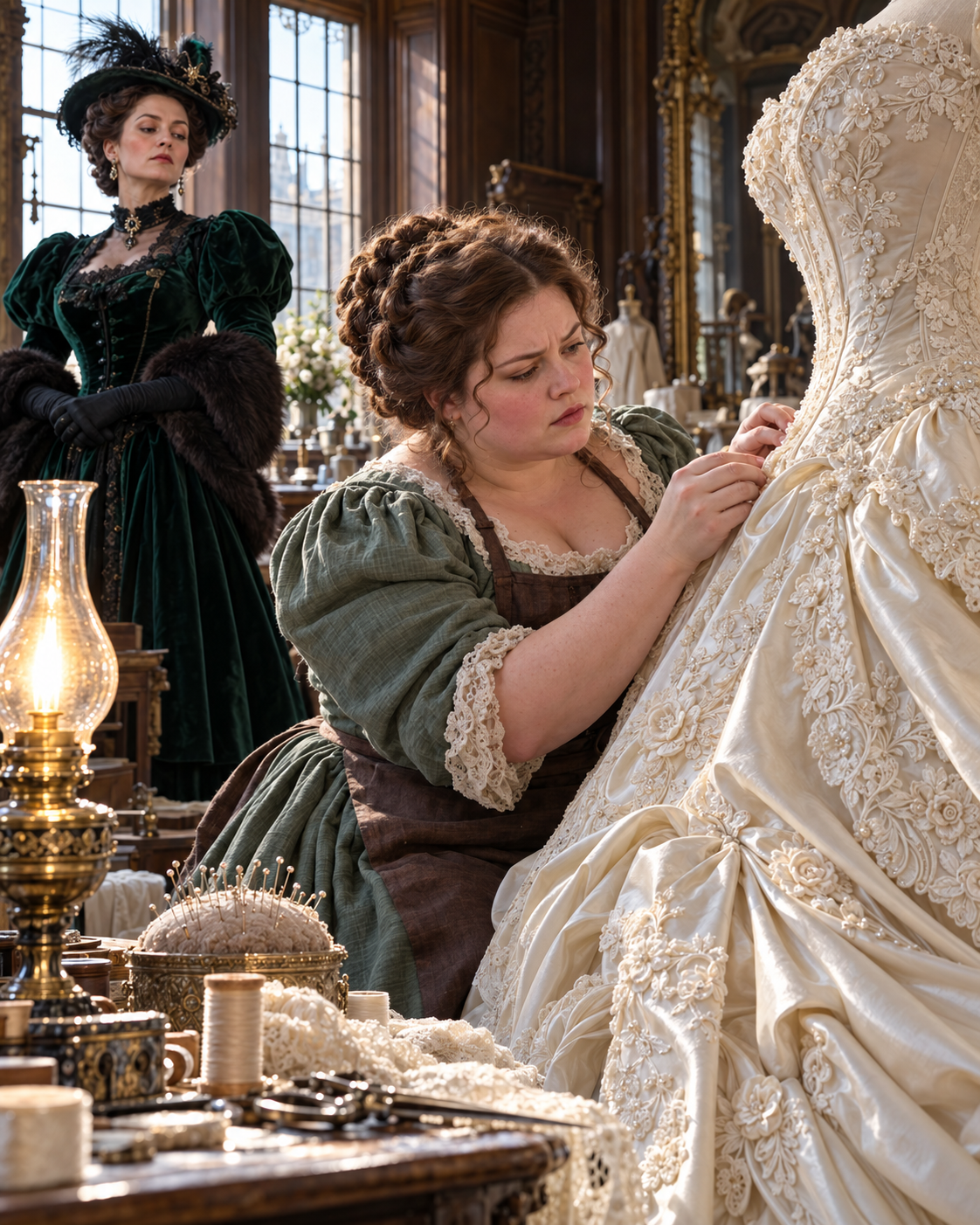
There was the ivory bridal gown.
My aunt’s unfinished masterpiece.
Its delicate silk had been damaged by smoke, but the bodice and most of the skirt had survived.
“I found it near the back wall after the fire,” Rhett explained. “Clara’s old storage cabinet protected part of it.”
My mother approached the gown with trembling fingers.
“She started this for me,” she whispered.
“But I never got to wear it.”
I touched the fragile embroidery along the neckline.
For decades, the gown had hidden a secret that nearly destroyed us.
Now it stood before us, imperfect but beautiful.
Like our family.
I spent the following weeks restoring it.
My mother helped repair the lace.
Iris carefully replaced the missing pearls.
Every stitch felt like a conversation with Aunt Clara.
Every repaired seam reminded me that broken things could become beautiful without pretending they had never been damaged.
One evening, Rhett found me working beneath the soft light of the sewing room.
“You’re still here?”
“Almost finished.”
He sat beside me and watched my hands move across the silk.
“Who are you making it for?”
I hesitated.
For years, I had imagined wearing a wedding dress someday.
But after everything that happened, marriage felt less important than the quiet miracle of having people who loved me.
“I don’t know,” I admitted.
Rhett took the needle gently from my fingers and set it aside.
“Then maybe you should stop trying to finish everything alone.”
He lowered himself onto one knee.
There was no audience.
No music.
Only the hum of the old ceiling fan and the warm smell of pressed fabric.
He opened a small ring box.
Inside was a simple gold band holding a tiny diamond.
“Mabel Renford,” he said, his voice unsteady, “I can’t promise life will never hurt us again.”
Tears filled my eyes.
“But I promise you’ll never have to face it believing you’re alone.”
I laughed and cried at the same time.
“Rhett, are you asking me to marry you?”
He smiled.
“I’ve been trying for five minutes.”
“Yes,” I whispered.
Then I threw my arms around him.
We married the following spring beneath the old oak trees behind Bellweather Manor.
I wore the ivory silk gown my aunt had begun decades earlier.
My mother walked beside me down the flower-lined path.
Iris stood waiting with a bouquet of white roses.
Gordon, whose injuries had finally healed, sat in the front row, wiping his eyes with a handkerchief.
When I reached Rhett, he looked at me as though the entire world had disappeared.
“You look beautiful,” he whispered.
I smiled through my tears.
“So do you, cowboy.”
He laughed.
And for the first time in my life, the laughter around me carried no hidden fear.
After the ceremony, my mother asked me to walk with her.
We wandered toward the little chapel where our lives had nearly ended.
Sunlight streamed through the stained-glass windows.
She stopped before Theodore’s memorial plaque.
“Your grandfather wasn’t a perfect man,” she said.
“He made choices that hurt people he loved.”
I nodded.
“But in the end, he tried to make them right.”
She touched my wedding ring.
“That’s all any of us can do, sweetheart. We can’t change yesterday, but we can choose what kind of person tomorrow will meet.”
I looked through the chapel doorway.
Beyond it, children were running across the lawn, chasing butterflies beneath the spring sunshine.
Women from Clara’s House laughed together near the garden tables.
Iris was helping Gordon into a chair.
And Rhett stood beneath the oak tree, waiting for me.
For so long, I had believed inheritance meant receiving whatever someone left behind.
A house.
A fortune.
A piece of land.
But Theodore Bellweather had taught me something far more important.
Sometimes we inherit wounds.
Sometimes we inherit silence.
And sometimes we inherit the responsibility to end the cruelty that began long before we were born.
I took my mother’s hand and led her back toward the celebration.
That evening, when the guests had gone and the sky turned gold above Alder Creek, I returned to Clara’s House.
I placed the original photograph of my mother holding me as a baby beside Aunt Clara’s sewing machine.
Then I opened a small wooden drawer.
Inside lay the letter that had changed everything.
“For the daughter who survives.”
For years, I had thought survival meant enduring pain without letting anyone see me break.
Now I knew better.
Survival meant finding the courage to love again.
It meant telling the truth even when your voice trembled.
It meant refusing to become cruel simply because the world had been cruel to you.
I folded the letter and placed it beneath a fresh piece of ivory silk.
Then I began sewing a tiny dress for the first baby expected at the women’s home.
Outside, Rhett called my name.
I switched off the lamp and walked toward the door.
Before leaving, I looked back at the shop my aunt had dreamed of saving.
The windows glowed softly beneath the evening stars.
And somewhere in the quiet, I could almost hear her voice again.
“Some stitches hold more than fabric, Mabel.”
I smiled.
“You’re right, Aunt Clara.”
Because the strongest things we leave behind aren’t always the things we own.
Sometimes they’re the lives we help mend, the people we refuse to abandon, and the love we choose to give even after the world has broken our hearts.
And as Rhett took my hand beneath the Alder Creek stars, I finally understood that my family’s greatest inheritance had never been the Bellweather fortune.
It was the freedom to turn a painful past into a kinder future.
THE END.