The entire town of Ashfork, Wyoming, had watched Eleanor Whitmore lose everything in a matter of minutes.
The stranger stood motionless beneath the pale Wyoming moon, holding an envelope that seemed to carry more danger than any weapon.
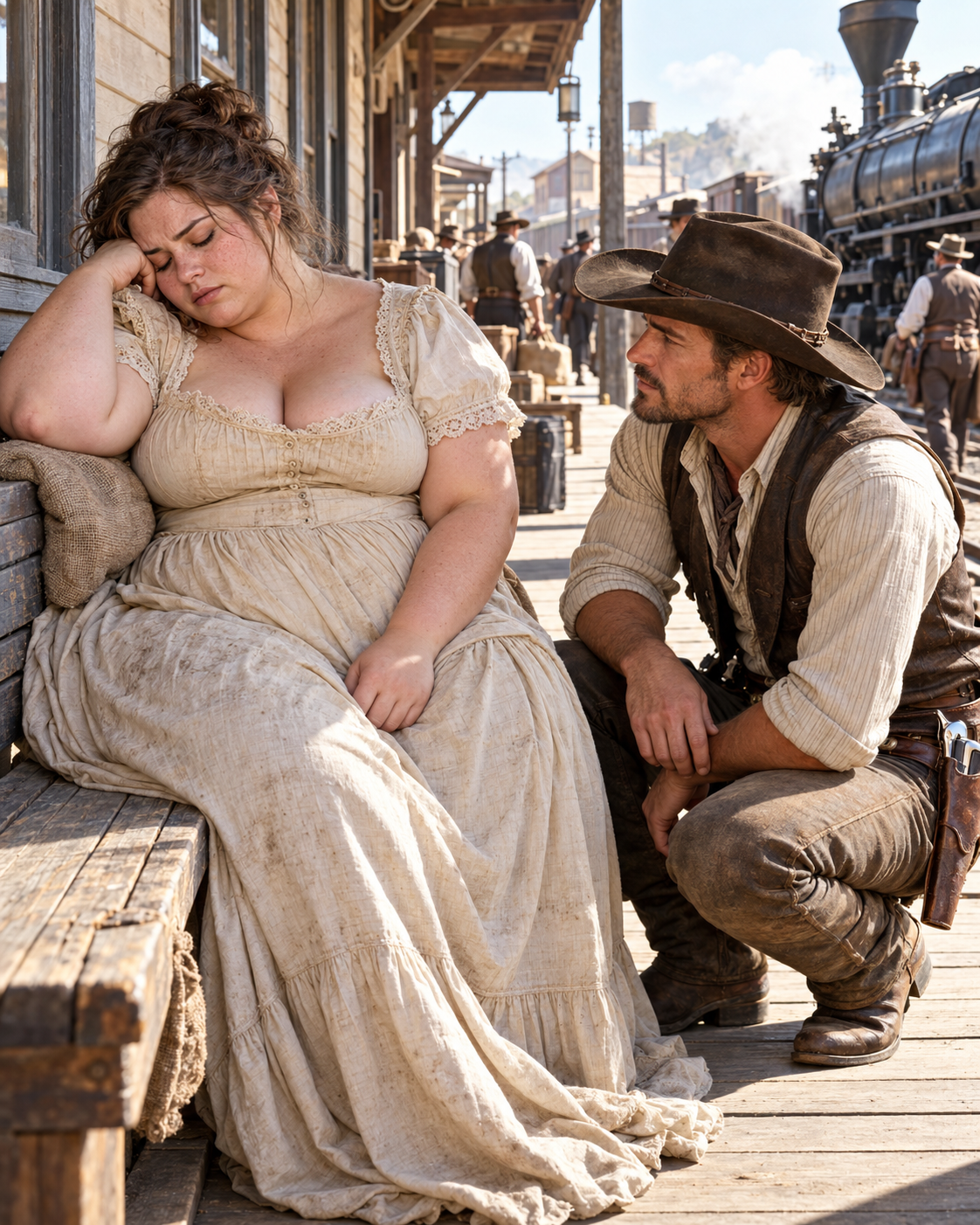
Eleanor Whitmore pressed her hand against the farmhouse window, her breath catching when she recognized the handwriting on its front.
She had seen those elegant, slanting letters hundreds of times before, on promises of marriage, affectionate notes, and letters describing a future that had never existed.
They belonged to Charles Bennett, the man who had publicly humiliated and abandoned her in Ashfork.
For one terrible moment, Eleanor felt herself standing in the crowded town square again, hearing Charles announce that he could never marry a woman without money or respectable connections.
But something was different now.
She was no longer the frightened woman he had left behind.
“Thomas,” she whispered, “that envelope came from the man who abandoned me.”
Thomas Walker turned toward her, his expression hardening.
“Then we need to know why someone brought it here.”
Before either could move, the stranger placed the envelope beneath a loose board beside the barn and hurried toward a waiting horse.
Thomas stepped onto the porch, but the rider was already disappearing beyond the cottonwood trees.
The darkness swallowed him before Thomas could recognize his face.
Eleanor remained inside while Thomas retrieved the envelope, carefully watching the empty pasture for any sign of another visitor.
When he returned, he placed it on the kitchen table without opening it.
Whatever secrets it contained, he believed Eleanor deserved to face them on her own terms.
She broke the seal with trembling fingers.
Inside was a single sheet of expensive stationery bearing the letterhead of Bennett & Vance Land Holdings.
Her stomach tightened.
Charles Bennett was connected to Randolph Vance.
The discovery seemed impossible, yet there it was, written plainly across the top of the page.
The letter contained only a few sentences.
“Eleanor, you have become involved in matters you do not understand. Leave Walker’s ranch before Friday. What happened in Ashfork was unfortunate, but what happens next may be beyond my control. Do not make the mistake of believing Thomas Walker can protect you.”
There was no apology.
No explanation.
Only a warning.
Thomas read the letter after Eleanor silently handed it to him.
For several moments, he said nothing.
Then he looked toward the window, where the distant mountains stood like black walls against the night.
“Vance knew who you were before you came here,” he said.
Eleanor shook her head.
“That cannot be. Charles never mentioned him.”
“Maybe he never wanted you to know.”
The words settled heavily between them.
Eleanor remembered how Charles had insisted they travel to Ashfork rather than marry in Denver, where they had first met.
She remembered his strange impatience during their journey, the conversations he stopped whenever she entered a room, and the way he had disappeared into Vance’s office the morning before their engagement ended.
At the time, she had been too devastated to question any of it.
Now every memory seemed to contain a hidden meaning.
“What if Charles never intended to marry me?” she asked quietly.
Thomas looked at her.
“What if bringing me to Ashfork was part of something else?”
Neither knew the answer.
But one thing had become clear.
The danger surrounding the Walker ranch was no longer merely a dispute over cattle and land.
Someone had deliberately placed Eleanor in the middle of it.
And someone desperately wanted her gone.
THE MAN WHO KNEW TOO MUCH
By sunrise, Thomas had made his decision.
They would travel to see Samuel Briggs, the former county clerk who might remember the mysterious property transfer.
The journey took them across miles of open Wyoming country, where autumn grass bent beneath the wind and distant mountains rose beyond the sagebrush plains.
Eleanor rode beside Thomas in his old wagon, holding the suspicious documents inside a leather satchel.
For much of the journey, neither spoke.
Finally, Thomas broke the silence.
“You can still leave, Eleanor. I have enough money hidden away to buy you a train ticket.”
She turned toward him.
“Do you want me to leave?”
“No.”
The answer came so quickly that she almost smiled.
“Then stop offering.”
Thomas looked ahead, but the faintest warmth touched his weathered face.
Samuel Briggs lived in a crooked wooden cottage outside the small settlement of Dry Creek.
The property looked abandoned, with an overgrown vegetable garden and a broken fence leaning toward the road.
But smoke rising from the chimney suggested otherwise.
Thomas knocked three times.
An elderly man opened the door only a few inches.
When he saw Thomas, his expression changed.
“Walker,” he whispered. “You shouldn’t be here.”
“We need to talk about my father’s land.”
Briggs immediately glanced toward the road.
Then he stepped aside.
“Get inside before somebody sees you.”
His cottage smelled of woodsmoke, old books, and coffee.
Eleanor placed the land agreement on a small table.
The old man’s hands began trembling before she had even explained what they had discovered.
“Where did you find this?”
“In my father’s records,” Thomas answered.
Briggs slowly lowered himself into a chair.
“I hoped that paper had been destroyed.”
Eleanor leaned forward.
“Then you know what it means?”
The old man closed his eyes.
“Twelve years ago, Randolph Vance began purchasing ranches throughout this county. Some owners sold willingly. Others refused.”
“Like my father,” Thomas said.
Briggs nodded.
“Your father owned the northern grazing corridor. Vance wanted it because it connected his properties to the river crossing.”
“Then why didn’t he offer to buy it?”
“He did. Your father refused.”
Briggs swallowed painfully.
“After that, strange documents began appearing in the county records. Transfers, mortgages, liens. Papers carrying signatures that didn’t always belong to the men whose names appeared on them.”
Thomas stood abruptly.
“You’re telling me my father was robbed?”
“I’m telling you that Vance built an empire using documents that should never have been accepted.”
Eleanor opened her satchel and removed the cattle receipts.
“And the missing cattle?”
Briggs examined them carefully.
“That came later. Vance used fraudulent debts to pressure ranchers. When they couldn’t pay, he took livestock or demanded more land.”
Thomas stared at the old man.
“Why didn’t you stop him?”
Briggs looked down at his hands.
“Because I was a coward.”
The confession seemed to drain the strength from his body.
“My daughter was sick. Vance offered to pay her medical expenses if I looked the other way. At first, I told myself I was only helping my family.”
His voice cracked.
“But one lie became ten, and by the time I understood what I had helped create, men had lost their homes.”
Eleanor felt anger rising inside her, but she saw something else in Briggs’s expression.
Shame that had survived for more than a decade.
“Can you prove what happened?” she asked.
Briggs hesitated.
Then he crossed the room, removed a loose floorboard, and lifted out a narrow tin box.
Inside were copies of property transfers, handwritten payment records, and several letters carrying Randolph Vance’s signature.
“I kept these because I knew someday someone might come asking.”
Thomas reached toward the box.
But Briggs stopped him.
“There’s something else.”
He unfolded a letter dated only six months earlier.
At the bottom was another familiar name.
Charles Bennett.
Eleanor felt the room tilt around her.
THE BETRAYAL BEHIND THE BETRAYAL
According to Briggs, Charles Bennett had been working for Vance’s business interests for nearly two years.
Educated, charming, and skilled at gaining people’s confidence, Charles helped arrange financial agreements that made Vance’s transactions appear legitimate.
But his latest assignment had involved something unusual.
Vance needed access to an old bookkeeping system used by several cattle companies in Denver.
Eleanor had worked for one of those companies before her engagement.
Her ability to organize financial records had impressed Charles when they first met.
At least, she had believed that admiration was genuine.
Now she wondered whether it had been calculated.
Briggs handed her another letter.
“Vance wrote that Bennett was bringing someone who could help reconcile the accounts without realizing what she was doing.”
Eleanor stared at the words.
Charles had not merely broken her heart.
He had intended to use her.
“But why abandon me publicly?” she asked.
Briggs studied her.
“Perhaps Bennett changed his mind about involving you. Or perhaps Vance wanted you stranded and desperate enough to accept work wherever it appeared.”
Thomas frowned.
“Why would he want Eleanor at my ranch?”
“Because Vance still couldn’t find the original deed your father kept. Without it, some of his claims could be challenged.”
The old man’s voice dropped.
“Your father told me once that he had hidden proof of the fraud somewhere on the property.”
Thomas shook his head.
“He never mentioned anything like that.”
“Maybe he was trying to protect you.”
Eleanor slowly understood the terrible possibility.
Charles had brought her to Ashfork hoping she could gain access to records that Vance could not obtain himself.
But Thomas’s decision to shelter her had changed everything.
Instead of unknowingly helping Vance, she had begun exposing him.
Outside, a horse suddenly neighed.
Briggs moved toward the window.
His face lost its color.
“Someone followed you.”
Thomas looked through the curtain.
Two riders were approaching the cottage.
One wore a black coat.
The other carried a rifle across his saddle.
“Back door,” Briggs said urgently.
He pushed the tin box into Eleanor’s hands.
“Take these to Judge Margaret Holloway in Cheyenne. She’s the one person I know who never accepted Vance’s money.”
“What about you?” Eleanor asked.
The old man managed a sad smile.
“I’ve spent twelve years hiding from what I did. It’s time I stopped.”
Thomas refused to leave him defenseless.
Instead, he helped Briggs escape through the rear garden, leading him toward an abandoned wagon trail while Eleanor carried the evidence.
They reached their horses just as the front door of the cottage crashed open.
A voice shouted behind them.
Thomas urged Eleanor forward.
They rode hard across the dry creek bed as the first gunshot cracked through the morning air.
The bullet struck a fencepost several yards away.
Eleanor ducked instinctively.
Thomas turned his horse across the narrow crossing, forcing the pursuers to slow while Briggs escaped along a separate trail.
The chase continued until the riders reached a rocky ridge where horses could travel only single file.
Thomas knew the country better than their pursuers.
He guided Eleanor through a concealed passage between two sandstone slopes, then doubled back toward the ranch.
By sunset, they had lost the men following them.
But when the Walker homestead finally appeared in the distance, Eleanor saw something that made her heart sink.
A column of smoke was rising from the barn.
THE NIGHT THE RANCH ALMOST DIED
Thomas jumped from the saddle before his horse had fully stopped.
Flames climbed the barn’s western wall, spreading toward the hayloft.
Several terrified cattle crowded against the outer fence while the horses kicked wildly inside their stalls.
Eleanor ran toward the water trough.
“Get the animals out!” she shouted.
Thomas disappeared into the smoke.
For one horrifying moment, Eleanor could see nothing but orange flames and falling embers.
Then he emerged leading two frightened horses.
Together they opened the pasture gate and drove the animals toward the open field.
The heat was unbearable.
Smoke rolled across the yard as the roof began to collapse.
Eleanor seized a blanket, soaked it in the trough, and helped Thomas rescue the final trapped calf.
They barely reached the fence before the barn’s roof gave way with a thunderous crash.
By the time the fire finally died, almost nothing remained.
Thomas stood before the smoking ruins, his shoulders motionless.
His father had built that barn.
His grandfather had raised cattle on the same land.
And now another piece of his family’s history had been reduced to ashes.
Eleanor approached quietly.
“I’m sorry.”
Thomas stared at the destruction.
“For years, I thought losing this ranch would mean I had failed everyone who came before me.”
He lowered his head.
“But tonight I nearly lost you trying to save it.”
Eleanor took his hand.
“You didn’t lose me.”
He turned toward her.
There was something vulnerable in his eyes that she had never seen before.
“I don’t know how to keep fighting a man who can destroy everything I own.”
Eleanor looked at the smoldering barn.
“Then we stop fighting him the way he expects.”
Thomas frowned.
“What do you mean?”
“We stop trying to save every fence, every animal, every building. We protect the evidence, and we make sure the truth reaches someone he cannot control.”
For the first time that evening, Thomas looked as though hope might still be possible.
But Eleanor knew they had little time.
If Vance was willing to destroy a barn, he might do far worse to prevent the documents from reaching Cheyenne.
That night, they hid the original evidence inside a flour sack beneath the farmhouse floor.
Eleanor made careful copies of the most important records.
Then she wrote a statement explaining every discrepancy she had discovered.
Thomas watched her work until the first light of dawn appeared above the eastern hills.
“You’ve done more for this ranch in a few weeks than anyone has done in years,” he said.
She looked up.
“You gave me a place to stand when I had nothing.”
He shook his head gently.
“You had something, Eleanor. You just hadn’t been treated like it mattered.”
For a long moment, neither moved.
Then Thomas reached across the table and covered her hand with his.
And Eleanor realized that somewhere between shared hardship and quiet trust, her feelings for him had become something far deeper than gratitude.
A DANGEROUS OFFER
Two days later, Randolph Vance arrived at the Walker homestead in a polished black carriage.
Charles Bennett sat beside him.
Eleanor watched from the porch as the man who had abandoned her stepped down onto the dusty yard.
His expensive suit looked absurd against the burned remains of the barn.
“Eleanor,” Charles began, offering a carefully practiced smile.
She did not return it.
Vance approached Thomas with a leather portfolio beneath his arm.
“Terrible accident,” he said, glancing at the ruins. “Barn fires can happen so easily in dry weather.”
Thomas’s expression remained cold.
“What do you want?”
“A business arrangement.”
Vance opened the portfolio.
“I understand your finances have become difficult. I’m prepared to purchase your remaining property at a generous price.”
Eleanor glanced at the document.
The amount was barely half the ranch’s reasonable value.
“And if Thomas refuses?” she asked.
Vance smiled.
“Then certain outstanding debts may require immediate settlement.”
Charles stepped closer to Eleanor.
“Please, don’t make this harder than necessary.”
She turned toward him.
“Did you ever intend to marry me?”
His smile disappeared.
“Eleanor, this isn’t the time.”
“Answer me.”
Charles looked toward Vance.
That single glance told her more than any confession could.
“You were useful,” Charles said at last. “You understood accounts. You knew how to make complicated records appear orderly.”
Eleanor felt a sharp ache in her chest.
But it was not the crushing pain she remembered from Ashfork.
It was the final disappointment of discovering that a person she had loved was smaller than she had imagined.
“And when I became inconvenient?”
Charles looked away.
Vance snapped the portfolio shut.
“Enough. Walker, you have until Monday to sign.”
Thomas stepped forward.
“Get off my land.”
Vance’s smile vanished.
“You should consider carefully what you’re willing to lose.”
After the carriage disappeared down the road, Eleanor looked at Thomas.
“We have to leave tonight.”
He nodded.
But neither noticed the small figure watching from the distant ridge.
Someone had heard the entire exchange.
THE ROAD TO CHEYENNE
Their journey to Cheyenne began beneath a moonless sky.
Thomas drove the wagon while Eleanor guarded the documents beneath her seat.
They had traveled nearly ten miles when a rider appeared from the darkness.
Thomas reached toward the rifle beside him.
“Easy!” the stranger called.
It was Samuel Briggs.
His clothes were dusty, and his horse looked exhausted.
“I found something,” he said breathlessly.
From beneath his coat, he produced a small leather notebook.
“Vance kept a private record of payments to officials and businessmen. I found a copy among papers I hid years ago.”
Eleanor opened it beneath the wagon lantern.
The entries included dates, amounts, and names.
Among them was the county sheriff.
But another name appeared repeatedly.
Charles Bennett.
Briggs pointed to an entry made shortly before Eleanor’s arrival in Ashfork.
It described a payment for bringing a qualified bookkeeper into the county.
Eleanor stared at the page.
The last remaining doubt disappeared.
Her humiliation had been part of a plan.
Not every detail had unfolded as Vance intended, but the purpose was undeniable.
Charles had brought her there for her skills, not for marriage.
Thomas saw the pain cross her face.
“Eleanor—”
She closed the notebook.
“I’m all right.”
And this time, she meant it.
They continued toward Cheyenne together.
By midmorning, however, three riders appeared behind them.
Thomas recognized one as Vance’s ranch foreman.
The men gained ground rapidly.
Near a narrow bridge crossing a rocky stream, Thomas pulled the wagon to a stop.
“We cannot outrun them with three people and a tired horse.”
Eleanor looked toward the approaching riders.
Then she noticed an old freight road running parallel to the creek.
“Briggs, take the documents and ride toward the station.”
Thomas immediately protested.
“I won’t leave you.”
“You’re not leaving me,” she replied. “You’re giving us a chance.”
She took the notebook and divided the evidence between Briggs and herself.
“If one of us is stopped, the other must reach the judge.”
Thomas studied her for a moment.
Then he nodded.
Briggs rode toward the railway settlement while Thomas turned the wagon onto the freight road.
The pursuing riders split into two groups.
For nearly an hour, dust and confusion concealed their movements.
Eventually, Thomas reached a bustling market road where freight wagons, farmers, and travelers made it impossible for Vance’s men to approach unnoticed.
By late afternoon, Eleanor and Thomas entered Cheyenne.
And for the first time since the barn burned, Eleanor allowed herself to breathe.
THE JUDGE WHO WOULD NOT BE BOUGHT
Judge Margaret Holloway received them in a modest office near the county courthouse.
She was a stern woman in her sixties, known for refusing favors from powerful businessmen.
As Eleanor explained the records, Holloway listened without interrupting.
Thomas provided the original family documents, while Briggs arrived shortly afterward carrying the remaining evidence.
For several hours, the judge compared signatures, payment records, and property transfers.
Finally, she removed her spectacles.
“These documents suggest a serious pattern of fraud.”
Thomas leaned forward.
“Can you help us?”
“I can ensure the evidence reaches the proper authorities. But accusations against powerful men require witnesses willing to testify under oath.”
Briggs spoke immediately.
“I’ll testify.”
The judge studied him.
“Even if it means admitting your own involvement?”
“Especially then.”
Holloway nodded.
Then she turned to Eleanor.
“Miss Whitmore, your bookkeeping analysis connects these transactions. Without it, many of these papers would appear unrelated.”
Eleanor felt her cheeks warm.
For so long, people had treated her abilities as useful only when someone else could profit from them.
Now a respected judge was recognizing the value of her work.
Before she could respond, the office door opened.
A clerk hurried inside.
“Judge, Randolph Vance is here. He says the Walkers have stolen confidential business documents.”
Holloway stood.
“Then perhaps Mr. Vance would like to explain why his confidential documents contain forged signatures.”
The confrontation that followed spread through the courthouse like wildfire.
Vance arrived confident, accompanied by Charles Bennett and an attorney.
But his confidence began to fade as Holloway questioned the suspicious transfers.
Charles tried to distance himself from the transactions.
Then Eleanor produced the notebook.
She opened it to the page describing the payment made for bringing her to Ashfork.
“Did you receive this money, Mr. Bennett?”
Charles stared at the entry.
His lawyer whispered urgently.
But Charles had already begun to understand that Vance intended to sacrifice him if necessary.
For several seconds, he remained silent.
Then he spoke.
“Yes.”
The room fell quiet.
Vance turned sharply.
“Charles, think carefully.”
Charles looked at him with sudden bitterness.
“I did. For two years, I did exactly what you told me.”
His confession did not excuse what he had done.
But it confirmed the scheme Eleanor had uncovered.
Charles admitted that Vance had hired him to manipulate accounts, arrange fraudulent transfers, and bring Eleanor to Wyoming because of her financial expertise.
He also admitted that he had abandoned her publicly after Vance decided she might prove difficult to control.
Eleanor listened without crying.
She had already mourned the man she thought Charles was.
Now she was simply hearing the truth about the man he had always been.
Vance tried to leave.
But Holloway ordered the evidence preserved and contacted the appropriate county authorities.
By evening, an investigation had formally begun.
THE PRICE OF THE TRUTH
The legal struggle did not end overnight.
For months, investigators reviewed property deeds, interviewed ranchers, and traced payments through Vance’s businesses.
Briggs testified about the forged transfers and accepted responsibility for his own misconduct.
Charles provided additional records in exchange for consideration during the proceedings.
Other ranchers came forward after learning that the Walker case was being investigated.
Some had lost grazing land.
Others had been charged debts they never incurred.
Several families had already abandoned their homesteads.
Their stories revealed that Thomas had never been Vance’s only victim.
The case eventually reached a packed courtroom in Cheyenne.
Eleanor testified for nearly three hours, explaining how the false cattle transactions had concealed money diverted from the ranch.
She described the repeated entries, altered totals, and land transfers that could not be reconciled with the original records.
Vance’s attorney attempted to undermine her credibility.
“Miss Whitmore, were you not publicly abandoned by your intended husband shortly before taking employment with Mr. Walker?”
Eleanor met his gaze.
“Yes.”
“And might your personal humiliation have influenced your judgment regarding Mr. Bennett’s business associates?”
A murmur passed through the courtroom.
Thomas gripped the edge of his seat.
But Eleanor remained calm.
“My personal history is not evidence of financial fraud,” she answered. “The documents are.”
She turned toward the judge.
“The figures do not change because someone dislikes the person who discovered them.”
The courtroom grew silent.
Even the attorney seemed momentarily uncertain how to continue.
Then Eleanor presented the final comparison.
It showed that several cattle shipments supposedly sold by Thomas had been credited to companies controlled by Vance.
The corresponding payments had never reached the Walker ranch.
Combined with the false land transfers and witness testimony, the evidence was overwhelming.
When the proceedings concluded, Vance was found responsible for the fraudulent scheme and faced criminal penalties and restitution orders.
Charles also faced consequences for his participation.
The county began correcting the affected property records.
And the disputed northern grazing land was restored to Thomas Walker’s ownership.
Outside the courthouse, reporters crowded around the steps.
One asked Eleanor how it felt to have helped expose one of the most influential businessmen in the region.
She thought for a moment.
“Sometimes people believe that because you have been humiliated, you have lost your worth.”
Her voice remained steady.
“But dignity is not something another person can take simply by refusing to recognize it.”
Thomas stood beside her.
And when Eleanor reached for his hand, he held it without hesitation.
THE HOME THEY BUILT
Spring arrived slowly in Wyoming.
Snow retreated from the foothills, streams filled with melting water, and green grass returned to the pasture where the old barn had burned.
With restitution and the return of his land, Thomas finally had the resources to rebuild.
But he refused to restore everything exactly as it had been.
The new barn was larger, stronger, and designed with Eleanor’s practical suggestions in mind.
They expanded the cattle operation carefully, keeping accurate records and establishing fair agreements with neighboring ranchers.
Eleanor also opened a small bookkeeping office in Ashfork.
She offered affordable services to farmers, widows, and ranch families who had never been taught how to understand the complicated contracts placed before them.
At first, only a few people came.
Then word spread.
By the end of summer, her office was busy almost every day.
Women who once passed her without speaking now stopped to ask for advice.
Men who had dismissed her as a helpless stranger began seeking her judgment.
But Eleanor never forgot the feeling of standing alone on that dusty road.
Whenever someone entered her office looking embarrassed or frightened, she offered them a chair before asking what they needed.
She understood that dignity sometimes begins with something as simple as being treated kindly.
One evening in early September, Thomas found her sitting on the farmhouse porch watching the sunset.
The sky glowed orange above the distant mountains, and the newly built barn stood proudly beyond the pasture.
He sat beside her.
“Do you ever think about leaving Wyoming?”
Eleanor smiled.
“Sometimes.”
Thomas looked down.
“I suppose there’s more opportunity for someone like you in Denver.”
“There might be.”
He nodded slowly, trying to hide his disappointment.
Eleanor turned toward him.
“But Denver doesn’t have this porch.”
Thomas glanced at her.
“Or these cattle,” she continued.
A faint smile touched his face.
“Those cattle can be troublesome.”
“Especially the brown one that keeps breaking the fence.”
“That’s Henry.”
“I know his name, Thomas.”
They laughed.
Then the silence between them became gentle and familiar.
Thomas reached into his coat pocket and withdrew a small velvet box.
Eleanor’s breath caught.
“I’ve spent most of my life believing that loving someone meant giving them the power to hurt you,” he said.
“After my father died, I kept everyone at a distance because I thought loneliness was safer than loss.”
He opened the box.
Inside was a simple gold ring, polished but unadorned.
“Then you walked into my life with one suitcase and more courage than anyone I’ve ever known.”
Eleanor’s eyes filled with tears.
Thomas took her hand.
“I’m not asking you to stay because you owe me anything. And I’m not asking you to give up the life you’re building.”
He paused.
“I’m asking whether you’d like to keep building it with me.”
For a moment, Eleanor could not speak.
She remembered Charles’s elaborate promises, the expensive gifts, and the grand future he had described so easily.
Thomas offered none of those things.
Only honesty.
Respect.
And a place where she had never once needed to pretend to be someone else.
“Yes,” she whispered.
Then, smiling through her tears, she repeated it.
“Yes, Thomas. I would.”
He slipped the ring onto her finger.
Beyond the fence, the cattle grazed peacefully beneath the fading sunlight.
And for the first time in years, the Walker ranch felt entirely at peace.
THE WOMAN WHO REFUSED TO DISAPPEAR
Their wedding took place the following June beneath a stand of cottonwood trees beside the northern creek.
Neighbors arrived in wagons decorated with wildflowers.
Children played in the grass, and tables overflowed with homemade bread, roasted meat, fresh pies, and preserves.
Samuel Briggs attended with his daughter, having spent the previous months making amends where he could.
The years of guilt still showed in his face, but there was a quiet peace in his eyes.
Judge Holloway traveled from Cheyenne to witness the ceremony.
Several families who had recovered property because of the investigation came as well.
Eleanor wore a simple ivory dress.
Thomas stood beneath the trees in a dark suit that made him look slightly uncomfortable.
When she approached, his expression softened in the way she had come to love.
They exchanged promises without grand speeches.
They vowed to tell each other the truth, even when it was difficult.
To share their burdens rather than carry them alone.
And never to mistake another person’s kindness for weakness.
After the ceremony, the guests gathered around the newly married couple.
An elderly woman from Ashfork approached Eleanor.
“I remember the day you were left standing outside the hotel,” she said quietly.
Eleanor recognized her as one of the townspeople who had watched Charles humiliate her.
“I wanted to help,” the woman continued, “but I was afraid of getting involved.”
She looked down.
“I’m sorry.”
Eleanor studied her for a moment.
Then she gently took the woman’s hand.
“Next time you see someone standing alone, don’t be afraid.”
The woman’s eyes filled with tears.
“I won’t.”
As evening approached, the celebration continued beneath lanterns strung between the trees.
Music drifted across the pasture, and laughter echoed from the farmhouse.
Thomas found Eleanor standing near the fence, watching the last golden light disappear behind the hills.
“Any regrets, Mrs. Walker?”
She smiled at the unfamiliar name.
“Only one.”
He raised an eyebrow.
“What’s that?”
“I wish I’d known sooner that the worst day of my life wasn’t the end of my story.”
Thomas slipped his arm around her shoulders.
“Maybe you had to reach that road before you could find your way here.”
Eleanor looked toward the farmhouse, the rebuilt barn, and the wide Wyoming land stretching beneath the evening sky.
She thought of the frightened woman who had arrived with nowhere to go.
That woman had believed her future depended on whether someone chose to love her.
But life had taught her something far more important.
Her worth had existed before Charles Bennett made his promises.
It had remained when he broke them.
And it had never depended on Thomas Walker rescuing her.
Thomas had offered her shelter, but Eleanor had found the courage to rebuild her own life.
Together, they had discovered that love was not possession, obligation, or grand declarations made before an audience.
It was the freedom to stand beside another person without surrendering yourself.
Years later, people in Ashfork would still tell the story of the abandoned woman who helped save a ranch from a powerful businessman.
Some spoke of the courtroom victory.
Others remembered the mysterious documents, the burning barn, and the dangerous ride to Cheyenne.
But Eleanor always believed the most important moment had happened long before any of those events.
It happened on a dusty Wyoming road when a quiet stranger stopped his wagon and treated a humiliated woman as though she still deserved respect.
That small act of kindness had not solved every problem.
It had not erased betrayal or guaranteed happiness.
But it had opened a door.
And sometimes a single open door is enough to change the direction of an entire life.
Because the people who leave us at our lowest point do not get to decide how our story ends.
Our value is not measured by those who abandon us, the wealth we possess, or the approval of the world.
It is revealed in the courage with which we rise, the integrity with which we live, and the kindness we choose to give when we have every reason to become bitter.
Eleanor Whitmore arrived in Wyoming believing she had lost everything.
She eventually discovered that the one thing she had never lost was herself.
And on the wide, windswept plains of the American West, beside a man who respected her strength and a home they built together, she finally understood the difference between being chosen by someone and choosing a life worthy of her own heart.
THE END.