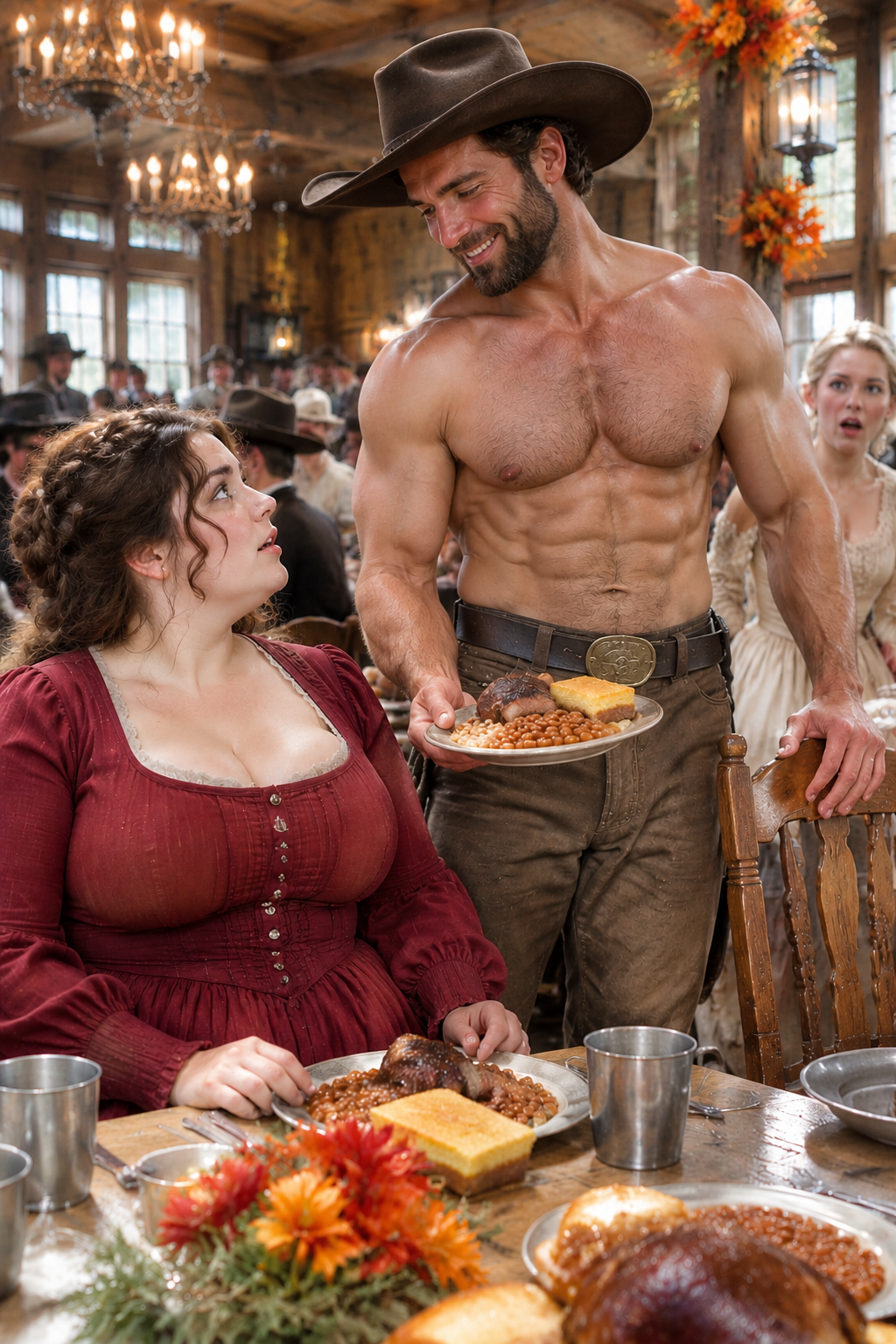
The entire room seemed to go quiet when Gideon Walker walked past every available seat and stopped beside the one woman nobody else wanted to sit with.
The voice came from behind them.
“Gideon Walker!”
Gideon slowly turned. A tall, well-dressed man stood near the entrance, holding a glass of whiskey. His expensive coat and polished boots made him look out of place among the farmers and ranchers of Red Willow.
“Didn’t expect to find you here,” the stranger said.
Gideon’s expression changed. The warmth that had been in his eyes moments earlier disappeared.
“Evening, Charles.”
Lillian glanced between the two men.
Charles looked at Gideon, then at the woman sitting beside him. His eyes lingered on Lillian’s burgundy dress before a faint smile appeared.
“Well, well. I see you’ve found yourself some company.”
Gideon didn’t answer.
Charles laughed quietly. “I suppose a man gets lonely out there on the ranch.”
Hattie set down her fork.
“Some people are lonely because they choose to be,” she said. “Others are lonely because the people around them have forgotten how to be decent.”
A few guests lowered their eyes.
Charles ignored her and turned back to Gideon.
“I need to speak with you. It’s about the ranch.”
“Whatever it is, it can wait.”
“It can’t.”
For several seconds, the two men stared at each other.
Finally, Gideon looked at Lillian.
“Would you mind if we finished our conversation after supper?”
She nodded, though disappointment had already begun to settle in her chest.
Charles walked away first.
Gideon remained seated for another moment.
“I’m sorry,” he said.
“You don’t owe me an apology.”
“Maybe not. But I don’t like leaving a conversation unfinished.”
Lillian smiled faintly.
“Then you should come back and finish it.”
He looked at her as if those simple words meant more than she realized.
“I intend to.”
The harvest supper continued, but Lillian found it difficult to concentrate.
She could feel the occasional glance from Edith Holloway and the other women who had spent years making her feel invisible.
Edith eventually approached their table.
“My goodness, Lillian. That’s quite a dress.”
“Thank you.”
“You made it yourself?”
“I did.”
Edith examined the burgundy fabric.
“How ambitious. I suppose it’s nice to have something to do when nobody asks you anywhere.”
The remark was delivered with a sweet smile, but everyone nearby understood its meaning.
Lillian’s fingers tightened around her napkin.
Before she could answer, Hattie spoke.
“She doesn’t need an invitation to make herself beautiful, Edith.”
Edith’s smile stiffened.
“I was only making conversation.”
“Then perhaps you should practice.”
A few people laughed.
Edith walked away, her cheeks red.
Lillian looked down.
“Thank you, Hattie.”
The older woman squeezed her hand.
“Don’t thank me for saying what should have been said years ago.”
When the music began, couples moved toward the dance floor.
Lillian stayed seated.
She had learned not to expect anyone to ask her.
Then she heard footsteps.
Gideon stood beside her.
“Would you care to dance?”
She blinked.
“With me?”
He glanced around the room.
“Unless there’s another Lillian Bennett hiding under this table.”
She laughed despite herself.
“I don’t know how well I dance.”
“That’s fortunate. I’m not much better.”
He held out his hand.
After a brief hesitation, she accepted.
The room seemed to grow quieter as they stepped onto the floor.
Gideon placed one hand carefully at her waist. He held her other hand with surprising gentleness for a man whose fingers were rough from years of ranch work.
They began to move.
Lillian was nervous at first, but Gideon kept his steps slow.
“You’re doing fine,” he murmured.
“I’m trying not to step on your boots.”
“If you do, I’ll consider it part of the evening.”
She smiled.
For the first time in years, Lillian wasn’t watching other people dance.
She was dancing herself.
And she was enjoying it.
Across the room, Edith watched with narrowed eyes.
But Lillian no longer cared.
After the supper, Gideon walked her home.
The autumn air was cold, and fallen leaves moved across the road beneath their boots.
For a while, neither spoke.
Then Gideon broke the silence.
“I owe you an explanation about Charles.”
“You don’t have to tell me anything you don’t want to.”
“I know. But I’d like to.”
He explained that Charles Whitmore was a businessman from the county seat. Years earlier, Charles had approached him with a proposal to purchase part of Blackpine Ranch.
Gideon had refused.
Charles believed the land held valuable timber and wanted to build a large operation there. He had offered more money than Gideon had ever seen in his life.
But the ranch had belonged to Gideon’s family for generations.
“My father taught me how to work that land,” Gideon said. “My mother planted the apple trees near the house. I buried them both there.”
Lillian understood.
“It must be difficult to consider selling it.”
“I’m not selling.”
He kicked a small stone from the road.
“Charles doesn’t like hearing no.”
“Is he causing trouble?”
“He’s trying.”
Gideon didn’t say more.
When they reached Lillian’s gate, he stopped.
“There’s something else I wanted to ask you.”
She looked at him.
“The question you started asking at supper?”
He nodded.
“I was wondering if you’d have dinner with me. Just the two of us. No harvest crowd, no music, no one watching.”
Lillian stared at him.
“Why?”
Gideon seemed surprised.
“Because I enjoy being around you.”
“People around here don’t exactly think I’m someone worth spending time with.”
“Then people around here have made a serious mistake.”
Her eyes began to sting.
She looked away quickly.
“All right,” she whispered.
Gideon smiled.
“Saturday?”
“Saturday.”
He tipped his hat.
“Good night, Lillian.”
“Good night, Gideon.”
She watched him walk away until the darkness swallowed his figure.
For the first time in a long while, she went to bed looking forward to tomorrow.
Saturday arrived with a clear sky and a sharp autumn wind.
Lillian spent most of the morning cleaning her little house.
She changed her mind about her dress three times before finally choosing a simple blue one.
She brushed her hair, pinned it neatly, and placed a small silver brooch at her collar.
It had belonged to her mother.
At exactly six o’clock, a knock came at the door.
Gideon stood outside holding a small bunch of wildflowers.
“They’re not much,” he said.
“They’re beautiful.”
“I picked them along the creek.”
Lillian took them carefully.
“Come in while I put these in water.”
He stepped inside.
His eyes moved around the small room. Everything was clean and neatly arranged. A sewing basket sat beside the window, and several unfinished garments rested on a chair.
“You’ve made this place comfortable,” he said.
“I’ve had practice making the best of what I have.”
Gideon looked at her.
“There’s nothing wrong with that.”
They walked to the little restaurant near the edge of town.
It wasn’t fancy, but the food was warm and the owner greeted them kindly.
At first, their conversation was cautious.
Then Gideon told her about the first time he had come to her shop.
“I remember thinking you were the only person in town who looked at a torn coat and saw something worth repairing.”
Lillian smiled.
“That’s my job.”
“No. I mean you didn’t complain about the work. You didn’t rush it. You checked every stitch twice.”
“Your coat was in bad shape.”
“It was.”
He paused.
“Most people don’t notice the things you notice.”
Lillian looked down at her plate.
“Perhaps because most people aren’t looking.”
Gideon nodded.
“I think you’re right.”
He told her that he had noticed her long before he brought the coat to her shop.
He had seen her carrying fabric through town, delivering dresses, and helping Hattie with her garden.
He had also seen the way people treated her.
“I didn’t understand it,” he said.
“People like having someone to look down on. It makes them feel taller.”
“Does it hurt?”
The question was so direct that Lillian almost laughed.
“Of course it does.”
She folded her hands.
“But you learn to live with it. Eventually, you stop expecting people to be kind.”
Gideon looked at her for a long moment.
“I hope you don’t expect that from me.”
She met his eyes.
“I don’t.”
And for the rest of the evening, she believed him.
Over the next few weeks, Gideon continued visiting her shop.
Sometimes he brought actual sewing repairs.
Sometimes he brought supplies she needed.
Once, he arrived with a new lamp because the old one had begun flickering.
Another time, he brought a sack of apples from his orchard.
He never made a show of his generosity.
He never treated her like someone who needed saving.
He simply made room for her in his days.
Lillian began to look forward to the sound of his boots outside her door.
She also began to notice things about him.
He always checked that her stove had enough wood before leaving.
He remembered how she took her tea.
He never interrupted when she was working.
And whenever she laughed, his face seemed to soften.
One afternoon, Hattie visited the shop and found Lillian smiling at a piece of fabric.
“You’re thinking about him again.”
Lillian nearly dropped her scissors.
“I’m thinking about a dress.”
“Of course you are.”
Hattie sat down.
“That man looks at you as though the sun rises over your sewing table.”
“Don’t be ridiculous.”
“I’m old, not blind.”
Lillian shook her head, but she couldn’t hide her smile.
Then Hattie’s expression grew serious.
“Just remember something, dear. A good man can bring happiness into your life, but he shouldn’t become the reason you believe your life has value.”
Lillian looked at her.
“I know.”
“Do you?”
Hattie reached across the table.
“You were worth knowing before Gideon ever walked through that door.”
Lillian felt a lump rise in her throat.
“I wish more people had seen that.”
“Some people never will. Don’t spend your life waiting for them.”
Lillian carried those words with her long after Hattie left.
Meanwhile, Charles Whitmore was becoming increasingly impatient.
He had spent months trying to persuade Gideon to sell a section of Blackpine Ranch.
The land included a stretch of timber near the northern creek, and Charles believed it could make him a fortune.
But Gideon refused every offer.
Charles had recently discovered that the ranch’s northern boundary contained an old mineral deposit. He was convinced that the property was worth far more than Gideon understood.
He needed Gideon to sign a new survey agreement before the county approved the next development application.
So he began spreading rumors.
He told people Gideon was having financial difficulties.
He suggested the ranch was about to be lost.
And when he learned Gideon was spending time with Lillian Bennett, he found another opportunity.
One afternoon, Charles entered her shop.
Lillian was measuring a customer’s sleeve.
“Good afternoon,” he said.
She looked up.
“Can I help you?”
“I believe you can.”
He waited until the customer had left.
Then he placed a small envelope on the counter.
“What’s this?”
“A business opportunity.”
Lillian didn’t touch it.
Charles smiled.
“I understand Gideon Walker has become a frequent visitor.”
“He’s a customer.”
“Of course.”
His eyes moved around the shop.
“How much longer do you intend to keep this place open?”
“That isn’t your concern.”
Charles chuckled.
“Straight to the point. I can appreciate that.”
He opened the envelope and revealed several banknotes.
“There’s a matter involving Gideon that I’d like you to help me with.”
Lillian looked at the money.
“What matter?”
“I want him to reconsider selling his land. Perhaps you could encourage him.”
“Why would I do that?”
“Because I would be willing to make it worth your while.”
Lillian stared at him.
“Are you asking me to betray someone?”
“I’m asking you to be practical.”
He pushed the envelope closer.
“There’s enough here to give your little shop a fresh start. You could purchase better equipment, move somewhere larger, perhaps even open a proper dressmaking business in the county seat.”
Lillian felt her face grow hot.
“Take your money.”
Charles’s smile disappeared.
“You should think carefully. Opportunities like this don’t come twice.”
“I don’t need your opportunities.”
He closed the envelope.
“Then perhaps you’ll discover how expensive loyalty can be.”
He walked out.
Lillian stood motionless for several seconds.
She had never been more certain that she had done the right thing.
But she was also frightened.
Charles was not the sort of man who accepted rejection gracefully.
That evening, she told Gideon what had happened.
He listened without interrupting.
When she finished, his jaw tightened.
“He offered you money?”
“Yes.”
“To persuade me to sell?”
“That’s what he said.”
Gideon stood and walked toward the window.
“I knew he’d try something.”
“What’s really happening, Gideon?”
He turned.
“I’ve been checking the old property records. My father left some documents in the house. I found references to an original land survey that doesn’t match the one Charles has been using.”
Lillian frowned.
“What does that mean?”
“It means he may be trying to claim land that doesn’t belong to him.”
He paused.
“I don’t have all the proof yet.”
“Then you need to find it.”
“I intend to.”
He looked at her.
“But I don’t want you caught in the middle.”
Lillian crossed her arms.
“I’ve spent most of my life being told to stay out of the way. I’m tired of it.”
Gideon gave a small smile.
“I wasn’t telling you to stay out of the way.”
“Good.”
“I was telling you that I don’t want anyone hurting you because of me.”
Her expression softened.
“Then don’t make decisions for me. Let me decide what risks I’m willing to take.”
Gideon was quiet.
Finally, he nodded.
“Fair enough.”
Two days later, trouble arrived at Blackpine Ranch.
Gideon had been working near the northern fence when he discovered that several fence posts had been removed.
A section of the boundary had been marked with fresh stakes.
He recognized the surveyor’s markings.
Charles had been there.
Gideon rode straight to town and confronted the county surveyor.
The man looked uncomfortable.
“I was only following instructions.”
“Whose instructions?”
“Mr. Whitmore’s office.”
“Did you have authorization from the property owner?”
The surveyor hesitated.
“I was told the paperwork was being handled.”
“Then you were told incorrectly.”
Gideon returned home and began searching his father’s old papers again.
That night, he found a letter tucked inside a leather-bound ledger.
It was dated nearly forty years earlier.
His father had written that the northern boundary included the entire creek bed and the timberland beyond it.
Attached was a faded map bearing the original county seal.
Gideon’s hands trembled.
This was what he had been looking for.
But the document was damaged, and the seal was difficult to read.
He needed someone to verify it.
The next morning, he brought it to Lillian.
She studied the map carefully.
“I can make out the writing, but the seal is too faded.”
“Do you know anyone who could help?”
Lillian thought for a moment.
“Mr. Samuel Price at the historical society. He has spent years restoring old town records.”
Gideon nodded.
“Will you come with me?”
“Of course.”
They visited Samuel that afternoon.
The elderly archivist examined the map through a magnifying glass.
He grew quiet as he studied the seal.
“Where did you find this?”
“My father’s papers.”
Samuel looked up.
“Do you know what this is?”
Gideon shook his head.
“It’s the original boundary survey for Blackpine Ranch.”
Samuel turned the document toward the light.
“And it appears to be authentic.”
Gideon leaned forward.
“Are you certain?”
“I can’t give you a final determination without comparing it to the county records. But I’ve seen this seal many times. It matches the period.”
Samuel walked to a cabinet and removed an old ledger.
He searched several pages before stopping.
“There.”
He pointed to an entry.
The original boundary description matched Gideon’s map.
But something else caught his attention.
A later entry had been added in a different hand.
Samuel frowned.
“This amendment is suspicious.”
“What amendment?” Gideon asked.
“It appears someone attempted to change the northern boundary decades after the original survey.”
“Who?”
Samuel traced the faded signature.
Then his face grew serious.
“Whitmore.”
Gideon stared at him.
“Charles’s father?”
Samuel nodded.
“Yes. And if this record was altered without proper authorization, the entire claim may be invalid.”
For the first time in months, Gideon felt hope.
But Samuel raised one finger.
“Don’t celebrate yet. We need the original county filing and a proper legal review.”
Gideon thanked him.
Outside, Lillian touched his arm.
“At least you have somewhere to begin.”
He looked at her.
“More than that. I have you.”
She smiled.
But neither noticed the man standing across the street.
Charles Whitmore had watched them leave the building.
And he had seen the old map in Gideon’s hands.
The following morning, Lillian received a visit from the county clerk.
He informed her that someone had filed a formal complaint against her business.
The complaint claimed she had accepted money to influence a land dispute.
Lillian was stunned.
“That’s a lie.”
The clerk looked uncomfortable.
“There’s a statement attached.”
“From whom?”
He handed her a paper.
It contained a signature she recognized immediately.
Edith Holloway.
Lillian read the statement twice.
Edith claimed she had seen Lillian accept an envelope from Charles Whitmore and had heard her promise to persuade Gideon to sell the ranch.
None of it was true.
The clerk explained that the complaint was preliminary, but the matter would need to be investigated.
After he left, Lillian sat behind her counter.
Her hands were shaking.
Edith had seen Charles enter the shop. She had apparently watched from outside.
But she had invented everything else.
Lillian wanted to cry.
Not because she was ashamed.
Because she was tired.
Tired of being judged.
Tired of defending herself.
Tired of people deciding what kind of woman she was without ever bothering to know her.
When Gideon arrived that afternoon, he found her sitting silently.
She handed him the complaint.
He read it, his expression darkening.
“Charles is getting desperate.”
“What happens now?”
“We prove the statement is false.”
“How?”
Gideon placed the paper on the counter.
“First, we find out exactly what Edith claims to have seen.”
Lillian looked at him.
“She’ll never admit she lied.”
“Then we’ll find someone who knows the truth.”
The next day, Hattie arrived at the shop with a determined expression.
“I heard what happened.”
Lillian sighed.
“Everyone has heard.”
“Good. Then everyone can hear the truth too.”
Hattie explained that on the day Charles visited the shop, she had been nearby delivering a basket of preserves.
She had seen him enter.
She had also seen him leave with the envelope still in his possession.
Lillian stood up.
“Why didn’t you tell me?”
“I didn’t know what was in it. I only realized what I’d seen when the rumors started.”
“Would you tell the clerk?”
Hattie lifted her chin.
“I’d tell the governor if I had to.”
Gideon smiled.
“That might not be necessary.”
But Hattie was not finished.
“There’s something else.”
She looked toward the window.
“Edith wasn’t alone that day. Her younger sister, Clara, was with her.”
Lillian frowned.
“Clara?”
“Yes. And Clara has never been comfortable with the way Edith treats people.”
Gideon nodded slowly.
“Perhaps we should speak with her.”
Clara Holloway was not difficult to find.
She worked at the local pharmacy and was known for being quiet and polite.
When Gideon and Lillian approached her, she looked frightened.
“I know why you’re here,” she said.
Lillian’s stomach tightened.
“Do you?”
Clara nodded.
“My sister told me what she wrote in that statement.”
“Was it true?”
Clara looked down.
“No.”
The answer came so softly that Lillian almost missed it.
Clara explained that she had been standing beside Edith when Charles visited the shop.
She had heard the entire conversation from the doorway.
She had seen Charles offer Lillian money.
And she had heard Lillian refuse it.
“Why didn’t you say something sooner?” Gideon asked.
Clara’s eyes filled with tears.
“Because she’s my sister. And I’ve spent my whole life being afraid of upsetting her.”
Lillian studied the young woman.
“Then you understand how it feels to let someone else decide what you should say.”
Clara nodded.
“I do.”
After a moment, she looked up.
“I’ll tell the truth.”
The county hearing was scheduled for the following Tuesday.
By then, the story had spread throughout Red Willow.
Some people believed Lillian.
Others believed Edith.
Charles had made sure the rumors reached every corner of town.
But Lillian refused to hide.
She wore her burgundy dress to the hearing.
The same dress she had made for herself.
Hattie sat beside her.
Gideon sat on her other side.
When the hearing began, Charles’s attorney presented the complaint.
Edith stood and repeated her statement.
She spoke confidently, occasionally glancing toward Lillian with a look of false sympathy.
Then Hattie was called.
She explained that she had seen Charles enter the shop and leave with the envelope.
She also stated that Lillian had never asked Gideon to sell the ranch.
Next came Clara.
Her voice trembled at first.
But as she continued, her words grew stronger.
She described the conversation exactly as she had heard it.
She repeated Lillian’s refusal.
Then she looked directly at her sister.
“You lied because you wanted to help Mr. Whitmore.”
Edith’s face turned pale.
“Clara, sit down.”
Clara shook her head.
“No. I’m tired of sitting down whenever you tell me to.”
A murmur moved through the room.
The clerk asked Edith whether she wished to revise her statement.
She refused.
But the evidence was enough to discredit the complaint.
The charge against Lillian was dismissed.
Charles’s attorney leaned toward him and whispered something.
For the first time, Charles looked uncertain.
But Gideon wasn’t finished.
He stood and presented the original survey map, the historical records, and Samuel Price’s preliminary findings.
The county clerk examined the documents.
A special review was ordered.
Charles objected loudly.
He claimed the documents were old and unreliable.
But Samuel, who had been invited to testify, explained that the original survey matched the earliest county records.
The hearing ended without a final ruling.
Still, one thing had become clear.
Charles’s claim was no longer unquestioned.
That evening, Gideon walked Lillian home.
She was exhausted.
“I never thought standing up for myself would feel so frightening,” she said.
“Being brave doesn’t mean you’re not frightened.”
She looked at him.
“Do you think we’ll win?”
Gideon stopped beside her gate.
“I think the truth has a way of finding its feet. Sometimes it just takes longer than we’d like.”
He reached for her hand.
“I also think you did something today that took more courage than anything I’ve done in years.”
“What?”
“You refused to let them make you ashamed of something you never did.”
Lillian squeezed his hand.
For a moment, neither spoke.
Then Gideon took a breath.
“I’ve been thinking about something.”
“That sounds dangerous.”
He laughed.
“Maybe.”
His expression became serious.
“I don’t want to keep finding excuses to visit your shop.”
Lillian’s heart began beating faster.
“What do you mean?”
“I want to visit because I want to see you. I want to take you to dinner because I enjoy your company. I want to know what makes you happy and what keeps you awake at night.”
He paused.
“And if you’ll let me, I’d like to court you properly.”
Lillian looked at him for a long moment.
“You already have been.”
Gideon smiled.
“Then perhaps I should make it official.”
She stepped closer.
“Perhaps you should.”
He kissed her gently beneath the autumn trees.
It wasn’t a grand kiss.
There were no witnesses or cheering crowds.
But to Lillian, it felt like the beginning of something she had never allowed herself to imagine.
The investigation into Blackpine Ranch continued for several weeks.
The county obtained the original survey documents from the regional archives.
An independent land examiner compared the records.
His report confirmed that the original boundary included the northern creek and the surrounding timberland.
The later amendment had never been properly approved.
Charles Whitmore’s claim was invalid.
Worse, the examiner discovered that several recent survey markings had been placed beyond the boundaries of Charles’s own property.
The county ordered the markings removed and referred the matter for further legal review.
Charles was furious.
He had expected Gideon to become frightened and accept his offer.
Instead, he had drawn attention to records that exposed his own actions.
His business partners began asking questions.
One withdrew from a proposed development deal.
Another demanded an explanation for the disputed survey.
Charles had spent years building his reputation on the belief that money could make people look away.
For once, it wasn’t working.
Edith also faced consequences.
Several women who had once repeated her gossip stopped inviting her to gatherings.
She blamed Clara.
She blamed Lillian.
She blamed everyone except herself.
Clara, however, began building a life separate from her sister’s approval.
She apologized to Lillian privately.
“I should have spoken sooner.”
Lillian accepted the apology.
“You spoke when it mattered. Now make sure you don’t lose your voice again.”
Clara smiled through her tears.
“I won’t.”
Winter arrived early that year.
Snow covered the roads around Red Willow, and the wind swept across the open fields.
Gideon spent most of his days repairing fences and preparing the ranch for the cold months.
Lillian’s shop remained busy.
Something unexpected had happened after the hearing.
Women who had once ignored her began bringing their clothes for alterations.
Some came because they genuinely admired her work.
Others came because they had heard about her courage.
Lillian welcomed customers politely, but she no longer changed her prices or worked late simply to earn their approval.
She had learned that being respected was different from being liked.
One afternoon, Edith entered the shop.
She looked uncomfortable.
Lillian was measuring a customer’s coat.
“Good afternoon,” she said.
Edith glanced around.
“I need a dress altered.”
Lillian nodded.
“What needs changing?”
Edith removed a folded garment from a bag.
“It’s for the winter charity supper.”
Lillian examined it.
The work was simple.
“I can have it ready by Friday.”
Edith hesitated.
Then she lowered her voice.
“About the hearing…”
Lillian continued measuring the dress.
“What about it?”
“I suppose things got out of hand.”
Lillian looked at her.
“You made a false statement about me.”
Edith’s face tightened.
“I was trying to help someone.”
“You were trying to hurt me.”
For once, Edith had no quick answer.
After a moment, she said, “I’m sorry.”
Lillian studied her.
She had imagined this moment many times.
In those imagined conversations, she had said everything she had wanted to say.
But now, standing face to face with the woman who had made so many years difficult, she felt strangely calm.
“An apology is a beginning,” Lillian said. “It doesn’t erase what happened.”
Edith nodded.
“I understand.”
Lillian handed her the receipt.
“Friday afternoon.”
Edith took it and left.
Hattie, who had been sitting near the window, looked up.
“That was kinder than I would have been.”
Lillian smiled.
“I don’t need to become cruel just because someone else was.”
Hattie nodded approvingly.
“Now you’re talking.”
As the months passed, Gideon and Lillian grew closer.
He began helping with small repairs around her house.
She occasionally visited the ranch and helped organize the old family records.
They learned each other’s habits.
Gideon discovered that Lillian hummed when she was concentrating.
Lillian discovered that Gideon talked to his horses as though they were old friends.
They also disagreed sometimes.
He was stubborn about accepting help.
She was stubborn about asking for it.
But they learned to listen.
One evening, Gideon invited her to the ranch.
He had prepared supper himself, though the potatoes were slightly burned and the bread was far too hard.
Lillian ate every bite.
“How is it?” he asked.
“Memorable.”
He frowned.
“That’s not encouraging.”
She laughed.
“It’s wonderful.”
After supper, they sat on the porch.
The sky was full of stars.
Gideon took her hand.
“I’ve been thinking about the future.”
“So have I.”
He looked toward the dark outline of the hills.
“I don’t want you to give up your shop. I know how much it means to you.”
Lillian rested her head against his shoulder.
“And I don’t want you to give up the ranch.”
“Good. Because I’m not planning to.”
They sat quietly for a while.
Then Gideon said something that made her lift her head.
“I’d like us to build a life together. Not because either of us needs rescuing. Because we make each other’s lives better.”
Lillian felt tears gather in her eyes.
“That’s exactly what I want.”
Spring returned to Red Willow.
The snow melted, the creek ran high, and the fields began turning green.
Gideon took Lillian to the old apple trees near his parents’ house.
He had spent weeks repairing the small wooden bench beneath them.
On the seat lay a little velvet box.
Lillian stopped walking.
“Gideon?”
He took the box and opened it.
Inside was a simple gold ring.
It wasn’t the most expensive ring in the county.
But it was beautiful.
“I don’t have a perfect speech,” he said.
“I wouldn’t expect one.”
He laughed nervously.
“I’ve spent most of my life believing I could handle everything on my own. Then I walked into your shop with a torn coat, and somehow, I kept finding reasons to come back.”
Lillian smiled through her tears.
“I noticed.”
“I don’t know exactly when it happened. But somewhere between the repairs and the conversations, I realized I didn’t want to go through another day without hearing your voice.”
He took her hand.
“Lillian Bennett, would you marry me?”
For a few seconds, she couldn’t speak.
Then she nodded.
“Yes.”
Gideon slipped the ring onto her finger.
She leaned forward and kissed him.
The apple trees moved gently in the spring breeze.
And for the first time, Lillian felt no need to wonder whether she deserved happiness.
She simply accepted it.
They married in early summer.
The ceremony took place beneath the old trees at Blackpine Ranch.
Hattie stood beside Lillian as her closest friend.
Clara attended and sat near the front.
Samuel Price gave a short speech about family, history, and the importance of preserving what mattered.
Even several people who had once ignored Lillian came to offer their congratulations.
Edith sent a small gift with a handwritten note.
Lillian accepted it without making promises about the future.
Some wounds healed slowly.
Some relationships never returned to what they might have been.
And that was all right.
Lillian wore a burgundy dress.
Not the exact dress from the harvest dance, but one she had sewn herself using the same rich fabric.
When Gideon saw her walking toward him, his eyes filled with tears.
He reached for her hand.
“You look beautiful.”
She smiled.
“So do you.”
He laughed.
“That’s generous.”
Their vows were simple.
They promised to respect each other, to speak honestly, to share the burdens of difficult days, and to celebrate the ordinary ones.
After the ceremony, there was music, food, and dancing.
Hattie danced with Samuel.
Clara laughed with the other guests.
And Gideon kept Lillian close through every song.
At one point, he leaned toward her.
“Do you remember the harvest supper?”
She smiled.
“The night you walked past every other seat?”
“I was nervous.”
“You didn’t look nervous.”
“I was terrified.”
She laughed.
“Of what?”
“That you’d tell me to sit somewhere else.”
Lillian looked at him.
“Why would I have done that?”
“Because I had no idea whether you wanted me there.”
She squeezed his hand.
“I was wondering the same thing.”
He kissed her forehead.
“Then I’m glad we both took a chance.”
Years later, people in Red Willow would still tell the story of the quiet dressmaker and the rancher who kept bringing torn things to her shop.
Some remembered the burgundy dress.
Others remembered the hearing that exposed Charles Whitmore’s dishonest dealings.
But Hattie always told the story differently.
She said it began when a woman finally stopped saving her best dress for a day that might never come.
She said Lillian had spent years believing she needed to become someone else before she could be loved.
And she said Gideon had reminded her that being seen by the right person could change everything.
But Lillian herself had a different lesson.
She never forgot the years when people looked through her as though she weren’t there.
She never forgot how it felt to sit alone while others laughed together.
And she never forgot the first time Gideon chose the chair beside her.
But she also understood something important.
Gideon hadn’t given her worth.
Hattie hadn’t given her worth.
Marriage hadn’t given her worth.
She had possessed it all along.
The people who failed to recognize it had been wrong.
The people who eventually recognized it were welcome to share in her happiness, but they no longer had the power to decide it.
Lillian kept her little sewing shop even after marrying Gideon.
She expanded it, hired two young women from town, and began teaching girls who wanted to learn the trade.
She made dresses for weddings, coats for winter, and simple garments for people who couldn’t afford expensive clothes.
She also made one burgundy dress every year.
Not because she needed another harvest dance.
But because she wanted to remember the woman who had finally decided that an ordinary day was reason enough to wear something beautiful.
And whenever someone asked how she and Gideon had fallen in love, she always smiled.
“It started with a torn coat,” she would say.
Then she would add, “But it lasted because he never treated me like something broken.”
Gideon, whenever he heard the story, would pretend to protest.
“That coat wasn’t the only thing I came back for.”
Lillian would laugh.
“I know.”
And that was the truth.
Sometimes love doesn’t arrive with grand promises or perfect timing.
Sometimes it arrives quietly, in the form of a repaired shoulder, a bundle of firewood, a chair pulled out at a crowded table, or a hand extended when the world has made you feel invisible.
But perhaps the greatest lesson in Lillian’s story was this:
Never postpone your happiness until someone else decides you’re worthy of it.
Wear the beautiful dress.
Open the door.
Speak your truth.
Take the seat you deserve.
And never mistake other people’s inability to see your value for a lack of value in yourself.
THE END.