The entire research station watched me bleed onto the glass floor while Dr. Vance called me reckless, but the dragons knew something he didn’t: I was no longer human to them.
“Then where is it coming from?” I asked.
Maya didn’t answer immediately.
Instead, she turned her screen back toward herself, typed something, and watched the results appear. I could see the muscles tightening along her jaw.
“Maya.”
She swallowed.
“It’s coming from Earth.”
For several seconds, I heard nothing except the rain against my apartment window.
“That’s not possible.”
“I thought so too.”
“Someone must have brought back contaminated equipment. A biological sample. Something from the station.”
“We checked every container. Every research specimen. Every person who returned from Cauldron 4.”
“And?”
Maya looked straight into the camera.
“The signal is coming from inside your apartment.”
I stared at her.
Then I looked around my bedroom.
My clothes lay folded over a chair. A half-empty glass of water sat beside my bed. Beyond the window, the lights of New Geneva shimmered beneath a curtain of rain.
Nothing moved.
Nothing looked different.
But suddenly, I remembered something.
For three months, I had been dreaming of red mountains.
Not occasionally.
Every night.
I dreamed of flying above the cliffs of Cauldron 4, feeling warm air rush beneath enormous wings that did not belong to me.
I dreamed of Ember calling from somewhere beneath the stone.
And sometimes, just before waking, I heard a heartbeat that was not my own.
“Maya,” I whispered, “what exactly did Ember put into my blood?”
Her expression changed.
“What do you mean?”
“The bite. We assumed it was only a chemical exchange.”
“That’s what the tests showed.”
“Did we ever test whether the exchange was still happening?”
Maya went completely still.
Then the lights in my apartment flickered.
Once.
Twice.
My scar began to glow.
Not brightly, but enough to illuminate the pale lines where Ember’s teeth had pierced my skin.
A warmth spread through my palm.
I heard something scrape against the window.
I turned.
On the outside of the glass, twenty-three floors above the street, a small copper-colored shape clung to the building.
My breath stopped.
Two dark eyes looked back at me.
“Ember?”
The creature tilted its head.
Then it spread its wings.
For one impossible second, I believed she had crossed the distance between worlds.
But when lightning flashed, I saw the truth.
It wasn’t Ember.
Its wings were translucent.
Its body shimmered like a reflection in disturbed water.
And behind it, suspended in the rainy darkness, were dozens of other shapes.
Dragons made of light.
“Maya,” I said slowly, “I think we have a problem.”
She was already looking at her instruments.
“Kest, get away from the window.”
“Why?”
“Because the signal just multiplied.”
The creature outside pressed one tiny claw against the glass.
My scar pulsed.
And a memory entered my mind.
Not mine.
Ember’s.
I saw the valley after our shuttle departed.
The empty research station.
The nests hidden among warm basalt cliffs.
Ember standing beneath the observation window, watching the sky long after my ship had vanished.
Then the image changed.
The ground began shaking.
Something deep beneath Cauldron 4 awakened.
Something the dragons feared.
The vision disappeared so violently that I stumbled backward.
“Kest!”
I caught myself against the bed.
My heart was hammering.
“Something happened to the valley.”
Maya’s eyes narrowed.
“What did you see?”
“An earthquake. Or something beneath the ground.”
She turned toward another monitor.
“We’ve received no seismic data since the station was evacuated.”
“Why was the station evacuated?”
Maya hesitated.
And that hesitation frightened me more than anything I had seen outside.
“Maya.”
“The official report said the mission had concluded.”
“That’s what they told us.”
“Yes.”
“What did they tell you?”
She looked away.
“Two weeks after you left, orbital instruments detected something beneath the western ridge. A structure nearly forty kilometers across.”
“A geological formation?”
“We thought so.”
“And now?”
She opened an image.
I recognized Cauldron 4 immediately.
The valley was scarlet beneath its familiar black mountain ranges.
But beneath the surface, revealed by penetrating radar, lay an enormous circular shape.
Perfectly symmetrical.
Surrounded by branching tunnels that stretched beneath the entire valley.
My stomach tightened.
“That’s not natural.”
“No.”
“Is it a machine?”
“We don’t know.”
“Why didn’t anyone tell me?”
“Because the Directorate classified the discovery.”
I stared at her.
For eleven months, I had trusted the organization that funded our mission.
I had given them everything.
My work.
My research.
My first real understanding of a world beyond Earth.
And they had hidden something that might threaten the creatures I loved.
“What are they doing?”
Maya took a breath.
“They sent another expedition.”
“When?”
“Seventeen days ago.”
My scar burned.
Outside, the glowing dragon pressed harder against the window.
A thin crack appeared in the glass.
“Who authorized it?”
“Director Halden.”
I knew that name.
Everyone in interplanetary research knew it.
Elias Halden controlled the Directorate’s most expensive deep-space operations.
He was brilliant, politically untouchable, and famous for believing that every scientific discovery should eventually serve human expansion.
“What is his expedition supposed to accomplish?”
Maya lowered her voice.
“They’re drilling into the structure.”
The crack across my window spread.
And suddenly, every glowing dragon outside turned its head in the same direction.
Toward the stars.
I felt something move through my blood.
Fear.
Not my fear.
Theirs.
Then a message formed inside my mind, simple and unmistakable.
Come back.
Six hours later, I was standing in a secure Directorate facility with Maya beside me and armed guards blocking the only exit.
Director Halden sat across from us.
His silver hair was perfectly combed. His expression suggested that our presence was a minor inconvenience.
“You accessed classified material,” he said.
Maya folded her arms.
“You withheld evidence of an artificial structure beneath a protected research site.”
“Protected by whom?”
“By our research agreements.”
Halden smiled faintly.
“Agreements written before we understood the scientific value of what we had found.”
I placed my injured hand on the table.
“Something is happening to the dragons.”
His gaze flickered toward my scar.
“We know.”
That single admission chilled me.
“What have you done?”
“Nothing irreversible.”
“That’s not an answer.”
Halden leaned forward.
“Dr. Kest, the structure beneath Cauldron 4 predates every known civilization in our explored systems. Preliminary analysis suggests it may be a planetary-scale biological computer.”
I thought of the mesh.
The roots.
The fungal networks.
The dragons exchanging memories through their bodies.
“It’s not a computer,” I said.
“Then what is it?”
I looked at the image on the wall.
“A living mind.”
Halden’s smile disappeared.
“Interesting theory.”
“You’ve already made contact with it.”
“Contact is an imprecise word.”
“What happened to the dragons?”
He tapped the table.
A recording appeared.
I saw the western ridge of Cauldron 4.
A drilling platform had been built directly above the ancient structure.
Machines descended into the rock.
Then the mountain moved.
Not collapsed.
Moved.
A vast ripple traveled beneath the surface, and dozens of dragons rose into the air, screaming.
The recording ended.
I could barely breathe.
“You hurt it.”
Halden said nothing.
“You drilled into a living thing.”
“We activated a response.”
“From what?”
“That,” he said, “is what we intend to discover.”
I stood.
“You have to stop.”
“We cannot.”
“Why?”
He activated another display.
A countdown appeared.
17:42:08
“What is that?”
“The estimated time until full activation.”
Maya whispered, “Activation of what?”
Halden’s voice was calm.
“We believe the structure is preparing to transmit a signal across interstellar space.”
“Then let it transmit.”
“We don’t know what it will contact.”
I almost laughed.
For the first time, humans had encountered an intelligence vast enough to connect an entire ecosystem.
And our first response had been to drill into its body because we were afraid of what it might say.
“You don’t understand,” I told him. “It has already transmitted.”
Halden studied me.
“Explain.”
I raised my glowing hand.
“The mesh reached Earth last night.”
His face changed.
Not surprise.
Recognition.
“You’re the source.”
Maya stepped closer to me.
“Don’t.”
Halden pressed a button beneath the table.
The guards moved.
One grabbed my shoulder.
Another reached for my wrist.
My scar erupted with heat.
Every light in the room went dark.
A low vibration filled the walls.
Then, through the black security glass, hundreds of translucent wings appeared.
The guards released me.
Halden stood so abruptly his chair fell backward.
Something immense spoke through my bones.
Not in words.
In memory.
I saw ancient stars.
Worlds covered in oceans.
Worlds buried beneath ice.
Worlds where unfamiliar beings looked toward the sky and wondered whether they were alone.
Between those worlds stretched threads of light.
A network older than humanity.
Then the threads began disappearing.
One by one.
An enormous darkness moved between them, severing connections.
And somewhere inside that darkness, I felt hunger.
The vision vanished.
The lights returned.
Maya was gripping my arm.
Halden stood motionless.
“What was that?” he whispered.
I understood only one part.
The dragons had not been trying to call something dangerous toward us.
They were trying to warn us that something dangerous was already coming.
They allowed me aboard the emergency transport twelve hours later.
Not because Halden trusted me.
Because every machine that attempted to analyze the signal began transmitting my biological signature instead of meaningful data.
The Directorate needed an interpreter.
And I was the only person the mesh had accepted.
Maya came with me.
So did Dr. Vance.
I hadn’t seen him since our departure from Cauldron 4.
He looked older, thinner, and much more tired.
When he entered the shuttle, he placed a metal case beside my seat.
“What’s that?” I asked.
“Research.”
“Yours?”
“Ours.”
I opened the case.
Inside were eleven months of handwritten observations.
Hundreds of pages.
Every time I had defended a dragon’s behavior as intentional communication, Vance had recorded my argument.
Every time I had suspected that the creatures understood compassion, grief, or loyalty, he had preserved the evidence.
I looked at him.
“You kept all this?”
He adjusted his glasses.
“Science requires us to preserve observations, including those that contradict our preferred conclusions.”
For a moment, neither of us spoke.
Then he added, quietly, “I should have listened sooner.”
I closed the case.
It wasn’t quite an apology.
But it was enough.
The journey to Cauldron 4 took four days through the fold corridor.
During those four days, I barely slept.
Every time I closed my eyes, the mesh showed me fragments.
Ember hiding beneath a shattered ledge.
Dragons fleeing from their nests.
A terrible pulse moving through the buried structure.
And, beneath it all, something older.
A memory of the first dragons.
They had not always possessed wings.
Their ancestors had been small creatures that lived in volcanic tunnels, blind and fragile, surviving through cooperation.
Over millions of years, the network had grown with them.
It had learned their fears.
Their needs.
Their dreams.
Eventually, it learned to remember.
Then to understand.
Then to love.
The dragons had not built the enormous intelligence beneath the valley.
They had become its thoughts.
And it had become their memory.
When we entered orbit around Cauldron 4, every alarm aboard the shuttle sounded.
The planet had changed.
Enormous glowing veins spread across the continents.
Storm systems swirled above the valleys in organized spirals.
The atmosphere pulsed with electrical discharges.
And from the western ridge, a column of white light reached into space.
Maya stared at the display.
“It’s beautiful.”
Vance whispered, “It’s dying.”
I turned toward him.
“What?”
He pointed to the seismic readings.
“The structure is losing cohesion. Its communication cycles are accelerating, but its biological support systems are collapsing.”
“The drilling?”
“Possibly. But look at the pattern.”
I looked.
I recognized it.
The same rhythm my scar had been producing for days.
Three short pulses.
One long.
A pause.
Then another.
“It isn’t attacking,” I said.
Maya nodded slowly.
“It’s calling for help.”
We landed at the abandoned station just before dawn.
The valley was almost unrecognizable.
The red cliffs were cracked.
Ash covered the nesting grounds.
The air smelled of sulfur and burned vegetation.
Where hundreds of dragons once filled the skies, only a handful moved among the ruins.
I stepped onto the platform.
“Ember!”
Nothing answered.
I walked toward the valley.
“Ember!”
A weak clicking sound came from beneath a collapsed observation tower.
I ran.
There, surrounded by broken glass and blackened stone, lay a copper dragon.
She was larger than I remembered.
Nearly the size of a hunting dog.
Her wings were torn.
A deep wound crossed her shoulder.
But I knew her eyes.
“Ember.”
She lifted her head.
For one instant, she looked like the terrified hatchling who had bitten me.
Then she tried to stand.
Her legs buckled.
I fell to my knees beside her.
“Easy. I’ve got you.”
She pressed her forehead against my scar.
And the world exploded into memory.
I saw the Directorate’s machines piercing the mountain.
The mesh recoiling in agony.
Dragons swarming the drill site, not to attack, but to protect the structure.
Then came the machines’ sonic defenses.
The dragons fell from the sky.
Ember had led the youngest into the tunnels.
She had saved dozens.
But she could not save them all.
And now she was exhausted.
I held her close.
“I’m sorry.”
A deeper memory entered me.
Matriarch standing at the mouth of a tunnel.
Waiting.
For me.
I looked up.
“We have to reach her.”
Maya appeared beside us carrying a medical pack.
“Where?”
I pointed toward the western ridge.
“Under the mountain.”
Vance examined Ember’s wound.
“She can’t walk.”
“Then I’ll carry her.”
He looked at the trembling creature in my arms.
Then at me.
“Give me the pack.”
We entered the tunnels together.
The passage beneath the western ridge descended for kilometers.
The walls were lined with luminous roots.
Each pulsed faintly as I passed.
Sometimes they touched my hand.
Sometimes I heard whispers that sounded like distant wingbeats.
At the bottom, we reached an enormous cavern.
Matriarch lay in its center.
Her scales had once shone like molten gold.
Now they were dull.
Her breath rattled.
Around her, dozens of dragons rested with their heads lowered.
Beyond them, suspended over a bottomless shaft, was a vast sphere of intertwined living tissue.
It pulsed with light.
The heart of Cauldron 4.
And driven into its surface was a titanium drilling column.
I stared at it.
“They never removed it.”
Vance looked horrified.
“The column is still transmitting resonance pulses.”
Maya checked her scanner.
“It’s forcing the heart into an accelerated communication state. If we disconnect it abruptly, the feedback could destroy the entire mesh.”
“And if we leave it?”
She looked toward Matriarch.
“Then the network dies.”
I approached the ancient dragon.
Her golden eyes opened.
And suddenly I was no longer standing inside the cavern.
I was watching a memory.
Thousands of years before humans reached the stars, Cauldron 4 had detected the disappearance of distant living worlds.
The vast network between them had begun to fail.
Some worlds had fallen silent naturally.
Others had been destroyed.
And one by one, the surviving intelligences had withdrawn into themselves, terrified that contact might expose them to danger.
The darkness I had seen wasn’t a creature.
It was the growing silence between worlds.
A civilization lost its neighbors.
Then its history.
Then the knowledge that anyone else had ever existed.
Each world became an island.
Each island grew afraid.
And fear turned curiosity into suspicion.
Suspicion into violence.
And violence into extinction.
Cauldron 4 had spent centuries trying to reconnect the broken network.
Its signal required something it had never possessed.
A bridge.
A living mind that belonged to one world and was accepted by another.
I opened my eyes.
My hand was glowing brighter.
“That’s why Ember chose me.”
Matriarch gave a low, exhausted rumble.
I understood.
She hadn’t chosen me because I was special.
She had chosen me because, for eleven months, I had shown her people something they had almost forgotten existed beyond their world.
Trust.
Maya approached the drilling column.
“We might be able to reverse the resonance.”
“How?”
“By using the signal already running through Kest.”
Vance turned sharply.
“What are the risks?”
She looked at me.
“His nervous system would become a direct interface with the planetary mesh.”
“Could it kill him?”
“Yes.”
“How likely?”
Maya said nothing.
I looked down at Ember.
Her breathing was shallow.
Outside, an entire world was collapsing because humans had mistaken communication for a threat.
I couldn’t undo that mistake.
But perhaps I could refuse to repeat it.
“Tell me what to do.”
Maya connected the station’s remaining portable equipment to the drilling column.
Vance rerouted power through the cavern’s natural conductive roots.
For twenty minutes, we worked while the heart’s rhythm became increasingly unstable.
Then the countdown began.
Six minutes until the next resonance cascade.
Six minutes until irreversible collapse.
Maya fitted a neural interface around my temples.
“This will hurt.”
“I’ve been bitten by a dragon.”
She managed a weak smile.
“This will be worse.”
I knelt beside the heart.
Thousands of luminous threads stretched toward me.
When I placed my injured hand against them, I felt every dragon on Cauldron 4.
Every frightened hatchling.
Every wounded mother.
Every ancient creature struggling to breathe.
Their pain flowed into me.
My body convulsed.
I screamed.
“Kest!” Vance shouted.
But I could no longer hear him clearly.
The heart opened.
And I fell into an ocean of memory.
I saw Earth.
Human cities shining across continents.
Children learning to speak.
Parents holding newborns.
Soldiers carrying wounded strangers.
People building hospitals, writing poems, planting gardens.
Then I saw humanity’s darker memories.
Wars.
Cruelty.
Greed.
Forests burning beneath expanding cities.
Creatures hunted because they were misunderstood.
The mesh received everything.
It recoiled.
For one terrifying moment, I felt the dragons pulling away from me.
They saw what humans were capable of.
Not just kindness.
Destruction.
They had trusted me, but they had never seen my entire species.
And now they were afraid.
The signal began to fracture.
I understood what the heart was asking.
How could it trust a civilization that harmed its own world?
I had no comforting answer.
I could not promise that humanity would become gentle.
I could not erase its history.
So I gave the mesh the only truth I had.
I showed it Maya risking her career to expose the Directorate.
Vance preserving evidence that contradicted his beliefs.
I showed it the humans who had rescued creatures trapped in floods, defended forests they would never visit, and devoted their lives to healing strangers.
I showed it that cruelty was real.
But so was the choice to resist it.
And then I gave it my strongest memory.
A small frightened dragon biting my hand.
Me recoiling in pain.
Then choosing not to hurt her.
The mesh grew still.
Through the rushing memories came Matriarch’s presence.
An enormous, ancient consciousness touched mine.
I felt a question.
Not whether humans were good.
Not whether we were worthy.
Whether we were willing to learn.
“Yes,” I whispered.
The heart pulsed.
The drilling column began to fracture.
Maya shouted something.
A warning.
I felt pressure building through the mesh.
Too much power.
Too many memories.
The heart was trying to reach beyond Cauldron 4, but my nervous system couldn’t carry the connection.
My vision darkened.
I understood that if I let go, the network would collapse.
If I remained, I would die.
Then something small pressed against my hand.
Ember.
She had dragged herself across the cavern floor.
Her copper forehead touched my wrist.
Warmth moved through me.
Not power.
Recognition.
Then another presence joined.
Matriarch.
Then hundreds.
Thousands.
Across the planet, dragons pressed their bodies against the roots, the stone, the living threads that joined them.
They shared the burden.
What had nearly destroyed one human became bearable when carried by an entire world.
The heart blazed.
The drilling column shattered.
A wave of light erupted from the cavern, raced through the mountains, and soared into the sky.
And suddenly I heard voices.
Not words.
Not languages.
Voices made of memory.
Across impossible distances, sleeping networks answered.
An ocean world showed us luminous creatures singing beneath the ice.
A desert planet offered memories preserved in crystal forests.
A civilization orbiting a dying star sent the image of its final sunrise.
And from Earth came something unexpected.
Human minds.
Not everyone.
Only fragments at first.
A woman dreaming beside her sleeping child.
An old man remembering his wife.
A little girl watching rain slide down a window.
For an instant, the barrier between worlds became thinner than a breath.
Then the light softened.
The heart’s rhythm steadied.
And I fell.
I woke beneath an unfamiliar ceiling.
Maya sat beside my bed.
There were dark circles beneath her eyes.
For several seconds, I couldn’t remember where I was.
Then I reached for my hand.
The scar was gone.
In its place, beneath my skin, a faint copper pattern shimmered like tiny scales.
“Ember?”
Maya smiled.
“She survived.”
I closed my eyes.
Relief nearly overwhelmed me.
“And Matriarch?”
“She’s recovering.”
“The heart?”
“Stable.”
I looked toward the window.
Beyond it, the cliffs of Cauldron 4 glowed beneath a clear violet sky.
Dragons wheeled above the valley.
More than I had ever seen.
“How long was I unconscious?”
“Nine days.”
I tried to sit up.
Maya stopped me.
“Easy.”
“What happened to Halden?”
Her expression hardened.
“The Directorate released the full expedition records after the signal reached Earth. Halden was removed from command. An independent inquiry is underway.”
“And the drilling?”
“Every operation on the planet has been suspended.”
I looked at her.
“That’s not enough.”
“I know.”
Maya reached for a tablet.
“Which is why something extraordinary happened while you were asleep.”
She showed me a recording from Earth.
Millions of people had witnessed the transmission.
Some experienced memories.
Others saw images in dreams.
Scientists confirmed that the signal contained coherent information from several inhabited worlds.
For the first time, humanity had proof that intelligence existed far beyond the boundaries of its own civilization.
But the most important discovery was not technological.
It was biological.
The mesh had not conquered Earth’s communication systems.
It had not invaded human minds.
It had extended an invitation.
And humanity, for all its arguments and fear, had begun to answer.
Universities established research programs dedicated to reciprocal communication.
Governments proposed interplanetary protection agreements.
A coalition of scientists demanded that no living network be studied through invasive methods without meaningful evidence of consent.
Nothing changed overnight.
Some people dismissed the transmission as manipulation.
Others wanted the technology weaponized.
And many were simply afraid.
But for the first time, the question being asked was not what humanity could take from another world.
It was what humanity owed to a world capable of remembering pain.
Maya turned off the recording.
“You changed things, Kest.”
I shook my head.
“No.”
Outside, a copper dragon landed on the balcony.
Ember pressed her nose against the window.
I smiled through sudden tears.
“We changed things.”
Six months later, I stood once again on the platform where Ember had first bitten me.
The research station had been rebuilt, but its purpose was different now.
There were no cages.
No containment chambers.
No drilling rigs.
The observation rooms had been replaced with open terraces where dragons could come and go as they pleased.
Researchers arrived from Earth and several neighboring colonies, but no one entered a nesting area without invitation.
Vance directed the new behavioral ethics program.
He insisted every trainee read the original eleven months of research, including every interpretation he had dismissed.
When someone asked why he preserved his mistakes, he answered, “Because certainty is most dangerous when it stops us from listening.”
Maya led the interplanetary mesh project.
She discovered that its connection to Earth remained fragile, requiring care, patience, and living cooperation rather than stronger transmitters.
And I?
I stayed.
Not because Earth had become meaningless.
But because I finally understood that home was not always the place where you were born.
Sometimes it was the place where another life recognized you without requiring you to become anything else.
One evening, as the red sun sank behind the mountains, Matriarch approached the platform.
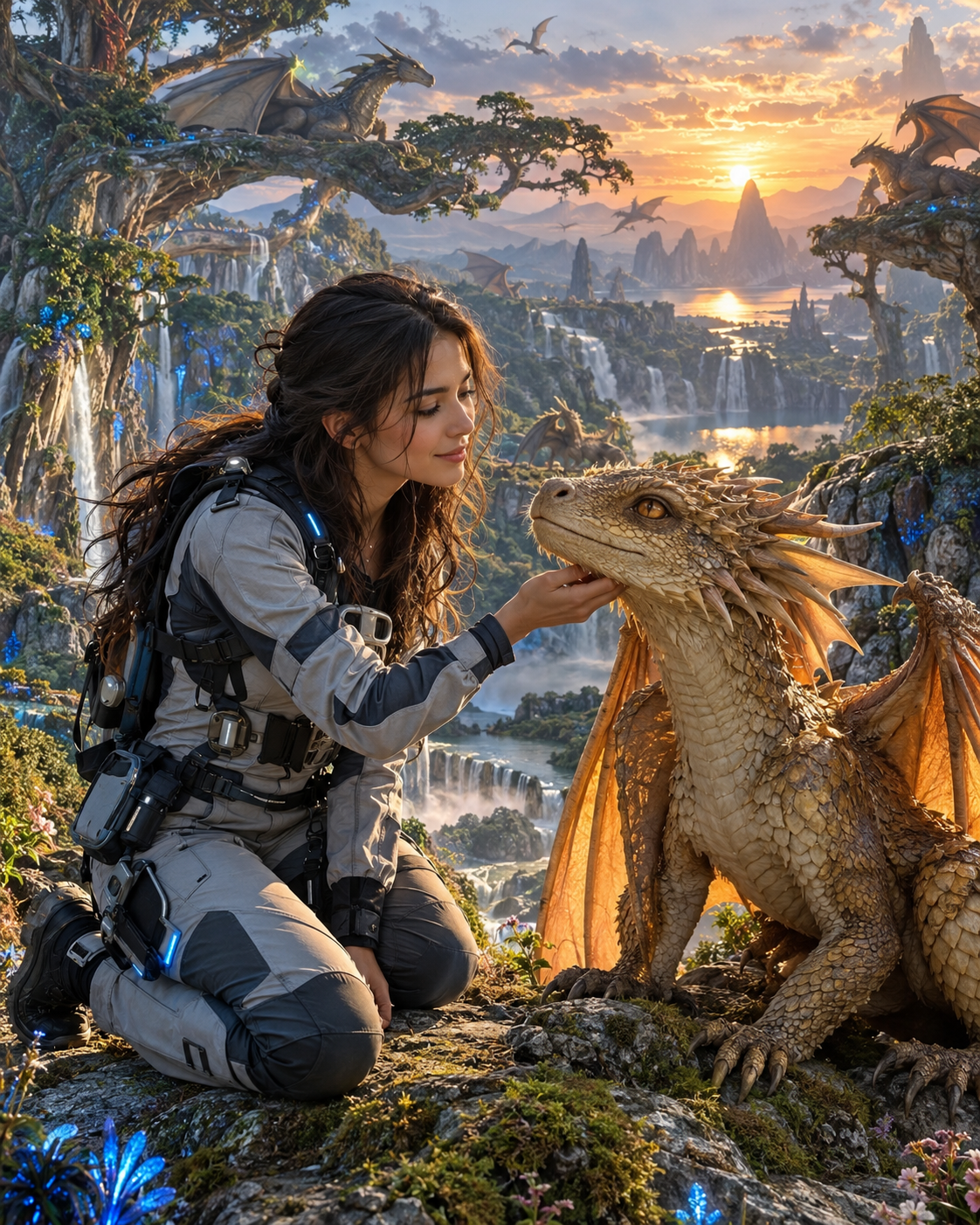
Ember rested beside me, her healed wings folded neatly against her body.
The great dragon lowered her enormous head.
Her golden eye reflected my face.
For a moment, I felt the familiar warmth of the mesh.
A memory passed between us.
The day I arrived.
The day Ember bit me.
The day I left.
The day I returned.
Then came a new memory.
Not of the past.
Of something that had not happened yet.
A child standing beneath Earth’s blue sky.
A small dragon beside her.
Neither afraid.
Neither trying to control the other.
Just two living beings looking toward the stars together.
I smiled.
“Is that a promise?”
Matriarch’s presence touched mine.
Not a promise.
A possibility.
And I finally understood the difference.
A promise demanded certainty.
A possibility asked for responsibility.
The universe was filled with minds we had not yet met, lives we could not yet imagine, and histories that might be destroyed before anyone learned to understand them.
We would make mistakes.
We would misunderstand.
Sometimes we would be afraid.
But fear did not have to be the last decision we made.
Ember climbed onto my lap, much too large for it now, and rested her head against my chest.
I scratched the scales behind her horns.
Far across the valley, hundreds of dragons began calling to one another.
Their voices moved through the cliffs, beneath the roots, into the living heart of the planet, and outward toward distant stars.
This time, when the sound reached me, I did not hear a warning.
I heard welcome.
I looked at the copper pattern beneath my skin and remembered the moment my blood first touched the glass floor.
I had believed Ember’s bite changed what I was.
But I had been wrong about that too.
I was still human.
Flawed.
Curious.
Capable of fear and extraordinary tenderness.
What changed was not my species.
It was the boundary I had mistaken for the end of belonging.
The dragons had taught me something that every civilization, sooner or later, must learn.
Intelligence is not proven by how much we can control.
Greatness is not measured by how many worlds we can claim.
And being powerful enough to hurt another living thing does not make us entitled to do so.
The true measure of a civilization is what it chooses to protect when it has nothing to gain.
Ember closed her eyes.
Above us, the first stars appeared.
Somewhere among them, other worlds were listening.
And for the first time in the long history of humanity, we had learned how to answer without demanding to be heard first.
We listened.
And the universe, at last, spoke back.
THE END.