The engagement party at the Belandi estate was supposed to be the kind of night people in America’s wealthiest social circles would talk about for years.
Sophia Belandi stood frozen at the entrance of the grand ballroom, her eyes fixed on the woman standing beside her mother.
For a moment, the elegant mansion seemed to disappear, replaced by a distant memory filled with smoke, sirens, and the terrifying sound of breaking glass.
She took another step forward, her breathing suddenly uneven.
“Mom,” Sophia whispered, “why does she look so familiar?”
Teresa turned toward her daughter, tears still streaming down her cheeks.
“Sophia, sweetheart, there’s someone I need you to meet.”
But Sophia barely heard her mother’s words.
Her gaze had settled on the curved scar just below Norah Bennett’s shoulder.
It was a mark she had seen once before, on the worst night of her childhood.
Thirteen years had passed, yet certain memories had never completely faded.
A dark stairwell.
A woman’s trembling voice.
Strong arms holding her close while flames swallowed everything around them.
And one sentence, spoken repeatedly through the smoke.
“Keep your eyes on me, little star. We’re going home.”
Sophia’s hand flew to her mouth.
“Little star,” she whispered.
Norah went completely still.
The room had been silent before, but now even the faint clinking of champagne glasses seemed to stop.
Sophia moved closer, her eyes shining with disbelief.
“Did you call me that?” she asked.
Norah’s lips trembled.
“You were frightened,” she answered softly. “I needed you to keep looking at me instead of the fire.”
Sophia made a small, broken sound before rushing forward and throwing her arms around Norah.
For thirteen years, she had imagined this reunion.
She had pictured herself finding the woman who saved her, thanking her properly, and telling her how much that single act of courage had meant.
Never had she imagined finding her working as a maid inside her own family home.
“I looked for you,” Sophia cried. “I asked Dad about you every year.”
Norah closed her eyes as Sophia held her tighter.
“I know, sweetheart.”
Sophia pulled back.
“You knew?”
Norah hesitated.
That hesitation was small, almost invisible, but Roman noticed it immediately.
Something about this reunion wasn’t as simple as everyone believed.
And the more he watched Norah’s expression, the more certain he became that she was hiding something.
Across the ballroom, Vanessa Caruso shifted uncomfortably beneath the attention of nearly two hundred guests.
Only minutes earlier, she had been the most important woman in the room.
Now nobody was looking at her expensive engagement ring or the custom-made gown that had cost more than most Americans earned in several months.
Everyone was watching the maid she had humiliated.
Vanessa approached Roman and caught his arm.
“Roman, please,” she whispered. “We can discuss this privately.”
He gently removed her hand.
“Not yet.”
His voice was controlled, but Vanessa recognized the anger beneath it.
“Your mother is emotional,” she continued. “And this woman could be taking advantage of an old family tragedy.”
Roman turned toward her.
“Be careful what you say next.”
Vanessa stiffened.
“I was only trying to protect your family.”
“By tearing someone’s clothes in front of our guests?”
Several people nearby exchanged uncomfortable glances.
Vanessa’s cheeks burned.
Before she could respond, a deep voice came from the opposite end of the ballroom.
“What in God’s name is happening here?”
Anthony Belandi had arrived.
Roman’s father was a respected New York real estate developer whose name appeared on hospitals, charitable foundations, and luxury buildings throughout Manhattan.
He was a man accustomed to controlling every room he entered.
But the sight before him stopped him cold.
His wife was crying.
His daughter was embracing a housemaid.
His son’s fiancée looked furious.
And dozens of guests were watching in uncomfortable silence.
“Teresa?” Anthony asked.
His wife turned slowly.
“We found her.”
Anthony frowned.
“Found whom?”
Teresa pointed toward Norah.
“The woman who saved Sophia.”
For a brief moment, Anthony’s face became unreadable.
Then something unexpected happened.
Instead of approaching Norah with gratitude, he took a step backward.
Roman noticed.
So did Teresa.
“Anthony?” she asked.
He forced a smile.
“That’s wonderful news.”
But his voice lacked warmth.
He glanced toward the guests and immediately instructed the event coordinator to resume the music.
“Everyone, please enjoy the refreshments,” he announced. “This is a private family matter.”
The orchestra began playing again, though the atmosphere remained painfully tense.
Anthony approached Norah and extended his hand.
“You have our gratitude, Miss Bennett.”
Norah looked at his hand but didn’t take it.
“Thank you, sir.”
Anthony lowered his arm.
“Perhaps we should discuss this somewhere more appropriate.”
Teresa stared at her husband.
“Why are you acting like this?”
“I’m trying to protect our family’s privacy.”
“From the woman who saved our daughter’s life?”
Anthony’s jaw tightened.
“Teresa, please.”
Roman stepped between them.
“Dad, there’s something you’re not telling us.”
Anthony looked at his son.
“This is neither the time nor the place.”
“Then let’s find the right place.”
Roman turned toward the guests.
“Ladies and gentlemen, thank you for coming tonight. Unfortunately, the celebration is ending earlier than planned.”
A wave of murmurs spread across the room.
Vanessa grabbed his sleeve.
“Roman, you can’t be serious.”
He looked directly at her.
“I’ve never been more serious.”
Within twenty minutes, the ballroom began to empty.
Luxury cars rolled away from the Belandi estate, carrying guests who would undoubtedly discuss the evening throughout Manhattan for weeks.
The chandeliers still glittered overhead, but the celebration had lost all meaning.
Inside the family library, Teresa sat beside Norah while Sophia refused to release her hand.
Roman stood near the fireplace.
Vanessa remained by the doorway, uncertain whether she was still welcome.
Anthony poured himself a glass of whiskey.
“Now,” Roman said, “someone needs to explain what really happened thirteen years ago.”
Teresa looked toward her husband.
“We were told the woman who rescued Sophia disappeared before the police could identify her.”
Anthony nodded.
“That’s what the report said.”
Norah lowered her head.
“That wasn’t exactly what happened.”
The room fell silent.
Anthony’s fingers tightened around his glass.
Norah drew a slow breath.
“I didn’t disappear that night. I stayed at the hospital until the next morning.”
Sophia looked startled.
“You did?”
Norah nodded.
“I wanted to make sure you survived.”
She glanced toward Teresa.
“I tried contacting your family afterward.”
Teresa’s expression changed.
“Nobody ever told me.”
“I wrote three letters,” Norah continued. “I also left my telephone number with someone from your husband’s office.”
Anthony set down his glass.
“That was a long time ago. Records get lost.”
Norah looked at him.
“But you received the letters, Mr. Belandi.”
A terrible silence followed.
Teresa slowly turned toward her husband.
“Anthony?”
He looked away.
Roman stepped forward.
“Dad, answer her.”
Anthony exhaled sharply.
“Yes. I received them.”
Sophia stared at him.
“You knew where she was?”
“For a while.”
“And you never told us?”
Anthony rubbed his forehead.
“You don’t understand the circumstances.”
“Then explain them,” Teresa said.
Her voice was no longer trembling.
It was cold.
Anthony walked toward the fireplace.
“After the fire, there was an investigation into the building’s safety conditions.”
Roman frowned.
“What does that have to do with Norah?”
Anthony said nothing.
Norah looked toward the photographs displayed above the fireplace.
One showed a much younger Anthony standing beside the mayor of New York at a ribbon-cutting ceremony.
Behind them was an apartment building.
A building Norah remembered very well.
“The fire happened at the Hawthorne Apartments,” she said quietly.
Roman nodded.
“Brooklyn. I remember.”
Norah turned toward Anthony.
“And your company owned that building.”
Teresa stared at her husband.
“What?”
Anthony’s face hardened.
“The property was held through an investment partnership.”
“That doesn’t change who owned it,” Norah replied.
Roman felt a sudden chill.
He remembered hearing vague stories about the Hawthorne fire when he was younger.
Seven families had lost their homes.
Several residents had been hospitalized.
One elderly tenant had died.
And his little sister had nearly become another casualty.
“What happened to the building?” Roman asked.
Anthony looked exhausted.
“There were violations.”
“What kind of violations?”
“Maintenance issues.”
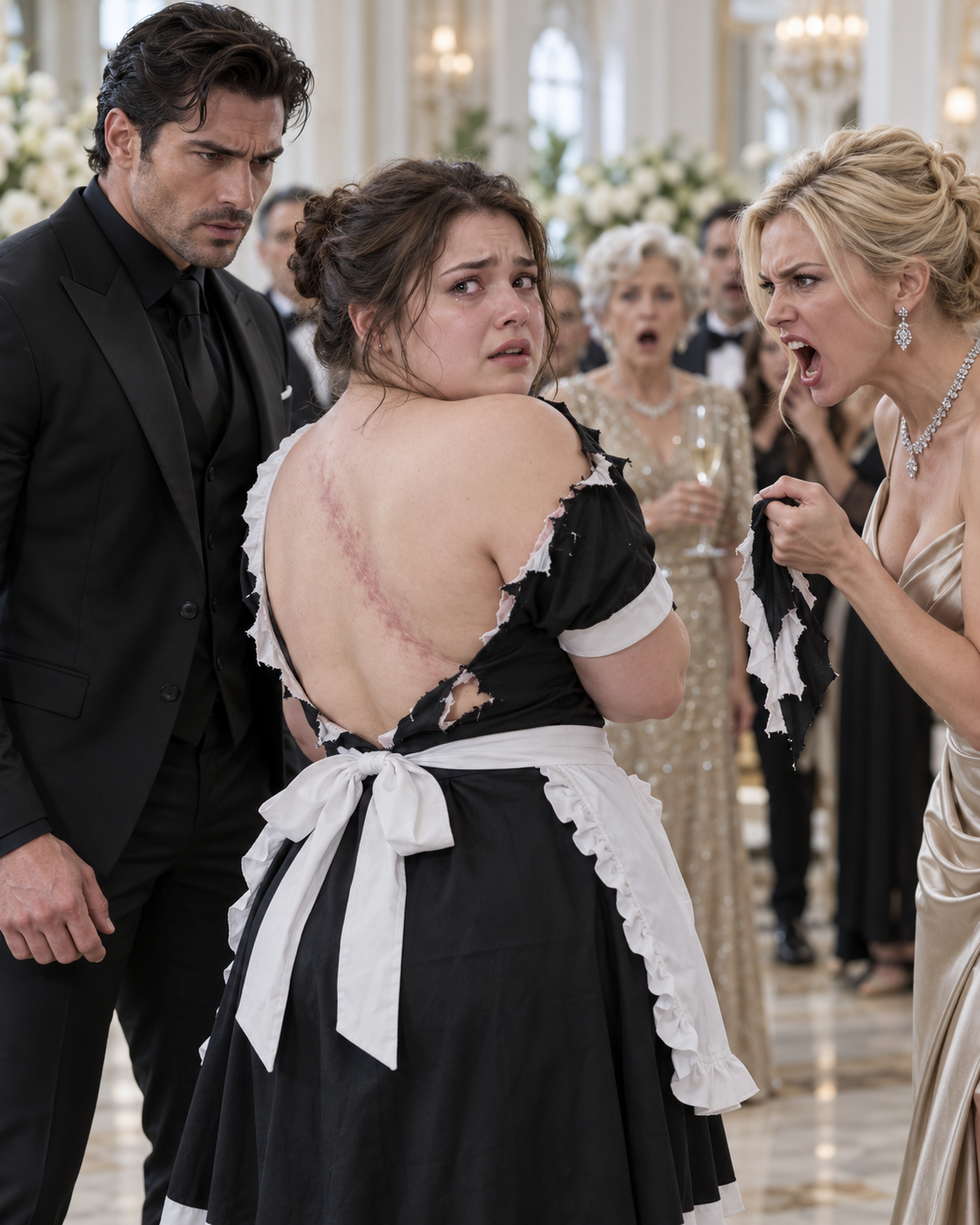
Norah shook her head.
“The emergency stairwell door was chained shut.”
Sophia gasped.
Teresa closed her eyes.
Norah continued, her voice steady despite the tears gathering in her eyes.
“The fire alarms on the fourth floor weren’t working. People were trapped because the exits weren’t safe.”
Roman turned toward his father.
“Did you know?”
Anthony looked at the floor.
“Not before the fire.”
Norah reached into the small pocket of her apron.
From it, she removed an old, carefully folded envelope.
“I’ve carried this for years because I never knew when I might need it.”
Anthony stared at the envelope as though it were something dangerous.
Roman accepted it and carefully unfolded the paper inside.
It was a photocopy of a maintenance complaint submitted six weeks before the fire.
The letter listed broken smoke detectors, blocked exits, and faulty electrical wiring.
At the bottom was a signature acknowledging receipt.
Anthony Belandi.
Roman read the document twice.
Then he looked up.
“You knew.”
Anthony remained silent.
“You knew people were living in a dangerous building.”
“It wasn’t that simple.”
“Children were sleeping there, Dad.”
Anthony suddenly raised his voice.
“Do you think I personally inspected every property my company owned?”
Nobody answered.
He continued, desperation creeping into his words.
“My managers told me the repairs were scheduled. I relied on their reports.”
“Then why didn’t you tell us?” Teresa asked.
Anthony looked toward Norah.
“Because she was going to testify.”
The truth landed heavily in the room.
Norah’s fingers tightened around Sophia’s hand.
“An investigator contacted me after the fire,” she explained. “I had seen the chained emergency door and the broken alarms.”
Anthony nodded reluctantly.
“The company was facing multiple lawsuits. My attorneys warned me that her testimony could destroy everything.”
Roman stared at his father.
“So you hid the fact that she saved Sophia?”
Anthony’s voice dropped.
“I thought keeping the matters separate would protect the family.”
Teresa rose slowly from the sofa.
“Protect us?”
She looked at him with an expression that frightened Roman more than anger ever could.
“Our daughter spent thirteen years wondering whether her rescuer survived.”
Anthony reached toward her.
“Teresa—”
“She cried on the anniversary of that fire every single year.”
He withdrew his hand.
“And all that time, you knew where the woman was?”
Anthony had no answer.
Norah stood.
“Mrs. Belandi, I didn’t come here to cause trouble.”
Teresa turned immediately.
“My dear, you haven’t caused any trouble.”
Norah looked down at her damaged uniform.
“I came to work here because I needed a job. When the agency assigned me to this estate, I didn’t even know your family owned it.”
Roman frowned.
“Then why didn’t you tell us once you recognized the name?”
Norah hesitated.
“Because I was afraid.”
“Of what?”
“Of losing another job because of what happened at Hawthorne.”
The room became very quiet.
Norah explained that after the fire, she had testified during the investigation despite pressure from people connected to the building’s management.
The testimony had helped establish serious failures in the property’s safety procedures.
But afterward, finding steady employment became difficult.
She couldn’t prove every rejection was connected, yet opportunities seemed to disappear whenever prospective employers learned about the case.
She had eventually found domestic work through agencies that rarely asked about her past.
“I learned that sometimes telling the truth can cost you more than staying silent,” she said.
Roman listened without interrupting.
For the first time, he understood that the woman who had carried his sister through flames had spent years paying a price his wealthy family barely understood.
Sophia rose from the sofa.
“Why didn’t you ever ask us for help?”
Norah gave a sad smile.
“Because I didn’t save you to earn a reward.”
Teresa began crying again.
But this time her tears carried something more painful than gratitude.
They carried shame.
Suddenly, Vanessa spoke from the doorway.
“This is becoming ridiculous.”
Every head turned.
She crossed her arms.
“Are we seriously going to destroy an entire family over something that happened thirteen years ago?”
Roman stared at her.
“Vanessa, stop.”
“No, Roman. Someone needs to be reasonable.”
She pointed toward Norah.
“She worked here for months without telling anyone who she was. Doesn’t that seem suspicious?”
Sophia stepped forward.
“She saved my life.”
“And now she’s turning your father against the entire family.”
Teresa’s expression hardened.
“Enough.”
But Vanessa wasn’t finished.
“Do you have any idea what people will say when they hear that Anthony Belandi ignored building violations? Your company’s stockholders, your business partners, the newspapers—”
Roman interrupted her.
“You’re worried about headlines?”
“I’m worried about our future!”
“Our future?”
His voice was barely above a whisper.
Vanessa looked toward the diamond ring on her finger.
“Roman, we’ve spent two years building a life together.”
He studied her face carefully.
For months, he had dismissed little moments that troubled him.
The way Vanessa spoke sharply to waiters.
The way she criticized housekeepers for mistakes she would have forgiven in wealthy friends.
The way she seemed to measure a person’s worth by their clothes, connections, and bank account.
He had told himself she was simply demanding.
Tonight, he finally understood the difference between having high standards and believing other people were beneath you.
“Vanessa,” he said quietly, “what would you have done if Norah hadn’t saved Sophia?”
She blinked.
“What?”
“If she had simply been a maid whose uniform you tore because you were jealous, would you still think you were wrong?”
Vanessa opened her mouth.
Then closed it.
Her silence answered him.
Roman slowly removed the engagement announcement card from the mantelpiece.
“I can’t marry someone who believes kindness must be earned through status.”
Vanessa stared at him.
“You’re ending our engagement?”
“I’m ending something I should have questioned a long time ago.”
Her eyes filled with tears.
“You would choose a servant over me?”
Roman shook his head.
“No. I’m choosing the kind of man I want to be.”
For the first time that evening, Vanessa seemed to understand that her actions had consequences she couldn’t negotiate away.
She removed the ring and placed it on the table.
The small sound of platinum touching polished wood seemed unusually loud.
Then she walked out without another word.
Roman watched the doorway close.
There was sadness in his expression, but no hesitation.
The following morning, the Belandi estate looked painfully ordinary.
Sunlight crossed the marble floors.
Gardeners trimmed the hedges.
Coffee brewed in the kitchen.
Yet nothing inside the mansion was the same.
Roman found Norah near the service entrance, carrying a small suitcase.
“Where are you going?”
Norah turned.
“I think it’s best if I leave.”
“Why?”
She gave him a tired smile.
“Because your family has enough problems without me becoming another one.”
Roman stepped aside from the doorway.
“You’re not a problem, Norah.”
She looked toward the long driveway.
“People like me don’t belong in houses like this when things get complicated.”
Roman thought about his father’s wealth, Vanessa’s cruelty, and the terrible distance between the lives they had known.
“Maybe that’s the problem,” he said. “We’ve spent too much time deciding who belongs where.”
Norah lowered her suitcase.
“Your father won’t want me here.”
“My father doesn’t get to decide what happens next.”
She studied him carefully.
“You sound angry.”
“I am.”
“Anger can make people do things they regret.”
Roman nodded.
“Then I’ll make sure what I do next comes from something better.”
That afternoon, Roman visited the Brooklyn neighborhood where the Hawthorne Apartments once stood.
The damaged building had been demolished years earlier, replaced by a modern residential complex.
Children rode bicycles along the sidewalk.
A woman pushed a stroller past a small grocery store.
Life had continued, as it always did.
But Roman couldn’t stop imagining the families who had once stood outside that burning building, watching everything they owned disappear.
He visited the local community center and spoke with longtime residents.
Some remembered the fire vividly.
Others remembered the young woman who had carried a little girl outside.
One elderly man, a retired firefighter named Daniel Mercer, recognized Norah’s photograph immediately.
“That girl had more courage than most grown men I’ve met,” Daniel said.
Roman sat across from him.
“Do you remember what happened?”
Daniel nodded.
“She came out with your sister and then tried to go back inside.”
Roman froze.
“She went back?”
“The firefighters stopped her. She kept saying there was an elderly woman on the fifth floor.”
Roman swallowed.
“Did they get her out?”
Daniel’s expression darkened.
“No.”
The answer struck Roman harder than he expected.
Daniel leaned forward.
“You want to know something about heroes, son?”
Roman nodded.
“They don’t always walk away feeling like heroes.”
He pointed toward Norah’s photograph.
“That young woman saved your sister, but I watched her cry because she couldn’t save someone else.”
Roman looked down at the picture.
He suddenly understood why Norah had never spoken proudly about that night.
To his family, the fire had become a story of miraculous survival.
To Norah, it had remained a memory of someone she couldn’t reach.
When Roman returned home, he found Sophia sitting with Norah in the garden.
They were drinking tea beneath an old oak tree.
Sophia was laughing at something Norah had said.
It was the first genuine laughter Roman had heard from his sister since the engagement party.
He sat beside them.
“I went to Brooklyn today.”
Norah’s smile faded.
Roman told her about Daniel Mercer.
When he mentioned the elderly woman, Norah looked away.
“Her name was Evelyn Parker,” she whispered.
Sophia reached for her hand.
“Did you know her?”
“She lived upstairs. She used to bring homemade cookies to the children.”
Norah’s voice broke.
“I heard her calling for help, but the smoke was too thick.”
Roman remained silent.
“I’ve wondered for thirteen years whether I could have done more.”
Sophia squeezed her hand.
“You brought me out alive.”
Norah wiped her eyes.
“But I couldn’t bring everyone.”
Roman leaned forward.
“Norah, you were nineteen years old. You were injured, and the building was burning around you.”
She looked at him.
“You did something extraordinary,” he continued. “Not being able to save everyone doesn’t erase the lives you did save.”
For several moments, nobody spoke.
Then Sophia rested her head against Norah’s shoulder.
“You gave me thirteen years I almost didn’t have,” she whispered. “And I plan to make them mean something.”
That evening, Teresa entered Anthony’s private study.
He was sitting behind his enormous mahogany desk, surrounded by documents from the company’s legal department.
For the first time in decades, he looked old.
“I’ve spoken to our attorneys,” he said.
Teresa remained standing.
“And?”
“They confirmed that the original investigation documented multiple safety failures.”
“Tell me something I don’t know.”
Anthony sighed.
“Some of the civil claims were settled. Others were dismissed or withdrawn. The company accepted responsibility for certain maintenance failures.”
Teresa watched him.
“But you never accepted responsibility yourself.”
Anthony said nothing.
She placed a photograph on his desk.
It showed six-year-old Sophia in a hospital bed, smiling weakly while holding a small stuffed rabbit.
“You remember this picture?”
“Of course.”
“That was the day after the fire.”
Anthony nodded.
“You were terrified of losing her,” Teresa continued. “So was I.”
Her voice softened.
“But somewhere along the way, you became more frightened of losing your reputation than of facing what happened.”
Anthony looked at the photograph for a long time.
“I built everything we have.”
“I know.”
“I wanted our children to have security.”
“And yet our daughter grew up believing the woman who saved her had vanished.”
Teresa moved toward the door.
“Money can build a beautiful home, Anthony. But it can’t make that home honorable.”
He looked up.
“Are you leaving me?”
Teresa stopped.
“I’m giving you a chance to remember who you were before being powerful became more important than being decent.”
Three days later, Anthony called a family meeting.
Norah was invited, though she initially refused.
Roman insisted that she deserved to hear whatever Anthony intended to say.
They gathered in the same library where the truth had first emerged.
Anthony stood beside the fireplace.
“I’ve spent most of my life believing that providing for my family justified almost every decision I made.”
He looked toward Sophia.
“But I confused providing for you with protecting myself.”
Nobody interrupted.
He turned toward Norah.
“Thirteen years ago, you saved my daughter’s life. Instead of thanking you, I allowed fear of legal consequences to dictate how I treated you.”
Norah lowered her eyes.
Anthony continued.
“I cannot undo the years you spent wondering whether this family remembered you.”
His voice trembled.
“But I can stop pretending the past doesn’t matter.”
He placed several folders on the table.
“I’ve asked an independent law firm to review the company’s records relating to Hawthorne. We will cooperate with any appropriate authorities, disclose the findings, and address any outstanding obligations.”
Roman studied his father.
“Even if it costs the company?”
Anthony looked at him.
“Especially if it does.”
Teresa exhaled slowly.
It wasn’t forgiveness.
Not yet.
But it was a beginning.
Anthony then turned to Norah.
“I also owe you a personal apology.”
Norah looked up.
“I should have thanked you thirteen years ago. Instead, I allowed you to become invisible to us.”
Her eyes filled with tears.
“I’m not asking you to forget what happened,” Anthony said. “And I’m not asking you to forgive me today.”
He paused.
“I only want you to know that I was wrong.”
For a long moment, Norah remained silent.
Then she spoke.
“Mr. Belandi, I’ve spent years wishing that night had never happened.”
Sophia looked heartbroken.
Norah gently squeezed her hand.
“Not because I regret saving Sophia. I would do it again without hesitation.”
She looked around the room.
“But because afterward, I stopped believing that doing the right thing mattered.”
Anthony bowed his head.
Norah continued.
“I don’t want money in exchange for my forgiveness. I want the people who lost their homes to know their suffering wasn’t forgotten.”
Anthony nodded slowly.
“Then that’s where we begin.”
Over the following months, the Belandi family changed in ways that astonished their friends and business associates.
The independent review uncovered additional records showing how maintenance warnings had been mishandled.
Anthony publicly acknowledged the company’s failures and committed resources to address the harm.
Some business partners distanced themselves.
Several contracts were delayed.
Newspapers across New York reported the story.
For a man who had spent his life controlling his public image, every headline felt like a punishment.
But for the first time, Anthony didn’t try to silence the criticism.
He faced it.
The family also established the Hawthorne Community Safety Fund, with oversight from independent community representatives.
Its purpose was practical: support eligible fire survivors, provide emergency assistance, and help improve safety awareness in older residential buildings.
Norah agreed to serve as an adviser only after insisting that survivors and neighborhood residents have meaningful voices in the program.
She refused to let her story become merely another photograph in a wealthy family’s publicity campaign.
Roman respected her more for it.
Meanwhile, Sophia began volunteering with organizations that supported families displaced by apartment fires.
She visited schools, spoke about emergency preparedness, and helped collect supplies for children who had lost their belongings.
The frightened little girl Norah once carried through a burning stairwell had grown into a woman determined to offer others the same compassion.
One afternoon, Sophia brought Norah to the community center in Brooklyn.
Inside, dozens of neighborhood residents had gathered for a small ceremony honoring people who had helped during the Hawthorne fire.
Daniel Mercer was there.
So were former tenants who still remembered Norah.
An elderly woman approached her carrying a faded photograph.
“Do you remember my mother?” she asked.
Norah looked at the picture.
Her breath caught.
“Evelyn Parker.”
The woman nodded.
“I’m her daughter, Margaret.”
Norah’s eyes filled immediately.
“I’m so sorry.”
Margaret gently took her hands.
“I’ve wanted to meet you for years.”
Norah began shaking.
“I tried to reach her.”
“I know.”
Norah stared at her.
Margaret smiled sadly.
“Mr. Mercer told me what happened. He said you tried to go back inside.”
A tear slid down Norah’s cheek.
“It wasn’t enough.”
Margaret shook her head.
“My mother spent her life teaching me that kindness means doing what you can, even when you cannot change everything.”
She squeezed Norah’s hands.
“You saved a child that night. My mother would have been proud of you.”
Norah began to cry.
Not the quiet tears she had learned to hide.
For the first time in thirteen years, she allowed herself to grieve openly.
Margaret embraced her.
And something inside Norah, something tightly closed since that terrible night, finally began to loosen.
Six months after the ruined engagement party, the Belandi estate hosted another gathering.
There were no photographers waiting outside.
No expensive orchestra.
No guest list designed to impress Manhattan society.
Instead, the garden was filled with firefighters, former Hawthorne residents, neighbors, family friends, and people involved in the new safety program.
Long tables were covered with homemade food.
Children chased one another across the lawn.
And near the oak tree stood Norah Bennett, wearing a simple blue dress.
She was no longer employed as a maid.
With financial stability from a new role helping coordinate community outreach, she had begun taking evening classes in social work at a local college.
For years, she had dreamed of helping families through difficult times.
Now she finally had the opportunity to pursue that dream.
Roman approached her carrying two glasses of lemonade.
“You look happy.”
Norah accepted one.
“I think I am.”
He smiled.
“That’s good.”
She looked toward the mansion.
“Funny, isn’t it?”
“What?”
“Six months ago, I was afraid to walk through that front door unless someone needed me to clean something.”
Roman glanced toward the house.
“And now?”
Norah smiled.
“Now I know a building doesn’t decide whether I belong somewhere.”
Roman nodded.
“Neither does a last name.”
Across the garden, Teresa was laughing with Sophia and Margaret Parker.
Anthony stood nearby, speaking with Daniel Mercer.
The conversations were sometimes difficult.
Trust had not magically returned.
But the family had finally stopped pretending that uncomfortable truths would disappear if nobody mentioned them.
As the sun began setting over the estate, Teresa stepped onto the small wooden platform beneath the oak tree.
She held no prepared speech.
Only an old silver bracelet.
“Sophia wore this the night of the fire,” Teresa began.
The guests grew quiet.
“After she came home, she told me that a woman had carried her through the smoke and promised she would be safe.”
Teresa looked toward Norah.
“For years, I thought the greatest gift that woman gave us was my daughter’s life.”
She paused.
“But I was wrong about one thing.”
Roman watched his mother closely.
“She also gave us a lesson that took our family thirteen years to understand.”
Teresa held up the bracelet.
“Courage is not measured by wealth, power, or the people who know your name.”
Her voice grew stronger.
“It is measured by what you are willing to do for someone who cannot offer you anything in return.”
The garden fell silent.
Teresa stepped down and placed the bracelet in Norah’s hand.
“Sophia wanted you to have this.”
Norah shook her head.
“I can’t take something so precious.”
Sophia approached her.
“You gave it back to me once,” she said softly. “Now I want it to remind you of something.”
Norah looked at her.
“You didn’t just save a little girl from a fire.”
Sophia smiled through her tears.
“You gave that little girl the chance to grow up and help other people.”
Norah closed her fingers around the bracelet.
For a moment, she couldn’t speak.
Then she embraced Sophia, the same way she had held her thirteen years earlier.
The guests began applauding.
Not because a wealthy family had finally recognized a hero.
But because a woman who had spent years feeling invisible was finally being seen.
Later that evening, Roman stood alone beside the garden fountain when his phone vibrated.
It was a message from Vanessa.
He hadn’t spoken to her since the engagement party.
The message was brief.
“I’ve been thinking about what you asked me that night. You were right. I treated Norah as though her dignity depended on who she was. I’m ashamed of that. I don’t expect you to forgive me, but I wanted you to know I’m trying to change.”
Roman read it twice.
He didn’t rush to reply.
He knew that genuine change required more than a message, just as regret did not automatically erase harm.
But he hoped Vanessa would eventually learn what his family had learned at such a painful cost.
A person’s worth was never determined by the uniform they wore.
Nor by the money in their bank account.
Nor by the family name engraved above their front door.
As darkness settled across the Belandi estate, Roman looked toward the garden.
His father was helping an elderly guest into a chair.
His mother was serving lemonade.
Sophia was laughing beside Norah.
And for the first time in years, the mansion felt less like a monument to wealth and more like a home.
Roman remembered how the entire story had begun.
A moment of jealousy.
A torn uniform.
A scar revealed before a room full of strangers.
Vanessa had believed that humiliating Norah would remind everyone of the difference between them.
Instead, that cruel moment had exposed a truth no amount of money could hide.
The woman with the least power in the ballroom had shown more courage than anyone.
And the family that seemed to possess everything had discovered how much they were missing.
One year later, Norah returned to the Brooklyn neighborhood where the Hawthorne Apartments once stood.
She was accompanied by Sophia, who carried a bouquet of white flowers.
They stopped beside a memorial plaque honoring those affected by the fire.
Norah placed the flowers beneath Evelyn Parker’s name.
For thirteen years, she had come to this place carrying guilt.
This time, she came carrying gratitude.
Sophia stood beside her.
“Do you still think about that night?”
Norah nodded.
“Every day.”
“Does it still hurt?”
“Sometimes.”
Sophia slipped her hand into Norah’s.
“Then why are you smiling?”
Norah looked at the young woman beside her, remembering the terrified little girl who had once clung to her neck.
“Because for a long time, I only remembered the people I couldn’t save.”
She gently squeezed Sophia’s hand.
“Now I’ve finally learned to remember the life that continued.”
A breeze moved through the nearby trees.
Children laughed somewhere across the street.
The city carried on around them, full of ordinary people living extraordinary stories that might never make the news.
Norah looked up at the clear afternoon sky.
Thirteen years earlier, she had entered a burning building with no thought of recognition, reward, or gratitude.
She had simply seen someone who needed help.
And that decision had changed more lives than she could ever have imagined.
Because true kindness is not about being seen doing something good. It is about doing what is right, even when nobody is watching.
And sometimes, the person the world overlooks is the very person who once gave someone else the chance to see another sunrise.
THE END.