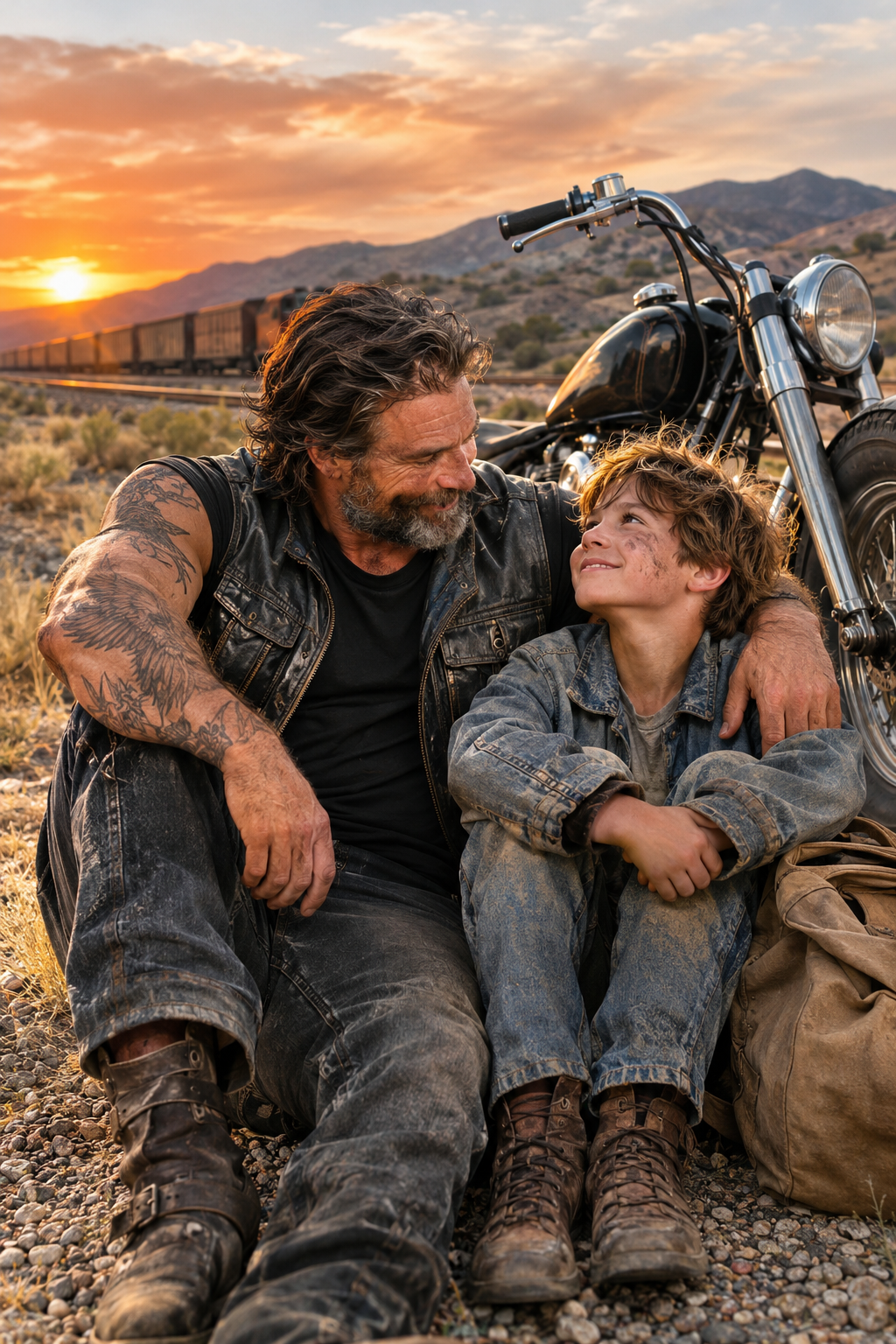
The eleven-year-old boy grabbed the biker’s arm beside the railroad tracks and whispered, “You shouldn’t be here. People in this town think you’re dangerous.”
The smoke was rising from the western ridge, thick and black against the pale Nevada sky. Hollis knew that color. He had seen it before in places where people had only minutes to escape.
“Wind’s pushing it toward town,” he muttered.
Toby followed his gaze. “Is it a fire?”
“Yeah, kid. And if we don’t move fast, it’s going to become a big one.”
Hollis pulled his phone from his pocket and called emergency services. He gave them the location, the direction of the wind, and what appeared to be the source of the fire. Then he looked at Toby.
“Go home. Tell your mother to get ready to leave. Don’t stop for anything that isn’t alive.”
“But what about you?”
“I’m going to see if anyone needs help.”
Toby shook his head. “I’m coming.”
“No, you’re not.”
“My house is closer to the ridge than yours. I know where the old roads are. I can help you find people.”
Hollis crouched until they were eye to eye.
“Listen to me. Being brave doesn’t mean running toward danger. Sometimes it means knowing when to get out of the way.”
Toby lowered his eyes, disappointed.
“Then promise you’ll come back.”
Hollis hesitated. For a moment, he saw another face in the boy’s expression. A face he had spent months trying not to remember.
“I promise I’ll do everything I can.”
He started his motorcycle and headed toward town.
Within minutes, the quiet afternoon had turned into chaos. Sirens echoed through the streets. People rushed out of their homes carrying bags, children, and frightened pets. A police cruiser moved from one street to another, ordering residents to evacuate.
Hollis stopped beside the general store, where several people were struggling to load supplies into a pickup.
“Which way is the fire moving?” he asked.
A gray-haired man pointed toward the western neighborhood.
“Straight toward Miller Road. There are six houses out there, and some of those old folks can’t move without help.”
“Have the firefighters been told?”
“They’re coming from Carson City. Could be twenty minutes.”
Hollis looked toward the smoke.
Twenty minutes was a lifetime.
“Give me the names and addresses.”
The gray-haired man stared at his leather vest.
“Who made you sheriff?”
“Nobody. But I used to be a firefighter. And right now, somebody needs to organize this.”
Something in Hollis’s voice made the man stop arguing.
He began writing down addresses.
Hollis called emergency services again, then asked the store owner for a paper map. He marked the homes that needed assistance and identified two roads that could still be used for evacuation.
A woman rushed toward him, tears streaming down her face.
“My husband! He’s at the house on Miller Road. He uses a wheelchair. I couldn’t get him into the truck!”
Hollis took her hands.
“What’s his name?”
“Walter. Walter Bennett.”
“Stay here. I’ll find him.”
“You can’t go there! The fire is too close!”
Hollis looked at her.
“Ma’am, I know what I’m doing. But I’m not going to make promises I can’t keep.”
He climbed onto his motorcycle and rode toward Miller Road.
At the same time, Toby stood in the doorway of his house, staring at the smoke.
His mother, Sarah, was hurriedly packing their belongings.
“Toby, get your shoes on. We have to leave.”
“Mom, Hollis is helping people.”
Sarah froze.
“Hollis? The biker?”
“He used to be a firefighter.”
“I don’t care what he used to be. We need to get out.”
“But what if someone gets left behind?”
Sarah knelt and held his shoulders.
“Your father died trying to save someone. I won’t lose you the same way.”
Toby looked at her, confused by the sudden pain in her voice.
“Dad didn’t die because he was a firefighter. He died because he helped people.”
Sarah’s eyes filled with tears.
For a moment, neither spoke.
Then she picked up their evacuation bag.
“We’re leaving. Now.”
Toby followed her outside, but his attention remained fixed on the western road.
He remembered what Hollis had told him.
Being brave didn’t mean running toward danger.
But it also didn’t mean forgetting the people who needed help.
As Sarah started the car, Toby noticed an elderly woman standing beside her porch. She was trying to lift a small dog into a carrier, but her hands were shaking too badly.
“Mom, wait!”
He jumped out before Sarah could stop him.
“Toby!”
He ran toward the woman.
“Mrs. Whitaker! Let me help!”
The old woman looked up in relief.
“Oh, sweetheart. I can’t get Biscuit into this thing.”
Toby carefully lifted the frightened dog and placed it inside.
“Are you ready?”
“I need my medication.”
“Where is it?”
“Inside, on the kitchen table.”
Toby started toward the house, but his mother caught his arm.
“No. We’re not going inside a house with a fire approaching.”
Sarah looked at Mrs. Whitaker, then at the approaching smoke.
“Do you have another supply?”
The woman shook her head.
Sarah took a deep breath.
“Come with us. We’ll get you to the evacuation center, and the emergency workers can help.”
Mrs. Whitaker nodded.
As Sarah helped the woman into the car, Toby realized something important.
He didn’t have to be reckless to be useful.
He could help without becoming another person someone might lose.
Meanwhile, Hollis reached Walter Bennett’s house.
The old man was sitting in his wheelchair near the front window. A blanket rested over his knees, and his breathing was shallow.
“Mr. Bennett?”
Walter turned.
“Who are you?”
“Name’s Hollis. I’m here to get you out.”
Walter glanced at the motorcycle outside.
“Didn’t know the town had started sending bikers to rescue old men.”
Hollis almost smiled.
“Neither did I.”
He checked the man’s condition and looked around for a safe exit. The front road was already filling with smoke. A narrow service lane behind the house offered a possible escape route.
“Can you transfer into a vehicle?”
“Not without help.”
Hollis found an old emergency evacuation chair in a storage closet. He had used similar equipment during his firefighting days.
“Then we’ll do this the old-fashioned way.”
He secured Walter carefully and began moving him toward the back exit.
Halfway down the hallway, a sharp crack sounded outside.
A burning tree limb had fallen across the driveway.
Walter grabbed Hollis’s arm.
“Leave me. Get yourself out.”
Hollis stopped.
He remembered another hallway.
Another burning building.
Another man shouting at him to leave.
His best friend, Daniel.
The memory came back so suddenly that he could almost smell the smoke from that terrible night.
Daniel had been trapped beneath a collapsed beam while Hollis tried to reach him.
“Go!” Daniel had shouted.
Hollis had refused.
Then another section of the building collapsed.
By the time the rescue team reached them, Daniel was gone.
Hollis had survived, but something inside him had never returned.
Now Walter was looking at him with the same expression.
“Son, I’m old. I’ve lived a good life. Don’t throw yours away.”
Hollis tightened the evacuation chair’s straps.
“I’m not leaving you.”
He pushed through the back door and maneuvered Walter toward the service lane.
The smoke was getting thicker. His eyes burned, and the heat was becoming unbearable.
Just when he thought they might not make it, a pickup appeared at the far end of the lane.
The driver jumped out.
It was the gray-haired man from the general store.
“Need a hand?”
“More than you know!”
Together, they lifted Walter into the truck and drove toward the evacuation center.
When Hollis arrived, the town’s residents were gathering in the school gymnasium. Firefighters were directing people inside while volunteers distributed water and blankets.
Hollis helped Walter out of the truck.
A woman rushed toward them.
“Walter!”
It was Walter’s wife.
She wrapped her arms around him, crying with relief.
“Thank you,” she whispered to Hollis.
He nodded, unsure what to say.
Then someone behind him spoke.
“It’s the biker.”
Hollis turned.
Several residents were staring at him.
The same people who had whispered about him at the general store.
The same people who had warned Toby to stay away.
A man stepped forward.
“You shouldn’t have gone out there. You could have gotten yourself killed.”
Hollis wiped soot from his forehead.
“Probably.”
“Then why did you do it?”
Hollis looked around the crowded gymnasium.
“Because somebody needed help.”
Before anyone could respond, a young police officer hurried inside.
“Has anyone seen a boy named Toby? Eleven years old? Brown hair?”
Hollis felt his stomach tighten.
“What happened?”
The officer looked toward Sarah, who had just entered with Mrs. Whitaker.
“His mother says he was helping with the evacuation, but he disappeared near the old railway crossing.”
Hollis’s face changed.
“Where exactly?”
“Near the maintenance road. The fire is moving that direction.”
Sarah pushed through the crowd.
“Please! Someone find my son!”
Hollis was already walking toward the exit.
The officer caught his arm.
“Hold on. You can’t go out there. Emergency crews are handling the search.”
“Then tell them a boy is missing near the old crossing. There’s a drainage tunnel beneath the road. If he got frightened by the smoke, he might have taken shelter there.”
“How do you know?”
“Because I’ve been there.”
The officer immediately radioed the fire command.
Hollis looked at Sarah.
“I’m going to help them search. You stay here.”
Sarah grabbed his jacket.
“Bring my son back.”
For the first time, Hollis saw the same fear in her eyes that he had carried since Daniel died.
“I’ll do everything I can.”
He headed toward the railway crossing with two firefighters.
The sky had darkened. Ash drifted through the air like dirty snow. The fire was spreading along the dry grass, and the wind was pushing it toward the town.
They searched the service road first.
“Toby!” Hollis shouted.
No answer.
They checked behind the maintenance shed.
Nothing.
Then Hollis noticed something near the fence.
A small blue backpack.
He recognized it immediately.
It was Toby’s.
He picked it up and saw a photograph sticking out of the side pocket.
The photograph showed a smiling man in a firefighter’s uniform, standing beside a young boy.
Toby’s father.
Hollis turned the photograph over.
There was a handwritten message on the back.
For Toby. Remember that being strong means protecting others, even when you’re afraid.
Hollis closed his eyes.
“Kid, where are you?”
A faint sound came from somewhere beneath the road.
Three knocks.
Hollis turned toward the drainage tunnel.
“Did you hear that?”
One of the firefighters nodded.
They approached carefully.
“Toby!”
Three more knocks.
Hollis dropped to his knees and shone his flashlight into the opening.
A small voice answered.
“I’m here!”
It was Toby.
“Are you hurt?”
“My ankle. I can’t get out.”
Hollis leaned closer.
“Listen carefully. Don’t move until we get to you. Understand?”
Toby began coughing.
“The smoke is coming inside.”
The firefighters quickly assessed the entrance. The tunnel was narrow, and part of the concrete lining had cracked.
One firefighter shook his head.
“We need the rescue team. We can’t safely enter without proper equipment.”
Hollis stared into the darkness.
“How long?”
“Ten minutes, maybe more.”
Ten minutes.
The words struck him like a physical blow.
He could hear Toby coughing again.
“Please,” the boy called weakly. “I don’t want to die.”
Hollis shut his eyes.
He remembered Daniel’s last words.
He remembered every night he had wondered whether he should have done something differently.
But this time, he refused to let grief make the decision for him.
He turned toward the firefighters.
“Get the rescue equipment. Bring the air supply. I’ll stay here and keep him talking.”
He knelt at the entrance.
“Toby, can you hear me?”
“Yes.”
“Good. I want you to tell me about your dad.”
There was a pause.
“He was a firefighter. He used to say that every person had a job to do.”
Hollis swallowed.
“What was his job?”
“To help people.”
“And what was yours?”
“To be his son.”
Hollis smiled sadly.
“That sounds like a pretty important job.”
Toby coughed again.
“I tried to help someone today. Mrs. Whitaker. But I think I made my mom scared.”
“Your mom is scared because she loves you. That’s not your fault.”
“I just didn’t want anybody to be alone.”
Hollis looked down at the photograph in his hand.
“Neither did your dad.”
The rescue team arrived with breathing apparatus and stabilization equipment.
They secured the tunnel entrance and began working their way inside.
Hollis remained beside the opening, calling out to Toby every few seconds.
Then a deep rumble came from the ridge.
The firefighters looked up.
“Move back! Slope collapse!”
A section of dry earth and rock slid down the hillside, sending debris across the service road.
One of the rescue firefighters lost his footing.
Hollis grabbed him and pulled him clear.
But the movement dislodged part of the damaged tunnel entrance.
Concrete cracked.
Dust filled the air.
The rescue team stopped.
“Everyone out! The structure is unstable!”
Hollis looked toward the darkness.
“Toby!”
No answer.
He felt his heart hammering.
The team leader grabbed his shoulder.
“We need another way in.”
Hollis studied the old maintenance map he had seen earlier. There was a secondary drainage access on the other side of the road, farther down the hill.
“There’s another entrance.”
“Is it accessible?”
“I don’t know. But it’s worth checking.”
They hurried around the embankment.
The second opening was partially blocked by branches and debris, but the firefighters managed to clear enough space to enter.
A rescue worker crawled inside with an air supply and a safety line.
Minutes passed.
Then a voice crackled through the radio.
“I have visual contact. The boy is conscious. He’s trapped beneath a fallen section of timber.”
Hollis closed his eyes in relief.
“Can you reach him?”
“Working on it.”
The rescue team carefully lifted the timber.
Toby cried out in pain.
“Easy,” the rescuer said. “We’re going to get you out.”
Finally, the boy emerged from the tunnel, pale and coughing, but alive.
Hollis rushed forward.
Toby opened his eyes.
“You came back.”
Hollis knelt beside the stretcher.
“I told you I would.”
Toby reached for his hand.
“I knew you weren’t dangerous.”
Hollis couldn’t speak.
He simply held the boy’s hand as the rescue team carried him toward the waiting ambulance.
At the evacuation center, Sarah was pacing near the entrance when she saw the ambulance arrive.
She ran toward it.
“Toby!”
The paramedics lifted him out.
“Mom!”
Sarah fell to her knees and wrapped her arms around her son.
She held him as if the entire world might try to take him away.
“Don’t ever scare me like that again,” she whispered.
Toby began to cry.
“I’m sorry.”
Sarah kissed his forehead.
“No. I’m just glad you’re here.”
Then she looked up.
Hollis stood several feet away, covered in ash, his jacket torn and his face exhausted.
Sarah slowly approached him.
For a moment, she couldn’t find the words.
Then she said, “Thank you for bringing my boy home.”
Hollis lowered his head.
“He brought himself home. I just helped.”
The fire continued burning through the night.
By morning, firefighters had managed to contain it before it reached the main residential area. Several buildings had been damaged, but no lives were lost.
The town had survived.
And something else had changed.
People who had once avoided Hollis began approaching him.
The owner of the general store offered him coffee.
The gray-haired man shook his hand.
Even the police officer who had initially questioned him admitted that the town had judged him too quickly.
But Hollis didn’t feel like a hero.
He felt tired.
And for the first time in months, he felt something other than guilt.
Three days later, he returned to the railway fence.
The grass was blackened in places, and the air still carried the faint smell of smoke.
He sat quietly, looking at the tracks.
A few minutes later, he heard footsteps.
Toby approached with a slight limp, leaning on a walking stick.
Sarah followed a short distance behind.
“Hey,” Toby said.
Hollis smiled.
“Hey, troublemaker.”
Toby sat beside him.
For a while, they watched the empty tracks.
Then Toby pulled a folded photograph from his pocket.
“That’s my dad,” he said.
Hollis nodded.
“I know.”
“Mom says you lost someone too.”
Hollis looked at the photograph.
“Yeah. My best friend.”
“Did he die in a fire?”
Hollis nodded slowly.
Toby was quiet.
“Do you think he would be proud of you?”
Hollis stared at the tracks.
“I don’t know, kid.”
Toby looked at him with the same seriousness he had shown on their first meeting.
“I think he would.”
Hollis swallowed.
“Why?”
“Because you helped people when nobody asked you to. And because you came back for me.”
Hollis turned away, trying to hide the tears gathering in his eyes.
He had spent months believing that surviving Daniel’s death was somehow a betrayal.
He had carried the weight of that night as though suffering was the only way to prove how much his friend had mattered.
But perhaps Daniel hadn’t wanted that.
Perhaps he had wanted Hollis to keep living.
To keep helping.
To keep finding reasons to care.
Toby leaned forward.
“Can I ask you something?”
“Sure.”
“Why do you keep riding around alone?”
Hollis looked at his motorcycle parked beside the road.
“Because I thought leaving everything behind would make the memories disappear.”
“Did it work?”
Hollis laughed softly.
“No. Not even a little.”
“Then maybe you should stop leaving.”
Hollis looked at him.
“What makes you think it’s that simple?”
Toby shrugged.
“My dad used to say that you can’t fix a broken thing by pretending it was never there.”
Hollis stared at the boy.
Those words felt strangely familiar.
Then he remembered the message on Toby’s photograph.
He took a deep breath.
“Your father sounds like he was a wise man.”
“He was.”
A comfortable silence settled between them.
Then Hollis reached into the pocket of his leather vest and pulled out a small silver firefighter’s badge.
It was old and slightly scratched.
“Daniel gave me this after our first major rescue. Said I should keep it to remember why I started.”
Toby studied it carefully.
“Is it his?”
“It was mine. But he gave it to me.”
Hollis turned the badge over.
On the back were two engraved words.
Never abandon.
“I used to think those words meant I had to save everyone,” Hollis said. “That if someone died, it meant I hadn’t done enough.”
Toby looked up.
“But you can’t save everyone.”
“No. You can’t.”
Hollis took a slow breath.
“That’s the hardest thing I’ve ever had to learn. Sometimes, doing everything you can still isn’t enough. And that doesn’t mean you failed.”
Toby considered this.
“Then what does it mean?”
“It means you’re human.”
Hollis placed the badge back in his pocket.
“And being human means you keep showing up, even when you’re afraid of getting hurt again.”
Toby smiled.
“Sounds like something my dad would say.”
“Maybe he and Daniel would have gotten along.”
Toby laughed.
For the first time since Hollis had met him, the boy’s laughter didn’t sound forced.
It sounded like a child who had finally remembered how to be one.
That afternoon, Sarah invited Hollis to dinner.
He almost refused.
He had become so accustomed to being alone that the idea of sitting at someone else’s table felt uncomfortable.
But Toby stood beside his mother, waiting for an answer.
“It’s just dinner,” the boy said. “You don’t have to be dangerous or anything.”
Hollis laughed.
“All right. Just dinner.”
The meal was simple. Roast chicken, potatoes, and warm bread.
Sarah asked Hollis about his years as a firefighter. He told her about the people he had worked with, the strange things they encountered, and the small moments that made difficult days worthwhile.
Eventually, the conversation turned to Daniel.
Hollis spoke about his friend for the first time without avoiding the painful details.
He described Daniel’s terrible jokes, his habit of singing off-key, and the way he always carried extra sandwiches because someone might be hungry.
Then he told them about the night Daniel died.
His voice broke when he reached the end.
“I keep thinking I should have gotten him out.”
Sarah placed her hand on the table.
“My husband used to tell me that the hardest part of being a firefighter wasn’t facing the flames. It was coming home knowing someone else couldn’t.”
Hollis looked at her.
“Did he ever talk about the people he couldn’t save?”
“Sometimes. But he also talked about the people he did save. He never wanted one tragedy to erase all the lives he had helped.”
Hollis looked down at his hands.
For months, he had remembered only the ending of Daniel’s story.
He had forgotten everything that came before it.
That night, after dinner, Toby walked him to the motorcycle.
“Are you leaving tomorrow?” the boy asked.
Hollis looked toward the dark road.
“I was planning to.”
Toby nodded, trying not to look disappointed.
Then he asked, “Could you stay a little longer?”
Hollis looked at him.
“How much longer?”
Toby shrugged.
“Until I don’t need to look at the tracks every day.”
Hollis felt something tighten in his chest.
He knew what the boy meant.
The railway crossing had become a place where Toby came to remember his father, just as Hollis had used it to remember Daniel.
Neither of them had known how to leave the past behind.
But perhaps they didn’t have to leave it behind.
Perhaps they only had to learn how to carry it differently.
“I can stay a while,” Hollis said.
Toby smiled.
“Good.”
The following weeks brought small changes.
Hollis rented a modest room above the general store and began helping the town repair homes damaged by the fire. He also volunteered at the local fire station, teaching basic emergency preparedness and helping maintain old equipment.
People who had once been suspicious now greeted him by name.
The sheriff even asked him to help organize a community fire-safety day.
Hollis accepted.
Toby became his unofficial assistant, although Sarah insisted that all his activities remain safely supervised.
Together, they helped distribute smoke detectors, check evacuation routes, and teach younger children what to do when an emergency happened.
Hollis never encouraged Toby to become a hero.
Instead, he taught him how to recognize danger, call for help, and protect himself and others without taking unnecessary risks.
One afternoon, while organizing supplies at the fire station, Toby discovered an old photograph on Hollis’s desk.
It showed Hollis and Daniel standing beside a fire engine, both covered in soot and smiling.
Toby studied it.
“That’s him?”
Hollis nodded.
“That’s Daniel.”
“He looks funny.”
“He was funny. Especially when he was supposed to be serious.”
Toby laughed.
Then he pointed at the photograph.
“Why are you both smiling?”
Hollis considered the question.
“Because we’d just saved a family from a burning house. A mother and two children. They all made it out.”
“Then why do you look sad when you talk about him?”
Hollis was quiet for a moment.
“Because I miss him. Missing someone doesn’t mean you aren’t grateful for the good memories. It just means they mattered.”
Toby nodded.
He seemed to understand.
That evening, Hollis received a phone call from an old number he hadn’t seen in months.
It was Daniel’s widow, Rebecca.
He stared at the screen for several seconds before answering.
“Hello?”
“Hollis?”
Her voice was gentle.
“It’s Rebecca.”
“I know.”
“I heard about the fire in Nevada. Someone told me you helped rescue a little boy.”
Hollis leaned back in his chair.
“Small town. News travels.”
She laughed softly.
Then her voice became serious.
“Daniel would have been proud of you.”
Hollis closed his eyes.
“I don’t know about that.”
“I do. He used to worry about you, you know. He thought you were too hard on yourself.”
Hollis said nothing.
Rebecca continued.
“After he died, I found a letter he’d written to you. He never mailed it. I wasn’t sure whether I should send it, but I think it’s time.”
Hollis felt his chest tighten.
“Can you read it to me?”
There was a pause.
Then Rebecca began.
“Dear Hollis,
If you’re reading this, it probably means I’ve forgotten to give it to you again. You know how I am with important things.
I’ve been thinking about something you said after our last rescue. You said you were afraid that one day we wouldn’t be fast enough to save someone.
I want you to remember this.
We are not measured by the people we couldn’t save. We are measured by the people who had another chance because we showed up.
If something ever happens to me, don’t spend your life standing at the place where I fell. Take the good parts of our friendship with you. Laugh again. Ride again. Help someone else.
And when you finally feel happy, don’t apologize for it.
Your friend,
Daniel.”
Hollis lowered his head.
For a long time, he couldn’t speak.
Rebecca waited patiently.
Finally, he whispered, “Thank you.”
“He loved you like a brother, Hollis.”
“I loved him too.”
“I know.”
After the call ended, Hollis sat alone for several minutes.
But this time, the silence didn’t feel like a punishment.
It felt like a place where he could finally breathe.
The next morning, he went to the railway crossing.
Toby was already there, sitting on the fence with his father’s photograph.
“Morning,” Toby said.
“Morning.”
Hollis sat beside him.
“I got a letter from Daniel’s wife.”
“Was it good?”
Hollis smiled.
“It was exactly what I needed.”
Toby looked toward the tracks.
“Do you think our dads can see us?”
Hollis considered the question carefully.
“I don’t know what happens after people die. Nobody can tell you for certain.”
Toby lowered his eyes.
“But I like to think that the people we love leave something behind. The things they taught us. The way they made us feel. The courage they gave us.”
Toby nodded.
“Then maybe they’re not completely gone.”
“Maybe not.”
A freight train appeared in the distance.
The two sat quietly as it passed, its great wheels thundering over the tracks.
When the noise faded, Toby stood and brushed the dust from his jeans.
“Can we go get breakfast?”
Hollis laughed.
“Now that’s an excellent idea.”
They walked toward town together.
For the first time in a long while, Hollis didn’t feel the need to look over his shoulder.
He still missed Daniel.
There would be days when the memories hurt, when a familiar smell or an old song brought the past rushing back.
And Toby would still have mornings when he wished his father could walk through the front door.
Neither of them would ever stop loving the people they had lost.
But they were beginning to understand that grief did not have to be the end of their stories.
Months later, the town held a small ceremony at the fire station to honor the people who had helped during the wildfire.
Walter Bennett was there with his wife. Mrs. Whitaker brought Biscuit, who barked at everyone wearing a uniform. Sarah stood beside Toby.
Hollis was called forward.
He looked uncomfortable as the sheriff handed him a framed certificate.
“For outstanding courage and service to our community.”
People applauded.
Hollis accepted the certificate, then turned toward the crowd.
“I appreciate this. But I wasn’t the only one who helped.”
He looked at Sarah.
“She protected her son and helped evacuate a neighbor.”
He looked at Walter.
“He refused to give up, even when things got frightening.”
Then he looked at Toby.
“And this young man reminded all of us that courage isn’t about how old you are or how strong you look. It’s about caring enough to do the right thing, while knowing when to ask for help.”
The crowd applauded again.
Toby’s cheeks turned red.
After the ceremony, he approached Hollis.
“Are you going to keep riding?”
Hollis smiled.
“Of course.”
“Even if you stay here?”
“Especially if I stay here.”
Toby looked thoughtful.
“Maybe someday I’ll ride with you.”
“When you’re older, properly trained, and your mother gives permission.”
Toby laughed.
“That’s a lot of conditions.”
“Good things usually come with conditions.”
They stood together outside the station as the evening sun settled over the Nevada hills.
Hollis looked at the little town that had once treated him like a threat.
Now it felt like somewhere he belonged.
He reached into his vest and touched Daniel’s old badge.
Never abandon.
For a long time, he had misunderstood those words.
He thought they meant never letting go, never walking away, never accepting that some things were beyond his control.
Now he understood something different.
They meant never abandoning the people who were still here.
Never abandoning hope.
And never abandoning yourself simply because life had hurt you.
Toby stood beside him, holding his father’s photograph.
“Hey, Hollis?”
“Yeah, kid?”
“I’m glad you came to this town.”
Hollis looked at him.
“Me too.”
The boy smiled.
“Even though everybody thought you were dangerous?”
Hollis chuckled.
“Especially then.”
They began walking toward the general store, where Sarah was waiting with dinner.
Behind them, the railway tracks stretched into the distance, disappearing beyond the hills.
The trains would keep coming and going.
The past would remain part of their lives.
But neither man nor boy needed to spend every day waiting for someone who would never return.
They had memories to honor, lives to live, and people who still needed them.
And sometimes, that was how healing began.
Not with forgetting.
Not with pretending the pain had never happened.
But with one person choosing to sit beside another and say, without needing many words:
You don’t have to carry this alone.
Because the truth is, we never know what someone is carrying beneath their appearance.
A leather vest, a quiet expression, a child’s silence, or an empty seat at the dinner table may hide a story we have never heard.
Judging someone before understanding them can make us miss the very person who might change our lives.
And grief, no matter how heavy, does not mean we must stop living.
The people we lose cannot always walk beside us, but the love they gave us can continue through every kindness we offer, every life we protect, and every new beginning we dare to embrace.
Sometimes, the greatest way to honor someone we have lost is not to stand forever where they left us.
It is to keep moving forward, carrying their love with us.
And sometimes, the person who helps us find our way home is the very person we once believed we should be afraid of.