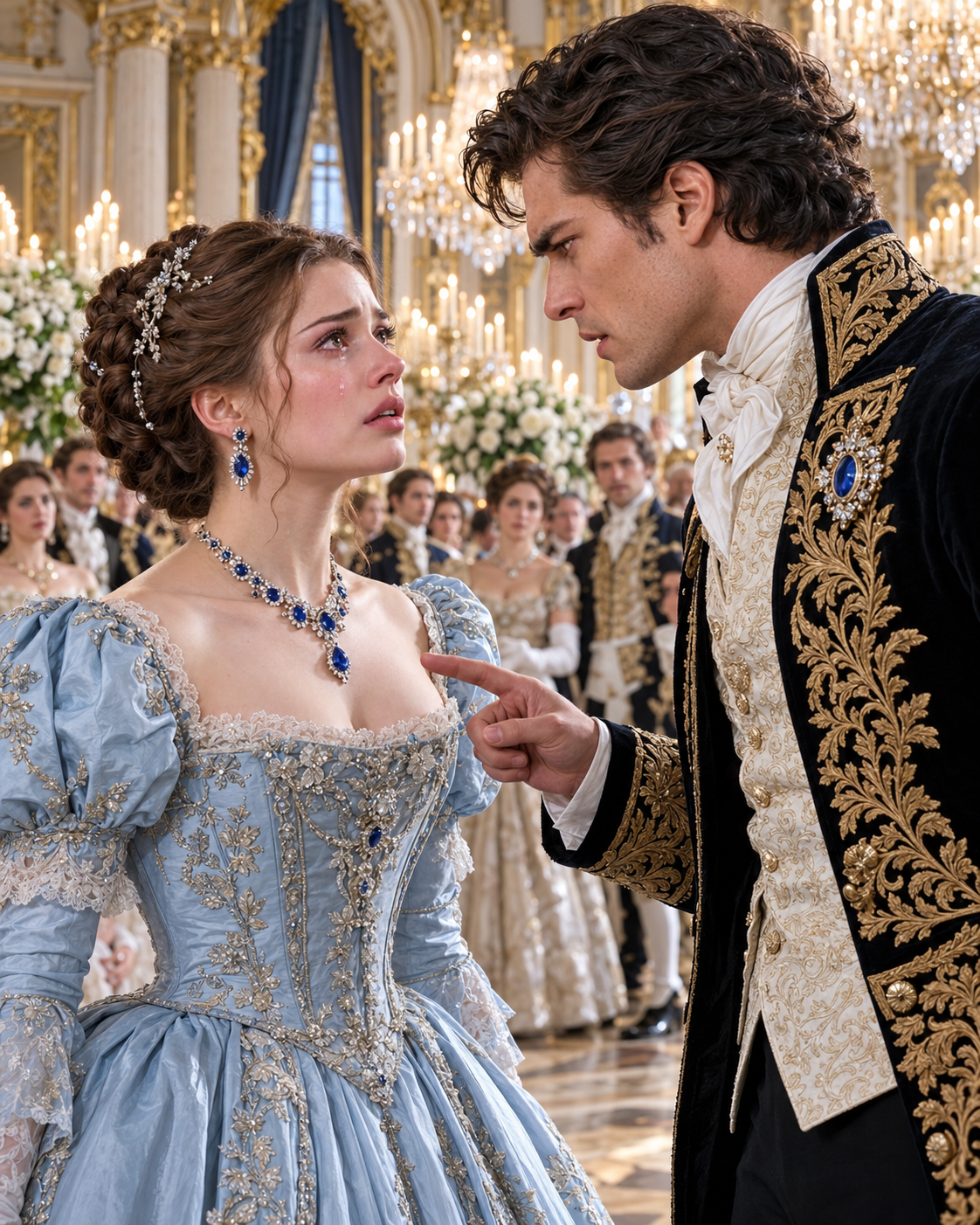
The Duke threw a coin at her feet.
The voice came from the darkness above the staircase, calm and deliberate, as though its owner had been expecting them all along.
Sebastian stepped in front of Eleanor before the man appeared.
“Come down where we can see you.”
A floorboard creaked.
Then an elderly gentleman emerged from the shadows, one hand gripping the banister, the other holding a walking stick polished smooth by years of use.
His coat was old but carefully brushed, and a long scar disappeared beneath the collar of his shirt.
Eleanor had never seen him before.
Sebastian, however, went completely still.
“Dr. Ashcombe?”
The old man gave a faint, exhausted smile.
“I wondered whether you would remember me, Your Grace.”
“You were my father’s physician.”
“And yours, when you were very young.”
Sebastian took a slow step toward him.
“You disappeared after my father’s funeral.”
“I disappeared long before that. Your father merely allowed people to believe otherwise.”
Eleanor looked toward the portrait above the fireplace.
Her mother’s painted eyes seemed almost alive in the firelight.
“What child?” she asked.
The physician’s attention shifted to her.
For a moment, his expression softened with something resembling grief.
“You have your mother’s eyes, Miss Winters.”
“Please don’t tell me what I have inherited from her. Tell me what happened.”
The old man lowered his gaze.
“Twenty-nine years ago, a woman arrived at this lodge during a winter storm. She was carrying a newborn child, and she was terrified.”
Sebastian glanced at the cradle in the painting.
“Who was she?”
“The late Duke’s younger sister, Lady Margaret Renford.”
Sebastian frowned.
“My father never had a sister.”
“He had one he ordered everyone to forget.”
The words settled over the room.
Outside, rain struck the shutters with sudden force.
Eleanor felt the cold through her traveling gloves.
“Why would he erase his own sister?”
“Because she married a man he considered beneath her station. A schoolmaster with neither fortune nor title.”
The physician moved toward the fire.
“When her husband died, Lady Margaret returned to Renford seeking protection. Your father agreed, but only if she surrendered her son.”
Sebastian’s jaw tightened.
“Why?”
“Because the boy represented a claim upon the family’s wealth that your father could not entirely control.”
Eleanor looked at the portrait again.
“And my mother?”
“She was Lady Margaret’s closest friend. When Margaret died from a fever shortly after arriving here, your mother discovered what the Duke intended.”
“What did he intend?”
The physician hesitated.
“To send the child away permanently, under a false name, and ensure no one could establish his connection to the Renfords.”
The steward stood motionless by the door.
Sebastian turned toward him.
“You knew?”
The old man’s face collapsed beneath the question.
“I helped carry the child from this house, Your Grace.”
For the first time, Sebastian’s voice lost its careful restraint.
“And you said nothing?”
“Your father threatened everyone who knew. Some of us were cowards. Others paid dearly for being brave.”
Eleanor’s fingers tightened around the locket.
“My father.”
Dr. Ashcombe nodded.
“Your parents sheltered the boy after Lady Margaret died. Your father refused to reveal his location, even when the Duke threatened to destroy his business.”
The room became terribly quiet.
Eleanor remembered her father’s hands, rough from work that had once belonged to other men.
She remembered her mother’s dresses being sold, one by one.
And she remembered the winter their house had been emptied, when her father had stood in the doorway watching strangers carry away the last of their furniture.
All those years, she had believed he had been punished for a failed financial arrangement.
But he had been protecting a child.
“Where is he now?” she asked.
The physician glanced at Sebastian.
Then he looked away.
“That is the question your father spent the rest of his life trying to answer.”
Eleanor felt something tighten beneath her ribs.
“You said my parents protected him.”
“They did. For nearly three years.”
“Then what happened?”
“A fire.”
The steward bowed his head.
“The old Winters property burned during the autumn of 1801. The boy disappeared that night.”
Sebastian looked sharply at Eleanor.
She had gone pale.
“I remember that fire,” she whispered.
Her memories came in fragments.
Smoke creeping beneath a bedroom door.
Her mother’s voice calling from somewhere beyond the hallway.
A small hand slipping from hers.
Then darkness.
She gripped the back of a chair.
“There was another child in our house.”
The physician nodded.
“You were very young, Miss Winters.”
“I thought he was my brother.”
“Your parents allowed you to believe so.”
Eleanor closed her eyes.
She could almost see him now.
A boy with dark curls, always reaching for the highest branches in the orchard.
A boy who shared his bread with her and called her Nell.
She remembered crying for him after the fire.
Her father had told her that some people were taken from us before we were ready.
She had believed the boy was dead.
“His name,” she whispered. “What was his name?”
“Thomas.”
Eleanor opened her eyes.
Sebastian stood beside the portrait, watching her with an expression she could not read.
“Thomas Renford?” he asked.
The physician nodded.
“Lady Margaret’s son.”
Sebastian turned toward the window.
For years, he had believed himself the final surviving member of his father’s bloodline.
Now, somewhere in England, there might be a cousin who had spent his childhood running from that same family.
“And you believe he’s alive?” Sebastian asked.
“I know he was alive six months ago.”
Eleanor looked up.
“Then why haven’t you told us?”
Dr. Ashcombe reached inside his coat.
He produced a letter, its edges frayed from repeated handling.
“Because the man who found him was murdered before he could tell me where Thomas had gone.”
A gust of wind rattled the shutters.
Sebastian took the letter.
The handwriting was hurried, several words smeared as though the writer had been interrupted.
He read it silently.
Then his expression changed.
“What does it say?” Eleanor demanded.
Sebastian looked toward the steward.
“Who else knows we’re here?”
“No one, Your Grace. I gave orders that the lodge was to remain undisturbed.”
Sebastian folded the letter.
“Then we have very little time.”
Eleanor stepped toward him.
“I will not be kept ignorant in a matter concerning my own family.”
He met her eyes.
“No. You won’t.”
He handed her the page.
There were only three sentences.
Thomas is alive.
He knows what happened to Lady Margaret.
And someone at Renford Hall has been paying to keep him silent.
Eleanor read the final sentence twice.
Then she looked at Sebastian.
His face had become as cold as the rain beyond the windows.
“Someone in my house,” he said.
The steward crossed himself.
Dr. Ashcombe moved toward the door.
“We should leave.”
But before anyone could follow, a sharp crack split the air.
The window shattered.
Glass scattered across the floor.
Sebastian seized Eleanor by the shoulders and pulled her down just as something struck the wooden paneling behind them.
The physician staggered backward.
For one horrible second, Eleanor thought he had been hit.
Then she saw the dark hole in the wall.
A bullet.
Outside, a horse whinnied.
Sebastian moved toward the broken window.
“Stay down!”
He looked through the rain just long enough to see a rider disappearing between the trees.
A black horse.
A gray cloak.
And a flash of silver at the rider’s shoulder.
The Renford household livery.
Sebastian stepped away from the window.
“Someone knew we were coming.”
The steward’s face had turned white.
“Your Grace, I swear—”
“Then help me discover who.”
Sebastian took Eleanor’s hand.
Not ceremoniously.
Not as a Duke claiming the right to guide someone beneath him.
He simply reached for her, and she allowed him to lead her out.
By the time they returned to Renford Hall, the rain had become a steady gray curtain.
Sebastian ordered every entrance watched and every carriage accounted for.
The household assembled in the great hall beneath the family portraits.
Eleanor stood beside the fireplace, studying their faces.
Some appeared frightened.
Others merely curious.
One man did neither.
Mr. Bartholomew Vale, the estate solicitor, stood near the staircase with his hands folded behind his back.
He was a narrow gentleman with silver spectacles and a voice so mild that it rarely seemed capable of carrying a threat.
For seventeen years, he had handled the Renford accounts.
And for seventeen years, he had been the only man besides Sebastian who possessed keys to the old Duke’s private papers.
“Your Grace,” Vale said, “I understand there has been an unpleasant incident.”
Sebastian watched him.
“An attempt upon someone’s life.”
“How dreadful.”
“Indeed.”
Vale adjusted his spectacles.
“Perhaps the constable should be summoned.”
“He already has been.”
Something flickered across the solicitor’s expression.
Only for a moment.
Eleanor noticed.
She also noticed a faint stain of fresh mud along the hem of his trousers.
“Have you been riding, Mr. Vale?” she asked.
The solicitor turned.
“No, Miss Winters. Why do you ask?”
“Your boots.”
He glanced down.
“An unfortunate encounter with the stable yard.”
Eleanor gave a small nod.
“How inconvenient.”
Sebastian dismissed the servants.
When the hall was empty, Vale approached the study.
“There are matters of estate security we should discuss privately, Your Grace.”
“You may speak before Miss Winters.”
The solicitor’s gaze moved between them.
“I understood her visit concerned the mortgage.”
“It did,” Sebastian replied.
“And now?”
“Now it concerns the truth.”
Vale smiled without showing his teeth.
“A remarkably expensive pursuit.”
Eleanor opened her portfolio.
“Not quite as expensive as falsifying estate accounts.”
The smile disappeared.
She placed three ledgers on the table.
“I spent the morning examining the payments made from Renford Hall during the past six years.”
Vale remained silent.
“Several substantial sums were recorded as repairs to the northern boundary.”
“Quite correct.”
“Yet the northern boundary has received no repairs.”
“Perhaps the invoices were misfiled.”
“Perhaps.”
She turned another page.
“But the payments were collected in person, always by the same intermediary.”
Sebastian leaned closer.
“Who?”
Eleanor looked directly at Vale.
“A solicitor operating under the name B. V. Harcourt.”
The old clock struck three.
Vale did not move.
Then, very slowly, he removed his spectacles.
“You are an observant woman, Miss Winters.”
“An expensive habit, I’ve been told.”
The solicitor’s mouth tightened.
“Your father had it too.”
Sebastian straightened.
“Careful, Vale.”
But Eleanor spoke first.
“You knew him?”
“Everyone in financial circles knew your father by the end. His difficulties were rather public.”
“Because men like you made them public.”
Vale slid his spectacles into his pocket.
“You have inherited his stubbornness.”
“And you have inherited nothing,” she said quietly. “You took it.”
For a moment, no one spoke.
Then Vale reached beneath his coat.
Sebastian moved instinctively toward Eleanor.
But the solicitor withdrew only a folded document.
“Before you accuse me further, Your Grace, you should read this.”
He placed it on the desk.
It bore the late Duke’s seal.
Sebastian unfolded it.
His expression hardened.
“What is it?” Eleanor asked.
“A private instruction from my father.”
Vale watched them carefully.
“His Grace understood that certain matters required discretion.”
Sebastian continued reading.
Then he let the paper fall.
“Discretion?”
The word came out almost soundlessly.
“You were authorized to arrange Thomas’s disappearance.”
Vale’s eyes narrowed.
“I was instructed to protect the family’s interests.”
“By destroying a child?”
“By preventing scandal.”
Sebastian stepped forward.
Vale retreated half a pace.
It was a small movement.
But Eleanor saw it.
The balance between them had shifted.
“You served my father,” Sebastian said. “You do not own his authority.”
The solicitor recovered himself.
“Authority is precisely what you lack, Your Grace. Your estate is bankrupt, your title carries obligations you cannot meet, and this lady has come to take what remains.”
Eleanor closed the ledger.
“Not yet.”
Vale turned toward her.
She met his gaze.
“I haven’t made my decision.”
For the first time, genuine uncertainty crossed his face.
Then he smiled.
“Perhaps you should make it quickly.”
A crash sounded beyond the study door.
Sebastian turned.
A servant cried out.
By the time he reached the corridor, a cloud of smoke was drifting beneath the eastern staircase.
“Fire!” someone shouted.
The cry spread through the house.
Sebastian ran toward the smoke.
Eleanor followed.
Servants hurried past carrying buckets, while the steward ordered the younger maids into the courtyard.
At the entrance to the records room, flames were already climbing the shelves.
Eleanor stopped.
Inside were the original estate registers.
Birth records.
Correspondence.
The documents that might prove Thomas’s identity.
And perhaps the only surviving evidence of what had happened to her parents.
She started toward the doorway.
Sebastian caught her arm.
“Absolutely not.”
“The records!”
“The roof could come down.”
“They’re destroying the evidence!”
A beam cracked overhead.
Sebastian looked at the fire.
Then at her.
“Which cabinet?”
“The iron one beside the far wall.”
He took a wet cloth from a servant and wrapped it across his mouth.
“Stay here.”
“Sebastian—”
But he was already inside.
Eleanor stood frozen as smoke poured through the doorway.
She could hear wood splitting.
The dull crash of a falling shelf.
Someone behind her pulled at her sleeve.
“Miss, you must leave!”
She shook the hand away.
Then Sebastian emerged through the smoke, coughing violently, an iron-bound box clutched against his chest.
His sleeve was burning.
Eleanor seized a bucket and threw water over his arm.
The flames vanished.
Sebastian stumbled against the wall.
For a moment, his breathing was the only sound she could hear.
Then he looked at her.
“Is this what you needed?”
Eleanor stared at the box.
The metal was blackened, its edges almost too hot to touch.
“You could have died.”
He gave a faint, uneven breath.
“Yes.”
“Why would you do that?”
Sebastian looked toward the burning room.
“Because I have spent too much of my life protecting the wrong things.”
Eleanor had no answer.
She simply took his injured hand and held it while the servants carried water past them.
That evening, the fire was extinguished.
Two servants had suffered minor burns, and a section of the east wing was ruined.
Mr. Vale was gone.
His horse was missing from the stables.
So was a small traveling chest from his rooms.
Sebastian sat in the study while Dr. Ashcombe dressed the burn across his forearm.
Eleanor stood nearby, examining the recovered box.
Its lock had been damaged by the heat.
With considerable effort, the steward forced it open.
Inside lay a bundle of letters, a woman’s miniature portrait, and a leather notebook.
The notebook belonged to Eleanor’s father.
She recognized his handwriting immediately.
For several minutes, she could not bring herself to open it.
The final time she had seen those letters formed by his hand, they were written on a list of household expenses.
He had been deciding which necessities they could no longer afford.
She turned the first page.
There were names.
Dates.
Payments.
And one repeated signature.
Bartholomew Vale.
Her father had kept records of every threat, every demand, every attempt to discover where Thomas had been taken.
Then Eleanor reached the final entries.
One was dated three days before the fire that destroyed their home.
If anything happens to us, the boy must be protected from Vale.
The next entry had been written in shaking ink.
Margaret’s son has been sent to the coast under the name Thomas Reed.
Eleanor pressed her hand against her mouth.
“Reed,” she whispered.
Sebastian looked up.
“What?”
She turned another page.
There was an address.
A fishing village on the Norfolk coast.
And beneath it, an entry dated twelve years later.
Thomas is alive. He has become a carpenter. He believes his family abandoned him.
Eleanor’s eyes filled.
Her father had found him.
He had known.
“Why didn’t he bring him home?” Sebastian asked gently.
She turned the page.
The answer was written in two sentences.
Vale has threatened Eleanor.
If I go to Thomas, he will come for her.
Eleanor lowered the notebook.
For years, she had believed her father’s silence meant defeat.
She had thought he had grown tired, withdrawn into himself, and surrendered to the injustice done to him.
But he had been choosing between two children.
One he had promised to protect.
And one he could not bear to lose.
A tear fell onto the page.
She wiped it away before it could blur the ink.
Sebastian moved closer.
“I am sorry.”
She shook her head.
“You didn’t do this.”
“My family did.”
“Your father did.”
Sebastian looked at her.
Eleanor closed the notebook.
“There is a difference.”
For a long time, neither spoke.
Then the steward entered.
“The constable has found Mr. Vale’s carriage abandoned near the south road.”
Sebastian rose.
“And Vale?”
“Gone.”
The old man hesitated.
“But there was something inside the carriage.”
He held out a child’s wooden horse.
Its paint was faded, and one leg had been repaired with a tiny piece of wire.
Eleanor went cold.
She remembered that toy.
Thomas had carved it himself.
He had given it to her on her fifth birthday.
For years, she had searched for it among the possessions rescued from the fire.
Now it lay in her palm, its rough wooden mane familiar beneath her fingers.
“Where did he find this?”
“In a parcel addressed to Miss Winters.”
Sebastian took the wrapping.
Inside was a note.
Come alone to the old bridge before midnight, or Thomas Reed dies knowing you abandoned him.
At eleven, Eleanor stood before the study window, wearing her traveling cloak.
Sebastian waited beside the fireplace.
“You cannot go alone.”
“If Vale sees you, he may kill Thomas.”
“If he sees you without protection, he may kill both of you.”
She tightened the clasp at her throat.
“Then what do you suggest?”
Sebastian approached the desk and unfolded a map of the estate.
“There is an old footpath beneath the bridge. The riverbank rises behind the western stones.”
Eleanor studied the drawing.
“You intend to follow me.”
“I intend to ensure that Vale leaves without another victim.”
She looked at him.
“Promise me you will not do something reckless.”
Sebastian glanced at the bandage beneath his sleeve.
“That is an unfortunate request to make of a man who entered a burning room this afternoon.”
Despite herself, she almost smiled.
Then her expression grew serious.
“Sebastian.”
He stopped.
“I cannot lose him again.”
His face softened.
“You won’t face this alone.”
The words were simple.
But Eleanor believed them.
The old bridge stood beyond the southern woodland, where the river narrowed between steep banks.
Moonlight touched the water in broken silver lines.
Eleanor crossed the stones slowly.
At the center of the bridge stood Bartholomew Vale.
He held a lantern.
Beside him was a man with broad shoulders, dark hair touched with gray, and wrists bound tightly behind his back.
Eleanor stopped breathing.
Even after all those years, she recognized his eyes.
“Thomas?”
The man lifted his head.
For a moment, he stared at her.
Then his lips parted.
“Nell?”
The name struck deeper than any memory.
No one had called her that since childhood.
She took a step forward.
Vale raised a pistol.
“Not another step.”
Eleanor stopped.
“What do you want?”
The solicitor’s face had lost its polished composure.
His coat was muddy, and a thin cut crossed his forehead.
“The notebook.”
She held it against her chest.
“You burned the records room to destroy it.”
“I burned what should have been destroyed years ago.”
“You tried to kill Dr. Ashcombe.”
“He should have remained silent.”
Thomas moved forward.
Vale struck him across the shoulder with the pistol.
Eleanor flinched.
“Don’t touch him.”
“Then give me the book.”
She looked at Thomas.
His face was bruised, but his eyes were steady.
He gave the slightest shake of his head.
Eleanor understood.
Vale could not afford to let either of them leave alive.
“The notebook won’t save you,” she said.
“It contains enough to bring your entire career to an end.”
Vale laughed bitterly.
“My career?”
He moved closer.
“Your father ruined me long before I ruined him.”
Eleanor stared at him.
“By refusing to surrender a child?”
“By refusing to understand the world as it is.”
Vale’s voice rose.
“Men like your father believed goodness could protect them. He trusted promises. He appealed to conscience. And when he discovered I had arranged the child’s disappearance, he threatened to expose me.”
“So you destroyed his business.”
“I made him understand the consequences.”
“And the fire?”
Vale fell silent.
Thomas lifted his head.
“Tell her.”
The solicitor tightened his grip on the pistol.
“Be quiet.”
“Tell her who ordered it.”
Eleanor looked between them.
Vale’s expression changed.
Something ugly entered his eyes.
“The Duke wanted the boy gone.”
“My father protected him,” Eleanor said.
“Your father should have surrendered him.”
“And when he refused, you set fire to our home.”
Vale said nothing.
He didn’t need to.
Eleanor felt the final pieces fall into place.
All those years, her father had carried the weight of that night without telling her who had caused it.
Not because he feared the truth.
Because he feared what she might do with it.
She looked at the notebook in her hands.
Then at the river below.
“You’ve spent twenty-five years destroying evidence,” she said.
Vale extended his hand.
“Give it to me.”
Eleanor stepped closer.
“Very well.”
Thomas stared at her.
“Nell, don’t.”
She lifted the book.
Vale leaned forward.
At that moment, a voice sounded from the darkness behind him.
“Put down the pistol, Vale.”
Sebastian stepped from the trees.
The constable emerged beside him, followed by two armed men.
Vale turned sharply.
His pistol swung toward Sebastian.
Everything happened at once.
Thomas drove his shoulder into the solicitor.
The lantern fell.
Vale stumbled against the bridge wall, and the pistol discharged.
The shot cracked across the water.
Eleanor cried out.
Sebastian fell to one knee.
For a terrible instant, no one moved.
Then the constable seized Vale.
Thomas kicked the pistol into the river.
Eleanor dropped beside Sebastian.
Blood stained the fabric above his shoulder.
“Sebastian.”
He tried to sit upright.
“I’m all right.”
“You’ve been shot.”
“A remarkably inconvenient development.”
“Don’t.”
The word broke in her throat.
He looked at her.
For the first time, she did not attempt to conceal what was written across her face.
His expression changed.
Slowly, he reached for her hand.
“Eleanor.”
She pressed her palm against the wound, trying to stop the bleeding.
“Save your strength.”
He gave the faintest smile.
“For once, I believe I shall follow your instructions.”
Sebastian survived.
The bullet had passed through the flesh of his shoulder without striking bone.
Dr. Ashcombe declared him extraordinarily fortunate and ordered several weeks of rest.
Sebastian argued.
The physician threatened to confine him to his bed.
Eleanor sided firmly with the physician.
For the first time in his life, the Fifth Duke of Renford discovered that his title carried remarkably little authority in his own sickroom.
Thomas remained at the Hall.
At first, he seemed uncomfortable beneath its grand ceilings, moving cautiously through rooms filled with expensive things he had spent his life repairing for other people.
He spoke little about the years after the fire.
But he told Eleanor enough.
He had been taken to the coast by a servant who believed she was saving his life.
The woman had raised him as her own until her death.
He had learned carpentry, married young, and lost his wife to fever four years earlier.
There were no children.
And there had been no one left to tell him who he really was.
When Vale found him, the solicitor claimed to have news of his family.
Thomas had followed him willingly.
He had not realized the danger until it was too late.
One evening, Eleanor found him standing before his mother’s portrait in the lodge.
He had removed the sheet and opened the shutters.
Late sunlight lay across the painted face.
“She looks kind,” he said.
“She was loved,” Eleanor replied.
Thomas nodded.
“I spent years thinking no one had wanted me.”
Eleanor stood beside him.
“Our parents wanted you.”
“They weren’t mine.”
“No,” she said softly. “But they chose you.”
Thomas looked at her.
Something trembled in his expression.
Then he reached for her hand.
Just as he had when they were children.
Neither spoke for a long time.
The investigation lasted several months.
With the surviving notebook, the physician’s testimony, Thomas’s account, and financial records recovered from Vale’s office, the authorities established the solicitor’s involvement in the fire, the forged debts, and the attempted murders.
Vale was convicted.
The late Duke’s written orders also exposed the cruelty beneath the Renford fortune.
Several debts that had ruined Eleanor’s father had been deliberately manufactured.
Properties had been seized through fraudulent arrangements.
Payments had been diverted into private accounts.
For years, the Hall’s polished windows had reflected wealth built partly upon other people’s suffering.
Sebastian read every document.
He did not turn away when the details became unbearable.
And he did not ask Eleanor to soften the truth.
One morning, she found him in the study, surrounded by ledgers and correspondence.
His injured shoulder was still stiff, but he had been working since dawn.
“What are you doing?” she asked.
He turned a page.
“Finding everyone my father harmed.”
She looked at the growing pile of names.
“There are dozens.”
“I know.”
“Some may already be dead.”
“Then perhaps their families are still owed something.”
She watched him carefully.
“You cannot undo everything.”
“No.”
He closed the ledger.
“But I can stop pretending nothing happened.”
Eleanor stood quietly beside the desk.
Once, she had come to Renford Hall intending to watch its master lose everything.
Now she was watching him willingly surrender the comforts his father had stolen.
It was not a dramatic transformation.
There were difficult days.
Sebastian sometimes spoke too sharply, particularly when pride made him defensive.
Eleanor was not always patient.
And forgiveness did not arrive neatly with the discovery of a villain.
But he learned to listen before giving orders.
She learned that distrust, however justified, could become another kind of prison.
Together, they began the slow work of repairing what had been broken.
In early spring, Eleanor returned to the study carrying the final mortgage documents.
Sebastian was standing beside the window, watching tenants repair the stone wall beyond the orchard.
She placed the papers on the desk.
“Your Grace.”
He turned.
“That sounds ominous.”
“It should.”
He glanced at the documents.
“The mortgage?”
“And the outstanding debts.”
He grew serious.
“Have you decided?”
Eleanor looked around the room.
The expensive curtains had been replaced with simpler ones.
The silver ornaments were gone.
Several paintings had been sold to settle legitimate debts and fund restitution.
Renford Hall was no longer quite so grand.
But the tenants’ roofs had been repaired.
The cottages had proper heating.
And for the first time in years, the estate workers were receiving their wages without delay.
“I have,” she said.
Sebastian nodded.
“If you intend to take the Hall, I will not contest it.”
“Even now?”
“Especially now.”
He approached the desk.
“Your father deserved justice. So did Thomas. And the people who suffered because of mine.”
Eleanor studied him.
“And what do you deserve?”
Sebastian gave a small, humorless smile.
“I haven’t given that much thought.”
“Perhaps that is part of the difficulty.”
He looked at her.
She opened the first document.
“I am not forgiving the debts.”
Sebastian went still.
For a moment, the old tension returned.
Then she continued.
“I am restructuring them.”
He blinked.
“What?”
“The estate will remain under your management, provided you accept several conditions.”
He looked down at the pages.
Eleanor pointed to the first section.
“A fixed portion of its income will go toward compensating families harmed by the previous Duke’s financial arrangements.”
Sebastian nodded.
“The tenant protections will become legally binding, regardless of who inherits the title.”
“Agreed.”
“And Thomas will receive the property and settlement that were rightfully reserved for his mother.”
Sebastian looked toward the garden, where Thomas was speaking with the estate carpenter.
“Agreed.”
Eleanor turned the final page.
“The remaining debt will be repaid over time, without forcing the tenants to bear the burden.”
Sebastian studied her.
“And if I fail?”
“Then I shall be a very troublesome creditor.”
For the first time that morning, he smiled.
“I believe you already are.”
She placed the pen before him.
He signed.
There was no ceremony.
No applause.
Only the quiet scratch of ink against paper.
Yet something about that ordinary sound seemed to change the room.
When Sebastian finished, he looked at Eleanor.
“Why?”
She knew what he meant.
Why had she spared him?
Why had she chosen the harder path of rebuilding when destruction would have been so much easier?
She considered the answer.
Then she reached into her pocket.
The coin from the ballroom lay against her palm.
Sebastian stared.
“You kept it.”
“Yes.”
“I hoped you’d thrown it into the river.”
“I considered it.”
She placed it on the desk.
“Do you remember what you called me that night?”
His expression darkened.
“Every word.”
“And what did you think I was worth?”
He looked at the coin.
Then at her.
“I was a fool.”
“An arrogant one.”
“Yes.”
“And needlessly cruel.”
“Without question.”
Eleanor folded her arms.
“You’re being unusually agreeable.”
“I am discovering that survival often depends upon it.”
She almost laughed.
Then he grew serious.
“I cannot erase that evening.”
“No.”
“But I can spend the rest of my life ensuring you never have reason to regret walking into this house.”
The silence that followed was different from the ones they had shared before.
Softer.
More dangerous.
Eleanor looked away first.
“Be careful, Your Grace.”
“Of what?”
“Making promises you intend to keep.”
Sebastian stepped closer.
“I have spent enough of my life making the wrong ones.”
Summer came slowly to Renford.
The gardens recovered.
Fresh paint brightened the cottages.
Children played along the paths where notices of eviction had once appeared.
Thomas established a workshop on the estate, employing young men who could not afford apprenticeships elsewhere.
He refused the grand rooms Sebastian offered him.
Instead, he chose a modest house overlooking the orchard.
When Sebastian protested, Thomas laughed.
“I’ve spent my life building chairs, cousin. I have no ambition to spend the rest of it sitting in one.”
The two men learned to speak as family.
Awkwardly, at first.
Their fathers had belonged to different worlds, and the consequences of that division had followed them into adulthood.
But shared work made certain conversations easier.
Sometimes Eleanor saw them standing together near the stables, arguing over timber prices or repairs.
On those afternoons, Renford Hall felt less like a monument to its past.
It felt like a place where people might finally begin again.
Eleanor stayed longer than she had intended.
At first, she told herself it was necessary to supervise the accounts.
Then it was to assist Thomas with the remaining legal matters.
Then the harvest required attention.
By autumn, she had run out of convincing explanations.
One evening, Sebastian found her in the library, reading beside the fire.
Rain brushed against the windows, much as it had on the morning of her arrival.
He stood in the doorway.
“Miss Winters.”
She looked up.
“Your Grace.”
“I have received a letter.”
“How fortunate for the postal service.”
“It concerns you.”
She closed her book.
“Should I be alarmed?”
“Possibly.”
He walked toward her, holding out an envelope.
Inside was a formal invitation to a ball at Renford Hall.
Eleanor raised an eyebrow.
“I understood we had agreed that lavish entertainments were an unnecessary expense.”
“We have.”
“Then why arrange one?”
“Because the tenants have completed the new schoolhouse, and I thought they might enjoy an evening in its honor.”
“A ball for the tenants?”
“For everyone connected to the estate.”
She glanced at the invitation.
There was no mention of titles or rank.
“And who is paying for it?”
“I have sold my father’s remaining collection of ceremonial swords.”
Eleanor stared.
“He valued those enormously.”
“I never cared for them.”
She lowered the invitation.
“Then I suppose I must attend.”
“I would be grateful if you did.”
Something in his voice made her look up.
Sebastian was standing unusually still.
“Is something wrong?”
“No.”
He hesitated.
“Though I have one further request.”
Eleanor waited.
“I should like the first dance.”
She looked toward the fire.
A smile touched her lips.
“That is a considerable favor to request from your creditor.”
“I am prepared to negotiate.”
“On what terms?”
Sebastian reached into his pocket.
He placed a small object on the table.
The coin.
But it was no longer alone.
Beside it lay a finely made silver pendant, shaped like an open circle.
Inside the circle was the smallest engraving of a winter branch beginning to bloom.
“I asked Thomas to help me design it,” Sebastian said.
Eleanor picked it up.
The workmanship was delicate but imperfect.
A tiny mark remained where the metal had been joined.
It had clearly been made by hand.
“I wanted you to have something that reminded you of a different beginning.”
Eleanor turned the pendant between her fingers.
“And the coin?”
“That stays with me.”
“Why?”
Sebastian looked at it.
“So I never forget what kind of man I was when you first met me.”
Her eyes lifted to his.
“And what kind of man are you now?”
He took a breath.
“One who hopes to be worthy of your company.”
Eleanor stood.
Outside, the rain softened.
“You understand,” she said, “that I am not easily impressed.”
“I have gathered as much.”
“And I will disagree with you.”
“Frequently, I expect.”
“And I will not become a quiet ornament in this house.”
“I should be disappointed if you did.”
She studied him for another moment.
Then she offered her hand.
“One dance, Sebastian.”
He accepted it.
“One dance.”
But neither believed it would remain only one.
The ball was held three weeks later.
Renford Hall had never looked quite like it did that evening.
There were no extravagant displays of wealth.
No towering arrangements of imported flowers.
No gentlemen measuring one another by the size of their estates.
Instead, candles glowed in the windows, local musicians filled the ballroom with music, and laughter traveled freely between people who had once entered the house only through its servants’ doors.
Eleanor arrived in a simple blue gown.
She wore the silver pendant at her throat.
Sebastian stood near the staircase, greeting an elderly tenant and her grandson.
When he saw Eleanor, he stopped speaking.
She descended the final step.
“You’re staring, Your Grace.”
“I am aware.”
“People will notice.”
“Let them.”
She smiled.
A year earlier, a room full of people had watched him humiliate her.
Now the same hall held men and women he had once been taught to overlook.
He offered his arm.
She took it.
The musicians began a waltz.
Sebastian led her onto the floor.
For several moments, neither spoke.
They moved beneath the soft candlelight, the sound of violins rising around them.
Then Eleanor noticed something near the fireplace.
A small wooden horse stood on the mantel.
Thomas’s childhood toy.
Its broken leg had been carefully repaired.
She looked at Sebastian.
“You put it there.”
“Thomas thought it belonged somewhere it could be seen.”
Eleanor watched the tiny horse as they passed.
For so many years, everything connected to her childhood had seemed defined by loss.
The house that burned.
The father who died with unanswered questions.
The boy she thought she would never see again.
Now Thomas was laughing with the steward beside the refreshments, and the old toy stood in a room once ruled by the man who had tried to erase him.
Eleanor’s eyes brightened.
Sebastian noticed.
“Are you all right?”
She nodded.
“Yes.”
And this time, the answer required no courage.
When the music ended, he did not immediately release her hand.
“Eleanor.”
She looked at him.
“I have something to ask you.”
“Another negotiation?”
“Possibly the most difficult one of my life.”
He led her toward the terrace, where the evening air carried the scent of rain and roses.
Beyond the balustrade, the estate stretched beneath a clear sky.
The cottages glimmered with distant lights.
Sebastian turned toward her.
“I cannot offer you a fortune.”
“I already have one.”
“Or a house without its share of troubles.”
“I know the accounts better than you do.”
He smiled faintly.
“I cannot even promise that I shall always be easy to live with.”
“That would be a most dishonest promise.”
He took both her hands.
“Then I can offer only myself, imperfect as that may be, and the promise that I will never again mistake pride for worth.”
Eleanor looked at him.
He had no rehearsed speech.
No carefully arranged audience.
No grand display intended to secure her admiration.
Only a man who had learned, painfully, that respect could not be inherited with a title.
“Will you marry me?” he asked.
For a moment, she said nothing.
Then she reached into the small pocket concealed within her gown.
She withdrew the old coin.
Sebastian stared at it.
“I thought I was keeping that.”
“You were.”
“Then how—”
“You left it on your desk.”
He gave a quiet laugh.
“Of course.”
She placed it in his palm.
“Keep it, Sebastian. But not as punishment.”
He closed his fingers around it.
“Then why?”
“Because I want us both to remember how little we understood about each other that night.”
She stepped closer.
“And because the person standing before you may be carrying a story you have never bothered to hear.”
Sebastian’s expression softened.
“Is that a yes?”
Eleanor smiled.
“Yes.”
He kissed her gently beneath the terrace lanterns.
There was no thunderous applause.
No dramatic declaration.
Only the sound of distant music, and the quiet certainty of two people who had chosen to see one another clearly.
They were married the following spring.
Thomas stood beside Sebastian during the ceremony, while Dr. Ashcombe watched from the front pew with tears shining behind his spectacles.
The tenants lined the church path with flowers gathered from their gardens.
Eleanor wore the silver pendant beneath her wedding gown.
Sebastian carried the coin in his pocket.
Years later, visitors to Renford Hall would sometimes notice a small framed display in the library.
Inside it rested a single worn coin.
Beneath it, in Eleanor’s handwriting, were the words:
“The worth of a person is never determined by what we choose to throw at their feet.”
Sebastian insisted the frame remain where everyone could see it.
And when his children eventually asked why their father had preserved such an ordinary object, he did not offer them a flattering version of the story.
He told them about a ballroom.
About a young woman in a gray dress.
About a moment of cruelty he could never take back.
Then he told them what she had done when she possessed the power to destroy him.
She had demanded accountability.
She had protected the innocent.
And when she discovered that he was willing to change, she had allowed him the chance to prove it.
He never called her decision mercy without also remembering the justice that had made it possible.
Because Eleanor had not saved him by pretending his family’s wrongs had never happened.
She had saved something better than his fortune.
She had helped him become a man who understood what his fortune was for.
And as Renford Hall grew older, the lessons of that difficult year remained in its walls.
A title could open doors, but it could not make a man honorable.
Wealth could purchase comfort, but never the right to humiliate another person.
And revenge, however tempting, could not restore the past.
Only truth, responsibility, and the courage to choose differently could build a future.
The Duke who once threw a coin at a stranger’s feet spent the rest of his life learning to lift others up.
And the woman who came to ruin him discovered that the greatest victory was not watching an enemy fall.
It was refusing to become the kind of person who had once caused her family so much pain.
Some inherit grand houses.
Some inherit terrible wounds.
But no one is required to pass either cruelty or hatred to the next generation.
That, Eleanor believed, was the only inheritance truly worth protecting.
THE END.