The duke placed a marriage contract in front of me and said, “I can save your father from ruin. But you must understand something. I am not offering you love.”
Edmund unfolded the letter slowly, his eyes moving across the page. I watched the color drain from his face.
“What does it say?” I whispered.
He did not answer.
His mother folded her hands, looking almost pleased.
“Perhaps,” she said, “you should ask your wife why her father received fifteen thousand pounds from Lord Ravenscroft three days before your wedding.”
I stared at her.
“That is impossible.”
“Is it?” she replied. “Your father sold you to one man while accepting money from another. Quite an extraordinary accomplishment.”
Edmund looked at me then, and the warmth that had begun to grow between us vanished.
“Did you know about this?”
“No.”
“Think carefully before you answer.”
The words struck harder than I expected.
“I have answered you.”
For a moment, neither of us moved. Then Edmund handed the letter to his steward.
“Have Mr. Whitmore prepare the carriage for my mother.”
The dowager duchess stiffened.
“Edmund, surely you cannot mean—”
“You have delivered your message. Good evening, Mother.”
She left in a fury, but the damage had already been done.
That night, Edmund did not come to dinner.
And when I passed his study, I heard him speaking to his steward.
“If Ravenscroft is involved, then this marriage may have been a trap from the beginning.”
I stood outside the door, my heart beating painfully.
A trap.
Was that what he thought I was?
I returned to my room without making a sound.
By morning, I had decided that whatever my father had done, I would discover the truth myself.
I wrote to him immediately, demanding an explanation. Three days passed without a reply.
On the fourth morning, a visitor arrived.
Lord Julian Ravenscroft was handsome in the careless way of men who had never been denied anything. His dark hair was perfectly arranged, his riding coat expensive, and his smile entirely unwelcome.
Edmund received him in the drawing room.
I entered just as Ravenscroft was saying, “I believe you have something that belongs to me.”
Edmund rose.
“Leave my house.”
Ravenscroft smiled.
“Such hostility. And here I thought we might discuss a family matter.”
His eyes moved toward me.
“Your Grace. How delightful to finally meet you.”
I felt an immediate dislike.
“What business do you have with my husband?”
“Your father, my dear, has made certain promises.”
“My father is not here.”
“No. Unfortunately, he has become rather difficult to locate.”
Edmund stepped between us.
“Whatever agreement you claim to possess, bring it to my solicitor.”
Ravenscroft’s smile widened.
“Oh, I intend to. But first, perhaps your wife should know that her father did not simply lose his fortune.”
He paused.
“He gambled it away. And when the money ran out, he began selling information.”
The room seemed to tilt.
“What information?”
Ravenscroft looked directly at Edmund.
“Information concerning the death of your brother.”
The silence that followed was terrible.
I had known Edmund once had an elder brother, Henry, who died seven years earlier. The servants rarely mentioned him, and Edmund never did.
But I had not known that his death was anything other than an accident.
Edmund’s voice became dangerously quiet.
“Get out.”
Ravenscroft bowed.
“As you wish. But secrets have a way of becoming expensive.”
After he left, I turned to Edmund.
“What did he mean?”
Edmund stood at the window, his hands clenched behind his back.
“My brother died when his carriage overturned near the northern bridge. The authorities declared it an accident.”
“And you disagreed?”
He closed his eyes.
“The carriage had been inspected that morning. Someone had loosened the wheel bolts.”
I felt cold despite the fire.
“Who?”
“We never found out.”
“Then why would Ravenscroft know anything?”
Edmund turned toward me.
“Because Henry was investigating his family’s financial affairs shortly before he died.”
I stared at him.
“Do you believe Ravenscroft killed your brother?”
“I believe his father had reason to want Henry silent.”
“And my father?”
“That,” Edmund said, “is what I intend to discover.”
For the first time, I understood that the man I had married was not simply cold.
He was grieving.
And grief, when carried too long, could become a prison.
I stepped closer.
“Then let me help you.”
His expression hardened.
“You are already involved far more deeply than I ever intended.”
“Because of my father?”
“Because you are my wife.”
Something in his voice made me stop.
But before I could answer, a servant appeared with a letter.
It was addressed to me.
There was no signature, only a single sentence.
If you wish to save your father, come to the old hunting lodge before midnight. Come alone.
I should have shown Edmund immediately.
Instead, I hid the letter in my sleeve.
It was the first truly foolish decision I made at Blackmere.
And it nearly cost us everything.
That evening, I waited until the household had settled. Snow still covered the grounds, but the storm had weakened enough for the servants to travel between the estate buildings.
I borrowed a heavy cloak, took a lantern, and slipped through the kitchen entrance.
The hunting lodge stood nearly two miles away, beyond a narrow stretch of woodland.
By the time I reached it, my fingers were numb.
A light burned behind the shutters.
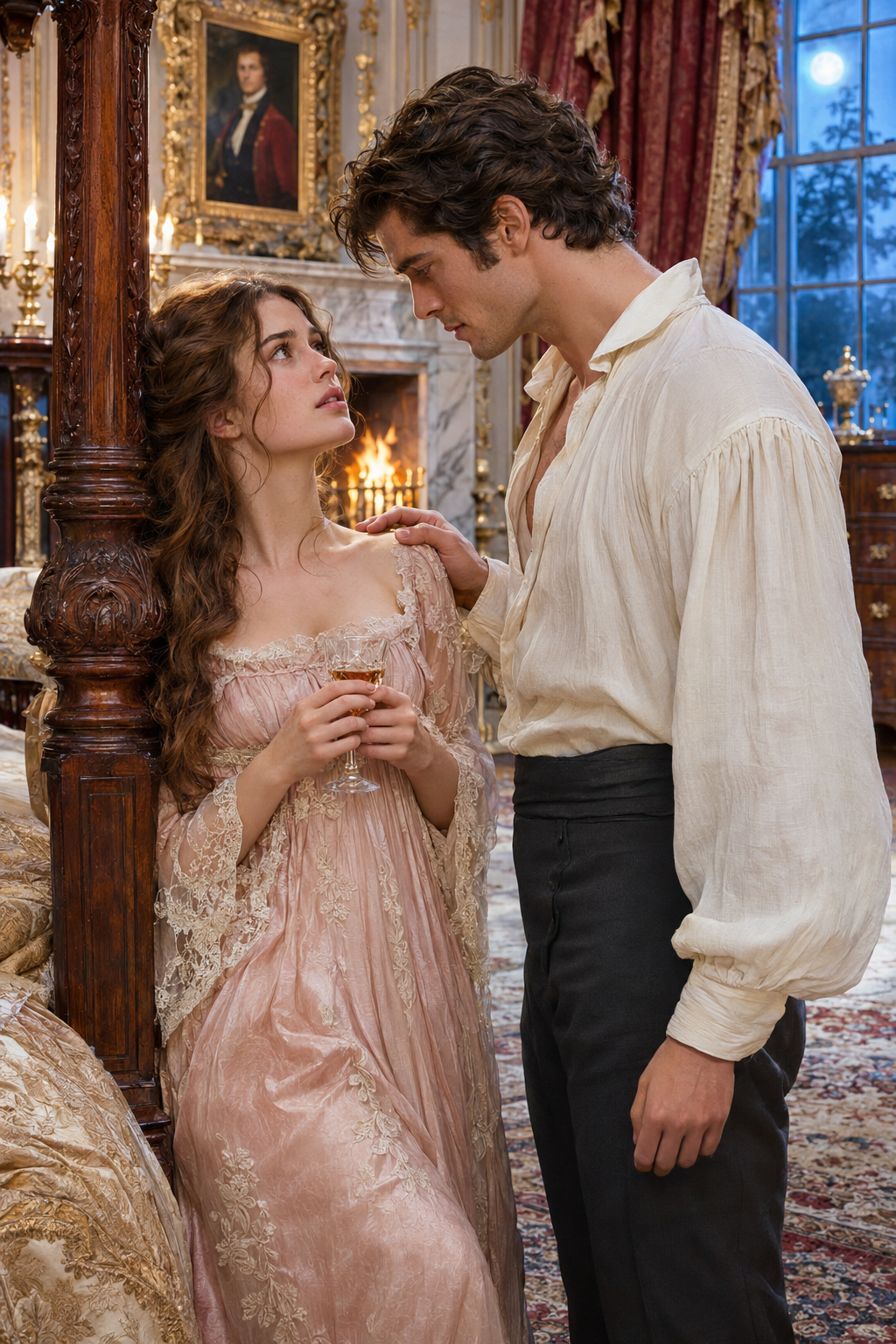
I knocked.
The door opened, and my father stood before me.
He looked twenty years older than he had at my wedding.
“Father!”
He pulled me inside.
“Thank God you came.”
His clothes were dirty, his cheeks hollow, and his hands trembled.
“What have you done?” I demanded.
He sank into a chair.
“I thought I could save us.”
“By taking money from Ravenscroft?”
His eyes filled with shame.
“I owed him more than I could repay. He promised to cancel the debt if I persuaded you to marry Ashford.”
I stared at him.
“Why?”
“Because Ravenscroft needed someone inside Blackmere Hall.”
The room fell silent.
My father covered his face.
“He wanted documents from Edmund’s study. Letters Henry Ashford had written before his death.”
“You expected me to steal them?”
“No! He said the marriage itself would give him leverage. I never imagined he would threaten you.”
I stepped backward.
“You sold my future to a man who wanted to destroy my husband.”
“I was desperate.”
“So was I,” I whispered. “But I did not betray you.”
My father began to cry.
For years, I had believed that tears could excuse almost anything.
That night, I learned they could not.
“Where are the letters?” I asked.
“I don’t know. But I have something else.”
He reached inside his coat and withdrew a small leather notebook.
“Henry gave me this seven years ago. He asked me to keep it safe until he could speak to Edmund.”
I opened it.
Inside were dates, payments, shipping records, and several names.
One appeared repeatedly.
Lord Sebastian Ravenscroft.
Julian’s father.
“What is this?”
“Evidence of illegal grain shipments. Ravenscroft was buying grain cheaply during shortages and selling it abroad at enormous profit. Henry discovered that several shipments had been taken from estates whose tenants were starving.”
I looked up.
“Blackmere?”
My father nodded.
“Henry intended to expose him.”
“Why didn’t you give this to Edmund?”
“Because Ravenscroft threatened to ruin us. Later, when Sebastian died, I thought the danger had passed.”
“And now Julian wants it.”
My father nodded again.
I closed the notebook.
“We must return to Blackmere immediately.”
A voice came from the doorway.
“I am afraid that will not be possible.”
Julian Ravenscroft stood there with two armed men.
My father rose so quickly that his chair fell backward.
“You promised she would not be harmed!”
Ravenscroft sighed.
“Your daughter is proving considerably more troublesome than expected.”
He held out his hand.
“The notebook, Your Grace.”
I clutched it against my chest.
“No.”
His smile disappeared.
“Do not mistake your new title for protection.”
One of the men stepped forward.
Before he could reach me, my father struck him with a fireplace poker.
Everything happened at once.
The second man lunged toward my father. I threw the lantern at his feet, and burning oil scattered across the wooden floor.
Ravenscroft shouted.
Smoke rose rapidly.
My father seized my arm.
“Run!”
We stumbled through the rear door into the snow.
Behind us, the lodge caught fire.
We had barely reached the trees when a gunshot shattered the night.
My father collapsed.
For one dreadful moment, I could not understand what had happened.
Then I saw the blood spreading across his coat.
“Father!”
He gripped my hand.
“Go.”
“I won’t leave you.”
“Listen to me.” His voice was barely audible. “I have failed you in every way a father can fail his child. Do not let me fail you once more.”
Footsteps approached through the snow.
I tried to lift him, but he pushed me away.
“Take the notebook. Tell Edmund the truth.”
Another shot rang out.
A branch broke above my head.
I ran.
I ran through darkness, through snow deep enough to swallow my boots, through branches that tore my face and hands.
Behind me, men shouted.
I had no idea where I was going.
Then, between the trees, I saw a moving light.
A lantern.
And heard someone calling my name.
“Elizabeth!”
Edmund.
I stumbled toward his voice.
He appeared on horseback, accompanied by three estate men.
The moment he saw me, he dismounted.
“Good God, Elizabeth!”
I fell into his arms.
“Ravenscroft,” I gasped. “He shot my father.”
Edmund’s face changed.
“Where?”
“The lodge. Please, he may still be alive.”
Edmund wrapped his coat around me and turned to his men.
“Find Mr. Bennett. Bring him back, whatever condition he is in. And do not let Ravenscroft escape.”
Then he lifted me onto his horse.
I tried to protest.
“My father—”
“My men will find him.”
His arms tightened around me.
“I thought I had lost you.”
The words were almost swallowed by the wind.
But I heard them.
And for the first time, I understood how much they mattered.
At Blackmere Hall, Edmund carried me directly to my room.
The physician examined my frozen hands and the cuts along my arms.
Edmund remained beside the bed.
When the physician finally left, I took the notebook from beneath my cloak.
“This is what Ravenscroft wanted.”
Edmund opened it.
As he read, his expression became increasingly grim.
Then he stopped at one particular page.
I watched his hand begin to tremble.
“What is it?”
He turned the notebook toward me.
There, beside a payment dated two days before Henry’s death, was a name.
Thomas Whitmore.
Edmund’s steward.
The man who had managed Blackmere for nearly twenty years.
The man who had helped rescue the villagers.
The man Edmund trusted more than anyone.
“No,” Edmund whispered.
But the evidence was unmistakable.
Whitmore had received five thousand pounds from Sebastian Ravenscroft.
And beside the payment, Henry had written three words.
Carriage wheel repairs.
Edmund rose so abruptly that his chair scraped across the floor.
“Stay here.”
I caught his wrist.
“Edmund, wait.”
He looked at me.
“Whitmore has access to everything. The accounts, the servants, the gates. If he knows we have this notebook—”
A crash sounded downstairs.
Then a scream.
Edmund rushed toward the door.
I followed despite his protests.
We reached the main staircase to find smoke pouring from the west corridor.
Servants were running with buckets.
Someone shouted that the nursery had caught fire.
The nursery.
Three village children had been sleeping there.
I ran before anyone could stop me.
The corridor was thick with smoke. Flames crawled along the curtains, and heat struck my face.
Inside the nursery, two children were huddled beneath a bed.
I dragged them toward the door.
But the youngest, little Annie, was nowhere to be seen.
“Annie!” I shouted.
A faint cry came from the adjoining room.
I found her trapped behind a fallen wardrobe.
I pulled desperately at the heavy wood.
It would not move.
Smoke filled my lungs.
Then Edmund appeared.
Together, we shifted the wardrobe enough for me to reach her.
He lifted the child into his arms and pushed me toward the door.
A burning beam fell behind us.
We escaped seconds before part of the ceiling collapsed.
Outside, beneath the freezing night sky, Edmund handed Annie to her mother.
Then he turned to me.
His face was streaked with soot.
“You could have died.”
“So could she.”
He stared at me, breathing hard.
And suddenly he pulled me against him.
His arms closed around me with a desperation that left no room for politeness.
“Do not ever frighten me like that again.”
I buried my face against his chest.
“I cannot promise that.”
A strange sound escaped him.
Half laughter.
Half despair.
Then he kissed my forehead.
It was the gentlest thing anyone had done for me in months.
But our moment lasted only seconds.
A stable boy came running across the courtyard.
“Your Grace! Mr. Whitmore has taken the north carriage!”
Edmund released me.
“Where is he going?”
“The old road toward Ravenscroft’s estate.”
I looked at Edmund.
“He set the fire.”
“Yes.”
“And Ravenscroft?”
Edmund’s expression became deadly calm.
“I suspect they are running out of places to hide.”
By dawn, the fire was extinguished.
The west wing was badly damaged, but everyone had survived.
My father had also been found alive.
The bullet had struck his shoulder, and although he had lost considerable blood, the physician believed he would recover.
I sat beside his bed for nearly an hour.
He apologized repeatedly.
Finally, I stopped him.
“Father, I love you. But love does not erase what you have done.”
He lowered his eyes.
“I know.”
“You must tell the authorities everything.”
His face crumpled.
“They will prosecute me.”
“Yes.”
“And you would allow that?”
I took his hand.
“I will stand beside you while you face the consequences. But I will not help you escape them.”
He wept quietly.
For the first time in my life, I did not try to rescue him from his own choices.
That afternoon, Edmund received word that Whitmore had been captured near the southern crossing.
Ravenscroft, however, had disappeared.
The steward confessed quickly.
Seven years earlier, Sebastian Ravenscroft had paid him to sabotage Henry’s carriage. Whitmore claimed he had only intended to delay Henry’s journey, not kill him.
Edmund listened without speaking.
Then Whitmore revealed something worse.
Henry had survived the initial crash.
He had been conscious when Whitmore arrived.
And Whitmore had left him there.
Alone.
In the freezing rain.
Edmund walked out of the room.
I found him later in the abandoned library, standing before a portrait of his brother.
Henry Ashford had been a handsome young man with Edmund’s dark eyes and the same serious expression.
Edmund did not turn when I entered.
“For seven years,” he said, “I believed I should have been with him.”
I remained silent.
“We argued that morning. Henry wanted to expose Ravenscroft immediately. I told him he was being reckless.”
His voice broke.
“He said I cared more about preserving the family name than protecting the people who depended on us.”
I stepped closer.
“Edmund—”
“He was right.”
“No. He was angry.”
“I let him leave alone.”
“You did not loosen those bolts.”
He shook his head.
“I should have stopped him.”
I stood beside him.
“Then you would have spent seven years wondering whether you had prevented him from doing what he believed was right.”
He looked at me.
“You cannot save someone from every danger, Edmund. Sometimes loving them means accepting that they have a will of their own.”
His eyes filled with tears.
I had never seen him cry.
“I miss him,” he whispered.
I took his hand.
“I know.”
He bowed his head, and I held him as the grief he had buried for seven years finally found its way out.
We remained there until the candles burned low.
When he spoke again, his voice was different.
“I married you because I believed I had nothing left to give anyone.”
I looked up.
“Why me?”
He hesitated.
“Your father approached my solicitor about the debts. I knew of Ravenscroft’s involvement, though not the full extent. I thought bringing you here might prevent Ravenscroft from using you against me.”
“So you married me to protect yourself?”
“At first, partly.”
The admission hurt.
Edmund tightened his hold on my hand.
“But I also remembered you.”
I frowned.
“Remembered me?”
“Five years ago, at a charity gathering in London. A young woman publicly challenged a wealthy gentleman who claimed poverty was the result of laziness.”
I stared at him.
“That was you?”
“I was standing near the doorway.”
I remembered the evening vividly.
I had been nineteen, furious, and thoroughly embarrassed afterward.
“You laughed at me.”
“I did.”
“You thought me ridiculous.”
“I thought you magnificent.”
My breath caught.
Edmund smiled faintly.
“When your father’s name reached me, I remembered the young woman who had refused to be silent in a room full of powerful men.”
“Then why tell me you could never love me?”
His smile disappeared.
“Because I was afraid I would.”
Before I could answer, a knock interrupted us.
The constable had arrived with terrible news.
Ravenscroft had taken refuge at the old northern bridge.
And he had sent a message.
Unless Edmund came alone before sunset, he would destroy the remaining evidence of his father’s crimes.
Edmund read the note once.
Then he folded it.
“I am going.”
“No,” I said immediately.
He looked at me.
“Elizabeth—”
“He wants you alone because he intends to kill you.”
“I cannot allow him to escape.”
“Then do not go alone.”
“He has threatened to burn the documents.”
“And if you die, what will they prove?”
Edmund was silent.
I stepped closer.
“You told me this marriage was an arrangement. You promised me comfort, security, and separate bedrooms.”
A reluctant smile touched his mouth.
“This seems a peculiar moment to discuss our marriage.”
“I am not finished.”
His smile faded.
“I accepted those terms because I believed I had no choice. But I have a choice now.”
I took his hand.
“And I choose not to become a widow because my husband is too stubborn to ask for help.”
He stared at me.
Then, slowly, he nodded.
We made a plan.
The constable and six men would approach through the woods. Edmund would ride toward the bridge, while I remained concealed in a carriage farther down the road.
At least, that was the plan.
Ravenscroft had anticipated us.
As Edmund reached the bridge, a gunshot rang out.
His horse reared.
I watched in horror as Edmund fell.
Before I could move, Ravenscroft emerged from behind the stone parapet.
He seized Edmund by the collar and dragged him toward the broken edge.
The old bridge had been damaged by the storm. Below it, the river rushed black and violent between walls of ice.
I jumped from the carriage.
“Julian!”
He turned.
His pistol swung toward me.
“Your Grace,” he called. “How predictably devoted.”
Edmund struggled to rise.
“Elizabeth, get back!”
I ignored him.
“You wanted the notebook,” I said.
Ravenscroft’s eyes narrowed.
“I already know your husband gave it to the constable.”
“Then you know the truth will come out.”
He laughed bitterly.
“Truth? Do you imagine truth matters to men with titles?”
“It mattered to Henry Ashford.”
His face twisted.
“Henry was a fool. My father offered him money, influence, anything he wanted. He could have been rich beyond imagination.”
“And instead he chose to protect starving families.”
“He chose to destroy mine!”
Ravenscroft raised the pistol toward Edmund.
I moved without thinking.
I stepped between them.
The gun fired.
Pain exploded through my upper arm.
I stumbled backward.
Edmund shouted my name.
For a moment, the world became a blur of snow, stone, and blood.
Then Ravenscroft lunged toward me, intending to seize me as a hostage.
Edmund struck him with such force that both men fell against the broken parapet.
The stones shifted.
Ravenscroft slipped.
Suddenly, he was hanging above the river, gripping the edge with both hands.
Edmund stood over him.
For one terrible second, I saw the choice in his face.
Seven years of grief.
Seven years of guilt.
Seven years of imagining the man responsible for his brother’s death.
Ravenscroft looked up.
“Help me!”
Edmund did not move.
I pressed my hand against my bleeding arm.
“Edmund.”
He turned toward me.
“Do not let him make you someone Henry would not recognize.”
His expression changed.
Then he dropped to his knees and seized Ravenscroft’s wrist.
With the constable’s help, he dragged him back onto the bridge.
Ravenscroft was arrested moments later.
As they bound his hands, he spat at Edmund.
“You should have let me fall.”
Edmund looked at him steadily.
“Yes,” he said. “A part of me wanted to.”
Then he turned away.
“But my brother deserves justice. Not revenge.”
I remember very little of the journey home.
Only Edmund holding me against him in the carriage, his hand pressed firmly over my wound.
“Stay awake,” he kept saying.
“I am awake.”
“Then keep talking.”
“About what?”
“Anything.”
I tried to smile.
“Your mother will be furious when she learns what happened.”
He gave a broken laugh.
“My mother can be furious until the end of time.”
“Such disrespect toward a duchess.”
“You are a duchess.”
“And a rather troublesome one.”
His eyes shone.
“The most troublesome woman in England.”
I closed my eyes.
“Edmund?”
“Yes?”
“If I die—”
“You are not dying.”
“If I do, promise me something.”
His voice shook.
“Anything.”
“Do not become cold again.”
He pressed his forehead against mine.
“Then you must stay and make certain I don’t.”
I survived.
The bullet had passed through the flesh of my upper arm without striking bone. The physician called it fortunate.
Edmund called it the worst afternoon of his life.
For nearly two weeks, he refused to leave my side.
He read to me, brought me tea, argued with the physician, and insisted on personally supervising every change of bandages.
One evening, I finally said, “You are being unbearable.”
He looked offended.
“I am ensuring your recovery.”
“You are frightening the servants.”
“They should be frightened if they neglect you.”
“Edmund.”
“Yes?”
“Sit down.”
He obeyed.
I took his hand.
“You cannot protect me from the entire world.”
His expression softened.
“I know.”
“Do you?”
“I am learning.”
I smiled.
“Then perhaps there is hope for you yet.”
He leaned forward and kissed me.
Not on the forehead.
Not on the hand.
On the lips.
It was gentle at first, almost hesitant, as though he feared I might disappear.
Then I reached for him with my uninjured arm, and the kiss became a promise neither of us had expected to make.
When he finally drew back, his eyes searched mine.
“Elizabeth, I owe you an apology.”
“For what?”
“For every day I made you feel unwanted in your own home.”
I swallowed.
“You were trying to protect yourself.”
“Yes. And in doing so, I hurt the one person who taught me how to live again.”
He reached into his coat and withdrew a folded paper.
I recognized it immediately.
Our marriage contract.
He placed it in my lap.
“I have instructed my solicitor to prepare a settlement in your name. Your financial security will no longer depend on remaining my wife.”
I stared at him.
“Edmund—”
“If you wish to leave, you may. I will not hold you to a bargain made out of desperation.”
He paused.
“But if you stay, I want it to be because you choose me.”
Tears blurred my vision.
“And what are you offering this time?”
He took both my hands.
“Everything I once believed I was incapable of giving.”
His voice trembled.
“My loyalty. My trust. My imperfect heart. And whatever years God allows me.”
I laughed through my tears.
“That sounds dangerously like love.”
“It is.”
He kissed my fingers.
“I love you, Elizabeth Ashford. More than I know how to say.”
I looked at the contract, remembering the frightened young woman who had signed it to save her father.
Then I tore it in half.
Edmund stared.
“Elizabeth!”
“I believe,” I said, “we should begin our marriage again.”
He laughed.
And this time, when he kissed me, there was no hesitation.
Spring arrived slowly at Blackmere.
The snow melted from the fields, the river returned to its banks, and the damaged west wing was rebuilt.
But the estate itself had changed.
Edmund established a permanent relief fund for struggling tenants. The old hunting lodge was replaced with a small infirmary, and a portion of the estate’s profits was dedicated to winter food supplies.
We named the fund after Henry.
When Edmund unveiled the plaque, he stood before the villagers and spoke about his brother without bitterness for the first time.
“Henry believed that privilege meant responsibility,” he said. “I spent many years forgetting that lesson. My wife helped me remember.”
I stood beside him, my eyes filling with tears.
The villagers applauded.
But the moment that moved me most came afterward, when little Annie ran toward Edmund and threw her arms around his legs.
“Thank you for saving me, Your Grace.”
He knelt beside her.
“You must thank the duchess. She found you.”
Annie looked at me solemnly.
“I know. But you came back for both of us.”
Edmund was silent for a long moment.
Then he smiled.
“Yes,” he said softly. “I suppose I did.”
My father eventually stood trial.
His cooperation helped expose the full extent of the Ravenscroft family’s crimes. Julian was convicted of conspiracy, attempted murder, and other offenses. Whitmore was convicted for his part in Henry’s death.
My father received a prison sentence for fraud and his involvement in Ravenscroft’s schemes.
It broke my heart.
But I visited him regularly.
Over time, our conversations changed.
He stopped asking me to excuse his mistakes.
Instead, he began asking about the villagers, the children, and the work we were doing.
One afternoon, he said something I had waited my entire life to hear.
“I used to think being a good father meant providing you with everything.”
I looked at him across the small prison table.
“And now?”
“Now I understand that I should have taught you how to live without sacrificing yourself for my failures.”
I reached across the table and held his hand.
“I think we are both learning.”
Even the dowager duchess changed, though she would never have admitted it.
She returned to Blackmere that summer, prepared to criticize our charitable expenses.
Instead, she found the estate prosperous, the tenants grateful, and her son happier than she had seen him in years.
At dinner, she studied me over her wineglass.
“You have made considerable changes to this household.”
“Yes, Your Grace.”
“Some of them rather unconventional.”
“I imagine so.”
She paused.
Then she said, “Edmund laughs now.”
I looked toward my husband, who was telling an absurd story to one of our guests.
“He does.”
The duchess lowered her eyes.
“I had forgotten what that sounded like.”
It was the closest thing to an apology she ever offered.
I accepted it.
Not every wound needed a grand confession to begin healing.
One year after our wedding, Edmund took me back to the little chapel where we had married.
There were no guests.
No witnesses beyond the elderly clergyman.
And no debts hanging over our heads.
Edmund stood before me, holding a small bouquet of white roses.
“I thought,” he said nervously, “we might make new promises.”
I smiled.
“Are you proposing to your own wife?”
“I am attempting to.”
“Then proceed, Your Grace.”
He took my hands.
“Elizabeth, when I first married you, I believed love was a weakness that made people vulnerable to suffering.”
His voice softened.
“Then you walked into my house, opened my kitchens, challenged my pride, and reminded me that a heart kept safely closed is not truly safe at all.”
I could barely see him through my tears.
“You taught me that love is not the absence of fear. It is choosing to care even when there is something to lose.”
I squeezed his hands.
“And you taught me,” I whispered, “that being needed is not the same as being loved.”
He smiled.
“I hope I have managed to do both.”
“You have.”
We exchanged our vows again.
This time, there was no contract.
No bargain.
No desperate father standing beside the fireplace.
Only two people who had been wounded by life and had somehow found their way toward each other.
When we stepped outside, the bells began to ring.
Edmund drew me close.
“Are you happy?” he asked.
I looked at the rolling green hills, the distant rooftops of Blackmere village, and the man whose heart I had once believed impossible to reach.
“Yes,” I said.
Then I smiled.
“But I reserve the right to become unhappy occasionally.”
He laughed.
“And I suppose we shall have to discuss it.”
I kissed him.
“Exactly.”
Years later, when our children asked how their father and I had fallen in love, Edmund always began with the same ridiculous claim.
“Your mother married me for my money.”
And I would reply, “Your father married me because he needed someone brave enough to tell him when he was wrong.”
Our children would laugh, and Edmund would pretend to be deeply offended.
But sometimes, after they had gone to bed, we would sit together beside the fire and remember the winter that changed everything.
We remembered the villagers who came to our gates.
The little girl rescued from the snow.
The secrets that nearly destroyed us.
And the terrible choices that taught us who we truly wanted to become.
I never forgot the morning I signed that first marriage contract.
At twenty-three, I believed my life was being taken from me.
I thought security was something another person could purchase, and love was a luxury reserved for women fortunate enough to choose freely.
I had been wrong.
Freedom did not arrive when my debts disappeared or when I became a duchess.
It arrived when I learned that my worth was not measured by how much I could sacrifice for others.
And Edmund’s freedom came when he understood that protecting his heart from pain had also prevented it from experiencing joy.
We did not save each other by becoming perfect.
We saved each other by refusing to let our worst experiences decide the people we would become.
On our twentieth wedding anniversary, Edmund placed a small wooden box beside my breakfast plate.
Inside lay a carefully preserved piece of paper.
One half of our original marriage contract.
I looked up in astonishment.
“You kept it?”
He smiled.
“To remind myself of the worst bargain I ever made.”
I raised an eyebrow.
“The worst?”
“Certainly. I offered a woman financial security in exchange for her hand, and she proceeded to take possession of my entire heart.”
I laughed.
“And do you regret it?”
He came around the table, took my hand, and kissed it.
“Every day,” he said solemnly. “My life has been entirely too interesting ever since.”
Then his expression softened.
“Not for a single moment.”
I rested my forehead against his.
Outside, the morning sunlight fell across Blackmere’s gardens, where our children were laughing beneath the old oak trees.
And I thought of the frightened young woman I had once been.
If I could have spoken to her, I would not have promised that everything would be easy.
It had not been.
I would not have told her that love could prevent heartbreak, betrayal, or loss.
It could not.
I would have told her something far more important.
That a difficult beginning does not determine the ending.
That forgiveness does not require surrendering justice.
That kindness is not weakness, and courage is not the absence of fear.
And above all, that the right kind of love never demands that you disappear in order to deserve it.
Edmund drew me toward the window, where the gardens were filled with roses.
“Whatever are you thinking about?” he asked.
I smiled at him.
“About the day you told me you were not offering love.”
He groaned.
“Must you remind me?”
“Occasionally.”
“And what have you concluded?”
I slipped my hand into his.
“That you were telling the truth.”
He looked startled.
I rose onto my toes and kissed his cheek.
“You were not offering me love, Edmund.”
I smiled.
“You were still learning how to give it.”
He held me close, and together we watched the sunlight spread across the home we had built.
Once, Blackmere Hall had been a place of silence, secrets, and sorrow.
Now it was filled with warmth, laughter, and second chances.
And that, I finally understood, was the greatest fortune either of us could ever have possessed.
Not the title.
Not the estate.
Not the wealth that had first brought us together.
But the extraordinary gift of being loved without being owned, of being forgiven without being excused, and of finding someone who would choose you freely, even after seeing every imperfect part of your soul.
For a marriage that began as a bargain had become something no contract could ever guarantee.
A love built not on obligation, but on choice.
And every morning for the rest of our lives, we chose each other again.
The years that followed brought Blackmere Hall a happiness I had once believed existed only in novels.
Our children grew beneath its ancient roof, filling the corridors with laughter, arguments, muddy footprints, and the sort of joyful disorder Edmund had once considered intolerable.
Our eldest daughter, Eleanor, inherited her father’s dark eyes and my unfortunate habit of challenging anyone who believed themselves unquestionably right.
Our son, Henry, named for the uncle he would never meet, possessed a gentle heart and an extraordinary talent for finding injured animals.
And our youngest, Rose, seemed determined to turn every quiet afternoon into an adventure.
Edmund adored them all.
Sometimes I would find him sitting on the nursery floor, surrounded by wooden soldiers and dolls, patiently allowing Rose to place a ridiculous ribbon in his hair.
The same duke who had once frightened an entire dining room into silence now permitted a five-year-old to declare him the king of an imaginary kingdom.
And he had never looked more content.
But happiness, I learned, was not a life without sorrow.
It was having someone beside you when sorrow inevitably came.
My father was released from prison after serving his sentence. He returned to a modest cottage near Blackmere, where he spent his remaining years teaching village children to read and helping families understand their accounts.
He never recovered his fortune.
He recovered something better.
His integrity.
When he died peacefully one autumn morning, Edmund stood beside me at his grave.
“I wish I had given him more time,” I whispered.
Edmund slipped his hand into mine.
“You gave him something far more difficult. You gave him the chance to become a better man without pretending he had never been a worse one.”
I leaned against him, grateful for the wisdom we had earned together.
Years passed.
Our children grew older.
Eleanor married a young physician who cared more about healing people than impressing society. Henry took responsibility for the estate and expanded the charitable work begun in his uncle’s name. Rose traveled across Europe, sending letters so full of adventures that Edmund repeatedly threatened to follow her and bring her home.
He never did.
He understood, at last, that love could not flourish inside a cage.
On a quiet winter evening, forty years after our first wedding, Edmund and I sat together before the fireplace.
Snow drifted beyond the windows.
It reminded me of the storm that had changed our lives.
His hair had turned silver, and the hands that once held a marriage contract with such cold certainty now trembled slightly as they reached for mine.
“Elizabeth,” he said, “there is something I have never told you.”
I looked at him with amusement.
“After forty years, I should hope there are still a few mysteries left.”
He smiled.
“On the morning of our wedding, I nearly called it off.”
I turned toward him.
“Why?”
“Because I saw you standing outside the chapel, looking so frightened. And I realized that I was asking you to surrender your freedom to a stranger.”
“Then why didn’t you?”
“Because you looked at me and smiled.”
I remembered that morning.
I had smiled because I was terrified of crying.
Edmund brushed his thumb across my fingers.
“I thought that if a woman could find the courage to smile on the worst day of her life, perhaps I could find the courage to become someone worthy of that smile.”
Tears filled my eyes.
“You did,” I whispered.
He shook his head.
“Not always.”
“No,” I agreed. “Not always.”
Then I kissed his hand.
“But you kept trying. And that mattered more.”
He rested his head against mine.
For a long while, neither of us spoke.
The fire crackled softly.
Outside, snow covered the same hills where we had once struggled against fear, betrayal, and death.
At last, Edmund whispered, “If I could live my life again, I would change a thousand things.”
I looked at him.
“Would you?”
“Yes. I would have trusted my brother. I would have listened to my tenants. I would have spent fewer years hiding from the world.”
He paused.
“But I would still walk into that chapel.”
I smiled through my tears.
“So would I.”
He kissed my forehead.
“Even knowing everything that followed?”
“Especially knowing everything that followed.”
That night, as the clock struck midnight, Edmund fell asleep with his hand resting over mine.
I watched the fire slowly fade and thought about the strange journey that had brought us there.
We had begun as two strangers bound by desperation.
We had become allies through hardship, lovers through trust, and companions through the countless ordinary days that followed.
And I finally understood that the greatest love stories were not made extraordinary by grand declarations or dramatic rescues.
They became extraordinary through the quiet decisions that followed.
The decision to listen after an argument.
To remain gentle when life became cruel.
To tell the truth when a lie would be easier.
To forgive without abandoning self-respect.
To keep choosing the same person, not because a contract demanded it, but because the heart still wished to.
I looked at Edmund, sleeping peacefully beside me, and remembered his first words about our marriage.
I am not offering you love.
How strange that a man who had offered me everything except his heart had eventually given me the one thing no fortune could purchase.
And how strange that a woman who had entered his home believing she had lost her freedom had discovered, within its walls, the courage to claim it.
I leaned forward and kissed his silver hair.
“Thank you,” I whispered.
He stirred slightly.
“For what, my love?”
“For learning to love me.”
His fingers tightened gently around mine.
“Thank you,” he murmured, “for teaching me that I could.”
Outside, the snow continued falling.
Inside, the fire burned low.
And in the great house that had once been known throughout England for its cold and distant master, two old hearts rested together, warm with a lifetime of love.
Our story had never been about a duke rescuing a penniless girl.
Nor had it been about a young woman saving a broken man.
It was about two imperfect people who discovered that love was neither a debt to be repaid nor a prize to be earned.
It was a gift, freely given and carefully protected.
And when I finally closed my eyes beside the man I had chosen, I knew that whatever tomorrow might bring, I would never again regret the morning I walked into that little chapel.
For the marriage that began without love had taught us its deepest meaning.
True love is not finding someone who promises you a perfect life. It is finding someone who will face an imperfect life beside you, and still choose your hand to hold until the very end.
And that was how our story ended.
Not with a bargain.
Not with a title.
Not even with a promise.
But with a love that had been freely chosen, faithfully lived, and never taken for granted.