The Duke of Witmore was about to marry a woman who had nothing to her name.
Nathaniel folded the letter and slipped it inside his coat before reaching for the door. Eleanor caught his wrist, her expression sharper than any warning she could have spoken.
“Not yet.”
Outside, Crowe tapped his walking stick against the stone floor.
“I trust marriage hasn’t made you forget your oldest friends, Nathaniel.”
The duke looked at Eleanor. She nodded toward the cabinet, where several documents remained scattered across the open drawer. Together, they returned the papers to their original positions.
Only then did Nathaniel open the door.
Sebastian Crowe stood beneath the corridor lantern, impeccably dressed, with rain glistening upon the shoulders of his coat. His gaze traveled past Nathaniel and settled upon Eleanor.
“An unusual place to spend one’s wedding evening.”
“My wife has an interest in family history,” Nathaniel replied.
“How fortunate. Though history can be rather unkind to certain families.”
Eleanor stepped into the light.
“Only when it is accurately recorded.”
For a fraction of a second, Crowe’s smile disappeared.
Nathaniel noticed.
Crowe removed his gloves with deliberate care, explaining that he had come to discuss an urgent financial matter. Several creditors, he claimed, had grown impatient. Without his intervention, Witmore might soon find itself facing the public humiliation of bankruptcy.
He produced a folded agreement from his coat.
“A temporary arrangement. Nothing more.”
Nathaniel accepted it without opening the document.
“Tomorrow, Sebastian.”
Crowe glanced once more toward the archives.
“Of course. Enjoy your evening.”
His footsteps receded along the corridor, accompanied by the measured tapping of his walking stick.
Nathaniel waited until the sound disappeared.
Then he unfolded the agreement.
Eleanor stood beside him as he read. The document granted Crowe administrative authority over the estate until its outstanding obligations had been satisfied. Among the properties listed as collateral was Witmore Manor itself.
And its entire historical collection.
Nathaniel read that particular clause again.
“He doesn’t want the estate.”
Eleanor shook her head.
“He wants the right to empty this room without anyone questioning him.”
Nathaniel returned to the archives and locked the door behind them. His father’s letter suddenly seemed heavier inside his coat.
For years, he had regarded Sebastian Crowe as the last dependable figure in a world of obligations and disappointments. Crowe had attended his father’s funeral, helped negotiate his inheritance, and stood beside him through every financial crisis.
Now those memories arranged themselves into something considerably uglier.
Eleanor reopened the letter beneath the lamp.
Her father had entrusted the previous duke with a collection of original correspondence proving that Crowe had fabricated the accusations against him. Yet there was no indication of where those documents had been placed.
Nathaniel examined the signature at the bottom.
“Why would my father agree to protect yours and then abandon him?”
Eleanor folded the letter carefully.
“That is a question I have been asking for years.”
There was no accusation in her voice. Somehow, that made it harder to hear.
They searched until midnight, opening cabinets and examining account books beneath the weakening light. Eleanor discovered references to payments made through intermediaries, while Nathaniel identified properties his father had supposedly sold to settle debts.
Several had eventually passed into Crowe’s possession.
But the correspondence that could prove the conspiracy remained missing.
As the clock struck one, Nathaniel noticed Eleanor rubbing her fingertips together. The archives were bitterly cold.
He removed his coat and placed it around her shoulders.
She looked up, momentarily surprised.
“You should rest.”
“So should you.”
Neither moved.
Eventually, Nathaniel summoned the elderly housekeeper, Mrs. Aldridge, who had served the Witmore family since before his birth.
She arrived carrying a tray of tea, her silver hair pinned neatly beneath her cap.
Nathaniel showed her the letter.
The old woman’s face changed.
“Where did you find that, Your Grace?”
“In my father’s cabinet.”
Mrs. Aldridge set the tray down with unusual care.
For several moments, she stared at the handwriting as though it belonged to someone standing in the room.
“Your father received that letter three days before he fell ill.”
Nathaniel frowned. His father had died several months after Eleanor’s father was accused.
“He was ill for much longer than that.”
“Not in the beginning, sir.”
The housekeeper lowered her voice.
“He had been preparing to travel to London. His luggage was packed. Then Lord Crowe visited.”
Eleanor’s fingers tightened around the edge of the table.
“What happened?”
“They argued. I heard your father say that he would not allow an innocent man to suffer for another man’s ambition.”
Mrs. Aldridge paused, looking toward the door.
“By morning, he had canceled his journey.”
Nathaniel rose slowly.
“Did he tell you why?”
“No, Your Grace. But afterward, he asked me to keep a package somewhere safe.”
The silence that followed was absolute.
Eleanor stood.
“Do you still have it?”
Mrs. Aldridge looked at Nathaniel, then at the woman he had married only hours earlier.
“I have been waiting a very long time for someone to ask.”
She led them through the servants’ quarters and down a staircase into the oldest section of the manor.
Behind a disused linen cupboard stood a narrow recess in the wall. From it, she withdrew a small wooden box wrapped in faded cloth.
Nathaniel recognized his father’s initials carved into the lid.
His hands hesitated before opening it.
Inside lay a collection of letters, a miniature portrait, and a sealed envelope bearing his own name.
He broke the seal.
The handwriting was unmistakable.
His father had written the letter shortly before his death, confessing that Crowe had threatened to destroy the Witmore family if he presented evidence defending Eleanor’s father.
At first, the duke had resisted.
Then Crowe revealed that he controlled several of the estate’s largest creditors and could demand immediate repayment of obligations Nathaniel’s father had never fully understood.
Faced with the prospect of leaving his son penniless, the old duke had surrendered.
Nathaniel stopped reading.
For the first time since entering the archives, he could not look at Eleanor.
She took the letter gently from his hands.
The final lines were written with an unsteady pen.
His father had preserved the evidence, hoping that someone with greater courage would eventually use it. He begged Nathaniel not to mistake his silence for innocence.
Eleanor lowered the page.
Nathaniel stared at the wooden box.
“My father knew yours was innocent.”
“Yes.”
“And he let Crowe destroy him.”
Eleanor did not answer immediately.
Outside, rainwater dripped steadily from the roof.
“My father spent his final years defending a name no one wished to hear,” she said. “I cannot pretend this changes nothing.”
Nathaniel accepted the words without protest.
He had inherited more than a ruined estate. He had inherited the consequences of another man’s fear.
Eleanor returned the letter to him.
“But you are not your father.”
He looked at her.
“Not unless you make the same choice.”
The following morning, Crowe received an invitation to Witmore Manor.
Nathaniel informed him that he was prepared to discuss the financial agreement privately.
Crowe arrived shortly before noon, carrying the document and wearing the satisfied expression of a man approaching a long-awaited victory.
Eleanor watched from the adjoining drawing room as Nathaniel received him.
Tea was served. The servants withdrew.
Crowe placed the agreement upon the desk.
“I assure you, this is the only sensible solution.”
Nathaniel examined the pages.
“And once I sign, you will assume control of everything?”
“Until your affairs are restored.”
“Including the archives?”
Crowe smiled.
“Old documents are hardly worth discussing.”
Nathaniel dipped his pen into the ink.
From behind the partially open door, Eleanor watched his hand hover above the signature line.
“Tell me something first, Sebastian. Did you know my father intended to defend Eleanor’s father?”
Crowe’s smile remained, but his fingers stopped moving.
“A regrettable affair. Your father understood the importance of discretion.”
“Discretion?”
“Some men confuse personal loyalty with political wisdom.”
Nathaniel set the pen down.
“And some men confuse blackmail with friendship.”
Crowe leaned back.
The pleasant expression vanished from his face.
“You should be careful about the language you use in your present circumstances.”
Nathaniel opened a drawer and removed a copy of one of the financial records discovered the previous evening.
Crowe studied it without touching the paper.
The document identified payments made to individuals responsible for acquiring Witmore properties at artificially reduced prices.
Each transaction had benefited companies controlled through Crowe’s associates.
Nathaniel watched him closely.
“You arranged every loss.”
Crowe released a quiet breath.
“Your father was a poor administrator. I merely understood opportunities he failed to recognize.”
“And Eleanor’s father?”
Crowe stood.
“I suggest you consider whether your new wife’s ambitions are worth the destruction of your family.”
Eleanor stepped into the room.
“My family has already experienced your generosity, Lord Crowe.”
He turned toward her.
“You have your father’s unfortunate habit of pursuing matters beyond your understanding.”
“And you have the unfortunate habit of leaving records.”
Crowe’s eyes narrowed.
Nathaniel saw the calculation behind them.
He had spent years mistaking that expression for intelligence.
Now he recognized it as fear.
Crowe collected the agreement from the desk.
“You have until tomorrow evening. After that, I cannot guarantee what your creditors will do.”
He walked toward the door, then stopped beside Eleanor.
“Your father believed the truth would protect him, too.”
Eleanor remained perfectly still until he departed.
Only when the carriage disappeared beyond the gates did she release the breath she had been holding.
Nathaniel approached the window.
“He knows we have something.”
“But not how much.”
They had intended to deliver the evidence directly to the authorities. However, several letters in the wooden box revealed that Crowe maintained relationships with men occupying influential positions within the government.
A private accusation could disappear as easily as the original evidence had.
They needed witnesses.
More importantly, they needed Crowe to believe that he still controlled the situation.
Nathaniel remembered an upcoming gathering at which several creditors, noblemen, and government officials were expected to attend. Crowe himself had arranged the evening to celebrate a recent political achievement.
The duke had received an invitation weeks earlier.
He retrieved it from his desk.
Eleanor studied the embossed lettering.
“He would never expect us to confront him there.”
“Especially if he believes I have surrendered.”
That afternoon, Nathaniel sent Crowe a brief note agreeing to sign the financial arrangement at the gathering.
Meanwhile, Eleanor spent several hours preparing copies of the recovered correspondence.
Mrs. Aldridge assisted her, carrying sealed packets between rooms and arranging for trusted servants to deliver them independently.
Nathaniel wrote to the magistrate responsible for overseeing the district, requesting his attendance at Crowe’s gathering on a matter of considerable importance.
He also contacted two creditors whose signatures appeared in the fraudulent accounts.
Neither responded immediately.
As darkness settled over the estate, Eleanor returned to the archives.
She found Nathaniel standing before his father’s portrait, the confession letter resting upon the table beside him.
“I used to think he had left me nothing but problems,” Nathaniel said.
Eleanor followed his gaze.
“He left you a choice.”
Nathaniel looked down at the letter.
“If we expose Crowe, my father’s involvement becomes public.”
“Yes.”
“The family name may never recover.”
Eleanor approached him.
“Then perhaps it should recover differently.”
He turned toward her.
There was no promise of comfort in her expression, no attempt to make the decision easier.
Nathaniel folded the confession and placed it among the documents they intended to present.
The following evening, Crowe’s residence glowed beneath hundreds of candles. Carriages lined the entrance, and music drifted through rooms crowded with elegantly dressed guests.
Nathaniel entered with Eleanor on his arm.
Conversations softened as they passed.
News of the duke’s financial difficulties had spread, and his marriage to an impoverished woman had inspired considerable speculation.
Crowe greeted them beneath the grand staircase.
“My dear Nathaniel. I am delighted you reconsidered.”
He kissed Eleanor’s gloved hand.
She endured the gesture without smiling.
Throughout dinner, Crowe displayed the effortless charm that had secured his position among the country’s most influential men.
Nathaniel watched him entertain the very people whose trust he had manipulated.
Eleanor noticed something else.
One of the creditors Nathaniel had contacted was seated near the far end of the table. The magistrate stood beside the fireplace, speaking quietly with another guest.
Their letters had been received.
After dinner, Crowe invited Nathaniel into the adjoining library.
Several prominent guests followed, apparently expecting to witness the generous rescue of a struggling nobleman.
The financial agreement lay ready upon the desk.
Crowe offered Nathaniel a pen.
“Shall we put these unpleasant matters behind us?”
Nathaniel accepted it.
Then he looked toward the gathered men.
“Before I sign, I believe my creditors deserve an explanation of how these debts were accumulated.”
Crowe’s expression stiffened.
“This is hardly the occasion.”
“On the contrary.”
Eleanor entered carrying a leather portfolio.
She placed the first document upon the desk.
One creditor stepped forward, adjusting his spectacles as he examined the account.
His confusion quickly gave way to anger.
“These payments were never authorized by me.”
Another guest took the document.
Crowe reached for it, but Nathaniel placed his hand firmly upon the paper.
“Let him finish.”
Eleanor distributed the remaining copies.
The room gradually fell silent as the guests discovered transactions, falsified obligations, and concealed transfers connecting Crowe to the systematic destruction of Witmore’s finances.
Crowe laughed once, sharply.
“Anyone can manufacture an account book.”
“Indeed,” Eleanor replied. “You demonstrated that rather effectively when you accused my father of treason.”
She opened the portfolio again.
This time, she produced the correspondence her father had preserved.
The letters revealed that the political communications used against him had been deliberately altered. Original copies contradicted the evidence presented during the proceedings, while Crowe’s private instructions established his involvement.
The magistrate stepped closer.
“Where were these obtained?”
“From the Witmore family archives,” Nathaniel answered.
Crowe’s gaze shifted toward the door.
Two guests were already standing beside it.
He turned back to Nathaniel.
“Your father participated in this. Are you prepared to disgrace him before everyone?”
Nathaniel removed the final letter from his coat.
“My father participated through silence.”
He handed the confession to the magistrate.
“And I will not defend that silence by continuing it.”
Crowe stared at him.
For the first time, there was nothing polished about his expression.
“You ungrateful fool. Everything you possess would have disappeared without me.”
Nathaniel met his gaze.
“Much of it disappeared because of you.”
Crowe struck the desk with his palm.
“Your father understood what was at stake!”
The outburst carried beyond the library.
Guests gathered in the corridor.
Eleanor watched as Crowe realized how many people had heard him.
His anger dissolved into a strained composure.
He attempted to leave, but the magistrate stepped into his path.
“I believe, Lord Crowe, that you should remain available for questioning.”
Crowe looked around the room, searching for a familiar face willing to intervene.
No one moved.
The men who had laughed at his jokes minutes earlier now avoided his eyes.
Eleanor stood beside the desk, holding her father’s final letter.
She had imagined this moment countless times. In those imaginings, she had always found something devastating to say.
But looking at Crowe now, she felt no desire to speak.
He was merely a man surrounded by the consequences of his own decisions.
The magistrate collected the documents and instructed that Crowe remain under supervision while the allegations were formally investigated.
As Nathaniel escorted Eleanor from the residence, the music in the ballroom had stopped.
Outside, the night air was cold and clear.
Eleanor descended the steps slowly.
Nathaniel offered his hand.
She accepted it.
Neither spoke until their carriage had traveled beyond the illuminated windows.
“Do you think it will be enough?” she asked.
Nathaniel looked at the portfolio resting between them.
“It is enough to make silence considerably more difficult.”
The investigation lasted several months.
Crowe’s associates, eager to protect themselves, began surrendering documents that confirmed the accusations. Creditors discovered that many of Witmore’s obligations had been deliberately inflated or fraudulently acquired.
The original treason proceedings were reopened.
Eleanor attended every hearing.
She sat beneath the high windows of the courtroom, listening as men who had once condemned her father reluctantly acknowledged the evidence of his innocence.
When the official judgment was finally reversed, she remained seated long after the proceedings ended.
Nathaniel waited beside her.
Her father’s name had been restored.
But no judgment could return the years he had lost, the dignity stripped from him, or the life Eleanor might have lived.
She unfolded the written declaration clearing him of all charges.
Then she pressed it against her chest and closed her eyes.
Nathaniel placed his hand over hers.
This time, she did not conceal her tears.
Crowe was convicted for his involvement in the conspiracy and financial fraud. His political influence collapsed, his properties became subject to legal claims, and the fortune he had accumulated through other families’ suffering began to disappear.
Witmore recovered several of its lost properties, although the estate remained far from prosperous.
Nathaniel sold unnecessary possessions, renegotiated legitimate debts, and abandoned the expensive habits his advisers had once insisted were essential to his position.
Eleanor worked beside him.
Together, they established an orderly system of accounts and opened the archives to independent examination.
One spring morning, Nathaniel found her standing beneath the portrait of his father.
She had placed the restored declaration of her own father’s innocence upon a nearby table.
“I thought revenge would feel different,” she admitted.
Nathaniel joined her.
“Does it disappoint you?”
She considered the question.
“No. I simply wish he were here to see it.”
Nathaniel took her hand.
Their marriage had begun as an arrangement neither had entered for love. Yet somewhere between the cold archives, the sleepless nights, and the decisions that had cost them both their illusions, something had quietly changed.
He withdrew a folded document from his pocket.
Eleanor raised an eyebrow.
“Another agreement?”
“An opportunity.”
The document granted her financial independence and the freedom to leave Witmore should she wish.
Nathaniel had signed it himself.
“You came here because you needed something from me,” he said. “You have it now.”
Eleanor studied the signature.
“And what do you want?”
He looked toward the garden, where sunlight rested upon the newly opened flowers.
“For you to stay. But not because you must.”
She folded the document and slipped it into her pocket.
Then she reached for his hand.
“Perhaps we should begin our marriage properly, Nathaniel.”
He smiled.
For the first time, neither of them had anything to conceal.
Years later, visitors to Witmore Manor would find the family archives preserved with extraordinary care. Among its records were documents celebrating achievements and others acknowledging failures that earlier generations might have preferred to erase.
Nathaniel never removed his father’s confession.
Eleanor never asked him to.
They understood that an honorable name was not one untouched by wrongdoing, but one whose bearers possessed the courage to confront it.
And when their children eventually asked how their parents had met, Eleanor would glance at Nathaniel with the same quiet, knowing expression she had worn at the altar.
Their story had begun with a marriage built upon necessity and a secret hidden inside a ruined inheritance.
It ended with something neither had expected to find.
A home where the truth no longer needed to be locked away.
Years passed, and the corridors of Witmore Manor gradually filled with sounds Nathaniel had once believed the house would never hear again.
Children ran beneath the ancestral portraits. Music drifted from the drawing room on winter evenings. The gardens, neglected during the estate’s darkest years, flourished beneath Eleanor’s patient supervision.
Yet one room remained almost exactly as it had been on their wedding night.
The archives.
On a quiet autumn afternoon, Eleanor sat beside the window, sorting correspondence when her eldest daughter entered carrying a small wooden box.
“Mama, what is this?”
Eleanor recognized the initials carved into its lid.
She set aside her papers.
“Something your grandfather left behind.”
The girl opened the box and withdrew the confession that had once nearly destroyed Nathaniel’s faith in his own family.
“Was he a bad man?”
Eleanor looked toward the portrait hanging above the fireplace.
For years, she had struggled with that very question.
“He was a man who became frightened and made a terrible decision.”
“Did Papa forgive him?”
Before Eleanor could answer, Nathaniel appeared in the doorway.
He had heard the question.
Crossing the room, he sat beside his daughter and examined the familiar letter.
“I wish he had made a different choice,” he said. “But I cannot change what he did.”
The girl frowned.
“Then why do we keep his letter?”
Nathaniel glanced at Eleanor.
“So that we remember what happens when protecting ourselves becomes more important than protecting someone innocent.”
His daughter considered this before carefully returning the letter to its box.
Outside, golden leaves scattered across the courtyard.
Eleanor watched Nathaniel take the child’s hand and lead her toward the gardens.
There had been a time when she believed the Witmore name represented everything her family had lost.
Now it belonged to her children.
And she intended to teach them that inheritance was not merely something received. It was something each generation had a responsibility to improve.
Several weeks later, a letter arrived bearing the seal of the prison where Sebastian Crowe remained confined.
Nathaniel discovered it among the morning correspondence.
He recognized the handwriting immediately.
Without opening it, he carried the envelope to Eleanor.
She studied it for a long moment before breaking the seal.
Crowe’s letter contained none of the arrogance she remembered. His sentences were uneven, his handwriting considerably weaker.
He wrote of his failing health and the disappearance of friends who had once competed for his attention.
He claimed that ambition had blinded him.
He asked whether she might find it within herself to forgive him.
Eleanor finished reading and placed the letter upon the table.
Nathaniel waited.
“Will you answer?”
She looked through the window, where their children were playing beneath the bare branches of an old oak.
“I spent years imagining what I would say if he ever asked me that.”
“And now?”
She folded the letter.
“Now I have other things worth thinking about.”
Nevertheless, that evening, Eleanor sat at her writing desk and composed a reply.
She did not offer forgiveness merely because Crowe had finally requested it.
Nor did she remind him of every cruelty he had committed.
She wrote that her father’s innocence had been established, that her family had found peace, and that she would no longer allow Crowe’s actions to determine the course of her life.
She hoped he would spend whatever time remained to him understanding the difference between regret and responsibility.
Then she sealed the envelope.
Nathaniel found her beside the fireplace afterward.
“Are you certain?”
Eleanor nodded.
“I cannot give him back the years he took from me. But I need not give him any more.”
Crowe died the following winter.
The announcement appeared in a newspaper beneath a brief account of his former political achievements and subsequent conviction.
Eleanor read it over breakfast.
She felt neither triumph nor sorrow.
She simply folded the newspaper and asked Nathaniel whether he intended to accompany her into the village that afternoon.
Life continued.
And that, she discovered, was a victory greater than anything she had once imagined.
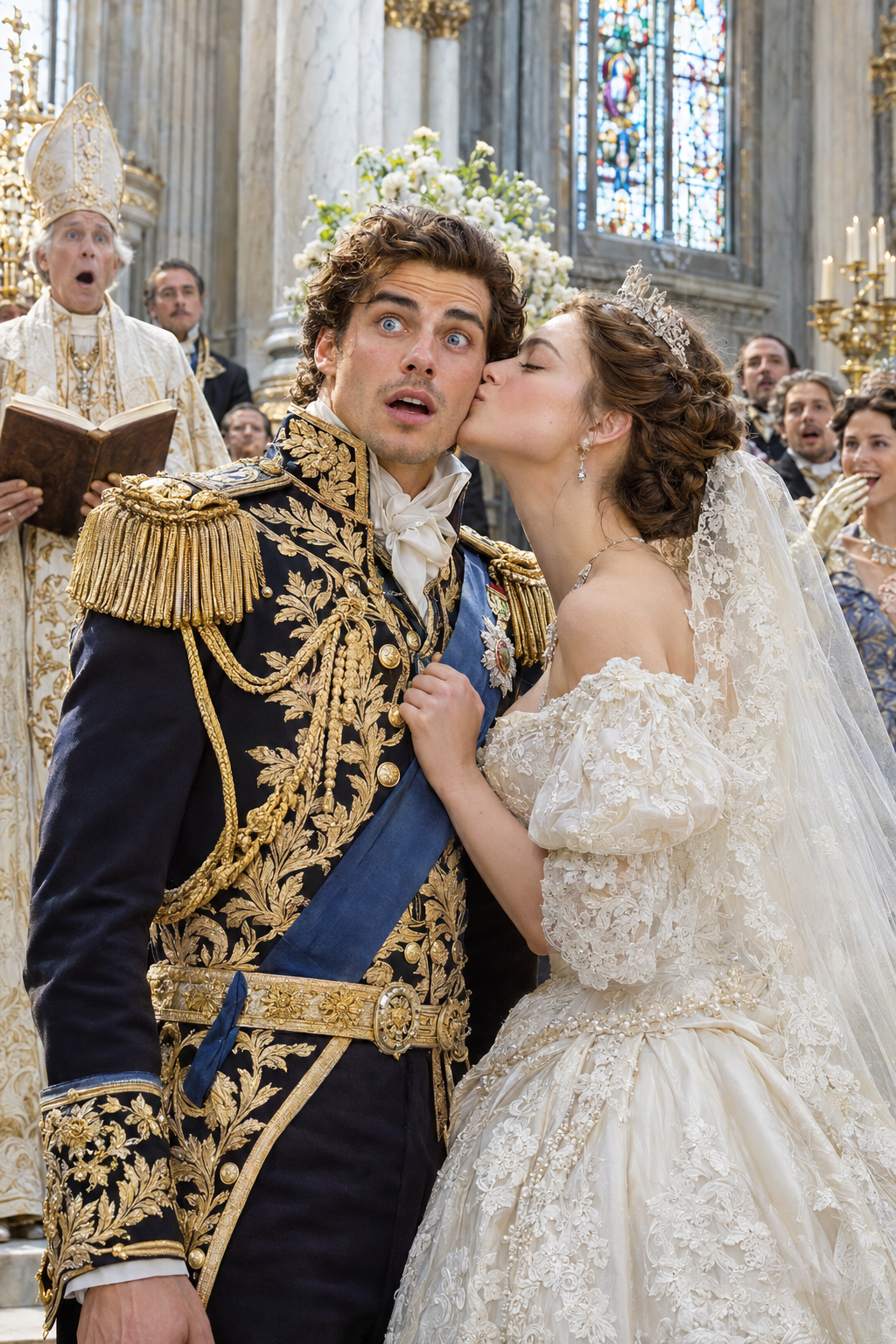
On their twentieth wedding anniversary, Nathaniel arranged a private visit to the chapel where they had exchanged their vows.
The stone walls remained unchanged. Afternoon light filtered through the stained-glass windows, casting familiar colors across the floor.
Eleanor walked slowly toward the altar.
“You were rather unhappy standing here,” she remarked.
Nathaniel smiled.
“I had just discovered that my bride knew considerably more about my affairs than I did.”
“You recovered remarkably well.”
“Eventually.”
He reached into his coat and withdrew a small object.
The iron key.
Eleanor stared at it before laughing softly.
“You kept it?”
“I thought it deserved a better purpose than opening a dusty room.”
He placed it in her palm, exactly as he had done twenty years earlier.
She closed her fingers around it.
For a moment, neither spoke.
They remembered the rain, the whispered accusations, and the uncertainty of two strangers bound together by an arrangement neither had understood.
Nathaniel looked at his wife.
“Would you marry me again?”
Eleanor pretended to consider the question.
“Do I still have access to the archives?”
“Unrestricted.”
“And authority over the household accounts?”
“I would not dare suggest otherwise.”
She smiled.
“Then I suppose I could be persuaded.”
Nathaniel laughed, drawing her gently toward him.
This time, there were no creditors waiting beyond the chapel doors, no conspiracies concealed within the estate, and no unspoken bargains between them.
Only the quiet certainty of a life they had chosen together.
When they returned to Witmore that evening, their children were waiting in the drawing room. Candles burned upon the mantelpiece, and flowers decorated the table.
Eleanor paused at the entrance.
For an instant, she remembered the young woman who had arrived at the manor with nothing but a ruined name and a carefully guarded purpose.
That woman had believed justice was the only thing she needed.
She had not imagined laughter returning to her life. She had not expected tenderness from the son of a man whose silence had contributed to her father’s suffering.
Above all, she had never expected to find happiness without first forgetting what had happened.
Nathaniel touched her shoulder.
“Everything all right?”
Eleanor looked at their children, then at the man beside her.
“Yes,” she answered. “Everything.”
Later that night, she returned the iron key to the wooden box in the archives.
Beside it lay her father’s letters, the declaration of his innocence, and the confession that had changed the course of the Witmore family.
She added one final document.
It was a letter addressed to her children.
In it, she explained that wealth could disappear, reputations could be manipulated, and even those entrusted with power could fail the people who depended upon them.
But integrity remained a choice that no circumstance could make on their behalf.
She asked them never to confuse obedience with goodness, silence with loyalty, or vengeance with justice.
And if they ever found themselves standing between the truth and something they were afraid to lose, she hoped they would remember what their parents had nearly sacrificed to bring that truth into the light.
Eleanor sealed the letter and closed the box.
Nathaniel waited for her in the corridor.
Together, they walked toward the staircase, leaving the archives behind them.
The door remained unlocked.
There was nothing inside that their family needed to fear anymore.
For the greatest legacy of Nathaniel and Eleanor Witmore was not the estate they had rescued, the fortune they had recovered, or even the noble name they had restored.
It was the courage to acknowledge the wrongs of the past without allowing those wrongs to govern the future.
Their marriage had begun with a woman seeking justice and a man desperate to preserve his inheritance.
It endured because both eventually understood that love was not the promise to protect someone from every painful truth.
It was the promise to stand beside them when that truth finally emerged.
THE END.