The Duke of Westbrook had been refused by many things in his life—bad weather, stubborn horses, and the occasional closed door
For several seconds, nobody moved. The rain continued tapping against the windows, and somewhere in the corridor, a servant quietly closed a door. Yet inside Lord Harcourt’s study, the Duke of Westbrook’s words seemed to have silenced every living thing.
Amelia looked down at the silver locket resting in her palm. The miniature portrait of the beautiful woman stared back at her, its delicate colors preserved beneath a thin oval of glass.
“Buried?” she repeated.
Westbrook did not answer immediately. His eyes remained fixed upon the locket, and when he finally extended his hand, Amelia noticed that his fingers were trembling.
“May I?”
She placed it in his palm.
He turned the little ornament over, revealing a narrow scratch beneath the clasp. His thumb moved across the mark with a familiarity that made Amelia’s throat tighten.
“I made this scratch when I was six years old,” he said. “I was playing with my father’s writing knife. Mother laughed when she discovered it and told me that even beautiful things need not be perfect.”
He opened the locket again.
“I watched my father place it inside her coffin.”
Lord Harcourt lowered himself into his chair.
Westbrook looked at him.
“Now I should very much like to know why it has been sitting in your desk.”
The older gentleman pressed a hand against his mouth. His face had become the color of the parchment scattered before him.
Amelia stepped toward her father.
“Papa, you must tell us.”
Lord Harcourt shook his head.
“I wanted to protect you both.”
“From what?” Westbrook asked.
The question was spoken quietly, but there was something in his expression that made Amelia instinctively move between the two men.
Her father reached for a glass of water. He managed to lift it halfway before setting it down again.
“Your mother was not buried wearing that locket,” he whispered.
Westbrook stood perfectly still.
“What?”
“She was meant to be. But on the morning of her funeral, I received a package from her maid. Inside was this locket and a letter instructing me to keep it hidden until a certain matter had been resolved.”
Westbrook’s jaw tightened.
“What matter?”
Lord Harcourt looked toward the rain-darkened window.
“The circumstances of her death.”
Amelia felt the room tilt beneath her.
For years, London society had accepted that the late Duchess of Westbrook had died following a sudden illness. The tragedy had been discussed in drawing rooms and gradually forgotten, as society always forgot suffering once it ceased to provide conversation.
But the expression on the duke’s face suggested he had never entirely believed that account.
“My mother was ill for only three days,” he said. “My father told me she suffered a fever.”
“That was what the physician reported.”
“And what did you believe?”
Lord Harcourt closed his eyes.
“I believed someone had frightened her into silence. I did not believe she would die because of it.”
Westbrook turned away, one hand gripping the back of a chair.
Amelia watched him struggle to master his breathing. She had seen him irritated, amused, and quietly affectionate, but never stripped of his composure so completely.
She reached toward him, then stopped.
There were moments when comfort offered too quickly felt like another demand.
Her father continued.
“Your mother discovered irregularities in a charitable trust established for the widows of naval officers. Large sums had disappeared. The accounts had been altered, and several signatures were false.”
“Who controlled the trust?” Amelia asked.
Lord Harcourt hesitated.
“Lord Ashworth’s father.”
Westbrook turned sharply.
“And you?”
“I served as one of the trustees.”
The admission landed heavily.
Amelia looked at the elderly gentleman who had taught her to value honesty above reputation, and for the first time she understood why he could barely meet her eyes.
“You knew?”
“I discovered the discrepancies after your mother approached me. She had evidence, and she intended to place it before the authorities. But Ashworth’s father threatened to accuse me of participating in the theft.”
“Had you?” Westbrook demanded.
“No. But I had signed documents without examining them carefully. My negligence made the fraud possible.”
Lord Harcourt’s voice broke.
“He offered to keep my name out of the scandal if I agreed to declare the accounts properly settled. I was young, newly married, and terrified of losing everything.”
Amelia felt an unfamiliar coldness spreading through her chest.
“So you agreed.”
Her father did not deny it.
“I told myself that no one would benefit from public disgrace. I persuaded myself the missing money could eventually be restored.”
“And the widows?” she asked.
He looked down.
“Some received less than they were owed.”
The silence that followed was worse than an accusation.
Westbrook slowly placed the locket upon the desk.
“My mother refused to accept the arrangement.”
“Yes.”
“And three days later, she was dead.”
Lord Harcourt covered his face.
“I have spent twenty-seven years wondering whether her death was truly an illness.”
Amelia expected Westbrook to shout. Instead, he walked toward the fireplace and stared into the dying embers.
When he spoke, his voice had become almost unnaturally calm.
“Why did you never tell my father?”
“Because Ashworth’s father possessed your mother’s original correspondence. He threatened to release altered letters suggesting that she had participated in the fraud herself.”
Westbrook turned.
“My father died believing she had been honest.”
“She was.”
“Then you allowed her reputation to remain vulnerable for twenty-seven years because you feared for your own.”
Lord Harcourt bowed his head.
“Yes.”
The single word seemed to age him more than the preceding conversation.
Amelia approached Westbrook.
“Your Grace…”
He looked at her, and something painful flickered behind his eyes.
“Did you know?”
She shook her head immediately.
“Not until tonight.”
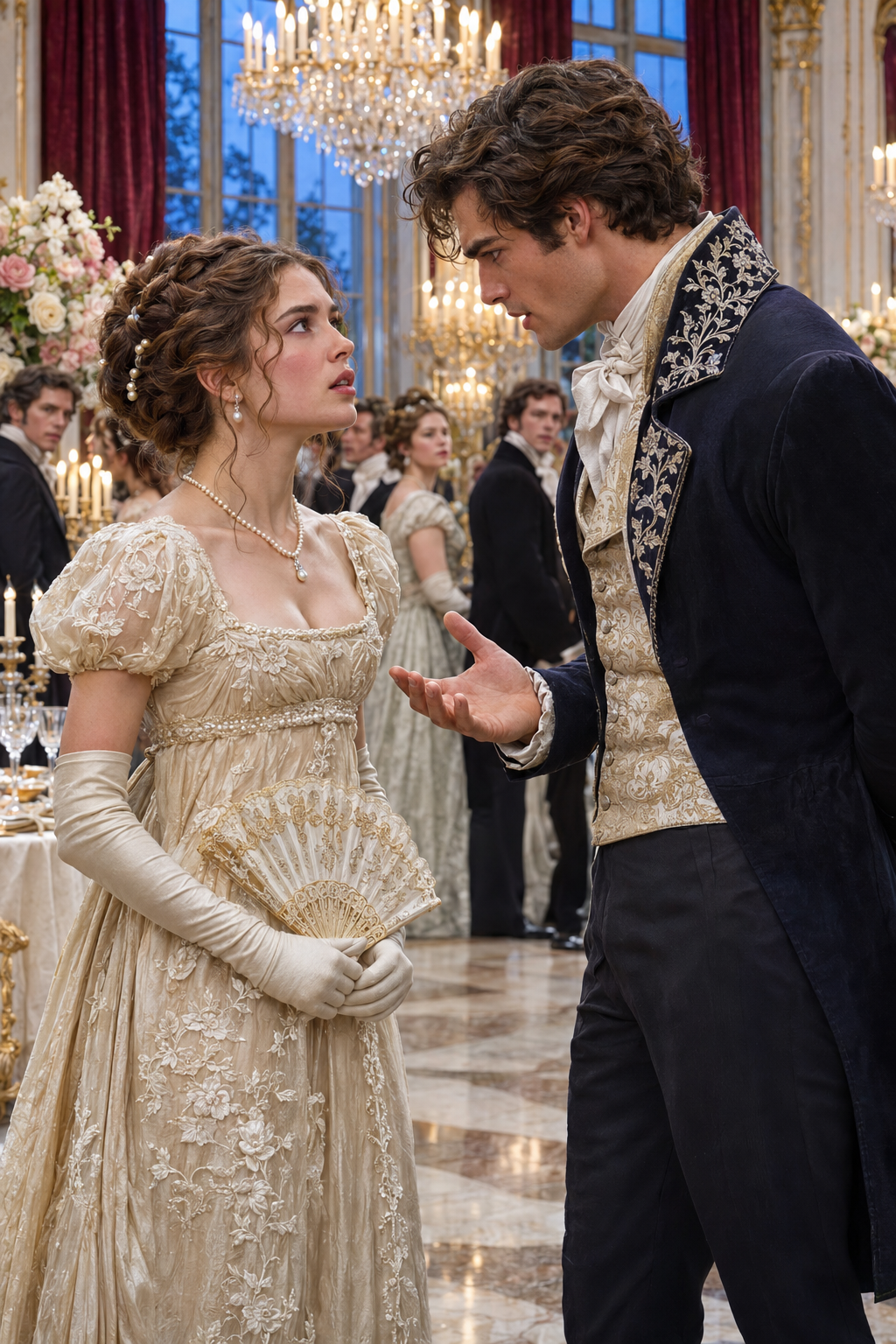
For a moment, he studied her face, searching for something she could not name. Then his expression softened.
“I believe you.”
Those three words should have reassured her.
Instead, they made the situation more unbearable.
Because Amelia now understood the choice Ashworth intended to force upon her.
If she refused his proposal, her father’s disgrace could destroy the Harcourt family. If she accepted, she would bind herself to the very man who possessed the means to dishonor Westbrook’s dead mother.
And if Westbrook discovered the full truth, he might never forgive her father.
A sudden knock interrupted them.
The butler entered carrying a small envelope.
“Forgive me, my lady. The messenger insisted this be delivered directly to you.”
Amelia recognized the handwriting before she broke the seal.
Ashworth.
Inside was a single sentence.
You have until noon tomorrow. Your father’s hesitation has already cost him enough.
Beneath the message lay a narrow strip of blue silk.
Amelia lifted it carefully.
Westbrook moved closer.
His face changed.
“Where did that come from?”
“It was inside the envelope.”
He took the silk between his fingers.
“My mother wore a ribbon of this color on the final evening I saw her.”
Lord Harcourt made a low sound.
“The missing account book,” he whispered.
Amelia turned toward him.
“What account book?”
“The duchess copied the fraudulent transactions into a private ledger. She concealed it before she died. Ashworth’s father searched her rooms, but he never found it.”
Westbrook stared at the silk.
“Then why send this?”
“Because Ashworth may have discovered where she hid it,” Amelia said.
Her father shook his head.
“Or because he wants us to believe he has.”
Westbrook folded the ribbon carefully.
“Either way, he has made his first mistake.”
Amelia looked up.
“What mistake?”
“He has told us that the evidence still matters.”
By midnight, the three of them had formed an uneasy agreement.
They would discover what had happened to the late duchess, locate her missing ledger, and determine whether Ashworth truly possessed the power he claimed.
But there was one condition.
Lord Harcourt would conceal nothing further.
He agreed with such visible difficulty that Amelia realized how deeply his fear had shaped the years of her childhood.
Westbrook departed shortly before dawn.
At the front steps, Amelia followed him into the cold morning air.
The rain had stopped, leaving the garden shining beneath a thin silver mist.
“Do you hate him?” she asked.
Westbrook understood whom she meant.
“I do not yet know.”
She lowered her eyes.
“He has been a good father to me.”
“Then perhaps he has done something worthwhile with the years he was given.”
The answer was neither forgiveness nor condemnation.
It was more generous than she had expected.
Westbrook reached for her hand.
“Amelia, whatever this reveals, you are not responsible for choices made before you were born.”
She looked at their joined fingers.
“And if my father’s disgrace becomes public?”
“Then we shall face what is true.”
She raised her gaze.
“We?”
He gave a faint, weary smile.
“You have been rather determined to disagree with me since the evening we met. I see no reason to abandon such a remarkable arrangement now.”
Despite everything, Amelia nearly laughed.
But the moment passed when he gently released her hand.
“I must find someone who knew my mother’s household.”
“Who?”
“Her former lady’s maid. I believed she died years ago, but I recently discovered she retired to Bath.”
He descended the steps.
“Until I return, promise me you will not meet Ashworth alone.”
Amelia watched him climb into his carriage.
“I promise.”
It was a promise she intended to keep.
But by ten o’clock that morning, Ashworth had made keeping it nearly impossible.
A sealed invitation arrived at Harcourt House, requesting Amelia’s presence at a private gathering hosted by Lady Wexford, a widowed countess whose drawing room had long served as a place where important arrangements were discussed without attracting unnecessary attention.
The note was accompanied by a second message.
Your father’s signature will be delivered to the newspapers at noon unless you attend.
Amelia read the message twice.
Then she sent for her oldest friend, Lady Beatrice Pembroke.
Beatrice arrived within the hour, her fashionable bonnet slightly crooked and her expression unusually serious.
“Tell me everything,” she said.
Amelia did.
Not all the details of the duchess’s death, for those remained uncertain, but enough to explain the threat and Ashworth’s demand.
Beatrice listened without interrupting.
When Amelia finished, she removed her gloves.
“Then you are not going alone.”
“Beatrice…”
“Please do not insult me by suggesting I should remain home practicing the pianoforte while someone attempts to sell my dearest friend into marriage.”
Amelia caught her hand.
For the first time that morning, she felt something resembling courage.
They arrived at Lady Wexford’s residence shortly before eleven.
Ashworth was waiting in the drawing room beside a table set for tea.
He appeared mildly disappointed to see Beatrice.
“Lady Pembroke. An unexpected pleasure.”
“How fortunate,” Beatrice replied. “I should hate to be an expected inconvenience.”
Amelia almost smiled.
Ashworth did not.
Lady Wexford sat near the window, her expression carefully neutral. Amelia suspected the countess knew only that a marriage negotiation was underway.
Ashworth gestured toward an empty chair.
“Lady Amelia, shall we discuss our future?”
“There is no future to discuss until you provide proof of your accusations.”
He poured tea.
“You have inherited your father’s taste for dangerous questions.”
“And you appear to have inherited your father’s taste for other people’s money.”
The teapot stopped in his hand.
Beatrice lowered her eyes to conceal a smile.
For several seconds, Ashworth examined Amelia as though seeing her for the first time.
Then he placed a folded document upon the table.
“This is a copy of the trust agreement bearing your father’s signature. It confirms that he approved the final accounts.”
Amelia examined the paper.
The signature was unmistakable.
But beside it, she noticed something strange.
The date had been written in darker ink.
She tilted the paper toward the light.
The final numeral appeared slightly crowded, as though inserted after the rest.
“May I retain this?”
“Certainly not.”
“Then I presume you object to independent examination.”
Ashworth’s expression hardened.
“Do not mistake stubbornness for intelligence, Lady Amelia.”
“Do not mistake a woman’s refusal for ignorance, my lord.”
The countess quietly set down her teacup.
Beatrice shifted closer to Amelia.
Ashworth leaned forward.
“Your father has spent twenty-seven years enjoying the advantages of a respectable name. I can remove those advantages with a single letter.”
“Then why have you not done so?”
He smiled.
“Because I am offering you an honorable alternative.”
Amelia held his gaze.
“You are offering yourself a wife who would despise you.”
“Affection is not a requirement of marriage.”
“Perhaps not for you.”
Something dangerous flashed across his face.
“You believe Westbrook loves you?”
Amelia remained silent.
Ashworth continued.
“He has been searching for the truth about his mother for years. Did it never occur to you that his sudden interest in the Harcourt family might have another purpose?”
The words struck more deeply than she wished to reveal.
“He has treated me with kindness.”
“Kindness can be remarkably useful when one wishes to gain access to a locked study.”
Beatrice straightened.
“That is quite enough.”
Ashworth ignored her.
“Ask yourself, Lady Amelia, whether the duke would have noticed you at all if your father had not been connected to his mother’s death.”
Amelia felt her face grow warm.
But she remembered Westbrook returning the pearl button. His tenderness toward the elderly servant. His quiet honesty in the garden.
Those moments had not been staged for her father’s benefit.
Or had they?
She hated Ashworth for making the question possible.
He pushed another paper toward her.
“A simple agreement. Sign it, and the matter ends.”
Amelia looked at the document.
It was a formal undertaking to accept his proposal.
Beneath the carefully arranged language lay a demand that she surrender her future without consultation or recourse.
She reached for the pen.
Beatrice stiffened.
“Amelia.”
Ashworth’s smile returned.
But instead of signing, Amelia drew a firm line through the paragraph that declared her acceptance irrevocable.
Then she wrote beneath it:
Subject to examination of all documents relating to the Harcourt trust and the late Duchess of Westbrook.
Ashworth stared at the alteration.
“What is this?”
“A counterproposal.”
“You are in no position to negotiate.”
“Then you are in no position to call this an honorable agreement.”
She rose.
Beatrice followed.
Ashworth’s voice stopped them at the door.
“Your father has until noon.”
Amelia turned.
“Then you had better send your messenger promptly.”
They left before he could answer.
Outside, Beatrice seized Amelia’s arm.
“Have you entirely lost your senses?”
“Possibly.”
“You have given him nothing.”
“Precisely.”
But Amelia’s confidence faded when she saw a familiar carriage waiting at the corner.
Her father’s carriage.
The driver stepped down, visibly shaken.
“My lady, you must come home. His lordship has been taken ill.”
Amelia climbed inside without another word.
By the time she reached Harcourt House, her father had been carried to his bedchamber.
The physician stood beside him, examining his pulse.
“He has suffered a severe collapse brought on by agitation,” the doctor explained. “His heart requires rest. Above all, he must avoid further distress.”
Amelia sat beside the bed.
Her father’s eyes opened briefly.
“Did you sign?”
“No.”
A tear slipped into his silver hair.
“Good.”
She brushed it away.
“Papa, we shall manage this.”
He struggled to speak.
“There is something else.”
“Not now.”
“Amelia, listen.”
His hand closed around hers.
“Your mother knew about the trust.”
Amelia went still.
“Mother?”
“She found out after we were married. She begged me to confess. I promised I would, but I kept delaying.”
His breathing grew uneven.
“Before she died, she wrote something. A letter for the duchess’s son.”
“Where is it?”
“Inside the music room.”
He closed his eyes.
“Behind the portrait of your grandmother.”
Amelia waited until he was sleeping before leaving the room.
The music room had remained almost unchanged since her mother’s death. Dust lay upon the pianoforte, and faded sunlight illuminated the gilt frame of her grandmother’s portrait.
Amelia climbed onto a chair and carefully lifted the painting from its hook.
Behind it was a narrow recess.
Inside lay a small wooden box.
She carried it to the table and opened it.
There were three letters, a folded receipt, and a worn leather notebook.
The notebook bore the initials E.W.
Eleanor Westbrook.
Amelia’s fingers tightened.
She opened the first page.
The handwriting was delicate but confident.
The entries described charitable payments, missing funds, and the names of widows whose allowances had been reduced.
Several pages contained figures carefully copied from official accounts.
Then, halfway through the notebook, Amelia discovered a passage that made her sit down.
Lord Ashworth has threatened Robert Harcourt again. He claims his son must inherit more than a title. I fear the boy has learned too much from his father.
Amelia turned the page.
If anything happens to me, Mrs. Finch knows where the originals are kept.
Mrs. Finch.
The duchess’s former lady’s maid.
The very woman Westbrook had gone to find.
Amelia pressed a hand against her mouth.
Then she unfolded the first letter.
It was addressed to the young Duke of Westbrook, but the handwriting belonged to her mother.
My dear child, if these words ever reach you, I pray you will understand that your mother was a woman of extraordinary courage. She refused to remain silent when others suffered, even when her own peace was threatened. I cannot undo my husband’s mistakes, but I can promise that I will not allow her sacrifice to be forgotten.
The letter ended with a sentence that made Amelia’s eyes burn.
May you grow into a man who values truth more than the approval of society.
She folded it carefully.
For the first time, her mother’s memory felt less distant, less like a gentle portrait hanging in a quiet room.
She had been a woman who had challenged her own husband’s cowardice.
A woman who had left evidence behind because she understood that promises were not always enough.
Amelia examined the receipt.
It recorded a payment to a coachman on the night before the duchess’s death.
The destination was listed as a country house belonging to the elder Lord Ashworth.
And beside the sum appeared a name.
Thomas Vale.
Amelia had heard that name before.
He had once been her father’s groom, dismissed suddenly when she was a little girl.
She hurried to the servants’ hall.
The housekeeper remembered him.
“Mr. Vale? Oh yes, my lady. He lives near the old coaching road outside Reading. Keeps a modest stable now.”
Amelia wrote down the directions.
Then she sent a letter to Westbrook’s London residence, explaining what she had found.
By evening, no reply had arrived.
The following morning brought worse news.
The morning newspaper carried a brief announcement concerning allegations of financial misconduct associated with Lord Harcourt’s name.
No details were supplied.
But the damage had begun.
By breakfast, two invitations had been withdrawn.
By luncheon, three acquaintances had sent polite notes expressing regret that they could not receive Amelia that week.
And by afternoon, Lady Wexford had requested that the proposed marriage negotiations be concluded without further delay.
Amelia placed the letters in a neat pile.
Then she ordered her carriage.
Beatrice joined her once again.
Together, they traveled toward Reading, where Thomas Vale maintained a weather-beaten stable beside a narrow country lane.
The old coachman emerged carrying a bucket.
When Amelia introduced herself, his face changed.
“Lord Harcourt’s daughter?”
“Yes.”
He looked toward the road.
“You should not have come.”
“Why?”
“Because the last person who asked me about that winter disappeared before I could answer.”
Beatrice gripped Amelia’s sleeve.
The old man led them into a small office behind the stable.
There, with the door bolted, he told them what he remembered.
On the night before the duchess became ill, he had driven her to Ashworth’s country residence. She had insisted upon confronting the elder lord about the missing charitable funds.
Thomas waited outside for nearly two hours.
When she finally emerged, she was pale and shaking.
“She told me not to stop until we reached Westbrook House,” he said. “But halfway home, another carriage blocked the road.”
Amelia leaned forward.
“Who was inside?”
“A gentleman. Young, handsome, wearing a dark green cloak.”
“Lord Ashworth?”
Thomas nodded slowly.
“He was barely more than a boy, perhaps nineteen. But he spoke with his father’s authority.”
“What did he do?”
“He demanded the duchess surrender a packet of papers. She refused.”
Thomas swallowed.
“He climbed into our carriage. I heard them arguing. Then she screamed.”
Amelia went cold.
“Did he hurt her?”
“I could not see. When he came out, he had the packet. The duchess was holding her arm, but she told me to continue driving.”
Thomas opened a drawer.
“She dropped this beneath the seat.”
He produced a silver cufflink bearing the Ashworth family crest.
Amelia recognized the design immediately.
Ashworth wore an identical pair.
“Why did you never come forward?”
Thomas’s eyes filled.
“My daughter was seven. Two men came to my house the next morning and told me accidents happened to children whose fathers spoke too freely.”
Beatrice lowered her gaze.
Amelia reached across the desk.
“You were frightened.”
“I was ashamed.”
“Then help us now.”
Thomas looked at the cufflink.
After a long silence, he nodded.
“I will testify.”
Their return journey was interrupted by a rider approaching at a furious pace.
The man wore Westbrook’s colors.
He handed Amelia a note.
Mrs. Finch has confirmed the existence of the original accounts. I am returning to London tonight. Trust no message that does not bear my personal seal.
Amelia read the note twice.
Then she looked at the rider.
“His Grace is safe?”
“Yes, my lady. He sent me ahead.”
Relief softened her face.
But it vanished when the rider added, “There has been trouble at Bath. Someone attempted to enter Mrs. Finch’s lodgings during the night.”
Beatrice exchanged a frightened glance with Amelia.
Ashworth was no longer merely threatening reputations.
He was searching for evidence.
And he was growing desperate.
Westbrook returned to Harcourt House shortly after midnight.
Amelia met him in the library, where the recovered notebook and letters lay upon the table.
He appeared exhausted.
His coat was damp from travel, and a shallow cut marked one hand.
When she noticed it, he quietly tucked his hand behind his back.
“What happened?”
“Nothing requiring your concern.”
“Your Grace.”
He sighed.
“Someone tried to relieve me of my documents outside Bath.”
“And you consider that nothing?”
“I consider it unsuccessful.”
She approached him.
For a moment, the entire room seemed smaller.
“I was frightened,” she admitted.
His expression changed.
“So was I.”
She looked up.
“For yourself?”
“For the possibility that I might return and discover you had agreed to marry Ashworth.”
Amelia shook her head.
“I could not.”
He gently touched her cheek.
“Good.”
Then he saw his mother’s notebook.
The tenderness vanished from his face.
He crossed the room and opened it with extraordinary care.
For several minutes, he read without speaking.
Amelia remained beside him.
When he reached the entry describing his mother’s confrontation with the elder Ashworth, he closed his eyes.
“She knew,” he whispered.
“She knew the danger.”
“And she went anyway.”
Amelia placed her mother’s letter before him.
“This was meant for you.”
He unfolded it.
She watched his face as he read.
His expression remained composed until he reached the final sentence.
Then his fingers tightened upon the paper.
“My father rarely spoke of her after she died,” he said quietly. “I believed it was because remembering hurt him.”
“Perhaps it did.”
“Perhaps he was also afraid of discovering how much he had failed to protect her.”
Amelia did not answer.
Instead, she moved closer and rested her hand over his.
Westbrook looked at her.
“Amelia, there is something I should confess.”
She felt a sudden uneasiness.
“When I first approached your family, I was already investigating the trust.”
Ashworth’s cruel suggestion returned to her.
She slowly withdrew her hand.
“You knew my father was involved?”
“I suspected.”
“And you attended our gatherings because of that?”
“At first, yes.”
She turned away.
The admission hurt more than she had expected.
Every conversation, every gentle attention, every unexpected meeting suddenly seemed vulnerable to another interpretation.
Westbrook did not attempt to touch her.
“I intended to question your father,” he continued. “I did not expect to meet a woman who would publicly refuse me before I had even decided whether I liked her.”
Amelia stared at the fireplace.
“And afterward?”
“Afterward, I found myself inventing reasons to see you that had nothing whatsoever to do with my investigation.”
She remained silent.
“I should have told you sooner.”
“Yes,” she whispered.
He accepted the rebuke.
“I was afraid you would believe every kindness had been calculated.”
“Was it?”
“No.”
She finally faced him.
He looked tired, vulnerable, and more sincere than any gentleman she had ever known.
“I cannot ask you to trust me merely because I say so,” he continued. “But I can promise that I will never again conceal something that affects your freedom to choose.”
Amelia studied him for a long moment.
Then she approached the table and placed his mother’s notebook between them.
“Then we begin with the truth.”
Together, they examined the evidence until dawn.
Mrs. Finch had provided the original account summaries, including several pages bearing the elder Ashworth’s unmistakable handwriting. Thomas Vale’s testimony established that the current lord had confronted the duchess shortly before her death.
But one question remained unanswered.
What had actually caused her illness?
The answer arrived unexpectedly from Mrs. Finch herself.
She had preserved a small memorandum written by the duchess’s physician, a man who had died many years earlier.
It described symptoms consistent with exposure to a toxic preparation sometimes used in household pest treatments.
The physician had not declared poisoning. He had merely recorded concerns that warranted further investigation.
Those concerns had never reached the family.
A second letter explained why.
The elder Ashworth had arranged for the physician’s debts to be paid shortly after the duchess’s death.
Westbrook read the correspondence in silence.
Amelia watched his expression harden.
“It is not proof of murder,” she said carefully.
“No.”
“But it is proof that questions were deliberately buried.”
He nodded.
“And perhaps enough to persuade the authorities to investigate.”
They decided to take their evidence to a respected magistrate and to the remaining trustees of the charitable fund.
Before they could depart, however, a servant entered carrying another letter.
Ashworth had summoned Amelia to Lady Wexford’s house the following evening.
This time, the invitation announced a formal dinner at which their engagement would be publicly declared.
Westbrook read the note.
“He intends to make refusal appear impossible.”
Amelia took the paper from him.
“Then we shall make refusal unmistakable.”
The following evening, Lady Wexford’s drawing room glittered with candlelight.
Distinguished guests gathered beneath painted ceilings, unaware that the carefully arranged entertainment was about to become something very different.
Ashworth stood near the fireplace, receiving congratulations from gentlemen who had already heard rumors of an engagement.
When Amelia entered, conversation softened.
She wore a pale blue gown without excessive jewels, and her expression was composed.
Beatrice accompanied her.
Westbrook arrived several minutes later.
His presence caused an immediate stir.
Ashworth’s smile tightened.
“Your Grace. I had not expected the pleasure.”
“I imagine there are several things you did not expect this evening.”
Amelia stepped forward.
“My lord, before any announcement is made, I should like to clarify one matter.”
Ashworth glanced toward the guests.
“Perhaps privately.”
“No.”
Her voice carried clearly across the room.
“You have informed several members of society that I have accepted your proposal. I have not.”
An uncomfortable silence settled over the gathering.
Ashworth’s expression hardened.
“Lady Amelia, surely you understand that certain family considerations require discretion.”
“I understand perfectly.”
She looked toward the elderly countess.
“Lady Wexford, I apologize for disturbing your evening. But I will not allow my silence to be mistaken for consent.”
The countess rose slowly.
“Then the matter is settled.”
Ashworth stepped closer.
“Not quite.”
He withdrew a folded document.
“I had hoped to spare Lord Harcourt embarrassment, but his daughter has left me little choice.”
Westbrook moved beside Amelia.
“Before you proceed, Ashworth, I suggest you examine what my solicitor has brought.”
A gentleman near the doorway stepped forward carrying a leather portfolio.
Behind him entered Thomas Vale and two surviving trustees of the charitable fund.
Ashworth’s confidence faltered.
Westbrook opened the portfolio.
“We have examined the original accounts. We have testimony concerning your conduct toward my mother on the night before her final illness. We also possess correspondence regarding payments made to her physician.”
Ashworth laughed sharply.
“Old papers and the fantasies of a disgruntled servant.”
“Then you should welcome a formal investigation.”
Several guests exchanged startled glances.
Amelia watched Ashworth’s eyes move toward the doorway.
For the first time, he appeared uncertain whether he could leave without attracting attention.
But the decisive moment came from someone nobody expected.
Lord Harcourt entered the drawing room.
He leaned heavily upon a cane, his face pale and his shoulders stooped.
Amelia hurried toward him.
“Papa, you should be resting.”
He gently squeezed her hand.
“I have rested long enough.”
The room fell silent.
Lord Harcourt turned toward the assembled guests.
“I have come to acknowledge my responsibility for a grave failure committed many years ago.”
Ashworth stared at him.
“Think carefully, Harcourt.”
“I have spent twenty-seven years doing nothing else.”
The older gentleman drew a breath.
“I signed financial documents without proper examination. When I discovered the misuse of charitable funds, I allowed fear for my reputation to prevent me from reporting what I knew. Though I did not take the money, my silence protected those who did.”
Amelia felt tears gather, but she kept her gaze steady.
Her father continued.
“The late Duchess of Westbrook possessed the courage I lacked. She wished to expose the fraud. I failed to support her.”
Ashworth stepped forward.
“You have no evidence that my father acted improperly.”
Lord Harcourt looked at him.
“I have the original records. And I have finally chosen to speak.”
The magistrate, who had arrived at Westbrook’s invitation, stepped into the room.
“Lord Ashworth, these allegations warrant a formal inquiry. I must ask that you make yourself available for questioning.”
Ashworth’s face twisted.
“You cannot seriously believe the accusations of a frightened old man.”
“No,” the magistrate replied. “I intend to examine the evidence.”
Ashworth looked around the room, searching for an ally.
But the guests who had once eagerly sought his approval now avoided his gaze.
Lady Wexford approached Amelia.
“My dear, I believe you have made your position clear.”
“Entirely, my lady.”
Ashworth turned toward Westbrook.
“You think you have won? Your mother’s death remains unexplained, and nothing you possess will bring her back.”
The duke’s expression changed, but his voice remained controlled.
“No. Nothing will.”
He stepped closer.
“But the women whose money your family stole are still living. Their children are still living. Justice may be late, but it is not useless.”
Ashworth said nothing.
For the first time in his life, his title could not command the room.
The investigation that followed lasted several months.
The records revealed that the elder Ashworth had diverted substantial charitable funds to cover debts and preserve his family’s estates. His son had later used knowledge of the fraud to threaten Lord Harcourt and others connected to the original trust.
Thomas Vale’s account of the roadside confrontation was supported by the duchess’s correspondence. Further evidence established that the younger Ashworth had seized documents from her carriage and had helped suppress inquiries after her death.
The precise medical cause of the duchess’s death could not be established after so many years. Neither the old physician’s memorandum nor the circumstances proved that she had been deliberately poisoned.
Westbrook accepted that uncertainty with difficulty.
Yet he refused to allow suspicion to become an accusation unsupported by proof.
Ashworth’s attempts at coercion, however, required no such speculation.
His letters and proposed marriage agreement spoke for themselves.
Proceedings were brought against him for his conduct, and claims relating to the misappropriated funds were pursued against the family estate.
The scandal spread through society with astonishing speed.
But its most important consequence occurred far from London’s drawing rooms.
The charitable trust was restored under new management.
Payments wrongfully withheld from widows and their families were identified and, where possible, repaid from recovered assets.
Lord Harcourt contributed a substantial portion of his remaining fortune toward the restitution.
It left him with a smaller estate and a diminished place in society.
But for the first time in twenty-seven years, he slept without waiting for a threatening letter.
Amelia visited him one afternoon as autumn sunlight entered his study.
He sat beside the window, reading correspondence from several families who had received long-overdue payments.
When he saw her, he smiled.
“You look happy.”
“I am.”
He set aside the letters.
“Have you forgiven me?”
Amelia considered the question.
“I love you, Papa. That has never changed.”
His eyes filled.
“But forgiveness is not the same as pretending you made no mistakes.”
He nodded slowly.
“I understand.”
She took his hand.
“I think Mother would have been proud that you finally told the truth.”
A faint smile touched his face.
“She would have been disappointed that it took me so long.”
“Perhaps.”
Amelia glanced at the restored portrait hanging above the fireplace.
“But she would have been glad you began.”
That evening, Westbrook invited Amelia to walk through the gardens of his country estate.
The roses were fading, and golden leaves covered the gravel paths.
They walked without hurry, occasionally brushing hands, enjoying the comfortable silence that had once seemed impossible between them.
Near a small stone fountain, Westbrook stopped.
“My mother used to bring me here.”
Amelia looked toward the weathered basin.
“Was she fond of gardens?”
“Very. She believed growing things required patience rather than command.”
Amelia smiled.
“A philosophy you have had some difficulty learning.”
“An extraordinary amount.”
He turned toward her.
“For much of my life, I believed strength meant never allowing anyone to see uncertainty.”
“And now?”
“Now I suspect strength may require admitting when one is afraid.”
Amelia watched him reach into his coat.
He withdrew a small velvet box.
Her breath caught.
“Amelia, when we first met, you declared you would rather remain unmarried than become my duchess.”
“An unfortunate opening to our acquaintance.”
“An unforgettable one.”
He opened the box.
Inside lay a delicate ring set with a single sapphire.
“I have no wish to command your future. I would rather spend my life earning the privilege of sharing it.”
His expression softened.
“Lady Amelia Harcourt, would you consider marrying a gentleman who has been repeatedly corrected by you and expects the instruction to continue?”
Amelia laughed through unexpected tears.
“Only if he promises never to become entirely agreeable.”
“I fear that would be beyond my abilities.”
She held out her hand.
“Then yes, Your Grace.”
He slipped the ring onto her finger.
For a moment, neither spoke.
Then Westbrook drew her gently into his arms, and she rested her forehead against his shoulder.
The gardens were quiet around them.
No musicians played. No fashionable audience waited for an announcement.
There was only the soft movement of autumn leaves and the steady warmth of the man who had learned to love her without attempting to possess her.
Their wedding took place the following spring.
It was a beautiful ceremony, but not an extravagant one.
Beatrice stood beside Amelia, smiling with the satisfaction of a woman who had witnessed every difficulty and refused to forget a single detail.
Lord Harcourt escorted his daughter down the aisle.
He walked slowly, leaning upon his cane, but his head was held high.
When he placed Amelia’s hand in Westbrook’s, the two men looked at each other for a long moment.
There were things between them that could never be entirely repaired.
Yet there was also understanding.
“Take care of her,” Lord Harcourt whispered.
Westbrook nodded.
“She has made it abundantly clear that she intends to take care of herself.”
Amelia smiled.
“Both of you would do well to remember it.”
Their laughter was quiet, but genuine.
After the ceremony, Westbrook led his bride into the sunlight.
Guests gathered upon the church steps, and bells rang across the village.
Amelia turned toward him.
“Do you suppose society will ever forget the evening I publicly refused you?”
“Certainly not.”
“How unfortunate.”
“On the contrary.”
He took her hand.
“It was the first occasion upon which someone valued her freedom more than my title. I should be grateful that you did.”
Years later, the restored charitable trust would continue assisting families who had once been neglected.
A small memorial would be established in Eleanor Westbrook’s name, honoring the woman who had refused to look away from suffering even when silence would have protected her.
Her son would speak of her not merely as a tragic figure from his childhood, but as someone whose courage had finally received the recognition it deserved.
And Amelia, now Duchess of Westbrook, would become known for a very different sort of stubbornness.
She challenged unfair practices, supported the education of young women, and refused to accept that respectability mattered more than honesty.
Sometimes, when visitors praised her influence, she would smile and say that she had learned a valuable lesson from a gentleman who once believed himself incapable of being refused.
Westbrook would invariably raise an eyebrow.
“And what lesson was that, my dear?”
“That even a duke may improve with proper guidance.”
He would laugh and kiss her hand.
But on quiet evenings, when the house had settled and the candles burned low, Amelia occasionally opened the small silver locket that had begun their most painful journey.
The portrait inside had been carefully restored.
Westbrook had given it to her after their wedding, saying his mother would have wanted it kept by someone who understood why the truth mattered.
Amelia would look at the gentle face, remembering the frightened father, the threatening letters, the unfinished questions, and the courage required to confront them.
Some things could never be undone.
Some answers would never be found.
But the past no longer controlled their future.
Because Amelia had discovered that love was not proved by obedience, and honor was not preserved by hiding one’s failures.
True honor required the courage to face them.
And the deepest kind of love did not demand surrender.
It offered the freedom to choose, again and again, even when the truth was difficult.
On the anniversary of the night they first met, Westbrook invited his wife to a ball at the very house where she had publicly rejected him.
The chandeliers glittered above the dancers, and familiar melodies drifted through the crowded ballroom.
He approached her with an exaggerated bow.
“Lady Amelia, might I have the honor of this dance?”
She studied him with a perfectly serious expression.
“I shall have to consider it, Your Grace.”
He leaned closer.
“I have become rather accustomed to your refusals.”
Amelia smiled and placed her hand in his.
“Then perhaps it is time you grew accustomed to my acceptance.”
As the orchestra began, he drew her into the dance.
Around them, society continued its endless conversations, its judgments, and its little performances of importance.
But neither paid much attention.
The duke who had once believed pride was strength and the woman who had once believed love required constant resistance moved together beneath the golden light.
And when Amelia looked into her husband’s eyes, she saw no demand, no threat, and no expectation that she become anyone other than herself.
Only a quiet promise freely made and faithfully kept.
For the first time, she understood why her mother had insisted that an honorable life was worth more than an untarnished reputation.
A reputation depended upon what others believed.
Honor depended upon what a person chose when no easy choice remained.
And love, when it was worthy of the name, never required a woman to sacrifice her voice in order to keep it.
THE END.