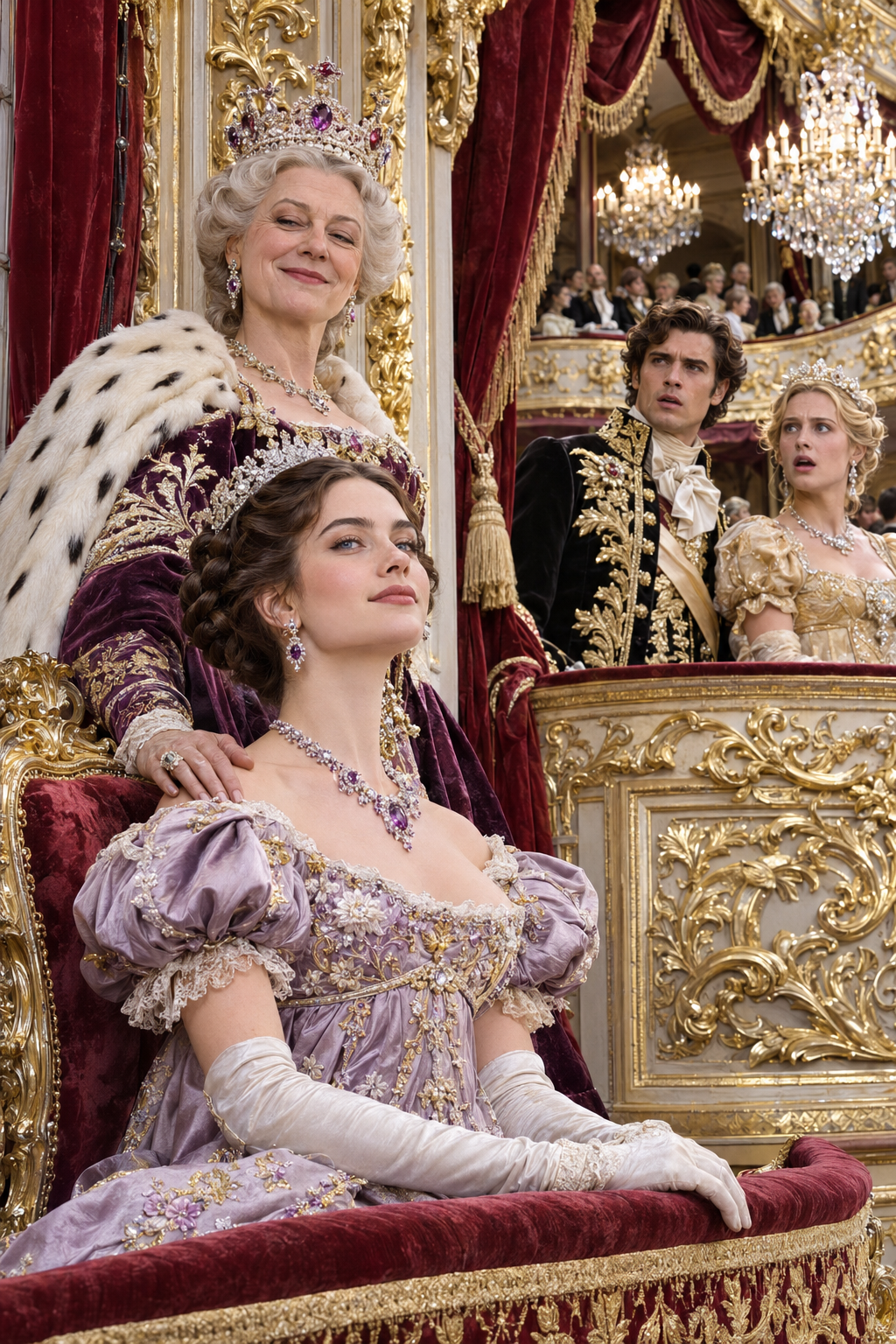
The Duke of Thornbury ordered his wife to give up her seat at the opera so his mistress could sit beside him.
The Duke read the first paragraph twice. Then he turned the page, his fingers tightening around the expensive paper.
“What is the meaning of this?”
Amelia remained seated beside the fireplace, her hands resting peacefully in her lap.
“I believe the meaning is quite clear.”
“This is absurd!” he shouted. “The Queen cannot simply change the laws of England because she happens to enjoy your music!”
“Her Majesty has done no such thing.”
The document explained that Amelia’s salary would be paid into a trust established for her separate use. Two independent trustees, including the Queen’s treasurer, would oversee the funds. Under the terms of the arrangement, the Duke would have no authority to withdraw the money, sell its assets, or interfere with its administration.
The Queen’s legal advisers had found a way to protect Amelia’s earnings through the established principles of equity.
The Duke threw the document onto the table.
“I am your husband!”
“Yes,” Amelia replied. “I am painfully aware of that.”
“You belong to me. Everything you possess belongs to me.”
Amelia rose slowly.
“Then perhaps you should ask yourself why Her Majesty has gone to such extraordinary lengths to protect me from you.”
For several seconds, the Duke could not speak. He had never heard his wife address him with such confidence. The timid woman who once apologized for playing the piano too loudly was standing before him without a trace of fear in her expression.
“You will regret this,” he finally said.
He stormed out of the room, slamming the door behind him.
Only when his footsteps disappeared did Amelia allow herself to sit down again. Her hands were trembling.
Courage, she was discovering, did not mean that fear had disappeared. It meant that fear was no longer making her decisions.
The following morning, Amelia awoke to find her bedroom door locked from the outside.
She pulled the bell beside her bed, but nobody came. Nearly an hour passed before she heard the familiar footsteps of her personal maid, Margaret.
“Your Grace?” Margaret whispered through the door.
“Margaret, what is happening?”
“His Grace has ordered that you remain in your room. He says you are unwell.”
Amelia closed her eyes. She should have anticipated something like this.
“Did he give instructions concerning my departure for Windsor?”
“He has dismissed the carriage, Your Grace.”
Amelia was expected at the palace that afternoon. The Queen had arranged for her to begin work on a new musical composition for an upcoming royal gathering.
“Margaret, I need your help.”
“Anything, Your Grace.”
“Find the letter on my writing desk downstairs. It bears the royal seal. Take it to the palace and tell them exactly what has happened.”
There was a moment of silence.
“His Grace will dismiss me if he discovers it.”
“I know. And I would never ask you to risk your livelihood without understanding the consequences.”
Margaret answered without hesitation.
“Then I had better leave before he notices.”
Three hours later, the Duke was enjoying breakfast when his butler entered the dining room, looking unusually nervous.
“Your Grace, there are visitors.”
“I am not receiving anyone.”
“I believe you must receive these gentlemen.”
Before the Duke could respond, two royal officials entered. Behind them stood the Queen’s treasurer, Sir Edmund Harcourt.
“Good morning, Your Grace.”
The Duke put down his coffee.
“To what do I owe this unexpected pleasure?”
“Her Majesty is concerned about the Duchess.”
“My wife is indisposed.”
“Indeed? We have received information suggesting otherwise.”
The Duke forced a laugh.
“Surely the Queen has more important matters to attend to than a disagreement between husband and wife.”
Sir Edmund did not smile.
“Her Majesty considers the unlawful interference with the duties of a royal servant a matter of considerable importance.”
The Duke’s expression hardened.
“She is not your servant. She is my wife.”
“She is both, Your Grace. And Her Majesty expects her at Windsor.”
Sir Edmund glanced toward the staircase.
“Shall we continue this conversation here, or would you prefer to explain the circumstances directly to the Queen?”
Twenty minutes later, Amelia descended the stairs carrying a small traveling bag. Margaret followed behind her.
The Duke stood in the entrance hall, his face red with anger.
“If you walk through that door,” he said, “do not expect to be welcomed back.”
Amelia stopped.
For years, the possibility of losing her home had frightened her into silence. She had endured lonely dinners, cruel remarks, and the humiliation of watching her husband entertain other women.
But as she looked around the magnificent house, she realized something.
It had never truly been her home.
“Then I shall not expect it,” she answered.
She stepped into the waiting royal carriage.
At Windsor, Queen Charlotte received her privately. Amelia attempted to apologize for the trouble she had caused, but the Queen raised a hand.
“You have caused no trouble, my dear. Your husband has managed that entirely on his own.”
Amelia lowered her head.
“I fear he will not surrender easily.”
“Men who mistake control for authority rarely do.”
The Queen walked toward a window overlooking the gardens.
“Tell me something, Amelia. When did you last compose a piece of music simply because you wished to?”
Amelia considered the question.
“Before my marriage, Your Majesty.”
“Then we have wasted enough time.”
The Queen arranged for Amelia to occupy comfortable rooms at Windsor while carrying out her duties. Margaret was offered employment in the royal household, ensuring that the Duke could no longer threaten her livelihood.
For the first time in years, Amelia slept without worrying about what the following morning might bring.
She spent her days composing, teaching music to members of the household, and attending to the Queen. Her confidence returned gradually. She began laughing again, something Margaret had almost forgotten she could do.
But in London, the Duke was discovering that his troubles extended far beyond his wife’s departure.
Invitations stopped arriving. Old acquaintances suddenly became unavailable. Gentlemen who had once competed for his attention now avoided him at their clubs.
Even Arabella Fox had grown impatient.
“You promised me that your wife would never become a problem,” she complained one evening.
“She will be dealt with.”
“Everyone is talking about her. They say the Queen considers her a remarkable woman.”
“The Queen will lose interest eventually.”
Arabella studied him carefully.
“And what happens if she does not?”
The Duke poured himself another drink.
What Arabella did not know was that his financial situation had become desperate.
The inheritance he had secured through his marriage was substantial, but years of gambling, extravagant purchases, and reckless investments had consumed much of it. Several creditors were demanding payment.
He had expected Amelia’s royal salary to provide some relief.
Now even that opportunity had been taken from him.
Then, one evening, while searching through his late mother’s belongings for something valuable to sell, the Duke discovered a bundle of letters tied with a faded blue ribbon.
The first letter contained Amelia’s name.
He sat down and began reading.
By the time he finished, he understood why his mother had insisted that he marry an orphanage music teacher.
And he understood that his wife might possess a claim to something far more valuable than her royal wages.
The next morning, he summoned his solicitor.
“These papers must disappear,” he said.
The solicitor examined the letters, his expression growing increasingly troubled.
“Your Grace, destroying these documents could have serious consequences.”
“Only if someone discovers they existed.”
The solicitor placed the letters back on the desk.
“I cannot assist you in this matter.”
“Then I shall find someone who can.”
Meanwhile, Amelia received an unexpected visitor at Windsor.
It was Mrs. Eleanor Whitmore, the elderly woman who had managed the orphanage where Amelia once taught music.
Amelia embraced her warmly.
“What a wonderful surprise!”
Mrs. Whitmore smiled, but there was sadness in her eyes.
“My dear, there is something I should have told you long ago.”
They sat together in Amelia’s private sitting room.
Mrs. Whitmore opened a worn leather bag and removed a small envelope.
“Do you remember the Duchess of Thornbury, your husband’s mother, visiting our orphanage?”
“Of course. She was always very kind to the children.”
“She was especially interested in you.”
Amelia nodded.
“I believed she admired my music.”
“She did. But that was not the only reason.”
Mrs. Whitmore handed her the envelope.
Inside was a letter written by the late Duchess.
Amelia recognized the handwriting immediately.
As she read, her eyes filled with tears.
The Duchess had been a close friend of Amelia’s mother, a talented musician who had died when Amelia was very young. Before her death, Amelia’s mother had entrusted a modest inheritance to the Duchess, asking her to safeguard it until Amelia reached adulthood.
The Duchess had invested the money carefully over the years. It had grown into a considerable fortune.
But there was more.
The late Duchess had purchased a country estate called Rosewood Hall and placed it in a separate trust for Amelia. She had intended the property to become a permanent home and music school for orphaned children.
“Why did nobody tell me?” Amelia whispered.
“The Duchess intended to explain everything after your wedding. But she became ill so suddenly that she never had the opportunity.”
Amelia remembered those terrible weeks. Her mother-in-law had died shortly after the marriage, and the Duke had taken control of all her papers.
“Your husband’s inheritance was conditional upon marrying you,” Mrs. Whitmore continued. “His mother hoped he would become a better man through your influence. I am afraid she greatly misjudged him.”
Amelia looked down at the letter.
“Does he know about Rosewood Hall?”
“I cannot say. But I have kept this copy for years, waiting until I could place it safely in your hands.”
Amelia immediately consulted Sir Edmund.
After examining the letter, the treasurer arranged for inquiries to be made with the solicitors who had managed the late Duchess’s estate.
What they discovered was deeply disturbing.
The Duke had been collecting rental income from Rosewood Hall for several years, despite having no right to it. Worse still, he was attempting to sell the property to settle his gambling debts.
“He cannot legally sell it,” Sir Edmund explained. “But he appears to believe that the original trust documents have been lost.”
“Have they?”
Sir Edmund smiled.
“Fortunately, your mother-in-law was a remarkably careful woman.”
A second set of documents had been deposited with an independent solicitor.
The Duke’s plans were about to collapse.
However, before Sir Edmund could take formal action, a scandal erupted across London.
An anonymous pamphlet appeared, accusing Amelia of manipulating the Queen, abandoning her marital duties, and using her royal position to enrich herself.
The writer suggested that her musical compositions were not even her own.
Copies circulated through fashionable drawing rooms and gentlemen’s clubs.
When Amelia saw one, her stomach tightened.
She recognized several phrases. They were expressions her husband frequently used.
The Queen was furious.
“We shall discover who is responsible.”
But Amelia had another concern.
“Your Majesty, perhaps I should resign.”
Queen Charlotte turned toward her.
“Why?”
“I cannot bear the thought of my presence bringing embarrassment upon you.”
The Queen took the pamphlet from her hands.
“Amelia, if every decent woman withdrew from public life because a dishonest man spoke against her, England would be a very quiet country indeed.”
She dropped the pamphlet into the fireplace.
“You will perform at the royal concert next Saturday, exactly as planned.”
The concert became the most anticipated event of the season.
Among the invited guests were influential aristocrats, musicians, judges, and members of Parliament.
The Duke received an invitation as well.
He interpreted it as a sign that the Queen was finally prepared to forgive him.
He arrived wearing his finest clothes, accompanied by Arabella, who was delighted at the prospect of returning to royal society.
But when they entered the grand music room, they found themselves seated far from the royal family.
Amelia appeared shortly afterward in a simple ivory gown, wearing her amethyst pendant.
The Duke barely recognized her.
She carried herself with a confidence that had nothing to do with jewels, titles, or expensive clothing.
When she sat at the piano, the room fell silent.
Her composition began gently, with a melody that reminded Mrs. Whitmore of the songs Amelia had once played for frightened children at the orphanage.
Gradually, the music grew stronger.
There were moments of sadness, followed by passages filled with determination and hope.
Even guests who had arrived eager to judge her found themselves completely absorbed.
When the final note faded, nobody moved.
Then Queen Charlotte stood and applauded.
The entire room followed.
Amelia bowed, her eyes shining.
The Duke watched in disbelief. Every accusation he had encouraged seemed ridiculous in the face of what they had just witnessed.
But his humiliation was not yet complete.
Sir Edmund approached him during the reception.
“Your Grace, I believe we have some unfinished business concerning Rosewood Hall.”
The Duke nearly dropped his glass.
“I have no idea what you mean.”
“Then perhaps these documents will refresh your memory.”
Sir Edmund presented copies of the original trust agreement, financial records, and correspondence establishing the Duke’s unauthorized collection of rental income.
The Duke glanced around nervously.
“This is hardly the appropriate place.”
“I agree. Which is why I suggest we discuss the matter privately.”
In an adjoining room, the Duke discovered Amelia, Mrs. Whitmore, and two legal advisers waiting for him.
His face went pale.
Amelia spoke first.
“Did you know that Rosewood Hall belonged to a trust established for my benefit?”
The Duke remained silent.
“Did you know that your mother intended it to become a school for children who had nowhere else to go?”
“She was an impractical woman,” he snapped. “Always wasting money on sentimental nonsense.”
Mrs. Whitmore gasped.
Amelia stared at her husband.
“And you were going to sell it?”
“I have obligations! Debts! Responsibilities that you could not possibly understand.”
“Those children had nothing,” Amelia answered. “Yet you were prepared to take even their future away from them.”
Sir Edmund explained the consequences. The trustees would seek an accounting and repayment of the missing funds through the Court of Chancery. The proposed sale would be stopped. The evidence against the Duke was substantial.
For the first time, he appeared genuinely frightened.
Then he turned toward Amelia.
“Surely we can settle this between ourselves. We are husband and wife.”
Amelia almost laughed at the sudden tenderness in his voice.
“How interesting that you remember our marriage whenever you need something from me.”
He reached for her hand.
“Come home. We can begin again.”
She withdrew it.
“I spent years hoping you would say those words. But you are not asking me to return because you love me. You are asking because you have finally discovered that I am valuable.”
The Duke lowered his voice.
“What do you want?”
“A formal separation. A binding agreement protecting my independence. And the return of every penny taken from the Rosewood trust.”
“You would destroy me?”
“No. I am simply refusing to let you destroy anyone else.”
The negotiations lasted several weeks.
Faced with the evidence and the prospect of a public legal battle, the Duke eventually agreed to a deed of separation and financial settlement. His remaining assets were used to repay the money he had taken.
He was forced to sell several valuable possessions and close his extravagant London household.
Arabella disappeared from his life shortly afterward.
She had always admired his wealth and influence. Once both began to vanish, so did her affection.
As for Amelia, she remained legally married but lived independently, protected by the settlement and the trusts established for her benefit.
She continued serving Queen Charlotte and composing music.
Two years later, Rosewood Hall opened its doors to its first students.
The once-empty estate became a lively school filled with children who had lost their parents or whose families could not afford an education.
There were classrooms, comfortable bedrooms, gardens, and a beautiful music room.
Amelia insisted that no child would ever be turned away simply because they could not pay.
On the opening morning, Queen Charlotte arrived to see what had become of the late Duchess’s dream.
Children gathered along the entrance path, holding flowers and singing a song Amelia had written especially for them.
Mrs. Whitmore stood beside the doorway, wiping tears from her eyes.
“You have given them a future,” she whispered.
Amelia shook her head gently.
“Someone once gave me a chance. I am merely passing it on.”
Later that afternoon, a little girl approached Amelia in the music room.
She wore a faded dress and carried a damaged violin.
“Your Grace, may I ask you something?”
“Of course.”
“Can someone like me become a great musician?”
Amelia knelt beside her.
“What do you mean, someone like you?”
The child looked at the floor.
“Someone who has nothing.”
Amelia touched the amethyst pendant around her neck.
She remembered being that frightened little girl. She remembered the opera, the laughter, the empty marriage, and the years she had spent believing that her worth depended upon someone else’s approval.
Then she smiled.
“My dear, having nothing is not the same as being nothing.”
She took the child’s violin and carefully examined its broken strings.
“We shall have this repaired. And tomorrow, you and I will begin your first lesson.”
Years passed, and Amelia’s compositions became widely admired. Several of her students grew into accomplished musicians and teachers, carrying her kindness into places she would never visit.
The Duke, meanwhile, lived quietly on what remained of his fortune. His title survived, but the respect he had once demanded never fully returned.
One winter, Amelia received a brief letter from him.
He admitted that he had treated her shamefully and expressed regret for the choices he had made.
She read it beside the fireplace at Rosewood Hall.
Then she folded it and placed it in a drawer.
She wished him peace, but she did not invite him back into her life.
Forgiveness, she had learned, did not require reopening the door to someone who had repeatedly caused her pain.
That evening, Amelia walked into the music room, where dozens of children were preparing for their annual concert.
The little girl with the broken violin was now a confident young woman, leading the school’s orchestra.
When the music began, Amelia closed her eyes.
She no longer thought about the magnificent opera house where her husband had ordered her to surrender her seat.
She thought about everything that had happened because she had finally refused to surrender herself.
The Duke had believed that a woman’s value came from the man who married her. He had mistaken her silence for weakness, her patience for permission, and her kindness for something he could exploit.
He had been wrong about all three.
Amelia had not needed revenge to prove her worth. She had needed the freedom to become the woman she had always been.
And the greatest victory of her life was not watching the man who humiliated her lose his power.
It was giving hundreds of children the opportunity to discover their own.
Many years later, when Amelia’s hair had turned silver and her hands could no longer move across the piano keys as quickly as they once had, an unexpected carriage arrived at Rosewood Hall.
Margaret entered the music room with a troubled expression.
“Your Grace, the Duke of Thornbury is here.”
Amelia slowly closed the book she had been reading.
She had not seen her husband in nearly twenty years.
“Is he alone?”
“Yes, Your Grace. And I fear he is quite ill.”
Amelia looked through the window. An elderly man stood beside the carriage, leaning heavily on a walking stick.
There was little left of the proud gentleman who had once commanded an entire room with a glance.
“Bring him inside, Margaret.”
The Duke entered cautiously. His eyes traveled across the portraits of former students, the shelves of music books, and the beautiful piano standing near the window.
“So this is what became of Rosewood Hall,” he murmured.
“Yes,” Amelia replied. “This is what became of it.”
He lowered himself into a chair.
For a while, neither spoke.
Finally, he reached inside his coat and withdrew a small velvet box.
“I have something that belongs to you.”
Amelia opened it. Inside was a delicate gold bracelet that had once belonged to her mother-in-law.
“I found it among Mother’s possessions,” he explained. “She intended you to have it.”
Amelia studied the bracelet.
“Thank you for returning it.”
The Duke looked toward the window, where several children were playing in the garden.
“I hear your school has become rather famous.”
“We have been fortunate.”
“No,” he said quietly. “You have worked for it.”
Amelia looked at him in surprise.
It was perhaps the first time he had ever acknowledged her accomplishments without resentment.
“I have spent many years thinking about that evening at the opera,” he continued. “I thought I was humiliating you. I never understood that I was humiliating myself.”
His voice began to shake.
“I cannot change what I did. But before I die, I wanted to apologize to you in person.”
Amelia remained silent for a moment.
She had imagined hearing those words countless times during the early years of their separation. Back then, she believed an apology might somehow repair everything that had been broken.
Now she understood that some things could not be restored.
And some things were better left behind.
“I accept your apology,” she finally said.
The Duke’s eyes filled with tears.
“Can you ever forgive me?”
“I forgave you long ago. Carrying anger would have cost me more years than you had already taken.”
He nodded slowly.
“I suppose I have no right to ask for anything else.”
Amelia poured him a cup of tea.
“You may stay for the afternoon concert, if you wish.”
He looked up.
“You would allow that?”
“Of course. The children have worked very hard.”
That afternoon, the Duke sat in the back row of the music hall.
He listened as children from the poorest corners of England performed music with remarkable skill. He watched Amelia encourage a nervous young pianist and congratulate a boy who had struggled to finish his piece.
When the orchestra began playing one of her most celebrated compositions, he quietly began to cry.
For the first time, he understood the magnitude of what he had nearly destroyed.
Before leaving, he approached Amelia.
“My mother was right about you.”
Amelia smiled faintly.
“She was right about many things.”
“And I was a fool.”
She did not disagree.
The Duke died peacefully several months later. In his final will, he left what remained of his personal fortune to Rosewood Hall.
Amelia accepted the gift on behalf of the children.
She used the money to establish a scholarship for young musicians who could not afford instruments or lessons.
She did not name the scholarship after herself or the Duke.
Instead, she named it after his mother, the woman whose kindness had helped make everything possible.
As Amelia grew older, she gradually entrusted the school to her former students. Among them was Elizabeth, the little girl who had once approached her carrying a broken violin.
Elizabeth had become an accomplished musician and a gifted teacher.
One spring morning, Amelia called her into the garden.
“I believe it is time for you to take my place.”
Elizabeth shook her head.
“Nobody could ever take your place.”
“Then make a place of your own,” Amelia replied. “That is what I have always wanted for you.”
Elizabeth took her hand.
“How can I ever repay you for everything you have given me?”
Amelia smiled.
“Find another frightened child who believes she has nothing to offer the world. Give her the chance someone once gave you.”
Several years later, Amelia passed away peacefully in her sleep at Rosewood Hall.
On the table beside her bed rested her mother’s bracelet, a portrait of Queen Charlotte, and the amethyst pendant that had changed the course of her life.
News of her death spread throughout England.
Former students traveled great distances to attend her memorial. Some had become celebrated musicians. Others were teachers, nurses, craftsmen, and parents.
Each carried a different memory of the woman who had believed in them when nobody else did.
Elizabeth stood before the gathered mourners in the music hall.
“Many people knew her as the Duchess of Thornbury,” she began. “Others knew her as a royal composer. But to us, she was the woman who opened a door when the rest of the world had closed theirs.”
She paused, struggling to control her emotions.
“She taught us that talent does not belong only to the wealthy. That dignity cannot be purchased with a title. And that kindness, when passed from one person to another, can change generations.”
The orchestra performed Amelia’s favorite composition.
As the music filled the hall, there was not a dry eye in the room.
Above the entrance to Rosewood Hall, Elizabeth later placed a small inscription containing the words Amelia had spoken to her many years before.
“Having nothing is not the same as being nothing.”
Generations of children would pass beneath those words.
Most would never know the full story of the neglected duchess who had once been ordered to surrender her seat at the opera.
They would never know how close their school had come to being sold, or how much courage it had taken for one woman to stand against a man who believed he owned her future.
But they would inherit the freedom she had fought to protect.
And that was Amelia’s true legacy.
The Duke had once possessed everything society considered important: wealth, power, privilege, and an ancient title. Yet none of those things had earned him the love and respect he desired.
Amelia had entered the world with almost nothing. Through courage, compassion, and determination, she had created something that would endure long after her name disappeared from fashionable conversations.
Her story was a reminder that the greatest measure of a person’s life is not how many people bow before them, but how many people are able to stand taller because of them.
And somewhere within the walls of Rosewood Hall, another child sat down at a piano, played her very first note, and began a future that might never have been possible without Amelia.
The music continued.
THE END.