The Duke of Sherburn had refused every eligible woman in England. Then, before three hundred witnesses, he went down on one knee for a girl whose name he barely knew.
The words remained suspended between them, more unsettling than anything Xavian had discovered in his father’s letter.
“Ask her grandmother who witnessed the marriage.”
Angharad stared at the faded handwriting, her fingers still resting against the duke’s sleeve.
“What marriage?” she asked.
No one answered.
The fire gave a sudden crack, sending a small shower of sparks against the brass grate.
Lady Beatrice slowly lowered herself into a chair.
Across the room, Angharad’s grandmother stood perfectly still, her clouded eyes directed toward a place no one else could see.
Xavian folded the letter with deliberate care.
“Madam, I believe you owe us an explanation.”
The elderly woman drew a slow breath.
“Then I should begin with the night your father came to our house.”
Angharad stepped closer.
“Grandmother, please.”
The old woman reached for her hand.
“Your mother was seventeen when she married your father, my darling. They were very young, and very much in love.”
“I know that.”
“What you don’t know is that their marriage was witnessed by the Duke of Sherburn.”
Xavian’s expression changed.
“My father?”
“He stood beside them in a little chapel outside Bath. It was raining, and your mother had forgotten her gloves.”
The grandmother’s mouth softened briefly at the memory.
“Your father was so nervous that he dropped the ring.”
Angharad almost smiled.
Then she remembered the letter.
“But why would the duke have been there?”
“Because your father had saved his life.”
Silence settled over the room.
Lady Beatrice closed her eyes.
Xavian looked toward her.
“You knew?”
“I knew part of it.”
“Then perhaps someone should finally tell me the whole of it.”
The grandmother tightened her hold on Angharad’s fingers.
“Your father and the old duke served together during the war. They were caught in an ambush, and your father carried him nearly two miles through enemy fire.”
Xavian had heard the story before.
His father had spoken of an unnamed officer who had brought him back from the battlefield.
He had never mentioned the man’s name.
“Captain Vaughn,” Xavian said quietly.
The grandmother nodded.
“Your father offered him money afterward. Land. A position at Sherburn. Anything he wished.”
“But he refused?”
“He asked for only one thing.”
Angharad looked up.
“What?”
“That if misfortune ever came upon his family, the duke would protect his children without demanding anything in return.”
Xavian glanced down at the letter.
“And my father agreed.”
“He did more than agree. He placed part of his personal fortune into a trust for Captain Vaughn’s descendants.”
Lady Beatrice leaned forward.
“A trust that could not be touched until the rightful heir came of age.”
Angharad frowned.
“But I turned twenty-one last spring.”
“Yes,” her grandmother whispered.
“Then why have I never received anything?”
The answer came from the doorway.
“Because someone made certain you wouldn’t.”
Everyone turned.
A man stood just beyond the threshold, his dark traveling coat wet from the rain.
Xavian recognized him immediately.
Sir Edmund Vale.
The family’s solicitor.
He had managed the Sherburn estates since before Xavian inherited the title.
And he was not supposed to be in London.
“Sir Edmund,” Xavian said coldly. “You were expected in Yorkshire.”
“I returned when I learned Miss Vaughn had taken up residence here.”
His eyes moved toward the document in Xavian’s hand.
For a brief moment, his expression tightened.
Then he smiled.
“I see you have discovered an old family misunderstanding.”
The grandmother’s grip on Angharad suddenly became painful.
“That voice,” she whispered.
Sir Edmund looked at her.
“Mrs. Vaughn.”
She recoiled.
Angharad moved between them.
“Grandmother?”
The elderly woman raised one shaking finger.
“He came to our house after your parents died.”
Sir Edmund’s smile disappeared.
“He told me the duke’s promise had been withdrawn.”
Xavian turned toward the solicitor.
“Is that true?”
Sir Edmund adjusted his cuffs.
“The circumstances were complicated.”
“That was not my question.”
A dangerous stillness entered the room.
Sir Edmund had served the family for thirty years, and he was accustomed to speaking with authority.
But the young duke standing before him was no longer the quiet boy he had once advised.
“Your Grace, I would strongly recommend we discuss this privately.”
“No.”
Xavian moved beside Angharad.
“You will answer in front of the people you have apparently been lying to.”
Sir Edmund glanced toward the door.
Lady Beatrice noticed.
“Do not trouble yourself with leaving,” she said. “I have already sent for the footmen.”
For the first time, Sir Edmund appeared uncertain.
Xavian held up the letter.
“What does the agreement have to do with Miss Vaughn entering Sherburn House?”
The solicitor said nothing.
“Why does it mention a marriage?”
Still nothing.
Then Angharad’s grandmother spoke.
“Because the money was never the only thing your father promised.”
She reached toward the ivory key hanging from her neck.
“The old duke feared that if Captain Vaughn died, men who understood the value of his estate would strip his daughter and grandchildren of everything.”
Xavian looked at Sir Edmund.
The solicitor’s face had grown noticeably pale.
“So your father created a safeguard,” the grandmother continued. “The inheritance would remain protected until one of Captain Vaughn’s descendants entered Sherburn House under the duke’s personal protection.”
Angharad looked around the magnificent drawing room.
“And now I am here.”
“Yes.”
“But the letter says the agreement must not end.”
The grandmother hesitated.
“Because leaving the house before the trust is transferred could allow its trustees to challenge your claim.”
Sir Edmund suddenly stepped forward.
“That is a gross misrepresentation of the document.”
Lady Beatrice lifted one eyebrow.
“Then perhaps you will explain why the Vaughn trust disappeared from the estate accounts fifteen years ago.”
His mouth closed.
Xavian watched him carefully.
“What happened to the money?”
The solicitor looked toward the windows.
Rain continued to strike the glass.
“Your father made several investments.”
“Investments in whose name?”
Sir Edmund remained silent.
Xavian took one step closer.
“Yours?”
The solicitor’s composure fractured.
“Your Grace, you must understand that the estate was in considerable difficulty after your father’s death.”
“And you solved that difficulty by taking money belonging to a child?”
“It was intended to be temporary.”
Angharad stared at him.
“Temporary?”
Her voice was quiet enough that Xavian nearly missed it.
“My grandmother sold her wedding ring to pay for my schooling.”
Sir Edmund would not meet her eyes.
“She spent three winters without a proper fire because coal was too expensive.”
The solicitor shifted uncomfortably.
Angharad took another step toward him.
“Was that temporary too?”
For a moment, no one moved.
Then Sir Edmund straightened.
“I have protected the Sherburn family through circumstances you cannot possibly comprehend, young lady.”
Xavian’s voice cut through the room.
“Do not speak to her again.”
Sir Edmund turned.
The duke stood between him and Angharad, his expression completely unreadable.
“You were entrusted with my father’s affairs. You had access to our accounts, our properties, and our confidence.”
“Your Grace—”
“And you used that confidence to steal from a family who could scarcely afford bread.”
Sir Edmund’s face darkened.
“You cannot prove theft.”
Xavian glanced toward Lady Beatrice.
His great-aunt rose.
“Perhaps not yet.”
She opened a small leather portfolio on the side table.
“But we can prove something else.”
Sir Edmund went rigid.
Lady Beatrice withdrew a ledger bound in faded blue cloth.
“I have always wondered why your handwriting appeared in the old duke’s private accounts after his death.”
She laid the book beside the letter.
“Now I believe I understand.”
Xavian opened it.
There were dates, signatures, transfers, and several entries marked with the initials E.V.
At the bottom of one page, a substantial sum had been moved from the Vaughn trust into a private investment company.
The company’s director was Edmund Vale.
Xavian looked up.
“You used her inheritance to finance your business.”
Sir Edmund swallowed.
“The investment was perfectly legitimate.”
“And the profits?”
The solicitor said nothing.
“Where are they?”
“Your Grace, I beg you to consider the reputation of your family.”
Xavian closed the ledger.
“My family’s reputation is no longer your concern.”
He moved to the door and called for his steward.
Within moments, two footmen appeared.
“Sir Edmund is to remain in the house until the magistrate arrives,” Xavian instructed. “He is not to contact his office or remove any documents.”
Sir Edmund’s face flushed.
“You would have me arrested in front of servants?”
Xavian looked at him steadily.
“You allowed a blind woman to beg for the money that was legally hers.”
The solicitor lowered his eyes.
“I believe you have been shown considerably more courtesy than you deserve.”
The footmen escorted him away.
When the door closed, Angharad released a breath she had been holding.
Her grandmother began to tremble.
Angharad guided her into a chair and knelt beside her.
“Why didn’t you tell me?”
The old woman’s fingers searched for her face.
“I was afraid, darling.”
“Of what?”
“That if you knew there was money waiting for you, you would spend your life chasing it instead of building one of your own.”
Angharad rested her cheek against her grandmother’s hand.
“We could have been comfortable.”
“I know.”
“You could have had a warmer room.”
“I know, my love.”
Angharad closed her eyes.
Across the room, Xavian looked away.
He suddenly remembered his father’s favorite saying.
A gentleman’s honor was not measured by what he possessed, but by what he refused to take from those who possessed less.
For years, Xavian had regarded those words as little more than aristocratic sentiment.
Now they seemed painfully specific.
Lady Beatrice quietly approached him.
“There is something else,” she whispered.
Xavian turned.
“The final clause of the agreement.”
He looked toward Angharad, still kneeling beside her grandmother.
“Tell me.”
“The old duke specified that if a Sherburn heir offered marriage to a Vaughn descendant while she was residing under his protection, he could not interfere with her inheritance or make it conditional upon her acceptance.”
Xavian frowned.
“Why would he include such a clause?”
“Because he knew that money and marriage have a dreadful habit of becoming entangled.”
She paused.
“He wanted the girl to be free to refuse.”
Xavian looked down at the engagement ring on his hand.
A simple gold band he had purchased for Angharad as part of their arrangement sat in a small velvet box in his study.
They had never discussed what would happen to it afterward.
“Does she know?”
“Not yet.”
“Then we shall tell her.”
Lady Beatrice caught his sleeve.
“Xavian.”
He stopped.
“Are you certain this is still merely an arrangement?”
He did not answer.
And for once, his silence told her everything.
During the following week, Sherburn House became the center of a scandal that spread through London with astonishing speed.
Sir Edmund Vale was formally charged with fraud and the misappropriation of trust funds.
The newspapers published details of the missing inheritance.
Old acquaintances suddenly remembered Captain Vaughn’s bravery.
Women who had ignored Angharad at balls began sending invitations.
And several gentlemen who had never previously noticed her existence discovered an urgent desire to make her acquaintance.
Angharad accepted none of them.
She spent her mornings with her grandmother and her afternoons assisting Lady Beatrice with correspondence.
Her behavior remained perfectly composed.
But Xavian began noticing the changes.
She no longer lingered in the library after dinner.
She avoided the conservatory where they had once spoken during a rainstorm.
And whenever their hands accidentally touched, she withdrew hers first.
One evening, he found her standing beside the staircase where everything had begun.
She was wearing the ivy-green gown.
The repaired ribbon had been replaced with a narrow band of silk.
“You are going out?” he asked.
Angharad turned.
“Lady Beatrice has invited me to accompany her to the opera.”
“I had hoped to speak with you.”
“About the trust?”
“Not entirely.”
She studied him.
“Then perhaps it should wait.”
“Angharad.”
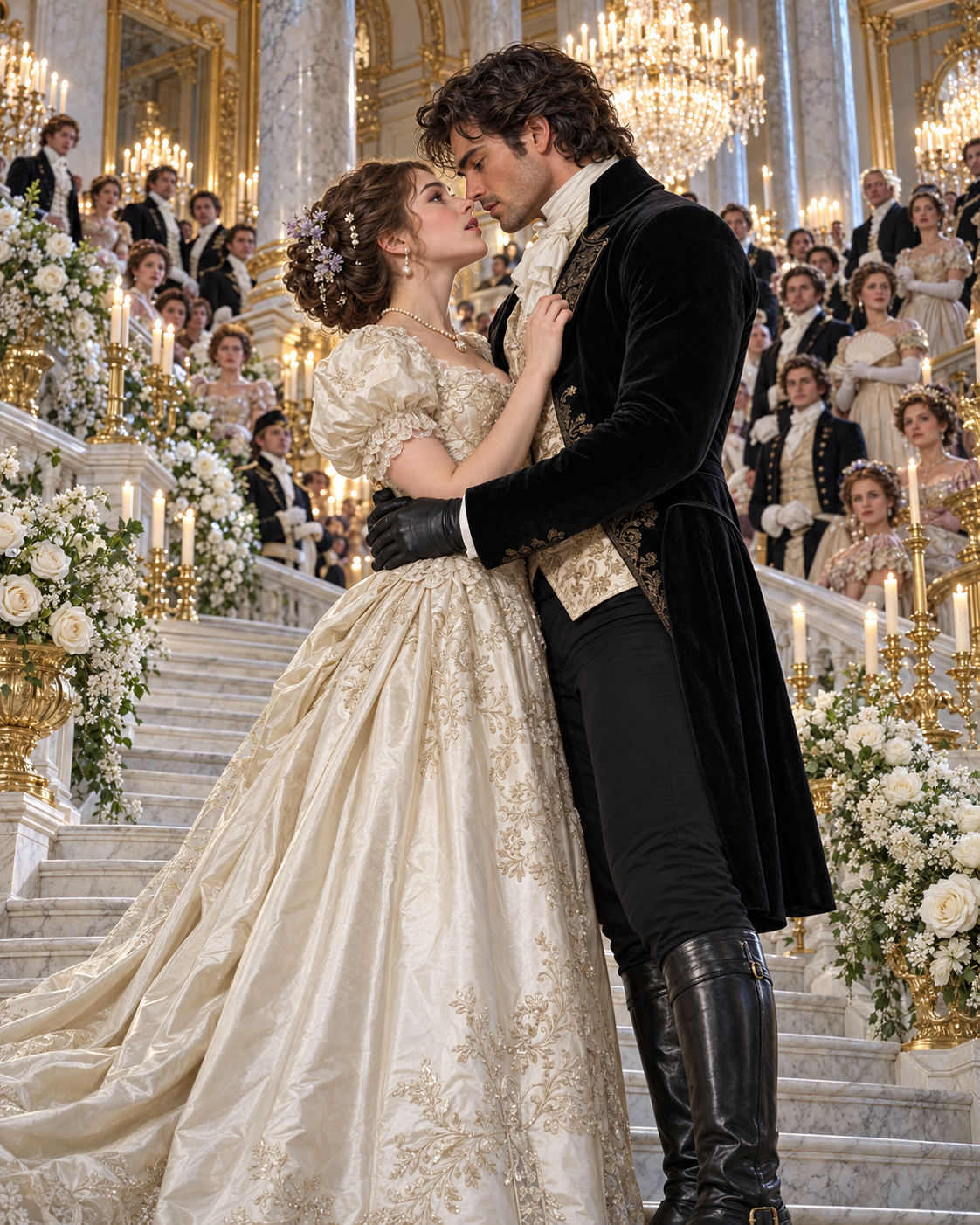
She looked away.
He had never used her name so gently before.
“I know what you are about to say,” she replied.
Xavian frowned.
“I rather doubt that.”
“Our engagement has served its purpose. My reputation is restored, your matchmaking mothers have retreated, and my family’s affairs are finally being settled.”
She smoothed her gloves.
“There is no longer any reason to continue.”
His expression tightened.
“Is that what you wish?”
Angharad hesitated.
The clock in the hall struck seven.
“Isn’t it what we agreed?”
Xavian looked at her for a long moment.
Then he stepped aside.
“Yes.”
The word came out more harshly than he intended.
Angharad’s face remained composed.
“Then I suppose we should be congratulated on our success.”
She passed him without waiting for a reply.
Xavian watched her descend the stairs.
For the first time in his life, he understood that a perfectly reasonable agreement could be an extraordinarily foolish thing.
Three days later, Angharad received a letter from the trustees appointed to recover her inheritance.
The missing funds had been traced.
Most of the principal could be restored, with additional compensation expected once Sir Edmund’s assets were sold.
A substantial country property, originally purchased for the Vaughn family, would also be transferred into her name.
She would no longer need the duke’s protection.
She would have a home of her own.
A home where her grandmother could live comfortably.
Everything she had once hoped for was finally within reach.
So why did she sit beside the window with the letter unopened for nearly an hour?
Her grandmother entered quietly, guided by her walking stick.
“You have been sighing at that window all morning.”
Angharad folded the letter.
“I have not.”
“Then perhaps the curtains have developed lungs.”
Despite herself, Angharad smiled.
Her grandmother sat beside her.
“Is it the duke?”
Angharad looked down.
“Grandmother.”
“That is generally the tone you use when the answer is yes.”
“He has been very kind.”
“Kind?”
“And honorable.”
“Indeed.”
“And considerate.”
The old woman tilted her head.
“My dear, you are describing a respectable bank manager.”
Angharad laughed softly.
Then her smile faded.
“He never asked me to stay.”
Her grandmother reached for her hand.
“Did you ask him whether he wanted you to?”
Angharad shook her head.
“I couldn’t.”
“Why?”
“Because our engagement was never real.”
Her grandmother remained silent for a moment.
“Wasn’t it?”
Angharad turned toward her.
“Grandmother, we made an arrangement.”
“Yes, darling. And somewhere along the way, you began listening for his footsteps in the corridor.”
Angharad stared at her.
“How could you possibly know that?”
The old woman smiled.
“I may be blind, child, but I am not deaf.”
Before Angharad could reply, someone knocked.
Lady Beatrice entered, carrying a newspaper.
Her expression was unusually grave.
“I thought you should see this before anyone else does.”
She placed the paper in Angharad’s hands.
A bold headline filled the front page.
THE DUKE OF SHERBURN’S CONVENIENT BRIDE.
Beneath it was a detailed account of their temporary engagement.
The arrangement had been exposed.
Every carefully negotiated condition appeared in print.
The promised separation.
The protection of Angharad’s reputation.
The duke’s desire to escape marriage.
Someone had even quoted portions of their original written agreement.
Angharad felt the room grow strangely quiet.
“Who gave them this?”
Lady Beatrice’s expression hardened.
“Sir Edmund’s associates, I suspect.”
The article suggested that Angharad had manipulated the duke into a false courtship to secure her inheritance.
It implied that Xavian had been deceived.
And it ended with a cruel question about whether any respectable gentleman would now consider her a suitable wife.
Angharad carefully folded the newspaper.
Her hands did not tremble until she placed it on the table.
“Does His Grace know?”
“Not yet.”
Angharad stood.
“Then please don’t tell him until I have left.”
Lady Beatrice stared at her.
“My dear—”
“I will not have him dragged through another scandal because of me.”
Her grandmother rose slowly.
“Angharad.”
But Angharad was already moving toward the door.
“I have spent most of my life being grateful for whatever kindness others could spare.”
She stopped and turned back.
“I will not allow that kindness to become a chain around his neck.”
Xavian returned to Sherburn House shortly before noon.
He found his great-aunt waiting in the entrance hall.
She handed him the newspaper.
He read it without speaking.
Then he turned to the steward.
“Where is Miss Vaughn?”
The man hesitated.
“Her belongings have been taken to the carriage, Your Grace.”
Xavian looked up sharply.
“What?”
“She intends to depart for her new property this afternoon.”
The duke crossed the hall without another word.
He found Angharad in the east wing, closing the final trunk.
Sunlight fell across the floor.
The rooms were already losing the small touches that had made them hers.
The roses were gone.
Her books had been removed.
Only a single ivy-green ribbon remained on the dressing table.
“You’re leaving.”
Angharad turned.
“Yes.”
“Without speaking to me?”
“I thought it would be easier.”
“For whom?”
She looked at him.
“Your Grace, please.”
He crossed the room.
“Is this because of the newspaper?”
She said nothing.
“Angharad, answer me.”
“Does it matter?”
“It matters to me.”
She looked away.
“That is precisely the problem.”
He stopped.
Angharad drew a careful breath.
“I have become accustomed to things I have no right to expect.”
“Such as?”
“Your company.”
The words were barely audible.
She looked down at her hands.
“Your attention. The way you remember that my grandmother dislikes her tea too hot.”
Xavian remained motionless.
“The way you leave books open beside the fire because you know I will return to finish them.”
She swallowed.
“And I have begun mistaking those small kindnesses for something they were never intended to be.”
He took another step.
“Angharad—”
“No.”
She finally met his eyes.
“If you are about to offer another arrangement to protect me, please don’t.”
A faint tremor entered her voice.
“I could survive society laughing at me. I don’t think I could survive pretending to be loved by you any longer.”
The silence afterward seemed to stretch across the entire house.
Xavian stared at her.
Then he spoke.
“Who told you that I was pretending?”
Angharad’s breath caught.
He moved closer.
“I have spent years refusing to let anyone near enough to inconvenience me.”
His mouth tightened into something resembling a rueful smile.
“Then you appeared on my staircase and ruined an extraordinarily comfortable life.”
She looked at him uncertainly.
“I began arranging my evenings around conversations with you. I found myself remembering every word you said.”
He glanced toward the ribbon on the dressing table.
“And when you weren’t in a room, I noticed the absence before I noticed anything else.”
Angharad’s eyes shone.
“Xavian…”
“I thought that if I waited until the season ended, I could discover a suitable way to ask you to stay.”
He took her hand.
“But you are right about one thing.”
She looked up.
“We cannot continue pretending.”
Before she could answer, hurried footsteps sounded in the corridor.
Lady Beatrice appeared at the door.
“Xavian, there is a gentleman downstairs.”
The duke did not release Angharad’s hand.
“Tell him I am occupied.”
“I would, but he has brought documents from Sir Edmund’s office.”
Something in her voice made him turn.
“What documents?”
“Evidence that Sir Edmund was not acting alone.”
They gathered in the library twenty minutes later.
The visitor was a young clerk named Thomas Reed, whose anxious hands never stopped moving against the brim of his hat.
He had worked for Sir Edmund for seven years.
And for seven years, he had copied financial records without questioning why certain entries were concealed from the family’s official accounts.
“I believed everything was authorized,” he told Xavian.
“Until last winter.”
“What happened last winter?”
“Sir Edmund ordered me to destroy correspondence relating to the Vaughn trust.”
Thomas placed a bundle of letters on the desk.
“I kept them instead.”
Xavian opened the first envelope.
The handwriting was familiar.
His father’s.
But the letters were addressed not to Sir Edmund.
They were addressed to Xavian himself.
He unfolded the oldest.
My son,
If this reaches you, I trust you have become a better man than I was.
Xavian sat down slowly.
The letter continued.
I spent much of my life believing that wealth gave me the power to put every wrong right.
Captain Vaughn taught me that a man can possess very little and still give everything.
I promised to protect his family, yet I allowed my own fear of scandal to make that protection unnecessarily complicated.
Xavian frowned.
Fear of scandal?
He looked toward Angharad’s grandmother.
The old woman bowed her head.
“There is something we haven’t told you,” she whispered.
Lady Beatrice approached her.
“Margaret, perhaps now is the time.”
Angharad sat beside her grandmother.
“What is it?”
Margaret Vaughn drew a trembling breath.
“Your mother was not the daughter of the man you knew as your grandfather.”
Angharad froze.
“What?”
“Captain Vaughn married me after I was widowed. He raised your mother as his own.”
Xavian looked down at the letter.
His father’s words continued.
The old duke had once loved Margaret before she married her first husband.
Their attachment had ended when his family refused to accept a woman without fortune.
Years later, after Margaret had been widowed, the two met again.
By then, he had married Xavian’s mother and had a son.
Nothing improper occurred between them.
But he never forgot how easily his family had dismissed a good woman because she lacked a title.
Captain Vaughn, Margaret’s second husband, knew the truth and never resented him for it.
When he saved the duke’s life in battle, their friendship became a bond neither man could break.
The Vaughn trust had been intended as repayment for that debt and as an acknowledgment of an older injustice.
But the duke had feared that future heirs might misunderstand his motives or try to control Margaret’s descendants through marriage.
That was why he had included the protection clause.
That was why the trust became secure once a Vaughn descendant entered Sherburn House.
And that was why he had forbidden anyone from conditioning the inheritance upon a marriage.
Xavian reached the final paragraph.
The marriage my father had instructed them to investigate was not some secret union involving Angharad.
It was Margaret’s first marriage.
Its certificate established the legal identity of her daughter and proved that Angharad was the rightful beneficiary.
The duke’s handwriting grew uneven near the end.
If a Vaughn daughter ever enters your home, remember that your duty is not to keep her there.
Your duty is to make certain she can leave without fear.
Only then will you know whether she stays because she wishes to.
Xavian lowered the letter.
For a long moment, he could not speak.
Every complication, every secret clause, every misunderstanding had led to a truth almost painfully simple.
His father had not tried to arrange a marriage.
He had tried to prevent one from becoming a prison.
Xavian looked toward Angharad.
She was watching him quietly.
In that moment, he understood what he had nearly done.
He had offered protection while keeping control of the terms.
He had given her security without asking what freedom might look like to her.
And now, if he truly loved her, he had to be willing to let her walk away.
The following morning, Xavian called a gathering in the ballroom.
The same ballroom where he had first met Angharad.
The same chandeliers shone overhead.
Many of the same guests attended, drawn by curiosity after the newspaper scandal.
Lady Harcourt stood near the staircase, whispering behind her fan.
Several gentlemen watched with expressions of carefully concealed satisfaction.
Xavian entered alone.
He carried no notes.
When the room fell silent, he stepped forward.
“You have all read a certain account of my engagement.”
A faint murmur passed through the crowd.
“I will not insult your intelligence by denying that the engagement began as an arrangement.”
The whispers grew louder.
Xavian continued.
“Miss Vaughn and I entered into it freely. I believed it would protect her from unkind speculation, while offering me the temporary peace I had failed to achieve by less theatrical means.”
A few guests smiled.
He did not.
“But I made a mistake.”
The room grew still.
“I believed that because I held the title, the fortune, and the greater influence, I could decide what protection should look like.”
He glanced toward Angharad, standing beside Lady Beatrice at the edge of the room.
“Miss Vaughn never asked me to rescue her.”
She lowered her eyes.
“She asked only to be treated with dignity.”
Xavian turned back to the guests.
“The Vaughn inheritance has now been legally restored. Miss Vaughn is the sole beneficiary, and no marriage, engagement, or association with my family is required for her to retain it.”
Lady Harcourt’s fan stopped moving.
“She is entirely free to choose her own future.”
Xavian paused.
“And I intend to respect whatever choice she makes.”
A gentleman near the windows cleared his throat.
“Then the engagement is over, Your Grace?”
Xavian looked at Angharad.
“That decision belongs to Miss Vaughn.”
The room turned toward her.
For a moment, she did not move.
Then she stepped away from Lady Beatrice.
Her green gown whispered against the floor as she approached the duke.
The crowd parted.
Angharad stopped before him.
“Your Grace.”
“Miss Vaughn.”
Her lips trembled with the smallest suggestion of a smile.
“You are making quite a spectacle.”
“I seem to have developed a talent for it.”
She glanced toward the staircase.
“I remember another occasion when you did precisely that.”
“I was trying to free your dress.”
“And this time?”
Xavian looked directly into her eyes.
“This time, I am trying to free you.”
Something shifted in her expression.
For a few seconds, the room seemed to disappear around them.
“Then you have succeeded,” she whispered.
His face softened.
“But there is one thing I would like to ask.”
She raised an eyebrow.
“Another arrangement?”
“No.”
Xavian reached into his coat and withdrew the small velvet box.
He did not open it.
Instead, he placed it in her hand.
“This is yours to keep, whether you accept me or not.”
Angharad stared at the box.
“I don’t understand.”
“It was purchased for the engagement we invented.”
He took a slow breath.
“But I would rather begin something real without asking you to wear the evidence of a lie.”
He stepped back.
Then, before three hundred astonished guests, the Duke of Sherburn went down on one knee once more.
This time, no ribbon held him there.
“Angharad Vaughn, I cannot promise that I shall always be an easy man to love.”
A gentle ripple of laughter moved through the room.
“Lady Beatrice would undoubtedly confirm that I am frequently stubborn, often severe, and occasionally impossible.”
From the crowd, his great-aunt replied, “Only occasionally?”
Even Angharad laughed.
Xavian smiled up at her.
“But I can promise to listen when you disagree with me, to stand beside you when the world is unkind, and never to confuse loving you with possessing you.”
His voice lowered.
“I am not asking you to repay a kindness, fulfill an obligation, or rescue me from another season of matchmaking mothers.”
He opened his empty hands.
“I am asking whether you would choose to share your life with me.”
Angharad looked down at him.
For a moment, her eyes filled with tears.
Then she knelt before him.
A collective gasp rose from the guests.
Xavian blinked.
“What are you doing?”
“Correcting the balance of power, Your Grace.”
She took both his hands.
“If you intend to spend the rest of your life kneeling whenever we have an important conversation, your knees will suffer terribly.”
He laughed.
A genuine, helpless laugh that startled several people who had known him for years.
Angharad smiled.
“I have loved you for longer than I was willing to admit.”
Xavian’s expression changed.
“But I needed to know that I could leave before I could freely choose to stay.”
She tightened her hold on his fingers.
“And I choose you.”
He closed his eyes briefly.
When he opened them, the formidable Duke of Sherburn looked very much like a man who had finally found his way home.
“Then may I kiss you?”
Angharad tilted her head.
“You may, provided you intend to stop asking permission for every small happiness.”
He drew her closer.
And when he kissed her, the ballroom erupted in applause.
Their wedding took place six weeks later in the chapel at Sherburn.
It was not the grand society event the newspapers had predicted.
Angharad wanted the ceremony to be small.
Xavian agreed without argument, which Lady Beatrice declared the first genuine miracle of married life.
Margaret Vaughn sat in the front pew, her hands folded around a small bouquet of white roses.
When Angharad reached her, she bent and placed a kiss against her grandmother’s cheek.
“You look beautiful,” Margaret whispered.
Angharad smiled.
“You cannot see me.”
“I have been seeing you perfectly well for twenty-one years, darling.”
Xavian waited beside the altar.
He wore no ceremonial decorations, only a dark coat and the watch his father had once carried through the war.
When Angharad reached him, he took her hand.
There was no grand declaration.
No theatrical promise.
Only two people standing close enough to hear each other breathe.
As the vows were spoken, Angharad felt his thumb move gently across her fingers.
She pressed his hand in return.
That was enough.
In the months that followed, the recovered Vaughn fortune became more than a private inheritance.
Angharad established a charitable trust to provide legal assistance to widows, orphaned children, and families whose property had been wrongfully withheld.
She insisted that its trustees include women who understood what it meant to be dependent upon the goodwill of others.
Xavian contributed generously, but never attempted to control its decisions.
Sometimes he disagreed with his wife.
Quite often, in fact.
Their discussions occasionally lasted through dinner, much to Lady Beatrice’s amusement.
But he had learned that disagreement was not a threat to affection.
And Angharad had learned that accepting help did not mean surrendering independence.
Margaret remained at Sherburn House, where every piece of furniture stayed precisely where she expected it.
Xavian personally instructed the servants never to rearrange her sitting room.
He also acquired the habit of reading aloud to her after supper.
She often corrected his pronunciation.
He accepted these corrections with considerably less grace than he believed.
One autumn evening, nearly a year after the ball, Angharad found him standing on the grand staircase.
He was looking down at something in his hand.
“What have you there?” she asked.
Xavian turned.
“A rather dangerous object.”
She approached.
Between his fingers lay a small piece of ivy-green ribbon.
The original ribbon.
The one that had caught in his spur.
“You kept it?”
“Naturally.”
“Why?”
He considered the question.
“Because it is the only thing in this house that ever managed to stop me when I was determined to walk away.”
Angharad smiled.
“How unfortunate that such a small thing caused so much trouble.”
Xavian looked at the repaired gown she had chosen to wear that evening.
“It caused a scandal, exposed a thief, uncovered a family promise, and nearly cost me the woman I love.”
“An impressive achievement for a ribbon.”
“Indeed.”
He tied it carefully around her wrist.
Angharad studied the faded silk.
Then she looked at him.
“Do you ever regret that night?”
Xavian leaned against the banister.
“Frequently.”
She raised an eyebrow.
“Frequently?”
“Of course. I should have removed my spur before entering the ballroom.”
Angharad laughed.
He drew her toward him.
“But the accident itself?”
His expression softened.
“Not for a moment.”
Below them, the hall glowed in the warm light of evening.
Somewhere in the east wing, Margaret was asking a servant to move a vase that had been placed three inches too far to the left.
Lady Beatrice’s laughter drifted from the drawing room.
And beyond the windows, the gardens settled beneath the first gold leaves of autumn.
Angharad rested her head against her husband’s shoulder.
For a while, neither spoke.
Then Xavian kissed the ribbon around her wrist.
“My father spent his life trying to repay a debt of honor,” he said quietly.
“He could not have known what it would bring into this house.”
Angharad looked up at him.
“Perhaps he understood something you had yet to learn.”
“And what was that?”
She touched his cheek.
“That kindness is not a bargain, Xavian. It is a gift. And love means allowing someone to receive it without owing you anything in return.”
He covered her hand with his.
For once, he offered no clever reply.
He simply kissed her forehead.
Years later, the story of the Duke of Sherburn and the young woman in the ivy-green gown would still be told in drawing rooms across England.
Some remembered the scandal.
Others remembered the stolen inheritance, the public proposal, or the extraordinary sight of a duke kneeling before a woman society had once considered beneath him.
But Angharad remembered something smaller.
A cold staircase.
A torn ribbon.
A man’s steady hand reaching toward her when everyone else had turned to stare.
He had offered to help her climb the stairs without demanding anything in return.
Neither of them understood, on that extraordinary evening, how far they would travel together.
And that became the quiet truth at the center of their marriage.
A person’s worth had never depended on wealth, ancestry, beauty, or the approval of a crowded ballroom.
Nor was love proven by grand promises or the power one person held over another.
It was proven in the freedom to choose, the courage to remain, and the small daily acts of care that asked for nothing in exchange.
The duke had entered that ballroom believing he possessed everything a man could reasonably desire.
Only when he opened his hand and gave another person the freedom to walk away did he discover what had been missing.
And Angharad, who had once feared that accepting kindness might cost her dignity, discovered that the right kind of love did not make her smaller.
It gave her room to become entirely herself.
Their story had begun with a ribbon that trapped two strangers together.
It endured because neither ever again tried to keep the other bound.
THE END.